Araştırma Makalesi / Research Article
This article has been devoted to be answered the question of “are there any sexist approaches lead-ing to discrimination based on gender in the degrees of specialist and academician in medicine in Turkey?” Study design consists of a quantitative and qualitative research. Authors have aim to bring up the data on this subject by examining the figures of the institutions where a vast majority of the doctors have been employed. In order to bring up the discrimination present related to sexuality in the distribution of the doctors, and the reasons of this discrimination, authors tried to evaluate the quantitative and qualitative data together by doing partly organized interviews with the doctors from various groups.
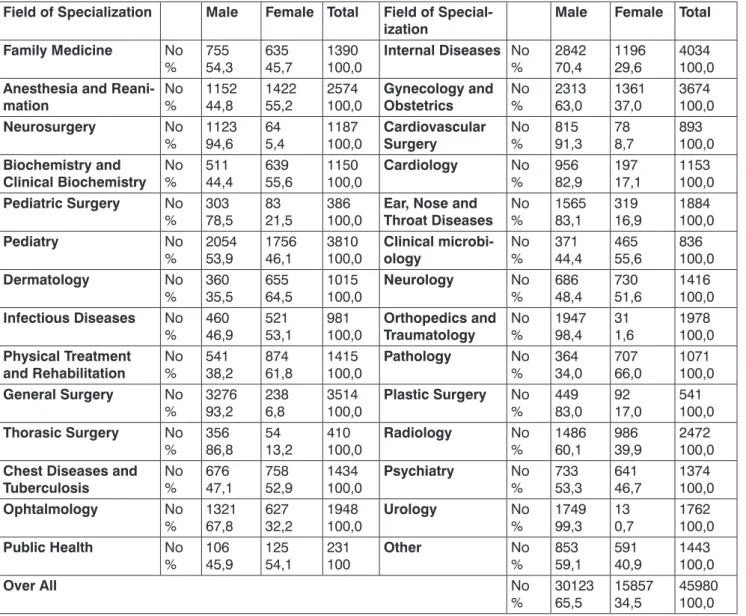
When the gender distribution of the doctors is examined according to their speciality field, it has been shown statistically that the male and female doctors have been distributed in definite special-ized fields, and in this sense there has been a discrimination based on sexuality. It is ascertained that almost all of some specialization fields have been comprised of male doctors.
While male doctors are represented by 34 % even in the specialization field of most of the female doctors, the female doctors are represented by 1-2 % in the specialization field of most of the male doctors. The rate of female doctors in the twelve fields of specialization of twenty-eight fields exam-ined is below 33% which is accepted as the critical sill. Moving from this result, while it can’t be said that there is a specialization field for women, but contrary it is possible to say that there are some specialization fields in medicine for men. The women take place in the departments where protec-tive medical services are given with less financial income; they are less popular but are the kitchen of the work in basic medical science.
Key words: Gender Discrimination, Medical Specialties, Glass Ceiling, Woman Studies, Turkey. Bu makale “Türkiye’ de tıpta uzmanlık dallarının seçiminde ve akademisyenlikte cinsiyete dayalı yak-laşımların etkili olup olmadığı” sorusu üzerine kurgulanmış bir çalışmaya dayanmaktadır. Çalışma deseni niceliksel ve niteliksel iki araştırma içermektedir. Bu amaçla Sağlık Bakanlığı ve üniversitelere bağlı tıp fakültelerinde görev alan hekimlerin kadın erkek oranları araştırılmıştır. Verilere SPSS 11.5 İstatistik paket programı kullanılarak, Pearson ki kare testi ile uygulanmıştır. Araştırmada kadın ağır-lıklı ve erkek ağırağır-lıklı dallardaki asistanlık, uzmanlık ve akademisyenlik aşamalarındaki kadın hekim-lerle yarı yapılandırılmış görüşme tekniği kullanılmış, toplam 26 hekimle derinlemesine görüşmeler de yapılmıştır.
Kadın hekimlerin erkek hekimlere göre çok az farkla da olsa daha fazla uzmanlaştığı anlaşılmaktadır. Kadın hekimlerin ve erkek hekimlerin belli uzmanlık alanlarında dağıldığı, bazı uzmanlık alanlarının neredeyse tamamen erkek hekimlerden oluştuğu ve cinsiyete dayalı bir ayrımcılık bulunduğu ista-tistiksel olarak gösterilmiştir.
İncelenen yirmi sekiz uzmanlık alanının on ikisinde kadın hekimlerin oranı kritik eşik kabul edilen % 33 ün altındadır. Yirmi sekiz uzmanlık alanının tamamında erkekler % 33 ve üzerinde temsil edilmek-tedir. Bu sonuçtan hareketle kadınlara özgü bir uzmanlık alanı olduğu söylenemezken, tersi, yani erkeklere özgü uzmanlık alanları bulunduğu söylenebilir.
Kadınlar mesai saatleri düzenli olan, nöbeti olmayan, akademik ilerlemelerinde engel bulunmayan, dışlanmayacaklarını düşündükleri uzmanlık alanlarına yönelmektedirler. Özellikle cerrahi uzmanlık alanlarında kadınların sayısı sınırlıdır. Araştırmamız eğitim ve meslek hayatları boyunca kadınların cinsiyete bağlı ayrımcılıkla karşılaştıklarını niteliksel olarak da ortaya koymuştur.
Anahtar Sözcükler: Cinsiyet Ayrımcılığı, Tıpta Uzmanlık Dalları, Cam Tavan, Kadın Çalışmaları, Türkiye.
1 Ankara University, Social Sciences Institute, Department of
Women’s Studies (MD, Med Spec., MA)
2 Ankara University School of Medicine, Medical History and Ethics
Department (MD, Med Spec., PhD)
*This article has been based on Dr. İlknur Genc Kuzuca’s MA thesis (Ankara University Social Sciences Enstitute, Woman’s Studies Department, accepted on May 28th 2007, supervisored by Prof. Berna Arda)
What Can We Say About Gender Discrimination in Medicine? A
Limited Research From Turkey*
Tıpta Cinsiyet Ayrımcılığı Hakkında Ne Söyleyebiliriz? Türkiye’ den Sınırlı Bir Araştırma
İlknur Genç Kuzuca
1, Prof. Berna Arda
2As generally accepted the history of medi-cine, is a kind of history of a profes-sion has a lot of affecting and shap-ing factors. One of them depends on social – cultural- economic base.
Without doubt this history can write from the different points of view like feminist one. The place of women in medicine started with being “mother”, changed to “witchdoctorship”,
“nurs-Received: 26.08.2010 • Accepted: 25.10.2010 Corresponding author
Prof.Dr. Berna Arda
Ankara University Faculty of Medicine, Department of Medical History and Ethics, Morphology Building
2nd floor, Sıhhiye-ANKARA
Phone : +90 312 310 30 10 / 361 Fax : +90 312 310 63 70 E-mail Address : [email protected]
ing”, “midwifery” and reached to-day’s successful samples even in the surgical fields. The early pioneers endured the hard years of study with little support even from their own families and of-ten flagrant discrimination. It is obvi-ous they had to worked very hardly to prove their academic merit. In front of this historical background, this article devoted to find an answer whether gender discrimination in medicine at the end of the 20th century or not with
a limited data from Turkey.
Material and method
Although quantitative methods are used more in the field of women studies, this research has been combined quan-titative and qualitative data as a com-plementary of each other. SPSS 11.5 statistical package program has been used, Pearson ki quare test has been applied by getting the rates of male and female specialist and practitio-ner doctors employed in the medical schools and Ministry of Health hospi-tals. P<0.05 values have been accepted statistically in meaningful levels. In this research, partly structured interview
technique done with female doctors in
the degrees of assistants, specialization and academician, and in more female and more male employed branches, has been used. By asking open-ended questions to the doctors deeply applied interviews have been done as well. In order to reflect the views of the male doctors related with the subject, five male doctors have been interviewed. The doctors in Turkey are employed in
The Ministry of Health, Universities, The Ministry of Labor and Social Se-curity, private hospitals and offices, and in a very small amount in the other ministries and institutions. The vast majority of doctors are employed in the hospitals of the Ministry of Health and University hospitals. For that reason, this research has been lim-ited with these main two institutions.
The Quantitative Data in the Dis-tribution of the Doctors in Turkey Based on Gender and Specialization
The rate of representation of female stu-dents at the faculties in our country is similar to many developed countries. The rate of female students at all of the universities between the years 1927-1991 continued increasing from 11%
to 34%. This rate today went up to 44% after the year 2000.
Directing to choose a profession begins at the age of childhood and is intensified at the periods of school; this is brought up by various researches (1). By the ef-fect of family, choosing medical educa-tion rate has been higher among the male students (2).
The number of students at all of the schools of medicine in Turkey in 2006 is 41.521 (including the newly registered students and attending and graduate students in 2006) and 24.391(58%) of these students are male, 17.130 (41.3%) are female. Gender distribution of the number of
students entered all other faculties is 1.233.504 male (55.4%), 994.139 female (44.6%) in the same year and with the same approach.
When the gender distribution with the medical schools and other faculties is compared, the difference is found at meaningful level statistically (X²= 187,511 P<0.001). It is proved that the girls entered the medical school at a less rate than the boys(Table-1). The number and the gender information
of the doctors employed in all units of education and research hospitals, other hospitals, the first step health institutions have been reached. The total number of these doctors is noted as 62.837. In the personnel informa-tion system there wasn’t any knowl-edge about the sex column of the 680(1.08%) doctors, that’s why 680 doctors are excluded from the evalu-ation. 21.123 (33,63%) of the doc-tors were female, 41.034 (65.37%) of them were male, as it was recorded (Table-2).
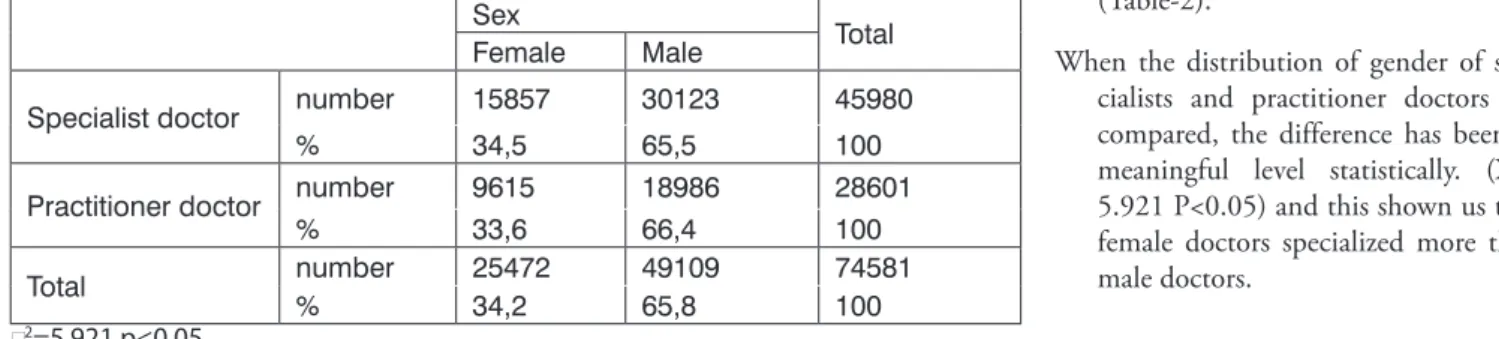
When the distribution of gender of spe-cialists and practitioner doctors are compared, the difference has been at meaningful level statistically. (X²= 5.921 P<0.05) and this shown us that female doctors specialized more than male doctors.
Table 2: The number of specialist and practitioner doctors and their distribution of gender
Sex Total
Female Male
Specialist doctor number 15857 30123 45980
% 34,5 65,5 100
Practitioner doctor number 9615 18986 28601
% 33,6 66,4 100
Total number% 2547234,2 4910965,8 74581100
c2=5,921 p<0.05
Table 1: Distribution of the students at the schools of medicine and other faculties according to gender in 2006.
sex
Total
female male
Other faculties number
% 99413944,6 123350455,4 2227643100,0
School of medicine number
% 1713041,3 2439158,7 41521100,0
total number
% 101126944,6 125789555,4 2269164100,0
Totally 26 specialization fields are deter-mined by joining some of the closely related branches; and sex distribution of these doctors in these fields has been examined.
When the gender distribution is compared in all of the specialization fields with-out separating the Ministry of Health and University, meaningful levels of differences have been noted(Table-3). The number of women specialists in the initial ten departments of State hospitals and University hospitals where the majority of specialists are women and their percentages in wom-en doctors have bewom-en searched. The initial ten specialization fields, where
women doctors are more in number,
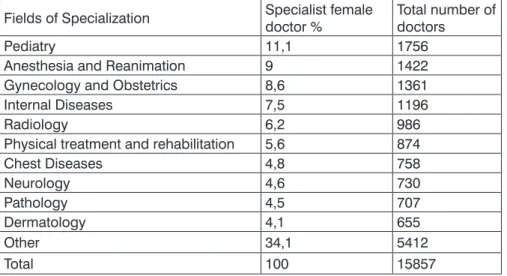
and the initial 10 fields of specializa-tion, where women/men doctors are more in number, are different. Pedia-try, Gynecology and Obstetrics, Inter-nal diseases and Radiology branches have more women doctors compared with other branches but in these fields the number of men specialists are more( Tables- 4, 5, 6).
While the number of female doctors are the most in pediatry, the branches that have the most female specialist doctors according to male/female doctors rate are the following branches: Pathol-ogy, DermatolPathol-ogy, Physical Treatment and Rehabilitation and Microbiology Branches.
The fields where the male specialist
doc-tors are more comprises from surgery except Cardiology.
Gender Distribution of Specialist Doctors in Three Main Parts
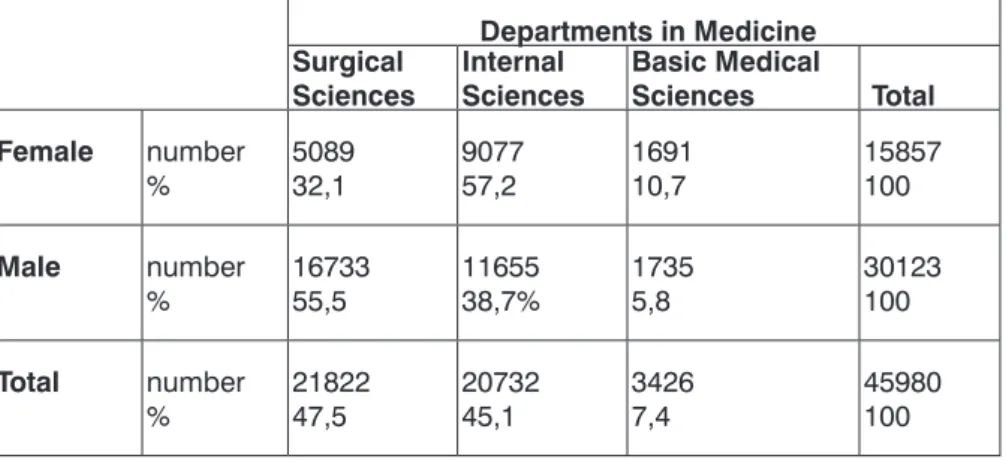
The fields of specialization are gathered under three parts in the schools of medicine. These are: Basic, Internal and Surgical Medical Sciences. The specialization branches taking place in these fields are listed on the table 7. In the light of the department/sex rela-tion, all of these parts resulted mean-ingfully different from each other when compared two by two.
While it is observed that male doctors took place more in surgery
depart-Table 3: Gender Distribution of Specialized Doctors According to the Fields
Field of Specialization Male Female Total Field of
Special-ization Male Female Total
Family Medicine No
% 75554,3 63545,7 1390100,0 Internal Diseases No % 284270,4 119629,6 4034100,0 Anesthesia and
Reani-mation No % 115244,8 142255,2 2574100,0 Gynecology and Obstetrics No % 231363,0 136137,0 3674100,0
Neurosurgery No
% 112394,6 645,4 1187100,0 SurgeryCardiovascular No % 81591,3 788,7 893100,0 Biochemistry and
Clinical Biochemistry No % 51144,4 63955,6 1150100,0 Cardiology No % 95682,9 19717,1 1153100,0
Pediatric Surgery No
% 30378,5 8321,5 386100,0 Throat DiseasesEar, Nose and No % 156583,1 31916,9 1884100,0
Pediatry No
% 205453,9 175646,1 3810100,0 ologyClinical microbi- No % 37144,4 46555,6 836100,0
Dermatology No
% 36035,5 65564,5 1015100,0 Neurology No % 68648,4 73051,6 1416100,0
Infectious Diseases No
% 46046,9 52153,1 981100,0 TraumatologyOrthopedics and No % 194798,4 311,6 1978100,0 Physical Treatment
and Rehabilitation No % 54138,2 87461,8 1415100,0 Pathology No % 36434,0 70766,0 1071100,0
General Surgery No
% 327693,2 2386,8 3514100,0 Plastic Surgery No % 44983,0 9217,0 541100,0
Thorasic Surgery No
% 35686,8 5413,2 410100,0 Radiology No % 148660,1 98639,9 2472100,0 Chest Diseases and
Tuberculosis No % 67647,1 75852,9 1434100,0 Psychiatry No % 73353,3 64146,7 1374100,0 Ophtalmology No % 132167,8 62732,2 1948100,0 Urology No % 174999,3 130,7 1762100,0 Public Health No % 10645,9 12554,1 231100 Other No % 85359,1 59140,9 1443100,0 Over All No % 3012365,5 1585734,5 45980100,0 c2=7696,681 p<0,001
ments, female doctors are observed to take place more in internal depart-ments and basic medical sciences de-partments. Among the three main parts, the department where the fe-male doctors took place most is the basic medical sciences department. The internal and surgical ones follow it. The biggest rate difference against women is determined at Surgical Sci-ences Department (Table-7).
The rate of women at the universities holding the cadres of professor, associ-ate professors and assistant professors are notably lower compared with the rate of all female doctors. This is the sign that female doctors have problems in academic life. Another sign which is attracting attention is that although the rate of female doctors in the cadres of professor, associate professor, and assistant professors lower, the number of women is increasing gradually from the lower to upper degrees.
These figures show us that when the wom-en once start the academic study in this field, there aren’t more hindrances for women to promote to higher de-grees because the number of female doctors in professor cadres is more than the other two cadres. On the other side, the rate of female instruc-tors at the universities is noted to be over the average rates. The fact that these instructors are not counted as lecturers, and that they have no right to give vote in university board and they don’t take place in the decision making mechanism, besides they don’t require to do academic study, and they are kind teachers, is the extension of social gender point of view (Table- 8).
The qualitative findings on choos-ing the field of specialization and discrimination based on gender
In this section, 26 doctors have been inter-viewed. This question was asked to the doctors: “Did you face discrimination based on sex before the medical edu-cation while choosing this profession (such suggestions by your family that the medical education is difficult for women or that any branch of special-ization is not suitable for women)?” All of the doctors answered that their fam-ilies supported and encouraged them while entering the medical school. The question “Is there a distribution of
sex of the fields of specialization?”
was asked; the majority of the doctors said that there were definitely prefer-ences based on sex and there were rea-sons of them. The specialization fields that the female doctors preferred had no or a few days of being on duty, this was the reason noted most. The other reason for preference was the more defi-nite working hours. Contrary to this, in some fields of specialization very of-ten on duties, tiresome and indefinite working hours were the reasons why these fields of specialization not ferred. The fields of surgery weren’t pre-ferred by female doctors for not feeling discriminated or isolated, in addition to the reasons mentioned above.
Table 4: The initial 10 departments where women specialist doctors are employed and their numbers and percentages.
Fields of Specialization Specialist female doctor % Total number of doctors
Pediatry 11,1 1756
Anesthesia and Reanimation 9 1422
Gynecology and Obstetrics 8,6 1361
Internal Diseases 7,5 1196
Radiology 6,2 986
Physical treatment and rehabilitation 5,6 874
Chest Diseases 4,8 758 Neurology 4,6 730 Pathology 4,5 707 Dermatology 4,1 655 Other 34,1 5412 Total 100 15857
Table 5: According to female doctor/male doctor rate the initial 10 specialization field where female doctors are the most in number and their numbers and percentages
Field of specialisation Male Female Total
Pathology Number% 36434,00 70766,00 1071100
Dermatology Number% 36035,50 65564,50 1015100,00
Physical Treatment and
Rehabilitation Number% 54138,20 87461,80 1415100
Clinical Microbiology Number% 37144,40 46555,60 836100
Clinical Biochemistry Number% 51144,40 63955,60 1150100
Anesthesia and Rean. Number% 115244,80 142255,20 2574100
Public Health Number% 10645,90 12554,10 231100
Infectious Diseases Number% 46046,90 52153,10 981100
Chest Diseases Number% 67647,10 75852,90 1434100
“Are the public expectations related to your sex and play any role for you to choose these fields?” Eight female doctors answered ‘YES’ to this ques-tion. They stated: “I wanted a field of specialization so that I would be able to have more time for my home, my husband, myself and for my children”. The other doctors who answered as “NO” to the question gave such answers as: “It was a field I always wanted, I preferred the fields that my Examination of Specialization in Med-icine (ESM) grade would be enough, I wanted any of the fields just to be a specialist”.
“Have you ever stayed between the so-cial roles expected from you, or faced any difficulty in your profes-sion?” The doctors who said “Yes” to this question took place in both sexes, and they were generally married and had children. Female doctors said that most of the responsibilities of children and housework were on themselves. Although the majority of them had servants and some of them got help from their parents, they got very tired because of carrying the responsibility themselves. Because of this they show great effort to save time for especially academic activities and compared with their male colleagues they lived the loss of time and power more than them.
A Few Statements Emphasizing the Discrimination
“This department is not a branch that
dis-crimination is applied much, the women even may be preferred because they are more careful, self-denying and peevish. But in spite of these facts, it changes re-lated with the hospital and the head of the department. For example, until I become the head of the department, no permission used to be ever given after the birth and to breastfeed. I, now, permit them to do these. The previous head of the department, who was a man, had never forgiven one of our friends who used her legal afterbirth per-mission right, he was even against her. ”
(A Female Associate Professor, Chief of clinic in the field of Pathology)
“When I first came to the department, the
lecturers were not glad. ‘A woman came again, it would be better if a man came’ they said. For example, especially one of our male lecturers said ‘she does not come along to the visits with us’ and always takes the senior male assistants with him. A patient became worse once, we were two female assistants together with him. ‘What shall I do with these women?’ he said nervously.” (An assistant doctor)
“You can never be co-seniors. You can only
be the row students of your male co-senior colleagues. When we wrote an article
titled ‘There is discrimination in surgery’ a female lecturer, our elder sister at the faculty of medicine wrote a very tough let-ter saying ‘I have never met any discrimi-nation. Female surgeon is already alone. These are lazy.’ But I know her assistant-ship. They never behaved her equally, they suppressed her very much then Believe me, when I was pregnant I could not have got as many permissions as the male assistants have got saying that their wives were preg-nant and they were going to take them to be checked”. (A female specialist surgeon
in education hospital)
Table 6: The initial 10 specialization branches in which specialist male doctors are the most according to female/male doctor rate, their numbers and percentages.
Field of Specialization Male Female Total
Urology Number% 174999,30 130,70 1762100,00
Orthopedics and Traumatology number% 194798,40 311,60 1978100,00
Neurosurgery number% 112394,60 645,40 1187100,00
General Surgery number% 327693,20 2386,80 3514100,00
Cardiovascular Surgery number% 81591,30 788,70 893100,00
Thorasic Surgery number% 35686,80 5413,20 410100,00
Ear Nose Throat Diseases number
% 156583,10 31916,90 1884100,00
Plastic Surgery number% 44983,00 9217,00 541100,00
Cardiology number% 95682,90 19717,10 1153100,00
Pediatric Surgery number% 30378,50 8321,50 386100,00
Table 7: The gender distribution of the specialist doctors in Surgical, Internal and Basic Sci-ences Departments
Departments in Medicine Surgical
Sciences Internal Sciences Basic Medical Sciences Total
Female number % 508932,1 907757,2 169110,7 15857100 Male number % 1673355,5 1165538,7% 17355,8 30123100 Total number % 2182247,5 2073245,1 34267,4 45980100 c2=2349,3 p<0.001
“You have entered the world of men.
Ev-erybody is following you their eyes are on you. When I first attended a congress and presented paper there was deep si-lence in the lecture hall. Now there are many women in this branch. There weren’t any women’s dressing rooms, for example. They used to get out and then I was changing dresses. All of the surgery tools are made for men. They are large and according to the size of them. When I became associate professor, I will have the tools made according to the hands of woman, or buy them.” (A female
acade-mician surgeon)
All of the doctors answered this question saying: “The level and quality of edu-cation should be improved”. There were some who gave the answer: “Pro-moting the socio-economic level of the society will solve these problems”. A doctor said that this was a problem of the system: “This problem cannot be solved unless the responsibilities on women such as home, family, etc. aren’t completely solved”.
“We have to teach women that it is not an
ob-ligation for women to admit their social roles. They don’t want to pay a price, they admit it for daily ease and don’t want to have any problems. They stay between two roles comprising of their works and houses. They feel the responsibility of get-ting approval, they must get over this”.
Discussion
Our research quantitatively and qualita-tively put forth that the women have met discrimination based on gender during their educational and profes-sional lives. Beginning from the enter-ing phase of the medical school until choosing the branch of specialization, during the steps of their career, they have lived the difference of preference based on the gender phenomenon. The women have been living this dis-crimination sourcing from their fami-lies, their colleagues on higher steps, their professors, their co-senior col-leagues, assistant health staff, and the patients in various phases.
As Üşür emphasized, if a social group with different problems are not
repre-sented in a field in the rate of 1/3, that group cannot start talking on behalf of themselves in their language on their problems. Üşür states this situation has been proved by research and adds that when the women are represented over the rate of at least 30% which is “the critical sill” they will start stating their problems (3).
Among 28 fields of specialization were examined in our study. The rate of fe-male doctors in 12 branches is below 33% which is accepted as the critical sill. These fields include surgery spe-cialization fields excluding internal diseases and cardiology fields. In the fields of surgery, where female doctors are very few, the women are feeling this discrimination more than the others. In none of the 28 specialization field, the
rate of the male doctors was proved to be under 33%. While the rate of fe-male doctors was 66% the most, in the fields where the rate of female doctors as more, the rate of male doctors in the fields where they were dense, was changing between 78.5% with 99.3%. Looking at these rates while it is not a very correct approach to mention the areas special for women, the approach claiming that there are fields specially for male doctors can be said to be more correct.
The specialization fields which we can call as the kitchen of the work where doc-tors do not come face to face with the patients but they support the diagnos-tic process, such as microbiology, bio-chemistry, pathology; and the fields in which the patients mostly don’t know if they are doctors or not, such as an-esthesiology and reanimation, the fe-male doctors in these fields are densely employed. Densely employment of them in these fields is the sign of being used at the back plan as the workers of the unseen jobs.
In order for women to maintain the housework and taking care works in the frame of social sex roles, they tend to choose the branches which are suit-able for both roles in their professional lives. This tendency was put forth in their responses given to the questions
during the interviews above.
Both in the cultures of east and west, women have been seen in the posi-tion of taking care for centuries. In the basic medicine sciences which are service-weighed, relatively less popular unseen but “the kitchen of the work” the reason why women are densely employed in the departments where protective doctors’ services such as “public health” and their financial in-come is less, is the extension of that point of view.
The doctors, who attempt to interfere the human body, have been privileged in all times. There has always been a view point to those doctors as if they had been supernatural. For this reason even the simplest surgical interferences in the eyes of the society are always more important than the other methods of treatment. Surgeons have always been more respectful in front of the society because they dominate the body, cut it, mend it and reconstruct it. Shortly, they are evaluated as the owners of dif-ferent power on human body. Men have been taking place densely in the fields of specialization that are con-sidered more respectful and further in front of the eyes of the society. The fact that the rate of the female
doc-tors in the position of clinic chief is considerably lower compassed with the rate of whole female doctors; but that there are more female doctors over the average, in the position of assistant clinic chief which is a lower step, is the sign of glass ceiling phenomenon. The women are unable to promote after a definite step in their careers. Some un-seen preventions are there, especially when promoting to the administrative cadres (4).
Before the application of The Examina-tion of SpecializaExamina-tion in Medicine (ESM) September 1987 in choosing doctors for the fields of specialization, every department used to do their interviews and written examinations themselves. With ESM, such an ex-amination based on grading centrally, more objective, controllable for valid-ity, started to use. ESM eliminated the
traditional gender preferences of the authorities, choosing the candidate doctors in specialization in medicine before. ESM examination ensured the female or male doctors to enter the departments they want, provided that they get the grades required.
When the application of choosing the students of specialization by ESM for twenty years is considered, the number of women is still limited especially in surgery specialization fields. In spite of this examination some specialization fields are considered to be not suitable for women.
Although there is no discrimination before the laws practices in daily life don’t completely reflect this. One of the hin-drances in front of the women in their work life which is, perhaps, most diffi-cult to be changed, and the other is the social gender roles which are expected from the women at home as well. These roles are: meeting the require-ments that are seen as women’s works, child care, old and sick people’s care etc. (5). Unless the social viewpoint that accepts the understanding that these roles are under the responsibili-ties of women doesn’t change, in spite of the equality preventions taken in the laws, these roles don’t change easily from today and tomorrow. Besides the sharing of these responsibilities with laws, an institutionalized educational system beginning from pre-school even from babyhood period at home, and investigating the social gender roles, should be settled in our country. The equality of sex should be aimed to
enliven in education in the laws, in practices to spread to all of the poli-cies. In order for woman to be present at the work life, the policies directed to be shared and made comfortable by the institutions they work, concern-ing the social sexuality roles, should be planned not only over women but also over both sexes .Because while these rights are making women part-ly comfortable, they cause them to get squeezed between the triangle of “house-family-child” and to stay back in their careers. For example; the use of birth permission only by women, the
obligation of opening crèche is bound to the number of women working in the institution.
As Stein stated: “Although precautions directed to support the women are taken in the labor division based on sex realized in the family, these precau-tions and regulaprecau-tions are not helping women to make their motherhood and professions suitably because this problem is considered as women’s problem. They don’t include a dimen-sion directed to share the production load equally again between the men and women in the family. This limited consideration won’t help to break up the conventional role given to women, on the contrary it will tighten this role undoubtedly, Although the equality between sexes is ensured in the con-stitution, the hierarchy between sexes has never been questioned, at reverse, it has always been produced again” (6). When we evaluated the after birth unpaid
permission given to women, they are being away from their work life and their academic careers is interrupted for one year when they use this per-mission. Their motherhood role is be-ing strengthened and in takbe-ing care of the child only the mother should be responsible. Such a point of view may come forth. The female doctors who don’t want to use this permission be-come squeezed between the dilemma of home-work and this creates density. The programs directed to the reasons of
inequality, from primary education to university, the subjects examining the social gender roles should be included in the programs. In all written and vi-sual press, the movies, advertisements, news etc. producing the social gender roles should be replaced with those which have the view of equality, and works should be done to provide this. This authoritative form of relationship goes
on increasingly during the stages of spe-cialization and after spespe-cialization. It is not very easy to question the rules and decisions of clinic administrators and lecturers, this situation are being valid not only in administrative running but also in scientific decisions. In many
de-cisions and applications, the views of the clinic administrators and lecturers to the life and science are being defi-nite. This situation shows incongruous application to the rule of merits. Work conditions during and after
special-ization education are really too heavy and tiring in some departments. Dur-ing this period the fellows are work-ing like hospital employees, beyond being students, and they are being suppressed under the load of work whereas the assistants are in the sta-tus of students during specialization education. Out of the work hours seen they might have to spend their time at the hospital and to bring this to a form of life style in some fields. Even if it is out of this obligation, a life devoted to the hospital might lead to be able to go up the steps of career until they reach definite degrees. Female doctors, staying at the dilemma of home-work, stay out of this situation, and have to continue this race from behind. In many of the clinics, work hours are far over the legal work hours, and criticiz-ing or discusscriticiz-ing this is mostly out of question.
On the other hand, the work hours are de-termined by the law, and forced labor is defined as a guilt. In the years our re-public was founded, four female doc-tors, out of eight female doctors grad-uated from the faculty of medicine, did their specialization on surgery branches and they were supported and encouraged, which was striking (7, 8). Nowadays, in the 21st century the fact
that the women are still squeezed in definite specialization fields, and that they are hindered in some fields, are, separately, notable findings.
The solution of the problems mentioned above will be possible by changing the medical education into student centered education in all phases, by bringing fair examination systems, by keeping the work hours in the periods defined by the laws, by employing ad-equate number of doctors and doing good planning. Provided that these solutions are applied, they will reflect directly to the academic success of the female doctors.
REFERENCES
1- Franzoi SL: Social Psychology .3rd Ed. newYork: Mc Grow Hill 2003:123
2- Vehid S, Köksal S, Erginöz E, Yetişyiğit T., (2001) ‘‘ The role of having physician in family on selecting medical education.’‘ Cerrahpaşa J Med; 32 (2): 91-96.
3- Üşür S: ‘‘Türk Kadını ve Fırsat Eşitliği: Pa-nel: 30.05.2003, Başkent Üniversitesi Strate-jik Araştırmalar Merkezi, www.sam.başkent. edu.tr/arsiv.html (in Turkish)
4- Neumann. A. ‘‘ The Science Glass Ceil-ing: Academic Women Scientists and The Struggle To Succeed ‘‘ Contemporary
Socıology-A Journal Of Reviews ; 2006; 35 (2): 144.
5- Dökmen YZ: Toplumsal Cinsiyet, Sosyal
Psikolojik Açıklamalar, İstanbul:Sistem Ya-yıncılık; 2004: 42 (in Turkish).
6- Stein RH: ‘‘Yüksek Öğretimde Bilim Kadın-ları: Demokratik Alman Cumhuriyeti Ör-neğinden Edinilen Deneyimler. Dönüşüm Sürecinde Ortaya Çıkan Değişiklikler’’,
Akademik Yaşamda Kadın , Ed. Coşkun, H., Ankara: Türk Alman Kültür İşleri Ku-rulu Yayın Dizisi İçinde. 1996: s. 144-149. ( in Turkish)
7- Dölen E: “Cumhuriyet’in İlk 15 Yılında İstan-bul Üniversitesi’nde Kız öğrenciler”. Sağlık
Alanında Türk Kadını; Cumhuriyet’in ve Tıp Fakültesi’ne Kız Öğrenci Kabulünün 75.Yılı (Ed.: N Yıldırım). İstanbul: Novar-tis,1998: 8-47.(in Turkish)
8- Etker Ş, DinçG: “Cumhuriyet’in İlk kadın Cerrahları”, Sağlık Alanında Türk Kadını;
Cumhuriyet’in ve Tıp Fakültesi’ne Kız Öğrenci Kabulünün 75.Yılı (Ed. N Yıldı-rım). İstanbul: Novartis, 1998: s. 48-59. (in Turkish)