Corresponding author Dr. Elif Şen
And Sok. 14/6 Çankaya06680 Ankara, Türkiye Tel : +90 (532) 452 76 60 Fax : +90 (312) 319 00 46 e-mail adress : [email protected] Received: 25.10.2005 • Accepted: 09.03.2005
Aim: The inhalation route is widely used for the treatment of obstructive lung diseases. It is
con-sidered that inadequate inhaler technique is the leading cause of therapy failure. This study was aimed to evaluate the parameters on adequate inhaler technique (IT) and treatment compliance of patients.
Materials and Methods: A questionnaire was applied to 200 patients with obstructive lung
dis-ease (55 hospitalized and 145 outpatients) who were using inhaler devices in a chest disdis-eases department of a university hospital.
Results: In outpatient and hospitalized groups, the most selected form of inhaler therapy was
metered dose inhaler (MDI). Younger patients were using inhaler devices more correctly than older ones (p<0.05). There was a positive relationship between the duration of therapy and prop-er IT (p<0.05). An initial education of inhalprop-er usage and propprop-er IT wprop-ere also statistically associ-ated (p<0.001). There was no relationship between the educational level of patients and proper IT, awareness of the diagnosis and maintenance of inhaler therapy. The relations between the number of hospitalization and correct application technique, awareness of the diagnosis and maintenance of inhaler therapy were significant in hospitalized patients. Patients who know their diagnosis, were using inhaler devices correctly.
Conclusion: The inhaler technique can be improved with an initial instruction of usage in these
patients. The educational level of the patient may not influence the correct application rate with-out an adequate initial education of usage. In hospitalized patients, this period can be an op-portunity for the education of inhaler technique and serve to select a proper inhaler treatment modality in individual basis.
Key words: inhaler usage, education, questionnaire, therapy compliance, asthma, COPD
Amaç: Obstrüktif akciğer hastalıklarının tedavisinde inhalasyon yolu yaygın olarak
kullanılmak-tadır. Yetersiz inhaler tekniği tedavi başarısızlığının başlıca nedeni olarak kabul edilmektedir. Bu çalışma hastaların doğru inhaler tekniği kullanmaları ve tedavi uyumu üzerine etkili parametreleri değerlendirmeyi amaçlamıştır.
Gereç ve Yöntem: Bir üniversite hastanesine başvuran obstrüktif akciğer hastalığı olan ve inhaler
cihazlar kullanan hastalara 200 hastaya ( 145 poliklinik hastası ve 55 yatan hasta) anket uygulandı.
Bulgular: Poliklinik ve yatan hastalarda en fazla seçilen inhaler tedavi formu ölçülü doz inhalerdi
(ÖDİ). Genç yaştaki hastalar inhalerlerini yaşlı olanlara gore daha doğru kullanıyorlardı (p<0,05). Tedavi süresi ile doğru kullanım tekniği arasında pozitif bir ilişki olduğu belirlendi (p<0,05). Baş-langıçta inhaler kullanım eğitiminin verilmesi ile doğru uygulama tekniği arasında istatistiksel olarak anlamlı bir ilişki vardı (p<0,001). Hastaların eğitim düzeyleri ile doğru uygulama tekniği, tanılarını bilmeleri ve tedavilerini sürdürmeleri arasında ilişki saptanmadı. Hastaneye yatış sayısı ile hastaların tanılarını bilmeleri, doğru tekniği kullanmaları ve inhaler tedaviyi kullanmayı sürdür-meleri arasındaki ilişki anlamlıydı. Hastalık tanılarını bilen hastalar inhaler cihazlarını doğru olarak kullanıyorlardı.
Sonuç: Başlangıç olarak uygun bir kullanım eğitiminin verilmesi ile inhaler teknik belirgin
ola-rak iyileştirilebilir. Başlangıçta yeterli bir kullanım eğitimi verilmediğinde, hastanın eğitim düzeyi doğru kullanım oranına etkili olmamaktadır. Hastanede yatan hastalarda, inhaler tekniği eğitimi için bu süreç bir fırsat olabilir ve bireysel olarak uygun inhaler tedavi seçeneğini belirlemeyi sağ-layabilir.
Anahtar sözcükler: inhaler kullanımı, eğitim, anket, tedavi uyumu, astım, KOAH
Assessment of inhaler technique and treatment
compliance of hospitalized patients and
outpatients in a university hospital
Bir üniversite hastanesinde poliklinik hastaları ve yatan hastalarda inhaler tekniği ve tedaviye uyumun değerlendirilmesi
Elif Şen
1, Uğur Gönüllü
1, Zuhal Ekici
2, Nazmiye Kurşun
31Chest Diseases Department, Faculty of Medicine,
Ankara University, Ankara, Turkey
2Chest Diseases Department, Başkent University, Konya,
Turkey
3Bioistatistics Department, Faculty of Medicine, Ankara
T
he inhalation route is widely used for the treatment of obstructive lung diseases. The use of inhaled ae-rosols allows selective treatment of the lungs directly by achieving high drug concentrations in the airway while reducing systemic adverse effects by minimizing systemic drug level (1-4). Thus, inhaled drug therapy maximizes therapeutic effect in chronic airway diseases whilst mini-mizing undesired side-effects. The National Heart, Lung and Blood Institute (NHLBI), World Health Organiza-tion (WHO) Global Initiative for Chronic Obstructive Lung Disease (GOLD), and Global Initiative for Asthma (GINA) recommended that bronchodilator medications are central to symptom management in COPD (Chronic Obstructive Pulmonary Disease) and asthma patients in which inhaled therapy is preferred (4,5). Inhaled bronc-hodilators constitute the cornerstone of therapy in airflow obstruction. Main delivery methods include metered-dose inhalers (MDI), dry-powder inhalers (DPI), and nebuli-zers (N) (6). On the other hand, glucocorticosteroids are currently the most effective anti-inflammatory medication for the treatment of asthma, and inhaled glucocorticoste-roids are the preferred treatment for patients with persis-tent asthma at all levels of severity (4). They can also be used regularly for the treatment of COPD patients with a documented spirometric response to glucocorticosteroids or for those with an FEV1< 50% predicted and repeated exacerbations requiring treatment with antibiotics or glu-cocorticosteroids (5). Patient should learn the effective use of an inhaler device to assure delivery of the drug to the air-ways, because one of the most important disadvantages of aerosol drug therapy, is that specific inhalation techniques are necessary for the proper use of each of the available types of inhaler device (1).In this study, it was aimed to document rate of proper inhalation technique and to detect the factors associated with inhalation technique in patients with obstructive lung disease. It was also considered to compare differences and similarities between the outpatients and hospitalized patients by means of the inhaler technique and treatment compliance.
Materials and Methods
The study group consisted of patients with obstructive lung disease (asthma, COPD and bronchiectasis). The di-agnosis of COPD was based on GOLD criteria, and asth-matic patients were diagnosed according to the criteria of GINA. Bronchiectasis was demonstrated with high resolu-tion thorax CT, and airway obstrucresolu-tion with spirometric evaluation. Patients were included into the study if they were actually using an inhaler therapy on the admission to the outpatient clinic or they were using an inhaler therapy
during their hospitalization period. Patients were recruited consecutively during the study period of four months. All the patients accepted to participate to the study. A ques-tionnaire was applied to the patients about inhaler devices technique. Patient’s age, diagnosis, educational level, form of inhaler therapy (MDI, DPI, N), use of one or more dif-ferent type of inhalers, patient’s awareness of the diagno-sis, duration of therapy, initial education of proper usage, maintenance of therapy and proper dosage (determined as the dose prescribed by the physician in the last visit), and intervals for each type of inhaler therapy were asked and recorded by face to face interview. The inhaler technique was directly observed and evaluated by two pulmonolo-gists. The evaluation of proper inhaler technique was made according to the requisite steps of correct usage for each type of inhaler device and if the patient made a mistake in one or more of these steps or made them incompletely, it was recorded as improper inhaler technique. Additionally, the number of hospitalization were recorded for hospital-ized patients.
Statistical analysis was made by SPSS 10.0, and t- test was used for measurable variables with normal distribution, and Mann-Whitney U test for other measurable variables uncompatible with normal distribution. Chi-square, and Fisher’s exact test were applied for nominal variables, and a p value less than 0,05 considered statistically significant. Results
A total of 200 subjects (145 outpatient and 55 hospi-talized patient) consisted of final study group. Prescribed inhaler agents were β-2 agonists, anticholinergics and in-haler steroids. Patients’ characteristics in outpatient and hospitalized groups were shown in Table 1. The overall proper IT rate was 65.5% (n:131). In outpatient group: the rate of proper inhaler technique was 66%, and the rate of awareness of the diagnosis was 58.6% in the patients us-ing their inhalers appropriately. In hospitalized group: the rate of awareness of the diagnosis was 65.5%, and a proper inhaler technique was observed in 64% of these patients. The rate of patients using appropriately the daily dose for the prescribed inhaler agent was 58,5% (n:117), and 83 patients (41.5%) were using their inhaler therapy insuf-ficiently or in overdoses. Mean age of patients who were taken the proper daily dose and intervals was 58.4±12.7, and 62.8±12.9 for the group who were using their inhaler therapies in improper dosages. There was a statistically sig-nificant difference between mean ages of these two groups (p<0.05). There was no difference between the educational levels of the patients and proper daily dosages and inter-vals.
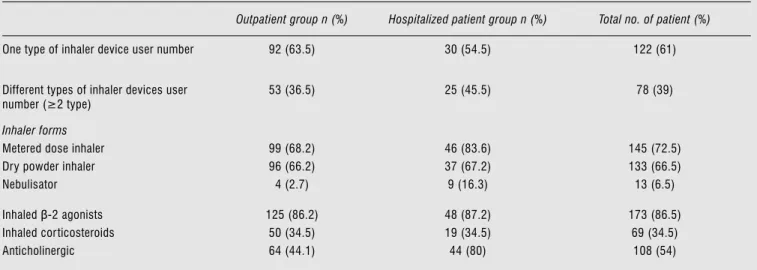
The types of inhaler devices, specific inhaler therapy content, inhaler technique, and awareness of the diagnosis status of patients according to the distribution in outpa-tient and hospitalized groups were shown in Table 2. The most used form of inhaler therapy was being MDI in both groups. The rate of nebulisator usage in hospitalized pa-tients was 16.3%. Seventy eight of the papa-tients (%39) were using two or more different type of inhaler devices. There were no significant difference on proper IT and proper
daily dosages and intervals between the patients using one type and two or more different types of inhaler devices. It was also investigated if the content of the inhaler treatment were effective on proper IT. The proper IT rate was not changed between the patients using bronchodilator thera-pies and inhaled glucocorticosteroids. There were also no significant difference of proper IT in COPD and asthma patients. Some parameters such as patient’s age, duration of therapy, and initial education of instruction were
sta-Table 1. Patients’ characteristics in outpatient and hospitalized groups
Outpatient Hospitalized patients Male/Female (n %) 65/80 (44.8/55.2) 32/23 (58.2/41.8) Mean age ± SD (min-max) (year) 57.73 ± 13.88 (21- 78) 63.90 ± 9.82 (47- 80) COPD no.of patients( %)
Age ± SD DMD*±SD (min-max year) 85 (58.6) 62.62 ± 10.59 (40-70) 3.5 ± 4.29 (0.5-11) 42 (76.3) 65.71 ± 9.28 (60-78) 4 ± 3.32 (1-20) Asthma no.of patients(%)
Age ± SD DMD*±SD (min-max year) 52 (35.8) 51.85 ± 13.69 (21-67) 2.8 ± 4.22 (1-15) 7 (12.7) 63.57 ± 9.40 (47-80) 5.5 ± 3.88 (3-25) Bronchiectasis no.of patients(%)
Age ± SD DMD*±SD (min-max year) 8 (5.6) 65.60 ± 7.90 (51-78) 4 ± 1.64 (1-15) 6 (11) 60.16 ± 13.56 (52 -75) 6.5 ± 1.22 (4-15) Educational level (EL) n(%)
No education Primary school Middle school High school University 34 (23.5) 68 (46.9) 16 (11) 17 (11.7) 10 (6.9) 8 (14.6) 27 (49) 7 (12.8) 8 (14.6) 5 (9)
*DMD: disease mean duration
Table 2. Inhaler devices, specific inhaler therapy content, inhaler technique, and knowledge of diagnosis status of the patients according to the
distribution in outpatient and hospitalized groups.
Outpatient group n (%) Hospitalized patient group n (%) Total no. of patient (%)
One type of inhaler device user number 92 (63.5) 30 (54.5) 122 (61) Different types of inhaler devices user
number (≥2 type)
53 (36.5) 25 (45.5) 78 (39)
Inhaler forms
Metered dose inhaler Dry powder inhaler Nebulisator 99 (68.2) 96 (66.2) 4 (2.7) 46 (83.6) 37 (67.2) 9 (16.3) 145 (72.5) 133 (66.5) 13 (6.5) Inhaled β-2 agonists
Inhaled cor ticosteroids Anticholinergic 125 (86.2) 50 (34.5) 64 (44.1) 48 (87.2) 19 (34.5) 44 (80) 173 (86.5) 69 (34.5) 108 (54)
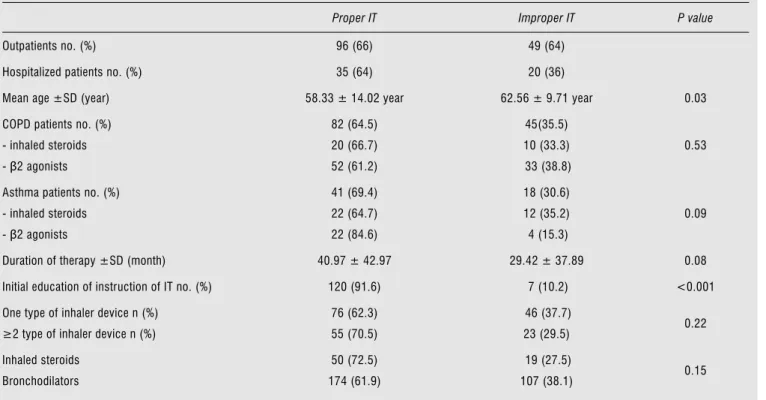
statistically significant (p<0.001). These parameters were shown in Table 3.
There were no relationship between the educational lev-el of patients and proper application technique, awareness of the diagnosis, maintenance of inhaler therapy. When we compared outpatient and hospitalized group’s of patients, there was no statistically significant difference in gender, educational levels, proper IT, awareness of the diagnosis, maintenance of therapy. In hospitalized patients, rela-tions between the number of hospitalization and proper IT, awareness of the diagnosis and maintenance of therapy were significant (Table 4). The patients who know their di-agnosis, had a higher mean number of hospitalization, and they were properly using their inhaler devices. They were also continuing to use their inhaler medications.
Discussion
The use of inhaled aerosol medications for the treat-ment of pulmonary diseases, has advantages over oral and parenteral routes of delivery. There are also disadvantages such as a less than optimal technique which can result in decreased drug delivery and reduced efficacy (1). Improper IT is common among patients. Inhaler technique together with medication concordance, patient education and mo-tivation are important factors in symptom and disease con-trol (7,8).
Table 3. Parameters effective on proper IT and improper IT.
Proper IT Improper IT P value
Outpatients no. (%) 96 (66) 49 (64) Hospitalized patients no. (%) 35 (64) 20 (36)
Mean age ±SD (year) 58.33 ± 14.02 year 62.56 ± 9.71 year 0.03 COPD patients no. (%)
- inhaled steroids - β2 agonists 82 (64.5) 20 (66.7) 52 (61.2) 45(35.5) 10 (33.3) 33 (38.8) 0.53 Asthma patients no. (%)
- inhaled steroids - β2 agonists 41 (69.4) 22 (64.7) 22 (84.6) 18 (30.6) 12 (35.2) 4 (15.3) 0.09 Duration of therapy ±SD (month) 40.97 ± 42.97 29.42 ± 37.89 0.08 Initial education of instruction of IT no. (%) 120 (91.6) 7 (10.2) <0.001 One type of inhaler device n (%)
≥2 type of inhaler device n (%)
76 (62.3) 55 (70.5) 46 (37.7) 23 (29.5) 0.22 Inhaled steroids Bronchodilators 50 (72.5) 174 (61.9) 19 (27.5) 107 (38.1) 0.15
Table 4. Number of hospitalization and related factors of therapy
compliance and knowledge of diagnosis in hospitalized patients.
Number of patients Mean number of hospitalization P value Proper IT* İmproper IT 35 20 3.52 ± 2.68 1.45 ± 0.60 < 0.001 Aware of diagnosis Unaware of diagnosis 40 15 3.23 ± 2.62 1.53 ± 0.74 < 0.05 Maintenance of inhaler therapy on admission Discontinuity to the therapy on admission 45 10 3.06 ± 2.52 1.40 ± 0.51 < 0.05
*IT- inhaler technique
tistically significant on proper application of the inhaler device. Younger patients were using inhaler devices more correctly than olders. The longer duration of therapy was related with the proper IT (p <0.05). An initial education of instruction and proper application technique were also
In this study, our primary objective was to evaluate the effects of the parameters on adequate IT and therapy compliance related factors in patients. Study group was consisted of older persons with low educational level, since 23,5% (n:47) of patients had high school and university education. We found that age is an important factor on proper IT. This result is concordant with other studies. Many older patients have been shown to have poor inhaler technique (8). This has been documented with MDI, only 60% of older people have been reported to have adequate MDI technique (9). Mirici et al. reported that patient’s age was negatively correlated with compliance to inhala-tion technique (10). Older patients were also using their inhaler therapies in low or overdoses and improper inter-vals according to our findings. Proper IT rate in the study group is inadequate, since 65,5% of patients were using their inhalers correctly.
The increasing number of inhalation devices that are available for patients has resulted in a confusing number of choices. Each type of aerosol device has its own advantages and disadvantages. MDIs are quicker to use, but require the most patient training to ensure coordination for proper use. The improper timing breath initiation is a common problem. DPIs are easier to use than MDIs because they are breath-actuated, but they require a relatively rapid rate of inhalation in order to provide the energy necessary to drug aerosolization. Nebulizers require minimal patient cooperation and coordination, but are cumbersome and time consuming to use (1,11).
The most used form of therapy was MDIs either in out-patients and in hospitalized out-patients, since they are the first choice of administration for the delivery of short acting β-2 agonists as preferred rescue medication in obstructive lung diseases. Because many delivery devices are now avail-able, some patients are using two or more different type of inhaler devices concomittanley (12). Approximately half of the patients were using two or more different type of inhaler devices in our study, but there were no signifi-cant difference on proper IT and proper daily dosages and intervals between the patients using one type and two or more different types of inhaler devices. The proper IT rate was not changed between the patients using bronchodi-lator therapies and inhaled glucocorticosteroids, and also there were no significant difference of proper IT in COPD and asthma patients. The differing pathology of asthma and COPD has importance on the treatment approach of these two diseases strikingly different. Asthma can be fully controlled with current treatments, and in contrast COPD cannot be fully reversed and may progress (13). There is no specific study addressing this issue extensively. Goodman
et al. investigated the influence of the diagnosis on proper use of MDI, and they found no significant differences in technique between patients with a diagnosis of asthma or COPD (14). Although we didn’t found such difference in the study group, it may adversely affect the patient adher-ence with COPD therapy.
Another parameter on proper IT is the duration of ther-apy, since we found that mean duration of therapy were longer in patients who were correctly using their inhaler devices than others who were improperly using the inhaler therapy. Kıter et al. reported that age was negatively and duration of using inhaler was positively correlated with correct use of inhalers (15).
We should emphasize two of our results especially. Firstly; an initial education of instruction and proper IT was related in the study group, and secondly there were no relationship between the educational level of patients and proper IT. The educational level of the patient may not influence the correct application rate without an adequate initial education of usage. There was an impressive remark that we could made according to our findings; patients who had an initial education of instruction, were using a proper IT, nevertheless ninty percent of patients who were misusing their inhaler devices, had no education of usage. Ünlü et al. was investigated the efficacy of education on misuse of inhalers in COPD patients, and they found that training in application reduced the error ratio to a tolerable level (16).
Secondary objective of our study was to compare the outpatients and hospitalizeds’ groups. There was no sta-tistically significant difference between these two groups in gender, educational levels, proper IT, knowledge of di-agnosis, maintenance of therapy. In hospitalized patients, number of hospitalization was higher in patients who had a proper IT and a knowledge of diagnosis. These patients were also maintaining the inhaler therapy.
The hospitalized setting presents a unique opportu-nity for health care providers to instruct the patient on the proper use of each device, but the benefit of such an approach has not been assessed in randomized trials (1). Our results were also supporting this point of view, since number of hospitalization was related with a proper IT. Our study had some limitations, as our data reflected the results of the patients admitted and followed-up in an uni-versity hospital, and not those of lacking to follow-up.
Inhaler therapy is prescribed frequently in worldwide for obstructive lung disease. Their misuse is generally due to an improper IT. It can be a particular problem especially in elderly patients, and be improved significantly with a proper instruction of patients. The educational level of
the patient may not influence the correct application rate without an adequate initial education of usage. In hospital-ised patients, this period can consolidate the education of inhaler usage technique and serve to select a proper inhaler treatment modality in individual basis.
In conclusion, this study addressed to the currently asked and investigated problem in the treatment of airway
diseases. A proper patient education on the use of each of the inhaler devices is essential, and the assessment of IT should be the part of subsequent visits. It is also possible to organize a regular educational program which gives a chance to reassess proper IT and to increase patients com-pliance to the inhaler therapy.
References
1. Dolovich MB, Ahrens RC, Hess DR et al. Device selection and outcomes of aerosol therapy: Evidence-based guidelines. Chest 2005; 127: 335-371.
2. Roche N, Chinet T, Huchon G. Ambulatory inhalation therapy in obstructive lung diseases. Respiration 1997; 64:121-30
3. Newhouse MT, Dolovich MB. Control of asthma by aerosols. N Engl J Med 1986; 315:870-874.
4. Global Initiative for Asthma (GINA) 2003 Update: Workshop Report, Global Strategy for Asthma Management and Prevention. p: 1-180. (www.ginaasthma.com)
5. National Heart, Lung and Blood Institute/ World Health Organization. Global strategy for the diagnosis, management and prevention of Chronic Obstructive Lung Disease: National Heart, Lung and Blood Institute and World Health Organization Global Initiative for chronic obstructive lung disease(GOLD); workshop summary. Am J Respir Crit Care 2001;163: 1256-1276. 6. Turner MO, Patel A, Ginsburg S et al. Bronchodilator delivery in
acute airflow obstruction. Arch Intern Med 1997; 157: 1736-1744. 7. De Blaquiere P, Christensen DB, Carter WB. Use and misuse of
metered-dose inhalers by patients with chronic lung disease: a controlled, randomized trial of two instruction methods. Am Rev Respir Dis 1989; 140: 910-16.
8. Ho SF, O’Mahony MS, Stewart JA et al. Inhaler technique in older people in the community. Age and Ageing 2004; 33:185-188.
9. Franks M, Briggs P. Use of a cognitive ergonomics approach to compare usability of a multidose dry powder inhaler and a capsule dry powder inhaler: an open-label, randomized, controlled study. Clin Ther 2004; 26: 1791-1799.
10. Mirici A, Meral M, Akgün M ve ark. İnhalasyon tekniklerine hasta uyumunu etkileyen faktörler. Solunum Hastalıkları 2001; 12: 13-21.
11. Berry RB, Shinto RA, Wong FH et al. Nebulizer vs spacer for bronchodilator delivery in patients hospitalized for acute exacerbations of COPD. Chest 1989; 96: 1241-1246.
12. Melani AS, Zanchetta D, Barbato N et al. Inhalation technique and variables associated with misuse of conventional metered-dose inhalers and newer dry powder inhalers in experienced adults. Ann Allergy Asthma Immunol 2004; 93: 439-46.
13. Bateman ED. Improving inhaler use in COPD and the role of patient preference. Eur Respir Rev 2005; 14: 96: 85-88. 14. Goodman DE, Israel E, Rosenberg M et al. The influence of age,
diagnosis, and gender on proper use of metered-dose inhalers. Am J Respir Crit Care Med. 1994; 150:1219-1221.
15. Kıter G, Sevinç C, Çımrın AH. Farklı inhaler tekniklerine hastaların uyumları. Tüberküloz ve Toraks 1999; 47: 278-283. 16. Ünlü M, Şahin Ü, Akkaya A. KOAH’lı hastalarda inhalasyon
aletlerinin yanlış kullanılmasına eğitimin katkısı. Selçuk Üniversitesi Tıp Fakültesi Dergisi 2001; 17: 33-36.