Effect of Priming on Germination of Lagenaria siceraria
Genotypes at Low Temperatures
Burcu Begum KENANOĞLU1 Ibrahim DEMİR1 Kazım MAVİ1
Halit YETİŞİR2 Davut KELEŞ3 Geliş Tarihi: 28.11.2006
Abstract :This work was carried out to test whether germination of fifteen Lagenaria siceraria genotypes which were collected from western and southern parts of Turkey were improved by KNO3 and NaCl treatments.
The experiment was conducted in two consecutive years, 2004 and 2005. Germination tests were performed at 15 0C and 18 0C. Results indicated that the effect of the treatments varied between the genotypes, temperatures
and solutions that were used. KNO3 treatment was better and effective in larger number of lots than NaCl in both
years. NaCl promoted germination in a few but inhibitive in large number of lots at both temperatures. As germination temperature was reduced, the positive effect of the KNO3 became greater. As a conclusion, priming
treatments, specifically KNO3, appears to be promising in enhancing germination percentages of Lagenaria
siceraria particularly at 15 0C that is the prevailing temperature in rootstock production for grafted watermelon
seedling in unheated glasshouse conditions in early spring.
Key Words: Lagenaria siceraria, priming, germination, low temperature
Lagenaria siceraria
Genotiplerinin Düşük Sıcaklıkta Çimlenmesi Üzerine
Ekim Öncesi Uygulamaların Etkisi
Öz: Bu çalışmada; Türkiye’nin batı ve güney bölgelerinden toplanan, 15 adet Lagenaria siceraria
genotipine ait tohumlar KNO3 ve NaCl uygulamasına tabi tutularak çimlenme oranları araştırılmıştır. Araştırma,
2004-2005 yıllarında yürütülmüştür. Çimlendirme testleri, 15 0C ve 18 0C sıcaklılarda yapılmıştır. Sonuçlar,
uygulamaların etkisinin genotipler, sıcaklıklar ve kullanılan solüsyonlar arasında fark olduğunu göstermiştir. Birçok genotipte her iki yılda da, KNO3 uygulaması NaCl uygulamasına göre daha etkili ve iyi sonuç vermiştir.
Her iki sıcaklıkta, NaCl az da olsa çimlenmeyi olumlu etkilemiştir; fakat, birçok genotipte çimlenmeyi engellemiştir. Çimlenme sıcaklığı düştükçe KNO3 uygulamasının pozitif etkisi daha iyi gözlenmiştir. Sonuç olarak;
uygulamalar, özellikle de KNO3 uygulaması ile 15 0C sıcaklıkta, Lagenaria siceraria tohumlarının çimlenme
yüzdesi arttırılmıştır. Belirtilen uygulama, erken ilkbahar döneminde ısıtmasız sera koşullarında aşılı karpuz fidesi için anaç üretiminde etkili şekilde kullanılabilir.
Anahtar Kelimeler:Lagenaria siceraria, ekim öncesi uygulamalar, çimlenme, düşük sıcaklık
Introduction
Cultivated Lagenaria siceraria (Malign) Stanley is commonly known as the white-flowered bottle gourd. It has been cultivated annual monocious, vigorous climber species and five wild perennial diocious species. The genus Lagenaria also contains five wild species: L. brefilora (Benth) Roberty, L.
abyssinica (Hook F.) Jeffrey, L. rufa (Gilg) Jeffrey, L.
spherical (Sonder) Naudin and L. guineensis
(G. Don) Jeffrey (Motimoto et al. 2005). The fruits are
generally eaten as a vegetable in Africa and Asia. Immature fruits are eaten by boiling, frying or stuffing like fruit of Cucurbita pepo. The mature fruit is often scooped out and the skin used as containers, bowls, music instruments, decorative purposes or in some cases, fishing floats. Shoots, tendrils and leaves are also cooked and the seeds are removed for oil extraction or for use in cooking. Tendrils and young leaves are also used for some medical
1Depart. of Horticulture,Fac. of Agriculture, Ankara Univ. -Ankara/ Turkey,
2Depart. of Horticulture, Fac. of Agriculture, Univ. of Mustafa Kemal Hatay/ Turkey,
purposes (Tindall, 1983). Furthermore, L. siceraria is used as rootstocks for watermelon against soil-born diseases and low soil temperature. Grafting of watermelon onto bottle gourd was first performed in Korea and Japan in the late 1920s (Ashita 1927). L.
siceraria is one of the species used as rootstock for
watermelon and it shows high compatibility rate with watermelon (Lee 1994, Oda 1995; Yetisir and Sari 2003).
Watermelon seedlings are grafted for various purposes such as to control Fusarium wilt, to increase low temperature tolerance and yield by enhancing water and plant nutrient uptake (Masuda et al. 1981, Oda 1995). Although cucurbit species of Cucurbita
moschata, Cucurbita maxima, Benincasa hispida, are
commonly used as rootstocks in watermelon grafting was first performed on Lagenaria species and are still being used in a large extend. Most recent studies comparing various rootstocks indicated that Lagenaria type rootstocks produced higher yield and vigorous plants and are more resistant to Fusarium wilt compared to those cucurbits used in watermelon production (Yetisir and Sari 2003).
Watermelon has been cultivated intensively under low tunnels in southern part of Turkey for early production. One of the basic problems in grafted watermelon seedling production is erratic and slow germination of rootstock seeds (Lagenaria species) in early sowings (Shik et al. 1999). Rapidly developed rootstock seedlings will certainly provide earlier grafting due to the longer hypocotyls which will make early transplanting in the field possible thus resulting in early maturation. However, it was reported that
Lagenaria species are very sensitive and require
longer times to germinate at low temperatures (Chang et al. 1996) which are prevailing during the early spring sowings. This delays fast and efficient grafted seedling production.
Several priming treatments have been reported to enhance germination percentage and rate of seeds under low temperature sowings in various crop seeds (Bradford et al. 1990, Taylor et al. 1998, Lin and Sung, 2001; Demir and Mavi, 2004). Salt solutions have been used for such aims and particularly KNO3 and KH2 PO4
treatments were found promoting the germination percentage of gourd seeds at low temperatures (Shik et al. 1999, Chang et al. 1996). One important aspect of such treatments is that their effect may not only change due to the concentration, treatment period,
chemical agent or treatment temperature but also according to genotypes and even among the lots within the same species (Heydecker and Coolbear 1977).
In this study, we tested whether KNO3 and NaCl
treatments can enhance low temperature germination percentages of fifteen Lagenaria siceraria genotypes which were collected from southern and western parts of Turkey.
Materials and Methods
Seed materials: This experiment was conducted
on fifteen genotypes of Lagenaria siceraria collected from various regions of western and southern parts of Turkey. Experiment was conducted in two consecutive years in seed science laboratory at Ankara University. Genotypes were collected in 2004 (first year) and same lots were grown in 2005 (second year) in Central Horticultural Research Experiment Station in Mersin / Turkey to obtain seeds. Seeds were extracted from mature fruits (70-75 days after anthesis) dried at 25 0C.
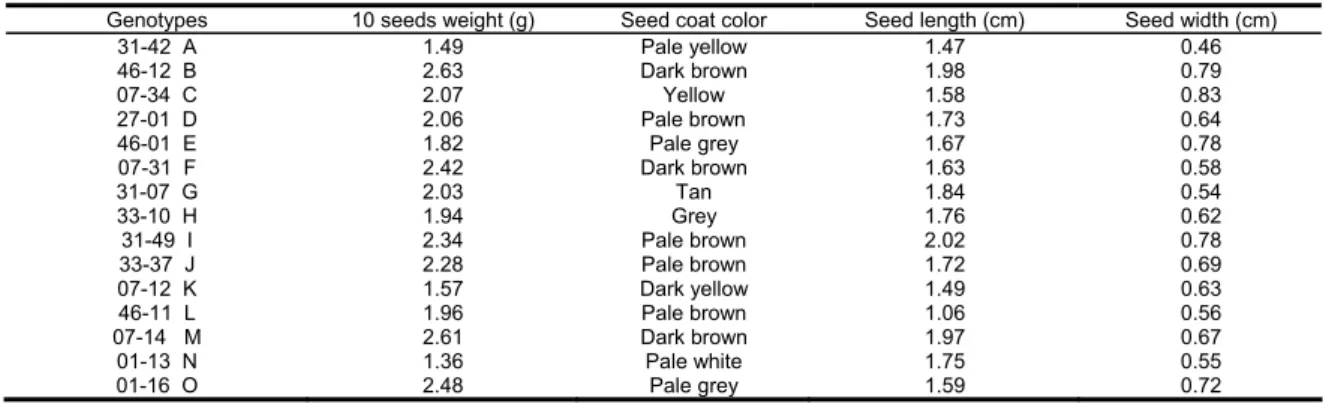
Seeds were hermetically stored at 5 0C until use. Seed moisture content determined by high temperature oven method (130 0C , 1 h) (Ista 1996) which were lower than 10 %.Genotypes number and codes were given along with 10 seeds weight, seed coat colour, seed length and seed width in Table 1. Every measurement was carried out on five replicates of 10 seeds selected randomly in each genotype and means were taken.
Advantage or disadvantage of the treatments compared to untreated seeds was presented in Table 3.
Salt priming treatment: Seed priming was
carried out on top of filter paper (GmBH, Made in Germany) moistened with 30 ml of 4 % KNO3 or 1 %
NaCl solutions and kept at 20 0C for 6 days in the dark
in sandwich boxes (18x9x5 cm) (Bradford 1985). Three hundred seeds were used for each priming solution and genotype. During the priming treatment, boxes were covered with plastic film to prevent loss of liquid. At the end of the treatment seeds were washed under tap water for 30 seconds and dried to the original weight on top of filter paper on laboratory bench (20±2
0C, 45-50 % RH) for two days. Germination tests were
conducted within two days after the treatment and seeds were stored at 5 0C during that period.
Table 1. Changes in colour, length, width and 10 seed weights of seeds of genotypes of Lagenaria spp. used in this work
Table 2. The effect of KNO3 and NaCl treatments on 4th and 7th day germination percentages Lagenaria spp. At 15oC. 15ºC
2004 2005
KNO3 NaCl Control KNO3 NaCl Control
Genotypes 4 day 7 day 4 day 7 day 4 day 7 day 4 day 7 day 4 day 7 day 4 day 7 day
36-42 A 46-12 B 07-34 C 27-01 D 46-01 E 07-31 F 31-07 G 33-10 H 31-49 I 33-37 J 07-12 K 46-11 L 07-14 M 01-13 N 01-16 O 99 95 61 99 56 3 96 93 75 73 40 47 39 3 27 99 99 92 100 59 28 100 96 77 85 57 71 47 3 69 4 37 7 17 0 1 19 0 1 8 1 1 0 0 12 5 67 20 21 1 28 25 96 4 29 3 0 0 0 24 1 1 8 47 4 0 0 0 3 15 16 1 0 0 1 1 27 63 87 37 33 3 1 5 52 56 24 3 5 21 58 35 30 0 40 16 8 33 29 11 15 1 3 0 0 86 72 63 61 55 52 45 41 35 35 23 20 19 1 0 16 4 8 7 31 11 5 4 3 0 12 0 1 0 0 28 11 9 12 35 21 16 4 3 3 17 0 7 1 0 0 0 0 0 0 0 0 0 1 0 13 0 1 0 0 0 4 4 0 11 23 0 0 0 3 28 0 7 0 0
Mean 60.4a* 72.1A 7.2b 21.5B 6.5b 27.9B 18.6a 40.5A 6.8 a 11.1B 0.9b 5.3B
* Small letters are to compare 4th day big letters are for 7th day germination among the treatments within the same year
Table 3. The advantages and disadvantages of the KNO3 and NaCl treatments on germination of Lagenaria spp. At 15 and 18 oC in 2004 and 2005.
Genotypes 10 seeds weight (g) Seedcoat color Seed length (cm) Seed width (cm)
31-42 A 1.49 Pale yellow 1.47 0.46 46-12 B 2.63 Dark brown 1.98 0.79 07-34 C 2.07 Yellow 1.58 0.83 27-01 D 2.06 Pale brown 1.73 0.64 46-01 E 1.82 Pale grey 1.67 0.78 07-31 F 2.42 Dark brown 1.63 0.58 31-07 G 2.03 Tan 1.84 0.54 33-10 H 1.94 Grey 1.76 0.62 31-49 I 2.34 Pale brown 2.02 0.78 33-37 J 2.28 Pale brown 1.72 0.69 07-12 K 1.57 Dark yellow 1.49 0.63 46-11 L 1.96 Pale brown 1.06 0.56 07-14 M 2.61 Dark brown 1.97 0.67 01-13 N 1.36 Pale white 1.75 0.55 01-16 O 2.48 Pale grey 1.59 0.72 2004 2005
KNO3 NaCl KNO3 NaCl
Genotypes 150C 180C 150C 180C 150C 180C 150C 180C 98 72 29 13 22 -5 97 95 72 33 1 47 44 2 31-42 A 46-12 B 07-34 C 27-01 D 46-01 E 07-31 F 31-07 G 33-10 H 31-49 I 33-37 J 07-12 K 46-11 L 07-14 M 01-13 N 01-16 O 48 27 1 -3 -1 15 -5 4 19 69 1 -10 35 40 -32 -2 4 40 -1 -66 -36 -29 22 -1 -1 -23 -53 -24 -3 -5 3 -56 -11 -47 -45 -60 -33 -52 -73 -1 -58 -86 -32 -29 -89 -16 87 68 59 61 46 29 45 41 37 32 -5 20 12 1 0 34 -1 11 -4 -6 -7 -11 61 -3 -12 20 90 -3 7 22 28 7 5 12 24 -2 16 4 3 0 -11 0 0 1 0 12 -36 -59 -39 -12 -27 -49 -15 -86 -70 -57 24 -50 1 -12 Total 668 158 -173 -688 533 198 87 -475
Low temperature germination tests
Germination of treated and untreated seeds were carried out by using three replicates of fifty seeds each at 15 0C and 18 0C between wet rolled paper towels
(ISTA, 1996). Fifty seeds were placed between three (two down one up) of 20x20 cm sized filter papers wetted with 18 ml of distilled water (EC 5 μScm-1 g-1).
Rolled papers were placed in self zipped and tightly closed polyethylene bags and kept in the dark at appropriate temperatures. Towel papers were weted by spraying the water as required throughout the germination period. Seeds with two mm radicle protrusion were considered to have germinated. Counts were made 4 and 7 days after the test was set up.
Means of the three replicates of the treated and untreated seeds of each genotype were compared by Duncan’s multiple range test at 5 % level. Statistical analysis was carried out by using SPSS statistical package.
Results and Discussion
KNO3 treatment significantly increased
germination percentages of 5 lots at 18 0C and 12 lots at 15 0C (P<0.05) in 2004 (Figure 1). Only in one lot (lot N), KNO3 was found adversely effective on
germination. Contrastingly, NaCl treated seeds had lower germination than untreated ones in 12 lots at 18
0C and in 8 lots at 15 0C in 2004. NaCl was effective
only in two lots, B and G at 15 0C, out of 15 lots and two temperatures.
Although all are not the same lots as in 2004, KNO3 treatment enhanced germination of five lots
significantly (P<0.05) at 18 0C in 2005 (Figure 2).
However, its effect extended to 12 lots at 15 0C in the same year. Germination of control seeds of 10 lots was significantly higher than that of NaCl treated ones at 18
0C while only three treated lots had higher germination
than control at 15 0C in 2005.
Fourth and seventh day counts of germination tests in Table 2 indicate that KNO3 treated seed lots
had much faster germination than both NaCl treated and control seed lots at 15 0C. Within the first four days of the test means of the 15 lots were 60.4 % and 18.5 % in KNO3 treated ones in 2004 and 2005.
Corresponding values in NaCl treated and control were 7.2 and 6.8 %, 6.5 % and 0.9 %, respectively, in two consecutive years (Table 2). Advancement observed by KNO3 compared to NaCl and control on seventh
day counts showed similar trend and was significantly (P<0.05) in favour of KNO3 treatment (Table 2).
Total advantages of the two treatments in two consecutive years with regard to temperatures were presented in Table 3. The largest advantage was observed in KNO3 treatment in both years and at
temperatures.
At 15 0C KNO3 increased total germination 668 in
2004, 533 in 2005. It decreased to 158 and 198 at 18
0C in 2004 and 2005, respectively. NaCl treatment was
disadvantageous at both temperatures in 2004. Contrarily, it is advantageous at 15 0C but not at 18 0C (Table 3).
Priming seeds for germination under unfavourable temperatures reported in various crop seeds (Pill 1995). Following priming, seeds have completed phase 1 (hydration) and II (lag phase) of germination and only require a favourable water potential gradient for water uptake in order to begin radicle growth (Pill 1995). Specifically, salt-priming in which various salts were used were found enhancing germination at low temperatures in cucurbits (Sachs 1977, Bradford 1985, Nerson et al. 1985, Demir and Oztokat, 2003, Korkmaz et al. 2005). Shik et al. (1999) and Chang et al. (1996) indicated that KNO3 was very
promoting germination of Lagenaria seeds at low temperatures. Treated seeds had not only high germination percentages but also low mean germination time. It was reported that induction of KNO3 in germination occurs through obtaining
excessive O2 and phosphate uptake (Bliss et al. 1986).
Moreover, it is effective on dormancy release and suggested as a routine use in germination tests in those seeds likely to be dormant (ISTA 1996).
Advancement of priming may depend on various factors occur during the treatment. One hypothesis is that it can be due to metabolic repair of deleterious events during treatment and that advancement in germination events i.e. enzymatic changes, to reduce lag time between imbibition and radicle emergence does also occur (Bradford et al. 1990). Along with metabolic advancement, Nerson et al. (1985) found that KNO3 priming also increased embryo length in
tetraploid watermelon seeds. Treated seeds had stronger embryos and in turn broke up the seed coat blockage. We have not measured the embryonic development of the genotypes in our work but it is likely that priming may increase germination of some
Lagenaria genotypes through increasing the embryo
size. Hard seed coat is one cause of emergence failure in watermelon seeds (Sung and Chiu 1995). Priming might soften the seed coat and in turn ease of the mechanical restriction on embryo.
One of the clear findings of the present work is that NaCl treated seeds gave worse performance than
those of control seeds. Some of the previous studies had shown similar results. NaCl hinders DNA and RNA synthesis (Bliss et al. 1986) and Ca and K uptake during treatment (Durrant et al. 1983). It was also proposed that NaCl may not allow the seeds to reach the critical level of seed moisture so that metabolic processes (second phase of imbibition, lag phase) are not activate sufficiently (Ashraf and Foolad 2005). However, we did not determine the final seed moisture content that seeds reached following treatment. Therefore we are not able to compare two salttreatments with regard to that aspect. It was reported that critical moisture level or initial stage of lag phase (second part of imbibition) varies among the species and it is specifically related to chemical
composition of seed (Vertucci 1989). This probably needs to be determined for Lagenaria spp to understand the starting point of activation of pre-sowing seed treatment mechanism.
Grafted vegetable seedling technology has improved greatly in recent years. Lagenaria spp. were used as rootstock widely in watermelon seedling production (Yetisir and Sari 2003). Obtaining fast and well developed rootstock seedlings at low temperatures are advantageous in early grafting which would lead to early maturation. As a conclusion, KNO3
treatment has an advantage in obtaining well-developed rootstocks seedlings and can be a useful tool for achieving such aim.
Figure 1. Germination percentages of Lagenaria spp. genotypes at 15 and 18 oC in 2004
2004 (18oC ) 0 10 20 30 40 50 60 70 80 90 100 A B C D E F G H I J K L M N O Genotypes G er m inat ion P er cent age 2004 (15oC) 0 10 20 30 40 50 60 70 80 90 100 A B C D E F G H I J K L M N O G er m inat ion Per cent age Genotypes 2004 (15oC ) 0 10 20 30 40 50 60 70 80 90 100 A B C D E F G H I J K L M N O G er m inat ion P er cent age Genotypes 2004 (18oC) 0 10 20 30 40 50 60 70 80 90 100 A B C D E F G H I J K L M N O Genotypes G er m inat ion P er cent age * * * * * * * * * * * * * * * * * * * * * * * * * * * * * * * * * * * * * * * * □ Control ■ KNO3 □ Control ■ NaCl
Figure 2. Germination percentages of Lagenaria spp. genotypes at 15 and 18 oC in 2005 2005 (18oC) 0 10 20 30 40 50 60 70 80 90 100 A B C D E F G H I J K L M N O Genotypes G em ina tion Per ce nt ag e 2005 (18oC) 0 10 20 30 40 50 60 70 80 90 100 A B C D E F G H I J K L M N O Genotypes G er m inat ion Per ce nt ag e 2005 (15oC) 0 10 20 30 40 50 60 70 80 90 100 A B C D E F G H I J K L M N O Genotypes G er m inat ion Per ce nt ag e 2005 (15oC) 0 10 20 30 40 50 60 70 80 90 100 A B C D E F G H I J K L M N O Genotypes G er m in at ion P er cent age * * * * * * * * * * * * * * * * * * * * * * * * * * * * * * * □ Control ■ KNO3 □ Control ■ NaCl References
Ashita, E. 1927. Grafting of watermelons’ Korea (Chosun)
Agr. Newsletter 9. (in Japanese).
Ashraf, M. and M. R. Foolad. 2005. Pre-sowing seed treatment - A shotgun approach to improve germination plant growth and crop yield under saline and non-saline conditions. Advances in Agronomy 88: 223-267. Bliss, D. R., Platt, K. A. Aloia,. and W. W. Thompson. 1986.
Chnages in plazmalemma organization in cowpea radicle during imbibition in water and NaCl solutions. Plant Cell and Environment 9: 727-733.
Bradford, K. J. 1985. Seed priming improves germination and emergence of cantaloupe at low temperature. HortScience 20: 596.
Bradford, K. J., J. J Steiner and S. E Trawatha. 1990. Seed priming ınfluence on germination and emergence of pepper seed lots. Crop Science 30: 718-721.
Chang, Y. K., K. J. Hwa, Y.Y. Rog, and L. S. Ho. 1996. Effects of fruit maturity and afterripening period on the germination of gourd seeds. Journal Korean Society Horticulture Science 37: 197-200.
Demir, I. and C. Oztokat. 2003. Effect of salt priming on germination and seedling growth at low temperatures in watermelon seeds during development. Seed Science and Technology 31: 765-770.
Demir, I. and K. Mavi. 2004. The effect of priming on seedling emergence of differentially matured watermelon (Citrullus lanatus (Thunb.) Matsum & Nakai) seeds. Scientia Horticulturae 102: 467-473.
Durrant, M.J., A. A. Payne, and J. S. Mclaren. 1983. The use of water and some inorganic salt solution to advance sugarbeet seed. I. Laboratory studies, Annals of Applied Biology 103: 507-515.
Heydecker, W. and P. Coolbear. 1977. Seed treatments for improved performance. Survey and attempted prognosis. Seed Science and Technology 5: 353-525. ISTA, International Seed Testing Association 1996.
International rules for seed testing. 1996. Seed Science and Technology 24, Supplement.
Korkmaz, A., N. Ozbay, I. Tiryaki and M. N. Nas. 2005. Combining priming and plant growth regulators improves muskmelon germination and emergence at low temperatures. Europe Journal HortScience Science 70 (1): 29-34.
Lee. J. M. 1994. Cultivation of grafted vegetables I. Current status, grafting methods and benefits. HortScience 29: 235-239.
Lin, J. M. and J. M Sung. 2001. Pre-sowing treatments for improving emergence of bitter gourd seedlings under optimal and suboptimal temperatures. Seed Science and Technology 29: 39-50.
Masuda M., T. Nakamura and K. Gomi. 1981. Studies on the caharacteristics of nutrient absorption of rootstocks in grafting of fruit vegetables. II. Effect of rootstock C.
ficifolia on the growth and mineral composition of xylem
sap in cucumber in relation to potassium concentration in culture system. ‘Bulletin of Faculty of Agriculture Miyazaki University.
Motimoto, Y., P., H. Maundu and H. Fujimaki. 2005. Diversity of landraces of the white-flowered gourd (Lagenaria
siceraria) and its wild relatives in Kenya: fruit and seed
morphology. Genetic Research Crop Evolution (in
press).
Nerson, H., H. S Paris, Z. Karchi and M. Sachs. 1985. Seed treatments for improved germination of tetraploid watermelon. HortScience 15: 253-254.
Oda, M. 1995. New grafting methods for fruit bearing vegetables in Japan. Japan Agricultural Research Quarterly 29: 187-198.
Pill, W. G. 1995. Low water potential and pre-sowing germination treatments to improve seed quality, p.319-359. In: A. S. Basra (ed.). Seed quality. Food Products Press. Binghampton, NY, USA.
Sachs, M. 1977. Priming watermelon seeds for low temperature germination. Journal Amsterdam Society Horticulture Science. 102: 175-178.
Shik, B. M., J. Yeon Ok and J. Lai. 1999. Seed treatment to improve germinability of gourd (Lagenaria siceraria Standl.). Korean Journal Horticulture Science Technology 17: 747-749.
Sung, J. M. and K. Y. Chiu. 1995. Hydration effect on seedling emergence strength of watermelon seeds differing in ploidy. Plant Science 110: 21-26.
Taylor, A. G., P.S. Allen, M. A. Bennett, K. J. Bradford, J. S. Burris and M. K. Misra. 1998. Seed enhancements. Seed Science Research 8: 245-256.
Tindall, H.D. 1983. Vegetables in the Tropics. Macmillan International College Edition, Macmillan Press, 1983. Vertucci, C. W. 1989.The kinetics of imbibition: Controlling
factors and relevance to seedling vigor. p. 93-114. In: Seed Moisture, P.C. Stanwood and M. B. McDonald. (Eds), CSS special publication number 14. Wisc. USA. Yetisir, H. and N. Sarı. 2003. Effect of different rootstock on
plant growth yield and quality of watermelon. Australian Journal of Experimental Agriculture 43: 1269-1274.
İletişim Adresi :
Burcu Begüm KENANOĞLU
Ankara Üniversity Faculty of Agriculture Department of Horticulture-Ankara Tel: 0-505-341 02 31