Introduction
Among the large pelagics exploited in Turkey, the swordfish (Xiphias gladius L.) is least important based on low annual landings. For example, in 1999, the amount
was only 230 t (1). The exact time when swordfish fishery starts in Turkey is unknown. Onat (2) reported that, in the late 1960s, swordfish fishery by harpoon started in April, May and June, and also swordfish were
Investigations on Drift-Net Fishery for Swordfish
(Xiphias gladius L.) in the Aegean Sea
Okan AKYOL
Ege University, Faculty of Fisheries 35100, Bornova-Izmir - TURKEY
Mustafa ERDEM
Mu¤la University, Faculty of Fisheries 48000, Mu¤la - TURKEY
Vahdet ÜNAL, Tevfik CEYHAN
Ege University, Faculty of Fisheries 35100, Bornova-Izmir - TURKEY
Received: 19.02.2003
Abstract: This study reports an investigation carried out on swordfish drift-net fishery at 2 main swordfish fishing ports, Sivrice (northern) and Fethiye (southern), in the Aegean Sea in 2001-2002. Forty-five boats are used for swordfish fishing in the Turkish Aegean Sea. In these major areas, the highest number of boats 6-10 m in length and 11.5-80 hp in engine power was in the Sivrice area, while the highest number 10-14 m in length and 85-135 hp in engine power was in the Fethiye area. Almost all of the boats were made of wood. Swordfish drift-netting accurs in practice between Sivrice and the island of Lesvos and in both national and international waters between Fethiye and Rhodes. The drift nets are made of multiflament polyamide (PA) netting yarn, 210d/54-60 no, are about 3 to 7 km long, have a 500 mm mesh opening and are 20 meshes deep at Sivrice. They are about 14 km long, made up of various nets mixed together with 4 km for leerfish (Lichia amia) and 6 km for bullet tuna (Auxis rochei), have a 440 mm mesh opening, and are 30 meshes deep in the part for swordfish in Fethiye. Illuminated buoys are attached to each side of the net. Fishing effort and catch per unit effort (CPUE) in the swordfish biomass were rather low at Sivrice. The low CPUE in the biomass was probably the result of worsening meteorological conditions in the region. In each area, bluefin tuna (Thunnus thynnus), little tunnies (Euthynnus alletteratus), Mediterranean spearfish (Tetrapturus belone), albacores (Thunnus alalunga), bullet tuna (Auxis rochei), dolphinfish (Coryphaena hippurus), dolphins (Delphinus delphis), manta rays (Mobula mobular), sunfish (Mola mola) and sharks (Mustelus vulgaris) were recorded as non-target catches.
Key Words: Swordfish, Xiphias gladius, drift-nets, Aegean Sea.
Ege Denizi’nde (Türkiye) K›l›ç Bal›klar› (Xiphias gladius L.) ‹çin Kullan›lan Sürüklenen Solungaç A¤lar› Bal›kç›l›¤› Üzerine Araflt›rmalar
Özet: Bu çal›flma, Ege Denizi’nde iki ana bal›kç›l›k liman› olan Sivrice ve Fethiye’de k›l›ç avc›l›¤› için kullan›lan sürüklenen solungaç a¤lar› üzerine 2001 ve 2002 y›l›nda yürütülen araflt›rma sonuçlar›n› içermektedir. Toplam 45 tekne Ege Denizi’nde k›l›ç bal›¤› avc›l›¤› yapmaktad›r. Fethiye alan›nda 10-14 m boyunda ve 85-135 BG’ndeki tekneler en yüksek say›dayken, Sivrice alan›nda 6-10 m boyunda ve 11,5-80 BG’ndeki tekneler ço¤unluktad›r. Hemen hemen teknelerin tamam› ahflap malzemeden yap›lm›flt›r. Sürüklenen solungaç a¤lar› ile k›l›ç bal›¤› avc›l›¤› pratikte Sivrice ve Midilli aras›nda ve Fethiye k›y›lar› aç›klar› ile Rodos adas› aras›nda ulusal ve uluslararas› sularda yap›lmaktad›r. Sivrice’de sürüklenen a¤lar, multiflament polyamid (PA) ip, 210d/54-60 numara ip kal›nl›¤›nda, yaklafl›k 3-7 km uzunlu¤unda, 500 mm tam göz boyu ve 20 göz derinli¤inde; Fethiye’de 4 km’si akya (Lichia amia), 6 km’si tombik (Auxis rochei) olmak üzere toplam 14 km uzunlu¤unda kar›fl›k a¤lardan oluflmufl, k›l›ç a¤› bölümü 440 mm tam göz boyunda ve 30 göz derinli¤indedir. Ifl›kl› flamand›ralar a¤›n her iki ucuna tutturulmufltur. Sivrice’de bal›kç›l›k gücü ve a¤›rl›kça birim çabaya düflen av miktar› oldukça düflük de¤erlerde kaydedilmifltir. A¤›rl›kça düflük de¤erdeki birim çabaya düflen av, muhtemelen bölgede kötü giden meteorolojik flartlar›n sonucudur. Her iki alanda yunus (Delphinus delphis), manta (Mobula mobular), pervane bal›¤› (Mola mola), köpekbal›klar› (Mustelus vulgaris), mavi yüzgeçli orkinos (Thunnus thynnus), yaz›l› orkinos (Euthynnus alletteratus), Akdeniz k›l›c› (Tetrapturus belone), albakor (Thunnus alalunga), tombik (Auxis rochei), ve lambukalar (Coryphaena hippurus), hedef d›fl› av olarak kaydedilmifltir.
caught using drift-nets in the Bosphorus on moonless nights between September and November.
Northridge (3) stated that drift gillnets (or drift-nets), in common with other types of gillnet, are among the simplest and oldest methods of fishing. Such nets operate by gilling or entangling fish in the meshes of a sheet of netting. The netting is held more or less vertically in the water column by means of a buoyant floatline at the top of the net. Nets rigged in this way may be used singly or, by joining them together serially, as a fleet of nets. Drift-nets are usually fished at night, as the meshes of the net are less visible to the fish, and multiflament twines are also used in many drift-net fisheries, and have an advantage that they are less rigid than monoflament ones, which means that once a fish is gilled, it is less likely to be able to escape (3).
Currently, 2 methods are commonly used in swordfish fishery in Turkish waters: drift-netting and long-lining. According to recent activities, swordfish fishery is limited to 2 main fishing ports, Sivrice and Fethiye.
Only fragmentary information on swordfish fishery in Turkey exists, such as the studies by Onat (2), Artüz (4), Tokaç et al. (5), Göko¤lu and Oray (6), Al›çl› (7), and Erdem and Akyol (8).
The aim of this investigation was to give a satisfactory picture of the drift-net fishery for swordfish and to produce the first set of basic data for drift-net fishery in the Aegean Sea.
Materials and Methods
Data on the number of fishing vessels, the corresponding catch, non-target catches, the fishing gear’s characteristics, and the location of the fishing grounds were obtained through direct investigations at Sivrice fishing port during 2001 and Fethiye fishing port during 2002. Estimates of the total catch were obtained
through direct investigations and interviews with fishermen.
Fishing effort (f) and catch per unit effort (CPUE) were calculated using the following formula, modified from De Metrio and Megalafonou (9): f = (a’/100) x g where (a’/100) represents the average length of nets placed daily in the sea divided by the 100 net unit (200 m length of stretched net is called 1 unit and the length of the drift-net is 66 m after being mounted on the upper and lower ropes). Therefore, 100 net unit is equal to 100 x 66 = 6600 m for the drift-nets used for swordfish. “g” is the number of fishing days. The CPUE was computed in the biomass with the formula CPUE = kg/f .
Fork length (from the tip of the lower jaw to the fork of the caudal fin = LJFL) and total weight of 115 swordfish were measured during 9 surveys on board off the Fethiye coast.
The allometric growth formula W = aLb
was used to determine the length-weight relationship, where W is total weight, L is fork length, and a and b are constants.
Results
Fishing Ports
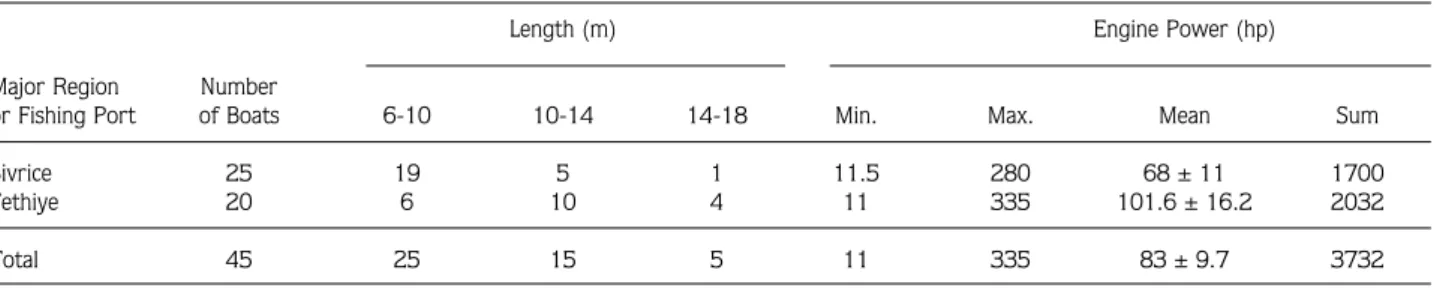
The investigation showed that 45 boats from the 2 main ports, in 2 major areas, fished for swordfish in Turkey during 2001-2002. The number of boats, grouped by size and engine power (hp), are shown in Table 1.
Table 1 shows that Sivrice has a higher number of boats than Fethiye. In these major areas, the highest number of boats 6-10 m in length and 11.5-80 hp in engine power was in the Sivrice area, while the highest number 10-14 m in length and 85-135 hp in engine power was in the Fethiye area. Almost all of the boats were made of wood with only one (17 m long; 280 hp) being made of steel, in the Sivrice area. Two or three
Table 1. Division of vessels according to size and engine power.
Length (m) Engine Power (hp)
Major Region Number
or Fishing Port of Boats 6-10 10-14 14-18 Min. Max. Mean Sum
Sivrice 25 19 5 1 11.5 280 68 ± 11 1700
Fethiye 20 6 10 4 11 335 101.6 ± 16.2 2032
persons work on each boat. Concerning the engine power of the fishing boats, the Fethiye fleet has higher engine power than the Sivrice fleet. This is obviously due to boats from the Fethiye area conducting their activities much further from port.
Fishing Grounds
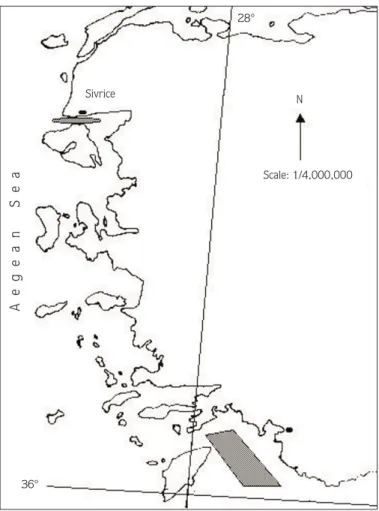
Swordfish drift-netting occurs in practice between Sivrice and the island of Lesvos, named the Müsellim Strait, and in both national and international waters between Fethiye and Rhodes (Figure 1). Fishery takes place at a depth range of 150 to 350 m in the Müsellim Strait, and 1000 to 3000 m in the Fethiye region.
Fishing Period
According to a Turkish fishery circular, there are 2 seasonal closures for swordfish fishing. These are from
June 1 to July 31 and from October 1 to January 31 (totally 6 months) in all Turkish territorial waters (10).
During the rest of the year, fishing is carried out only 70-80 days a year due to the meteorological conditions and phase of the moon. Fishing takes place only on moonless nights. However, the Fethiye fleet carries out its fishing activity using drift-nets or drifting long-lines in international waters of the Mediterranean until 15 July.
Drift-net Characteristics
The drift-nets are made of 210d/54-60 no, multiflament polyamide (PA) 500 mm mesh size netting, rigged as 3 to 7 km long, and 20 meshes deep at Sivrice (Figure 2). While in the Fethiye region the nets are about 14 km long, made up of 4 km for leerfish (Lichia amia) (210d/24 no, 480 mm mesh size), 6 km for bullet tuna (Auxis rochei) (210d/18-24 no, 340 mm mesh size) and
N Scale: 1/4,000,000 Sivrice 28° 36° Aegean Sea
Figure 1. Distribution of drift-net activities for swordfish in the Aegean Sea.
i
✓
4 km for swordfish (210d/42 no, 440 mm mesh size, 30 meshes deep). Illuminated buoys are attached to each side, for ease of visibility at night. The setting of drift-nets begins at about sunset, with hauling at about midnight for checking, and then once or twice more before sunrise.
Non-target Catches
In the Sivrice region, bluefin tuna (Thunnus thynnus), little tunnies (Euthynnus alletteratus), Mediterranean spearfish (Tetrapturus belone), bullet tuna (Auxis rochei), dolphinfish (Coryphaena hippurus), manta rays (Mobula mobular), sunfish (Mola mola) and sharks (Mustelus vulgaris) were recorded as non-target catches. A total of 2141 kg landings caught by 23 boats, on 17 fishing days in 2001 were separated as 1260 kg (59%) of swordfish and 881 kg (41%) of bluefin tuna and a small fraction of Mediterranean spearfish as non-target catches at Sivrice. In the Fethiye region, bluefin tuna (T. thynnus), little tunnies (E. alletteratus), albacores (Thunnus alalunga), Mediterranean spearfish (T. belone), bullet tuna (A. rochei), dolphinfish (C. hippurus), sharks (M. vulgaris) and dolphins (Delphinus delphis) were recorded as non-target catches.
Fishing Effort and CPUE
In the 2 major areas, Sivrice was selected as the pilot port for precise effort and corresponding catch in the fishing season. The fishing effort and CPUE according to boats at Sivrice are shown in Table 2.
Size Distribution
Fork lengths of 115 swordfish caught in the sea off Fethiye were measured in 2002. Most of the catch ranged from 130 to 160 cm. The proportion of individuals longer than 130 cm, which is the minimum landing size in Turkey (10), was 90% (Figure 3).
Length-weight Relationship
The length-weight relationship for 115 specimens for the sexes combined was
W = 7 x 10⁻⁸
x L3.532
, r = 0.949
where W is expressed in kilograms and L in centimetres. Figure 4 demonstrates the length-weight relationship of swordfish.
Al›çl› (7) reported that the length-weight relationship for 794 specimens for the sexes combined of swordfish in the south-eastern Mediterranean was 6.10-7
L3.617
, r = 0.983. These findings were found to be quite similar.
Discussion
There is a gap in the literature on Turkish drift-net fishing. Northridge (3) reported the existence of only sardine drift-nets, 365 m in length with a 32 mm mesh. The number of vessels operating this gear was not given (3). Although Tokaç et al. (5) gave a little information about the technical characteristics of a drift-net in the Sivrice region, the present study provides the first comprehensive information on swordfish drift-net fishery.
Lashed with nylon twine
Head (Upper) Rope PP ∅5mm
Mesh Size: 500 mm PA 210 d/54-60 No Hanging Ratio (E)= 0.33 20
Mesh in Height
Lower Rope PP ∅5mm
Figure 2. Drift-net scheme, used in the Sivrice region.
©
/Fishing effort and CPUE in the swordfish biomass were rather low (mean CPUE, 7.7 ± 1.3 kg) in Sivrice. The CPUE was lower than that registered in the Gulf of Taranto (9) or at the islands of Kalymnos, Chania and Kythnos in Greek waters (11). The low CPUE in the biomass was probably the result of unstable
meteorological conditions in the region. However, most fishermen in the region fish for swordfish part-time. The reasons are not only related to low CPUE but also highly related to economic factors such as the low income level of fishermen, and the high cost of fishing operations. Indeed, that is why swordfish fishery is undertaken
part-Table 2. Fishing effort and CPUE according to boats at Sivrice.
Number of Landings Length
Boats Fishing Days (kg/year) of Nets (m) f CPUE
1 72 1000 5940 65 15.4 2 75 700 6600 75 9.3 3 60 400 5280 48 8.3 4 140 1000 6600 140 7.1 5 80 1000 3960 48 20.8 6 75 500 3960 45 11.1 7 80 200 7920 96 2.1 8 60 400 6600 60 6.7 9 60 200 5280 48 4.2 10 60 200 3300 30 6.7 11 50 145 7260 55 2.6 12 50 110 4620 35 3.1 13 65 206 6600 65 3.2 14 30 27 3960 18 1.5 15 40 60 3300 20 3 16 30 250 3960 18 13.9 17 2 0 1320 0 0 18 40 200 4620 28 7.1 19 50 200 6600 50 4 20 50 400 5940 45 8.9 21 40 200 5940 36 5.6 22 40 50 4620 28 1.8 23 20 350 3960 12 29.2 24 15 70 3960 9 7.8 25 45 250 3960 27 9.3 Means 53.2 ± 5.4 325 ± 60 5042 ± 307 44 ± 6 7.7 ± 1.3 Fethiye Area n = 115 0 5 10 15 20 25 110 120 130 140 150 160 170 180 190 LJFL (cm) %
Figure 3. Length frequency distribution of swordfish in the Fethiye region in 2002.
1
1
1 1
time in the region and most fishermen have a second livelihood like olive farming and animal husbandry.
Ten species, T. thynnus, E. alletteratus, T. belone, A. rochei, T. alalunga, M. mobular, C. hippurus, M. mola, M. vulgaris and D. delphis were recorded as non-target catches from drift-net fishery in the Aegean Sea. Fishermen in the Fethiye region reported that 23 dolphins were caught (of which 18 died) by drift-nets in 2002, while no dolphin by-catch was reported in the Sivrice region. According to Northridge’s (3) review, at least 44 non-target fish species have been recorded in Mediterranean drift-net fisheries, but catch rates are unknown. In addition, both turtles and marine mammals are also caught. Non-target species in the Aegean Sea were at lower levels than in the Mediterranean.
Fishing for swordfish normally takes place over 6 months in Turkey. However, the main activity is concentrated in May, August, and September on moonless nights, because of closed seasons and bad
meteorological conditions. When not fishing for swordfish most fishermen in Turkey are engaged in other coastal fisheries or farming.
In Greek waters, swordfish fishery is only closed from October 1 to January 31. This closure aims to protect zero group (newly born) individuals and fishing is carried out only with drifting long-lines because drift-nets are strictly banned in Greece (Dr. G. Tserpes, pers. comm.).
In Turkey, swordfishing in all Turkish territorial waters is banned during 2 periods, June 1 - July 31, and October 1 - January 31. This is done to protect the young fish and reproductive activity. Moreover, all types of drift-netting are banned throughout the year. However, most Turkish fishermen claim that drift-netting is more size selective than long-lining. According to them, young swordfish can pass through the mesh easily. Indeed, few undersized fish were caught by the drift-nets during our observation period. The authors of this study suggest further investigation of this matter.
W = 9E-07L3.532 r = 0.949 0 20 40 60 80 100 120 140 0 50 100 150 200 250 LJFL (cm) Weight (kg)
Figure 4. Length-weight relationship of swordfish in the Fethiye region.
References
1. Devlet ‹statistik Enstitüsü: Su Ürünleri ‹statistikleri 1999. T.C. Baflbakanl›k Devlet ‹statistik Enstitüsü, Yay›n No. 2429, Ankara, 45 p., 2001.
2. Onat, S.: Pelajik bal›klar ve avlanma devreleri. Bal›k ve Bal›kç›l›k Derg., 1970; 18: 39-40.
3. Northridge, S.P.: Driftnet fisheries and their impacts on non-target species: a worldwide review. FAO Fish. Tech. Paper, No. 320, Rome, 1991; 115 p.
4. Artüz, M.‹.: Ege bölgesi su ürünlerinin biyolojisi. Bal›k ve Bal›kç›l›k Derg., 1971; 19: 2-5.
5. Tokaç, A., Metin, C., Lök, A., Gurbet, R.: Kuzey Ege Denizi’nde k›l›ç a¤lar› ile yap›lan k›l›ç bal›¤› (Xiphias gladius L.,1758) avc›l›¤›. E¤itiminin 10. Y›l›nda Su Ürünleri Sempozyumu, 12-14 Kas›m, ‹zmir, 1991; 653-661 p.
6. Göko¤lu, M., Oray, I.K.: Antalya Körfezi’nde k›l›ç bal›¤› avc›l›¤›nda kullan›lan paraketalar ile k›l›ç bal›¤› avc›l›¤›n›n yap›l›fl› ve av yapan teknelerin özellikleri üzerine araflt›rma. Su Ürünleri Avlama ve ‹flleme Tek. Seminer Tebli¤leri, ‹st. Beyo¤lu Rotary Kulübü, Yay›n No. 14, ‹stanbul, 1992; 48-51 p.
7. Al›çl›, Z.: Güneydo¤u Akdeniz’de k›l›ç bal›klar›n›n (Xiphias gladius L.,1758) uzunluk-a¤›rl›k iliflkileri üzerinde araflt›rmalar. ‹st. Üniv. Fen Bil. Enst., Doktora Tezi, 1996; 112 p.
8. Erdem, M., Akyol, O.: Fethiye yöresinde (Akdeniz) paragatla k›l›ç (Xiphias gladius L.) avc›l›¤› üzerine bir ön çal›flma. Ege Üniv. Su Ürün. Derg., 2005; (Bask›da).
9. De Metrio, G., Megalafonou, P.: Catch, size distribution, growth and sex ratio of swordfish (Xiphias gladius L.) in the Gulf of Taranto. FAO Fish. Rep. No. 394, Rome, 1988; 91-102 p.
10. Tar›m ve Köyiflleri Bakanl›¤›: Denizlerde ve ‹çsularda Ticari Amaçl› Su Ürünleri Avc›l›¤›n› Düzenleyen 2002-2004 Av Dönemine Ait 35/1 Numaral› Sirküler. T.C. Tar›m ve Köyiflleri Bak. Koruma ve Kontrol Gen.Md.lü¤ü, Ankara, 2002; 84 p.
11. De Metrio, G., Megalafonou, P., Tselas, S., Tsimenides, N.: Fishery and biology of the swordfish Xiphias gladius L., 1758 in Greek waters. Rep. of the Second Tech. Cons. on Stock Assess. in the Eastern Medit., Athens, 18 March-1 April, 1989; 135-145 p.