REAL GAMMA SCATTERING AT TESLAx N COLLIDER
M.KANTAR
Department of Physics, F aculty of Sciences and Arts, Muğla University, Muğla, TURKEY (Received Jan. 24, 2001; Revised Feb. 02, 2001; Accepted March 28, 2001)
ABSTRACT
The proposal for measurement of polarized gluon and quark distributions in scattering of polarized real y beam on polarized nuclear target have been considered. High energy y beam is obtained by backscattering of laser beam off electrons from ring and linac type accelerators. Requirements for lasers and design problems are discussed.
1. INTRODUCTION
Investigations indicate that measurement of polarized gluon distribution should play a crucial role in our understanding ofnucleon spin structure. To obtain a full experimental inforrnation about the spin composition of nucleon, more and better experiments are needed. We proposed an experiment ([2], [3]) to directly measure the polarized gluon distribution in the scattering of polarized real gamına beam on polarized nuclear target.
2. MAiN CONSIDERATIONS
2.1. Formation of Polarized Real Photon Beam
The polarized real photon beam is produced by scattering circularly polarized laser photons [ 1] off high energy electrons provided by ring (LEP, TRISTAN, HERA) or linear (SLAC, NLC) accelerators. The energy distribution of backscattered photon is [5] where J(ro)
=
_l _ 2"a2 2 [ -1-+
1-y-
4r(l - r)+
A-,A. 0rK(l - 2r)(2 -y)]
(1) E,ac ıan, 1-yy=ro!E,, r=y![K(l-y)l K=4E,molm; (2)
ro is the energy of the backscattered photon, A-, and /40 are helicities of initial electron and laser photon and O'c
=
a~+
A-,A-00':
is the total Compton cross section.16 M.KANTAR
Fig. 1, shows the energy distribution of real photons, for K
=
5, A0=
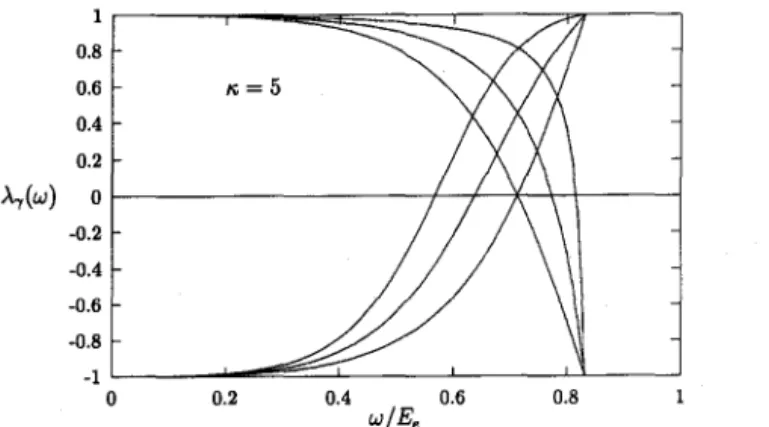
1 and different values of A,. Helicity ofthe backscattered photon is a function of its own energyA0(l-2r)(l- y + _!_) + A,rKrl + (1- y)(l-2r)2]
,ly(m)
=
ı
ı-y
l
l-y + ı-y 4r(l - r)-A,A0rK(2r -1)(2-y)
Plotting ,ly(m) versus m we see from Fig. 2 that at the highest m value, fully polarized real photon beam is obtained in the case of opposite polarization of electron and laser photon beams.
5 4 ıı;=5 4 3 3 E,f(w) 2 2 o ~ - - ~ - - ~ - - ~ - - - ~ - - ~ o 0.2 0.4 0.6 0.8 w/E,
Figure 1. Energy distributions of backscattered photons. Numbers from l to 5 correspond to A,Ao
=
0.9, 0.5, O.O, - 0.5, - 0.9, respectively1 ,--,--.,.;;;;;~:.::::::==:::::r:::::---:::;;;ı;ır--7 0.8 0.6 0.4 0.2 ıı:=5 ,½(w) o f---ı'----,ı----J<-+-+---1 -0.2 -0.4 -0.6 -0.8 -1 L_ _ _ ..,__~§::::::i__ _ _ ____ı _ _ _ J...L _ ___j o 0.2 0.4 0.6 0.8 w/E.
Figure 2. Helicity ofbackscattered photons asa function oftheir energy. Set of curves starting from bottom (lower set) are plotted A0
=
-1 and thosestarting from the top (upper set) for ,l0 = 1. Lines from the left to right for lower set correspond to A, = 0.9, 0.5, O.O and for upper set A, = O.O, 0.5, 0.9.
The maximal energy of backscattered photons mmax
=
KE, !(K+
I) will increase, in principal, up to nearly the electron beam energy. Between the iP (Interaction Point) and target a slit or collimator with a small opening is needed to select high energy photons. According to the energy dependence of photon scattering angle0 (m)= m,
✓E,K
-(K+l)r E, m (3)
the highest energies have the smallest scattering angle compared to the trajectory of the incorning electron. For monochromatization i.e. 0.99mmax ~ m ~ mmax, the angle
0r ~ 1.2µ rad for LEP. Taking the distance between the conversion region and the
selecting slit as 100 meter, one easily obtains slit diameter d
=
360µm. Compton backscattering angle 0r is smaller than 0, corning from the divergence of electronbeam. If a slit is used instead of collimator for monochromatization, lurninosity will decrease by a factor of 0r / 0,. Behind the slit an absorber anda magnet should be
placed in order to sweep away any electrons, hadrons or muons produced here. After all, we have monochromatic, fully polarized y beam corning to the target.
2.2. Number of Converted Photons
The number of converted photons nr is deterrnined by the requirement of obtaining one event in each collision with the polarized target
/3
k n,T,,ar P=
l (4)where
/3
is fraction of the photons passing through the slit, T,, is density of nucleons in the target and n, is number of electrons in a bunch. Substituting the value of total cross section of gamına-proton interaction (arp :::100µb),n,,
thickness of our target and/3
in the case of 1 % gamına beam monochromaticity imınediately gives the number of converted photonnr
=
kn,As long as electron bunches from the ring accelerators are used repeatedly, the smaller k the larger target thickness is preferable. in the linac case where each electron bunch is used once, keeping k larger may be more effective. So the polarized target with lower thickness can be chosen.
2.3. Luminosities
For the ring type accelerators integrated lurninosity is given by
Lint 'b J,
/J~
kT 107ring = rep ne n
'a+,b+'J
18 M.KANTAR
here, Ta is acceleration time, T f is fılling time, Th may be considered as mean lifetime of the beam, and given by
ln(l-8) c Tb
=
ln(l - k) 2,r R (6)
where ı5 is maximal fraction of used electrons permitted by beam dynamics. After each collision n, will be reduced like
n,"'(1-~k)n, (7)
where l represents the number of collision. fr,p
= (
c / 2,r R)nb is repetition rate, here c is the speed of light, 2,r R is the circumference of the ring and nb is number of bunches in the ring. Considering the above mentioned requirement, maximum integrated luminosity for ring type accelerators takes the following formL~
=
Tb frepn,
_ı_
Ta+Tb+Tf n, c,YPFor linac type accelerators, integrated luminosity is
L\~!ac
=
frep/3
k n ,Tn 10 7 or the maximum integrated luminosity3. LASER P ARAMETERS
Lmax
=
frep l07lınac
c,yp
Our laser has to fulfıll the following requirements:
a) Repetition rate should be commensurable with frequency of electron bunches reaching the conversion region,
b) The energy oflaser photons should be ofthe order of 1 eV,
c) Laser pulse energy would be determined by conversion coeffıcient. For the linac type electron accelerators frequency of laser pulses should be commensurate with frep. in the case of multibunch accelerator mirror system should
be used in order to convert all bunches accelerated in one linac pulse [ 4]. Let us recall the defınition of the conversion factor
n A
k =ı=- (8)
n, A0
where A0 is the laser pulse energy such that each electron in a bunch is subject to
collision with a laser photon and A is a pulse energy needed. The condition for each electron to be scattered once from the laser bunch is given by
(9) where n0 i:, the number of photons in a laser pulse, S1as,r is the trans verse area of the laser bunch in the conversion region and ac = ıo-25 cm2 is the Compton cross-section of the electron. Since all electrons should pass through the laser buııch, it is clear that Sıaser 'cS, =41raxay. Laser pulse energy /4ı is defıned as /4ı =n0co0 ,
here co0(1 eV) is the energy oflaser photon. The value ofrequired pulse energy
A
=
k/4ıturns out to be in the order of µ J. in order to increase conversion effıciency, the length of laser and electron bunches must overlap in the interaction region.
4. APPLICATIONS
4.1. Processes
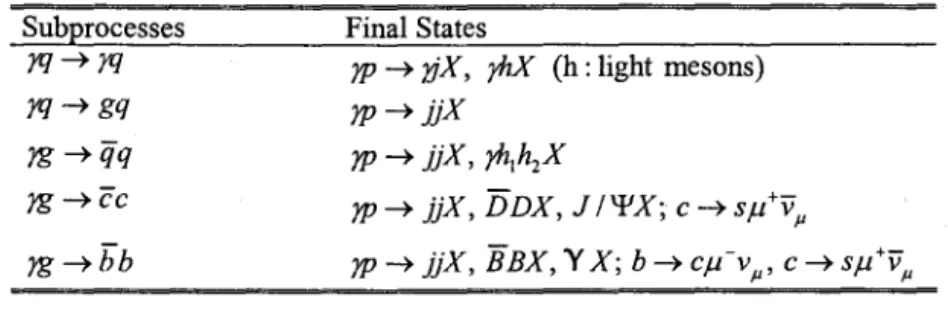
The proposed experiment will give opportunity to investigate wide spectrum of polarization phenomena, starting from polarized
r
-nucleon total cross section to the polarized quark and gluon distributions including peripheric interactions, exclusive meson productions ete. The main subprocesses of photoproduction and corresponding final states are listed in Table 1.Table 1. The main inclusive photoproduction processes to deterrnine parton distributions. Subprocesses yq • yq yq• gq ;g•
cc
Final StatesJP • riX, yhX (h : light mesons) Jıp ➔ jjX
JP • jjX, rhıhıX
}P • jjX, DDX, J /'f'X; C • sµ+vµ
JP • jjX, BBX, Y X; b • cµ-vµ, c • sµ+vµ
Here, we are interested in polarized parton distributions in nucleons. The information will come from heavy quark productions such as open charm, J / 'f'
and Y (at NLC) productions.
in oıır calculations, we used the parametrization for the helicity difference gluon distribution function [6]
20 ·M.KANTAR
(10) where
N
=
/':,.G(Qg)! ,B(0.6,1.8) (11)Three sets are labeled by 1, 2 and 3 according to values of !:,.G(Qg)
=
0.5, 0.3 and 5.7 atQg
=
4GeV2, respectively. The distribution can be obtained at any Q2 by evolving it with Altarelli-Parisi equations.
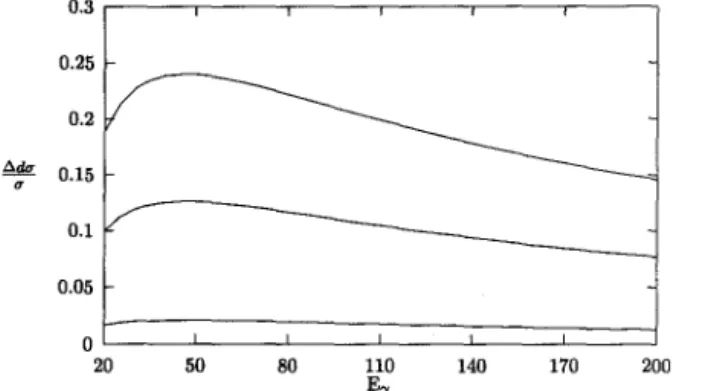
The results for the asymmetry for three sets of polarized gluon distributions as a function of Er are ploted in Fig. 3 and Fig. 4 for J / qı and Y productions respectively. Clear sensitivity to different parton parametrization can be seen.
0.3 0.25 0.2 A,ı,, 0.15 (T 0.1 0.05 o 20 50 80 110 140 170 200 &y
Figure 3. J / qı production asymmetry in polarized gamma-proton scattering for three sets ofpolarized gluon distributions. Curves from Iowest to highest correspond to sets 1, 2 and 3, respectively.
0.25 0.2 o.ıs AT 0.1 0.05 o 100 200 300 400 500 600 700 E~(GeV)
Figure 4. Y production asymmetry in polarized gamma-proton scattering for three sets of polarized gluon distributions. Curves from lowest to highest correspond to sets 1, 2 and 3, respectively.
in the following subsection, we consider the proposed REGAS experiment for several accelerators and present the necessary parameters. Throughout the calculations we have taken K=5 and consequently
/3
= 0.026, nr = 0.96 x 10⁴, we used deuterated butanol target with the length about 40 cm and thickness4 x 1025 cm -2• The distance between iP and the selecting slit is taken as 100 m.
4.2. REGAS at TESLA xN
The parameters of TESLA electron beam :
E,(TeV) n,(1010) f,,p(Hz) nb CJ"_.(nm) ay(nm) a2(mm)
250 5.15 10 800 640 100 1
The parameters of the REGAS experiment :
COo(eV) 0r(µrad) k(l0-1) A(pJ) Linı
1.3 0.51 1.86 3.1 0.8(fb-1
)
arp(YP • Y X)
=
1 nb at Er= 200 GeV; Ny=
0.8xl06 20000 Y • µ+ µ-.5. CONCLUSIONS
Having almost monochorornatic and fully
r
-beam, the REGAS experiment will provide advantages in investigations of polarized phenomena. When it comes to gluon polarization, at intermediate scale machines (LEP, HERA, TRISTAN, SLAC, TESLA, so on) main inforrnation will come from J / qı and open charrn bottom productions will be more advantageous.ACKNOWLEDGEMENTS
1 would like to thank TUBIT AK for gıvıng fınancial support to vısıt Fermilab in U.S. and also thank High Energy Physics Group at Ankara University for useful discussions.
22 M.KANTAR
REFERENCES
[1] Anderson, S.G, Laser Parameters Handbook, Laser Focus World (1996). [2] Alekhin, S.I., Borodulin, V.I. and Sultansoy, S., Inter. J. of Modem Phys. A 8
(1993) 1603.
[3] Atağ, S. et al., Europhysics Lett 29 (1995) 273; Turkish J. of Physics 19 (1995) 815; Nucl. Instr. and Meth. A 381 (1996) 23.
[4] Çiftçi, A.K. et al., Nucl. Instr. and Meth. A 365 (1995) 317.
[5] Ginzburg, I.F. et al., Nucl. Instr. and Meth. 205 (1983) 47; ibid. 219 (1984) 5; Telnov, V.I., Nucl. Instr. and Meth. A 294 (1990) 72; Borden, D.I., Bauer, D.A. and Caldwell, D.O., SLAC Preprint SLAC-PUB-5715, Stanford (1992). [6] Keller, S. and Owens, J.F., Phys. Rev. D 49 (1994) 1199.