AMELIORATIVE EFFECTS OF EXOGENOUS ASCORBIC ACID AND POTASSIUM
NITRATE ON ANTIOXIDANT DEFENSE SYSTEM AND MINERAL NUTRIENT
UPTAKE IN TOMATOES UNDER SALT STRESS
MAHMUT YILDIZTEKINDepartment of Herbal and Animal Production, Koycegiz Vocational School, Muğla Sıtkı Kocman University, Mugla, Turkey
Corresponding author’s email: [email protected] Abstract
The aim of this study was to analyze the effects of ascorbic acid (AsA) and potassium nitrate (KNO3) on the salt-based
oxidative stress in Lycopersicon esculentum Mill. leaves. The obtained results showed that the saline stress had negative effect on plant vegetative growth and other biochemical parameters. The KNO3 (10 and 20 mM) and AsA (1 and 2 mM)
treatments increased the relative water content (RWC) in fresh leaves and dry matter (DM) under salinity (125 mM). The addition of AsA and KNO3 significantly increased both antioxidative enzyme activities (i.e. superoxide dismutase,
peroxidase and catalase) and the photosynthetic pigments contents of the plant leaves, while the Lipid peroxidation and proline levels decreased. It was considerable that the negative effects of salt-stress were reduced for vegetative growth and other biochemical parameters of tomato plants. The results of this study showed that the usage of AsA and KNO3 could
increase salt stress tolerance and ensure protection for tomato plants against oxidative stress.
Key words: Antioxidative enzymes, Ascorbic acid, Lycopersicon esculentum Mill., Oxidative stress, Potassium nitrate. Introduction
Salinity is a type of abiotic stress that limits the yield production in agricultural regions. Today, approximately 13% of the total agricultural land all around the world is affected by high salinity. It was reported that about 4 million hectares of agrictural land in Turkey is affected by salinity (Koyuncu, 2012). It is predicted that this rate will increase by 50% worldwide in the next 20 years (Hasanuzzaman et al., 2013). The increase in soil salinity causes plant production to decrease and the defense system of plants to weaken (Chinnusamy et al., 2005). Salinity can lead to the formation of chlorosis and necrotic stains on the leaves, thus causing the quality of the plant to decrease (Bayat
et al., 2014). Salinity is generally related to unbalanced
nutrient intake in plants and the low osmotic level of the soil solution (Alhasnawi et al., 2016).
Sodium (Na+) and chlorine (Cl-) can be found at
high levels in the salt composition of the soil and can decrease the uptake of potassium (K), calcium (Ca) and nitrogen (N) ions by plants (González & González-Vilar, 2001; Inal et al., 1995). The amount of K in the leaves of the plants is directly proportional to the resistance of the plant against salinity (Sherif et al., 1998). The Na/K and Na/Ca ratios rapidly deteriorate due to the intake of
Na+ and other cationic elements such as K and Ca in the
element binding regions inside the plant tissues. Thus, the plant osmoregulation disrupts and inhibits the activation of enzymes and negatively affects the plants’ metabolism. In such cases, the external stress level of the plant can be reduced by potassium supplementation (Tuna et al., 2017).
Ascorbic acid (AsA) has been reported to be an important component in the signaling systems of the plant cells, connected with phytohormones and to have positive effect on various stresses involving salinity (Khan et al., 2011; Alhasnawi et al., 2015). The antioxidant defense
system, which involves enzymatic and non-enzymatic antioxidants, adjusts a possible harm of reactive oxygen species (ROS) that accumulate in stress conditions (Alhasnawi et al., 2014b). The superoxide dismutase (SOD), which is an enzymatic antioxidant that catalyzes
the dismutation of superoxide (O2.-) to hydrogen peroxide
(H2O2), is found in cytosol, chloroplast, mitochondria and
peroxisome organelles. Catalase (CAT) detoxifies H2O2
without the need of a reductant and is present in mitochondria, peroxisomes and glycosides. Peroxidase (POD), which is found in cytosol and mitochondria, detoxifies H2O2 using various substrates as a reductant
(Yilmaz et al., 2011). Lipid peroxidation (LPO) and chlorophyll also support the enzyme activities positively (Dogan, 2012). Thus, there is a significant correlation between the increase in the antioxidant enzyme activities and the decrease in the oxidative stress damage in plants (Yildiztekin et al., 2018).
The present study aimed to examine the impacts of saline stress on the intensity of proline, the antioxidatint enzymes such as SOD, POD and CAT, the accumulation of LPO, the amount of H2O2, relative water content
(RWC) and fresh-dry weight in the leaves of the tomato plant. The effects of exogenously treated AsA and
potassium nitrate (KNO3) on the antioxidant defense
system and various physiological properties in tomatoes (Lycopersicon esculentum L.) were investigated.
Material and Methods
Plant growth conditions: The tomatoes (Lycopersicon esculentum Mill. cv. ‘Manyla F1’) grown abundantly in
the province of Muğla, Turkey were cultivated at the beginning of February till the end of March, 2017. Three seedlings were planted in peat and perlite (1:3 w/w) in two liter pots. The plant development stages were observed for the first 15 days. After their adaptation to the medium, the seedlings were reduced as one plant/pot. The
experiment was performed under suitable atmospheric conditions (day time: 30°C average; night: 18°C average) in randomized blocks and in three repeatitions. Each nutrient solution was changed every three days. In this study, two different growth media, namely saline and non-saline, were used. The saline water (125 mM) was applied twice a week for a total of eight weeks. On day 21st,
various levels of KNO3 (10, 20 mM), AsA (1, 2 mM) and
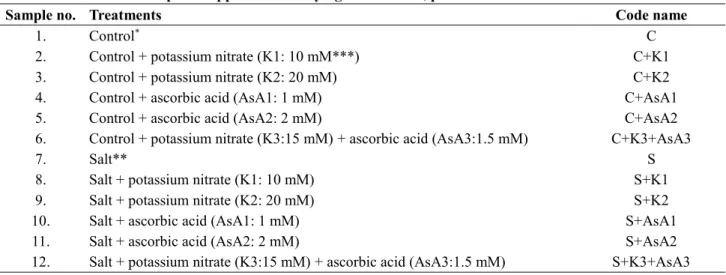
their combinations were applied to each pot of the three groups. These groups were also in duplicate where one groups (Table 1, samples 7-12) was provided with sodium chloride (NaCl: 125 mM) while the other was the control (Table 1, samples 1-6). After the treatments, the leaves were collected. Table 1 shows the amount of salt and other treatments with their codes.
The solution suggested by Hoagland and Arnon (1950) was used in this study as a nutrient source. The pH of the nutrient medium was adjusted to 6.5 with potassium hydroxide (0.01 mol L-1). During the growth
period, the plants were watered with irrigation water. The cultivated plants were harvested on the 75th day.
The leaves were collected from each block separately
for biochemical studies. The leaves were stored at -20 oC
immediately after harvesting.
Dry matter (DM) and inorganic nutrient analysis:
Three random plant samples from each groups were divided into two groups as leaves and roots. DM was obtained by drying them in a forced air oven at 70 °C for 2 days (based on dry weight). Ca2+, K+ and Na+ were
analyzed according to Chapman & Pratt’s method (1982).
Relative water content (RWC): RWC was analyzed
according to Barrs & Weatherley’s method (1962) and calculated according to González and González-Vilar’s (2001) following formula:
RWC (%) = [(FW-DW) / (TW -DW)] * 100.
Chlorophyll analysis: The chlorophyll was extracted
from the youngest leaves using an aqueous solution of
90% acetone. After recording the absorbance of the supernatant at the appropriate wavelengths, the chlorophyll concentrations were calculated using Strain & Svec’s procedure (1966).
Electrical conductivity (EC): The procedure described
by Dionisio-Sese & Tobita (1998) was used to evaluate EC using the following formula:
Electrical conductivity (%) = (EC1/EC2)*100.
Proline content: The proline content of the leaves was
determined by Bates et al.’s procedure (1973).
Lipid peroxidation (LPO) levels: The LPO level was
analysed by determining the malondialdehyde (MDA) level using Cakmak & Horst’s protocol (1991) with certain alterations recommended by Weisany et al., (2012).
Activities of Antioxidative enzymes: Fresh leaf materials
(500 mg) were plunged in a sodium phosphoate buffer (50 mM) containing 1% soluble polyvinyl pyrrolidine. SOD was determined according to Giannopolitis & Reis (1977), and Cakmak et al.’s methods (1993). The CAT activity was determined by the method of Bergmeyer (1970). The activity of ascorbate peroxidase was analysed by the procedure of Nakano & Asada (1987). POD was analyzed according to Herzog & Fahimi’s method (1973). The Bradford protocol (1976) was used to estimate the total soluble proteins.
Determination of the hydrogen peroxide (H2O2) activity: The content of H2O2 was analyzed by
spectrophotometry according to Velikova et al.’s protocol (2000) at 390 nm.
Statistical analysis: The analysis of variance was
performed using SPSS (v. 22), an analytical software programme. The significant differences between the mean values were evaluated by the LSD test where p≤5%.
Table 1. Tomato plants applied with varying levels of salt, potassium nitrate and ascorbic acid.
Sample no. Treatments Code name
1. Control* C
2. Control + potassium nitrate (K1: 10 mM***) C+K1
3. Control + potassium nitrate (K2: 20 mM) C+K2
4. Control + ascorbic acid (AsA1: 1 mM) C+AsA1
5. Control + ascorbic acid (AsA2: 2 mM) C+AsA2
6. Control + potassium nitrate (K3:15 mM) + ascorbic acid (AsA3:1.5 mM) C+K3+AsA3
7. Salt** S
8. Salt + potassium nitrate (K1: 10 mM) S+K1
9. Salt + potassium nitrate (K2: 20 mM) S+K2
10. Salt + ascorbic acid (AsA1: 1 mM) S+AsA1
11. Salt + ascorbic acid (AsA2: 2 mM) S+AsA2
12. Salt + potassium nitrate (K3:15 mM) + ascorbic acid (AsA3:1.5 mM) S+K3+AsA3
*Nutrient solution and irrigation water (C: control) **Nutrient solution added with salt (NaCl: 125 mmol L-1)
Results
The obtained results of the present study showed that the salinity had a detrimental effect on the biochemical and physiological structures of the plants. The treatments
of KNO3 and AsA increased the DM and RWC rates of
the leaves under salinity stress. Furthermore, the antioxidative enzyme activities such as SOD, POD and CAT increased with the amounts of total chlorophylls and carotenoids in the plant samples while the EC, LPO and proline contents decreased.
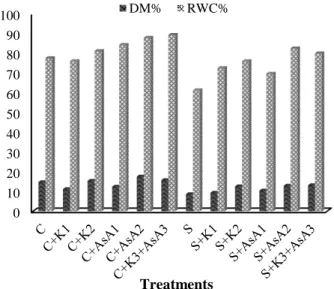
The salt stress significantly decreased the DM and RWC rates of the tomato leaves. However, this decrease was smaller when NaCl was combined with K and AsA. This means that the usage of K (10 and 20 mM) and AsA (1 and 2 mM) improved the DM and RWC rates of the plants under salt stress compared with salt alone (Fig. 1).
Due to the high concentration of Na+ in the plant
growth medium with salt, the K and Ca contents and K/Na and Ca/Na ratios were found to be decreased. When
KNO3 and AsA were treated with salty conditions, it was
observed that the K+ and Ca2+ contents of the plants
increased (Table 2).
Salinity caused significant reduction in the total amount of chlorophyll and carotenoid in the tomato leaves. The individual treatments of K1, K2, AsA1 and AsA2 and a combination of K3 + AsA3 increased the photosynthetic pigments compared with the control groups and the plants exposed to salt stress. The total amount of chlorophyll and carotenoid in the leaves of the plants grown under salt stress was determined to be the highest in the AsA2 treatment. In addition, the application of AsA2 and the combined treatment (C + K3 + AsA3) was found as the most effective (Fig. 2).
It was also determined that there was an increase in the EC and proline levels in tomato leaves grown under salt stress compared with the control groups. However, the treatments of AsA and K showed similar responses
between EC and proline composition (Fig. 3). The KNO3
and AsA supplements significantly improved these parameters.
The second treatment with AsA (AsA2) induced the highest reduction in the amount of proline (49.38 nmol g-1, FW) while the highest increase was found in the
samples treated with salt (S) (109.78 nmol g-1, FW)
compared with the control group (59.23 nmol g-1, FW).
A similar result of the leaf proline level was also found for electrical conductivity (EC) in the tomato plant leaves (Fig. 3).
The antioxidative enzyme activities such as SOD, POD and CAT increased during salt stress compared with the control group (p<0.05). On the other hand, the K and AsA treatments caused an increase in the activities of the antioxidative enzymes, while decreasing the LPO and H2O2 levels (Table 3).
The highest SOD activity was obtained from
S+K3+AsA3 treated plants (21.47 Unit mg-1 protein).
Similar results were also found in other enzyme activities. However, a distinct decrease was observed in the LPO and H2O2 levels of leaves treated with K and
AsA (Table 3).
Fig. 1. Effect of K and AsA on the DM and RWC rates of tomato plants grown in different growth media.
Fig. 2. Effect of K and AsA on the total amount of chlorophyll and carotenoid of tomato plant grown in different growth media.
Fig. 3. Effect of K and AsA on proline content and EC of tomato plants grown in different growth media.
0 10 20 30 40 50 60 70 80 90 100 DM% RWC% Treatments 0 5 10 15 20 25 30 35
Total Chlorophyll Carotenoid
mg kg -1 FW c de b cd a b h g ef f c cd Treatments 0 5 10 15 20 25 30 35 0 20 40 60 80 100 120 C C+ K 1 C+ K 2 C+ A sA 1 C+ A sA 2 C+ K 3 + As A3 S S + K1 S + K2 S + As A 1 S + As A 2 S + K3 + As A3 Proline EC% Pr o lin e (n m o l g -1 FW ) Ele ctr ic a l C o n d u ctiv ity (% ) Treatments
Table 2. The effects of salt (125 mM) with or without the varying levels of combined KNO3 and AsA on the concentrations of Na, Ca and K in the leaves and roots of the tomato plants.
Treatments Leaf (%) Root (%)
Ca Na K Ca/Na K/Na Ca Na K C 2,81b 0,14e 4,50c 20,85d 33,30e 1,04e 0,23gh 1,42d C + K1 3,15a 0,08f 4,68b 40,76c 60,66c 1,63a 0,18gh 1,75b C + K2 2,82b 0,07f 4,94a 40,07c 70,07b 1,19d 0,57e 1,99a C + AsA1 3,18a 0,08f 4,57bc 39,75c 57,13d 1,17d 0,16hi 1,34de C + AsA2 2,64c 0,05f 3,56d 51,85a 69,83b 1,43b 0,09i 1,60c C + K3 + AsA3 2,87b 0,07f 4,92a 42,87b 73,63a 1,36c 0,17ghi 1,16f S 1,24g 1,72a 2,70gh 0,72f 1,57g 0,31h 1,33a 0,61i S + K1 2,01e 0,77c 3,33e 2,59e 4,30f 0,93f 1,11c 0,95g S + K2 1,93e 0,62d 2,85fg 3,09e 4,58f 0,75g 1,22b 0,76h S + AsA1 2,17d 1,08b 2,95f 2,00ef 2,72fg 0,80g 0,48f 0,86g S + AsA2 1,82f 0,59d 2,65h 3,05e 4,45f 1,15d 0,82d 1,31e S + K3 + AsA3 1,98e 0,82c 3,18e 2,40e 3,87f 0,91f 0,25g 0,86g Sig. (p≤0.05) * * * * * * * * F-test 485.613 1030.441 265.750 1827.315 2023.373 280.708 377.060 178.148 Note: Values followed by different letters, in the same column, are significantly different at p≤0.05 based on F-test * p≤0.05
Table 3. The effects of salt (125 mM) with or without varying levels of combined KNO3 and AsA on Superoxide dismutase (SOD: Unit mg protein-1), peroxidase (POD: unit protein-1), catalase (CAT: Unit protein-1), lipid
peroxidation (LPO: nmol g−1 FW) levels and H2O2 activities in tomato plant leaves.
Treatments SOD POD CAT LPO (µM gH2-1O FW) 2
C 7,13 ± 1,02 g 4,27 ± 0,76 h 0,78 ± 0,091 g 7,85 ± 1,22 cd 7,45 ± 1,56 e C+K1 7,75 ± 0,96 fg 5,01 ± 0,87 g 0,85 ± 0,086 f 7,13 ± 1,17 d 7,67 ± 1,54 de C+K2 8,04 ± 1,13 f 6,13 ± 0,95 fg 1,09 ± 0,102 ef 7,01 ± 1,69 d 7,91 ± 1,48 de C+AA1 9,78 ± 1,21 e 8,71 ± 0,98 e 1,74 ± 0,093 de 6,24 ± 1,49 e 7,01 ± 1,91 ef C+AA2 10,76 ± 1,35 de 9,92 ± 1,05 d 2,34 ± 0,167 d 5,93 ± 1,54 ef 6,54 ± 1,17 f C+K3+AA3 11,89 ± 1,48 d 10,95 ± 1,65 cd 3,29 ± 0,362 c 5,21 ± 1,08 f 5,65 ± 1,07 g S (125 mM) 9,86 ± 1,45 e 6,75 ± 0,85 f 0,96 ± 0,082 ef 11,42 ± 1,45 a 13,04 ± 1,89 a S+K1 10,33 ± 1,34 de 7,32 ± 0,69 ef 1,23 ± 0,093 e 9,74 ± 1,59 b 12,95 ± 1,94 a S+K2 11,36 ± 0,98 d 8,65 ± 0,84 e 1,79 ± 0,113 de 8,93 ± 1,64 bc 11,76 ± 1,96 b S+AA1 14,73 ± 1,39 c 11,43 ± 1,14 c 2,96 ± 0,158 cd 7,91 ± 1,98 c 9,62 ± 1,18 c S+AA2 16,47 ± 1,53 b 13,54 ± 1,23 b 4,56 ± 0,547 b 8,36 ± 1,56 c 9,34 ± 1,78 c S+K3+AA3 21,47 ± 1,85 a 19,89 ± 1,46 a 6,79 ± 0,956 a 6,99 ± 1,05 de 8,01 ± 1,84 d
Note: Data represents the average of three replicates ± SE. Different letters indicate significant difference at p<0.05 Discussions
Salinity has a direct effect on the osmotic potential of natural and agricultural ecosystems. It inhibits the growth and synthesis of main compounds increasing the osmotic capacity of cells. Therefore, salinity induces metabolic processes to improve the antioxidant activities of enzymes (Manaf, 2016). K is an important macronutrient required in the growth and development of plants. It plays a role in cell division, protection against the turgor pressure, supporting the cell osmoregulation, opening and closing of the stomata, and activating more than 60 enzymes (Hawkins & Lewis, 1993). AsA protects plants against free oxygen radicals causing oxidative damage. This is an important plant metabolite acting as a modulator of the cellular signal in many physiological processes, e.g. mitosis. Stress tolerance can be improved by increasing
ASA level at the cellular levels. It is believed that the exogenous use of AsA also mitigates drought in plants (Aziz et al., 2018).
In this study, the K and Ca contents, K/Na and Ca/Na ratios, DM and RWC were found to decrease due to the high Na content in the tomato plants grown under salt stress. However, these values were positively affected by the exogenous K and AsA applied to the plants. In addition, under salt stress, the plant media supplemented with AsA showed a significant increase in K+ and Ca2+
levels when it was compared with salt alone (Table 2; Fig. 1). On the other hand, the treatment of K and AsA was applied to modify RWC which was affected by salt. The highest value of these parameters was obtained from the C+K3+AsA3 application. Similar results were also reported by Khafagy et al., (2009) and Alhasnawi et al., (2015). Many studies in the literature have shown that
significant effects of abiotic stress on plant growth can be alleviated by K and ASA in different crops such as tobacco (Bahrami-Rad & Hajiboland, 2017), cotton (Zahoor et al., 2017), canola (Shafiq et al., 2015), cucumber (Naz et al., 2016) and cauliflower (Latif et al., 2016). Salt resistance is usually attributed to the K or AsA-induced upregulation in the oxidative defense system, photosynthesis and osmoprotection metabolism.
Chlorophyll content in plants is commonly used as an index that indicates the tolerance levels of abiotic stress. The protection of photosynthetic activity, including chlorophyll content, is the first aim of the defense when under stress (Anjum et al., 2011; Mahmood et al., 2012). The reduction of chlorophyll concentrations of plants under stress such as salinity is generally related with the limitation of plant growth (Liu et al., 2012; Kováčik et
al., 2011; Singh & Gautam, 2013). Salt treatment has
negative effect on the photosynthetic pigments content.
However, the plant media supplemented with K+ and AsA
(either alone or combined) increased the total chlorophyll and carotenoid content in the present study. These findings are in agreement with the results of Ahanger & Agarwal (2017), who found similar response of wheat plant to water and osmotic stress. Similarly, Billah et al. (2017) found an increase in the chlorophyll pigments in maize hybrid leaves when AsA was applied. Therefore, it can also be concluded that exogenous AsA application significantly enhances the total chlorophyll and carotenoid contents in tomato plants (Fig. 2), and that AsA protects photosynthetic pigment.
The accumulation of proline in many plant species under stress has been found to be correlated with stress tolerance. However, the accumulation of proline is not a specific indicator for tolerance to drought, since its accumulation represents a general response to various abiotic stresses in plants (Hernández-Sánchez et al., 2014). One of the parameters investigated in this study, also known as the membrane permeability, was EC which can be defined as the ion instability due to intracellular and extracellular osmotic imbalance that develops under salt and water stresses (Ghoulam et al., 2002; Munns, 2002). In the present study, salt stress significantly increased the amounts of free proline and EC in tomato plant leaves in comparison to the control. The exogenous application of K and AsA significantly reduced the proline and EC content as compared to control and salt stress (Fig. 3). Wang & Han (2009) reported that proline accumulation could be a consequence of salt tolerance in clover species. Tuna et
al., (2017) also reported that the application of K and Ca
to the tomato plant, grown under salt stress, decreased the MP and free proline coverage in the leaves.
Cells are protected against oxidative stress by maintaining both the enzymatic (SOD, POD and CAT) and non-enzymatic (phenolics, carotenoids, AsA, tocopherols) antioxidant defense systems (Israr et al., 2011; Akram et al., 2017). The induction of ROS scavenging enzymes (e.g. CAT, POD, and SOD) occurs as stress response (Alhasnawi et al., 2014a). In this study, it was determined that the activities of antioxidative enzymes such as POD, CAT, and SOD
increased as a result of the salt stress compared to the control. With AsA and K applications to the plant media, POD, CAT and SOD increased more than
control or salt. However, when the LPO and H2O2
contents of the plant leaves were examined, a decrease was observed when K and AsA were applied (Table 3). Similarly, Ahanger & Agarwal (2017) reported that the application of K in wheat plants (exposed and not exposed to the salt stress) significantly increased the antioxidative enzyme activities of the plant leaves. On the other hand, Athar et al., (2008) evaluated the SOD, CAT and POD activities of leaves after AsA application to the wheat cultivars with salt stress. They reported that the CAT activities of both cultivars increased significantly, but decreased in SOD activity. The POD activity of salt-stressed plants of both cultivars were slightly affected due to the AsA treatment by the rooting medium. These higher levels of antioxidant enzymes may be attributed to their property to strengthen the plant’s resistance against oxidative damage. In related reports, a significant inverse correlation has been found between the antioxidant enzyme activity and oxidative stress damage in plant species such as tomato, pea, wheat and rice. Antioxidative enzyme activities were increased with K and AsA application but decreased in the LPO and H2O2 levels of tomato leaves (Table 3).
During salt stress, LPO and H2O2 levels increased in
tomatoes, which is similar to the study of Farooq et al., (2013) conducted on the wheat plant. Furthermore, the
applications of K and AsA alleviated the LPO and H2O2
contents of the tomato plants under salty conditions, which is similar to the results of Dolatabadian et al., (2009) in maize and of Malik et al., (2015) in wheat plants. In another study, it was reported that reducing the level of LPO, which improved due to the K applied to tomato plants under NaCl stress, alleviates the stress damage, positively affects the growth parameters, and effectively reduces the oxidative damage induced by K (Amjad et al., 2016). Aziz et al., (2018) found that the leaves of the quinoa plant had a higher H2O2 content
than the control while investing the effects of water deficit regimes on the plant.
Conclusion
The present results clearly showed that the salt application to tomatoes at higher concentrations caused suppression in growth and chlorophyll content, and increased electrical conductivity, lipid peroxidation and proline. In addition, this study reported that the application of AsA and K enhanced the salinity endurance of plants probably through the hormonal regulation of plant defense systems against oxidative stress. This is significant as the main aim of this study was to obtain an insight into the mechanisms by which AsA and K applications promote the preservation of plant against salt stress. Salinity is one of the most important issues encountered during agricultural production. The salinity of the soil also turns into a main agricultural challenge within vegetable growing areas. However, the treatments of AsA and K could be utilized in the rehabilitation of the land which can increase crop yield both in arable areas and in arid soils stored with salinity.
Acknowledgments
The valuable technical assistance provided by Atilla Levent Tuna is gratefully recognized.
References
Ahanger, M.A. and R.M. Agarwal. 2017. Potassium up-regulates antioxidant metabolism and alleviates growth inhibition under water and osmotic stress in wheat (Triticum aestivum L). Protoplasma, 254(4): 1471-1486.
Akram, N.A., F. Shafiq and M. Ashraf. 2017. Ascorbic acid-a potential oxidant scavenger and its role in plant development and abiotic stress tolerance. Front. Plant Sci., 8: 613. Alhasnawi A.N., A.A. Kadhimi, A. Isahak, A. Mohamad, F.
Doni, W.W. Yusoff and C.M. Zain. 2014b. Salinity stress in plant and an important antioxidant enzyme. Life Sci. J., 11: 913-920.
Alhasnawi, A.N., A.A. Kadhimi, A. Isahak, A. Mohamad, W.M.W. Yusoff and C.R.C.M. Zain. 2015. Exogenous application of ascorbic acid ameliorates detrimental effects of salt stress in rice (MRQ74 and MR269) seedlings. Asian J. Crop Sci., 7: 186-196.
Alhasnawi, A.N., A.A. Kadhimi, A.R. Ibrahim, A. Isahak, A. Mohamad, F. Doni, W.W. Yusoff and C.M. Zain. 2014a. Salinity tolerant enhancement, tissue culture In vitro biochemical procedures. J. Plant Biol. Res., 3: 51-64. Alhasnawi, A.N., C.C. Radziah, A.A. Kadhimi, A. Isahak, A.
Mohamad and W.M.W. Yusoff. 2016. Enhancement of antioxidant enzyme activities in rice callus by ascorbic acid under salinity stress. Biol. Plant., 60(4): 783-787.
Amjad, M., J. Akhtar, B. Murtaza, G. Abbas and H. Jawad. 2016. Differential accumulation of potassium results in varied salt-tolerance response in tomato (Solanum lycopersicum L.) cultivars. Hort. Environ. Biote., 57(3): 248-258.
Anjum, S.A., L. Wang, M. Farooq, I. Khan and L. Xue. 2011. Methyl jasmonate‐induced alteration in lipid peroxidation, antioxidative defence system and yield in soybean under drought. J. Agron. Crop Sci., 197(4): 296-301.
Athar, H., A. Khan and M. Ashraf. 2008. Exogenously applied ascorbic acid alleviates salt-induced oxidative stress in wheat. Environ. Exp. Bot., 63: 224-231.
Aziz, A., N.A. Akram and M. Ashraf. 2018. Influence of natural and synthetic vitamin C (ascorbic acid) on primary and secondary metabolites and associated metabolism in quinoa (Chenopodium quinoa Willd.) plants under water deficit regimes. Plant Physiol. Bioch., 123: 192-203.
Bahrami-Rad, S. and R. Hajiboland. 2017. Effect of potassium application in drought-stressed tobacco (Nicotiana rustica L.) plants: Comparison of root with foliar application. Ann. Agric. Sci., 62(2): 121-130.
Barrs, H.D. and P.E. Weatherley. 1962. A re-examination of the relative turgidity technique for estimating water deficits in leaves. Aust. J. Biol. Sci., 15: 413-428. doi: 10.1071/ BI9620413.
Bates, L.S., R.P. Waldren and I.D. Teare. 1973. Rapid determination of free proline for water stres studies, Plant Soil, 39: 205-207.
Bayat, R. S. Kusvuran, S. Ellialtioglu and A.S. Üstün. 2014. Effects of proline application on antioxidative enzymes activities in the young pumpkin plants (Cucurbita pepo L. and C. moschata Poir.) under salt stress. Turk. J. Agric. Nat. Sci. 1(1): 25-33.
Bergmeyer, N. 1970. Methoden Der Enzymatischen Analyse, Berlin: Akademie Verlag, 1: 636-647.
Billah, M., M.M. Rohman, N. Hossain and M.S. Uddin. 2017. Exogenous ascorbic acid improved tolerance in maize (Zea mays L.) by increasing antioxidant activity under salinity stress. Afr. J. Agric. Res., 12(17): 1437-1446.
Bradford, M.M. 1976. A rapid and sensitive method for the quantitation of micrograms quantities of protein utilizing the principle of Protein-Dye Binding. Anal. Biochem., 72: 248-254.
Cakmak, I., and W.J. Horst. 1991. Effect of aluminum on lipid peroxidation, superoxide dismutase, catalase, and peroxidase activities in root tips of soybean (Glycine max). Physiol. Plant., 83: 463-468.
Cakmak, I., D. Strbac and H. Marschner. 1993. Activities of hydrogen peroxide-scavenging enzymes in germinating wheat seeds. J. Exp. Bot., 44: 127-132.
Chapman, H.D. and P.F. Pratt.1982. Methods of plant analysis. I. Methods of analysis for soils, plants and water. Chapman Publishers, Riverside, California.
Chinnusamy, V., A. Jagendorf and J.K. Zhu. 2005. Understanding and improving salt tolerance in plants. Crop Sci., 45: 437-448.
Dionisio-Sese, M.L. and S. Tobita. 1998. Antioxidant responses of rice seedlings to salinity stres. J. Plant Sci., 135: 1-9. Dogan, M. 2012. The affect of nitrogen application on salt stress
and antioxidant enzyme activities. SDU J. Nat. Appl. Sci., 16(3): 297-306.
Dolatabadian, A., S.A.M. Modarres Sanavy and M. Sharifi. 2009. Alleviation of water deficit stress effects by foliar application of ascorbic acid on Zea mays L. J. Agron. Crop Sci., 195(5): 347-355.
Farooq, M., M. Irfan, T. Aziz, I. Ahmad and S.A. Cheema 2013. Seed priming with ascorbic acid improves drought resistance of wheat. J. Agron. Crop Sci., 199(1): 12-22. Ghoulam, C., A. Foursy and K. Fares. 2002. Effects of salt stress
on growth, inorganic ions and proline accumulation in relation to osmotic adjustment in five sugar beet cultivars. Environ. Exp. Bot., 47(1): 39-50.
Giannopolitis, C.N. and S.K. Ries. 1977. Superoxide dismutases occurrence in higher plants. Plant Physiol., 59: 309-314. González, L. and M. González-Vilar. 2001. Determination of
relative water content. In: Handbook of Plant Ecophysiology Techniques, ed. M.J. Reigosa, pp. 207-212. Dordrecht, the Netherlands: Kluwer Academic Publishers. Hasanuzzaman, M., K. Nahar, S.S., Gill and M. Fujita 2013.
Drought stress responses in plants, Oxidative Stress, and Antioxidant Defense. In: Climate change and plant abiotic stress tolerance. (Eds.): Tuteja, N. & S.S. Gill. Wiley-VCH Verlag GmbH and Co. KGaA, Weinheim.
Hawkins, H.J. and O.A.M. Lewis. 1993. Effect of NaCl salinity, nitrogen form, calcium and potassium concentration on nitrogen uptake and kinetics in Triticum aestivum L. cv. Gametos. New Phytol., 124: 171-177.
Hernández-Sánchez, I.E., D.M. Martynowicz, A.A. Rodríguez-Hernández, M.B. Pérez-Morales, S.P. Graether and J.F. Jiménez-Bremont. 2014. A dehydrin-dehydrin interaction: the case of SK3 from Opuntia streptacantha. Front. Plant Sci., 5: 520.
Herzog, V. and H. Fahimi. 1973. Determination of the activity of peroxidase. Anal. Biochem. 55: 554-562.
Hoagland, D.R. and D.I. Arnon. 1950. The water culture method for growing plants without soil. Uni. Calif., Berkeley College Agric. Exp. Stn. Circ., No. 347.
Inal, A., A. Gunes and M. Aktas. 1995. Effects of chloride and partial substitution of reduced forms of nitrogen for nitrate in nutrient solution of the nitrate, total nitrogen and chlorine contents of onion. J. Plant Nutr., 18: 2219-2227. Israr, M., A. Jewell, D. Kumar and S.V. Sahi. 2011. Interactive
effects of lead, copper, nickel and zinc on growth, metal uptake and antioxidative metabolism of Sesbania drummondii. J. Hazard. Mater., 186(2-3): 1520-1526. Khafagy, M.A., A.A. Arafa and M.F. El-Banna. 2009.
Glycinebetaine and ascorbic acid can alleviate the harmful effects of NaCl salinity in sweet pepper. Aust. J. Crop. Sci., 3(5): 257.
Khan, T.A., M. Mazid and F. Mohammad. 2011. A review of ascorbic acid potentialities against oxidative stress induced in plants. J. Agrobiol., 28: 97-111.
Kováčik, J., B. Klejdus, F. Štork, J. Hedbavny and M. Bačkor. 2011. Comparison of methyl jasmonate and cadmium effect on selected physiological parameters in Scenedesmus quadricauda (chlorophyta, chlorophyceae). J. Phycol., 47(5): 1044-1049.
Koyuncu, N. 2012. Response of some durum wheat (Triticum durum Desf.) cultivars to In vitro high level salinity. J. Cent. Res. Ins. Field Crops, 21(2): 70-74.
Latif, M., N.A., Akram and M. Ashraf. 2016. Regulation of some biochemical attributes in drought-stressed cauliflower (Brassica oleracea L.) by seed pre-treatment with ascorbic acid. J. Hort. Sci. Biotech., 91(2): 129-137.
Liu, X., H. Chi, M. Yue, X. Zhang, W. Li and E. Jia 2012. The regulation of exogenous jasmonic acid on UV-B stress tolerance in wheat. J. Plant Growth Regul., 31(3): 436-447. Mahmood, M., S.S. Bidabadi, C. Ghobadi and D.J. Gray. 2012. Effect of methyl jasmonate treatments on alleviation of polyethylene glycol-mediated water stress in banana (Musa acuminata cv.‘Berangan’, AAA) shoot tip cultures. Plant Growth Regul., 68(2): 161-169.
Malik, S., M. Ashraf, M. Arshad and T.A. Malik. 2015. Effect of ascorbic acid application on physiology of wheat under drought stress. Pak. J. Agri. Sci., 52(1).
Manaf, H.H. 2016. Beneficial effects of exogenous selenium, glycine betaine and seaweed extract on salt stressed cowpea plant. Ann. Agric. Sci., 61(1): 41-48.
Munns R. 2002. Comparative physiology of salt and water stress. Plant Cell Environ., 25: 239-50.
Nakano, Y. and Y. Asada. 1987. Purification of ascorbate peroxidase from spinach chloroplasts: Its inactivation in ascorbate depleted medium and reactivation by monodehydroascorbate radical. Plant Cell Physiol., 28: 131-140.
Naz, H.I.R.A., N.A. Akram and M. Ashraf. 2016. Impact of ascorbic acid on growth and some physiological attributes of cucumber (Cucumis sativus) plants under water-deficit conditions. Pak. J. Bot., 48(3): 877-883.
Shafiq, S., N.A. Akram and M. Ashraf 2015. Does exogenously-applied trehalose alter oxidative defense system in the
edible part of radish (Raphanus sativus L.) under water-deficit conditions?. Sci. Hort., 185: 68-75.
Sherif, M.A., T.R. El-Beshbeshy and C. Richter. 1998. Response of some Egyptian varieties of wheat (Triticum aestivum L.) to salt stress through potassium application. Bull. Fac. Agri. Uni. of Cairo., 49: 129-151.
Singh, P.K. and S. Gautam. 2013. Role of salicylic acid on physiological and biochemical mechanism of salinity stress tolerance in plants. Acta Physiol. Plant., 35(8): 2345-2353. Strain, H.H., and W.A. Svec. 1966. Exraction, separation,
estimation and isolation of chlorophylls, 21-66, (Eds.): Bernon, V.P., G.R. Seely. In the chlorophylls Academic Pres, New York.
Tuna, A.L., M. Yildiztekin, S. Köskeroglu and İ. Yokas. 2017. Does potassium and calcium affect the antioxidative system of tomato plant under salt effect?. Turk. J. Agric. Res., 4(1): 71-78.
Velikova, V., I. Yordanov and A. Edreva. 2000. Oxidative stress and some antioxidant systems in acid rain-treated bean plants, protective role of exogenous polyamines. Plant Sci., 151: 59-66.
Wang, X.S. and J.G. Han. 2009. Changes of proline content, activity, and active isoforms of antioxidative enzymes in two alfalfa cultivars under salt stress. Agric. Sci. China., 8(4): 431-440.
Weisany, W., Y. Sohrabi, G. Heidari, A. Siosemardeh and K.G. Golezani. 2012. Changes in antioxidant enzymes activity and plant performance by salinity stress and zinc application in soybean (Glycine max L.). Plant Omics, 5: 60-67.
Yildiztekin, M., A.L. Tuna and C. Kaya. 2018. Physiological effects of the brown seaweed (Ascophyllum nodosum) and humic substances on plant growth, enzyme activities of certain pepper plants grown under salt stress. Acta Biol. Hung., 69(3): 325-335.
Yilmaz, E., A.L. Tuna and B. Burun. 2011. Tolerance strategies developed by plants to the effects of salt stress. C.B.U. J. Sci., 7(1): 47-66.
Zahoor, R., H. Dong, M. Abid, W. Zhao, Y. Wang and Z. Zhou. 2017. Potassium fertilizer improves drought stress alleviation potential in cotton by enhancing photosynthesis and carbohydrate metabolism. Environ. Exp. Bot., 137: 73-83. (Received for publication 25 March 2019)