54
Kabul (Accepted) :09/03/2019
The Effect of Season on the Fatty Acid Content of Deep Water Pink Shrimp
in Marmara Sea
Leyla KALYONCU
Selçuk University, Science Faculty, Department of Biology, KONYA
Abstract: Total fatty acid composition of Parapenaeus longirostris (Lucas 1846), as called deep water pink shrimp collected from Marmara Sea, in spring and autumn was investigated by gas chromatographic method. Palmitic acid (C16:0), oleic acid (C18:1 ω9), docosahexaenoic acid (C22:6ω3) and stearic acid (C18:0) identified as the primary fatty acid constituents. PUFA (38.14%) in the spring was detected to be higher than SFA and MUFA. The contents of eicosapentaenoic acid (C20:5ω3) and C22:6ω3 in total fatty acid in the rose shrimp ranged from 7.46% (autumn) to 12.46% (spring) and from 5.34% (autumn) to 13.97% (spring), respectively. ω3/ω6 ratios are 2.95-2.88(%) in autumn and spring respectively. P. longirostris may be a valuable nutrient in terms of PUFA especially in spring and ω3/ω6 ratios for human consumption.
Keywords: Rose shrimp, fatty acid profile.
Marmara Denizindeki Derin Su Pembe Karidesi’nin Yağ Asidi İçeriğine
Mevsimin Etkisi
Öz: Marmara Denizi’nden ilkbahar ve sonbaharda toplanan ve derin su pembe karidesi olarak
adlandırılan Parapenaeus longirostris’in (Lucas 1846) toplam yağ asit bileşimi, gaz kromatografi yöntemi ile araştırılmıştır. Major yağ asidi bileşeni olarak palmitik asit (C16:0), oleik asit (C18:1ω9), dokosaheksaenoik asit (C22:6ω3) ve stearik asit (C18:0) tespit edilmiştir. İlkbaharda PUFA (%38.14), SFA ve MUFA’dan daha yüksek bulunmuştur. Pembe karideste eikosapentaenoik asit (C20:5ω3) ve C22:6ω3 içeriği toplam yağ asidinde sırasıyla, %7.46’dan (sonbahar) %12.46’ya (ilkbahar) ve %5.34’den (sonbahar), %13.97’ye (ilkbahar) değişmektedir. ω3/ω6 oranı sonbahar ve ilkbahar için sırasıyla 2.95 ve 2.88 (%)’dir. P. longirostris ω3/ω6 oranı bakımından ve özellikle ilkbaharda PUFA açısından insan tüketimi için değerli bir gıda olabilir.
Anahtar Kelimeler: Pembe karides, yağ asidi profili.
1. Introduction
Sea products contain high levels of ω3 polyunsaturated fatty acid (PUFA), especially eicosapentaenoic acid (EPA, C20:5ω3) and docosahexaenoic acid (DHA, C22: 6ω3). ω3 and ω6 PUFAs are considered as the basis for the growth and development of children. These are also precursors of the compound hormones
known as eicosanoids, which are involved in various metabolic processes that are very important for the human body, especially for cardiovascular activity (Eder, 1995; Inhamuns and Franco, 2008). It has been reported that DHA is necessary for brain growth and functional development in children and is also necessary for normal
55 brain function in adults (Horrocks and Yeo, 1999).
EPA is the most significant essential fatty acid of the ω3 series in human nutrition because it is the forerunner of 3-series eicosanoids (Chen et al., 1995). Maes et al. (1999) notes that depression is associated with low levels of polyunsaturated fatty acids.
From the family Penaeidae, Parapenaeus longirostris (Lucas 1846, deep water pink shrimp) lives in depths ranging from 20 meters to 700 meters (Carpenter and Angelis, 2014; Soultani et al., 2016). P. longirostris is one of the world’s most popular shellfish. P. longirostris is actually the target species of an important fishery of trawlers in the Mediterranean. P. longirostris caught by trawling in the Mediterranean and Spain, France, Italy, Algeria, Tunisia, and Turkey is the most important shellfish resources along the coast (Sbrana et al., 2006). Marmara Sea, Aegean Sea and Mediterranean Sea shrimp are also high potential in our country. P. longirostris is important seafood. The shrimp has rich protein, calcium and vitamins (A and D) and PUFA, such as DHA and EPA (Feliz et al., 2002). The fatty acid composition of different shrimp species is reported by many researchers (Ayas et al., 2013; Oksuz et al., 2009; Rosa and Nunes, 2003; Soultani et al., 2016). The main purpose of this study was to determine the fatty acid profile and ω3/ω6
fatty acids ratio of the muscle lipids of P. longirostris in Marmara Sea.
2. Materials and Methods
The samples of P. longirostris to be analyzed were taken from Marmara Sea in two different seasons (spring and autumn). The number of samples analyzed for each season should be given. They were caught by the local fishermen in the middle of March and October for each season during 2014-2015 and gender differences were not taken into account. Samples have been carried to the laboratories in frozen form. Samples were fractionated using an Ultra-Turrax T25 homogenizer, which was used for this method by Folch et al. (1957). Moss et al. (1974) method was used for transesterification with BF3 methanol.
The mixture of fatty acid methyl esters in hexane/chloroform was analyzed using an HP Agilent 6890N model gas chromatograph. Capillary column has been used. Helium has been used as carrier gas.
3. Results and discussion
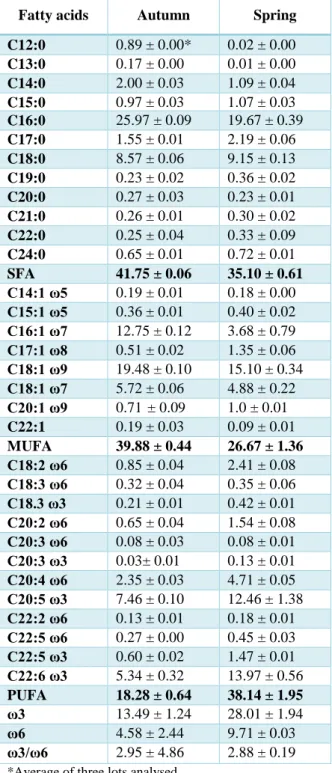
Total fatty acid composition of muscle lipids of P. longirostris is presented in Table 1. 32 fatty acids identified in muscle lipids of P. longirostris for two seasons (autumn and spring). The highest fatty acids in the P. longirostris were C16:0 (palmitic acid), C22:6ω3 (DHA), C18:0 (stearic acid),
56 C18:1ω9 (oleic acid), and C16:1ω7 (palmitoleic acid).
Table 1. Fatty acid composition of muscle lipids of
Parapenaeus longirostris (Values are % of total fatty acid expressed as mean± standard deviation)
Fatty acids Autumn Spring C12:0 0.89 ± 0.00* 0.02 ± 0.00 C13:0 0.17 ± 0.00 0.01 ± 0.00 C14:0 2.00 ± 0.03 1.09 ± 0.04 C15:0 0.97 ± 0.03 1.07 ± 0.03 C16:0 25.97 ± 0.09 19.67 ± 0.39 C17:0 1.55 ± 0.01 2.19 ± 0.06 C18:0 8.57 ± 0.06 9.15 ± 0.13 C19:0 0.23 ± 0.02 0.36 ± 0.02 C20:0 0.27 ± 0.03 0.23 ± 0.01 C21:0 0.26 ± 0.01 0.30 ± 0.02 C22:0 0.25 ± 0.04 0.33 ± 0.09 C24:0 0.65 ± 0.01 0.72 ± 0.01 SFA 41.75 ± 0.06 35.10 ± 0.61 C14:1 ω5 0.19 ± 0.01 0.18 ± 0.00 C15:1 ω5 0.36 ± 0.01 0.40 ± 0.02 C16:1 ω7 12.75 ± 0.12 3.68 ± 0.79 C17:1 ω8 0.51 ± 0.02 1.35 ± 0.06 C18:1 ω9 19.48 ± 0.10 15.10 ± 0.34 C18:1 ω7 5.72 ± 0.06 4.88 ± 0.22 C20:1 ω9 0.71 ± 0.09 1.0 ± 0.01 C22:1 0.19 ± 0.03 0.09 ± 0.01 MUFA 39.88 ± 0.44 26.67 ± 1.36 C18:2 ω6 0.85 ± 0.04 2.41 ± 0.08 C18:3 ω6 0.32 ± 0.04 0.35 ± 0.06 C18.3 ω3 0.21 ± 0.01 0.42 ± 0.01 C20:2 ω6 0.65 ± 0.04 1.54 ± 0.08 C20:3 ω6 0.08 ± 0.03 0.08 ± 0.01 C20:3 ω3 0.03± 0.01 0.13 ± 0.01 C20:4 ω6 2.35 ± 0.03 4.71 ± 0.05 C20:5 ω3 7.46 ± 0.10 12.46 ± 1.38 C22:2 ω6 0.13 ± 0.01 0.18 ± 0.01 C22:5 ω6 0.27 ± 0.00 0.45 ± 0.03 C22:5 ω3 0.60 ± 0.02 1.47 ± 0.01 C22:6 ω3 5.34 ± 0.32 13.97 ± 0.56 PUFA 18.28 ± 0.64 38.14 ± 1.95 ω3 13.49 ± 1.24 28.01 ± 1.94 ω6 4.58 ± 2.44 9.71 ± 0.03 ω3/ω6 2.95 ± 4.86 2.88 ± 0.19 *Average of three lots analysed.
Palmitic acid from saturated fatty acids is the highest percentage in the autumn (25.97%). Likewise, palmitic acid was also
found to be the highest fatty acid in the spring season (19.67%). The percentage of palmitic acid in the autumn is higher than the spring. According to Yerlikaya et al. (2013), the main SFAs in shrimp species were palmitic acid and stearic acid. Whereas palmitic acid content of shallow water shrimp species ranged between 14.27– 17.99%, it was 19.03–21.16% in deep sea species. The highest value for C16:0 (21.16 ± 0.39 %) was determined in P. longirostris. Saglik and Imre (1997) determined 23.1% C16:0 and 6.2% C18:0 for P. longirostris. These values are similar to the results of this study.
Oleic acid was identified as a primary monounsaturated fatty acid (MUFA) in autumn. This fatty acid in muscle tissue of shrimp was found to be 19.48%. In another study of fatty acids in shrimp; the dominant saturated fatty acid (SFA) is palmitic acid. The most common MUFA was C18:1ω9. EPA and DHA are predominantly PUFAs, respectively. These four fatty acids represented 55-70% of the total fatty acid content of the three species analyzed. PUFA fraction (42.1-48.4%) followed by MUFA (26.3-34.6%) and SFA (22.9-27.4%) (Rosa and Nunes, 2003). In our study, PUFA in the spring (38.14%) was found to be higher than SFA and MUFA. In addition to, our present work, it has been found that SFAs, MUFAs and PUFAs have ranged from 41.75% to 35.10%, from 39.88% to 26.67% and from
57 18.28% to 38.14% for shrimp, respectively. In this study, which detects fatty acids, there are enough fatty acids that are important for health. Palmitoleic acid (12.75%) was the second most abundant MUFA for autumn in the present study. Similarly Sağlık and Imre (1997) found that C16:1 ω7 was the second major MUFA in muscle tissue of shrimp.
In other study (Soultani et al., 2016) DHA and EPA were predominant PUFAs in the lipid of both shrimp muscle and cephalothorax followed by arachidonic acid (C20:4 ω6 AA). AA was found to be the third highest PUFA in samples collected in spring (4.71%) in present study. Variations in the fatty acid composition may be related to changes in the fish's eating habits (Norrobin et al.,1990). The high level of DHA (13.97%) increases the PUFA content in shrimp in spring. In spring, a high rate C20:5 (12.46%) raises in the PUFA amount in shrimp. DHA and EPA have extremely useful properties for the prevention of human coronary artery disease (Leaf and Weber, 1988). The findings of other researchers represent the highest values of PUFA for DHA and EPA; however, the results varied according to shrimp species.
Like other marine derived organisms, shrimp species are good sources of PUFA. P. longirostris is a food source that can be renewed according to these results. According to Ayas et al. (2013), fatty acid composition of crustaceans is associated with external factors such as life cycle and temperature, water salinity, feed and season. In our study, PUFAs levels were found to be 38.14% in spring. DHA is the highest level in PUFAs (13.97%). The ω3/ω6 ratio is a good index to compare the relative nutritional value of fish oils (Pigott and Tucker, 1990). An increase in the ratio of ω3/ω6 fatty acids in human diets is necessary in the diet to help prevent coronary heart disease by reducing plasma lipids and reducing cancer risk (Kinsella et al., 1990). Our study has revealed that P. longirostris is a species having a high nutritional value for human consumption due to its high ω3/ω6. These ratios are 2.95 and 2.88(%) in autumn and spring respectively. This study has shown that P. longirostris may be a valuable nutrient in terms of PUFA especially in spring and ω3/ω6 ratios for human consumption.
References
Ayas D, Ozogul Y, Yazgan H (2013). The effects of season on fat and fatty acids contents of shrimp and prawn species. European Journal of Lipid Science and Technology 115: 356–362.
58
Carpenter KE, De Angelis N (2014). The living marine resources of the Eastern Central Atlantic. Volume 1: Introduction, Crustaceans, Chitons, and Cephalopods. FAO Species Identification Guide for Fishery Purposes Rome, FAO.
Chen IC, Chapman FA, Wei CI, Porteir KM, O’Keefe SF (1995). Differentiation of cultured and wild sturgeon (Acipencer oxyrinchus desotoi) based on fatty acid composition. Journal Food Science 60(3): 631–635.
Eder K (1995). Gas chromatographic analysis of fatty acid methyl esters. Journal of Chromatography B 671: 113–131.
Feliz GLA, Gatlin MD, Lawrance LA, Valezquez PM (2002). Effect of dietary phospholipid on essential fatty acid requirements and tissue lipid composition of Litopenaeus vannamei juveniles. Aquaculture 207: 151–167.
Folch J, Lees M, Sloane Stanley GH (1957). A simple method for the isolation and purification of total lipids from animal tissues. Journal of Biological Chemistry 226: 497–509.
Horrocks LA, Yeo YK (1999). Health benefits of docosahexaenoic acid DHA. Pharmacological Research 40: 211–225.
Inhamuns AJ, Franco MRB (2008). EPA and DHA quantification in two species of freshwater fish from Central Amazonia. Food Chemistry 107: 587–591.
Kinsella JE, Lokesh B, Stone RA (1990). Dietary n-3 polyunsaturated fatty acids and amelioration of cardiovascular disease:possible mechanisms. American Journal Clinical Nutrition 52(1): 1–28.
Leaf A, Weber PC (1988). Cardiovascular effects of n-3 fatty acids. New England Journal of Medicine 318: 549–555.
Maes M, Christophe AB, Delanghe J, Altamura C, Neels H, Meltzer HY (1999). Lowered omega3 polyunsaturated fatty acids in serum phospholipids and cholesteryl esters of depressed patients. Psychiatry Research 85: 275–291.
Moss CW, Lambert MA, Merwin WH (1974). Comparison of rapid methods for analysis of bacterial fatty acids. Applied Microbiology 28: 80–85.
Norrobin MF, Olsen RE, Tande KS (1990). Seasonal variation in lipid class and fatty acid composition of two small Copepods in Balsfjorden, Northern Norway. Marine Biology 105: 205–211.
Oksuz A, Ozyilmaz A, Aktaş M, Gercek G, Motte J (2009). A comparative study on proximate, mineral and fatty acid compositions of deep seawater rose shrimp
59
(Parapenaeus longirostris, Lucas 1846) and red shrimp (Plesionika martia, A. Milne-Edwards,1883). Journal of Animal and Veterinary Advances 8(1): 183–189.
Pigott GM, Tucker BW (1990). Effects of technology on nutrition. New York: Marcel Dekker.
Rosa R, Nunes ML (2003). Nutritional quality of red shrimp, Aristeus antennatus (Risso), pink shrimp, Parapenaeus longirostris (Lucas), and Norway lobster Nephrops norvegicus (Linnaeus). Journal of the Science of Food and Agriculture 84: 89–94. Saglık S, Imre S (1997). Fatty acid composition and cholesterol content of mussel and shrimp
consumed in Turkey. Turkish Journal Marine Sciences 3(3): 179–189.
Sbrana M, Viva C, Belcari P (2006). Fishery of the deep-water rose shrimp Parapenaeus longirostris (Lucas, 1846) (Crustacea: Decapoda) in the northern Tyrrhenian Sea (Western Mediterranean). Hydrobiologia 557: 135–144.
Soultani G, Strati FI, Zoumpoulakis P, Miniadis-Meimarogloy S, Sinanoglou VJ (2016). Assessment of functional lipid constituents of red (Aristaeomorpha foliacea) and pink (Parapenaeus longirostris) shrimps. Journal of Aquaculture Research & Development 7(10): 1–6.
Yerlikaya P, Topuz OK, Buyukbenli HA, Gokoglu N (2013). Fatty acid profiles of different shrimp species: effects of depth of catching. Journal of Aquatic Food Product Technology 22: 290–297.