KADİR HAS UNIVERSITY
SCHOOL OF GRADUATE STUDIES
PROGRAM OF FINANCE AND BANKING
ESTIMATE THE YIELD CURVE FOR SOVEREIGN BONDS IN TURKEY
AND FORECASTING TURKISH ECONOMY FROM THE SHAPE OF
YIELD CURVE (2005 - 2018)
TEOMAN SAMET TEMUÇİN
ADVISOR: PROF. DR. NURHAN DAVUTYAN
SECONDARY ADVISOR: ASS. PROF. DR. SABRİ ARHAN ERTAN
PHD THESIS
ESTIMATE THE YIELD CURVE FOR SOVEREIGN BONDS IN TURKEY
AND FORECASTING TURKISH ECONOMY FROM THE SHAPE OF
YIELD CURVE (2005 - 2018)
TEOMAN SAMET TEMUÇİN
ADVISOR: PROF. DR. NURHAN DAVUTYAN
SECONDARY ADVISOR: ASS. PROF. DR. SABRİ ARHAN ERTAN
PHD THESIS
Submitted to the School of Graduate Studies of Kadir Has University in partial
fulfillment of the requirements for the degree of PhD in the Program of Finance and
Banking
ISTANBUL, MAY, 2019
iii
ACKNOWLEDGMENT
This research is the outcome of great efforts of nearly 6 years spent through different
stages of PhD program. However, it will not be fair for me to take the entire credit for
its completion since it would not be possible without the support, motivation and
contribution of others. Therefore, I would like to express my sincere gratitude:
To my beloved wife Seda YÜRÜYEN TEMUÇİN for her continuous support
during my intense studies and my parents Aysel/Turgay TEMUÇİN for proving
me that the biggest form of virtue is “working hard”.
To all my lecturers who have thought me or have participated in the examining
jury and to especially my doctoral advisors Prof. Dr. Nurhan DAVUTYAN and
Ass. Prof. Dr. Sabri Arhan ERTAN for their support during my doctoral studies
and their efforts spent for my research.
To the Garanti Bank Internal Audit Department and my esteemed managers for
their support and continuous motivation for finalization of my research
successfully.
To the Scientific and Technological Research Council of Turkey (TÜBİTAK)
for the financial aids they have provided for my research.
Finally to the founder of the Republic and great leader Mustafa Kemal
ATATÜRK who has paved the way for science in Turkey and has always
praised science throughout his life with saying “I do not leave any verses,
dogmas, nor any molded standard principles as moral heritage. My moral
heritage is science and reason.”
iv
TABLE OF CONTENTS
ACKNOWLEDGMENT ... iii
LIST OF TABLES ... vi
LIST OF GRAPHS ... vii
ABBREVIATIONS ... viii
ABSTRACT ... ix
ÖZET ... xi
CHAPTER - 1...13
1.
ESTIMATING TURKEY YIELD CURVE FOR SOVEREIGN BONDS ...13
1.1 Introduction ...13
1.2 Extended and Dynamic Nelson-Siegel Models ...15
1.3 Data and Methodology ...17
1.4 Estimation Results and Comparison of Methods ...20
1.4.1. GRG nonlinear optimization method ...20
1.4.2. Matlab optimization method...24
1.4.3. Ordinary least squares method ...27
1.4.4. Comparison of methods ...31
1.5 Conclusion of Chapter 1 ...37
CHAPTER - 2...39
2.
FORECASTING PERFORMANCE OF TURKISH ECONOMY...39
2.1 Introduction ...39
2.2 Dynamic Nelson-Siegel (DNS) Model...42
2.3 Data and Model ...46
2.3.1. Data ...46
2.3.2. Model ...50
2.4 Forecasting Results ...53
2.4.1. Graphical analysis ...53
2.4.2. Empirical analysis ...57
2.5 Conclusion of Chapter 2 ...65
CONCLUSIONS ...67
REFERENCES ...69
CURRICULUM VITAE ...73
APPENDICES ...75
A. ENS Estimation Results of GRG NonLinear Methodology ...76
v
C. ENS Estimation Results of Matlab Opt. Methodology ...92
D. DNS Estimation Results of Matlab Opt. Methodology ... 101
E. DNS Estimation Results of OLS Methodology... 109
F. A New Attempt: ENS Estimation Results of OLS Methodology ... 126
G. Graphical Representations and Unit Root Test Results... 135
H. Variable Descriptions of Regression Analysis... 160
vi
LIST OF TABLES
T
ABLE
1.1
E
XAMPLE
:
H
OW TO
E
STIMATE
T
URKEY
Y
IELD
C
URVE VIA
ENS
ON
31.01.2018 ...20
T
ABLE
1.2
C
OMPARISON OF
O
PTIMAL
P
ARAMETERS OF
ENS
AND
DNS
FOR
2018
Q1 ...21
T
ABLE
2.1
D
ESCRIPTIVE
S
TATISTICS OF
V
ARIABLES
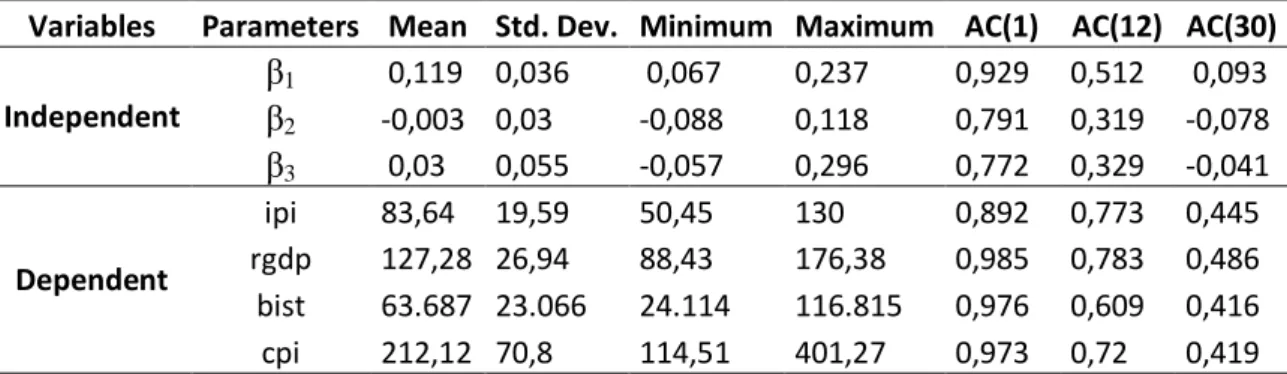
...48
T
ABLE
2.2
U
NIT
R
OOT
T
EST
R
ESULTS OF
V
ARIABLES
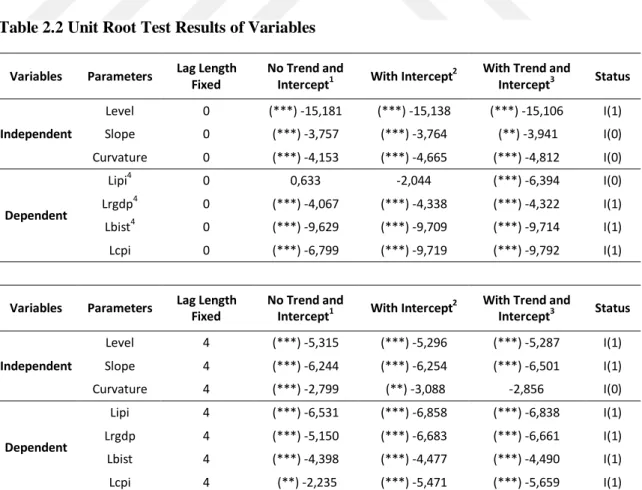
...51
T
ABLE
2.3
R
EGRESSION
R
ESULTS OF
M
ODEL
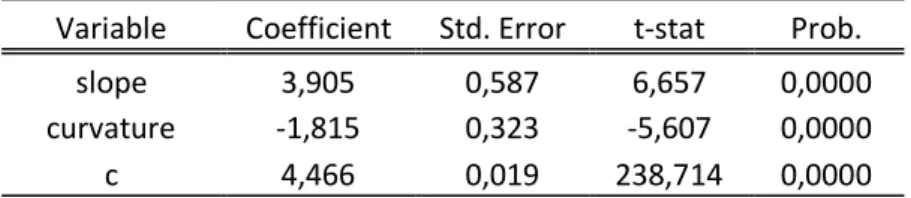
2.3.1 ...58
T
ABLE
2.4
R
EGRESSION
R
ESULTS OF
M
ODEL
2.3.2 ...59
T
ABLE
2.5
R
EGRESSION
R
ESULTS OF
M
ODEL
2.3.3.
A
...60
T
ABLE
2.6
R
EGRESSION
R
ESULTS OF
M
ODEL
2.3.3.
B
...61
T
ABLE
2.7
VAR
G
RANGER
C
AUSALITY
T
EST
R
ESULTS
(BIST100
I
NDEX
) ...61
T
ABLE
2.8
R
EGRESSION
R
ESULTS OF
M
ODEL
2.3.3.
C
...62
T
ABLE
2.9
VAR
G
RANGER
C
AUSALITY
T
EST
R
ESULTS
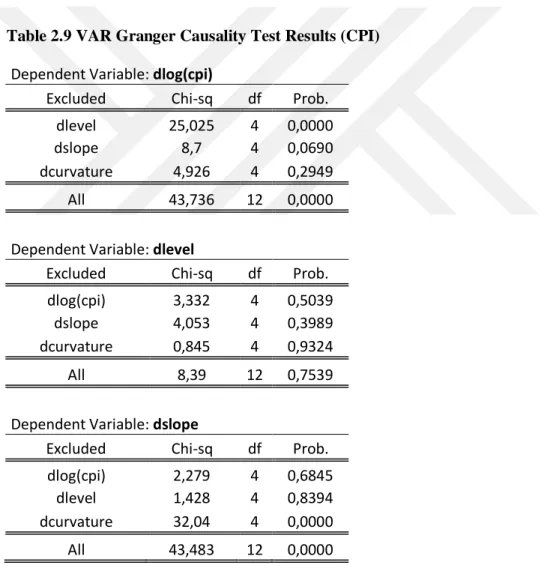
(CPI) ...63
T
ABLE
A.1
ENS
E
STIMATION
R
ESULTS OF
GRG
N
ON
L
INEAR
M
ETHODOLOGY
...76
T
ABLE
B.1
DNS
E
STIMATION
R
ESULTS OF
GRG
N
ON
L
INEAR
M
ETHODOLOGY
...84
T
ABLE
C.1
ENS
E
STIMATION
R
ESULTS OF
M
ATLAB
O
PT
.
M
ETHODOLOGY
...93
T
ABLE
D.1
DNS
E
STIMATION
R
ESULTS OF
M
ATLAB
O
PT
.
M
ETHODOLOGY
... 101
T
ABLE
E.1
DNS
E
STIMATION
R
ESULTS OF
OLS
M
ETHODOLOGY
... 109
T
ABLE
E.2
A
DJUSTED
R
V
ALUES AND
S
IGNIFICANCE OF
B
ETAS IN
OLS
M
ETHODOLOGY
... 117
T
ABLE
F.1
ENS
E
STIMATION
R
ESULTS OF
OLS
M
ETHODOLOGY
... 126
T
ABLE
F.2
T
URKISH
Y
IELD
C
URVES
E
STIMATED VIA
OLS
M
ETHODOLOGY
... 134
T
ABLE
G.1
G
RAPHICAL
R
EPRESENTATION OF
S
EASONALLY
A
DJUSTED
D
EPENDENT
V
ARIABLES
... 135
T
ABLE
G.2
G
RAPHS OF
D
EPENDENT
V
ARIABLES
’
L
OGARITHM
F
ORMS
... 137
T
ABLE
G.3
U
NIT
R
OOT
T
EST
R
ESULTS
... 139
T
ABLE
H.1
V
ARIABLE
D
ESCRIPTIONS OF
M
ODEL
2.3.1 ... 160
T
ABLE
H.2
V
ARIABLE
D
ESCRIPTIONS OF
M
ODEL
2.3.2 ... 160
T
ABLE
H.3
V
ARIABLE
D
ESCRIPTIONS OF
M
ODEL
2.3.3 ... 161
T
ABLE
I.1
E
CONOMETRIC
A
NALYSIS
R
ESULTS OF
M
ODEL
2.3.1... 162
T
ABLE
I.2
E
CONOMETRIC
A
NALYSIS
R
ESULTS OF
M
ODEL
2.3.2... 163
T
ABLE
I.3
E
CONOMETRIC
A
NALYSIS
R
ESULTS OF
M
ODEL
2.3.3... 167
(Note: Table 1.1 indicates the first table in Chapter 1, Table 2.1 indicates the first table in
Chapter 2 and Table A.1 indicates the first table in Appendix.)
vii
LIST OF GRAPHS
G
RAPH
1.1
E
STIMATED
T
URKEY
Y
IELD
C
URVES VIA
ENS
AND
DNS
FOR
2018
Q1 ...21
G
RAPH
1.2
C
OMPARISON OF
E
STIMATED
(GRG
N
ONLINEAR
)
AND
A
CTUAL
Y
IELDS
...22
G
RAPH
1.3
T
URKISH
Y
IELD
C
URVES
E
STIMATED VIA
ENS/DNS
GRG
N
ONLINEAR
...23
G
RAPH
1.4
C
OMPARISON OF
E
STIMATED
(M
ATLAB
)
AND
A
CTUAL
Y
IELDS
...25
G
RAPH
1.5
T
URKISH
Y
IELD
C
URVES
E
STIMATED VIA
ENS/DNS
M
ATLAB
O
PTIMIZATION
...26
G
RAPH
1.6
C
OMPARISON OF
E
STIMATED
(OLS)
AND
A
CTUAL
Y
IELDS
...28
G
RAPH
1.7
T
URKISH
Y
IELD
C
URVES
E
STIMATED VIA
OLS
M
ETHODOLOGY
...29
G
RAPH
1.8
C
OMPARISON OF
E
STIMATED
Y
IELDS
B
ASED ON
M
ATURITIES
...32
G
RAPH
2.1
T
IME
S
ERIES OF
E
STIMATED
DNS
P
ARAMETERS
...45
G
RAPH
2.2
T
IME
S
ERIES OF
D
EPENDENT
V
ARIABLES
...48
G
RAPH
2.3
US/UK
T
ERM
S
PREAD AND
R
ECESSIONS
...54
G
RAPH
2.4
T
URKEY
T
ERM
S
PREAD AND
R
ECESSIONS
...55
G
RAPH
2.5
T
URKEY
T
ERM
S
PREAD AND
B
EAR
M
ARKETS
...57
(Note: Graph 1.1 indicates the first graph in Chapter 1 and Graph 2.1 indicates the first graph in
Chapter 2.)
viii
ABBREVIATIONS
BIST100
: Istanbul Stock Exchange 100
CPI
: Consumer Price Index
DNS
: Dynamic Nelson-Siegel
ENS
: Extended Nelson-Siegel
EU
: European Union
GDP
: Gross Domestic Product
IPI
: Industrial Production Index
OLS
: Ordinary Least Squares
UK
: United Kingdom
ix
ABSTRACT
TEMUÇİN, TEOMAN SAMET. ESTIMATE THE YIELD CURVE FOR SOVEREIGN
BONDS IN TURKEY AND FORECASTING TURKISH ECONOMY FROM THE SHAPE
OF YIELD CURVE (2005 - 2018), Ph.D. THESIS, ISTANBUL, 2019
Yield curve that reflects the interest expectations of market participants is one of the
cornerstones of the financial analysis. In the first chapter of our study, Turkey yield
curve for sovereign bond market is estimated in 2005-2018 by using Extended
Nelson-Siegel (ENS) and Dynamic Nelson-Nelson-Siegel (DNS) models. Since Turkish sovereign
market becomes more liquid and 10-year fixed rate coupon bonds were started to be
traded after 2010, this allows us to make estimation for 10-year term to maturity. As a
result of estimation via two methodologies, it is concluded that Dynamic Nelson-Siegel
model estimates Turkey yield curve slightly better than the Extended Nelson-Siegel
model. Besides, OLS (Ordinary Least Square) is better methodology than optimization
tools in DNS.
This is why, the estimated Turkey yield curve via Dynamic Nelson-Siegel model with
OLS methodology is used to forecast Turkish macroeconomic and financial indicators
in the second chapter of the study. The yield curve can be simply perceived as a
representation of interest rates of treasury bonds or other security instruments in
different maturities. However, that simple graph is beyond the representation of interest
rate. If it is read carefully, the market efficiency theory can be beaten and regular profits
from the market can be made. Many scholars and empirical studies of them have proved
the significant forecasting ability of the yield curve about recessions, turning points in
the stock market and inflation rates. Therefore, it seems as a reliable mechanism for
forecasting to some important indicators in the macroeconomic set. I also simply test the
forecasting capabilities of the estimated Turkey yield curve on Turkish recessions, bear
market, industrial production index, bist100 index and consumer price index. As a result
of analysis, it is concluded that parameters, which represent the Turkey’s yield curve,
contain important information and predictions regarding recessions, bear market
formation, bist100 index and consumer price index.
x
Keywords: Sovereign Bonds, Yield Curve Estimation, Nelson Siegel, Turkey Yield
Curve, Forecasting Recession, Bear Market and Inflation
xi
ÖZET
TEMUÇİN, TEOMAN SAMET. TÜRKİYE HAZİNE KAĞITLARININ VERİM
EĞRİSİNİ TAHMİN ETMEK VE TÜRKİYE EKONOMİSİNİ VERİM EĞRİSİ
ÜZERİNDEN ÖNGÖRMEK (2005 - 2018), DOKTORA TEZİ, İSTANBUL, 2019
Piyasa katılımcılarının faiz beklentilerini yansıtan verim eğrileri finansal analizin temel
taşlarından biridir. Tezin 1.Bölümü’nde, 2005-2018 yılları arasındaki Türkiye Hazine
kağıtlarının verim eğrileri Extended Nelson-Siegel (ENS) ve Dynamic Nelson-Siegel
(DNS) modelleri aracılığıyla tahmin edilmiştir. 2010 yılından sonra Türkiye menkul
kıymet piyasalarının daha likit olması ve 10 yıllık Hazine kağıtlarının işlem görmeye
başlaması, verim eğrisi tahminlerimizin 10 yıllık yapılmasına imkan tanımıştır. İki
metodoloji ile yaptığımız verim eğrisi tahminleri üzerinden ulaşılan sonuç: Dynamic
Nelson-Siegel modelinin Türkiye verim eğrilerini Extended Nelson-Siegel modelinden
bir miktar daha iyi tahmin ettiği yönündedir. DNS modeli içerisinde ise, OLS
yönteminin optimizasyon araçlarına göre daha iyi bir yöntem olduğu sonucuna
ulaşılmıştır.
Araştırmamızın 2.Bölümü’nde, Dynamic Nelson-Siegel modeli OLS yöntemiyle elde
edilen verim eğrileriyle, Türkiye makroekonomik ve finansal verileri tahmin edilmeye
çalışılmıştır. Verim eğrisi, farklı vadelerde hazine bonosu ya da diğer menkul
kıymetlerin faizlerini gösteren basit bir eğri olarak algılanabilir ancak söz konusu eğri,
faizlerin temsilinden çok daha öte bir anlam taşımaktadır. Verim eğrisi dikkatli
okunursa, piyasa etkinliği teorisi kırılabilir ve hatta piyasadan düzenli kârlar elde
edilebilir. Birçok akademisyen ve bilimsel araştırma, verim eğrisinin resesyonları,
borsadaki dönüş anlarını ve enflasyon oranlarını tahmin etmede anlamlı sonuçlar
verdiğini kanıtlanmıştır. Bu yüzden verim eğrisi, makroekonomik kümedeki bazı
göstergeleri tahmin etmek için güvenilir bir araç olarak gözükmektedir. Çalışmanın
2.bölümünde, ilk bölümde tahmin ettiğimiz Türkiye verim eğrisinin; Türkiye’deki
resesyonları, ayı piyasasını, sanayi üretim endeksini, bist100 endeksini ve enflasyon
oranlarını öngörebilme kabiliyeti test edilmiştir. Analizlerin sonucunda, Türkiye verim
eğrisini temsil eden parametrelerin, Türkiye’de resesyon, ayı piyasası oluşumu, bist100
endeksi ve tüketici fiyat endeksinin gelişimine ilişkin önemli bilgi ve öngörüler içerdiği
tespit edilmiştir.
xii
Anahtar Sözcükler: Devlet Tahvili, Verim Eğrisi Tahmini, Nelson Siegel, Türkiye
Verim Eğrisi, Resesyon, Ayı Piyasası ve Enflasyon Tahmini
13
CHAPTER - 1
1.
ESTIMATING TURKEY YIELD CURVE FOR SOVEREIGN BONDS
1.1 INTRODUCTION
Yield curve (also known as term structure of interest rates or spot rate curve) indicates
the relationship between interest rate of security and term to maturity. The main benefit
of estimating yield curve is that having interest rate data without being affected by
interest rate fluctuation of specific bonds (Akıncı et al., 2006). Besides, estimating
accurate yield curve is crucial for monetary policy decisions and portfolio management.
If discounted bonds that have term to maturity from one-day to ten-year and traded on a
daily basis, then the graph of these bonds’ interest rate would automatically give the
yield curve. However, since we have a limited number of securities with specific term to
maturity, we need to estimate yield curve.
There are several methodologies which estimate the yield curve in literature. Bliss and
Fama (1987) got available spot rate and then estimated the curve via regression. This
method is called as smoothed bootstrap (Annaert et al., 2012). Similar to this method,
there are other curve fitting spline methods that include many estimated parameters such
as quadratic and cubic splines (McCulloch (1971, 1975)), exponential splines (Vasicek
and Fong, 1982), basis splines (Steeley, 1991), maximum smoothness splines (Adams
and Deventer, 1994) and roughness penalty function splines (Fisher et al., 1994;
Waggoner, 1997).
Under the models of the short rate, some apply equilibrium method which models the
dynamics of the instantaneous rate and obtains yields at other maturities under specific
assumptions about risk premium. Vasicek (1977), Cox et al. (1985) and Duffie and Kan
(1996) are important contributors to equilibrium methodology. Some use no-arbitrage
method which tries to fit the yield curve at a point in which there is no chance of
14
arbitrage. We mean that the yield curve is estimated by eliminating the possibility of
arbitrage returns with different maturities. Hull and White (1990) estimated yield curve
by comparing the results of two models and interest rate option prices. Brennan and
Schwartz (1979) and Ho and Lee (1986) are other contributors to the no-arbitrage
methodology. Unlike these academics in no-arbitrage literature, Heath-Jarrow-Morton
(1992) differently modeled the entire forward curve as opposed to simple short rate.
Models mentioned so far are mainly used for derivative pricing. Lastly and popularly,
parametric models are used for estimating yield curve. In this group, Nelson-Siegel
(1987) model, its extension by Svensson (1994) and its dynamic version by Diebold and
Li (2006) are widely used by central banks, academia and other market participants for
estimating yield curve. Nelson-Siegel built a static model which makes a curve fitting of
the current data regardless of forward time period. The logic of these models will be
explained in the next section.
The purpose of this chapter of the thesis is to estimate Turkey yield curve for discounted
and fixed coupon government bonds by applying the Nelson‐Siegel model’s derivatives,
namely Extended Nelson-Siegel (ENS) and Dynamic Nelson-Siegel (DNS) models.
Since these methods are commonly used by many financial institutions and there is a
consensus in literature on their quality for fitting better yield curves, we apply ENS and
DNS for estimating Turkey yield curve. As a result of estimation, although both ENS
and DNS have very similar shapes for yield curve, DNS estimates Turkey yield curve
slightly better than ENS by comparing their sum of squares of deviation between
theoretical price and dirty price of securities. Besides, OLS technique in DNS
methodology performs better in estimating yield curves than optimization techniques.
The figures regarding these figures will be shared in the following sections.
First chapter of the thesis is organized as follows. In section 1.2, a detailed explanation
and formulas of Nelson-Siegel model and its derivatives will be discussed. Besides, we
provide how they interact and contribute to each other to estimate yield curve. In section
1.3, our data for Turkish sovereign bond market and methodologies for estimating will
be introduced. In section 1.4, estimated yield curve, founded ENS and DNS parameters
15
and their advantages and disadvantages will be evaluated and compared. In the final
section, our concluding remarks regarding Chapter-1 of the thesis will be mentioned.
1.2 EXTENDED AND DYNAMIC NELSON-SIEGEL MODELS
Nelson and Siegel (1987) estimated the yield curve by using four parameters. (1.2.1)
According to the authors, β
0
, β
1
and β
2
represent the short, medium and long-term
components of the yield curve. The long term component is represented via β
0
because
it remains constant when term to maturity parameter (T) evolves. β
1
serves the
representation of short-term and β
2
contributes the representation of the medium-term
component. As Ibanez (2016) stated, the fourth parameter (𝜆), which is not entirely
described, is a decay factor. That’s means it influences the fitting power of the model.
r(T) = β
0
+ (β
1
+ β
2
)
1 − e
−
𝑇
𝜆
𝑇
𝜆
– β
2
𝑒
−
𝑇
𝜆
(1.2.1)
where β
0
, β
1
, β
2
and
𝜆 are parameters (𝜆 must be positive) to be extracted from the
current bond price.
The Extended Nelson Siegel (ENS) Model Svensson (1994) added an extension to the
model in order to fit better and capture highly non-linear, in other words hump-shape
(or U-shape), yield curves. Therefore, the curve is estimated by using six parameters.
(1.2.2) The logic of estimation is the same as in the case of the Nelson Siegel model.
r(T) = β
0
+ (β
1
+ β
2
)
1 − e
−
𝑇
𝜆1
𝑇
𝜆1
– β
2
𝑒
−
𝑇
𝜆1
+ β
3
(
1 − e
−
𝑇
𝜆2
𝑇
𝜆2
− e
−
𝜆2
𝑇
)
(1.2.2)
where β
0
, β
1
, β
2
, β
3
, 𝜆
1
and 𝜆
2
are parameters (𝜆
1
and 𝜆
2
must be positive) to be extracted
from the current bond price.
The Dynamic Nelson Siegel (DNS) Model Diebold and Li (2006) introduced the
dynamic version of the Nelson Siegel model. (1.2.3) The most important contribution of
them to the literature, DNS parameters that represent the curve can be used for
forecasting purposes as well. In other words, they reinterpreted the parameters as level
16
factor therefore it is β
1
= yt(∞). The slope parameter (β
2
) represents the short-term
factor which is defined as ten-year yield minus the three-month yield by Diebold and Li,
i.e. β
2
= y
t
(120) – y
t
(3). The curvature parameter (β
3
) represents the medium-term factor
which is defined as twice the two-year yield minus the sum of the ten-year and
three-month yields, i.e. β
3
= 2y
t
(24) - (y
t
(120) + y
t
(3)). Later on, we will also graph estimated
parameters against β
1
, β
2
, β
3
and test whether the logic works for Turkey as well or not
in Chapter-2. Although 4 parameters could be estimated by nonlinear least squares,
Diebold and Lie preferred to fix
𝜆 at a predefined value so as to increase reliability of
betas. Now, betas could be estimated by using ordinary least squares because
non-linearity in the equation is eliminated by fixing 𝜆.
r(T) = β
1
+ β
2
(
1 − e
−λT
λT
) + β
3
(
1 − e
−λT
λT
− e
−λT
)
(1.2.3)
where β
1
, β
2
, β
3
and
𝜆 are parameters (𝜆 must be positive) to be extracted from the
current bond price.
In the following sections, we will estimate Turkey’s yield curve for sovereign bond
market by using these two methodologies, namely ENS and DNS. ENS will be applied
in order to achieve a better fit yield curve because it contains hump-shape as well by
using six parameters. DNS will be also applied so as to get foreseeable parameters and
use them for forecasting purposes in Chapter-2 of the thesis.
17
1.3 DATA AND METHODOLOGY
The data consists of monthly observations of Turkish sovereign bonds and bills market
in the period of February 2005-December 2018. One of the most important feature of
our thesis is that Turkish yield curve would be estimated with the latest bond market
data. We need to point out that Turkish sovereign market becomes more liquid and
longer maturities are started to be traded in the same period as well. This is why it is
necessary to make such a kind of work for current data in order to get longer and
trustworthy yield curves. February 2005 is chosen as a starting point because 5-year
fixed coupon rate bonds were started to be traded in Turkey. Besides, Turkish financial
markets became more transparent, accountable and officially controlled in early 2000s
with the foundation of new financial regulatory bodies such as Banking Regulation and
Supervision Agency and additional precautions were taken in order to protect investors.
On the other hand, 10-year fixed coupon rate bonds were started to be traded in January
2010. We conclude that estimating 10-year yield curve without having a security with
10-year term to maturity and traded in the market would give incorrect estimation
results. This is why although yield curves which have 5-year term to maturity are
estimated in 2005-2010, 10-year yield curves are estimated for 2010-2018 period.
The data is received from Istanbul Stock Exchange database. Each day’s data reports
value date, days to maturity, days to coupon, accrued interest, prices, simple and
compound rate of return and transaction volume of each security. Since the data is daily,
the last business day of each month is used as a representative of the related month. The
sample consists of 167 months (n=167). Although both fixed coupon and floating rate
bonds are issued in the period, we only apply TL denominated zero-coupon and
fixed-coupon rate bonds for curve estimation since cash flows of floating rate bonds cannot be
determined in advance.
Besides, the 7-9 most liquid sovereign bonds of each specific day to maturity (around
3-month, 6-3-month, 1-year, 2-year, 3-year, 4-year, 5-year, 7-year and 10-year) are chosen
for estimating yield curve. For instance, if the last business day of the month includes
15 sovereign bonds, we choose the most liquid 9 of them which represent specific days
to maturity and exclude illiquid ones by working in each 167 of them manually. The
18
reason why we do this is that the price of illiquid ones could manipulate the estimation
results and estimated yield curves will not reflect the reality. Besides thanks to this
method, the possibility of manipulating the entire data of the securities that are focused
on a certain period (such as from 1 month to the 1 year) has been eliminated. Moreover,
since Istanbul Stock Exchange’s daily data does not include coupon rates of the bonds,
we calculated them by using accrued interest. The coupon rates are calculated with the
following formula
1
;
C = (
364 × AI
182−Days to Coupon
)
(1.3.1)
where C represents coupon rate and AI represents accrued interest.
Weighted average price is used as clean price and dirty price is calculated by summing
up clean price and accrued interest of each bond. After we calculate r(T) by using
formula (1.2.2) and (1.2.3), present value of each coupon and principal payments are
obtained. We reach ENS and DNS theoretical prices by summing up all present values
of coupon and principal payments. And then, we minimize the sum of the squared
deviations of the dirty prices from the estimated theoretical prices of 9 bonds found via
ENS and DNS. (1.3.2)
min. A(β
0
, β
1
, β
2
, β
3
, 𝜆
1
, 𝜆
2
) = ∑
(𝑃
𝑖
𝐸𝑁𝑆/𝐷𝑁𝑆
− 𝑃
𝑖
𝐷𝑖𝑟𝑡𝑦 (𝐷𝑎𝑡𝑎)
)
2
9
𝑛=1
(1.3.2)
We apply two methodologies, namely GRG nonlinear and Matlab optimization tools in
order to minimize the sum of the squared deviations between dirty price and ENS/DNS
theoretical prices.
Besides, we apply ordinary least squares as a different technique for estimating
Turkey’s yield curve. Diebold and Li (2006) defined 𝜆 as if it determines the maturity at
which the loading on the curvature factor (β
3
) reaches its maximum and fixed
𝜆 at a
predefined value by assuming 30 months used as medium term in US sovereign bond
market. Since Diebold and Li worked on a developed economy, we need to fix
𝜆 at a
1
19
different value so as to reflect Turkey yield curve accurately. Murat Duran (2014) fixed
𝜆 at 1,017 for Turkey yield curve estimation between 2010 and 2014. We realize that
the loading on the medium-term (curvature) factor, i.e. ((1 − e
−λT
)/λT) − e
−λT
, is
maximized at around 24 months (T=2) for Turkey case. Therefore, the curvature factor
(β
3
) reaches its maximum at 𝜆=0,897 by assuming 24 months (T=2) as medium term in
Turkish sovereign bond market in order to use ordinary least squares for estimating
betas. After all, we fix 𝜆 at 0,897 for the period of February 2005-December 2018 when
we apply OLS methodology of Diebold&Li for estimating betas.
Moreover, we attempt to add a new perspective to the literature. We simply apply
Diebold&Li’s technique of OLS beta estimation for Svensson (ENS) formula as well.
After making some mathematical adjustments on Svensson formula (1.2.2), we get
(1.3.3) for Extended Nelson Siegel Model. This mathematical representation of ENS
formula also exists in Gilli et al.’s (2010) working paper:
r(T) = β
0
+ β
1
(
1 − e
−
𝑇
𝜆1
𝑇
𝜆1
) + β
2
(
1 − e
−
𝑇
𝜆1
𝑇
𝜆1
− e
−
𝑇
𝜆1
) + β
3
(
1 − e
−
𝜆2
𝑇
𝑇
𝜆2
− e
−
𝑇
𝜆2
) (1.3.3)
Now, we adapt Diebold&Li’s curvature interpretation to Svensson model and the
loading on the medium-term (curvature) factors are maximized at
𝜆
1
=1,115 and
𝜆
2
=2,788 by assuming 24 months (T=2) as first curvature and 60 months (T=5) as
second curvature (medium term) of the yield curve respectively in Turkish sovereign
bond market. After fixing 𝜆
1
at 1,115 and 𝜆
2
at 2,788, we apply ordinary least squares
for estimating 4 betas in 1.3.3 as a new attempt.
However, we do not fix any
𝜆 value during GRG nonlinear or Matlab optimization
techniques of ENS/DNS estimations. Since we decide to use the optimization method in
order to minimize the sum of the squared deviations (1.3.2), adding an extra constraint
to the equations makes the estimation results inefficient. This is why we do not fix any
parameter at all during the optimization techniques.
20
1.4 ESTIMATION RESULTS AND COMPARISON OF METHODS
1.4.1. GRG Nonlinear Optimization Method
Both ENS and DNS model do not work perfectly because running a standard
optimization technique could not achieve complete price equality between theoretical
and realized dirty prices for 167 observations. However, the difference is minor for
most of our data. The sum of the squared deviations between ENS theoretical price and
dirty price for bonds is less than “2” for 94% of our daily observations. The same ratio
is %96 for DNS. We can also conclude that DNS estimates Turkey yield curve slightly
better than ENS model by comparing their sum of square deviations between theoretical
prices and dirty prices of securities. Although the sum of square deviation is 129,2 in
ENS methodology for 167 observations, the sum is 101,3 for DNS methodology.
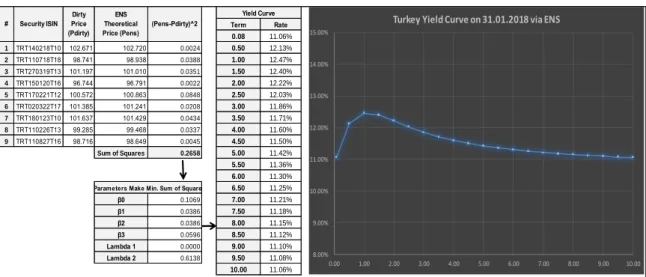
As mentioned above, we work on last business day of every month one by one and
apply optimization method GRG nonlinear in Excel. Let us discuss first quarter of 2018
ENS and DNS results as an example for closer inspection by comparing their
theoretical/dirty prices, sum of squared errors and shape of yield curves (Table 1.1,
Table 1.2 and Graph 1.1) before presenting whole results for 167 observations.
Table 1.1 Example: How to Estimate Turkey Yield Curve via ENS on 31.01.2018
Table-1.1. shows how Turkey yield curve on 31.01.2018 is calculated via ENS. First, dirty prices of the most liquid 9 securities
based on specific day to maturity are got from Istanbul Stock Exchange database and they are compared with calculated ENS
theoretical prices. The optimal ENS parameters are determined by minimizing the sum of difference between dirty and ENS
theoretical prices based on GRG nonlinear. Then, Turkey yield curve is plotted with optimal ENS parameters based on different
terms.
Term Rate 0.08 11.06% 1 TRT140218T10 102.671 102.720 0.0024 0.50 12.13% 2 TRT110718T18 98.741 98.938 0.0388 1.00 12.47% 3 TRT270319T13 101.197 101.010 0.0351 1.50 12.40% 4 TRT150120T16 96.744 96.791 0.0022 2.00 12.22% 5 TRT170221T12 100.572 100.863 0.0848 2.50 12.03% 6 TRT020322T17 101.385 101.241 0.0208 3.00 11.86% 7 TRT180123T10 101.637 101.429 0.0434 3.50 11.71% 8 TRT110226T13 99.285 99.468 0.0337 4.00 11.60% 9 TRT110827T16 98.716 98.649 0.0045 4.50 11.50% Sum of Squares 0.2658 5.00 11.42% 5.50 11.36% 6.00 11.30% 6.50 11.25% β0 0.1069 7.00 11.21% β1 0.0386 7.50 11.18% β2 0.0386 8.00 11.15% β3 0.0596 8.50 11.12% Lambda 1 0.0000 9.00 11.10% Lambda 2 0.6138 9.50 11.08% 10.00 11.06% Parameters Make Min. Sum of SquareYield Curve # Security ISIN Dirty Price (Pdirty) ENS Theoretical Price (Pens) (Pens-Pdirty)^2 8.00% 9.00% 10.00% 11.00% 12.00% 13.00% 14.00% 15.00% 0.00 1.00 2.00 3.00 4.00 5.00 6.00 7.00 8.00 9.00 10.00