• Sonuç bulunamadı

Gender issues and conflicts in brontë's Jane Eyre: an interpretive synthesis for informing critical literacy instruction

N/A
N/A
Protected

Academic year: 2021

Share "Gender issues and conflicts in brontë's Jane Eyre: an interpretive synthesis for informing critical literacy instruction"

Copied!
218
0
0

Yükleniyor.... (view fulltext now)

Tam metin

(1)

GENDER ISSUES AND CONFLICTS IN BRONTË'S JANE EYRE: AN

INTERPRETIVE SYNTHESIS FOR INFORMING CRITICAL

LITERACY INSTRUCTION

A MASTER’S THESIS

BY

MERVE ERENTUĞ

THE PROGRAM OF CURRICULUM AND INSTRUCTION

İHSAN DOĞRAMACI BILKENT UNIVERSITY

ANKARA


ME

R

V

E

E

R

E

N

T

U

Ğ


(2)
(3)
(4)

GENDER ISSUES AND CONFLICTS IN BRONTË'S JANE EYRE: AN INTERPRETIVE

SYNTHESIS FOR INFORMING CRITICAL LITERACY INSTRUCTION

The Graduate School of Education

of

İhsan Doğramacı Bilkent University

by

Merve Erentuğ

In Partial Fulfilment of the Requirements for the Degree of

Master of Arts

in

Curriculum and Instruction

Ankara

(5)

İHSAN DOĞRAMACI BILKENT UNIVERSITY

GRADUATE SCHOOL OF EDUCATION

GENDER ISSUES AND CONFLICTS IN BRONTË'S JANE EYRE: AN INTERPRETIVE

SYNTHESIS FOR INFORMING CRITICAL LITERACY INSTRUCTION

Merve Erentuğ

Oral Defence May 2018

I certify that I have read this thesis and have found that it is fully adequate, in scope and in

quality, as a thesis for the degree of Master of Arts in Curriculum and Instruction.

---

Asst. Prof. Dr. Necmi Akşit (Supervisor)

I certify that I have read this thesis and have found that it is fully adequate, in scope and in

quality, as a thesis for the degree of Master of Arts in Curriculum and Instruction.

---

Asst. Prof. Dr. Tijen Akşit (Examining Committee Member)

I certify that I have read this thesis and have found that it is fully adequate, in scope and in

quality, as a thesis for the degree of Master of Arts in Curriculum and Instruction.

---

Assoc. Prof. Dr. Perihan Savaş, METU (Examining Committee Member)

Approval of the Graduate School of Education

(6)

ABSTRACT

GENDER ISSUES AND CONFLICTS IN BRONTË'S JANE EYRE: AN

INTERPRETIVE SYNTHESIS FOR INFORMING CRITICAL LITERACY

INSTRUCTION

Merve Erentuğ

M.A., Program of Curriculum and Instruction

Supervisor: Asst. Prof. Dr. Necmi Akşit

May 2018

The purpose of this study is to identify the issues as well as conflicts of gender in

Charlotte Brontë's Jane Eyre with the aim of providing lines of arguments as

guidelines to inform critical literacy instruction. To this end, MA theses and PhD

dissertations focusing on Jane Eyre were selected to ascertain second-order

interpretations through interpretive synthesis. The second-order interpretations were

then synthesised by using social institutions for generating third-order interpretations

in the form of lines of arguments to provide guidelines for critical literacy

instruction.

Key words: Jane Eyre, gender, teaching literature, critical literacy, interpretive

synthesis, social institution

(7)

ÖZET

JANE EYRE’DE CİNSİYET BAĞLAMINDA SORUNLAR VE ÇATIŞMALAR:

ELEŞTİREL ÖĞRETİM ÜZERİNE BİR YORUMLAYICI SENTEZ

Merve Erentuğ

Yüksek Lisans, Eğitim Programları ve Öğretim

Tez Yöneticisi: Dr. Öğr. Üyesi Necmi Akşit

Mayıs 2018

Bu çalışmanın amacı Charlotte Brontë’nin Jane Eyre adlı romanı içerisinde yer alan

cinsiyet bağlamı ile ilgili sorun ve çatışmaları belirleyerek, eleştirel okuryazarlık

öğretiminde kullanılmak üzere tartışma çizgisi geliştirmektir. Bu nedenle Jane Eyre

romanı üzerine yazılan yüksek lisans ve doktora tezleri yorumlayıcı sentez

aracılığıyla incelenmiş ve ikincil bakış açılar oluşturulmuştur. Bu ikincil yorumlar,

toplumsal kurum kavramları çerçevesinde birleştirilerek eleştirel okuryazarlık

öğretimi amaçlı yönergeler sağlamak üzere üçüncül bakış açıları geliştirilmiştir.

Anahtar kelimeler: Jane Eyre, cinsiyet, edebiyat öğretimi, eleştirel okuryazarlık,

yorumlayıcı sentez, toplumsal kurumlar

(8)

ACKNOWLEDGEMENTS

Foremost, I would like to express my special thanks and sincere gratitude to my

supervisor Asst. Prof. Dr. Necmi Akşit for all his encouragement, guidance and

constructive feedback throughout the process of writing my thesis. I would also like

to thank for the countless contributions that he has made with all his valuable

information, advices and support of my studies.

I would also like to express my sincere gratitude to Bilkent University and to

Graduate School of Education for giving me the opportunity of being a part of this

distinguished university and program. Graduate School of Education has supported

not only my professional and academic development with distinguished

opportunities but also showed trust in my progress. With this respect, I would like to

express my special thanks individually to all of my instructors at Graduate School of

Education, namely Prof. Dr. Alipaşa Ayas, Prof. Dr. Margaret Sands, Asst. Prof. Dr.

Necmi Akşit, Asst. Prof. Dr. Tijen Akşit, Asst. Prof. Dr. Armağan Ateşkan, Asst.

Prof. Dr. Jennie Farber Lane, Asst. Prof. Dr. Aikaterini Michou, Assoc. Prof. Dr.

Erdat Çataloğlu, Asst. Prof. Dr. İlker Kalender, who not only shed light to my

education within these two years with all the precious knowledge that they have

provided, but also became my role models as a future teacher.

Finally, this thesis has been dedicated to my beloved mother Pınar Şener for all of

her endless love and trust, valuable support, encouragement and appreciation of my

studies. She has been my first teacher, my role model and foremost my most precious

and will always be.

(9)

TABLE OF CONTENTS

ABSTRACT ……….

III

ÖZET ………...

IV

ACKNOWLEDGEMENTS ………

V

TABLE OF CONTENTS ……….

VI

LIST OF TABLES ………..

XII

LIST OF FIGURES ……….

XVII

CHAPTER 1: INTRODUCTION ………

1

Background ………..

1

Problem ………

3

Purpose ……….

4

Research questions ………...

5

Significance ………..

5

Definitions ………

6

CHAPTER 2: REVIEW OF RELATED LITERATURE ………...

7

Introduction ………..

7

Curricular ideologies ………

7

Scholar academic ideology ………

7

Social efficiency ideology ………..

8

(10)

Critical pedagogy ……….

12

Critical literacy ………

14

Teaching literature ………...

16

Cultural model ………

17

Language model ………

17

Personal growth model ………..

17

Literature as resource ……….

18

Language-based approach ………..

18

Literature for personal enrichment ……….

18

Teaching the conflicts ………..

19

Social institutions ……….

19

Economy ……….

20

Education ………

20

Family ……….

20

Law ……….

20

Marriage ……….

21

Medicine ……….

21

Politics ………

21

Religion ………..

21

CHAPTER 3: METHOD ……….

22

Research design ………

22

Qualitative synthesis ………..

22

Interpretive synthesis ……….

23

Meta-ethnography ………..

24

(11)

Method of data collection and analysis ………

30

CHAPTER 4: RESULTS ……….

34

Introduction ………..

34

List of primary sources ………

34

List of selected sources ………

35

List of selected M.A. theses ………..

35

List of selected Ph.D. dissertations ………

36

Social institutions ……….

39

Social institutions: theses and dissertations ……….

41

Economy ………..

41

Class ………...

43

Consumption ………..

47

Status ………..

48

Education ……….

52

Progress ………..

53

School ……….

58

Family ………..

61

Conventionality ……….……

62

Exclusion ………

63

Oppression ………..

66

Status ………..

69

(12)

Marriage ……….

76

Colonial ……….

78

Conventional ………..

80

Equality ………..

83

Status ……….

86

Submission ……….

90

Medicine ………...

92

Body ………..

92

Politics ……….

95

Colonialism ………

96

Discourse ………

100

Gender ………

103

Nationalism ………..

109

Oppression ……….

110

Patriarchy ………..

113

Status ……….

116

Religion ………..

118

Beliefs ………..

119

Oppression ………

122

Submission ………

123

Other theses and dissertations ……….

124

Adaptations ………

126

Authorship ……….

126

(13)

Overview of the study ………..

129

Major findings and conclusion ……….

130

Economy ………..

130

Class ………

131

Consumption ………..

133

Status ……….

134

Education ……….

136

Progress ……….

137

School ……….

139

Family ……….

140

Conventionality ……….

141

Exclusion ………

142

Oppression ……….

143

Status ……….

145

Law ………..

147

Justice ……….

147

Marriage ………

149

Morals ………

150

Marriage ………...

151

Colonial ……….

151

Conventionality ………..

153

(14)

Body ………..

161

Politics ……….

162

Colonialism ………

163

Discourse ………

165

Gender ………

166

Nationalism ………

168

Oppression ……….

169

Patriarchy ………..

170

Status ……….

171

Religion ………

173

Beliefs ………

173

Oppression ……….

175

Submission ………

176

Other theses and dissertations ……….

177

Adaptations ………

177

Authorship ……….

178

Implications for practice ……….

179

Implications for further research ……….

181

Limitations ………..

181

REFERENCES ………

182

APPENDIX A: Primary sources on gender ……….

187

(15)

LIST OF TABLES

Table

Page

1

Number of M.A. theses and Ph.D. dissertations in total as

found in ProQuest

34

2

Number of selected M.A. theses and Ph.D. dissertations

35

3

List of selected M.A. theses

36

4

List of selected Ph.D. dissertations

36

5

Number of entries per M.A theses and Ph.D. dissertations for

each social institution

41

6

Number of data sources for the sub-category entries of

economy

42

7

Economy: Class

43

8

Economy: Consumption

47

9

Economy: Status

49

10

Number of data sources for the sub-category entries of

education

53

11

Education: Progress

53

(16)

15

Family: Exclusion

64

16

Family: Oppression

66

17

Family: Status

69

18

Number of data sources for the sub-category entries of law

72

19

Law: Justice

72

20

Law: Marriage

74

21

Law: Morals

75

22

Number of data sources for the sub-category entries of

marriage

77

23

Marriage: Colonial

78

24

Marriage: Conventional

80

25

Marriage: Equality

83

26

Marriage: Status

87

27

Marriage: Submission

90

28

Number of data sources for the sub-category entries of

medicine

93

29

Medicine: Body

93

30

Number of data sources for the sub-category entries of politics

95

(17)

32

Politics: Discourse

100

33

Politics: Gender

103

34

Politics: Nationalism

109

35

Politics: Oppression

110

36

Politics: Patriarchy

113

37

Politics: Status

116

38

Number of data sources for the sub-category entries of

religion

119

39

Religion: Beliefs

120

40

Religion: Oppression

122

41

Religion: Submission

123

42

Number of entries per M.A. theses and Ph.D. dissertations in

the other category

125

43

Other: Adaptations

126

44

Other: Authorship

127

45

Summary guidelines: Class

131

(18)

49

Summary guidelines: School

140

50

Summary guidelines: Conventionality

141

51

Summary guidelines: Exclusion

142

52

Summary guidelines: Oppression

144

53

Summary guidelines: Status

146

54

Summary guidelines: Justice

148

55

Summary guidelines: Marriage

149

56

Summary guidelines: Morals

151

57

Summary guidelines: Colonial

152

58

Summary guidelines: Conventionality

154

59

Summary guidelines: Equality

156

60

Summary guidelines: Status

158

61

Summary guidelines: Submission

160

62

Summary guidelines: Body

161

63

Summary guidelines: Colonialism

163

64

Summary guidelines: Discourse

165

65

Summary guidelines: Gender

167

(19)

67

Summary guidelines: Oppression

170

68

Summary guidelines: Patriarchy

171

69

Summary guidelines: Status

172

70

Summary guidelines: Beliefs

174

71

Summary guidelines: Oppression

175

72

Summary guidelines: Submission

177

73

Summary guidelines: Adaptations

178

74

Summary guidelines: Authorship

178

75

Appendix A: List of sources on gender

187

76

Appendix A: List of sources on race

192

(20)

LIST OF FIGURES

Figure

Page

1

Gender database

29

2

Sample excel sheet

31

3

Sample transition from 1

st

level to 2

nd

level coding

32

4

Sample first and second level coding of a study

32

5

Social institutions used for synthesis

40

6

Sub-categories of economy

42

7

Sub-categories of education

52

8

Sub-categories of family

61

9

Sub-categories of law

71

10

Sub-categories of marriage

77

11

Sub-categories of medicine

92

12

Sub-categories of politics

96

13

Sub-categories of religion

119

14

Other theses and dissertations

125

(21)

16

Major constructs of consumption

133

17

Major constructs of status

135

18

Major constructs of progress

137

19

Major constructs of school

139

20

Major constructs of conventionality

141

21

Major constructs of exclusion

142

22

Major constructs of oppression

144

23

Major constructs of status

146

24

Major constructs of justice

148

25

Major constructs of marriage

149

26

Major constructs of morals

150

27

Major constructs of colonial

152

28

Major constructs of conventionality

154

29

Major constructs of equality

156

30

Major constructs of status

158

(22)

34

Major constructs of discourse

165

35

Major constructs of gender

166

36

Major constructs of nationalism

168

37

Major constructs of oppression

169

38

Major constructs of patriarchy

170

39

Major constructs of status

172

40

Major constructs of beliefs

174

41

Major constructs of oppression

175

(23)

CHAPTER 1: INTRODUCTION

This chapter introduces the background, problem, purpose, research questions and

significance of the thesis.

Background

Curriculum and schools are seen as mediums where the social power structures and

political ideology is either reproduced or questioned according to the specified

curriculum ideology. Radical pedagogy views education as a model of “social

stratification” (as cited in Pinar, Reynolds, Slattery, & Taubman, 1995, p. 249) and

hegemonic ideologies without any change in the dominant social orders of race, class

and gender. It is stated that, “the school in general, and the curriculum in particular,

play important roles in both oppression and reform” (as cited in Pinar et al., 1995, p.

244). Stratification within curriculum and schools has possibilities for resistance and

as Giroux (1983) argues, resistance is possible with a thorough understanding of the

dominant ideological structures (Pinar et al., 1995).

Critical literacy helps identify alternative interpretations, making students become

aware of ideological stances. Teachers and students also emphasize the stratification

as information is passed from the teacher to students in a similar power relation

(Freire, 1972). However, critical pedagogy sees education as an opportunity of

liberation from and a change of these power relations as students develop critical

(24)

Critical literacy has a similar aim of having students who can acknowledge and

reflect on social injustices. (Coffey, 2008). Critical literacy practice involves reading

and analysis of texts in order to raise consciousness on the social and political issues

(as cited in Bishop, 2014). Thus, critical literacy can be emphasized in the classroom

environment to improve students’ reflection on power structures and to raise

awareness of social agency (Dozier, Johnston, & Rogers, 2006).

In terms of education and school curriculum, it is about prioritizing what to teach and

whether to focus on these critical ideological topics or not. Certain system alternative

curricular ideologies support a reflection and a critical approach to system based

curriculum on social issues about oppressive power structures. Critical exploratory

theorizers focus on the relationship between society and education through the lenses

such as gender, race and politics. Overall, their main focus is to examine social

orders and the lived experiences of individuals in relation with education (Marsh &

Willis, 2007). One such approach is social reconstructionist ideology. Social

reconstructionists claim that society is threatened with conflicts of injustice and thus

“the purpose of education is to facilitate the construction of a new and more just

society” (Schiro, 2013, p.6).

Literature instruction and critical literacy content provide the necessary personal

experience and awareness of society through a means of critical analysis of power

structures, and can raise awareness of power relations through the inclusion of

multiple perspectives. The use of literature in classroom enables students to have a

better understanding of the self and an identification about social and cultural topics

(Carter & Long, 1991). Graff (1992) argues the importance of focusing on social

(25)

conflicts as a part of teaching literature and suggests that “‘by turning ‘conflict’ into

a subject for the classroom, real conflict is defanged and too easily ‘understood’” (as

cited in Showalter, 2003, p.31). His discussion points out the necessity of having a

critical view of conflicts within the classroom in order to raise multiple perspectives

about social orders.

IB programs aim to encourage students who “critically consider power and

privilege” (IBO, 2013, p.7), and more specifically emphasize “the development of an

understanding of “critical literacy” in students.” (IBO, 2013, p.5). To this end, the

critical study of a literary text becomes crucial in highlighting critical literacy as a

skill that students need to achieve through reading multiple perspectives and that

teachers need to be equipped with to develop instructional guidelines.

Problem

Education emphasizes social stratification rather than focusing on changing the

dominant social orders, which leads to the functioning of schools and curriculum in

line with power relations through a reproduction of the political and social conflicts

such as gender, race and class (Pinar et al., 1995). In terms of critical pedagogy,

education offers chances of social change and awareness to identify different forms

of oppression. While as Giroux states “classrooms at all levels of schooling . . .

resemble a “dead zone” where any vestige of critical thinking, self-reflection . . .

quickly migrates to sites outside of the school (Giroux, 2011, p.153), critical

(26)

(Freire, 1972, p.60) is a matter of ideological choice.

Students’ critical consciousness can be facilitated through an understanding of

conflicts (as cited in Buffington & Moneyhun, 1997) and critical engagement with

texts, for them to extend their reading to an understanding of the society and power

in general (Vasquez, 2017). Reading is no longer considered as a linguistic act but

means deciphering dominant power structures. It is considered as both social and

political, and one needs to go beyond what the author presents, stopping giving the

text authority (Sluys, Lewison, & Flint, 2006). In order to facilitate critical literacy

on the part of students, they need to be shown ways that would lead them to question

any preconceived ideas, and become aware of anybody silenced or marginalized.

Teaching literature provides platform for raising such awareness (Bishop, 2014).

Purpose

The purpose of this study is to identify issues and conflicts concerning gender by

using the lenses of social institutions, and to develop guidelines for critical literacy

instruction. To these ends, the researcher focused on the novel Jane Eyre by the

author Charlotte Brontë, selected from IB’s Prescribed List of Authors (PLA), which

upon examination was considered conducive to critical literacy instruction.

The researcher analysed MA theses and PhD dissertations focusing on the selected

novel which yielded second-order interpretations and allowed room for interpretive

synthesis. The second-order interpretations were then used to generate third-order

constructs in the form of lines of argument to inform critical literacy instruction.

(27)

Research questions

The research question which this thesis will focus on is as follows:

1.   How do issues and conflicts concerning gender, derived from Brontë's Jane

Eyre through interpretive synthesis, inform the development of guidelines for

critical literacy instruction?

Significance

This study provides guidelines for critical literacy instruction within the context of

Jane Eyre. Both pre-service and in-service teachers, whether in IB and non-IB

context, would benefit from the findings of this study as it intends to help become

aware of, and question, power relations, discourses and structures concerning gender.

Critical thinking requires disengagement from implicit conventions of power

relations “to exert more conscious control over . . . everyday lives” (Kincheloe, 2000,

p.24). Similarly, raising critical awareness as opposed to stratification in education is

essential in developing critical consciousness, requiring teachers to be equipped with

necessary skills to instruct such disposition.

The study is also significant in that it uses interpretive synthesis in general, and

meta-ethnography in particular, in the context of education, to collect and interpret

second order constructs in the existing MA and PhD studies for developing

third-order interpretations to develop instructional guidelines. The outcomes of the study

provide platform for exploring how second-order constructs could be collated and

(28)

The study might also be instrumental in including such concepts as critical

consciousness or critical literacy in teacher education programs in Turkey to raise

awareness on the part of prospective teachers. Teachers can initiate change and

impact on others through teaching. To teach critical literacy, however, teachers need

to know what it means to be critically literate.

Definitions

Critical literacy

Critical literacy indicates the reading of and responding to texts with a focus on

issues of power and hegemony (Coffey, 2008). The aim of critical literacy is defined

as an understanding and awareness of the social world through analysis of texts

(Luke, 2012).

Second-order interpretation

Second order interpretations or second order analysis is the analysis of data selected

from the previously conducted research (Janet, 2008).

Third-order interpretation

Third order interpretations or constructs are the results of synthesis (Barnett-Page &

Thomas, 2009) which provide interpretations extending those provided by first and

second order constructs (Campbell, Pound, Morgan, Daker-White, Britten, Pill,

Yardley, Poper, & Donovan, 2011).

(29)

CHAPTER 2: REVIEW OF RELATED LITERATURE

Introduction

This chapter starts with curricular ideologies which lay the foundations of the role of

the teacher and the learner (Schiro, 2013). It then explores, critical approaches to

curriculum making, as one of the ideologies, which focuses on how domination or

injustices in society are problematic within curricula (Marsh & Willis, 2007), and

which also links to the idea that education can also allow room for both the

maintenance and change of the dominant orders (Pinar, 1995). The chapter further

introduces the concept of critical literacy instruction which similarly provides

students with a thorough understanding of power structures and society through

critical reading (Vasquez, 2017). The chapter continues with a brief reference to how

teaching literature might be providing platform for developing critical awareness

(Carter & Long, 1991; Lazar, 1993; Graff, 1995). Finally, it introduces a social

institutions framework to facilitate analyses, interpretation and discussion.

Curricular ideologies

Schiro (2013) classifies curricular ideologies as Scholar Academic, Social

Efficiency, Learner Centered and Social Reconstruction. These different curricular

ideologies exhibit different approaches towards the aim of schooling, and teaching

and learning.

(30)

through the ages (Schiro, 2013). Therefore, at the center of scholar academic

ideology lies a thorough understanding of an academic discipline with all its

components and a theoretical understanding of the subject so that students will both

learn and help to integrate new truths into the knowledge areas (Schiro, 2013).

Scholar academic ideology follows a hierarchy of those who are in quest of the

knowledge, those who help in teaching and exchanging the knowledge and finally

those who learn what is being taught (Schiro, 2013). Thus, in this hierarchical

relationship, teachers are responsible for helping students accomplish the academic

understanding and knowledge of the discipline under study in order to help them

move to the top of the hierarchy (Schiro, 2013).

Social efficiency ideology

Education and curriculum under social efficiency ideology is organised so that

students will be committed citizens who are capable of functioning according to their

society’s desired needs (Schiro, 2013). Under this ideology, the curricular objectives

are defined to train students with the abilities, knowledge and responses to fulfil

social needs (Schiro, 2013). For this reason, approach towards teaching and learning

in social efficiency ideology is organised according to “cause and effect, action and

reaction, and stimulus and response” (Schiro, 2013, p.5), which means that the needs

of the society are determined as objectives to which students are expected to respond

in a convenient manner.

Learner-centered ideology

Learner centered ideology sees individuals as having a potential of development and

schools as places where this potential development is made possible (Schiro, 2013).

(31)

The main aim of the learner centered ideology is to help students grow personally

and academically, and the curriculum is planned in accordance with the individual

needs, thus making the development of students’ the main objective of education

(Schiro, 2013). Different than other curricular ideologies, learning in learner centred

ideology is seen as a way of revealing the abilities and a way of accomplishing

personal and social development in students (Schiro, 2013). For this reason, in

learner centered ideology, communication, cooperation, exchange of ideas and a

positive environment is key for understanding and contextualising development

(Schiro, 2013).

Social reconstruction ideology

Social reconstructionists view society as problematic with unequal and conflicting

situations based on gender, race and class (Schiro, 2013) and the social

reconstructionist curriculum is designed for “developing a vision of a society that is

better than the existing one, a society in which its problems and conflicts are

resolved.” (Schiro, 2013, p.6). Therefore, the aim of social reconstructionist ideology

is to change these inequalities for the better and to have a more just future society

which is only possible through education (Schiro, 2008).

At the center of social reconstructionist ideology is society, cultural constructs and

problems which include hardship, exploitation, racial discrimination, sexism and the

like. In this view schools are also seen as part of these structures that “shape and

(32)

and cultural constructs and claim that education “has the power to educate people to

analyse and understand social problems, envision a world in which those problems

do not exist” (Schiro, 2008, p.134).

Social reconstructionists view that if the society is under risk, “human experience,

education, truth and knowledge” are under threat (Schiro, 2008, p.143). Thus, within

the social reconstruction curriculum, language of critique in the classroom has a vital

role in providing students with the experience of coping with social problems

(Schiro, 2008). Giroux (2006) defines the aim of social reconstruction and its

educational vision as “it teaches students to think critically about the knowledge they

gain, and what it means to recognize antidemocratic forms of power and to fight

substantive injustices in a world marked up by deep inequalities” (as cited in Schiro,

2008, p.152). This vision of education, allow students to analyse, question and react

to and change the conflicts.

Critical exploratory curriculum theorising

Curriculum theorising focuses on the question of what to teach in order to inform and

provide a guide for the planning of a curriculum (Marsh & Willis, 2007). Based on a

definition of curriculum theory, any curriculum “can be planned, enacted, and

experienced in many different ways appropriate to many different circumstances and

people” (Marsh & Willis, 2007, p.96). To this end, curriculum theorising focuses on

providing different understandings and versions of curriculum and consider the

extent to which a topic or an issue is taught, the choices to be considered in selecting

a specific topic or issue, and the definition of knowledge (Marsh & Willis, 2007).

Marsh and Willis (2007) argues that curriculum theorising involves a consideration

(33)

and identification of recurring ideas as well as forming connections between these

ideas and the teaching framework.

There are distinct approaches to curriculum theorising one of which is

critical-exploratory. Specifically, critical exploratory theorizers point out the problems and

insufficient characteristics of the curricula with an emphasis on “domination,

exploitation, resistance and what constitutes legitimate knowledge” (Marsh & Willis,

2007, p.119) which also provides a critical view on the relationship between

education and social stratification. Critical-exploratory curriculum theorising also

focuses on the experienced curriculum through “individual experience itself and with

how systematic education can contribute to high-quality experiencing” (Marsh &

Willis, 2007, p.120) which also prioritises the teacher-student interaction as vital for

students’ learning experiences. Critical exploratory curriculum theorising led to

different approaches to curriculum conceptualisation. Among these theorized views

of curriculum are “social and cultural control” (Marsh & Willis, 2007, p.127), which

is based on the relationship between class domination and education; “gender

analysis and feminist pedagogy” (Marsh & Willis, 2007, p.127) in which Pinar et al.

(1995) specifically examine how curriculum represents the inequalities of gender as

well as sexuality that the society imposes; and “racial theorizing” which examines

curriculum on grounds of racial inequality (Marsh & Willis, 2007, p.127). The

common aspect of these different approaches to curriculum theorising has been

defined in nine steps by Klohr (1980) some of which are a focus on the “experience”,

(34)

Social stratification in education

The idea of reproduction theory in education refers to how schools function within

the ideology of the social, political and economic structures through implicit and

explicit curricular practices, the selection of legitimized knowledge as well as

through the structuring of schools according to power relations (Pinar et al., 1995).

Bowles and Gintis (1976) suggest that the practice of education is a training of

students for complying with the economy (as cited in Pinar et al., 1995) while it

should actually be a place of inquiry. To this end, radical pedagogy tries to show that

“the school system reflects and sustains the logic of capital as well as dominant

social practices and structures that are found in a class-, race-, and gender- divided

society.” (McLaren, 2007, p.215).

Established by Paul Willis (1981), reproduction theory in education started to be

debated through the resistance theory in terms of how education and curriculum can

be a sight for focusing on the “oppositional forces” within society (as cited in Pinar,

et al. 1995, pp.253). According to Giroux (1981), it is resistance not reproduction

theory in education that will empower society and will provide a shift towards

critical pedagogy (as cited in Pinar et al., 1995).

Critical pedagogy

Domination and emancipation have been the focus of critical theorists of the

Frankfurt School, who defined their goal as seeking “human emancipation”

(Bohman, 2016, para.2). Accordingly, critical theory has been interdisciplinary,

involving inquiry and transformative approach to society (Bohman, 2016). To

(35)

for increased education to counteract authoritarian trends” (Bronner, 2017, p.5).

While focusing on both the historical and the present events and their effects on the

individual, critical theory provides an understanding of liberation from unequal

power structures such as in the state and in society as well as a better understanding

of pedagogy (Bronner, 2017).

Emerging from critical theory, critical pedagogy questions the injustices in society

and whether the systems of education serve for these injustices (Burbules & Berk,

1999). Critical pedagogy not only aims to question the unjust and hegemonic

practices but as Burbules and Berk (1999) state, critical pedagogy shares the essence

of action with critical thinking so that the term critical means both to question and to

act upon so that students understand “themselves, the world, and the possibilities for

transforming the taken-for granted assumptions about the way we live” (McLaren,

2007, p.214).

One of the most common concepts of critical pedagogy is the “banking concept of

education” (Freire, 1972, p.60) which is used as a metaphor in which students are

being filled with knowledge that they receive from the teacher without inquiry. In

Freire’s (1972) view, this situation represents the relationship between that of an

oppressor and an oppressed as in this view of education learning becomes a form of

oppression that limits students’ active participation in the classroom discourse. Thus,

critical pedagogy, starts with, and extends the idea of, “problem-posing education”

(36)

awareness of, and liberation from unequal power structures, and provides chances for

a critical view for students (Freire, 1972).

Like social reconstructionism, radical pedagogy sees education and schooling in

direct relation with society. Anything within the society is reflected on education and

any positive change in education will positively affect the society. For this reason,

the followers of radical pedagogy like Giroux and McLaren view education as a

possible ground for the democratization and reconstruction of the society (1989). In

this respect Giroux’s (1988) idea of “language of critique” and “language of

possibility” (as cited in Burbules & Berk, 1999, p.51) suggests the importance of

critical pedagogy in changing schools into places where the dominant ideologies are

questioned. In this view a student of critical pedagogy is one who not only questions

those injustices but someone who also takes emancipatory action.

Critical literacy

Critical pedagogy aims to have students who are aware of conflicts within the society

and in order to realize and reflect upon these conflicts, students need to be critical.

Emerging from the views of the Frankfurt School on critical theory, and followed by

Paulo Freire’s view of critical consciousness, it is argued that critical literacy can

provide “a more critically informed and just world” (Vasquez, 2017, para.1). Freire

(1972) refers to reading as a process of critical engagement with and reflection of the

reading (as cited in Vasquez, 2017), and later Freire with another scholar, Macedo

(1987), stated that “reading the word is simultaneously about reading the world” (as

cited in Vasquez, 2017, para.3), highlighting the importance of reading in acting

upon society and raising awareness.

(37)

Critical literacy in language learning, means to “view language, texts, and their

discourse structures as principal means for representing and reshaping possible

worlds” (Luke, 2012, pp.8-9). Therefore, critical literacy shows that language is not

neutral. Reading literature can provide this critical view because it requires students

to read in between the lines and “to read texts in an active, reflective manner for a

better understanding of power, inequality, and justice in human relationships”

(Bobkina & Stefanova, 2016, p.679).

Critical literacy can help to raise students’ awareness because it is about

“understanding the relationship between texts, meaning-making and power to

undertake transformative social action that contributes to the achievement of a more

equitable social order” (as cited in Vasquez, 2017, para.6). Critical literacy is in a

reciprocal relationship with critical pedagogy as critical literacy also raises

consciousness on unequal social roles and structures and in turn results in “praxis”

(Bishop, 2014, p.53). As it is highlighted by Bishop (2014), critical literacy

instruction can raise awareness of the social injustices and power relations through

acts of reading.

Critical literacy provides the idea that the reading of a text involves re-construction

of the meaning and a critical awareness of power relations and roles of gender, class

and race and other social issues in society, thus highlighting that critical literacy can

provide not only understanding textual messages but also an understanding of their

(38)

in Bishop, 2014, p.51). Thus, critical literacy provides students with not only a

critical view of a text but also of the society.

Teaching literature

Literature instruction provides real language practice in context and helps students to

ask and evaluate critical questions that they encounter in literary texts. Though the

using literature in language classroom has been argued on the grounds of whether

literature helps to improve language skills or not, it is suggested that the exposition

to different uses of creative language helps ESL/EFL learners to improve their

vocabulary and grammar use (as cited in Khatib, Rezaei, & Derakhshan, 2011).

Similarly, Brumfit and Carter (2000) state that literature provides authentic context

for students in which they need to actively explore the text and construct meaning.

Another idea for teaching literature is that it provides “cultural and intercultural

awareness” (as cited in Khatib et al., 2011, p.202) as students read about the issues

that are universal or read about cultures different than their own. As well as being a

source for language development and aesthetic experience, Rosenblatt (1995) views

the process of reading literature as an identification and an exchange between the

reader and the text. In this exchange of meaning, the student brings in prior

experience and, in exchange, gains more emotional, social, cultural and political

experiences which increases the students’ awareness (Rosenblatt, 1995).

Carter and Long (1991) and Lazar (1993) answer the question of why teaching

literature is important by referring to different models and approaches used for

different objectives in teaching literature in a language classroom (Carter & Long,

1991).

(39)

Cultural model

The cultural model sees literature as a means of representing different cultures,

thoughts and ways of living which students will learn and come to understand as they

study literature (Carter & Long, 1991).

Language model

The importance of teaching literature as a course content is mainly related with its

contribution to language skills but Carter and Long (1991) state that the sole use of

literature as language text will “substitute language activities in place of a genuine

engagement with the work as literature” (p.2). Instead Carter and Long (1991), in

their work, claim that the focus on language in literature instruction should help

students to figure out the connotative uses of language so that they can learn how to

read a literary text.

Personal growth model

Personal growth model is used in order to “help students to achieve an engagement

with the reading of literary texts” (Carter & Long, 1991, p.3). Critical literacy helps

in providing students with an engagement with the issues that are presented in

literary texts which in turn helps students to be engaged with the social issues

(Bishop, 2014).

(40)

of a literary text for classroom reading and analysis is crucial in this approach as the

selected text needs to be engaging, motivating and impressive so that students can

both identify with and learn from these narratives (Carter & Long, 1991).

Literature as a resource

The view of literature as a resource focuses on the study of literature for learning the

“critical concepts, literary conventions and metalanguage” (Carter & Long, 1991,

p.3). Using literature as a content is a more academic approach within which students

learn the different means of reading literary texts through an analysis of literary

theories and terms as well as contextualisation of literature (Lazar, 1993).

Language-based approach

In language-based approach the focus is on the language such as style components

and “linguistic analysis” (Carter & Long, 1991, p.7). In this approach, the main aim

is to increase students’ language awareness through a focus on lexical and

grammatical items of a literary text (Lazar, 1993).

Literature for personal enrichment

Approaching literature as a way of personal enrichment is about choosing and using

literary texts with which students can identify so that they will also contribute to the

learning of English (Lazar, 1993). Students’ personal enrichment can be achieved

through critical literacy focus, as this way students will learn “the role that language

and texts play in the construction of the self and the social” (Bishop, 2014, p.55),

which in return may facilitate the understanding of language and the social world.

(41)

Teaching the conflicts

The idea of teaching the conflicts was first used by Gerald Graff (1992) in his work

Beyond the culture wars. Graff uses the term to refer to “conflicts of all kinds,

philosophical, epistemological, political, even ethical” (as cited in Buffington &

Moneyhun, 1997, p.1). Accordingly, Graff suggests that these different forms of

conflict should be first included in the curriculum and studied in the classroom as the

best way to overcome the cultural conflicts (as cited in Buffington & Moneyhun,

1997). It is stated that conflicts exist within the classroom and between the students

and the teacher (as cited in Buffington & Moneyhun, 1997). While education in

general and the classroom context in particular tries to avoid the study of conflicts,

Graff argues the importance of teaching “disciplinary and political conflicts” (as

cited in Showalter, 2003, p.31) especially in literature classes where teachers and

students can work collaboratively in discussions as they read texts. Graff (1995) in

his work, suggest that even when conflicts are taught, it is done so in a passive

manner. Regarding a dialogical teaching learning environment Gerald Graff presents

his view “of teaching the conflicts as a strategy for overcoming . . . passivity” (Graff,

1995, p.277) and also suggests that the way in which conflicts are to be taught should

include “considerable thought about which academic conflicts figure to speak to

students’ already-formed interests and experiences” (Graff, 1995, p.277).

Social institutions

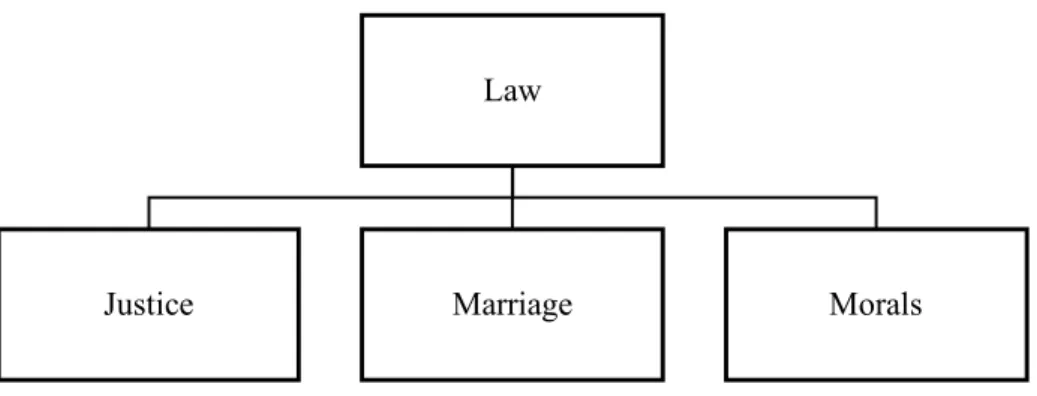
(42)

p.51). The social institutions are listed as “the family, religion, law, politics,

economics, education, medicine, science, and the military” (Henslin, 1998, p.88).

Accordingly, social institutions can be arranged differently based on the structure of

a society or similarly, institutions can gain or lose prominence, but will be central to

the understanding of the needs within a society (Brinkerhoff, White, & Ortega,

1995).

Economy

The institution of economy is responsible from “producing and distributing goods

and services” (Henslin, 1998, p.293).

Education

The institution of education is responsible from the transmission of “knowledge and

skills across the generations” (Henslin, 1998, p.89).

Family

Henslin (1998) defines family as a group that “consists of two or more people who

consider themselves related by blood, marriage, or adoption.” (p.309). Family as a

social institution provides maintenance of the society through taking care of

reproduction as well as safeguarding of children (Henslin, 1998).

Law

Law is a social institution which aims to “maintain social order” (Henslin, 1998,

p.89).

(43)

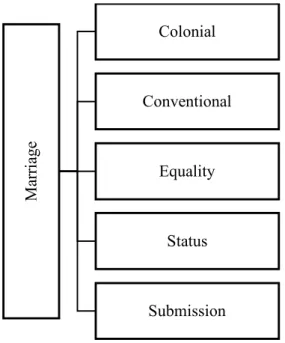
Marriage

Brinkerhoff, White, and Ortega (1995) define marriage as “an institutionalized social

structure that provides an enduring framework for regulating sexual behavior and

childbearing” (p.172). Marriage plays a crucial role for the institution of family in

defining and organising the familial relationships and providing roles to the members

of a family (Henslin, 1998).

Medicine

In its most fundamental role, the social institution of medicine provides the needs for

healing the unhealthy (Henslin, 1998).

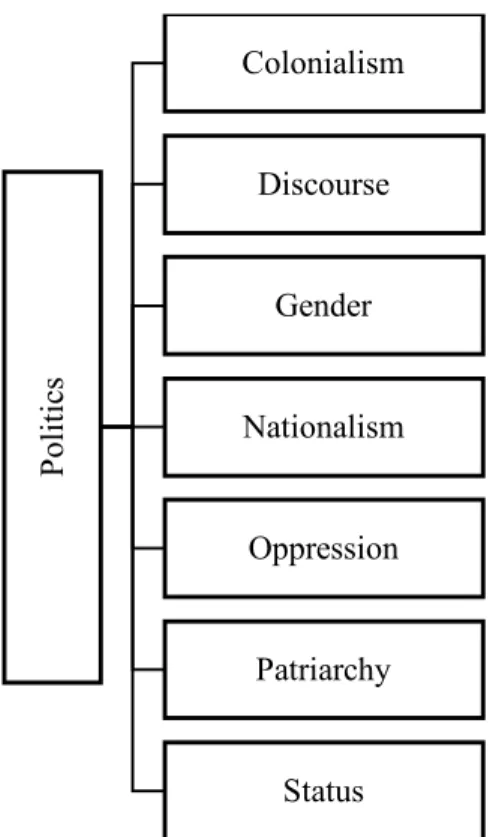
Politics

The social institution of politics creates hierarchies regarding “power and authority”

(Henslin, 1998, p.280). Accordingly, the institution of politics runs with the system

of a governance and power relations within the groups (Henslin, 1998)

Religion

Religion as a social institution is defined by Durkheim (1912) through beliefs,

practices and the moral community which eventually provides “a unified system of

beliefs and practices relative to sacred things” (as cited in Henslin, 1998, p.349).

(44)

CHAPTER 3: METHOD

This chapter introduces the research method used, and provides information about

how the database was formed, how second order interpretations were identified and

how the third order interpretations were derived.

Research design

This study aims to identify issues and conflicts concerning gender within the context

of Brontë's Jane Eyre for developing lines of argument as guidelines to inform

critical literacy instruction. To this end, MA theses and PhD dissertations focusing

on Jane Eyre were selected to ascertain second-order interpretations through

interpretive synthesis. The second-order interpretations that were further synthesised

within the context of social institutions were then used to generate third-order

constructs in the form of lines of argument to provide guidelines for informing

critical literacy instruction.

Qualitative synthesis

Even though, still developing, qualitative synthesis has been used for research in

education (Campbell, Pound, Morgan, Daker-White, Britten, Pill, Yardley, Pope, &

Donovan, 2011). Synthesis extends narration and a review of related literature as

synthesis includes the interpretation and reinterpretation of studies and it is referred

to as a “conceptual innovation” (Campbell et al., 2011, p.2).

(45)

interpreting and representing them in a collective form” (Campbell et al., 2011, p.5).

Thus, what makes qualitative synthesis a distinct research methodology is that the

research is “based on the published findings” (Campbell et al., 2011, p.2).

It is identified that the synthesis of qualitative studies and research has different

methods which are “narrative, critical interpretive synthesis, study,

meta-ethnography, grounded formal theory, thematic synthesis, textual narrative synthesis,

framework synthesis and ecological triangulation.” (Barnett-Page & Thomas, 2009,

p.5). Each of these different qualitative synthesis methods have different approaches

to synthesising the studies and these different approaches are named as numeric

synthesis, narrative synthesis and interpretive synthesis (Campbell et al., 2011).

While different methods can be used for synthesising qualitative studies, the research

method selected for this study is interpretive synthesis.

Interpretive synthesis

Interpretive synthesis is defined as “bringing together of findings on a chosen theme”

(Campbell et al., 2011, p.2) and the results of an interpretive synthesis is defined as

“a new interpretation or theory that goes beyond the findings of any individual

study.” (p.8). Strike and Posner (1983) suggest that interpretive synthesis results in a

“conceptual innovation” (as cited in Britten et al., 2002, p.209) such as a new

interpretation or a theory based on the synthesis. This synthesis is based on second

order constructs, through the analysis of the recurring concepts which will then form

(46)

Schütz’s (1962) concept of first order and second order constructs is frequently

utilized in meta-ethnographic studies. First order in this context is the novel, Jane

Eyre, itself. Second order construct refers to the interpretations of the authors of the

theses and dissertations. Third order constructs are generated by synthesising and

interpreting first and second order constructs for generating lines of arguments.

Meta-ethnography

Meta-ethnography “is the translation of studies into one another, which encourages

the researcher to understand and transfer ideas, concepts and metaphors across

different studies” (Britten et al., 2002, p.210) to produce new interpretations as

“higher order constructs” (Barnett-Page & Thomas, 2009, p.15).

Noblit and Hare (1988) indicate that the synthesis through meta-ethnography

answers “how to put together written interpretive accounts” (as cited in Barnett-Page

& Thomas, 2009, p.5) as it is a method for building up “an inductive and interpretive

form of knowledge synthesis” (as cited in Doyle, 2003, p.325). The process of

meta-ethnography involves detailed reading of the selected studies to identify recurring

concepts, and an analysis of these concepts to identify the overarching ideas

(Campbell et al., 2011). Then these analyses are translated between different studies

which produce the interpretive synthesis (as cited in Britten et al., 2002). There are

three different approaches to the synthesis of studies under meta-ethnography.

Studies can be translated into each other to inform wider concepts which is called as

“reciprocal translational analysis” (Barnett-Page & Thomas, 2009, p.5), the

differences between the studies can be highlighted in “refutational synthesis” (p.5),

and finally studies can inform a wider understanding as “lines-of-argument

(47)

synthesis” (p.5). This study will use lines of argument synthesis for providing

summary guidelines on critical literacy instruction, as lines of argument synthesis is

used to express the finding of the study as a “whole” (Noblit & Hare, 1988, p.63).

Meta-ethnography is defined as a seven staged process by Noblit and Hare (1988) (as

cited in Atkins et al., 2008; Britten et al., 2002; Campbell et al., 2011; Noblit &

Hare, 1988). The stages were named as “getting started; deciding what is relevant to

the initial interest; reading the studies; determining how the studies are related;

translating the studies into one another; synthesising translations; and expressing the

synthesis.” (Britten et al., 2002, p.1).

The details of the stages are as follows;

•   Stage 1: The first stage of interpretive synthesis includes the identification of

a research area which is convenient for qualitative research (Campbell et al.,

2011; Atkins et al., 2008). In stage 1, the researcher identified a research

question to be studied through qualitative research (Atkins et al., 2008).

During this stage, with the help of the related literature, the initial area of

interest, purpose of the study, research question that the study aims to answer

and the online database were defined.

•   Stage 2: This stage involves “deciding what is relevant to initial interest”

(Atkins et al., 2008, p.3) and includes identifying and selecting the

(48)

abstracts (Atkins et al., 2008). During stage 2, according to the research

question, the database and key words of gender, race and class were selected

to identify the studies that are relevant to the research interest. In total, 229

studies were found. Then, these studies were primarily analysed by reading

the abstracts of each study individually in order to decide on their relevancy.

As Atkins et al. (2008) state the definition and limitation of the scope of the

study helps to have a convenient amount of studies to focus on, and it is

during this stage that gender was identified as the focus and scope of the

study.

•   Stage 3: This stage is defined by Noblit and Hare (1998) as “the repeated

reading of the accounts and the noting of interpretative metaphors” (p.28). It

is stated that the aim of stage 3 is “becoming as familiar as possible with the

content and detail of the included studies and beginning the process of

extracting ‘metaphors’ or emerging themes” (Atkins et al., 2008, p.6). In

order not to interpret or lose necessary information from the studies, during

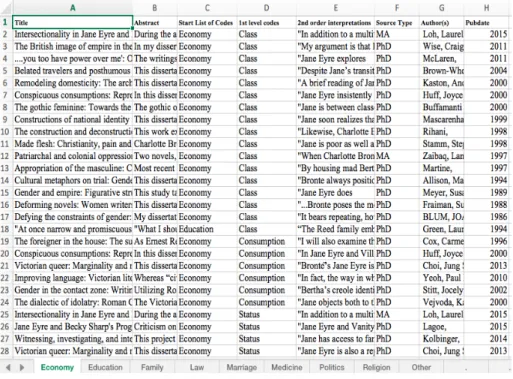
this stage, key ideas from the studies were transferred to a Microsoft Excel

sheet in the form of key words and statements taken from the studies’

abstracts (Figure 1). This stage included detailed reading and annotation of

the abstracts of the selected studies on gender, to determine initial ideas and

themes within each study for further analysis. The ideas and themes that

emerged from the studies during this stage were used as the initial reference

for the categorisation of the studies.

(49)

individually. These themes, or metaphors, are used in order to label and

categorise the studies and to determine the relation between studies.

According to Noblit and Hare (1988), these metaphors can be defined

through the words of the primary author or words that the researcher

establishes (as cited in Doyle, 2003). As stated, the repeated use of key

concepts and ideas to label each study forms primary synthesis and

connection between the studies (Campbell et al., 2011). During this stage, the

recurring ideas were identified in connection with the social institutions, and

used in order to label the studies to find a pattern and connection between the

studies, which would help to form a narrative regarding stages 6 and 7.

Regarding the identified ideas in stage 4, social institutions were presented in

figures in order to highlight how they are used in analysis.

•   Stage 5: This stage includes the translation of the studies by referring to the

ideas that were identified in stage 4 and comparing these key ideas within the

studies with one another (Noblit & Hare, 1988). Translation of the studies

means “comparing the metaphors and concepts in one account with the

metaphors and concepts in others” (Atkins et al., 2008, p.7). Translating the

studies into one another is a stage in which second order interpretations are

also used (as cited in Britten et al., 2002). The second-order interpretations,

which are the authors’ interpretations in each study, were selected based on

the key ideas that were identified in stage 4. Each second-order interpretation

(50)

•   Stage 6: In this stage, the translations are synthesised into “a higher order

interpretation which distils the translations into more than the parts alone

which implies-a “line of argument” synthesis.” (Atkins et al., 2008, p.7). The

line of argument is the “development of a new model, theory or

understanding by synthesizing and interpreting first and second order themes

found in the text” (p.6). As Doyle (2003) states, “translations consist of

textual units in either the original or newly created language” (p.330).

Translations are built from the records in the tables as presented in the form

of second-order interpretations. Synthesis and connection between the studies

are conducted “by reading the concepts and interpretations off the grid”

(Britten et al., 2002, p.211), which for this study refers to the reading of the

second-order interpretations and the codes indicated in tables. After the

synthesis, the lines of arguments were developed by taking into account but

also extending the second-order interpretations.

•   Stage 7: The final stage of meta-ethnography includes a final account of the

synthesis (Campbell et al., 2011). Noblit and Hare (1988) state that stage

seven of meta-ethnography “involves writing the synthesis, while considering

the audience for which it is being created” (as cited in Cahill, Robinson,

Pettigrew, Galvin, & Stanley, 2017, p.135). The presentation of the results of

synthesis can be expressed in the form of a text or in the form of visual

presentation (as cited in Cahill et al., 2017). For this study, the lines of

arguments were presented in tables that referred to the major constructs and

the corresponding lines of arguments in the form of statements and questions

as guidelines to inform critical literacy instruction.

(51)

Sampling

The context for the study was identified as Jane Eyre, after selecting its author from

from the IB Prescribed List of Authors and a careful prior analysis of the plot and the

themes, to ensure if the study is conducive for analysis and for providing guidelines

on critical literacy. To identify MA theses and PhD dissertations, the researcher used

the ProQuest Theses and Dissertations online database and selected the following

search terms ‘gender’, ‘race’, and ‘class’. The researcher then identified the relevant

studies by reading the abstracts, and formed a database, using a spreadsheet program.

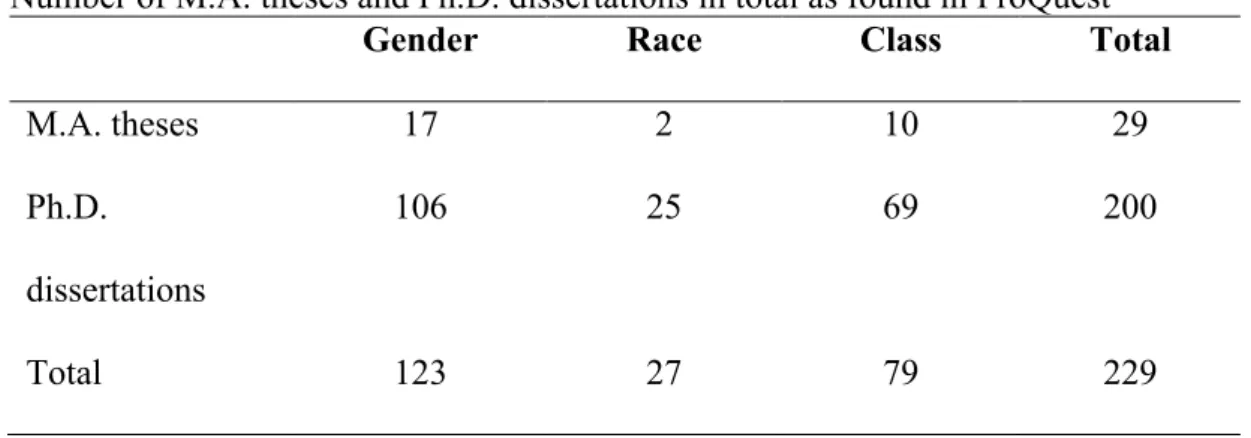
Initially, the researcher found a total of 229 studies, and given the number of studies

and the scope the thesis, she then reprioritized her focus, and concentrated on gender,

which formed more than fifty percent of the studies: 106 PhD dissertations, and 17

MA theses (Figure 1).

Şekil

Figure 2. Sample spreadsheet
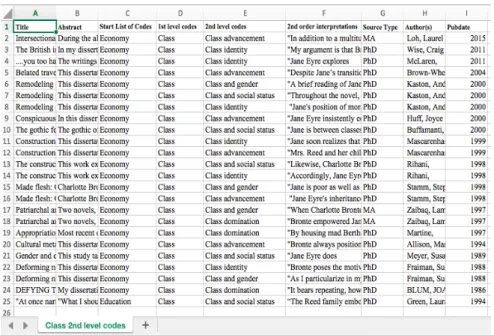
Figure 3. Sample transition from 1 st  level to 2 nd  level coding
Table 1 indicates the total number of studies that were found in the ProQuest Theses  and Dissertations database
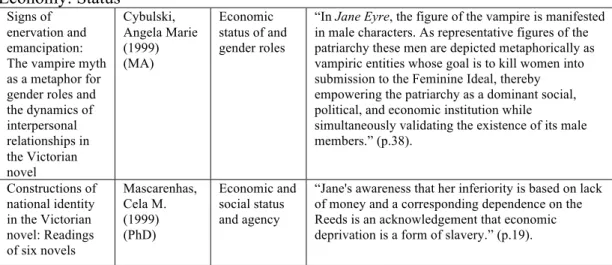
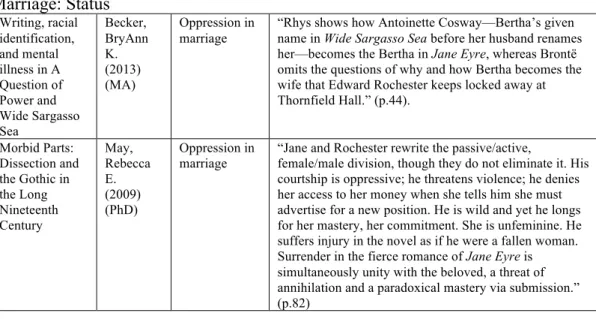
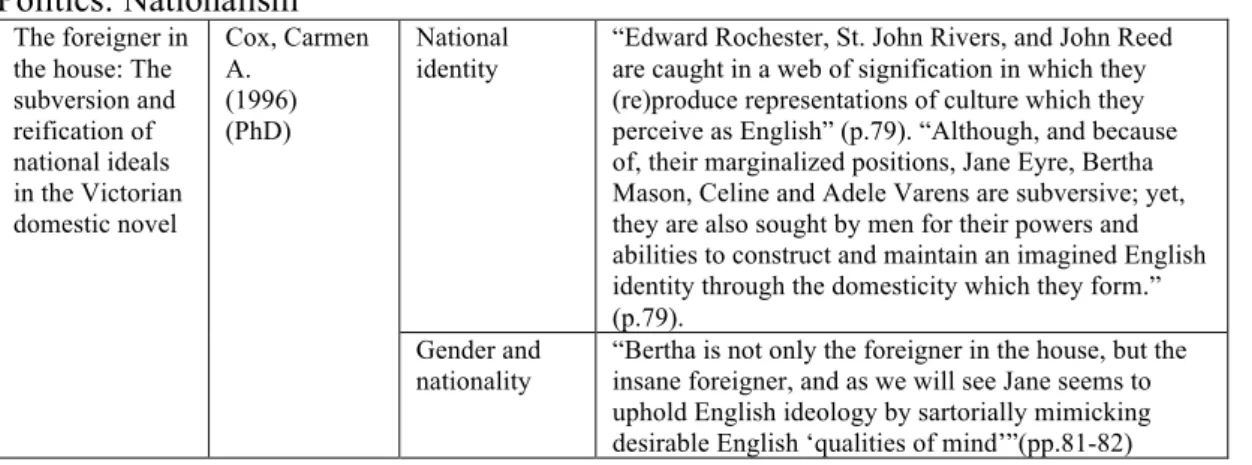
Table 9 (cont’d)  Economy: Status
+7

Referanslar

Benzer Belgeler

Variations of the calculated magnetic moment of the single Ti atom adsorbed to each (4 × 4) supercell of graphene with charging and applied perpendicular electric field.. (a) Side

While this pro- posed view is inline with our observations regarding catalyst particles with very high sulfur content facilitating CNT growth and may be extrapolated to explain

Üçüncü bölümde, adi diferansiyel denklemin simetri ile çözülebilmesi için gerekli olan değiĢmezlik Ģartı, değiĢmezlik Ģartından belirleyici denklemlerin

On the other hand, the Turkish Na- tional Pre-school Curriculum does not encour- age the teaching and learning of numeracy and literacy at preschool level; instead it stresses the

Abb. 8 Nilüfer, Bursa: Levallois-Kern vom Freilandfundplatz »Görükle-Deneme Tarlası«.. rakter bezüglich der Produktion lithischer Gerätschaften ist jedoch augenfällig. Die hier

The object of investigation is the concept of kernel with values locally bounded operators and that is invariant under an action of a ∗-semigroup and the main result refers to

GSEA revealed a signi ficant enrichment for gene sets, including E2F target genes related to cell cycle and DNA strand elongation related genes in the sensitive subgroup, suggesting

contrast-induced nephropathy, myocardial infarction, prognosis We read with interest the paper by Sigirci et al entitled “Can thrombus burden predict contrast-induced nephropathy