Contents lists available atScienceDirect
Colloids and Surfaces A
journal homepage:www.elsevier.com/locate/colsurfa
Haloalkanes and aromatic hydrocarbons sensing using Langmuir–Blodgett
thin film of pillar[5]arene-biphenylcarboxylic acid
Ahmed Nuri Kursunlu
a,1, Yaser Acikbas
b,1, Mustafa Ozmen
a,⁎, Matem Erdogan
c, Rifat Capan
c aDepartment of Chemistry, Faculty of Science, University of Selcuk, 42250, Konya, TurkeybDepartment of Materials Science and Nanotechnology Engineering, Faculty of Engineering, University of Usak, 64200, Usak, Turkey cDepartment of Physics, Faculty of Science, University of Balikesir, 10145, Balikesir, Turkey
G R A P H I C A L A B S T R A C T
SPR kinetic study of P5-BPCA LB thin film for chloromethane vapor.
A R T I C L E I N F O Keywords:
Pillararene Langmuir-Blodgett Surface plasmon resonance Quartz crystal microbalance Volatile organic compounds Swelling
A B S T R A C T
Here, a pillar[5]arene derivative including biphenylcarboxylic acid groups was designed for obtaining a mac-rocycle with an ideal cavity for volatile organic compounds. The pillar[5]arene -biphenylcarboxylic acid (P5-BPCA) based Langmuir-Blodgett (LB) thin films were produced onto 50 nm thick gold-coated glass and 3.5 MHz quartz crystal substrates to form a thin film chemical sensor element. Surface plasmon resonance (SPR) and Quartz crystal microbalance (QCM) techniques were employed to characterize all the P5-BPCA LB thin film layers. The mass of LB film layer loaded onto a quartz crystal and the resonance frequency shifts per layer were determined to be 711.71 ng per layer (2.68 ng mm−2) and 48.24 Hz per layer, respectively. The P5-BPCA LB thin
film sensor element was exposed to various haloalkane and aromatic hydrocarbon vapors. The sensitivities of the P5-BPCA LB film sensor were determined between 1.776 and 3.976 Hz ppm−1. Sensitivity with detection limits
were obtained between 0.754 and 1.689 ppm against organic vapors. The results showed that P5-BPCA LB thin film was highly selective with a large response to chloromethane vapor.
https://doi.org/10.1016/j.colsurfa.2018.12.050
Received 10 September 2018; Received in revised form 9 November 2018; Accepted 25 December 2018
⁎Corresponding author at: Department of Chemistry, University of Selcuk, 42250 Konya, Turkey.
E-mail address:[email protected](M. Ozmen).
1These authors contributed equally to this work.
Colloids and Surfaces A 565 (2019) 108–117
Available online 26 December 2018
0927-7757/ © 2018 Elsevier B.V. All rights reserved.
1. Introduction
The occurrence of host-guest systems provides a guide for the de-velopment of macrocyclic molecules due to their excellent properties in various researches [1–6]. Novel origin macrocyclic molecules have been designed and prepared by sensor chemists on host-guest principle [7,8]. Among host molecules, pillararenes are one of the youngest classes and they are named as new key players in supramolecular chemistry [9–11]. It has been discovered in 2008 that their fascinating properties such as planar chirality, tunable cavity made them more advantageous from other macrocycles such as calixarene, crown ether, cyclodextrin, etc [12–16]. The high potential of the host macrocycles was successfully operated in sensor studies and the functionalized pil-lararenes were offered as a gas sensor for carbon monoxide, propane, hydrogen sulfur [17–19]. The pillararene chemists focused mostly on the pillar[5]arene derivatives though other varieties including four, six or seven moieties are available. Guest sensitivity and selectivity related with the cavity of the target pillar[5]arene is appropriate for detection purposes [20–23]. Although other macrocycles widely served as host cycles in the detection of volatile solvent guests, these solvents have been seldom reported with pillar[5]arene for the inclusion complexa-tion [24–26]. The generated pollution of organic volatiles threatens life both indoors and outdoors due to their irritant, toxic and carcinogenic effects. Yet, they are extensively used in daily working environments and are required in chemistry laboratories, synthetic dyes, plastics-cosmetics-wood industries and paints. They must be removed before they reach critical levels and their detection has become an increasingly significant issue during the last few decades. There is an increasing desire to design novel sensor molecules with lower cost when compared to existing sensors [27–30].
Thin organic films with a few nanometer (monolayer) thickness are very important in many applications such as sensors [31], detectors [32], displays [33], coatings [34] and electronic circuit components [35]. The Langmuir-Blodgett (LB) method is the most promising method for preparing nanoscale organized monolayer/multilayers as it enables precise control of the monolayer thickness, homogeneous de-position over large areas, multilayer structures with varying layer composition and deposition on any kind of solid substrate [36].
In spite of significant researches in pillararene chemistry, studies on new generation pillararene compounds and LB thin film fabrication technique are still very limited for gas sensor applications. This paper reports the findings of a study that started with the synthesis of pillar[5] arene including biphenylcarboxylic acid (P5-BPCA) and the prepara-tion of thin films utilizing the LB thin film method. Then, the prepared LB films were subjected to various saturated VOCs vapors to investigate the swelling process in chemical sensor applications. These volatile organic compounds were easily detected by means of the appropriate cavity and host–guest inclusion interaction. Using the SPR and QCM measurement systems, variations in the intensity of reflected light and the resonance frequency were monitored in real time during swelling in which organic vapor was introduced into a gas cell. Early-time Fick’s law of diffusion was adopted to fit the SPR results. The results show that this P5-BPCA LB film material has an excellent sensitivity and se-lectivity for chloromethane and can have potential applications in the development of room temperature organic vapor sensing devices. 2. Materials and methods
2.1. Materials
The synthesis route of 1,4-bis(2-iodoethoxy)benzene, I- pillar[5] arene and P5-BPCA were given inScheme 1where all reactions were carried out in argon atmosphere. 4′-Hydroxy-4-biphenylcarboxylic acid, boron trifluoride etherate, carbon tetraiodide, 1,4-Bis(2-hydro-xyethoxy)benzene, potassium hydroxide, paraformaldehyde, sulphuric
acid triphenylphosphine, chloroform, methanol, potassium carbonate, benzene, dichloromethane, 1,2-dichloroethane, and toluene were commercially obtained from Sigma-Aldrich, Merck, Acros and TCI.1
H-NMR and 13C-NMR spectra were carried out at r.t. on a Varian
400 MHz. The elemental analyses results were taken from a TruSpec Elemental Analyzer. The infrared measurements were performed on a Bruker Fourier Transform Infrared FTIR (ATR).
2.2. The preparation of 1,4-bis(2-iodoethoxy)benzene
To 100 mL of acetonitrile of triphenylphosphine (3.15 g, 6 mmol) and 1,4-Bis(2-hydroxyethoxy)benzene (1.19 g, 6 mmol) mixture solu-tion, carbon tetraiodide (6.12 g, 12 mmol) was slowly added in small portions at 0 °C. The reaction was allowed to stir at room temperature for 4 h in an argon gas atmosphere. The resulting mixture was poured through 200 g of ice and 1,4-bis(2-iodoethoxy)benzene precipitated as a white solid. After filtration in vacuum, the product was washed with cold methanol:H2O (3:2). The product was dried in desiccator. (2.50 g,
86%).1H-NMR (400 MHz, chloroform-d, room temperature) δ (ppm):
6.89 (s, 4H, ArH), 4.35 (t, J = 5.2 Hz, 4H, CH2), 3.49 (t, J = 5.7 Hz, 4H,
CH2).13C-NMR (100 MHz) δ (ppm): 150.41, 116.00, 75.22, 4.35.
2.3. The preparation of I- pillar[5]arene
I- pillar[5]arene was obtained according to a known literature method [26]. 1,4-bis(2-iodoethoxy)benzene (2.82 g, 6.75 mmol) was solved in 1,2-dichloroethane (80 mL) at r. t. and then paraformaldehyde (0.51 g, 18 mmol) was added to this solution. After one hour, BF3.OEt2
(0.8 g, 6.75 mmol) was injected by syringe to main mixture. Under a nitrogen atmosphere, the reaction was continued while stirring for 3 h in the absence of light. The polymer particles were observed and the heterogenic mixture was filtrated in rough column (di-chloromethane:cyclohexane (50:50)). The pale yellow solid re-purified with same mixture solvent in column. White needle crystals were ob-tained (0.96 g, 35%). 1H-NMR (400 MHz, chloroform-d, room
tem-perature) δ (ppm): 6.89 (s, 10 H), 4.33 (t, J = 5.4 Hz, 20 H), 3.86 (s, 10 H), 3.50 (t, J = 5.4 Hz, 20 H).13C-NMR (100 MHz) δ (ppm): 149.92,
125.91, 116.29, 67.41, 29.59, and 3.89. Elemental Analysis calcd.: C55H60I10O10: C, 30.72; H, 2.81; found: C, 30.62; H, 3.11.
2.4. The preparation of P5-BPCA
P5-BPCA was synthesized by a classical method for the organic molecule including carboxylic acid [37]. 1.61 g of potassium hydroxide was dissolved in 100 mL of methanol. Then, 2.0 g (93 mmol) of 4′-hy-droxy-4-biphenylcarboxylic acid and 2.0 g (9.3 mmol) of I- pillar[5] arene were added to the solution and refluxed for 18 h. 100 mL of 20% aqueous potassium hydroxide solution was added and refluxed for an-other 3 h. After cooling, concentrated H2SO4was dropped into the
so-lution until it was acidic. Filtration and recrystallization from methanol gave 1.26 g of pure product (yield 45%).1H-NMR (400 MHz,
chloro-form-d, room temperature) δ (ppm): 8.12 (d, 20H, ArH). 7.84 (d, 20H, ArH), 7.71 (d, 20H, ArH), 7.08 (d, 20H, ArH), 6.95 (bs, 10H, ArH), 3.86-3.82 (bs, 80 H). 13C-NMR (100 MHz) δ (ppm): 167.9. 158.43,
149.85, 144.99, 132.11, 131.01, 128.14, 126.93, 125.17, 118.92, 116.29, 114.92, 69.15, 30.13. Elemental Analysis calcd. C185H150O40:
C, 73.74; H, 5.02; found: C, 74.02; H, 5.32; m/z found for [M+H]+,
3013.6.
2.5. LB film preparation
Nima Technology, model 622 LB trough was used to deposit the newly synthesized P5-BPCA macrocycle on gold-coated glass and quartz crystal substrates. Dilute solution of P5-BPCA in chloroform was prepared in 0.59 mg mL−1concentration and 500 μL of solution were
poured by well-known microliter syringe of Hamilton onto the pure water subphase of LB trough. Prior to LB trough compression, solution was left for 10 min and compressed at speed of 25 cm2 min−1at room
temperature. In order to control the stability of isotherm graphs, this cycle was carried out several times and 18 mN m−1value of the surface
pressure was chosen as a deposition pressure for the monolayers. The dipping speed was fixed for monolayers as 30 mm min−1during
de-position.
2.6. SPR and QCM techniques
In this work, BIOSUPLAR 6 Model 321 Surface Plasmon Resonance Spectrometer equipped with a low power laser diode at the wavelength of 632.8 nm was used for kinetic measurements. It has an angular re-solution better than 0.003 °, refractive index of the glass prism is known as 1.62 and it is suitable to get data in solution and dry air. SPR sub-strates are found commercially and gold layer was homogeneously deposited on a glass slide. Semi-transparent flow chamber as a cell was constructed in-house to record the interaction between active layer of potential sensor materials and VOC was used. Two tiny cylindrical hoses called, inlet and outlet bridged this SPR cell. The complete SPR system is computerized and checked by Biosuplar-Software which is responsible for data collection and presentation. The photodetector reaction can be measured versus time for different modes: single mea-surement, tracking, or slope mode. It is possible to visualize and com-pare the data taken from both measurement channels. In order to see the interaction between P5-BPCA and VOC’s, LB films of P5-BPCA materials were exposed to VOC’s for 2 min and dry air for 2 min cycles. All data was evaluated by WINSPALL software and the fitting procedure helped find out the thickness of the P5-BPCA LB thin film.
Beside deposition of monolayers of P5-BPCA material onto quartz crystal substrate, two concentric, disc shaped raw quartz slices sand-wiched between two electrodes (3.5 MHz from GTE SYLVANIA Company) were used for the QCM measurement. The shift of the fre-quency referred to the degree of response between sensor and analyst. All experiments were conducted at room temperature and precision was given as 1 Hz.
3. Results and discussions 3.1. Characterization of compounds
As shown in Fig. S1, the functional groups of I- pillar[5]arene and P5-BPCA were illuminated by FTIR spectroscopy. The comments on the infrared spectrum of 1,4-bis(2-iodoethoxy)benzene had been reported in previous paper [26]. The infrared spectra of both I- pillar[5]arene and target compound gave multi-vibrations corresponding from aro-matic/aliphatic C–H stretching between 2850–3050 cm―1. The
stretching vibrations of aromatic C]C bonds of pillararene core ap-peared around 1498 and 1400 cm―1as multiple bands in broad or
sharp forms. The C–O sharp band at 1231 cm―1in the spectrum of
1,4-bis(2-iodoethoxy)benzene shifted to 1201 cm―1in the spectrum of
I-pillar[5]arene while the corresponding peak was observed at 1200 cm―1as broad form in the infrared spectrum of P5-BPCA. The
most specific difference between I- pillar[5]arene and P5-BPCA is broad peak around 1700 cm―1that is assigned to the C]O vibration
band of 4-biphenylcarboxylic acid group. All FT-IR measurements show the successful synthesis of target macrocycle.
Previous literature [26] reported that the singlet peaks observed at 6.91 ppm assign to CH on benzene unit of 1,4-bis(2-iodoethoxy)ben-zene. Moreover, two triplet peaks at 4.32 ppm and 3.51 ppm show identical CH2 fragments in para position. In 1H-NMR of I- pillar[5]
arene, singlet peak assigns to the methylene bridge protons at 3.87 ppm through annulus-rotation and the integration ratio of aromatic CH protons declined from four to two due to bilateral bonding from para position. Other CH2protons appeared almost in same ppm values and
triplet form following pentameric cyclization. Then, 4′-hydroxy-4-bi-phenylcarboxylic acid was reacted with I- pillar[5]arene and new peaks are observed in aromatic region and some shifts/overlapping occurred on existing peaks (Fig. S2). For example, CH2peaks approached each
other and almost overlapped owing to similar electron withdrawing group dually bounded ethylene unit. In addition, the aromatic proton peaks of biphenyl carboxylic acid group rise as various doublets in NMR spectrum of P5-BPCA. It could be claimed that P5-BPCA has a pseudo D5 symmetry. The integration values of all peaks equivalent amount for Scheme 1. The synthesis route of P5-BPCA.
intermediate and target products. Similar results were also obtained in
13C-NMR spectra that the peaks can be clearly attributed to the
corre-sponding carbon moieties in the target molecule. The symmetrical and asymmetrical rotation of biphenyl carboxylic acid moieties of P5-BPCA can shrink or increase to the cavity of pillar[5]arene core depending on freedom motion. This can be explained by multi/complex stretching and bending vibrations between various atoms and groups in macro-cycle having a molecular weight like 3013 gmol―1. Actually, this is not
surprising and can submit to a more stable structure having an excellent D5 symmetry. On the other hand, intermolecular interactions as polar-polar or hydrogen bonding affected the characterization of target macrocycle that the carboxylic acid fragments play a significant role in all push-pull equilibrium just as an octopus.
3.2. SEM, contact angle and AFM measurements
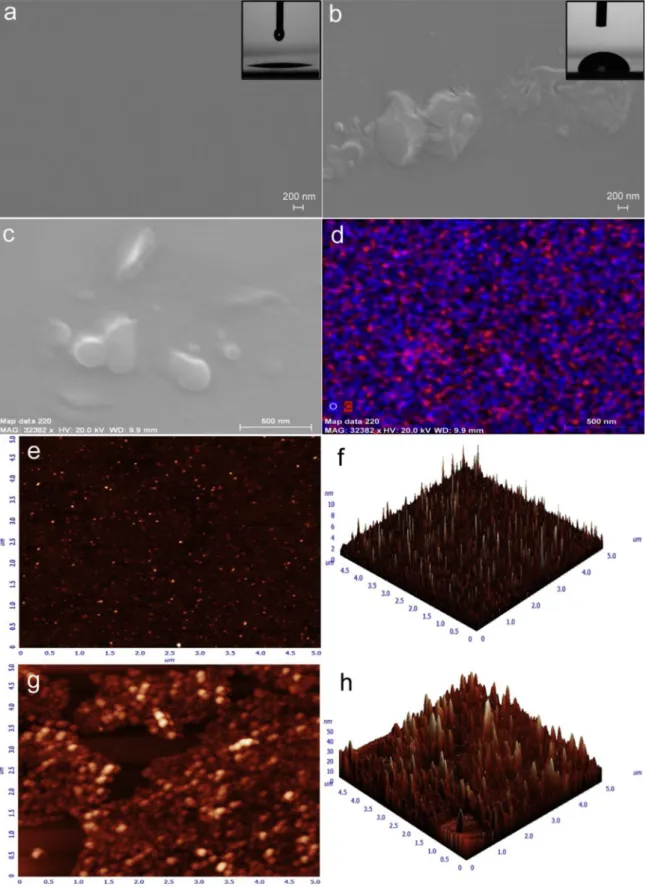
SEM observations were made in a Zeiss EVO LS10 model scanning electron microscope operated at 20 kV. When we compared the images of scanning electron microscopy of the clean glass substrate (Fig. 1a) and the P5-BPCA LB film (Fig. 1b), it can be seen that a matrix of or-ganic pillar[5]arene-biphenylcarboxylic acid molecules have been formed. In addition, the Energy Dispersive X-ray (EDX) mapping of the P5-BPCA SEM image (Fig. 1c) demonstrates the presence and homo-geneous distribution of C and O elements (Fig. 1d).
Contact angle measurements were carried out using the sessile drop method to investigate the wetting properties of the formed LB film on glass. Water Contact Angles of surfaces were measured on a Krüss FM40Mk2 EasyDrop contact angle instrument with 5.0 μL water dro-plets. Contact angle measurements were taken at least five times at different locations on the surface. The average values were used in contact angle analysis. The standard software supplied by Krüss was used for evaluation of data. The equilibrium contact angle of water on clean glass surface (inset ofFig. 1a) was measured as 6° ± 2.2° while for the P5-BPCA LB film (inset ofFig. 1b) the measured contact angle of water drop was 83° ± 3.1°. The formation of P5-BPCA layers on clean glass substrate increase the contact angle owing to hydrophobic frag-ments of the macrocycle.
AFM images were obtained by using NT-MDT AFM NTEGRA Solaris model instrument. Semi-contact mode of AFM in air was used to in-vestigate the thin film surface morphology. The 2D and 3D AFM images of the cleaned glass and LB film of P5-BPCA surfaces are presented in Fig. 1e–h, respectively. The differences between bare (Fig. 1e) and P5-BPCA-coated (Fig. 1g) glass surfaces can be seen that the formation of P5-BPCA LB film changed the topography of the bare glass surface. From the topographical data, the area roughness (Ra) and the root mean
square (RMS) values have been calculated as 0.3310 nm and 0.5338 nm, respectively for bare glass surface while 4.9404 nm and 6.5377 nm for P5-BPCA LB film on an area of 5 μm × 5 μm. It can be said that the P5-BPCA LB films on bare glass surface are uniform, close-packed, and homogeneous. AFM image shows that P5-BPCA LB film has a grainy and porous form. This may be an advantage for gas sensing applications due to its high surface to volume ratio [38].
3.3. Isotherm graph and transfer ratio
Fig. 2indicates the surface arrangement of P5-BPCA monolayer
(π-A isotherm graph) at the air-water interface at a value of pH 6. This
graph was used to analyze the surface behavior and calculate the area per molecule,am, for a floating monolayer at the air-water interface
given by [39] = a AM cN V m w A (1)
where A is the limited area of the molecules compressed by the moveable barriers (taken from Fig. 2), Mw (3013 g mol−1) is the
molecular weight of P5-BPCA, c (0.59 mg mL−1) is the solution
con-centration, V (500 μL) is the solution volume spread over the air-water interface and NA(6.023 × 10²³) is the Avogadro’s number. UsingFig. 2 and a method of extrapolating the linear region of the isotherm to zero pressure,amwas estimated to be 1.80 nm2. A suitable surface pressure
fromFig. 2for P5-BPCA LB film deposition process was found to be 18 mN m−1. In our recent study the same surface pressure was used for
pillar[5]arene-quinoline LB thin film preparation [26].
The deposition process of each LB film monolayer can be monitored to calculate the transfer ratio value (TR) given by:
=
TR A A1 2 (2)
where A1is given by reduced area of the monolayer on the water
sur-face during the deposition process and A2is the area of coated LB film
on the solid substrate. Decreasing of the monolayer area on the water surface for each bilayer should be equal to the transfer process of monolayer onto the solid substrate. Using Eq.2TR ratio is calculated to be 95% for the P5-BPCA and this result confirms that a uniform and reproducible LB film deposition occurred during the LB film fabrication. It is also consistent with our previous study where TR value was cal-culated over 94% for the pillar[5]arene-quinoline LB thin film [26]. As a result, monolayers at air-water interface based on pillar[5]arene are suitable coating materials for LB films and can easily transfer onto glass, quartz crystal and a gold coated glass slide with a high transfer ratio.
3.4. Quartz crystal microbalance results
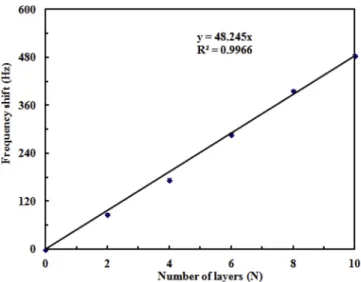
QCM measurement technique allows us to study the mass change of the quartz crystal surface deposited LB thin film as a function of re-sonance frequency [40]. In here, a mass change per unit area ( m) versus the resonance frequency change ( f ) on the P5-BPCA LB film layer/multilayer quartz crystal is calculated from the Sauerbrey equa-tion [41].Fig. 3shows the deposition of the P5-BPCA LB films onto a quartz crystal substrate for ten layers. It is clear that the number of LB film layers is increased, and the resonance frequency shift is also in-creased. This linearity between f and N shows that a regular deposi-tion of P5-BPCA onto the QCM substrate occurred adequately and equal mass of P5-BPCA is deposited per unit area. The frequency shifts of 48.24 Hz/per layer for the P5-BPCA LB films are determined from the slope ofFig. 3. The amount of deposited mass on the quartz crystal substrate per bilayer is estimated as 711.71 ng (2.68 ng mm−2) for the
P5-BPCA LB film usingFig. 3and the Sauerbrey equation.
3.5. Surface plasmon resonance results
A picture of the SPR system including an ideal SPR curve and time dependent SPR kinetic measurement is given in Fig. S3. The LB film thickness and vapor sensing performance of the P5-BPCA material was characterized using SPR system. Optical contact between the P5-BPCA gold-coated glass and prism was made by an index matching liquid. The SPR angle and curve are achieved when the plasmon waves resonate with the incident light that were absorbed by free electrons at the thin gold surface. The experimental SPR curves as a function of the angle of incidence (θ) was taken to check the deposition process of P5-BPCA onto 50 nm gold-coated glass substrate and given inFig. 4. When the number of LB film layers is increased, the angle of incidence is shifted to larger angles. The SPR curve of the bare gold is used as a reference. The linear relationship between Δθ (the peak shifts of the SPR curves) and N is shown as an inset graph inFig. 4. This linear graph indicates that a uniform deposition process of P5-BPCA material onto the gold-coated glass substrate occurred adequately and the same amount of mass of P5-BPCA was deposited per unit area.
The film thickness of P5-BPCA LB films was calculated with the Fresnel theory using the Winspall software which was developed by Wolfgang Knoll [42] by fitting the experimental SPR curves. Since the
P5-BPCA LB films are transparent at λ = 632.8 nm, and the extinction coefficient (k) of these LB films is estimated as zero (k = 0) [43]. The SPR curves (presented as experimentally and fitted) of the bare gold film and four-layer P5-BPCA LB films are shown inFig. 5. Same cal-culation was carried out for different layer numbers (4, 8 and 12 layers)
of P5-BPCA LB film. The inset graph inFig. 5shows that the thickness of the P5-BPCA LB films increased linearly with the number of layers. The P5-BPCA LB film thickness is determined as 1.10 ± 0.08 nm by using Winspall software.
Fig. 1. SEM images of bare glass (a), P5-BPCA coated glass (b, c), EDX mapping of image “c” (d); AFM images of bare glass surface (e, f) and P5-BPCA coated glass (g, h). Contact angle images of bare glass (inset of image “a”) and P5-BPCA coated glass (inset of image “b”).
3.6. Vapor sensing properties of the P5-BPCA LB film
Figs. 6 and 7show the photodetector response of the P5-BPCA sensing materials for saturated organic vapors. The SPR kinetic study was carried out by injection of dry air and organic vapor for 2 min, periodically. Haloalkanes and aromatic hydrocarbons as organic vapors were chosen to investigate their interaction with P5-BPCA LB thin films. To ensure the response stability of P5-BPCA LB film sensor, at the beginning film was exposed to dry air for 120 s and there was certainly no change at all seen inFig. 6. When the P5-BPCA film was exposed to saturated organic vapors, surface adsorption effect took place and a sudden increase can be seen. After the vapor molecules start diffusing into the P5-BPCA film, frequency begins to change downward ex-ponentially. For the recovery of the film dry air was introduced into the cell at the time of 240 s. Desorption of vapor molecules starts between 240 and 244 s, and frequency values instantaneously return to initial values. These surface adsorption, diffusion and desorption processes refer to reproducibility, reversibility and sensitivity of P5-BPCA LB thin films. The physical properties of the organic vapors, changes of fre-quency and diffusion coefficients for P5-BPCA LB thin films against each organic vapor are presented inTable 1. P5-BPCA LB thin film sensor is remarkably more selective and sensitive to chloromethane vapor than all the other haloalkane and aromatic hydrocarbon vapors. SPR kinetic measurements were repeated three times to ensure re-producibility of the sensor response. The inset graphs inFigs. 6 and 7 display the QCM kinetic response of the P5-BPCA LB thin film sensor for haloalkanes and aromatic hydrocarbons at saturated concentration values. This LB film shows a response to all vapors that is fast, re-producible and reversible after flushing the gas cell with fresh air. The SPR and QCM kinetic measurements show that LB film sensor prepared with P5-BPCA material is found to be more sensitive to chloromethane vapor than other organic vapors. Also, the reproducibility of the P5-BPCA LB thin film sensor for chloromethane and m-xylene vapors with different concentration values are shown in Fig. S6. When the con-centration of the vapor percentage increases, the frequency shifts or photodetector response increases proportionately.
The limit of detection (LOD) of the P5-BPCA LB film sensor was calculated by the measured sensor sensitivity (Hz / ppm). LOD was defined by [26]:
=
LOD 3 /S (3)
where, is the noise level of the fabricated QCM sensor, andSis the sensitivity to a specific analyte of the sensor. The sensitivity of LB film Fig. 4. SPR curves versus the angle of incidence (θ). Inset: SPR peak shifts (Δθ)
as a function of number of layers.
Fig. 5. Experimental (dots) and fitted (lines) SPR curves for 50 nm bare gold substrate and 4-layer P5-BPCA LB thin film. Inset: The calculated thickness values of the P5-BPCA LB films as a function of layer.
Fig. 2. Isotherm graph of the P5-BPCA monolayer.
Fig. 3. The frequency shifts of the P5-BPCA LB film against the number of layers.
sensor was obtained from the frequency shift curves when exposed to organic vapors (chloromethane and m-xylene) in Fig. S7. The approx-imate values of the curves were obtained from this figure. In this study, the resonance frequency was recorded in air for use as the absolute frequency of the QCM system, and the frequency response was stable within ± 1 Hz over a period of 25–40 min. Therefore, the frequency noise was estimated at 1 Hz. The sensitivities of the P5-BPCA QCM sensor to chloromethane and m-xylene vapors were obtained as 3.976 Hz ppm−1and 1.776 Hz ppm-1, respectively. Also, the detection
limit performances of the P5-BPCA QCM sensor to chloromethane and m-xylene vapors were calculated as 0.754 ppm and 1.689 ppm, re-spectively, at room temperature.
The following equation [44] can be used for concentration changes
in time if Fick’s second law of diffusion is applied to a plane sheet and solved by assuming a constant diffusion coefficient:
= + = C C x d n n n x d Dn d t 2 cos sin exp( ) n 0 1 2 2 2 (4)
whereC0and C are the concentration of the diffusant at time zero andt. xcorresponds to the distance at which C is measured.Dis the diffusion coefficient anddis the initial thickness of the slab. The concentration terms of the amount of diffusant can be transferred as
=
M CdV
V (5)
whereMis the mass uptake and V is the volume element. If Eq.(4)is Fig. 6. The photodetector response of the P5-BPCA LB thin film for haloalkane vapors. Inset: The frequency change of the P5-BPCA LB thin film against haloalkane vapors.
Fig. 7. The photodetector response of the P5-BPCA LB thin film for aromatic hydrocarbon vapors. Inset: The frequency change of the P5-BPCA LB thin film against aromatic hydrocarbon vapors.
considered for a plane volume element and used in Eq. (5), the fol-lowing Equation can be reached [45].
= + + = M M n n D d t 1 8 1 (2 1) exp( (2 1) ) t n 2 0 2 2 2 2 (6) whereMt andM , represent the penetrant mass sorbed into the
de-posited film at time t and at equilibrium state, respectively. Eq. (7) represents early time approximation [46] of the Eqs.(6)and can be used to interpret swelling data.
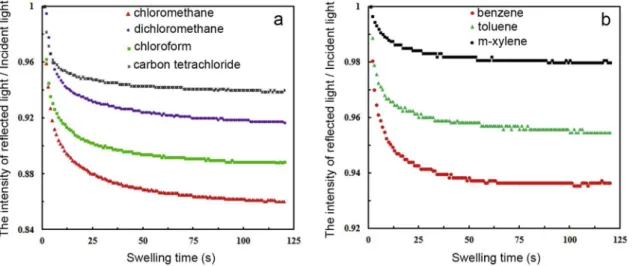
= M M D d t 4 t 2 1 2 (7) Figs. 6 and 7show the kinetic SPR data which is used to obtain the P5-BPCA LB film parameters due to swelling. The normalized intensity of reflected light against swelling time where the consolidation process involves setting the time to =t 0 for each swelling cycle is given in Fig. 8a and b. When the duration of vapor exposure increased, the in-tensity of reflected light decreased. This can be explained with the chain interdiffusion between P5-BPCA chains during vapor exposure. As the saturated vapors penetrate into P5-BPCA LB film, the P5-BPCA chains interdiffuse and transparency of the P5-BPCA LB film increases, which results in the decrease of intensity of light reflected from the P5-BPCA LB film. These results can be related to the amounts of diffusant entering the P5-BPCA LB film, Mt; that is, the intensity of reflected light (Irf(t)) should be directly proportional to Mt[44,47]. Eq. (7)is now given by: = M M I I D d t 4 t rf t rf ( ) ( ) 1 2 1 2 (8) where Irf t( )and Irf ( )are the intensities of reflected light at any time, t
and saturation point in Irf, respectively. The normalized intensities of
reflected light [Irf( )Irf t( )] are plotted inFig. 9a and for the square root
of swelling time respect to Eq.(8). The diffusion coefficients (Ds) for the
swelling of P5-BPCA film were found using the slopes of the linear graphs inFig. 9a and b.
As shown inFigs. 6 and 7, the photodetector response changes (ΔIrf)
or the resonance frequency changes of the P5-BPCA thin film sensor for the haloalkane and aromatic hydrocarbon organic vapors are observed in the order of chloromethane > dichloromethane > chloroform > carbon tetrachloride and benzene > toluene > m-xylene, respec-tively. Also, the values of diffusion coefficient are found to be 11.91 × 10⁻¹⁶ cm2s-1, 9.67 × 10⁻¹⁶ cm2s-1, 7.29 × 10⁻¹⁶ cm2s-1,
5.64 × 10⁻¹⁶cm2s-1for chloromethane, dichloromethane, chloroform,
carbon tetrachloride and 2.63 × 10⁻¹⁶ cm2s-1, 1.01 × 10⁻¹⁶ cm2s-1,
0.39 × 10⁻¹⁶ cm2s-1for benzene, toluene and m-xylene, respectively.
Similar ordering is observed in both the photodetector response changes/frequency shifts and diffusion coefficients for all harmful or-ganic vapors. The interaction mechanism between the P5-BPCA LB thin film and these volatile organic vapors could be explained by physical absorption between hydrogen bonding or dipole/dipole interaction [48]. The high response of the photodetector intensity and diffusion coefficient are found for haloalkane vapors than aromatic hydrocarbon vapors. This result may be explained by the high and low dipole mo-ment values of organic vapors [49,50].
Table 1gives the order between dipole moments, vapor pressures and diffusion coefficients of haloalkane vapors. It is clear that the molar volume of carbon tetrachloride (97.10 cm3mol−1) is the biggest among
used haloalkane vapors. While chloromethane (22.74 cm3 mol−1)
molecules are easily diffused into the P5-BPCA LB film, the diffusion of carbon tetrachloride into the P5-BPCA LB film is slower and difficult. Similar relationship can be observed among aromatic hydrocarbon vapors. While m-xylene (122.00 cm3 mol−1) vapor can diffuse
diffi-culty into the same LB film structure, the penetration of benzene (86.36 cm3 mol−1) molecules into the same LB film is easier. The
Table 1
The physical properties of the organic vapors. Organic vapors Molar volume
(cm3mol−1) Vapor pressures (kPa, 20 °C) Dipole moment(D) Photodetectorresponse change
(ΔIrf) Frequency shift (Δf) D(cm 2s−1)x10-16 Chloromethane 22.74 506.09 1.90 0.44 114 11.91 Dichloromethane 64.10 46.5 1.60 0.32 100 9.67 Chloroform 80.70 21 1.08 0.23 86 7.29 Carbon tetrachloride 97.10 12 0 0.16 51 5.64 Benzene 86.36 9.95 0 0.18 64 2.63 Toluene 107.10 2.91 0.36 0.12 39 1.01 m-xylene 122.00 0.8 0.30 0.05 15 0.39
Fig. 8. Normalized intensity of reflected light against swelling time, for various haloalkane vapors (a) and aromatic hydrocarbon vapors (b).
smallest molar volume of chloromethane may help the molecules to interact with the cavities in the bulk of the thin film. In addition, the vapor pressure values of each organic vapors are also given inTable 1. It can be noticed that chloromethane has the highest vapor pressure with a large ΔIrf and Δf than other vapors. This can be explained in
terms of vapor pressure of organic vapors has an important parameter in the sensing mechanism such as surface adsorption processes.
The effect of dipole moment on vapor sensing mechanism using organic thin films was studied in terms of the solubility properties of the vapor molecules and this work was concluded that the effect of dipole moment is another parameter in the interaction mechanism [51]. Chloromethane vapor has the highest dipole moment (1.90) with a large photodetector response than other organic vapors. It can be concluded that the effect of dipole-dipole interaction between sensing element and vapor molecules is another parameter in the sensing me-chanism.
Our results have been attributed to higher vapor pressure, dipole moment and lower molar volume of vapor molecule yields a large ΔIrf.
It has been proved that vapor molecules with high molar volume may cause lower interaction during gas sensing because of their difficulty to move and diffuse into the bulk of the thin film [52].
4. Conclusions
In here, the synthesized P5-BPCA was fabricated as an LB thin film and its volatile organic vapor sensing behavior was investigated using QCM and SPR techniques. The P5-BPCA LB film transferred onto the substrates with a reasonable high transfer ratio value of ∼95%. Also, a linear relationship between Δθ and the P5-BPCA LB film layers in-dicates that the P5-BPCA molecule was orderly deposited as equal mass per unit area onto gold coated glass substrates. A similar linear re-lationship occurred for QCM measurement with a linear, increasing relationship between resonance frequencies and the P5-BPCA LB film layers. The frequency shift per layer and the deposited mass onto a quartz crystal were found to be 48.24 Hz per layer and 711.71 ng per layer (2.68 ng mm−2), respectively. These linear relationships suggest
that equal mass per unit area was deposited onto the gold-coated glass and quartz crystal substrates during the fabrication of the P5-BPCA LB thin film layers. The P5-BPCA LB film thickness was determined to be 1.10 ± 0.08 nm. The response of SPR and QCM kinetic measurements to haloalkane vapors is higher than the aromatic hydrocarbon vapors. The physical parameters of organic vapors such as molar volume and dipole moment involve important roles in the sensing mechanism which is attributed to dipole/dipole interactions or hydrogen bonding
between the P5-BPCA LB film and the organic vapor molecules. Thus, the P5-BPCA LB thin film proposed here is promising for VOC sensing applications.
Acknowledgements
We thank Prof. J.-F. Nierengarten and Dr. I. Nierengarten for their helpful discussions. Financial support for this work is provided by the Research Foundation of Selcuk University (BAP-16611114) and the Research Foundation of Usak University (UBAP-2017/HD-MF001). Appendix A. Supplementary data
Supplementary data associated with this article can be found, in the online version, athttps://doi.org/10.1016/j.colsurfa.2018.12.050. References
[1] S.A. Fahmy, F. Ponte, M.K. Abd El-Rahman, N. Russo, E. Sicilia, T. Shoeib, Investigation of the host-guest complexation between 4-sulfocalix[4]arene and nedaplatin for potential use in drug delivery, Spectrochim. Acta Part A: Mol. Biomol. Spect. 193 (2018) 528–536.
[2] A.J.M. Valente, O. Soderman, The formation of host-guest complexes between surfactants and cyclodextrins, Adv. Coll. Interf. Sci. 205 (2014) 156–176. [3] S. Yang, M. You, L. Yang, F. Zhang, Q. Wang, P. He, A recyclable electrochemical
sensing platform for breast cancer diagnosis based on homogeneous DNA hy-bridization and host-guest interaction between cucurbit[7]uril and ferrocene-na-nosphere with signal amplification, J. Electroanal. Chem. Lausanne (Lausanne) 783 (2016) 161–166.
[4] F. Zeng, Y. Han, Z.C. Yan, C.Y. Liu, C.F. Chen, Supramolecular polymer gel with multi stimuli responsive, self-healing and erasable properties generated by host-guest interactions, Polymer 54 (2013) 6929–6935.
[5] B. Liu, H. Zhou, S. Zhou, J. Yuan, Macromolecules based on recognition between cyclodextrin and guest molecules: synthesis, properties and functions, Euro. Poly. J. 65 (2015) 63–81.
[6] P.F. Duan, L. Qin, M.H. Liu, Langmuir-Blodgett films and chiroptical switch of an azobenzene-containing dendron regulated by the in situ host-guest reaction at the air/water interface, Langmuir 27 (2011) 1326–1331.
[7] L. Shangguan, H. Xing, J.H. Mondal, B. Shi, Novel rare earth fluorescent supra-molecular polymeric assemblies constructed by orthogonal pillar[5]arene-based molecular recognition, Eu(III)-coordination and pi-pi donor-acceptor interactions, Chem. Commun. (Camb.) 53 (2017) 889–892.
[8] M.L. Chen, S.R. Nielsen, T. Uyar, S. Zhang, A. Zafar, M.D. Dong, F. Besenbacher, Electrospun UV-responsive supramolecular nanofibers from a cyclodextrin-azo-benzene inclusion complex, J. Mater. Chem. C Mater. Opt. Electron. Devices 1 (2013) 850–855.
[9] T. Ogoshi, T. Yamagishi, Pillararenes: versatile synthetic receptors for supramole-cular chemistry, Eur. J. Org. Chem. 15 (2013) 2961–2975.
[10] T. Ogoshi, T. Yamagishi, Y. Nakamoto, Pillar-shaped macrocyclic hosts pillar[n] arenes: new key players for supramolecular chemistry, Chem. Rev. 116 (2016) 7937–8002.
[11] C.L. Sun, H.Q. Peng, L.Y. Niu, Y.Z. Chen, L.Z. Wu, C.H. Tung, Q.Z. Yang, Artificial
Fig. 9. Plot of the intensity of reflected light against square root of swelling time, for various haloalkane vapors (a) and aromatic hydrocarbon vapors (b). The solid line represents the fit of the data to Eq.(8).
light-harvesting supramolecular polymeric nanoparticles formed by pillar[5]arene-based host-guest interaction, Chem. Commun. (Camb.) 54 (2018) 1117–1120. [12] T. Ogoshi, Y. Shimada, Y. Sakata, S. Akine, T. Yamagish, Alkane-shape-selective
vapochromic behavior based on crystal-state host-guest complexation of pillar[5] arene containing one benzoquinone unit, J. Am. Chem. Soc. 139 (2017) 5664–5667. [13] Q. Lin, K.P. Zhong, J.H. Zhu, L. Ding, J.X. Su, H. Yao, T.B. Wei, Y.M. Zhang, Iodine
controlled pillar[5]arene-based multiresponsive supramolecular polymer for fluorescence detection of cyanide, mercury, and cysteine, Macromolecules 50 (2017) 7863–7871.
[14] X. Yang, W. Cai, S. Dong, K. Zhang, J. Zhang, F.H. Huang, F. Huang, Y. Cao, Fluorescent supramolecular polymers based on pillar[5]arene for OLED device fabrication, ACS Macro Lett. 6 (2017) 647–651.
[15] Z.V. Singh, L.L. Tan, M.G. Cowan, Y.W. Yang, W. Zhang, D.L. Gin, R.D. Noble, Pillar [5]arene/Matrimid (TM) materials for high-performance methane purification membranes, J. Membrane Sci. 539 (2017) 224–228.
[16] V. Montes-Garcia, B. Gomez-Gonzalez, D. Martinez-Solis, J.M. Taboada, N. Jimenez-Otero, J. de Una-Alvarez, F. Obelleiro, L. Garcia-Rio, J. Perez-Juste, I. Pastoriza-Santos, Pillar[5]arene-based supramolecular plasmonic thin films for label-free, quantitative and multiplex SERS detection, ACS Appl. Mater. Interfaces 9 (2017) 26372–26382.
[17] L.L. Tan, Y.L. Zhu, H. Long, Y.H. Jin, W. Zhang, Y.W. Yang, Pillar[n]arene-based supramolecular organic frameworks with high hydrocarbon storage and selectivity, Chem. Commun. (Camb.) 53 (2017) 6409–6412.
[18] D. Cao, H. Meier, Synthesis of pillar[6]arenes and their host-guest complexes, Synthesis 47 (2015) 1041–1056.
[19] P. Wang, J. Ma, D. Xia, A H2S and I−dual-responsive supramolecular polymer
constructed via pillar[5]arene-based host-guest interactions and metal coordina-tion, Org. Chem. Front. 5 (2018) 1297–1302.
[20] Y. Liu, X. Chen, J. Ding, L. Yu, D. Ma, J. Ding, Improved solubility and bioactivity of camptothecin family antitumor drugs with supramolecular encapsulation by water-soluble pillar[6]arene, ACS Omega 2 (2017) 5283–5288.
[21] C. Han, D. Zhao, T. Li, D. Sun, Stereoselective synthesis of pillar[4]arene[1]cis-diepoxy-p-dione and X-Ray crystal structure of host-guest system, Chem. Asian J. 12 (2017) 2354–2358.
[22] R. Wang, Y. Sun, F. Zhang, M. Song, D. Tian, H. Li, Temperature-sensitive artificial channels through pillar[5]arene-based host-guest interactions, Angew. Chem. Int. Ed. 56 (2017) 5294–5298.
[23] J. Yao, W. Wu, W. Liang, Y. Feng, D. Zhou, J.J. Chruma, G. Fukuhara, T. Mori, Y. Inoue, C. Yang, Temperature-driven planar chirality switching of a pillar[5] arene-based molecular universal joint, Angew. Chem. Int. Ed. 56 (2017) 6869–6873.
[24] C. Park, K.T. Kim, Pillar[n]arenes and other cavitands: aspects of complex ther-modynamics, Chin. J. Chem. 33 (2015) 311–318.
[25] Q. Yao, B. Lu, C. Ji, Y. Cai, M. Yin, Supramolecular host-guest system as ratiometric F3+ion sensor based on water-soluble pillar[5]arene, ACS Appl. Mater. Interfaces 9
(2017) 36320–36326.
[26] A.N. Kursunlu, Y. Acikbas, M. Ozmen, M. Erdogan, R. Capan, Preparation of pillar [5] arene-quinoline Langmuir-Blodgett thin films for detection of volatile organic compounds with host-guest principles, Analyst 142 (2017) 3689–3698. [27] Y. Bao, P. Xu, S. Cai, H. Yu, X. Li, Detection of volatile-organic-compounds (VOCs)
in solution using cantilever-based gas sensors, Talanta 182 (2018) 148–155. [28] N. Kilinc, O. Cakmak, A. Kosemen, E. Ermek, S. Ozturk, Y. Yerli, Z.Z. Ozturk,
H. Ureya, Fabrication of 1D ZnO nanostructures on MEMS cantilever for VOC sensor application, Sens. Actuators B-Chem. 202 (2014) 357–364.
[29] T. Hyodo, T. Hashimoto, T. Ueda, O. Nakagoe, K. Kamada, T. Sasahara, S. Tanabe, Y. Shimizu, Adsorption/combustion-type VOC sensors employing mesoporous gamma-alumina co-loaded with noble-metal and oxide, Sens. Actuators B-Chem. 220 (2015) 1091–1104.
[30] Y. Acikbas, S. Bozkurt, E. Halay, R. Capan, M.L. Guloglu, A. Sirit, M. Erdogan, Fabrication and characterization of calix[4]arene Langmuir-Blodgett thin film for gas sensing applications, J. Inclusion Phen. Macro. Chem. 89 (2017) 77–84. [31] H.Y. Zhao, S.Q. Fan, Y. Chen, Z.H. Feng, H. Zhang, W. Pang, D.H. Zhang,
M.L. Zhang, Oxygen plasma-treated graphene oxide surface functionalization for sensitivity enhancement of thin-film piezoelectric acoustic gas sensors, ACS Appl. Mater. Interfaces 9 (2017) 40774–40781.
[32] J. Figueira, J. Loureiro, J. Marques, C. Bianchi, P. Duarte, M. Ruoho, I. Tittonen, I. Ferreirat, Optimization of cuprous oxides thin films to be used as thermoelectric touch detectors, ACS Appl. Mater. Interfaces 9 (2017) 6520–6529.
[33] J.H. Kwon, Y. Jeon, S. Choi, J.W. Park, H. Kim, K.C. Choi, Functional design of highly robust and flexible thin-film encapsulation composed of quasi-perfect sub-layers for transparent, flexible displays, ACS Appl. Mater. Interfaces 9 (2017) 43983–43992.
[34] V. Gutierrez-Cano, F. Rodriguez, J.A. Gonzalez, V. Diaz, Thermal degradation of hydrophobic graphite-based thin film nano-coatings observed by Raman spectro-scopy, Thin Solid Films 648 (2018) 8–11.
[35] B. Dey, P. Debnath, S. Chakraborty, B. Deb, D. Bhattacharjee, S. Majumdar, S.A. Hussain, Study of compression-induced supramolecular nanostructures of an imidazole derivative by Langmuir-Blodgett technique, Langmuir 33 (2017) 8383–8394.
[36] R.T. Rodrigues, P.V. Morais, C.S.F. Nordi, M.J. Schoning, J.R. Siqueira, L. Caseli, Carbon nanotubes and algal polysaccharides to enhance the enzymatic properties of urease in lipid Langmuir-Blodgett films, Langmuir 9 (2018) 3082–3093. [37] A. Marini, V. Domenici, C. Malanga, R. Menicagli, C.A. Veracini, Synthesis of
deuterium-labelled, optically active, ferroelectric liquid crystals, Tetrahedron 66 (2010) 3472–3477.
[38] S. Mun, Y. Park, Y.E.K. Lee, M.M. Sung, Highly sensitive ammonia gas sensor based on single-crystal poly(3-hexylthiophene) (P3HT) organic field effect transistor, Langmuir 33 (2017) 13554–13560.
[39] Y. Acikbas, R. Capan, M. Erdogan, F. Yukruk, Characterization of 1,7-dibromo-N,N’-(bicyclohexyl)-3,4:9,10-perylendiimide Langmuir-Blodgett film for organic vapor sensing application, Appl. Surf. Sci. 350 (2015) 135–141.
[40] Y. Ebara, K. Itakura, Y. Okahata, Kinetic studies of molecular recognition based on hydrogen bonding at the air-water interface by using a highly sensitive quartz-crystal microbalance, Langmuir 12 (1996) 5165–5170.
[41] G. Sauerbrey, Verwendung von Schwingquarzen zur Wägung dünner Schichten und zur Mikrowägung, Z. Phys. 155 (1959) 206–222.
[42] Z. Ozbek, R. Capan, H. Goktas, S. Sen, F.G. Ince, M.E. Ozel, F. Davis, Optical parameters of calix[4]arene films and their response to volatile organic vapors, Sens. Actuators B-Chem. 158 (2011) 235–240.
[43] A.K. Hassan, A.V. Nabok, A.K. Ray, A. Lucke, K. Smith, C.J.M. Stirling, F. Davis, Thin films of calix-4-resorcinarene deposited by spin coating and Langmuir-Blodgett techniques: determination of film parameters by surface plasmon re-sonance, Mater. Sci. Eng. C 8-9 (1999) 251–255.
[44] M. Erdogan, R. Capan, F. Davis, Swelling behaviour of calixarene film exposed to various organic vapours by surface plasmon resonance technique, Sens. Actuators B-Chem. 145 (2010) 66–70.
[45] J. Crank, The Mathematics of Diffusion, Oxford University Press, London, 1975, pp. 26–41.
[46] Y. Acikbas, F. Taktak, C. Tuncer, V. Butun, R. Capan, M. Erdogan, Characterization of PDPA-b-PDMA-b-PDPA triblock copolymer Langmuir-Blodgett films for organic vapor sensing application, Mol. Cryst. Liq. Cryst. 634 (2016) 104–117. [47] Y. Acikbas, M. Erdogan, R. Capan, F. Yukruk, Optical characterization of an
N,N-dicyclohexyl-3,4:9,10-perylene bis(dicarboximide) Langmuir-Blodgett film for the determination of volatile organic compounds, Anal. Lett. 49 (2016) 2573–2586. [48] I. Capan, B. Ilhan, Gas sensing properties of mixed stearic acid/phthalocyanine LB
thin films investigated using QCM and SPR, J. Optoelectron. Adv. Mater. 17 (2015) 456–461.
[49] S. Ichinohe, H. Tanaka, Y. Kanno, Gas sensing by AT-cut quartz crystal oscillator coated with mixed-lipid film, Sens. Actuators B-Chem. 123 (2007) 306–312. [50] T. Ceyhan, A. Altindal, A.R. Ozkaya, M.K. Erbil, O. Bekaroglu, Synthesis,
char-acterization, and electrochemical, electrical and gas sensing properties of a novel tert-butylcalix[4]arene bridged bis double-decker lutetium(III) phthalocyanine, Polyhedron 26 (2007) 73–84.
[51] A.K. Hassan, C. Goy, A.V. Nabok, Interaction of volatile organic vapours with azo-calix[4]-resorcinarene and poly(9-vinylcarbazole) thin films using SPR measure-ments, Thin Solid Films 516 (2008) 9006–9011.
[52] I. Capan, M. Erdogan, G.A. Stanciu, S.G. Stanciu, R. Hristu, M. Goktepe, The in-teraction between the gas sensing and surface morphology properties of LB thin films of porphyrins in terms of the adsorption kinetics, Mater. Chem. Phys. 136 (2012) 1130–1136.