The Digital Exhibition and Keyimage Ontology
*Dijital Sergiler ve Anahtar Resim Ontolojisi
Mícheál Mac an AIRCHINNIGH
**and
Kalina SOTIROVA
***Abstract
The Age of Image predates and is currently contemporaneous with the Information Age. In our times the explosive expansion of Web 2.0 Social Space, typified by the phenomena of De.licio.us, Flickr, MySpace, YouTube…, and the concomitant emergence of folksonomy, present interesting challenges in the management of this information. One key process by which to accomplish this in Social Space, is the wedding of folksonomy (of the people) with ontology (of the machine). Such a wedding must necessarily be conducted in the shared physicality of the word, of language. In this respect, WordNet together with OWL, play the role of matchmaker. But the same Social Space also provides an opportunity for natural folksonomical tagging by digiFoto (key)image. The research harness for experimental keyimage tagging consists of Flickr as the main (digiFoto image) Social Space testbed and De.licio.us as the auxillary outreach secondary Social Space. Protégé Editor with OWL-DL provides the support
*Bu makale
“Değişen Dünyada Bilgi Yönetimi Sempozyumu, 24-26 Ekim 2007, Ankara.” da
bildiri olarak sunulmuştur.
**Dr.;School of Computer Science and Statistics, University of Dublin, Trinity College
Dublin 2, Ireland. ( [email protected]).
***Department of Humanities Informatics, Institute of Mathematics and Informatics, Bulgarian
for the bridge from keyimage to the formal ontology. The primary end user application domain is the keyimage tagging of paintings in an online art gallery.
Keywords: Access, Art, Folksonomy, Keyimage, Ontology.
Öz
Görüntü Çağı, Bilgi Çağından önce gelir ve günümüzde Bilgi Çağıyla çağdaştır. De.licio.us, Flickr, MySpace, YouTube. . . gibi olgularla örneklenen Web 2.0 Sosyal Uzayının tahminlerin ötesinde büyümesi ve bununla birlikte ortaya çıkan etiketleme bilgi yönetiminde ilginç gelişmelere sahne olmaktadır. Sosyal Uzayda bilgi yönetimini başarmak (insanlar tarafından gerçekleştirilen) etiketleme ve (makineler tarafından gerçekleştirilen) ontolojinin birleştirilmesini gerektirmektedir. Böyle bir birleştirme mutlaka sözün ve dilin ortak fizikselliğiyle gerçekleştirilmelidir. Bu hususta Web Ontoloji Dili1 (OWL) ile WordNet çöpçatan rolü oynarlar. Öte yandan aynı Sosyal Uzay dijiFoto (anahtar) resimle doğal folksonomik işaretleme yapmak için de bir fırsat sağlar. Deneysel anahtar resim işaretlemesi yapmak için kullanılan araştırma araçları ana (dijiFoto görüntü) Sosyal Uzay sınama ortamı olan Flickr ile yardımcı ikincil Sosyal Uzay sınama ortamı olan De.licio.us’dan oluşmaktadır. OWL-DL (OWL Betimleme Mantığı) ile Protégé Editor anahtar resimden biçimsel (formal) ontolojiye köprü kurmak için destek sağlar. Başlıca son kullanıcı uygulama alanı bir çevrimiçi sanat galerisindeki tabloların anahtar resim işaretlemesidir.
Anahtar sözcükler: Erişim, Sanat, Etiketleme, Anahtar resim,
Ontoloji.
Prologue
The spirit of a people breathes through its culture. And the culture is always growing and developing. It is manifested through language and artefact. The language covers poetry, theatre, rhetoric… The artefact is the sculpture, the painting, the architecture… But there is more to the culture than these. There is the music and song. There is the dance. All these things may be
comprehended by one word: “play” (Sotirova, 2004) (Huizinga, 1955).Tradition is the word we use to describe the trajectory of a culture in space-time, recognizing that there is a past — real and invented — a present, and a hoped for future. And, moreover, that different places — viz., Ireland, Turkey, Bulgaria, Japan — have experienced various cultural traditions over the time-line. But to be and remain true, the tradition must support growth, the culture, the future. If not, then it dies.
In our times, culture and tradition are confronted with the digital. In an earlier paper entitled “Keyimage Ontologization & Folksonomy in Web 2.0 Social Space” (Mac an Airchinnigh & Sotirova, 2007b) we deliberately situated our research work within what we call the emerging field of the Digital re-Discovery of Culture (DrDC) (Sotirova, 2005). And our focus was on what we call the experience of personal “physicality of soul” of the individual who discovers the cultural reality through and beyond the digital gateway.
In particular, we concentrate on the image [painting, photograph, publicity image (Berger, 1972, p. 129)] as typical focal point for our (post)modern culture and we explore to what extent one can be led in a playful way, an entertaining way, perhaps through a purposeful designed game, the Digital re-Discovery of Culture game of Inquiry (DrDCg) on the internet, to that self-awakening of one’s own (people’s) cultural spirit.
The Digital Exhibition
We have been experimenting with the use of Flickr (Flickr) as a practical and cheap research environment by which one might explore the interaction of people with images and their understanding of the meanings that underlie them. This experiment is already of 18 months duration. Now the time is ripe for the next stage. We are putting together a project: “the Digital Art Exhibition,” the end goal of which is to deliver an art exhibition digitally and simultaneously in a variety of places around the globe: say Ankara, Beijing, Cairo, Dublin, Johannesburg, Moscow, New York, Sofia, …
There is a remarkable precedent for such a Digital Exhibition:
“Pursuing an entirely new idea of exhibiting and using works of art, this exhibition (organized by Renato Parascandolo, under the scientific direction of Claudio Strinati and Ferdinando Bologna) offers the public a truly unique opportunity. Fifty-four reproductions of paintings by Caravaggio—created using high-definition digital technology and innovative techniques that just five years ago were inconceivable—are now on show in the rooms of Castel Sant’Angelo in Rome.” (RAI International online, circa 2004).
Details of this Impossible Exhibition are still available online (Parascandolo, 2004). Our notion of Digital Exhibition, although compatible with the above, is radically different in nature. Specifically, ours is mobile. It is carried around from place to place on a need basis. The places are typically schools, universities, libraries, galleries, often in small towns and villages. The intention is to bring (digital) exhibitions to the people. The mobile unit of the exhibition may well be the same as that of the photography laboratory which we propose to be used to digitize the 2D and 3D works of art.
The technology for our Digital Exhibition must be simple to use and configure. And it must be cheap to acquire and maintain. Let us begin with a scenario. The exhibition will take place in public in a portable three sided square-shaped cubicle ( ) within a school, or university, or library, or art gallery… The capacity of the cubicle is to accommodate about 6-10 people standing comfortably and there will also be room for a chair or two, taking into account the possibility of wheelchair users and/or security guards.
For the exhibition technology, let us imagine there will be 3 screens and a portable input device. The screens, mounted on
the main structural wall of the cubicle, are landscape (L),
portrait (P), and square (S) shaped. A single physical screen model will be used for each type of framing in order to keeps costs under control. The input device is like the iPod Touch (iTouch). Being mobile, the digital exhibition will be grounded on its own very
high performance computer with networking capabilities, both broadband and wireless.
One can simulate/prototype the Digital Exhibition technology cheaply in the short term with 4 Negroponte “One Laptop per Child” (OLPC) devices (Negroponte, 2008), or even 4 multimedia mobile phones such as the Nokia N95. On a very practical note, however, such configurations might be ideal for Digital Exhibitions in the so-called Developing World countries.
Digital Content
For the digital exhibition, we need digital content. And there is a big difference between the original painting, say, and its digitized form. To see it in digital form, even of the highest resolution, can never match the face to face encounter between the actual painting, wherever it may be, and the spectator. Such face to face encounter is one class of physicality of soul, a part of which is to see the detail of the brushwork of the painter, to see the colours exactly as they are in the light setting of the exhibit, gallery, museum, church, mosque…. On the other hand, for most people, paintings can only ever be seen in their print form and now in their digital form. The former is exclusive and/or expensive. The latter is inclusive and essentially free. In each case there is a different physicality of soul.
Often, it is the case that the digital form is “better” than the original. That is to say, the image seen by projected light on a high resolution screen is far more striking, clearer, and more captivating, than the original which can only be seen by reflected light, often of poor quality in an Art gallery or Museum. And modern digital technology may be used to enhance the original artwork to allow one to “see” inside the painting. The digital form of the Book of Kells is a simple classical example of such a new art form. To see it for real is to be visually disappointed. The nearest one might get to experience its reality is to purchase a high quality facsimile. Another well-known example: the “real” painting of the Mona Lisa pales (or darkens) in comparison to the digital one.
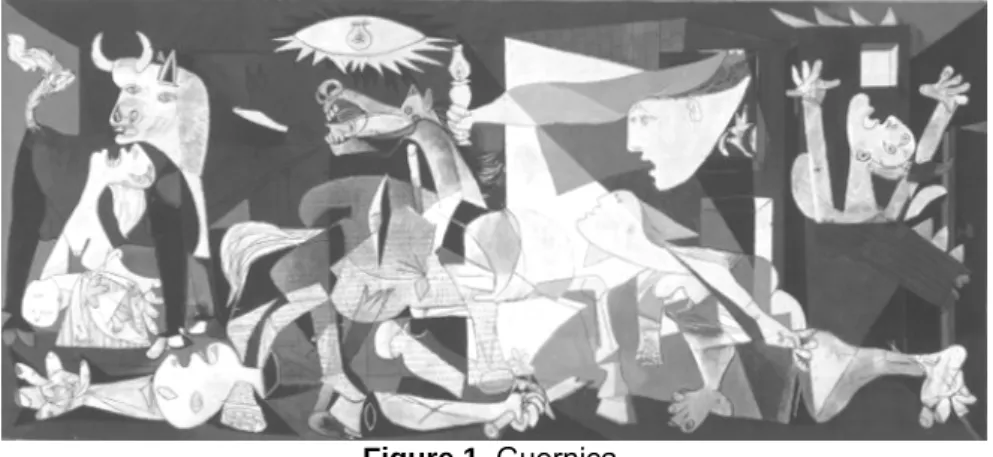
The print form of a painting is intended to match that of the original. But if the original is a mural like Guernica (Figure 2), then direct physical experience of scale (350.5 x 782.3 cm) is not possible in the printed form. For comparison, the scale of the print in (Thompson, 2006, pp. 198-199) is about 11.7 x 26.1 cm. A certain degree of physical experience of scale is possible in the digital world. One may be presented with a % size indicator of the image and the possibility of panning and zooming such as used in the National Gallery, London (Mantegna, 1505-6). The physical location of paintings such as Guernica, Museo Nacional Centro de Arte Reina Sofia, in Madrid is also out of (physicality) bounds for most people.
In the Digital Exhibition, a painting such as Guernica (Figure 1) (Picasso, 1937) will automatically be selected for display on the L screen (landscape format) because of its intrinsic shape. A viewer may also choose to use the iTouch to select it to be displayed concurrently on the S screen and to display the square outline being viewed on the L screen. The S screen is also the ideal shape to be used as a zooming or panning device for a digital image. Furthermore, we imagine the S screen would act as a possible overall display device for the whole exhibition where each image is represented by a square thumbnail in much the same way as is currently done on Flickr.
Folksonomy
Images and paintings in their print form (and by that we now mean printed in a book or catalogues) are usually accompanied by a great deal of textual information, frequently of technical, historical and social nature. Online Museums of Art & Art Galleries present the images in similar (textual) contexts. Information attached to the image and the associated text is already very well managed. Here we take information management to be “the handling of information acquired by one or many disparate sources in a way that optimizes access by all who have a share in that information or a right to that information.” It may be “characterized by the phrase ‘Getting the right information to the right person at the right place at the right time’ ” (W en). As part of that information, we take for granted formal markup languages based on XML and even include the Semantic Web Ontology Language (OWL) “texts” based on RDF. In Web 2.0 Social Space, Web 2.0 being a “human friendly and socially inclusive” name for Semantic Web, such management is played out against the backdrop of folksonomy, “an Internet-based information retrieval methodology consisting of collaboratively generated, open-ended labels that categorize content such as Web pages, online photographs, and Web links.” (W en). This curious neologism may be likened to astronomy. Just as one studies the myriad stars and their satellites in World Space, one studies the people, in their interactions in the Social Space of the internet.
Tagging
Let us illustrate this by use of a very practical domain, that of the tagging of paintings and photographs of an Art Gallery Collection online by enthusiasts. The Steve Project (steve project) (Chun, Cherry, Hiwiller, Trant, & Wyman, 2006) is prototypical. Whereas the professional, the curator, the art critic, will describe a painting in a certain way, using culturally apt and learned text, the new/naïve spectator will inevitably resort to the language of the pop(ular) culture. One is not certain of the existence of such naïve spectators. Why would they want to look? As a working hypothesis, we will assume that there will be sufficient number of such spectators willing to engage with images online and to comment upon what they see with short texts, or even simple
words and phrases, called tags. The ultimate goal of a project such as Steve seems to be that the Museum will learn how to see, understand, and communicate with their putative visitors, fundamentally at a distance, and for the few in practical visitation.
Flickr experiment
To mimic the tagging task and to explore a theory of folksonomy with respect to “Art Galleries” we have set up our own experimental framework in Flickr (Flickr). In place of real paintings in a real gallery, we use real digiFotos in a real Web 2.0 Network (Орела). At the time of writing (February 2008) there were approximately just over 9000 such digiFotos.
Let us begin with a simple example. The digiFoto, entitled
Mother and Child shows two (blue) bottles, one large, one small;
«bottle» is a good tag. The title of the image suggests 3 tags: «mother», «child», «mother and child».
Ontologically, the use of the word «child», rather than daughter or son, is significant. Specifically, in the Western Tradition, largely dominated by Christian influence for two millennia, we originally hypothesized that the choice of Child rather than the specific word Son universalizes the Christian narrative to everyone everywhere at all times. One wonders at what point in time did the «Mother and Child» concept become dominant? Subsequent thoughtful reflection suggested a much better explanation: for most of the history of man on earth, the gender of a child could not be known before actual birth; hence a gender-neutral concept word was necessary in language to refer to that which was yet to be born—the child.
In this paper we adhere to the ontological commitment articulated by Quine (1939), that “To be is to be the value of a variable” (Mautner, 1997, p. 400). In particular, we formally encode the concepts of our art world within the Sowa 12 upper ontology (Sowa, 2000) and deliberately restrict expressive power to the Description Logic (Baader, Calvanese, McGuiness, Nardi, & Patel-Schneider, 2003) variant of the Semantic Web Ontology Language (OWL) (W3C, 2004).
In our research work we innovatively focus on the use of images to tag images. For example, the digiFoto in (Figure 2) is used to tag the painting The Madonna with the Long Neck by Parmigianino (1532-40) (de Rynck, 2004, p. 172). The key concept is «(long neck)-ness». This concept forms part of our ontology. Such a tagging image is called a keyimage. The very act of making such an “image tagging” by another image calls to mind the possibility of other “long-neck” women in paintings, photographs, and so on. In other words, surely the Parmigianino painting is not unique? It turns out that indeed it is not. Gombrich remarks that very few people notice that Botticelli’s Venus has a long neck (Gombrich, 1995). When we come to formalize this concept in OWL-DL we choose a simple enumeration for the length of neck property: [short-neck, normal-neck, long-neck]. The judgment will then depend on what one considers to be a normal-neck. We suspect that such judgments will be culturally based and we are reminded of the danger of falling into the “heresy of eugenics”.
Having identified the property of “long neck”, one then seeks further validation on the Social Web. Specifically, one will google, search in Flickr, and so on. For the latter, one obtains 493 hits with search tags woman + long-neck, only 49 of which are available under Creative Commons license (Creative Commons Organization), of which we note one in particular as illustration (Evans, 2007) (Figure 3).
Many of the digiFotos which we use as keyimages in our research have been generated within the social computer game SIMS 2 (W en). Although the game play is in English, we have chosen to tag the emerging digiFotos mostly in Bulgarian (Slavic language) and some in Gaeilge (Irish Celtic language), both of which are official languages of the European Union (EU) since January 1st 2007. In this paper tagging form is emphasized rather
than tagging content. In practice, concepts are explored in two non-hegemonic languages of very different cultural backgrounds. To highlight this formal approach we deliberately use Bulgarian, Gaelic, and even some Turkish words.
Let us look at two of these digiFotos, taken from the SIMS 2 game, which have been used to tag the paintings Nevermore (Gauguin, 1897) tagged by the screenshot “Paul Gauguin, Nevermore, 1897” (Орела, 2006a), and Olympia (Manet, 1865) tagged by the screenshot “Росица Иванова, Titian's "Venus", Manet's "Olympia"” (Орела, 2006d). It is important to note that the latter keyimage is ambiguous, being also used to tag the painting
Venus of Urbino (Titian) (de Rynck, 2004, p. 178). The key
concept in this case is «female nude gazing at spectator», difficult to ontologize formally. The concept of Gaze (Harris, 2006, p. 126) is foundational.
Figure 3
Nature of tags
“What are tags? You can give your photos a "tag", which is like a keyword or category label. Tags help you find photos which have something in common. You can assign as many tags as you wish to each photo.” (Flickr).
Of course, it is natural to try to extract an ontology automatically from such tags (Schmitz, 2006). But in true folksonomical fashion the taggers tag as they will. A tag may be a single word or a phrase in quotes, such as “long neck.” One interesting use has been to assign a line of poetry as a single tag. Let us imagine that some poem contains 42 lines? Then one uses 42 tags. It is a very creative way in which to illustrate such a poem by a digiFoto. For
example, Wordsworth’s poem “I wandered lonely as a cloud” may be used to tag a digiFoto of a single (white) cloud in a blue sky. In this way the tagging is the thing, the picture is incidental. The poem itself conjures up an image in each reader’s mind and it is this image which is being tagged by the digiFoto. Such inversion is one of the striking features to emerge in the Social Web. It is unexpected. It is very like emergent behaviour in a complex system. Now that it has happened, it seems quite a natural phenomenon. We personally had been using the Description feature of Flickr to carry the poem and to use a digiFoto as image tag. Clearly both approaches can be used (redundantly) for the same poem. Perhaps, the tagging is best used in the conventional way of “naming” a poem by its first line.
Another noteworthy tagger is currently being prototyped: the Image Labeler (Google), which appears to be based on the ESP game (von Ahn & Dabbish, 2004). This seems to be a direct competitor of the Steve Project. That Google is taking an interest, suggests that folksonomical image tagging has arrived. The next big leap forward will be the use of images and not just words to do the tagging.
In the course of our research into the formal characterization of keyimage, especially with regard to its use in an ontology, and upon being challenged to produce an algorithm for the assignment of such, to images and paintings in general, we chanced upon the happy use of keyimage as tag or key in cubist painting:
“By abandoning illusionistic form, Picasso had removed the traditional framework upon which likeness in portraiture had always been hung. In his painting of Kahnweiler, he invented a whole new way of signalling a particular identity by turning characteristic features — the dealer's quiff, his long nose and his clasped hands, for example — into the signs that we now refer to as 'tags' or 'keys'.” (Thompson, 2006, p. 110)
Clearly, a recognizable detail in an otherwise unrecognizable image is one basis by which keyimage may be classified, albeit relatively.
How to Ontologize an Image
Instead of “how to ontologize” an image we might be more modest and begin with “how to read” it, or “how to talk about” it or even “how to look at” it. And for simplicity we might consider that definite sub-category of image, called painting. Let us work with “how to read” it?
“How to Read a Painting” (de Rynck, 2004) and “How to Read a Modern Painting” (Thompson, 2006) are two texts with which one might begin. Although similarly named, one being a “natural sequel” of the other, their “ontological structure” differs considerably. The former provides the “sizeable index… to help readers explore… by name… or alternatively by theme, motif or concept…” these “pre-Modern” paintings (circa 1300–1800). The latter contains an index of names only. To ontologize the “modern painting” from the latter requires patient, painting by painting, study. Something more is needed to assist in the ontologizing of the latter. For very basic professional work we make use of “Art History, the Key Concepts” (Harris, 2006) and Hall’s Illustrated Dictionary of Symbols in Eastern and Western Art (Hall & Puleston, 1994). The latter text is especially noteworthy for our research technique in that the concepts, given is descriptive form, are indexed by keyimage in the margin.
A pre-Modern Painting
Consider, for example, the painting The Introduction of the
Cult of Cybele at Rome (Mantegna, 1505-6) which is discussed in
“Learning to look at paintings” (Acton, 1997, p. 55). We are drawn to the text “She was worshipped in the form of a sacred round stone…” (p.55). In the ontologization we will use the binary relation form ‘Cybele hasRepresentation RoundStone’ which fits nicely into OWL-DL (W3C, 2004). But this ontologization is relative to the painting itself. In another (textual) image of Cybele she is represented by a pointed black stone (Ball Platner, 1929). How Cybele is represented by a stone is ambiguous, the resolution of which must be sought in the image in question. That Cybele is represented by a round stone is true relative to at least the
Mantegna painting. The keyimage for Cybele is publicly accessible on Flickr (Орела, 2006b) (Figure 4).
Figure 4. Кибела
A Modern Painting
In order to be expressive and still adhere to the requirements of black and white images for publication, what could be better than Picasso’s Guernica (Picasso, 1937) (Figure 1)?
“The bull is not Fascism, but it is brutality and darkness…. The horse represents the people, in this the Guernica mural is symbolic, allegoric. That is why I used the horse, the bull and so on. The mural is for the definite expression and resolution of a political problem and that is why I used symbolism.”
This quotation of Pablo Picasso (Thompson, 2006, pp. 198-199) provides us with exact concepts with which to tag the painting: «bull», «horse»…. We are also able to connect it with the «майка и дете» image in Figure 2. Here, in Guernica, the «Mother» is screaming for her dead «Child». Might one not use the
image of two (blue) bottles, the smaller being broken, to tag
Guernica?
On the other hand, with respect to description, a (post)modern artist may do the exact opposite to Picasso. René Magritte’s “Ceci n’est pas une pipe” is typical. “Ah, the famous pipe… I’ve been criticised enough for it! And yet… can it be stuffed with tobacco, my pipe? No it can’t, can it, it’s just a representation. So if I had written “This is a pipe” below the picture, I would have been lying!” — René Magritte in an interview with Claude Vial, 1966 (Magritte, 1979, p. 643).
The Digital Gallery
In the Web 2.0 Social Space one expects the Art Galleries and Museums to be online and accessible by anyone from anywhere, free of charge. In the first instance, the “local” language, say Bulgarian and the hegemonic Anglo-American English will mediate the access. Of particular interest to us, is digital access to the “National” collections in Sofia (website of National Gallery under construction) and Dublin (2008). Since there is not yet, at the time of writing (February 2008), adequate online access to the National Art Gallery in Bulgaria, we are obliged to rely on published works such as the catalogue of “Bulgarian Painting (1900-1950)” (Маринска & Щилиянов, 1999) and online sites such as the “Domino Art Galleries” (2008). With regard to the former we are very pleased to note that each artist’s work is introduced, not only by a very brief biography, but for us, more importantly, by an image of the painter in question, whether a self-portrait or portrait by another. In some sense this use of the portrait is in fact a keyimage for the painter. Such a typical keyimage of the painter Ivan Milev (Иван Милев) can be seen at (Орела, 2007). The national Gallery of Ireland does not yet provide adequate access online either (February 2008).
For historical reasons, Ireland might look to her closest “neighbour”, the UK in comparison. There are comparable institutions in London, such as the National Gallery (National Gallery London, 2008) and, the Victoria and Albert Museum (V&A) which has one of the largest collections of photographs in the
world. The National Gallery, London already has advanced web services such as the sending of a picture message to a mobile telephone. At the time of writing (February 2008) this service is only available to UK, Belgian, Dutch, French, Danish and Swiss mobile telephone users.
But, of course, one can not wait for large institutions to digitize their whole collections. As researchers, one must be practical. It is for this reason that we are focusing on the use of the Digital Exhibition introduced in the beginning of the paper. This will drive the digitization in the Galleries on a case by case basis of “user” need. The needs and requirements for a Digital Exhibition are similar to those for an old-fashioned Art Exhibition (Marincola & Philadelphia Exhibitions Initiative, 2006).
Let us imagine that we have settled on a specific Digital Exhibiton. For definiteness, we will further suppose that the Digital Exhibition is a particular “retrospective” of some of the works (paintings and sketches) of Владимир Димитров — Майстора (Vladimir Dimitrov — Majstora). The “Home Gallery” of Majstora is in Kjustendil, Bulgaria .
Method 1
In order to provide a sound ontological foundation for the exploration of folksonomy of paintings, it seems reasonable first to choose key concepts from WordNet (2008) that correspond to the curatorial language and that of the art critic. Let us look at the pictorial elements which one might consider to be important with respect to the visual qualities of a painting: composition, space, form, tone, colour (Acton, 1997, p. 225) and texture. From WordNet we choose «composition»: “noun: The spatial property resulting from the arrangement of parts in relation to each other and to the whole; ‘harmonious composition is essential in a serious work of art.’” From Mary Acton’s point of view «composition» is “the artist’s method of organizing a subject, of deciding what to put in and what to leave out in order to make an effective picture” (Acton, 1997, p. 1). The average folksonomer may be “educated” in this concept by a suitable access interface? A second example
someone; "the delicate cast of his features” (2008) and “Form is the term artists use to describe the feeling of volume in a painting” (Acton, 1997, p. 51). We note here that «form» may also be applied to the artist’s work in space. This latter definition suggests that there is an artist-focused ontology that suitably complements the curatorial ontology.
Method of ontologization is suggested by these two simple examples. For each professionally recognized concept in the domain, match its definition and use with a corresponding one from WordNet. If no such correspondence is found in WordNet, then there is an obvious gap to be filled.
Method 2
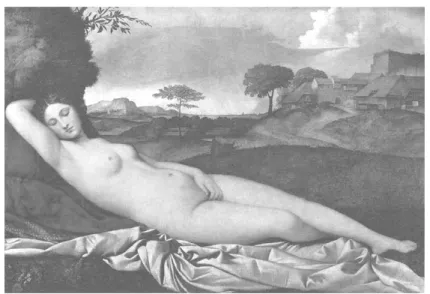
Since the presentation of an earlier version of this paper in Ankara (Mac an Airchinnigh & Sotirova, 2007a) we have recently become aware (January 2008) of the potentiality and usefulness of a relatively old but well established taxonomy for Art: ICONCLASS (Rijksbureau voor Kunsthistorische Documentatie [RKD]). For example, using the online browser (Rijksbureau voor Kunsthistorische Documentatie [RKD]) one might naïvely classify a painting such as Giorgione’s “Sleeping Venus” (Giorgione, c. 1510) (Figure 5) as iconclass:
3 Human Being, Man in General 31 man in a general biological sense
31A the (nude) human figure; 'Corpo humano' (Ripa) 31A7 the sexes (human being)
31A72 female sex; woman
An expert user of Iconclass (Posthumus, 2007) will already know that there is an “exact” classification:
9 Classical Mythology and Ancient History 92 gods ~ classical mythology
92C the great goddesses of Heaven, and their train 92C4 (story of) Venus (Aphrodite)
92C45 non-aggressive, friendly or neutral activities and
relationships of Venus
Figure 5. Sleeping Venus (B&W)
Using Iconclassify (Posthumus, 2007) and beginning with the keyword “sleeping” one will arrive at another different classification
3 Human Being, Man in General 31 man in a general biological sense 31B mind, spirit
31B1 sleeping; unconsciousness
31BB1 sleeping; unconsciousness - BB - out of doors 31BB13 sleeping on the ground - BB - out of doors
However, Iconclass is not formal in the strict sense of that term, not sufficient for the Semantic Web. A formal classification, for us, is one which is in OWL-DL syntax. In order to remedy this a research team in Trinity College Dublin is currently integrating Iconclass with an upper-level ontology for Museums which is now an ISO standard: the CIDOC Conceptual Reference Model (Nick Crofts, Martin Doerr, Tony Gill, Stephen Stead, & Matthew Stiff (editors), 2008) and, more importantly, fitting it with a comprehensive ART-ontology (Isemann, Mac an Airchinnigh, & Ahmad, 2007) which is under construction. It is worth noting here that this ART-ontology is grounded on “A Handbook of Anatomy
aspects of Iconclass (Rijksbureau voor Kunsthistorische Documentatie [RKD]) and the Foundational Model of Anatomy (Cornelius Rosse et al., 2008) with some folksonomical input from WordNet (WordNet, 2008).
Access by the Book
Orhan Pamuk was a painter at the age of 15 (Pamuk, 2005, pp. 239-250). In his memoir, he introduces his first love, whom he calls Black Rose (Siyah gül) and describes how their intimate relationship developed in the artistic context of painter and model:
“One day, without telling her, I did a sketch of her lying there. I saw this pleased her, so the next time she came I did another.” (Pamuk, 2005, p. 295)
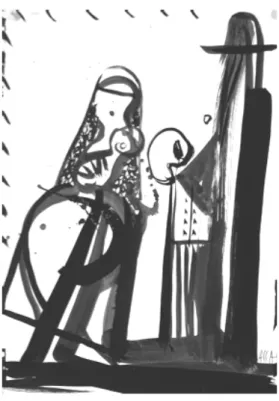
Why did Orhan Pamuk call her “Black Rose?” The name conjures up the image. Googling provides many “black roses.” A folksonomer may (be prompted to) choose one to her/his taste. Are there other keyimages which are appropriate for the ontology? To say that “BlackRose isa Rose and hasColour Black”, does not seem to cover the concept adequately at all. In other words to assign the colour Black to the Black Rose of Orhan Pamuk is to make a categorical error. Now let us imagine that we choose the sketch of (Асса) (Figure 6) to be the keyimage for Orhan Pamuk’s Black Rose? This is a typical folksonomical choice, illustrating how one might naturally choose an image by a current Bulgarian artist, Gredi Assa (Асса) (Figure 6) to tag the image of the Black Rose (Черна Роза) of Orhan Pamuk, a Turk. Such “typical folksonomy” is, of course, probably localized to the Bulgarian culture and is unlikely to extend beyond it.
Figure 6. Model & Painter
Painting and colour become the subject of Pamuk’s most famous book “My Name is Red” (Pamuk, 2002).
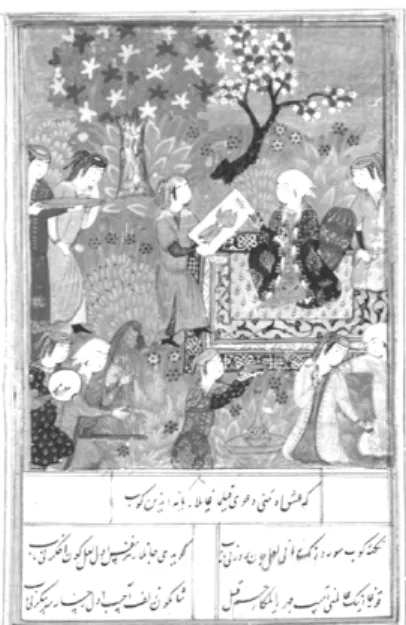
“One day Shirin… sees a picture of Hüsrev… Beholding this picture of the handsome Hüsrev in that beautiful garden, Shirin is stricken by love” (Pamuk, 2002, p. 47).
The book (indirectly) suggests to the reader that in order to re-live the story, they ought to seek out the pictures spoken of. In the paper “The practical sense of philosophizing: Why preserve anything at all, even digitally?” (Mac an Airchinnigh, 2004, pp. 128-130) there is a brief discussion on the use of the «picture portrait» as keyimage for “falling in love” and that the keyimage is just right. The picture Shirin examines Hüsrev’s portrait (Shirin-Hüsrev Unknown) (Figure 7) may now be used as keyimage in its own
in love. In particular, it may be used to key any painting where Cupid is active, such as in Botticelli’s Primavera (Spring) (W en).
Figure 7. Shirin examines Hüsrev’s portrait
The iconic Cupid (Eros) “works” for Europeans. It is culturally localized. What might be the keyimage for “falling in love” for India, Africa, Australia…? Would the Hindu love god Kāmadeva (W en) be appropriate for India? So (Heaney, 1999, p. xxvii). For ontologization purposes, using exactly one cultural artefact such as Turkish Shirin&Husrev for a keyimage is highly desirable. Adding others, from different cultures, could be ambiguous? This leads to another significant research question in the field. Does the addition of keyimages, each of which explains, i.e., point to some aspect of a painting, help or not in the overall ontologization as such?
Returning to the Book as access device. How does it fit with the Digital Exhibition of the title of the paper? Surely there is a mis-match? Not really, in principle! The Digital Exhibition is intended to
bring access to those who can not travel to the place where art can be experienced physically. In many ways, a book is just that: a device intended to bring access to those who… What better way to enhance the access and experience than to augment the book with its own Digital Exhibition?
Colour
“After all these years, everyone has their own mauve… they wrote their theses on blueberry iMacs, photographed their friends on one-use Kodaks… wore blue, green, even yellow… walked around as if these colours were the most natural thing in the world.” (Garfield, 2000, pp. 197, 200)
Colour is one of the five pictorial elements connected with the visual qualities of a painting, described in detail by Mary Acton. Colour may be used for many different purposes. She particularly insists that the work of Chevreul (W en) was a key influence in the development of the use of colour in (painting in the west in) the nineteenth century. We are personally familiar with the prior work of Goethe (Goethe & Eastlake, 1975), his remarkable experiments and the discovery of new colours.
From the point of view of ontology and folksonomy, colours and colour names and colour associations, all provide a very rich world for a digital re-discovery of culture (one’s own and that of the other). They also provide a major challenge for folksonomy.
Let us take the simple case of the colour red (Kırmızı in Turkish); (алено or червено in Bulgarian) (dearg in Gaelic). How can we tell whether or not these words describe the “same” colour red? Perhaps, a keyimage will be of some use?
One set of keyimages for colour might be presented by colour tiles. But because the perception of colour is contextual, and taking into account Goethe’s discoveries developed in detail in his Theory of Colours (Goethe & Eastlake, 1975), we hypothesized that we must initially present the tiles against some sort of neutral background.
to a folksonomy (Kobayashi & Nihon Kar*a Dezain Kenky*ujo., 1987). Koybayashi had introduced an interesting limited 18 word vocabulary by which to refer to groups of colours that go well together. For example, “alluring” refers to particular shades of purple, purple-red and pink that had been traditionally associated with women and “folksy” refers to the use of dark brown, olive green, brownish red in combination.
Later, the book on a Color Image Scale appeared (Kobayashi, 1991) and the vocabulary was greatly extended from 18 to 180 words. Here the words are presented as keywords to be linked with color combinations. The folksonomy of colour is now becoming robust. The third book in the series, Colorist—A practical handbook for personal and professional use (Kobayashi & Keiichi Ogata and Leza Lowitz, 1998), essentially defines a working color folksonomy (in the English language). For example, the category “Gorgeous” now covers the “feelings” of fascinating, alluring, brilliant, sexy, captivating, rich, decorative, luxurious, mellow, substantial, extravagant. Application of this colour folksonomy is the subject of ongoing research, in particular the construction of the Color Ontology in OWL-DL, and one will want to have comparable folksonomical terms in other languages, such as Bulgarian and Turkish.
The Keyimage Algorithm(s)
Words are free. No one can copyright them. This remark in itself leads one to re-examine that philosophy which in the modern age allows collections of words, organized in a certain way, to be copyrighted.
Keywords are words. No one can copyright the keywords used as tags in Flickr. Doubtless there will be those who will try to find a way to make money out of collections of keywords organized in a certain way.
In our research work we anticipate the future and propose to use keyimages to be used as tags in Flickr and that such use be extended to all kinds of art in general. Here we list a few principles that guide us.
1. A keyimage ought to be free, just like a keyword. No one is bigger than the language (a modification of the Bulgarian proverb “Никой не е по-голям от хляба”: no-one is bigger than the bread). The language is free for all. Such keyimages may be posted to a site such as Flickr with a creative commons license that allows one to use keyimages freely. 2. Every image must point to some digital image in a meaningful
way. By this we mean that the keyimage itself must be formally ontologized such that a property of the keyimage
pointsTo the property in the image. For example, the property
that a big bottle has a small bottle beside it and is of the same kind may be used for “Mother” and “Child”. To formalize such notions as “beside” and so on is already well-known to be difficult and challenging.
3. How many keyimages ought one to associate with any given
image (painting, )? Let us posit the number 5. Why? One has five digits on a hand. We hypothesize that even 5 independent and formal keyimages will be difficult to find for each image.
Let us consider some examples.
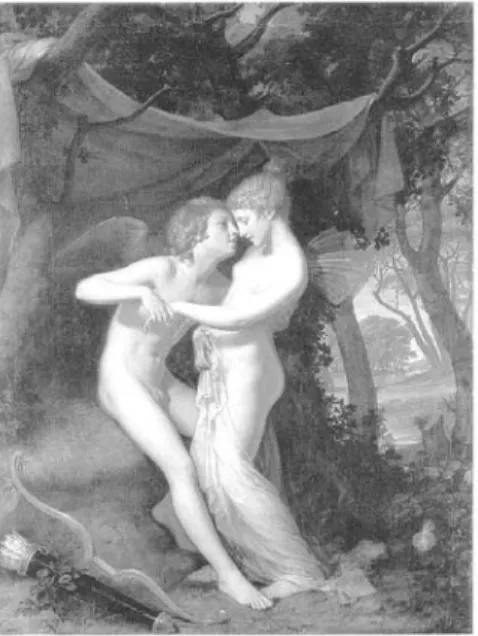
For Guernica (Figure 1), we propose keyimages associated directly with the keywords (tags): 1) «майка и дете» (Mother and Child), 2) «бик» (Bull), 3) «кон» (Horse), 4) «окото» (the Eye), 5) «цвете» (Flower). For Cupid and Psyche in the Nuptial Bower (Hamilton) (Figure 8) we propose keyimages 1) «пеперуда» (Butterfly), 2) «ябълка» (Apple), 3) «лък и стрели» (Bow and Arrows), 4) «пъпеш» (Melon), 5) «какавида» (Chrysalis).
4. The structure of keyimages ought to mirror that of keywords and be grounded in OWL-DL.
For example, «майка и дете» is keyimage of Gredi Assa's Model
and Painter which in turn is keyimage of Black Rose in Orhan
Pamuk's Istanbul. The «butterfly on apple» in Cupid and Pysche in
the Nuptial Bower (Figure 8) reflects «Psyche with wings» and is,
Figure 8. Cupid and Psyche in the Nuptial Bower
5. A keyimage will in principle key many different kinds of
images according to the property picked out. In this sense, a keyimage on its own is inherently ambiguous. Nevertheless, the property that a keyimage pointsTo or depicts some property of another image suggests that there is a well-defined means of ambiguity resolution. We expect there to be a comprehensive classification of the types of ambiguity of keyimages just as there is a classification for the types of ambiguity in play (Sutton-Smith, 1997).
The personal, folksonomical approach to “reading an image” is typified very well by the Google Image Labeller. To be able to comment on, to describe, to tag an image one must first be able to recognize the familiar.
We propose two basic types of algorithm or procedure by which one might construct and/or assign keyimages: the Kahnweiler algorithm and the Portrait algorithm. The former is
so-named (by us) after the cubist portrait painting of the same name (Picasso, 1910c) (Figure 9) by Pablo Picasso. The algorithm is based analogously on a simple universal mathematical principle: the construction of a pullback, or inverse-image, or pre-image of some mapping. In other words, the given image, in this case a painting, is considered to be the range of some mapping or function of the “observer”.
We have chosen the name Kahnweiler precisely because it is non-intuitive for the “average observer” to identify features that might be tagged in a simple folksonomical fashion. Here are the details
Kahnweiler algorithm
1. Begin with the image, say a painting or a photograph. For definiteness, look at the Kahnweiler painting (Picasso, 1910b) (Figure 9).
2. Identify and name the key characteristics which strike you. In Kahnweiler, we see the «quiff», the «long nose», the «clasped hands» (Thompson, 2006).
3. Attach a keyimage for each of the characteristics, viz. the «quiff», tagged by Teddy Boy image from (W en), the «long nose» by the sea horse image from (W en) and the «clasped hands» from the image of the painting by (Tiziano, 1550). 4. Tag the image with both the keyword and keyimage. 5. Tag the keyimage with pointer to the image.
6. Record the tagging in Protégé OWL-DL.
It might be the case that for such a cubist painting one needs to find another (intermediate) painting of the very same subject in order to be able to obtain details for which keyimages can be assigned. For example, Picasso did a cubist painting of Ambroise Vollard (Picasso, 1910a). If one is not familiar with special features or characteristics of Ambroise Vollard then it is natural to look for another portrait (painting or photograph) of Ambroise Vollard that will act as a direct keyimage to the Picasso painting. That of Cézanne (1899), done
11 years earlier, might not be appropriate. That of Pierre Bonnard (ca. 1924) 14 years later seems to be a better fit.
Figure 9. Kahnweiler
The next algorithm which we propose is based on the simple principle that to see and understand the work of art, one looks first (or back) to the author of that work.
Portrait algorithm
1. Begin with the artist, the creator or maker of the image: the painter, photographer, author… For definiteness, let us choose Turkish Nobel Prize winner: Orhan Pamuk.
2. Find a portrait/self-portrait and use that as keyimage to any work of her/him. Googling Orhan Pamuk provides abundant opportunities for a portrait.
3. If no such portrait exists, consider first the possibility of using a textual description that conjures up a picture of the artist. Such a description is deemed to be a (pseudo) keyimage. To highlight the significance of such a keyimage it might be formally introduced by the text “Let us imagine…” One of the obvious authors which fits this bill of needed pseudo keyimage is “God”. That is to say (in our opinion), no one has ever seen God. God is not see-able. But there are many portraits of God both in textual form and otherwise. Even the existence of God is doubted by some. In this latter case, we can and do use our imagination: What if? Nor do we hypothesize the singularity or plurality of “God”. Neither do we worry about God having gender. Finally, we do pay attention to the adjunction of “no graven image” in certain cultures. Research-wise, the issue is simply a matter of appropriate keyimage.
4. Tag the images which are to be associated with this keyimage portrait. For Orhan Pamuk, we choose the texts (in English) “My Name is Red”, “Istanbul”, “Snow”, “The White Castle”, “The Black Book”, “The New Life”, all of which have been read by the first author. Each text in turn may be considered to give rise to specific keyimages with which to tag modern Turkey, not-so-modern Turkey, the Ottoman Empire, and so on.
5. Now apply the rules of the Kahnweiler algorithm wherever
possible and/or appropriate.
Epilogue
One referee of the original text remarked that “[it] is like modern music: it is difficult to hear its melody. There are pieces but it is somewhat difficult to distinguish the connections among these pieces.” We had to agree then. Reading back over all that had been written, it seemed to us that there was a theme which
needed to be brought to the fore: the theme of access, both ordinary physical access and world-wide web access. It was to facilitate, encourage, enhance such access that drove us. We proposed that on a complete re-write we might begin with Orhan Pamuk’s “Access by the Book” and most certainly emphasize Riffkin’s “Age of Access” (Rifkin, 2000), in the hope that, in spite of the many remaining obvious imperfections in the text, the reader would find at least one melodic thread to follow or unravel in accessing Art wherever it may be found in the digital world. Now that the rewrite has been done, one notices that the emphasis has shifted entirely in the direction of access. The focus is all in the title: Digital Exhibition.
Acknowledgements
Khurshid Ahmad, Thérèse Mac an Airchinnigh, Daniel Isemann and Michael Emmanuel O’Rahilly all helped in the development of key concepts through their critical reading and subsequent discussion of early versions of this paper appeared in the proceedings of the Değişen Dünyada Bilgi Yönetimi Sempozyumu, Haceteppe University, Ankara (Mac an Airchinnigh & Sotirova, 2007a).
Catherine Sheridan, of the National Gallery of Ireland directed us to the Steve Museum project. Declan O’Sullivan’s proof reading of the penultimate version was particularly insightful.
A very special note of thanks is due to the anonymous referees of the Değişen Dünyada Bilgi Yönetimi Sempozyumu, whose feedback contributed significantly to the final form of that paper. Indeed, one referee insisted upon the “overall algorithm or procedure for finding the keyimage among many images.” This seemed at first to be an impossible task, so early in the stage of development of the research idea. In particular, we were aware of our use of many different algorithms, each particularised by the inputs (points of view) we were using in the construction of the system.
Feedback at the Symposium itself has informed further developments in our field of research in the Digital re-Discovery of Culture game of inquiry with specific focus on the use of the Social Web as support infrastructure for the emerging Digital Culture.
Moreover, the presentation of invited speaker Prof. Steve Whittaker “On The Future of Information Retrieval” (Whittaker, 2007) (Whittaker, 2008) showed us that there was a well-founded body of ongoing research that validated our own approach.
Thérèse Mac an Airchinnigh reviewed the final paper thoroughly. Her suggestions and corrections helped considerably. Any remaining faults are our own.
References
Note that we use the convention “W en” to denote a Wikipedia article in English.
Acton, M. (1997). Learning to look at paintings. London: Routledge.
Art Gallery — the Master. (2008). Художествена галерия “Владимир Димитров—Майстора”. Retrieved Feb 13, 2008, from http://www.artgallery-themaster.com/
Baader, F., Calvanese, D., McGuiness, D., Nardi, D., and Patel-Schneider, P. (Eds.). (2003). The Description Logic Handbook : Theory, Implementation
and Applications. Cambridge: Cambridge University Press.
Ball Platner, S. (1929). A Topographical Dictionary of Ancient Rome. Retrieved Dec 22, 2006, from http://penelope.uchicago.edu/Thayer/E/ Gazetteer/Places/Europe/Italy/Lazio/Roma/Rome/_Texts/PLATOP*/Aed es_Matris_Deum.html
Berger, J. (1972). Ways of seeing : based on the BBC television series with
John Berger. London: British Broadcasting Corporation and Penguin.
Bonnard, P. (Artist). (ca. 1924). Ambroise Vollard with His Cat Cézanne, P. (Artist). (1899). Ambroise Vollard
Chun, S., Cherry, R., Hiwiller, D., Trant, J., and Wyman, B. (2006). Steve.museum: An Ongoing Experiment in Social Tagging, Folksonomy, and Museums. Retrieved Dec 28, 2006, from http://www.archimuse.com/mw2006/papers/wyman/wyman.html
Cornelius Rosse et al. (2008). Foundational Model of Anatomy. Retrieved Jan 27, 2008, from http://sig.biostr.washington.edu/projects/fm/
Creative Commons Organization. Creative Commons. Retrieved Feb 9, 2008, from http://creativecommons.org/
de Rynck, P. (2004). How to read a painting : decoding, understanding and
enjoying the Old Masters. London: Thames & Hudson.
Domino : Art Galleries. (2008). Български художествени галерии. Retrieved Feb 13, 2008, from http://art.domino.bg/gallery.php?lang= Evans, S. b. (2007). Thailand: Hill Tribes. Retrieved Jan 9, 2008, from
http://www.flickr.com/photos/babasteve/406660060/ Flickr. Retrieved Jan 30, 2008, from http://www.flickr.com/
Flickr. Tags. Retrieved Jan 3, 2007, from http://www.flickr.com/photos/tags/ Garfield, S. (2000). Mauve : how one man invented a colour that changed
the world. London: Faber and Faber.
Gauguin, P. (1897). Nevermore. Retrieved Jan 4, 2007, from http://impression.alloilpaint.com/gauguin/gauguin88.jpg
Giorgione (Artist). (c. 1510). Sleeping Venus (or Dresden Madonna) [oil painting].
Goethe, J. W. v., and Eastlake, C. L. (1975). Goethe's Theory of colours. New York: Gordon Press.
Gombrich, E. H. (1995). The Story of Art (new ed.): Phaidon.
Google. Google Image Labeler. Retrieved Jan 3, 2007, from http://images.google.com/imagelabeler/
Hall, J., and Puleston, C. (1994). Illustrated dictionary of symbols in Eastern
and Western art. London: John Murray.
Hamilton, H. D. Cupid and Psyche in the nuptial bower (B&W) [Oil painting]. Harris, J. (2006). Art history : the key concepts. New York, NY: Routledge. Heaney, S. (1999). Beowulf. London: Faber and Faber.
Huizinga, J. (1955). Homo ludens; a study of the play-element in culture. Boston: Beacon Press.
Isemann, D., Mac an Airchinnigh, M., and Ahmad, K. (2007). Navigating
presented at the XVI-th European Symposium on Languages for Special Purposes (LSP).
Kobayashi, S. (1991). Color image scale. Tokyo ; London: Kosdansha International.
Kobayashi, S., Keiichi, O. and Lowitz, L.. (1998). Colorist : A Practical
Handbook for Personal and Professional Use. Tokyo ; New York ;
London: Kodansha International.
Kobayashi, S., and Nihon Kar*a Dezain Kenky*ujo. (1987). A Book of colors
: matching colors, combining colors, color designing, color decorating.
Tokyo ; New York: Kodansha International.
Mac an Airchinnigh, M. (2004). The practical sense of philosophizing: why preserve anything at all, even digitally? Review of the National Center for
Digitization Retrieved Jan 9, 2007,from http://elib.mi.sanu.ac.yu/pages/
browse_article.php ?cs=000001&rd=0000051
Mac an Airchinnigh, M., and Sotirova, K. (2007a, 24-26 Ekim). Keyimage
Ontologization & Folksonomy in Web 2.0 Social Space. Paper
presented at the Değişen Dünyada Bilgi Yönetimi Sempozyumu, Ankara: H.Ü.
Mac an Airchinnigh, M., and Sotirova, K. (2007b). Keyimage Ontologization
& Folksonomy in Web 2.0 Social Space. Paper presented at the
Değişen Dünyada Bilgi Yönetimi Sempozyumu.
Magritte, R. (1979). Écrits complets (ed. André Blavier). Paris.
Manet, E. (1865). Olympia. Retrieved Jan 4, 2007, from http://www.griseldaonline.it/percorsi/3checcoli_1d.htm
Mantegna, A. (1505-6). The Introduction of the Cult of Cybele at Rome. Retrieved Dec 22, 2006, from http://www.nationalgallery.org.uk/cgi-bin/WebObjects.dll/CollectionPublisher.woa/wa/work?workNumber=NG902
Marincola, P., & Philadelphia Exhibitions Initiative. (2006). What makes a
great exhibition? Philadelphia, PA Chicago, IL: Philadelphia Exhibitions
Initiative Distributed for Reaktion Books in the USA and Canada by the University of Chicago Press.
National Art Gallery Bulgaria. National Art Gallery Bulgaria. Retrieved Nov 29, 2006, from http://www.nationalartgallery-bg.org/
National Gallery London. (2008). The National Gallery, London. Retrieved Feb 13, 2008, from http://www.nationalgallery.org.uk/
National Gallery of Ireland. (2008). Home page of the National Gallery of Ireland. Retrieved Feb 13, 2008, from http://www.nationalgallery.ie/ Negroponte, N. (2008). One Laptop per Child. Retrieved Jan 14, 2008, from
http://web.media.mit.edu/~nicholas/
Nick Crofts, Doerr, M., Gill, T. Stead, S. and Stiff, M. (editors). (2008). CIDOC Conceptual Reference Model, version 4.2.2. Retrieved Jan 27, 2008, from http://cidoc.ics.forth.gr/
Pamuk, O. (2002). My name is Red (Benim Adım Kırmızı) (E. M. Göknar, Trans.). London: Faber.
Pamuk, O. (2005). Istanbul : memories of a city. London: Faber and Faber. Parascandolo, R. (2004). Tutta l'opera del Caravaggio, una mostra
impossibile. Retrieved Feb 8, 2008, from http://www.caravaggio.rai.it/ http://www.caravaggio.rai.it/index_en.htm
Parmigianino. (1532-40). The Madonna with the Long Neck. Retrieved Jan 4, 2007, from http://witcombe.sbc.edu/baroquetheory/images/ parmigianino.jpg
Picasso, P. (Artist). (1910a). Ambroise Vollard
Picasso, P. (1910b). Daniel-Henry Kahnweiler. Retrieved May 7, 2007,
from http://www.flickr.com/photos/mihalorel/486123855/, http://en.wikipedia.org/wiki/Daniel-Henry_Kahnweiler
Picasso, P. (Artist). (1910c). Kahnweiler (B&W)
Picasso, P. (1937). Guernica. Retrieved Feb 3, 2008, from http://en.wikipedia.org/wiki/Image:PicassoGuernica.jpg
Posthumus, E. (2007). Flickr ICONCLASSify. Retrieved Jan 21, 2008, from http://www.iconclass.org/flickr
RAI International online. (circa 2004). Caravaggio, an impossible exhibition. Retrieved Feb 8, 2008, from http://www.italica.rai.it/eng/principal/topics/ art/caravaggio4.htm
Rifkin, J. (2000). The age of access : the new culture of hypercapitalism, where
all of life is a paid-for experience. New York: J.P. Tarcher/ Putnam.
Rijksbureau voor Kunsthistorische Documentatie [RKD]. Iconclass. Retrieved Jan 19, 2008, from http://www.iconclass.nl/index.html
Rijksbureau voor Kunsthistorische Documentatie [RKD]. Iconclass Illustrated Libertas Edition. Retrieved Jan 19, 2008, from http://www.iconclass.nl/libertas/ic?style=index.xsl
Schmitz, P. (2006). Inducing Ontology from Flickr Tags. Retrieved Jan 3, 2007
Shirin-Hüsrev Unknown. Shirin examines Hüsrev’s portrait (B&W).
Sotirova, K. (2004). Edutainment games - homo culturalis vs homo ludens.
Review of the National Center for Digitization, 2004(4), 84-98.
Sotirova, K. (2005). EDUTAINMENT (Game) – DIGITAL (RE)DISCOVERY OF CULTURE. Review of the National Center for Digitization, 2005(6), 58-68.
Sowa, J. F. (2000). Knowledge representation : logical, philosophical, and
computational foundations. Pacific Grove, CA ; London: Brooks/Cole.
steve project. The Art Museum Social Tagging Project. Retrieved Feb 9, 2008, from http://www.steve.museum/
Sutton-Smith, B. (1997). The ambiguity of play. Cambridge, Mass. ; London: Harvard University Press.
Thompson, J. (2006). How to read a modern painting : lessons from the
modern masters. New York: Abrams.
Thomson, A. (1964). A handbook of anatomy for art students (5th ed.). New York,: Dover Publications.
Titian. (1538). Venus of Urbino. Retrieved Jan 4, 2007, from http://www.abm-enterprises.net/urbinovenus.htm,
Tiziano, V. (Artist). (1550). Mater Dolorosa (with clasped hands) [Oil on canvas, 68 x 61 cm].
V&A. Victoria and Albert Museum. Retrieved Jan 19, 2007, from http://www.vam.ac.uk/
von Ahn, L., & Dabbish, L. (2004). Labeling Images with a Computer Game. Paper presented at the "CHI 2004". from http://www.cs.cmu.edu/~biglou/ESP.pdf
W3C. (2004). Web Ontology Language (OWL). Retrieved July 8, 2006, from http://www.w3.org/2004/OWL/
W en. Folksonomy. Retrieved Jan 4, 2007, from http://en.wikipedia.org/wiki/Folksonomy
W en. Information Management. Retrieved Dec 2, 2006, from http://en.wikipedia.org/wiki/Information_management
W en. Kāmadeva. Retrieved Feb 13, 2008, from http://en.wikipedia.org /wiki/Kamadeva
W en. Michel Eugène Chevreul. Retrieved Jan 2, 2007, from http://en.wikipedia.org/wiki/Michel_Eugène_Chevreul
W en. Quiff. Retrieved May 7, 2007, from http://en.wikipedia.org/wiki/Quiff W en. Seahorse. Retrieved May 7, 2007, from http://en.wikipedia.org/
wiki/Seahorse
W en. The Sims 2. Retrieved Dec 19, 2006, from http://en.wikipedia.org/ wiki/The_Sims_2
W en. Sandro Botticelli. Retrieved Feb 13, 2008, from
http://en.wikipedia.org/wiki/Sandro_Botticelli
Whittaker, S. (2007, 24-26 Ekim). On the Future of Information Retrieval. Paper presented at the Değişen Dünyada Bilgi Yönetimi Sempozyumu, Ankara: H.Ü.
Whittaker, S. (2008). Research Interests and Profile. Retrieved Feb 13,
2008, from http://www.shef.ac.uk/is/staff/whittaker.html, http://dis.shef.ac.uk/stevewhittaker/index.html
WordNet. (2008). WordNet. Retrieved Jan 27, 2008, from http://wordnet.princeton.edu/
Асса, Г. Model and Painter [sketch].
Маринска, Р., & Щилиянов, П. (1999). Българската живопис (1900–
1950), София–Европа в контекста на европейското изкуство.
София: Национална Художествена Галерия.
Орела, М. Retrieved Dec 19, 2006, from http://www.flickr.com/photos/ mihalorel/
Орела, М. (2006a). Nevermore. Retrieved Jan 4, 2007, from http://www.flickr.com/photos/mihalorel/328176500/
Орела, М. (2006b). Кибела. Retrieved Feb 3, 2008, from http://www.flickr.com/photos/mihalorel/332841021
Орела, М. (2006c). отвлечено понятие: майка и дете. Retrieved Feb 3, 2008, from http://www.flickr.com/photos /mihalorel/314770692/
Орела, М. (2006d). Росица Иванова, Titian's "Venus", Manet's "Olympia". Retrieved Jan 4, 2007, from http://www.flickr.com/photos/ mihalorel/ 336742873/
Орела, М. (2007). Иван Милев, АВТОПОРТРЕТ, 1920, детайл. Retrieved April 28, 2007, from http://www.flickr.com/photos /mihalorel/475366586/