77
Letter to the Editor
The association between calcium dobesilate and
pancytopenia in type 2 diabetes: A case report
Tip 2 diyabet hastasında kalsiyum dobesilat ile pansitopeni ilişkisi:
Bir olgu sunumu
Aylin Cesur
1, Meltem Aylı
2, Mustafa Cesur
3, Sibel Ertek
41Department of Biochemistry, Medical Faculty, Gazi University, Ankara, Turkey 2Department of Hematology, Medical Faculty, Ufuk University, Ankara, Turkey
3Department of Endocrinology and Metabolic Diseases, Guven Hospital, Ankara, Turkey
4Department of Endocrinology and Metabolic Diseases, Medical Faculty, Ufuk University, Ankara, Turkey
Address for Correspondence: M.D. Sibel Ertek, Department of Endocrinology and Metabolic Diseases, Medical Faculty, Ufuk University, Ankara, Turkey
Phone: +90 312 204 42 30 E-mail: [email protected] doi:10.5152/tjh.2011.12
To the Editor,
Diabetic patients with polypharmacy are prone to unexpected drug side effects. Chronic venous insufficiency (CVI) is frequent in the type 2 diabetic population due to advanced age and obesity, and is associated with increased podiatric risk [1,2]. Calcium dobesilate (CaD) is a widely prescribed veno-tonic drug for CVI, diabetic retinopathy, and the symptoms of hemorrhoid attacks [3]. To date, all published cases of CaD-induced agranulocytosis are >60 years of age [4,5-10]. Ibanez et al. recently reported that CaD was strongly associated with the risk of agranulocytosis [10]. Herein we present a case of CaD-induced pancytopenia in an 80-year-old male diabetic patient. We had written informed consent from the patient.
The patient presented to our hospital with a fever of 39°C. He had been type 2 diabetic for 25 years and was treated with repaglinide 2mg b.i.d. and insulin glargine 20U o.p.d. He was also hypertensive and dyslipidemic, and was using atenolol 50 mg/day,
lisinopril 20 mg/day, amlodipine 10 mg/day, hydrochlorothiazide 50 mg/day, atorvastatin 10 mg/ day, and acetylsalicylic acid 100 mg/day for last 8 years. Six weeks before he presented to hospital he was diagnosed with CVI and CaD 500 mg b.i.d. was started following a cardiovascular surgery consultation.
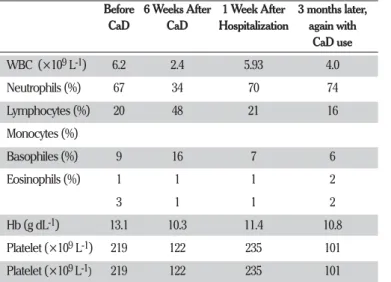
After 6 weeks of the treatment leukopenia, thrombocytopenia, and anemia were observed. His hematoxylin-eosin-stained blood smear confirmed markedly decreased platelet and leucocyte counts, accompanied by normochromic normocytic red cells (Table). CaD treatment was withdrawn because of the potential side effects. On physical examination the patient did not have organomegaly or palpable lymph nodes. His iron, ferritin, vitamin B12, and folate levels, and reticulocyte count were within normal limits, and ANA (anti nuclear antibody) and anti-double stranded DNA test results were negative. The patient was hospitalized and was prescribed intravenous ceftriaxone 2 g/day and clarithromycin 400 mg/day, following the diagnosis
of pneumonia. The patient was discharged after 1 week of hospitalization with improved hemogram results (Table 1).
Three months after discharge he was again admitted to our hospital with a fever of 38.6°C. It was learned that he again had started taking CaD. Pancytopenia was diagnosed, CaD was withdrawn, and the same intravenous antibiotic therapy was started again. Bone marrow biopsy and aspiration were performed from the iliac crest. Wright staining of the bone marrow aspiration smear microscopically showed normal erythroid and myeloid cell lines. The patient was discharged with a normal blood count after 1 week.
In conclusion, we want to emphasize the potential for serious side effects that affect the immune system in polypharmacy diabetic patients, such as granulocytopenia, and the importance of pharmacovigilance in patients with chronic diseases and the risk of comorbidity.
Conflict of interest statement
None of the authors of this paper has a conflict of interest, including specific financial interests, relationships, and/or affiliations relevant to the subject matter or materials included.
References
1. Lionis C, Erevnidou K, Antonakis N, Argyriadou S, Vlachonikolis I, Katsamouris A; CVI Research Group. Chronic venous insufficiency . A common health prob-lem in general practice. Int Angiol 2002;21:86-92. 2. Fowkes FGR, Ewans CJ, Lee AJ. Prevalance and risk
factors of chronic venous insufficiency. Angiology 2001;52:S5-15. [CrossRef]
3. Allain H, Ramelet AA, Polard E, Bentue-Ferrer D. Safety of calcium dobesilate in chronic venous disease, dia-betic retinopathy and haemorrhoids. Drug Saf. 2004;27:649-60. [CrossRef]
4. Zapater P, Horga JF, Garcia A. Risk of drug-induced agranulocytosis: the case of calcium dobesilate. Eur J Clin Pharmacol. 2003;58:767-72.
5. Ibanez L, Ballarin E, Vidal X, Laporte JR. Agranulocytosis associated with calcium dobesilate clinical course and risk estimation with the control and the case-population approaches. Eur J Clin Pharmacol. 2000;56:763-7.
6. Kulessa W, Becker EW, Berg PA. Recurrent agranulocy-tosis after taking calcium dobesilate. Dtsch Med Wochenschr. 1992;117:372-4. [CrossRef]
7. Garcia Benayas E, Garcia Diaz B, Perez G. Calcium dobesilate-induced agranulocytosis. Pharm World Sci. 1997;19:251-2. [CrossRef]
8. Azaceta G, Sáenz-Cusi A, Olave T, Palomera L. Agranulocitosis inducida por dobesilato cálcico: a propósito de un nuevo caso. An Med Interna 2000;17: 337-8.
9. Duggal L, Thukral R, Kumar S. Calcium dobesilate-induced agranulocytosis. J Assoc Physicians India. 2005;53:320-1.
10. Ibanez L, Vidal X, Ballarin E, Laporte JR. Population-based drug-induced agranulocytosis. Arch Intern Med. 2005;165:869-74. [CrossRef]
Cesur et al.
Pancytopenia with calcium dobesilate Turk J Hematol 2011; 28: 77-8
78
Table 1. The patient’s complete blood count during the follow-up peri-od, with and without medication
Before 6 Weeks After 1 Week After 3 months later,
CaD CaD Hospitalization again with
CaD use WBC (×109 L-1) 6.2 2.4 5.93 4.0 Neutrophils (%) 67 34 70 74 Lymphocytes (%) 20 48 21 16 Monocytes (%) Basophiles (%) 9 16 7 6 Eosinophils (%) 1 1 1 2 3 1 1 2 Hb (g dL-1) 13.1 10.3 11.4 10.8 Platelet (×109 L-1) 219 122 235 101 Platelet (×109 L-1) 219 122 235 101 CaD: Calcium dobesilate; WBC: white blood cells; Hb: hemoglobin