Introduction
In crop production, the main condition for high productivity depends on seeds being in the optimum living area. In other words, it is necessary for seeds to be placed at equal intervals within rows. With uniform spacing, the roots can grow to a uniform size (Steffen et al., 1999; Panning et al., 2000). For example, Lan et al. (1999)
determined that uniform seed spaces are important for crops such as sugar beet, because seed spacing uniformity is a significant factor affecting production costs and yield.
Although there are many planters having different seed metering units, the application of pneumatic single seed planters has rapidly increased due to the fact that their seeding performance is better than that of the
Effect of Different Operating Parameters on Seed Holding
in the Single Seed Metering Unit of a Pneumatic Planter
Zeliha Bereket BARUT*
Department of Agricultural Machinery, Faculty of Agriculture, University of Çukurova, 01330, Balcal›, Adana - TURKEY
Aziz ÖZMERZ‹
Department of Agricultural Machinery, Faculty of Agriculture, 07070, University of Akdeniz, Antalya - TURKEY
Received: 31.07.2003
Abstract: This research was performed to determine the effect of different operating parameters on seed holding in a single seed
metering unit. The metering unit was a vertical seed plate with a vacuum, used in seeding maize (Zea mays L.). An electronic counter in the metering unit was used to determine the holes without seed on the plate holes. The shapes of the holes, peripheral velocities, vacuum pressure, hole area on the seed plate and thousand grain weight of seed (TGW) were chosen as the operating parameters. A Factorial Completely Randomized Design was used for analysis of variance, Duncan’s multiple range test and mean comparison. The data were analyzed using the MSTAT-C statistics program. At the end of the research, it was found that the hole’s shape, peripheral velocity, vacuum pressure, the hole area and thousand grain weight of seed had an effect on the seed holding ratio (SHR) at a significance level of 1% (P < 0.01). The most suitable shape of the holes in the seed plate was oblong for maize seeds. The seed holding ratio decreased when the peripheral velocity of the seed plate increased, whereas the seed holding ratio increased parallel to the increase in vacuum pressure. An increase in the thousand grain weight of seed necessitated a larger hole area for holding seeds on the plate holes.
Key Words: Single seed planter, seed holding ratio, vacuum pressure, grain weight, hole area, hole shape
Pnömatik Tek Tohum Ekim Makinalar›nda Farkl› Çal›flma De¤iflkenlerinin Tohum Tutumuna Etkisi
Özet: Bu çal›flma; hava ak›ml›, delikli düfley plakal› ekici üniteye sahip bir tek dane ekim makinas›n›n m›s›r tohumlar›n›n ekiminde
kullan›lmas› durumunda, farkl› çal›flma de¤iflkenlerinin makinan›n ekim baflar›s› üzerine etkisini saptamak amac›yla yap›lm›flt›r. Tohum plakas› delik flekli, tohum plakas› çevre h›z›, vakum bas›nc›, tohum plakas› delik büyüklü¤ü ve tohumun bin dane a¤›rl›¤›n›n, delikli düfley plakadaki tohum tutumuna olan etkisini ortaya koymak amac›yla elektronik bir tohum say›c›dan yararlan›lm›flt›r. Araflt›rma sonunda, tohum plakas› delik flekli, tohum plakas› çevre h›z›, vakum bas›nc›, plaka delik büyüklü¤ü ve bin dane a¤›rl›¤›n›n, plaka deliklerinde tohum yakalanma oran›n› %1 (P < 0.01) önem seviyesinde istatistiksel olarak etkiledi¤i ortaya konmufltur. Çal›flmada, m›s›r tohumlar›n›n plaka deliklerinde yakalanmas› için en uygun tohum plakas› delik fleklinin oblong oldu¤u belirlenmifltir. Çal›flma bas›nc› ve tohum plakas› çevre h›z›, tohum yakalanma oran›n› birbirine göre ters orant›l› olarak etkilemifltir. Bu ba¤lamda, tohum plakas› çevre h›z› artt›kça tohum yakalanma oran› azalm›flt›r. Di¤er taraftan çal›flma bas›nc› artt›kça tohum yakalanma oran›n›n da bu art›fla parallel olarak artt›¤› ortaya konmufltur. Ayr›ca tohumun bin dane a¤›rl›¤› artt›kça tohumlar›n plaka deliklerine tutunmas› için daha büyük delik alanlar›na gereksinim oldu¤u saptanm›flt›r.
Anahtar Sözcükler: Tek tohum ekim makinas›, tohum yakalanma oran›, vakum bas›nc›, tohum a¤›rl›¤›, delik alan›, delik flekli
others. In additions, the devices of mechanical seed metering used in conventional drills are not capable of operating at high travel speed (Kumar, 2000). Thus, for high productivity, the metering unit of a pneumatic single seed planter should be accurate enough to plant seeds to the required seed distance on a row. This accuracy is expressed as the quality of the planters. Some studies reported that the parameters of planters were the following: seed cultivar, travel speed, peripheral velocity and the shape of the holes in the seed plate, vacuum pressure, coulter type, and covering unit. All these parameters had a large effct on the accuracy of longitudinal seed distribution (Önal, 1975; Aichinger, 1989; Klüver, 1991). Additionally, Schrödl (1987) reported that a higher vacuum pressure should be provided to suck maize seed on the plate holes as thousand grain weight increases. However, in his study, vacuum pressure and thousand grain weight did not have a statistically significant effect on seed spacing uniformity. For the accurate distribution of seeds, holding the seeds on the plate holes one by one without an interval is necessary. Barut and Özmerzi (1997) stated that seed cultivar, vacuum pressure, peripheral velocity and the shape of the holes in the seed plate affect the holding of seeds on plate holes.
The aim of this study was to analyze the effects of hole shape, peripheral velocity and hole area of the seed plate, vacuum pressure, and thousand grain weight on the seeding quality of a pneumatic single seed planter with a vertical seed plate for 3 maize varieties.
Materials and Methods
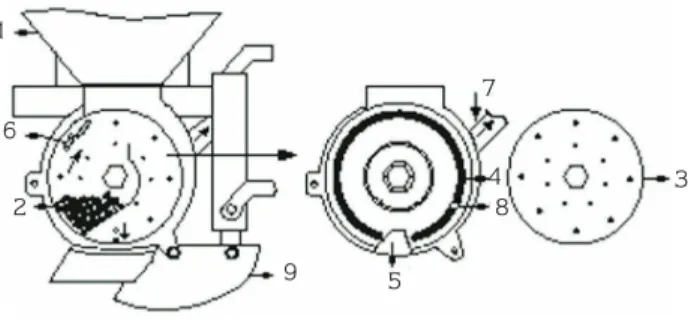
This research was carried out in a planter test unit designed at the Agricultural Machinery Workshop of the Agricultural Faculty of Akdeniz University. The test unit included a single seed planting unit with a vacuum and hole plate, a fan, an electronic counter, a tractor and an electric engine for the power source. The single seed planting unit was a row of general purpose planters designed for row crops such as maize, cotton and soybean (Figure 1). This unit consisted of a metering device, a seed hopper, a seed plate and an opener. The seed plate was driven by an electric engine. The vacuum pressure in the vacuum cell was obtained from a fan, which was driven by tractor power take-off shaft. In the study, an electronic counter was used to determine the
number of holding seeds on the plate holes. The sensor of the electronic counter consisted of an infrared receiver and a transmitter fixed to see the holes of the seed plate in the metering unit. The counter was designed to count the holes without seed on the plate. The seed distance was not directly measured during the experiments. A U manometer was used to measure and adjust the vacuum pressure.
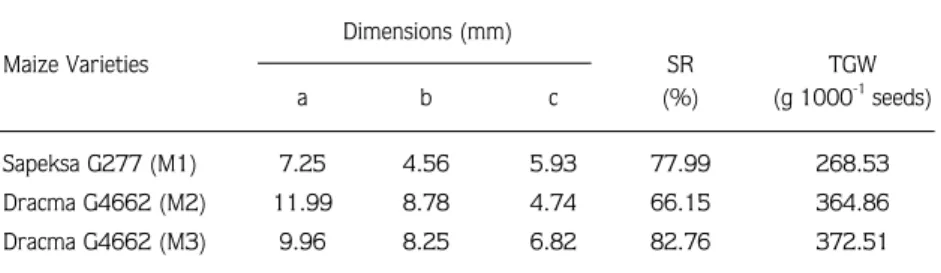
In the research, the seed holding ratio was calculated for 3 varieties of maize, namely M1, M2 and M3. M1 was a small-round variety called Sapeksa G277. M2 and M3 were large-flat and middle-round varieties called Dracma G4662. The characteristics related to the trial seeds are given in Table 1. In the study, 4 peripheral velocities of seed plate (0.16, 0.24, 0.32 and 0.40 m s-1), 4 hole shapes of seed plate (square, triangle, oblong and round), 4 vacuum pressures (1.0, 2.0, 3.0 and 4.0 kPa for a metering unit), 3 hole areas (9.62, 15.90 and 23.76 mm2) and 3 maize seeds with different thousand grain weights (268.53, 364.86 and 372.51 g 1000-1 seeds) were chosen as the operating parameters. The seed distance on a row was selected as 20 cm for maize.
Since seeds held on holes of the seed plate caused a pressure change, the vacuum pressure was adjusted while the holes of the seed plate were empty during the experiment. Seed plates with circular, square, equilateral triangular and oblong holes were used in the metering devices.
Based on area of circular holes of 3.5 (9.62 mm2; A1), 4.5 (15.90 mm2; A2) and 5.5 (23.76 mm2; A3) mm, square, equilateral triangular and oblong hole dimensions were determined. All the holes in the plates
1 6 2 9 5 8 4 7 3
Figure 1. The single seed metering unit of the pneumatic planter: 1, seed hopper; 2, seed; 3, seed plate; 4, air suction canal; 5, air cut; 6, separator; 7, vacuum tube to fan; 8, infrared receiver of electronic counter; 9, furrow opener.
were perforated by a laser cutter with computer support, taking the pattern from hole diameters of 3.5, 4.5 and 5.5 mm for maize. The oblong holes were placed in a circular position along their long axis (a) on the seed plate as shown in Table 2. The top points of the triangular holes are facing inward to the center of the seed plate. Based on hole area, the theoretical holding force of seeds on plate holes was calculated by Klüver (1991):
F = P x A ...………….…(1) where F is theoretical holding force, P is vacuum pressure and A is hole area. As to the equation, at constant holding force, a drop in pressure causes hole area to increase. After every 15 cycles of the 18-holed seed plate (total
270 holes), the holes without seed were counted and the seed holding ratio was calculated using the following equation:
SHR = ((270-EHN)/270)100 ...(2) where SHR is the seed holding ratio (%) and EHN is the empty hole number. In the study, the chi-square distribution was used to determine the lowest acceptable holding ratio. The acceptable holding ratio indicates the percentage of single seed drops. Chi-square values were calculated with the assistance of the full hole number determined in every 15 cycles of the experiments using Equation 3 (Düzgünefl, 1993).
Table 1. Characteristics of the seeds used in the study. Dimensions (mm) Maize Varieties SR TGW a b c (%) (g 1000-1seeds) Sapeksa G277 (M1) 7.25 4.56 5.93 77.99 268.53 Dracma G4662 (M2) 11.99 8.78 4.74 66.15 364.86 Dracma G4662 (M3) 9.96 8.25 6.82 82.76 372.51
SR, TGW, a, b and c are spherity ratio, thousand grain weight, length, width and thickness of the seeds, respectively.
Table 2. The dimensions of the holes in the seed plates used in the study. D i m e n s i o n s (mm)
Holes Hole Shape
Symbol A1 A2 A3
Circular d 3.5 4.5 5.5
Equil. Triangular a 4.7 6.1 7.4
Square a 3.1 4.0 4.9
Oblong a; b 2.0; 1.4 2.5; 1.9 3.0; 2.4
Hole areas of the seed plates are 9.62 mm2, 15.90 mm2and 23.76 mm2for A1, A2 and A3, respectively. d a a a a a a b
X2= Σ(f-f ′)2/f′...(3) where X2 is the chi-square value, f is the observed full hole number and f ′ is the expected full hole number (270). According to the equation, the low limit value of the acceptable holding ratio at 5% significance was 91.625%. The ratio over 91.625% was designated as an acceptable holding ratio for determining the seeding quality of a planter with different operating parameters. Percentage values were transformed on arcsine transformation for a true evaluation due to the calculated seed holding (SHR) ratio values dispersed with wide intervals using Equation 4 (Bek and Efe, 1988).
y’= Arcsine (SHR/100)1/2 ... (4) A 4-factor completely randomized design factorial variance analysis technique was used to examine the effects of the hole shape and peripheral velocity of the seed plate, the vacuum pressure, the hole size of the plate and thousand grain weight on the seed holding ratio using arcsine transformation values. In addition, 1 way and 4 ways interactions were analyzed and the significance levels of the results were statistically determined using Duncan’s multiple range test. In appraising the data, the MSTAT-C statistics program was used.
Results and Discussion
The Effect of Shape of the Holes in Seed Plate on the Seed Holding Ratio
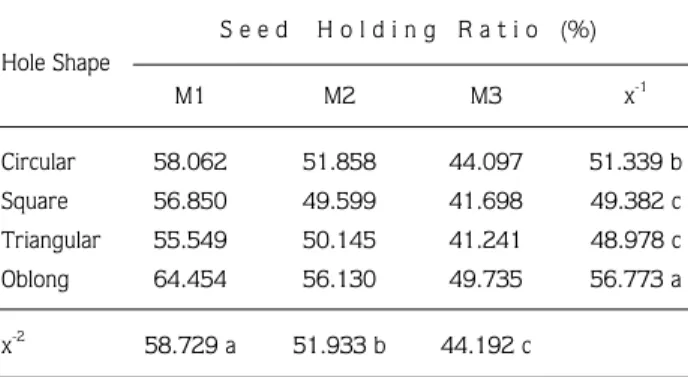
According to the results of the variance analysis for all maize varieties, hole shape affected the seed holding ratio at 1% (P < 0.01) significance. In addition, as a result of
Duncan’s test (x-1), the differences between the holding ratios of hole shapes were statistically significant for the 3 maize varieties (Table 3).
The highest seed holding ratio was achieved on the seed plate with oblong holes for all maize varieties (M1 of 64.45%; M2 of 56.13% and M3 of 49.74%), and the plates with circular holes followed this. The lowest seed holding ratio was obtained from the experiments using the plates with triangular and square holes.
The Effect of the Peripheral Velocity of the Seed Plate on the Seed Holding Ratio
For each maize variety, it was determined that the peripheral velocity of the seed plate was affected by the seed holding ratio at 1% (P < 0.01) significance and there were statistical differences between the holding ratio means of the seeds (Table 4).
An increase in the peripheral velocity of the seed plate caused seed holding ratios to drop. In other words, when the peripheral velocity of the seed plate increased, the empty hole number on the seed plate also increased. The highest seed holding ratio was achieved in M1 (71.76%) at the plate velocity of 0.16 ms-1, whereas the lowest seed holding ratio was obtained in M3 maize (29.75%) at the velocity of 0.40 ms-1.
As can be seen from Table 4, the seed holding ratio decreased with an increase in the plate velocity for each maize variety. Based on thousand grain weight, there were important differences between the seed holding ratio means of maize varieties (at x-2column). When the velocity was increased from 0.16 ms-1 to 0.40 ms-1, the seed holding ratio of M1, M2 and M3 maize seeds
Table 3. The effect of hole shape on seed holding ratio for M1, M2 and M3 maizes. S e e d H o l d i n g R a t i o (%) Hole Shape M1 M2 M3 x-1 Circular 58.062 51.858 44.097 51.339 b Square 56.850 49.599 41.698 49.382 c Triangular 55.549 50.145 41.241 48.978 c Oblong 64.454 56.130 49.735 56.773 a x-2 58.729 a 51.933 b 44.192 c Differences at 1% level.
Table 4. The effect of peripheral velocity of seed plate on seed holding ratio for M1, M2 and M3 maizes.
S e e d H o l d i n g R a t i o (%) Velocity (ms-1) M1 M2 M3 x-1 0.16 71.758 63.056 58.519 64.444 a 0.24 63.715 56.093 49.301 56.370 b 0.32 55.265 48.034 39.205 47.501 c 0.40 44.177 40.549 29.745 38.157 d x-2 58.729 a 51.933 b 44.193 c Differences at 1% level.
dropped 38.44%, 35.69% and 49.17%, respectively, according to the seed holding ratio in the velocity of 0.16 ms-1. The worst seed holding ratio was obtained with M3 because of its extra thousand grain weight. The changing of the plate velocity affected the seed holding ratio of M3 maize more than the other 2 maize varieties.
The Effect of Vacuum Pressure on the Seed Holding Ratio
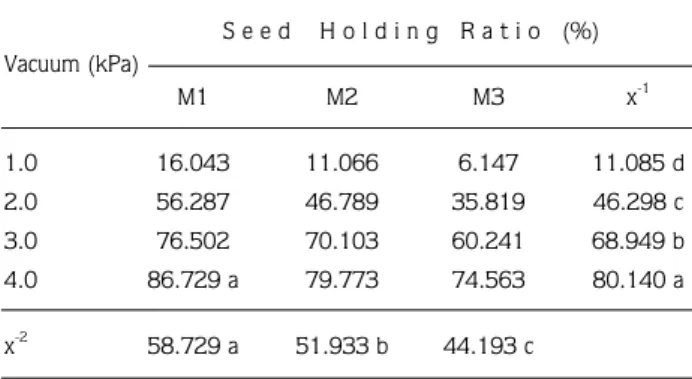
It was found that the vacuum pressure (1.0, 2.0, 3.0 and 4.0 kPa) affected the holding ratio at 1% (P < 0.01) significance. The differences between the holding ratio means of the vacuum pressure levels (x-1) were significant according to the results of Duncan’s test (Table 5). The pressure affected the seed holding ratio in direct proportion and while the vacuum pressure was increasing the value of the holding ratio also increased. As shown in Table 5, the highest seed holding ratio was with M1 (86.08%) at 4.0 kPa vacuum, whereas the lowest the seed holding ratio was with M3 (6.15%) at 1.0 kPa pressure.
When the seed holding ratio was 16.04%, 11.07% and 6.15% for M1, M2 and M3 maize varieties at 1.0 kPa vacuum pressure, the seed holding ratio reached 86.08%, 79.77% and 74.56%, respectively, in a vacuum pressure of 4.0 kPa. The changing vacuum pressure had a greather effect on the holding of M3 maize seed on the plate hole than on the other 2 maize varieties.
The Effect of the Hole Size of Seed Plate on the Seed Holding Ratio
According to the statistical test results, the size of the seed plate holes had a significant effect on the seed
holding ratio at the 1% level. The seed holding ratio increased with an increase in the hole size. The change of the size of the plate hole affected the seed holding ratio of M3 maize more than that of M1 and M2 maize. As the hole area decreased, holding heavy seeds on the plate hole became difficult. The results of Duncan’s test indicated that there was a significant difference between seed holding ratio means of hole areas (Table 6).
The lowest seed holding ratio was in M3 (19.71%) with a hole area of 9.62 mm2. The highest seed holding ratio was in M1 (76.01%) with a hole area of 23.76 mm2. The bigger hole size improved the seed holding ratio.
The Effect of Pressure, Velocity, Hole Shape and Hole Size on the Seed Holding Ratio
The results of the variance analysis indicated that 4 parameter interactions (shape of the holes in the seed plate x the negative working pressure x the peripheral velocity of the seed plate x the size of the plate holes) also affected the seed holding ratio at 1% (P < 0.01) significance. By using multiple regression analysis, the relationship between operating parameters and seed holding ratio was computed for each maize variety as follows: SHRM1= -20.868 + 23.033P - 9.119V + 1.788HS + 20.171HA R2 = 0.837 ...(5) SHRM2 = -29.61 + 22.944P - 7.55V + 1.336HS + 19.870HA R2 = 0.868 ...(6) SHRM3 = -38.776 + 22.967P - 9.641V + 1.646HS + 22.770HA R2= 0.865 …...(7)
Table 5. The effect of vacuum pressure on seed holding ratio for M1, M2 and M3 maizes. S e e d H o l d i n g R a t i o (%) Vacuum (kPa) M1 M2 M3 x-1 1.0 16.043 11.066 6.147 11.085 d 2.0 56.287 46.789 35.819 46.298 c 3.0 76.502 70.103 60.241 68.949 b 4.0 86.729 a 79.773 74.563 80.140 a x-2 58.729 a 51.933 b 44.193 c Differences at 1% level.
Table 6. The effect of the hole area size on seed holding ratio for M1, M2 and M3 maize. S e e d H o l d i n g R a t i o (%) Hole Area (mm2) M1 M2 M3 x-1 9.62 35.66 29.39 19.71 28.25 c 15.90 64.52 57.28 47.62 56.47 b 23.76 76.01 69.13 65.25 70.13 a Differences at 1% level.
where SHR is seed holding ratio (%), P is vacuum pressure (kPa), V is peripheral velocity of the seed plate (1:0.16 ms-1, 2:0.24 ms-1, 3:0.32 ms-1, 4:0.40 ms-1), HS is the hole shape on the seed plate (1: Triangular, 2: Square, 3: Circular and 4: Oblong) and HA is hole size (1: 9.62 mm2, 2: 15.90 mm2 and 3: 23.70 mm2). In the equations, the SHR is calculated using 1, 2, 3 or 4 instead of real values of velocity of seed plate, hole size and hole shape.
The seed holding ratio decreased as the velocity of the seed plate increased at constant pressure and hole size in the same hole shape for all maize seeds. In contrast to this, at constant peripheral velocity and hole size, a rise in the seed holding ratio was observed with an increase in vacuum pressure. Using the above equations, when the combinations of the 4-way interaction (hole shape x pressure x velocity x hole size) were tested, the most efficient (highest) seed holding ratios for the 3 varieties of maize were over 98% at 4.0 kPa vacuum, 0.16 ms-1 velocity and 23.76 mm2hole size in the study performed with an oblong holed plate. The lowest seed holding ratios for the 3 maize seeds were obtained at a peripheral velocity of 0.40 ms-1, vacuum pressure of 1.0 kPa and hole size of 9.62 mm2for all hole shapes.
Conclusion
In this study it was found that the most appropriate hole shape was oblong for planting maize seeds. Circular holes were also successful compared to the other hole shapes at seed holding. Similarly, Weller (1958) reported that circular hole shapes gave the best uniformity of seed distribution for lots of seeds (Klüver, 1991). With circular holes, the highest holding ratio was obtained at 3.0-4.0 kPa pressures, whereas vacuum pressures of 1.0
and 2.0 kPa were insufficient for seed holding. The lowest seed holding ratio was in the plates with square and triangular hole shapes. This finding was consistent with the results reported by Acar and Alizadeh (2002). These researchers found that the lowest pick up heights of sunflower seeds from a seed cell occurred at square hole shapes and the circular, oblong and triangular hole shapes followed the square ones.
When the holding ratio was evaluated in terms of the peripheral velocity of the seed plate, the highest holding ratio was obtained at the lowest peripheral velocity (0.16 ms-1). By increasing the velocity of the seed plate, seed holding ratio dropped. However, increased hole size and vacuum pressure yielded a better seed holding ratio at a higher velocity. As the vacuum pressures were 3.0 and 4.0 kPa, the acceptable holding ratio (91.62%) was reached at seed plate velocities of 0.16, 0.24 and 0.32 ms-1. An acceptable holding ratio (91.62%) was reached at a vacuum pressure of 4.0 kPa and hole size of 23.76 mm2 for all hole shapes and plate velocities. Similar results have been reported: an increase in velocity or a decrease in vacuum causes a deterioration in the uniformity of seed spacing in a row (Önal, 1975; Schrottmaier, 1976; Önal, 1987; Aichinger, 1989; Klüver, 1991; Barut and Özmerzi, 1997, Kumar, 2000). As to equation 1, an increase in hole area yielded a lower vacuum pressure at a constant holding force. Thus, a higher vacuum pressure was required for holding of a seed when a small hole instead of a big hole was used. For this reason, it is essential that a hole size according to seed size and weight should be used (Schrödl, 1977; Zehetner and Hammerschmid, 1984). Nevertheless, it is required that this laboratory study should be performed under field conditions as well.
References
Acar, A.‹. and H.H.A. Alizadeh. 2002. Pnömatik hassas ekim makinalarında ayçiçe¤i tohumlarının tutulmasına delik fleklinin etkisinin belirlenmesi. Tarım Bilimleri Dergisi, 8: 36-44. Aichinger, R. 1989. Vergleichsuntersuchung von Pneumatischen
Einzelkornsamaschinen mit Mais, Pferdebohnen, Puffbohnen und Sonnenblumen, Forschungsberichte der Bundesanstala für Landtechnik, Wieselburg, Heft 21.
Barut, Z.B. and A. Özmerzi. 1997. Hava akımlı hassas ekim makinalarında tohum plakası delik fleklinin ekim düzgünlü¤üne etkisi. Tarımsal Mekanizasyon 17. Ulusal Kongresi Bildiri Kitabı. 17-19 Eylül, Tokat, pp. 474-484.
Bek, Y. and E. Efe. 1988. Arafltırma ve Deneme Metodları-1, Ç.Ü. Ziraat Fakültesi Ders Kitabı, No:1, Adana.
Düzgünefl, O., T. Kesici and F. Gürbüz. 1993. ‹statistik Metodları. A.Ü. Ziraat Fakültesi Yayınları, No:1291, Ders Kitabı: 369, Ankara.
Klüver, B. 1991. Ablagegenauigkeit von Einzelkornsamaschinen für Körnerleguminosen. Forschungsbericht Agrartechnik des Arbeitskreises Forschung und Lehre der Max-Eyth- Gesellschaft (MEG), Nr. 215, Kiel.
Kumar, V.J.F. and C.D. Durairaj. 2000. Influence of head geometry on the distributive performance of air-assisted seed drills, J. Agric. Eng. Res., 75: 81-95.
Lan, Y., M.F. Kocher and J.A. Smith. 1999. Opto-electronic sensor system for laboratory measurement of planter seed spacing with small seeds, J. Agric. Eng. Res., 72: 119-127.
Önal, ‹. 1975. Bir pnömatik hassas ekim makinası ile mısır tohumunun ekim olanakları üzerinde bir arafltırma. TÜB‹TAK V. Bilim Kongresi TOAG Tebli¤leri, 29 Eylül-2 Ekim, ‹zmir, pp. 253-273. Önal, ‹. 1987. Ekim Dikim Gübreleme Makinaları. E.Ü. Ziraat Fakültesi
Yayınları, No:490. Bornova, ‹zmir.
Panning, J.W., M.F. Kocher, J.A. Smith and S.D. Kachman. 2000. Laboratory and field testing of seed spacing uniformity for sugarbeet planters. Applied Engineering in Agriculture, ASAE, 16: 7-13.
Schrottmaier, J. 1976. Elektronisches Messverfahren zur Bestimmung der Körnerverteilung von Saemaschinen. Forschungsberichte der Bundesversuchs und Prüfungsanstalt für landwirtschaftliche Maschinen und Geraete, Wieselburg, Heft 4.
Scrödl, J. 1977. Einzelkornsamaschinen DLG-Prüfberichte-Sammelband. DLG, Zimmeweg 16, Frankfurt/Main.
Schrödl, J. 1987. Einzelkornsamaschinen Konkskilde Preci-Sem Modell 06-40RH zur Maisaussaat mit Reihendüngerstreuer und Modell 06-30-RR zur Ackerbohnen und Sonnenblumenaussaat. DLG Prüfbericht, Nr.3946. DLG-Prüfungsabteillung, Frankfurt a Main. Steffen, R., R. Wolff, R. Iltis, M. Albers and D.S. Becker. 1999. Effect of two seed treatment coatings on corn planter seeding rate and monitor accuracy. Applied Engineering in Agriculture, ASAE, 15: 605-608.
Zehetner, H. and B. Hammerschmid. 1984. Welche Factoren Beeinflussen die Ablagegenauigkeit von Einzelkornsamaschinen bei Maissaat. Practische Landtechnik 4, pp.128-130.