KADIR HAS UNIVERSITY
GRADUATE SCHOOL OF SOCIAL SCIENCES NEW MEDIA DISCIPLINE AREA
WHAT SHOULD OTT BRANDS POST TO ENGAGE
WITH CONSUMERS ON INSTAGRAM?
BERSU BESLİ
SUPERVISOR: ASST. PROF. DR. PANTELIS VATIKIOTIS
MASTER’S THESIS
WHAT SHOULD OTT BRANDS POST TO ENGAGE
WITH CONSUMERS ON INSTAGRAM?
BERSU BESLİ
SUPERVISOR: ASST. PROF. DR. PANTELIS VATIKIOTIS
MASTER’S THESIS
Submitted to the Graduate School of Social Sciences of Kadir Has University in partial fulfillment of the requirements for the degree of Master’s in the Discipline Area of New Media under the Program of New Media.
iii
TABLE OF CONTENTS
ABSTRACT……….………..vii
ÖZET……….viii
INTRODUCTION……….….……1
1. REVIEW OF THE LITERATURE………..…….6
1.1 Marketing in a Digital Era………..………6
1.2 SNSs as an Instrument of Digital Marketing………..………7
1.3 Digital Content Marketing……….………10
1.4 Digital Consumer Engagement….………19
2. OBJECTIVES OF THE STUDY……….………..…..…30
3. INSTAGRAM………..……..38
4. METHODOLOGY OF THE RESEARCH………..….…..44
4.1 The Focus………..44
4.1.1 Netflix……….47
4.1.2 BluTV……….…49
4.2 Research………50
4.2.1 Research Framework………..50
4.2.2 Data Analysis Procedure……….………51
4.2.3 Qualitative Analysis………51
4.2.4 Quantitative Analysis………..52
4.2.5 Analysis Methods and Tools………...53
4.2.6 Limitations………..54
5.FINDINGS………..56
5.1 Introduction………..56
5.2 BluTV and Netflix………58
5.3 Vividness………..60
5.4 Best Day To Post………..62
5.5 Content Category……….67
iv 5.5.2 Current Product………..………..…….72 5.5.3 Infotainment...75 5.5.4 Customer Feedback……….76 5.5.5 Organization Branding………77 6. OVERALL DISCUSSION………78 SOURCES………..85 CURRICULUM VITAE...105
v LIST OF TABLES
Table 1. Set of DCM 29
Table 2. Monthly active Instagram users as of June 2018 39
Table. 3 Gender Distribution of Instagram Users 39
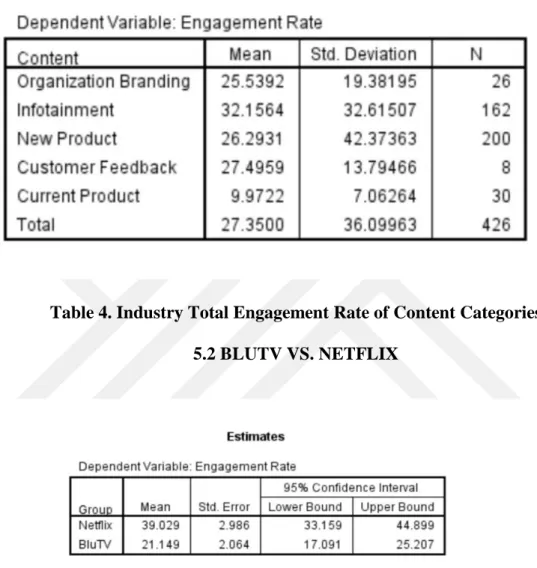
Table. 4 Industry Total Engagement Rate of Content Categories 58
Table. 5 Standard Errors of Engagement Rates of Blu TV and Netflix 58
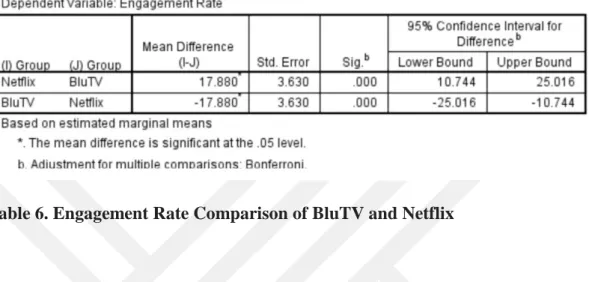
Table. 6 Engagement Rate Comparison of BluTV and Netflix. 59
Table. 7 Overall Means of The Engagement Rates 60
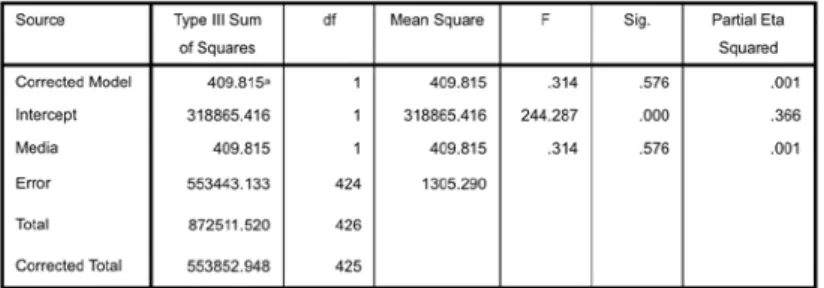
Table. 8 The Impact of Media Type to Engagement Rates 61
Table. 9 The Impact of Publish Date to Engagement Rates 62
Table. 10 Engagement Rates of Weekdays and Weekends. 63
Table. 11 The Impact of Week sets to Engagement Rates 63
Table. 12 Content Category Comparisons Based on Engagement Rates 64
Table. 13 Content Category Comparisons Based on Likes 65
Table. 14 Content Category Comparisons Based on Comments 66
Table. 15 Current Product Impact on Likes 67
Table. 16 New Product Impact on Comments 69
Table. 17 Comparison of Engagement Rates of Content Categories 70
Table. 18 Current Product Impact on Likes 71
Table. 19 Current Product Impact on Comment 72
Table. 20 Infotainment Impact on Likes 73
vi
LIST OF FIGURES
Figure 1. Type of Content 56
Figure 2. Content Categories Engagement Rate Distributions 57
Figure 3. Content Types 60
Figure 4. Content Category Distribution - Netflix and BluTV 67
Figure 5. Total Engagement Rate Comparison by RivalIQ 75
vii
ABSTRACT
BESLİ BERSU. WHAT SHOULD OTT BRANDS POST TO ENGAGE WITH CONSUMERS ON INSTAGRAM?, Masters Thesis, Istanbul, 2019
This study analyzes the most engaging content categories on Instagram. In order to understand and analyze the digital consumer engagement, Instagram content shared by two OTT brands, Netflix and BluTV will be examined. The aim of the study is to introduce an understanding on what factors indicate the essentials of a branded Instagram content created as a digital content marketing effort of an OTT brand in terms of digital consumer engagement by means of relational content analysis. The analysis takes the digital engagement metrics as a consumer feedback on the brands available on the branded Instagram content. This thesis tries to indicate whether the entrance of a new perception of social networking sites brings the brand - consumer interactivity notion to digital content marketing processes. The purpose of this thesis is to understand how should brands produce their content on Instagram in order to create high levels of digital consumer engagement. It aims to see which category of content determines the influence of the interactivity in Instagram marketing by picking two brands in OTT industry.
Key Words: Digital Content Marketing, Digital Consumer Engagement, Social Network Sites, Engagement, Instagram, Netflix, BluTV
viii
ÖZET
BESLİ BERSU. WHAT SHOULD OTT BRANDS POST TO ENGAGE WITH CONSUMERS ON INSTAGRAM?, Yüksek Lisans Tezi, İstanbul, 2019
Bu çalışma OTT markalarını takip eden Instagram kullanıcılarının en çok etkileş ime geçtiği içerik kategorilerini ortaya çıkarmayı hedeflemektedir. Dijital tüketici bağlılığı ve katılımını anlamak ve analiz etmek için, iki OTT markası olan Netflix ve BluTV tarafından Instagram içerikleri incelenmiştir. Markaların dijital mecralarda sürdürdüğü içerik pazarlaması çabalarının bir ürünü olan Instagram içeriklerini dijital tüketici etkileşimi bağlamında inceleyen çalışma, içerik analizi yöntemini kullanarak, bu markaların içerik planlamaları için temel bir anlayış geliştirmeyi planlamaktad ır. İçerik analizi, Instagram dijital etkileşim metriklerini tüketici geri dönüşü olarak ele almaktadır. Bu tezin amacı, OTT markalarının yüksek etkileşim seviyele rine erişebilmek için ne tür içerikler paylaşabileceklerini ortaya koymaktır. Bu endüstride yer alan markaların paylaşımları arasında hangi içerik kategorilerinin dijital tüketici etkileşimi bağlamında iletişimin interaktif olmasına katkıda bulunduğunu görmeyi amaçlamaktadır.
Anahtar Sözcükler: Dijital Tüketici Etkileşimi, Dijital İçerik Pazarlaması, Sosyal Medya, Instagram, Netflix, BluTV
1
INTRODUCTION
From a marketing point of view, the ways of communication and collaboration between brands and the consumer has been transformed since the advent of Web 2.0 (Enders et al. 2008). Social Networking Sites (SNSs) are a contemporary way for brands to communicate with their existing and potential consumers on online territories. Consumers increase their participation in technology-based social networks while more brands are using SNSs to strategically communicate with consumers (Hall-Phillips et al. 2016, Davis, Piven, and Breazeale, 2014). As they are interactive platforms, SNSs enable brands to connect with the consumer on a daily basis (Tafesse, 2016). Brand pages on SNSs are a dedicated and brand-moderated platform for brand communication and customer interaction. (De Vries et al., 2012). Deep and lasting customer-brand relationships are possible to be built by enhancing customer engagement on social media (Kumar, 2010). The brand-generated content is the primary mechanism through which brands connect with consumers in social media (Ashley and Tuten, 2015). Furthermore, consumers can interact with brand posts in real-time using built-in response options, such as “likes” and “comments” (Kabadayi and Price, 2014); although the feed-back types may vary in different SNSs.
In order to increase brand awareness, brand loyalty and brand-consumer interaction online, the first step for brands that seek to increase consumer engagement is their communication efforts on SNSs. Hence, brands seek for the most effective
2 strategies to increase consumer engagement through their own social network profiles (Schamari and Schaefers, 2015). Accordingly, it has been proved that consumers engaging with brands on SNSs, feel stronger connection with the brand (Calder, Malthouse & Schaedel, 2009; Chang & Fan 2017). Therefore, the SNS consumers are more likely to participate in brand communities (Algesheimer et al., 2005) so they are more likely to provide feedback for innovation to the brand (Kumar et al. 2010).
Recent studies suggest that SNSs are percieved as a platform to make online purchases in addition to simply communicating with firms and brands by the consumer (Barnes 2014, Chen and Shen 2015, Haslehurst et al. 2016, Bianchi et al. 2017). The majority of the academic studies laid their focus on the medium Facebook when it comes to digital marketing, especially social media marketing (Goor, 2012). On the contrary, industry practices urge academic-proven research on Instagram marketing under the reality that the number of brands utilizing Instagram has raised significantly (Stelzner, 2014). Moreover, Stelzner (2014) added that industry practices urge academic-proven research focusing on marketing efforts on Instagram as a result of the number of brands utilizing Instagram increased significantly.
In creating an effective content marketing strategy on SNSs, especially on Instagram where the branded content have a very high impact as consumers are in an active and voluntary manner interact with the brand page, consumer engagement in brand profiles on SNS: Instagram. As suggested in Hollebeek et al. (2014) DCE, must be studied to understand the motives of consumers to engage with brands in SNSs.
3 For Academic Research focusing on the marketing point of view in the field of Digital Consumer Engagement (DCE), the focus is mostly on the adoption to digital environments (Gavilanes, Flatten & Brettel, 2018; Brodie et al., 2011; Calder, Malthouse & Schaedel, 2009; Chu and Kim, 2011).
Even though Digital Content Marketing (DCM) related studies have attempted to classify content, only a few have done so from the perspective of profit-oriented brand communication. For instance, José Manuel Gavilanes, Tessa Christina Flatten & Malte Brettel (2018) conceptualized a model of categorization of digital content in terms of DCE for Facebook content to indicate the most successful categories to share on the platform to reach higher levels of engagement.
Although the previous research indicates the essentials to a successful Facebook content, it is important to establish what leads to an engageable content on another SNSs such as Instagram where responses of the consumer to brand messages become more interactive and more visible. Moreover, the academic research remains limited on observing DCM assets of brands on Instagram, not mentioning expanding the analysis deeper into a specific business environment such as over-the-top media (OTT) industry.
This thesis attempts to expand current Instagram knowledge into the DCE context of brand-customer relationship by taking brand-customer public interactions into consideration. Gavilanes, Flatten & Brettel (2018)’s approach of measuring DCM efforts of brands will be a path to examine the DCE on Instagram for branded content. content in terms of DCE in this thesis.
4 data of two brands in the OTT industry, Netflix and BluTV, under corresponding Instagram metrics (likes, comments, engagement rates) on branded posts as engagement measures.
The engagement metrics of branded content categories suggested in José Manuel Gavilanes, Tessa Christina Flatten & Malte Brettel (2018) for Facebook content will be applied to Instagram content. This research will contribute to the academic work in this area by questioning content marketing endeavours of brands on Instagram while expanding the content analysis practices into specific business environments and in the same industry relationally. Moreover, the academic literature will be expanded through the content analysis on Instagram usage of brand by identifying the DCE levels created via brand experience presented in branded content on Instagram profiles when taking into consideration the theoretical background of this research. To create a map for the structure of this thesis, the chapters are explained below.
Chapter 1, Review of Literature, provides information about the background of the study, definition of key terms, marketing in digital era, SNSs as an instrument of digital content marketing, previous literature indicating the (DCM) and Digital Consumer Engagement (DCE) fields regarding SNSs.
In Chapter 2, the theoretical frameworks DCM and DCE will be examined in terms of digital content marketing and then as a medium Instagram, is introduced. The general information about the application and its role in marketing will be discussed in this chapter.
Furthermore, Chapter 3, provides a detailed description of the research methodology followed in the current study. The chapter is divided into three sections. The first
5 section presents the objectives of the study where hypothesis and research question are formed. Secondly, the brands as focus of the study, Netflix and BluTV, are described briefly with the reason why they are being chosen. The third section concentrates on research, frameworks, tools and methods of analysis and limitations. Findings are revealed in Chapter 4, where the statistical analysis of the data collected on Instagram for both brands Netflix and Blu TV
Finally, a summary of the results is given in Chapter 5 with overall discussion in regard to the main approaches addressed in the literature review
6
CHAPTER 1
REVIEW OF LITERATURE
The research on application of social media regarding branding efforts in marketing is rapidly accumulating (Gensler et al., 2013). Although the number of researches in this field rapidly growing, far-reaching answers to some fundamental questions are still missing, such as what content elements make a digital content effective in terms of brand strategy (Lamberton and Stephen 2016). This thesis aims to take a step further in the research gap by taking customer-brand interactions into consideration by examining branded content shared on their Instagram accounts in terms of engagement regarding the content categories. This burgeoning body of research can briefly be summarized along two dominant theoretical perspectives: Digital Content Marketing (DCM) and Digital Consumer Engagement (DCE)
1. MARKETING IN A DIGITAL ERA
The shift to social media is bigger than ever and influential individuals, brands are rapidly emerging in the area with no global restrictions and has caused fundamental changes in the landscape of marketing and social media platforms have now become a natural part of companies’ marketing strategies (Kaplan & Haenlein, 2010; Zahoor & Quereshi, 2017)
Advertising is the point where creativity, business interest, needs of the consumer and regulation meet (Lohana, 2011). It is an effort to persuade customers and to actively
7 attempt to change or modify their attitude towards the brand (Solomon, 2002). Since the very beginning, advertisers are confronted with two main challenges reaching consumers: scarce resources and competition for attention. Scarce resources are often understood as advertising budgets that put practitioners under pressure to make efficient allocations to specific channels or media (Naik and Peters 2009; Vakratsas and Ma 2005); yet it also refers to the time and effort to create, manage, optimize and distribute quality branded content.
The spread of social media has changed consumer buying behavior as well as the way in which information is exchanged between companies and consumers (Sudha & Sheena, 2017; Virtanen, Björk & Sjöström, 2017; Zahoor & Quereshi, 2017). It can be said that one of the major changes on traditional marketing was determined by the emergence of digital marketing which required a reevaluation of the marketing strategies of companies willing to remain competitive in the new digital era.
2. SNSs: AS AN INSTRUMENT OF DIGITAL MARKETING
With the advent of Internet and after the SNSs, the setting of daily interactions of people have quite changed. To some, social media started as early as 1996, with the creation of the instant messaging system ICQ where people could send and receive text messages online. (Borders, 2009). It is surely beyond hope that ICQ was offering an entrance to a whole different social setting; yet with the invention of “Web 2.0” SNSs such as Friendster in 2002 started to change that setting more and more (Borders, 2009). According to Kaplan & Haenlein (2010), Web 2.0 is the technical foundation and platform of Social Media development.
8 founded Facebook in 2007. After the invention of Facebook, numerous SNSs such as Tumblr, Pinterest, Twitter, Instagram, Youtube, Google+, LinkedIn, Snapchat, Reddit, 4Chan, Flickr and more began to dominate the everyday life throughout the world. SNSs serve a variety of functions combining the interpersonal and mass communication formats all together. There is a free flow of information detached from the geographic boundaries and the usage has been experiencing a major growth every year. According to Raacke & Bonds-Raacke (2008), are the most popular and fastest growing types of internet sites (Nielsen-Wire, 2010): Social network sites (SNS). Kaplan and Haenlein (2010) defined social media as “a group of internet-based applications that build on the ideological and technological foundations of Web 2.0, which allows the creation and exchange of user-generated content” (p. 61). To Danah Boyd, SNSs are “social network sites as web-based services that allow individuals to (1) construct a public or semi-public profile within a bounded system, (2) articulate a list of other users with whom they share a connection, and (3) view and traverse their list of connections and those made by others within the system. The nature and nomenclature of these connections may vary from site to site.” (Boyd, 2007, p. 211). The “others” can also refer to brands on SNSs such as Instagram, Facebook, Twitter and YouTube.
Moreover, Jue et al. (2010:4) defines social media as referring "... to the many relatively inexpensive and widely accessible electronic tools that enable anyone to publish and access information, collaborate on a common effort, or build relationships.” Social media, as online channels for sharing and participating in a variety of activities, represent an increasingly important way for brands to
9 communicate with attractive audience segments (Murdough, 2009).
In fact, customers use social media over the purchasing process to collect information, to evaluate alternatives or even over the post purchase interaction such as posting their own experience on the social media (Drews and Schemer, 2010). According to Powers et al. (2012), above 20% of customers stated that social media is a key information source in the process of purchasing new products.
The focus attention on social media research is how such applications executed and adopted with success (Billings, 2014; Hardin, 2014; Hutchins, 2014). According to Hutchins (2014) understanding the role of social media over different contexts is important to contribute literature by expanding it through such important assets of social media. Dwivedi et al. (2015) mentioned that the vast majority of social media studies were observed to be within the marketing area. Tuten and Solomon (2015, p. 21) stated that the utilization of social media technologies, channels, and software is to create, communicate, deliver and exchange offerings that have value for an organization’s stakeholders.”
Indeed, the social media concept has been adopted over a wide range of different contexts. Yet, as the focus of the current study is the implication of social media in the marketing context, there is a need to address it by marketing perspective. Therefore, in this thesis, social media is defined as “a dialogue often triggered by consumers/audiences, or a business/ product/services that circulate amongst the stated parties to set in motion a revealing communication on some promotional information so that it allows learning from one another’s use and experiences, eventually benefitting all of the involved parties” (Dwivedi et al. 2015, p. 291).
10 Above all, understanding social media represent an attractive field to both professionals and researches (Gironda and Korgaonkar, 2014). So as to examine marketing efforts, numerous studies have addressed the role of social media in predicting the advertising activities (De Keyzer et al., 2015; Rejón-Guardia et al., 2016; Lee and Hong, 2016; Lin and Kim, 2016; Okazaki and Taylor, 2013; Swani et al., 2016; Wu, 2016). The brand perspective of SNS usage is investigated by Bernritter et al. (2016); Moro et al., 2016; Shi et al., 2016; Harrigan et al., 2017; Karaduman, 2013; Luo et al., 2015; Nguyen et al., 2016; Enginkaya and Yılmaz, 2014; Saboo et al., 2016; Saboo et al., 2015.
The customer point of view in terms of social media adoption is also a popular area in the field (Alarcón-del-Amo et al., 2016; Poba-Nzaou et al., 2016; Putzke et al., 2014; Lacka and Chong, 2016; Shokery et al., 2016; Gironda and Korgaonkar, 2014; Gummerus et al., 2012). The customer relationship management is tested by the practices of usage of the social media. (Maecker et al., 2016; Agnihotri et al., 2016; Xu, 2017).
Another approach of marketers examined the influence of social media in terms of electronic “word of mouth” (Teng et al., 2017; Viglia et al., 2016).
Indeed, there are a number of studies that have examined the relevant issues of social media over the consumer behavior context (Hamilton et al., 2016; Zhu et al., 2016; Bianchi and Andrews, 2015; Gironda and Korgaonkar, 2014; Wang et al., 2012). Yet, less attention has been paid to examine the role of social media from the marketing management perspective as mentioned by Bianchi and Andrews (2015) and Leeflang et al. (2014).
11 1.3 DIGITAL CONTENT MARKETING
Digital marketing is a use of digital technologies to create channels to reach potential recipients to achieve the business goals through more effective fulfillment of the consumer needs.
According to Rowley (2004), marketing communications in online environments is associated with creating presence, creating relationships, and creating value. The pressure of digital presence leads the marketers to one conclusion and content marketing has become the key of a successful online marketing campaign and the most important tool of the digital marketing as mentioned at Gong, Stump and Maddox (2013, p. 220) “over the past decades, content marketing has become one of the most efficient forms of marketing by leading brands”.
Content marketing can be defined as a management process where a firm identify, analyze and satisfy customer demand to gain profit with the use of digital content through electronic channels (Rowley, 2008), and the purpose of it is to “draw in leads and supplement brand credibility” (Silverman, 2012; p 14). According to Patrutiu Baltes (2015, p. 117), “content marketing is the present and especially the future of digital marketing and inherently to marketing in general. Therefore, a digital marketing strategy cannot be successful without having a quality content marketing.” Godin (2007, p. 34) notes that content marketing “is the only marketing left”. It has recently become a fast-growing market strategy with the help of technological
12 developments.
Nowadays, “content marketing” is a term one cannot escape from yetindeed, “content marketing” is a relatively young term. The term "content marketing" was used by John F. Oppedahl in 1996. (Patrutiu Baltes, 2015) In 1999, author Jeff Cannon stated that “in content marketing, content is created to provide consumers with the information they seek” (Gupta, 2015).
As explained at Du Plessis (2015) until the emergence of digital marketing the term content marketing was not actually referring the marketing efforts since the digitalization of marketing allowed companies to use a pull marketing strategy in digital platforms. As a matter of fact, the concept first mentioned made by Pulizzi and Barret (2009; p8) as: “it is the blend of both content and the marketing of that content that enables customer behavior.” Some of the relevant terms they included are: branded content, branded storytelling, information marketing, info-content. etc. The first academic research which concentrates on digital field content marketing was made by Holliman and Rowley (2014). On the other hand, until their academic approach, there have been several surveys (Handley and Chapman, 2011), and books offering advice on digital marketing (Handley and Chapman, 2011; Wuebben, 2012; Rose and Pulizzi, 2011).
According to Joe Pulizzi from Content Marketing Institute, “content marketing is the marketing and business process for creating and distributing relevant and valuable content to attract, acquire, and engage a clearly defined and understood target audience - with the objective of driving profitable customer action” (Pulizzi, 2012, p.1). Odden (2012) defined content marketing as a type of strategic marketing means that
13 encompasses creating and disseminating relevant and consistent content for the target population with the aim of driving profitable customer action.
Content marketing is a marketing and business process with the aim of profitable consumer action by creating and distributing valuable and challenging content to attract, acquire and engage a perfectly defined target audience (Pulizzi, 2013). According to Du Plessis (2015), content marketing can be defined as a strategic brand storytelling technique targeting at affecting consumer behavior and engaging them with the brand conversations in earned media and the author adds that with the spread of content marketing, brands were able to publish compelling brand stories on various media channels.
Nowadays, brands are curious about engaging the use of the content marketing tool in their marketing policies, regarding the limitations of the traditional marketing communication strategy on the contrary the huge opportunities brought by the dynamics of digital marketing channels. They are looking forward to benefit using digital channels to achieve their business goals in reaching new customers and enhancing current experience. In today’s digital world, content marketing is practiced by small and medium sized brands as well as large corporations such as Apple, Google, Microsoft etc.
A content marketing strategy has different aspects to success. First one is to match the message and content with the companies target audience to achieve customer engagement (Kilgour, Sasser, & Larke, 2015). However, to generate content which appeals a clearly defined audience is a process that involves an ongoing analysis of the consumer (Järvinen & Taiminen, 2016). On the other hand, brands use content
14 marketing to build a deeper relationship with customers using the modern digital channels by focusing on communicating (Royle & Laing, 2014 and the number of brands adding the usage of SNSs to their marketing efforts is increasing. Brands use content marketing to engage and retain existing customers, capture new readers and enhance relationships. Similarly, according to Corley II, Jourdan and Ingram (2013), the purpose of content marketing is to attract and retain customers. Besides, it offers relevant content with the aim of enhancing the consumer behavior.
The concept of DCM, the marketing of products where both the entity and the delivery of the product are digital was introduced by Koiso-Kanttila (2004). Swatman et al. (2006) refer to this as the “digital content market”. Rowley (2008, p. 518), mentions that “such digital content is an increasingly important part of the commercial landscape”.
Consequently, if brands seek to establish mutually satisfying long-term relationships with the consumer, they should seek to develop digital relationships using digital strategies that emphasize the co-creation of content and meaning. Brands, by marketing efforts, have always talked to their customers; the critical difference between past and present in this regard is that now, online communication tools allow customers to respond to brands (Mangold & Faulds, 2009).
At the beginning, companies used social media to share their advertisements, however, social media is now beyond the point to be a platform to share advertisements and more of a two-way communication platform (Kilgour, Sasser, & Larke, 2015). Digital content can be seen both as an instrument in marketing communication whereas it can be a product of the marketing mix. The interaction of the consumer with the shared
15 brand messages in digital era, leads to an increase in demand for content marketing” (Kosio- Kantilla, 2004; Pulizzi & Barrett, 2009).
Most noticeably, social media is a cost-effective medium allowing interactivity, collaboration and co-creation above two-way communication; integrating the communication and its distribution; providing opportunity to customization; and lastly delivering remarkable speed to the delivery of information communication and feedback (Shilbury, Westerbeek, Quick, Funk, & Karg, 2014).
Social media communication is more interactive and individualized for target audience. According to Verissimo & Borges Tiago (2014)’s conclusion, one of the marketing directors define the most important factor for the involvement of companies in digital media is that there are low investment requirements of the digital media when compared with traditional media. The cost-effective return helps the brand to achieve its marketing goals more efficiently and successfully compared to traditional tools of marketing (Leeflang et al., 2014). Moreover, digital marketing is mostly used on social media channels that today have a bigger audience compared to other traditional media channels (Forouzandeh, Soltanpanah, & Sheikhahmadi, 2014).
The aspects of content on social media were defined by Peters et al. (2013, p. 287) as:
“(1) content quality, subsuming content characteristics (e.g., interactivity, vividness), content domain (e.g., education, entertainment, information), and narrative styles; (2) content valence, subsuming emotions (e.g., anger, anxiety, joy) and tonality (e.g., positive, negative); and (3) content volume, subsuming counts and volumes.”
The technological developments in the past decades have led to change the way brands communicate with their customers, there have been a shift from a one-way to a two-way communication (Rahim & Clemens, 2012; Malthouse, 2007); Therefore Rowley
16 (2008) indicates that content marketing is delivered through electronic channels and is way more interactive with the audience by mostly using a a two-way communication compared to other marketing strategies.
Two-way communication is different from one-way communication in more than one points. First of all, it is more personalized than one-way communication, which focuses more to the mass De Pelsmacker, Geuens, & Van den Bergh (2018), it can be said that it is more familiar to interpersonal communication. Secondly, a two-way communication enables feedback and input from the audience De Pelsmacker, Geuens, & Van den Bergh.
Furthermore, the audience has an easy direct contact with the brand publishing content on the digital channels. Therefore, two-way communication enables more interaction, and higher engagement between a customer and a company (Kilgour, Sasser, & Larke, 2015). The effortless interactions in content marketing allow the consumer to be a part, and influencing the narrative content (Cronin, 2016). This enables companies to take advantage of the interactive platform and use the participatory interaction media to deliver content to the targeted audience (Kilgour, Sasser, & Larke, 2015). It can be said that the key attractor was interaction in other words, engagement.
Social media provides a platform where content marketing connects with the target audience (Ashley and Tuten, 2015). According to Halligan and Shah (2010), the use of content marketing implicates creating valuable content from the needs of potential buyers, who actively have engaged in searching information about the commodity. Therefore, creating content and using the social network channels to reach target audiences on platforms where the consumer is readily active, makes it easier to reach
17 your long term marketing goals such as brand awareness, brand loyalty and brand-consumer interactivity.
Today, any brand trying to be or to stay in the harsh competition on the digital market, must develop marketing content to its target audience and distribute the quality content with the help of the right social networks. This study will research the effective branded content on Instagram. According to Bartussek (2001), digital content producers must identify and serve customer needs since to Rowley (2008; p519), “DCM is the management process responsible for identifying, anticipating, and satisfying customer requirements profitably in the context of digital content”. Escobar (2016; p23) states that “to be able to identify the needs of a brands customer, active listening is required.”. Because social media feedback poses much greater and more immediate repetitional risk, it is even more important for companies to listen to it Than to call center or other traditional customer service interactions. (Smith, Wollan and Zhou, 2011).
Content marketing is a modern way to develop a long-term relationship with companies’ target audiences (Halevi & O'Hanlon, 2016). Monitorization of social media, analysis of feedback and comments, helps companies to define customer needs and interests (Järvinen & Taiminen, 2016). The metrics of engagement in Social Network Sites can be categorized as brand - consumer engagement. As explained in Ashley and Tracy (2014), “engagement is determined by the needs of consumer, and is important since customers are participants of the content created at the same time.”. According to Kilgour et al. (2015) content is correlated to attention and engagement. Moreover, and more importantly, content marketing differs from advertising in terms
18 of engagement, which is about engaging the potential customers in every possible way to help them solve their problems” (Ley, Pratt, & Wang, 2016). Therefore, marketing professionals should understand what specific content that is most effective for the target audience to achieve customer engagement. This leads to an increase of brand awareness, loyalty, and positive word-of-mouth for the company (Ashley & Tracy, 2014).
Despite the fact that content is one of the key points of marketing efforts in terms of effectiveness (Bertrand et al. 2010), research in the field is short when examining the relative effectiveness of branded content published on SNS platforms.
Marketers will benefit from understanding whether the creative appeals common in traditional advertising campaigns apply to branding in social media and, if so, what message strategies are most effective in achieving consumer engagement (Ashley at al., 2015).
Nguyen et al. (2015) while examining the role of social media in terms of brand innovation, mentioned that the knowledge created through social media platforms predicts brand innovation and it is assured in the study that the importance of social media as a strategic mechanism that could contribute to brand innovation.
Although the previous studies step up on understanding the fundamental aspects which should be taken into consideration by professionals and researchers on DCM over the social media platforms, there are some areas of the concept in need of investigation on researches related the effectiveness of marketing efforts addressing target audience on SNSs such as Facebook, Twitter, Youtube and Instagram. There is an obvious need to examine the impact of various research methods to provide a clear picture about social
19 media advertising in other words, DCM (Mangold and Faulds, 2009; Okazaki and Taylor, 2013; Steyn et al., 2011). The effect of the formats used on SNSs previously analyzed by Sabate et al. (2014) in terms of effectiveness. Similarly, de Vries, Gensler, and Leeflang (2012) studied how the vividness and interactivity of a post affects its popularity. The authors also looked at informational and entertaining content. Positive and negative types of content were differentiated in Tirunillai and Tellis (2012). The impact of the branded posts on SNSs regarding user engagement is studied by a few researches, the researches were taken likes, comments, and shares as metrics of evaluation (Lamberton and Stephen, 2016; Calder, Malthouse & Schaedel, 2009; Gavilanes, Flatten & Brettel, 2018; Cvijikj and Michahelles, 2011).
On the other hand, some studies offered a classification of the content on social networks yet the marketing perspective of profit-oriented brand communication or advertising is scarcely examined. Smith, Fischer, and Yongjian (2012) examined the consumer point of view. Other studies categorizing the types of content companies use on social networks are listed as: (Men and Tsai 2011; Parsons, 2013; Wallace, Wilson, and Miloch, 2011) yet none of the studies examine the categories of content in terms of digital consumer engagement.
One of the main focuses prior to social media marketing research is the role of attitudes and its dimensions. (Mir, 2012; Jung et al., 2016; Lee et al., 2016; McCaughey et al., 2016). This specific area of the field leads us to the conclusion that future studies should not ignore the importance of attitudes in their attempts to examine customer behavior and customer feedback on social media marketing activities (Alalwan et al., 2017).
20 It is stated that the hedonic aspects are a critical factor to motivate the consumer to engage in the marketing efforts on social media as examined by Carrillat et al. (2014) and Gummerus et al. (2012). Additionally, engagement has been another important asset regulate the level of consumer engagement in the social media environment. Hence, As Alalwan et al. (2017) suggested,.future studies should consider examining how such factor could have an influence on the customers’ feedback for the marketing actions in SNSs.
4. DIGITAL CONSUMER ENGAGEMENT
According to Higgins (2006), engagement is a second phase of experience beyond the hedonic source of experience resulting from a motivational force to action or no action. Customer engagement is behavior-based, extends beyond purchase, and has a brand or firm focus (Doorn et al., 2010). Dessart et al. (2016) suggests that consumer engagement captures consumers’ psychological and behavioral predispositions to interact with brands and other users in social media.
Within the broader context of social media, ‘engagement’ of consumer as a concept, is gaining attraction (Gavilanes, Flatten & Brettel 2018, Calder, Malthouse, and Schaedel 2009; van Doorn et al. 2010) in the literature in marketing research for consumer brand interactivity (Brodie et al. 2011).
“DCE” and “consumer engagement” concepts have been studied under different descriptions such as: customer engagement, customer brand engagement, advertising engagement, online engagement, digital consumer engagement (Gavilanes, Flatten &
21 Brettel, 2018; Calder, Malthouse, and Schaedel, 2009; Hollebeek, 2011; Brodie et al., 2011).
Hollebeek et al. (2014; p154)), defined consumer engagement, as “positively valenced brand-related cognitive, emotional and behavioral activity during or related to focal consumer/brand interactions”. Another definition of consumer engagement is when consumers are driven to interact with a brand in order to strengthen their emotional, psychological, or physical investment with it (Chaffey, 2007).
Social media has been described as an effective mechanism contributing brand objectives and strategy especially in customer relationship management and involvement of the customer (Filo et al., 2015). Usage of social media by brands to is also an area in the field for information interactivity, promotion and enhancing the customers buying behaviors (Zeng and Gerritsen, 2014).
Indeed, social media is widely considered as a main source of information that consumer “could return when he is in a process to take a purchasing decision” (Hamilton et al., 2016; Zhu et al., 2016; Erkan and Evans, 2016). Moreover, “Customer Engagement” is defined by Brodie et al. (2011) as a psychological state that occurs by advantage of interactive environment, co-creative customer experiences shared with a brand.
From a behavioral point of view, Calder and Malthouse (2008) distinguish media engagement from mere liking, implying that engagement is a stronger state of connectedness between the customer and the media rather than liking alone. Consumer engagement encompasses both a motivational state that leads to a heightened involvement in online brand activities (Baldus et al., 2015). It is understandable that
22 brands tend to use online channels where return on advertising investment can be tracked more accurately with instant feed-back (Breuer, Brettel, & Engelen, 2011). Moreover, it has powerful implications as it transpires behaviors and actions that translate into favorable brand outcomes (Jahn and Kunz, 2012). On contrary, some studies conclude that modern consumer is more active rather than passive, roles and behaviors in specific brand-based processes have changed (Ramani and Kumar, 2008; Pagani, Hofacker, and Goldsmith, 2011).
The use of information communication technologies offers numerous benefits to consumer such as efficiency, convenience, richer and more importantly, participative information, competitive pricing, cost reduction and product diversity (Bayo-Moriones & Lera-Lo´pez, 2007). SNSs tends to enhance the benefits of their usage as the user is able to communicate proactively as a consumer. Therefore, a variety of interactive practices and mechanisms have been developed by organizations to enhance their brand identity as well as their marketing performance (Leeflang et al., 2014; Filo et al., 2015; Schultz and Peltier, 2013).
Consumer engagement in SNSs leads to a stronger connection to the brand (Calder, Malthouse & Schaedel, 2009; Chang and Fan 2017). On the other hand, conventional marketing offers mostly a brand message in the flow of information with its channels consisting of print, television and radio where the feed-back is weak. However, digital channels, by their nature, offer an interactive communication, creates a platform to encourage a conversation between the brand and the consumer. As reported by Van Doorn et al. (2010) customer engagement is behavior-based, extends beyond purchase, and has a brand focus. Whereas, current literature suggests that activity on social
23 networks must be user-centered vs. message centered, the way can a brand effectively get its message across to the consumer while gratifying the consumer needs” (Chi, 2011, p.44-61).
In everyday life, branded contents on SNSs provide extra touch points to encourage the consumer-brand interactivity. The deepened relationship provided by SNSs helps marketers to discover common themes in consumer reactions, and influence consumers to engage with online content” (Murdough, 2009). In addition to this, according to Keller (2009) the touch-points for the brand-consumer interaction may include thoughts, emotions, perceptions, images and experiences and they create a set of brand memory on consumer perception.
Social media has changed the communication from company-to-consumer and added a consumer-to-consumer communication channel which has become very vital in marketing (Chu and Kim, 2011). Therefore, the users can seek after other consumers’ opinions about goods and services brands provide. In doing so, consumers have been shown to value peer judgments more than firm promotions, indicating a shift in the ground of persuasive power (Berthon, Pitt, Plangger, & Shapiro, 2012).
The increase in the usage of SNSs defines a fulfilling of consumption related needs for consumers such as joining a brand community, looking for product-related information, and finding support or advice while making purchase decisions (Mangold and Faulds, 2009). On the other hand, marketers have several aspects for branding within the social media landscape. These can be paid advertising, participating in social networks as a brand persona, developing branded engagement opportunities for customer participation within social networks, and publishing branded content (known
24 as content marketing or social publishing) in social channels (Tuten & Solomon, 2013). Additionally, the consumer is able to share their opinions on and/or share the branded content with their followers as a sign of digital consumer engagement. SNSs such as Instagram, are platforms where consumers spend considerable time to position themselves in the intense competition environment so as to “share their voice” (Corstjens and Umblijs, 2011). Although the SNS user’s main motivation is self-presentation (Kaplan and Haenlein, 2010), they share information about their brand preferences and brand related experiences via their likes, comments etc. (Wang, Meng, and Dong, 2012); the behavioral and cognitive responses, is not limited with “liking” and “commenting” on brand posts they are sharing the brand experience by creating user-generated content (Simon et al., 2013; Smith et al., 2012).
Besides the context of engagement, Hollebeek (2011) described three more facets of customer–brand engagement which are “dimensions, levels, and phases”. Moreover, the study added that engagement levels represent a specific engagement state at different phases of a relationship between companies and consumers (Hollebeek, 2011). The intensity of consumer engagement is highly dependent on the contextual conditions, such as the type of media (e.g., social networks), situational variables (e.g., advertising), and involved subjects (e.g., brand communities) (Brodie et al. 2011). Hence, DCE is used in reference to consumers’ interaction with a brand in an online environment (Close-Scheinbaum, 2015). It is obvious that examining consumer engagement leads to a better understanding of how and why people interact with brands in SNSs (Hollebeek, Glynn, and Brodie, 2014). Moreover, the adoption of consumer engagement to digital environments have been studied in numerous
25 studies.(Bouvier, Lavoue, and Sehaba 2014; Brodie et al. 2011; Calder, Malthouse, and Schaedel 2009; Chaffey 2007; Chu and Kim 2011).
The prior social media literature examines the impact of social media on consumer behavior such as attitudes, purchase decision and perception. (i.e. Hamilton et al., 2016; Gironda and Korgaonkar, 2014; Zhu et al., 2016; Erkan and Evans, 2016). Drews and Schemer (2010), considered the dependency of consumer to social media platforms as a source of information in their purchasing process. On the other hand, another point of view in the field concentrates on how social media influence customer attitude and purchase decision. For instance, Duffett (2015) discussed the performance and effectiveness of social media advertising activities predominantly depending on how customers could perceive and formulate their attitudes toward such activities. Among the consumer behaviors in the engagement levels that result in a brand mention shared to the person’s network, called influence impressions, are among the most desirable” (Li & Bernoff, 2008). In social media environments, consumers participate and share while engaging.
DCM efforts focusing on SNSs are crucial to a brand’s digital marketing strategy. Therefore, a vast of research is focused on the brand usage of SNSs by marketing researchers (Gavilanes, Flatten & Brettel 2018; De Vries et al., 2012; Lee et al., 2016;; Mangold and Faulds, 2009; McCaughey et al., 2016; Okazaki and Taylor, 2013; Swani et al., 2016; Wu, 2016; Gensler et al., 2013; Kaplan and Haenlein, 2010) mostly concluding as a support to the role of social media in enhancing the impact of promotional activities on the customer’s perception and awareness.
26 building (Fournier & Avery, 2011), the usage of social media for branding issues was also the focus of interest for a good number of marketing researchers (i.e. Bernritter et al., 2016; Moro et al., 2016; Shi et al., 2016; Popp and Woratschek, 2016; Harrigan et al., 2017; Gensler et al., 2013; Kaplan and Haenlein, 2010). According to Filo et al. (2015), using social media platforms contributes to the ability of firms to attach customers to their own brands more. Such trend has recently received a considerable interest in many marketing studies. Muk and Chung (2014) points out the factors motivating consumer to follow a brand page; they found out that kind of utilities such as hedonic and factional are the main factors for consumer to join brand community online. De Vries et al. (2012) noted that the acceptance of the brand posts by users are strongly contributed by “vividness, the post position, and interactivity”.
The information about the brand on SNSs must be relevant to the consumer if brands seek to encourage consumer to engage with it in self-relevant ways (Schmitt, 2012). Therefore, the vast majority of the researchers in marketing field support social media as a new tool that could help organizations to sustain their relationship with their targeted customers (Alalwan et al., 2017).
According to Carrillat et al. (2014), to have positive customer attitudes and provide the consumer more intimate and pleasurable experience, hedonic aspects have to be carefully addressed in social media promotional activities. Kim and Ko (2012) examined consumer engagement on brand loyalty level by social media usage and the results showed that marketing activities on SNSs have an influence on purchase intention, customer loyalty, value equity and relationship equity; as significant positive effects.
27 Since the consumer use of a brand media reflects the consumer engagement with the brand (Hollebeek et al., 2014), a brand's social network site-driven gratitude is expected to work as a driver of engagement with the brand page (Simon and Tossan, 2018). Gensler et al. (2013) suggests that it is an interesting issue for marketers social media technologies enabling brands to co-create brand stories with, an among, active networked consumer through higher levels of customer-brand interaction. Recently, customer engagement research in branding and relationship marketing, which has been argued to act as a vehicle for enhancing consumer relationships, profitability and growth (Brodie et al., 2011; Hollebeek, 2011).
The ways to enhance the relationships for brands regarding consumer engagement on Facebook is examined by Gummerus et al. (2012). According to the study, there are two kinds of customer engagement behaviors – they were community engagement behaviors and transactional engagement behaviors. Furthermore, in the research, Gummerus et al. (2012) proposed social benefits, hedonic benefits and functional benefits were all proposed as key relationship benefits that customers could have from engaging with the brand on Facebook.
Another study, Pereira et al. (2014), conducted a research on how involvement of the consumer on Facebook intended to explain the impact of using Facebook on the tie between customers and brands posted on the Facebook. They added that although customers seem to be excited to follow brands on Facebook, they are less interested in keeping contact with these brands as well as to share the branded content on their own pages.” Gamboa and Gonçalves (2014) has also studied the role of Facebook on enhancing customer loyalty.
28 Another example on a different social networking site, Twitter, was conducted by Kim et al. (2014) examining the impact of customer brand interactivity to the extent of how much the customer involving by re-tweeting brand messages on Twitter and concluded that the consumers more likely to retweet branded message has an extent level of brand trust, brand identification, Twitter usage frequency, intention to be a member in the community, and community commitment.
The customer perspective in terms of behavior and perception has taken the attention of a good number of articles in the digital marketing field. Leung et al. (2015) notes that the behavioral intention of customer to purchase is predicted by the attitude of the customer is related to Twitter, Facebook and other organizations. Moreover into the debate, Williams and Chinn (2010), noticed that customer experience could be contributed by using social media platforms assisting brands to provide a positive presentation of their brands by contacting and interacting more with the consumer. In line with the discussion, as Wang et al. (2012) states, the dimensions pertaining to the high degree of interactivity and personalization have contributed to both customers’ experience as well as the information resources needed by customers in their purchasing decisions; indicating that the intention of the consumer in terms of purchase decision is significantly predicted by the role of involvement. Wang et al. (2012) added that consumer involvement was largely enhanced by using social media. “Whether these interactions can provide value for consumers and favor engagement with brand-hosted social media remains unclear.” (Simon and Tossan, 2018 p. 175). Gavilanes, Flatten & Brettel et al. (2018) examines the Social Network Advertising (SNA) content in terms of Digital Consumer Engagement on branded content shared
29 on Facebook.
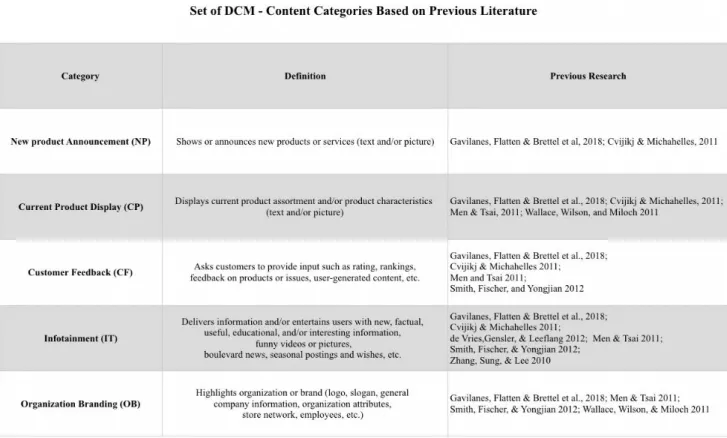
Table 1. Set of DCM
Table 1 above indicates the definitions of previous research for the categories of content used in to classify branded content shared on SNSs applied the set of categories prepared for Facebook content to Instagram content (Gavilanes, Flatten & Brettel et al, 2018; Cvijikj and Michahelles 2011; Men and Tsai 2011; Smith, Fischer, and
30 Yongjian 2012; Wallace, Wilson, and Miloch 2011; Zhang, Sung, and Lee 2010). Originally, Gavilanes, Flatten & Brettel et al. (2018) evaluated seven categories of SNA content including current product display, new product announcement, sweepstakes, sales, customer feedback, infotainment, and organization branding. Yet the data used in this thesis included only five without sweeptakes sand sales.
This research will contribute to the academic work in this area by questioning content marketing endeavours of brands on Instagram while expanding the content analysis practices into specific business environments and in the same industry relationally. Moreover, the academic literature will expand through the content analysis on Instagram usage of brand by identifying the DCE levels created via brand experience presented in branded content on Instagram profiles when taking into consideration the theoretical background of this research.
2. OBJECTIVES OF THE STUDY
As Ashley and Tuten (2014) suggested, branded social content can be used as advertising to influence consumer brand attitudes, in other words digital consumer engagement, and also provides consumers with content to share with their own networks. Additionally, it is proved in Gavilanes, Flatten & Brettel (2018) that DCE is an applicable form of social networks and by using relational content analyzing and operationalized to measure with a quantitative analysis method.
31 Brettel (2018), DCE is operationalized to enable quantitative analysis in measuring the concept on Instagram content. As concluded at the study, “the “likes” on a post could measure whether the branded content is being received with a positive attitude and so will increase cognitive and affective elaboration.” (Gavilanes, Flatten & Brettel, 2018, p. 11). Moreover, as mentioned at Vakratsas and Ambler’s (1999) a high level of elaboration leads to a more engaged type of action, such as comment on Instagram.
It is known that branded content with different intensities lead to different levels of DCE as measured by clicks, likes, and comments (Gavilanes, Flatten & Brettel, 2018; de Vries, Gensler, and Leeflang 2012; Sabate et al. 2014). In this thesis, all users are accepted to have neutral consuming since the data covers the engagement of the consumer after being exposed to the brand message.
For the consumer clicking the “like” button is a form of rating the branded content positively. As mentioned in Gavilanes, Flatten & Brettel (2018; p8), “despite requiring little time or effort, clicking the “like”button represents more emotional investment from the consumers’”. Furthermore, user-to-content interactions such as “liking” are consequently classified as a middle level of online activity (Muntinga, Moorman, and Smit, 2011). In brief, liking can be considered as a positive emotional state toward the brand or the content.
As cognitive and affective processing, comments should be taken into consideration since commenting on a branded content involves “consuming the post, forming a
32 (positive, neutral, or negative) position about the post, deciding to express that position with a contribution, formulating an appropriate contribution, and posting the comment.”( Gavilanes, Flatten & Brettel (2018; p8)) Commenting obviously requires more time and effort than a “like” and stronger cognitive processing of the branded input (Vakratsas and Ambler, 1999). All kinds of expressions, no matter which emotion it contains, represent emotional engagement with the content (Heath, 2007). As a result, Gavilanes, Flatten & Brettel (2018) describe commenting as moderate to strong DCE, in which consumers cocreate content in a limited brand environment.
Another data set is used for examining the content categories: Engagement Rate Total. To get an idea of the magnitude of engagement per post, the number of likes and comments of each post is weighted with the size of the brands audience. Engagement rate total is calculated via the formula below to create a general meaning of the data itself.
ERT = [(number of likes + number of comments) / number of followers]x1000
In addition to the measurement metrics, consumer engagement theory states that the level of engagement depends on the context (Brodie et al. 2011). Moreover, different media types exhibit different levels of interactivity, expressed through the degree to which users can influence the form and content of the media environment (Steuer, 1992).
33 to Daft and Lengel (1986), these media types represent different level of media richness which is commonly referred to as vividness of online content. Video content can attract more attention than photographic content since “a video is more vivid than a picture because the former stimulates not only sight, but also hearing.” (de Vries et al., 2012, p.85).
Vividness can be enlarged on social media, for instance by including videos, audio or animation (Coyle & Thorson, 2001). Adding vividness to a content stimulates different senses, influencing in turn one’s attitude and behavior (Petty & Cacioppo, 1989).
Making an analogy between the branded content shared on Instagram brand pages, a positive effect of vividness is expected, thus formulating the following hypothesis:
H1: The higher the level of post vividness, the higher the engagement level is.
SNS users are rather willing to engage with products on social networks when those products relate to their interests and hobbies (Harris and Dennis, 2011). As we know that the users of SNSs which are a part of online brand community on Instagram will be exposed to branded-content since they choose to follow the brand, they will be pleased to learn more about the existing and new products relating to their interests.
It is assumed that users engage more in OTT brand Instagram accounts as an entertainment industry brand at the weekends since they would have more time to spend on watching the provided product. Moreover, according to Iskandar and Arden (2016), the most popular day is Friday to post on Instagram. Therefore, a significant impact of Friday to consumer engagement is expected.
34 H2: Posts created on Friday result in higher level of engagement.
Kumar et al. (2016) suggested brand posts with current product information positively affect deeper stages of the purchasing funnel. Moreover, the authors mention current product related branded content has a significant positive effect on likes and comments. However, in OTT industry brands, current product announcements might be considered as old information. Therefore, a lower level of DCE is expected when current product displays are examined. Despite that, a positive impact on DCM metrics is expected for new product announcements (Gavilanes, Flatten & Brettel, 2018). Therefore, H3 and H4 are produced:
H3: Instagram branded-content announcing New Products has higher level of engagement compared to compared to one or more categories.
H4: Instagram branded-content that display current products has low levels of engagement.
While trying to create a positive relationship relying on brand-consumer interactivity, besides commercial oriented content, posts would lead to non-monetary gratification should also be created (de Vries, Gensler, and Leeflang, 2012). Users will be expecting entertaining or informative content, so they will visit the brands page more often and build stronger positive relationships with the brand (Foster, Francescucci, and West 2010); hence, a positive effect on likes and comments regarding the infotainment content is expected. The role of content in digital marketing in terms of the social media strategy is crucial when considering that consumer reaction to a product or price-related post might be different than an educational or entertaining post (Rishika
35 et al. 2013).
Social media introduces a ‘new avenue’ for two-way communication and creates ‘possibilities’ for more interactions between buyers and sellers if used properly (Agnihotri, R., et al., 2015). In addition to its interactive nature, social media has an interpersonal form, so normative and informative influences may work for advantage or against the objectives of the brand, depending on consumer engagement (Mangold & Faulds, 2009).
The hedonic needs, the need for an escape, aesthetic gratifications, are the robust motivators of entertainment; informativeness (need for resources and helpful information); and as a demotivation, irritation (Luo, 2002). Moreover, according to Taylor, Lewin, and Strutton (2011), the user can find branded content on SNSs such as Facebook as informative and entertaining”.
Therefore, a positive impact on likes is expected (Gavilanes, Flatten & Brettel; 2018). Moreover, if the positive attitude enough to motivate users to engage further such as comments on such posts to engage with the fun factor and escape from everyday problems, hence a positive response is expected. (Calder, Malthouse, and Schaedel 2009).
H5: Instagram branded-content that inform or entertain (Infotainment) users have the highest level of engagement.
SNS’s by their nature, provide a space to brand-consumer relationship where consumer is proactive. Brand posts online are where the brand creates a conversation
36 where the consumer will feel more participant. Although the point of views of Gavilanes, Flatten & Brettel (2018) and de Vries, Gensler, and Leeflang (2012) in the category of customer feedback included mostly company posts with questions, another popular way of stimulating users to react to the post and at the same time gather customer feedback was taken into consideration in this thesis. According to Burmann (2010), User Generated Content is suggested as a main asset in terms of managing the consumer feedback. Moreover, this UGC might represent the customer complaint or brand fan dedication. (Burmann, 2010). Moreover, consumers may share their own opinions and/or share a branded content with their network (Ashley and Tuten, 2014). As stated by Musser and O ’ Reilly (2006), in the participatory world of Web2.0 millions of users have started publishing their own brand-related content. While examining the interaction in the content category of consumer feedback, the User Generated Content re-shared by the brand was taken into consideration. Therefore, H6 is created:
H6: Instagram branded-content category Customer Feedback has high levels of engagement on digital consumer engagement.
Social media is also actively being used by brands to promote overall company and organization awareness; yet when the organizational information is not useful to end-users, the engagement rates are negatively affected. As Kelly, Kerr, and Drennan (2010) have argued that organizational branding content can be perceived as intrusive and leading to negative affective responses (Lu, 2016). Especially when the information related with the organization is not useful to consumer. On the other hand,
37 if a positive response is clear in terms of DCE on content category of organizational branding, an engagement level of brand loyalty level can be suggested as a rational. Since Sinha et al. (2011) found that when the knowledge of the consumer about a brand increases through social media, regardless of whether content of the brand’s social communications was functional or emotional in nature, the emotional attachment increases. Therefore, Organizational Branding contents is expected to have an effect on digital consumer engagement.
H7: Instagram branded-content for organizational branding on Instagram have an impact on digital consumer engagement.
The purpose of the study is to identify the most effective types of branded-content on Instagram with the effort of content marketing in order to see which factors in a content determines the influence of the interactivity by means of digital consumer engagement.
By analyzing two brands regarding their Instagram content, this research will contribute to the academic work in this area by questioning content marketing endeavours of brands on Instagram while expanding the content analysis practices into specific business environments and in the same industry.
The academic literature will expand through the content analysis on SNS usage of brands by identifying the DCE levels created via brand experience presented in branded content on Instagram profiles when taking into consideration the theoretical background of this research.
38
CHAPTER 3
Instagram is a mobile application giving photo sharing service which can be used by on smartphones and tablets. The company was launched in October 2010 by a programmer, Kevin Systrom and a software engineer, Mike Krieger.
Instagram is an online mobile platform where the users can capture, manipulate, and upload visuals. On the other hand, it is a networking service. Images are uploaded through mobile devices only, although there is a web version. Instagram recently launched the upload feature for mobile web browser only (Monckton, 2017).
As a social media platform with access to millions of future consumers, after its reveal, only in three months, December 2010, the application had one million users. Two years later the application was sold to Facebook for one billion US dollars. (Facebook Newsroom, 2012). The growth of Instagram is fueled by this rapid adoption of devices with high- functioning cameras (Salomon, 2013) since Instagram is dedicated to mobile experience.
The increase in the count of the users of Instagram have been increasing dramatically since then. Below is a diagram giving information on the number of monthly active Instagram users as of June 2018 (Statista, 2018).