THE INTERESTS OF EFL INSTRUCTORS IN TURKEY REGARDING INSET CONTENT
A THESIS PRESENTED BY EMEL ŞENTUNA
TO THE INSTITUTE OF ECONOMICS AND SOCIAL SCIENCES IN PARTIAL FULFILLMENT OF THE REQUIREMENTS
FOR THE DEGREE OF MASTER OF ARTS IN TEACHING ENGLISH AS A FOREIGN LANGUAGE
BILKENT UNIVERSITY JULY, 2002
Title : The Interests of EFL Instructors in Turkey Regarding INSET Content
Author : Emel Şentuna
Thesis Chairperson : Julie Mathews Aydınlı
Bilkent University, MA TEFL Program Committee Members: Dr. William E. Snyder
Bilkent University, MA TEFL Program
Dr. Tom Miller
USIS
The purpose of this study was to investigate the interests of EFL instructors’ working in the preparatory schools of Turkish state universities regarding the content of in-service training programs and to find out whether EFL instructors feel the need for different content in in-service training programs at different points in their careers.
The study was conducted in the Foreign Languages Departments of eighteen state universities. 530 EFL instructors in the following institutions participated in the study: Akdeniz University, Anadolu University, Ankara University, Boğaziçi
University, Celal Bayar University, Çukurova University, Dokuz Eylül University, Ege University, Erciyes University, Hacettepe University, Karadeniz Technical University, Marmara University, Mersin University, Middle East Technical University, Muğla University, Osmangazi University, Sakarya University, Yıldız Teknik University.
interests regarding different aspects of professional development in ELT. The second part included questions that allow participants to choose from more than one option, yes-no questions and open-ended questions to collect demographic information about the participants.
Quantitative data analysis techniques were used to analyze the data. For the items in the first part of the questionnaire, frequencies, means, standard deviations, and t-test were calculated. Frequencies, means, and standard deviations were found to identify the instructors’ general interests in terms of INSET content. Comparison of interests of the novice instructors who have less than 5 years of experience and the experienced instructors who have more than 5 years of experience were analyzed through means, standard deviations, and t-tests.
The results of the data analyses revealed that the instructors are at least fairly interested in attending INSET courses on all the items asked in the questionnaire. They were found to be most interested in having further training on ways of motivating students and raising students’ language awareness. The instructors also expressed interest in INSET courses on the implementation of new teaching methods, using new materials, raising their students’ awareness of their goals and objectives, teaching vocabulary, teaching speaking, teaching reading, promoting interaction, ways of determining students’ needs, and ways of evaluating the effectiveness of teaching.
The results also indicated that the novice teachers are more interested than the experienced teachers in most of the topic areas related to INSET content. 32 of
degrees of interest might be the divergence in the year of experience.
Implications for the development of teacher training programs in Turkey and for further research are discussed.
BILKENT UNIVERSITY
INSTITUTE OF ECONOMICS AND SOCIAL SCIENCES MA THESIS EXAMINATION RESULT FORM
JULY 28, 2002
The examining committee appointed by the institute of Economics and Social Sciences for thesis examination of the MA TEFL student
Emel Şentuna
has read the thesis of the student.
The committee has decided that the thesis of the student is satisfactory.
Thesis Title : The Interests of EFL Instructors in Turkey Regarding INSET Content
Thesis Advisor : Dr. William E. Snyder
Bilkent University, MA TEFL Program Committee Members : Julie Mathews Aydınlı
Bilkent University, MA TEFL Program Dr. Tom Miller
We certify that we have read this thesis and that in our combined opinion it is fully adequate, in scope and quality, as a thesis for the degree of Master of Arts.
__________________________________ Julie Mathews Aydınlı
(Chair) __________________________________ Dr. William E. Snyder (Committee Member) __________________________________ Dr. Tom Miller (Committee Member)
Approved for the
Institute of Economics and Social Sciences
______________________________________________ Kürşat Aydoğan
Director
ACKNOWLEDGEMENTS
I would like to express my appreciation to my thesis advisor, Dr. William E. Snyder for his genuine interest, invaluable guidance and enthusiastic encouragement throughout the program and the study. I would also thank Dr. Sarah Klinghammer and Julie Mathews Aydınlı for their continual support during the program.
I owe much to Prof. Dr. Gül Durmuşoğlu Köse, the department head of Anadolu University, School of Foreign Languages, Associate Prof. Aynur Yürekli and Bahar Cantürk, who have supported me to attend MA TEFL program.
I would also like to thank Dr. Mengü Noyan Çengel, the head of Foreign Languages Department, Ege University, Emil Atbaş, the general coordinator of Foreign Languages Department, Erciyes University, Prof. Dr. Özden Ekmekçi, the head of Foreign Languages Department, Çukurova University, Dr. Banu Tuzgiray, department head of School of Foreign Languages, Marmara University, Sibel Tüzel Köymen, department head of School of Foreign Languages, METU, Çiğdem Aysen, the head of Foreign Languages Department, Mersin University, Associate Prof. Erinç Özdemir, department head of School of Foreign Languages, Akdeniz University, Associate Prof. Metin Timuçin, the head of Foreign Languages Department, Sakarya University, Associate Prof. Şevki Kömür, department head of School of Foreign Languages, Muğla University, Dr. Perihan Akbulut, department head of School of Foreign Languages, Yıldız Teknik University, Associate Prof. Selami Ok,
department head of School of Foreign Languages, Dokuz Eylül University, Dr. Deniz Atlı, the head of Foreign Languages Department, Boğaziçi University, Münevver Büyükyazı, the coordinator of Foreign Languages Department, Celal Bayar University for their valuable help with administering the questionnaires.
I am also grateful to Meltem Coşkuner from Akdeniz University, Yonca Özsandıkçı from Karadeniz Teknik University, Zeliş Çoban from Yıldız University, Ülkü Göde from Çukurova University, Özge Alpaslan from METU, Petek Sunay from Ankara University, Petek Subaşı from Hacettepe University, Mine Akalın and Nadire Arıkan from Osmangazi University, who were the key teachers in these universities and helped me to administer the questionnaire.
I am especially indepted to my friends in MA TEFL, Ece Selva Karslı, Aliye Evin Kasapoğlu, Ayşegül Sallı, Özlem Gümüş, Semih İrfaner, Soner Arık, Dursun Demir, Neslihan Pekel, and Alper Özmaden who enhanced my life with their joy and turned the challenge into an enjoyable game.
My greatest thanks to my parents, my brother and my sister for their continuous encouragement and support throughout this program and my life.
“ Language teaching is a career for life, and career development is
a life-long process.”
P.J. Roe
TABLE OF CONTENTS
LIST OF TABLES………... LIST OF FIGURES………. CHAPTER I: INTRODUCTION……… Background of the Study………... Statement of the Problem………... Research Questions ………... Significance of the Problem………... Conclusion………. CHAPTER II: LITERATURE REVIEW……… Introduction……….... Language Teaching……… Teacher Education, Training, and Development……… In-service Education and Training………. Content of INSET Programs……….. Characteristics of Good INSET Programs………. Models of INSET Programs………... Why INSET Programs Fail……… In-Service Training and Development Programs in the World………. INSET in USA………... INSET in Spain……….. INSET in Hungary………. INSET in Denmark……… INSET in Turkey………... Conclusion………. CHAPTER III: METHODOLOGY………. Introduction……… Participants……….… Materials……….… Procedures……….. Data Analysis………. Conclusion………. xii xiii 1 1 3 5 5 6 7 7 7 9 14 17 18 20 24 26 26 28 29 30 32 36 37 37 37 41 42 43 44
CHAPTER IV: DATA ANALYSIS……… Introduction……… Instructors’ Interests in terms of INSET Content……….. Comparison of the Interests of Novice and Experienced Teachers…………... Questions Related to Methodology……… Questions Related to Classroom Management……….. Questions Related to Awareness Raising and Autonomy………. Questions Related to Materials……….. Questions Related to Testing………. Questions Related to Curriculum Development……… Questions Related to Second Language Acquisition………. Questions Related to Teacher Development………. Conclusion………. CHAPTER V: CONCLUSION………... Introduction……… Summary of the Findings………... Discussion……….. Implications for Turkish University EFL Context………. Limitations of the Study………. Suggestions for Further Research……….. Conclusion………. REFERENCES……… APPENDICES………. Appendix A: QUESTIONNAIRE……….. Appendix B: The Analyses of the Instructors’ General Interests Regarding INSET Content………. 45 45 46 50 50 58 61 63 65 69 71 73 74 77 77 77 82 85 86 86 88 89 93 93 98
LIST OF TABLES
TABLE PAGE 1- Distribution of the Participants According to the Universities………
2- Distribution of the Participants in terms of Sex and Age……… 3- Distribution of the Participants in terms of Total Experience and
Experience in Their Institution……… 4- Degree Programs Completed……….. 5- Items with Means Less than 1.75 (Very Interested)………... 6- Comparison of the Answers on Lesson Planning………... 7- Comparison of the Answers on Skills Teaching……… 8- Comparison of the Answers on Teaching Different Ability Levels…….. 9- Comparison of the Answers on English Language Culture and Teaching English……… 10- Comparison of the Answers on Teaching EAP and ESP………. 11- Comparison of the Answers on Implementation of New Teaching Methods and Communicative Language Teaching……… 12- Comparison of the Answers on the Ways of Dealing with Classroom Discipline Problems……… 13- Comparison of the Answers on Responding to Students………. 14- Comparison of the Replies Related to Promoting Interaction and Motivating Students……… 15- Comparison of the Items Related to Awareness Raising and Autonomy.. 16- Comparison of the Items Related Materials……….. 17- Comparison of the Items Related to Testing Skills………... 18- Comparison of the Answers on Preparing and Evaluating Tests and Test Items……… 19- Comparison of the Items Related to Curriculum Development………… 20- Comparison of the Items Related to SLA………. 21- Comparison of the Items Related to Teacher Development………. 22- Items that the Novice Teachers are ‘Very Interested’……….. 23- Items that the Experienced Instructors are ‘Very Interested’…………...
38 39 40 41 47 51 52 54 55 56 57 58 59 60 62 63 66 68 70 72 73 75 76
LIST OF FIGURES FIGURES
1- Differing Emphases in Two Approaches to Teacher Training………. 2- Teacher Training-Teacher Development Association……….. 3- Reflective Model………..
PAGE 12 13 23
CHAPTER I. INTRODUCTION Background of the Study
Turkey, which is a developing country, participates actively in many
international fields and has close relationships with many foreign countries. Because of this situation, there is a growing need for English as a foreign language (EFL). Owing to the fact that learning English is an increasing necessity, it is considered a prerequisite for study at universities in Turkey. Therefore, the number of EFL teachers has enlarged to meet this increasing demand for EFL in Turkey. Based on the recent statistics of the Ministry of Education, there is a great deficiency in the number of the English language teachers and 19,477 teachers are required in order to fill this gap (Türkiye Geneli Branşlar Bazında Öğretim Durumu, 2002).
To compensate the deficiency, teachers are trained in pre-service (PST) and in-service education and training (INSET) programs. Kahraman (2002) reports that totally 11,525 students are trained in English Language Teaching (ELT) Departments of universities, and 1,914 students graduated from these pre-service programs in 2000-2001 academic year. However, these numbers are still not adequate to fill the demand for English teachers.
Because of the shortage of teachers, it is essential to keep those who enter the field within it. Coşkuner (2001) mentions in her study that many EFL teachers think that professional development is one of the prerequisites of teachers’ commitment to the field of English language teaching. For the teachers who are working in
universities, local or international inservice activities, conferences, and seminars are designed by their own universities, INGED (İngilizce Eğitimi Derneği/English Language Education Association), the British Council, or publishing companies. The
main goal of in-service programs (INSET) is to develop effective teachers who can create a positive pedagogical environment and make decisions to maximize the effectiveness of learning (De Arechaga, 2001). Professional development and language teacher education is closely related with teaching, and establishes a bridge between classroom practice and knowledge in the field. Freeman (1989) states that the purpose of language teacher education is to create a change in the teacher’s decision making process which centers on their knowledge, skills, attitude, and awareness of themselves, their students, and the innovations in the field. EFL teachers’ needs reflect a wide range of variety in terms of knowledge, skills,
attitudes, and awareness. These needs should be taken as a basis for the development of INSET programs.
Teachers’ needs, expectations, and perceptions must be considered, and such interests must be given priority in the design of INSET programs. Thus, teachers, instead of being passive receivers of knowledge or imitators of model behaviors, will become active participants. This means that INSET programs should be designed employing a trainee-centered approach to get more fruitful results (Murdoch, 1994).
Generally, INSET courses include developmental elements and are
considered as important sources for professional development. Teacher development (hereafter TD) focuses on what teacher-learners know. The content of TD programs is organized according to teacher-learners’ experiences, perceptions, and knowledge to increase awareness and generate change in their behaviors. It depends on an individual teacher, teacher trainer, and their interaction. Teacher study groups, self development activities, reflections, discussions can be used in TD programs. As TD
gives importance to teacher-learners’ experiences, it is widely used in in-service contexts (Freeman, 2001).
Since teacher-learners are the participants of in-service training programs, their needs should be identified to determine the content of the program
appropriately (Dubin & Wong, 1990). Therefore, collecting data to make a fruitful needs analysis process is the first and fundamental step while designing an INSET program. Disregarding the individuals’ needs and concerns in INSET programs is one of the reasons why most professional development fails (Fullan, 1991).
Statement of the Problem
In Turkey there is an increasing demand for EFL, and there are increasing numbers of EFL teachers. To meet the demand for EFL teachers, a number of teachers are trained in pre-service and in-service programs. In particular, INSET programs are considered as significant sources for EFL teachers’ professional
development. These programs aim at creating competent teachers, in terms of subject matter and classroom skills, who are aware of the innovations in the EFL field, and open to the implementation of these new methods in their classes.
As shown in Coşkuner (2001), many EFL teachers think that professional development is an essential part of teachers’ commitment to the field of ELT. In this respect, in-service training programs can provide a source for professional
development if they actually fulfill the EFL teachers’ needs.
The aim of this study is to identify the perceptions of EFL instructors’ working in the preparatory schools of Turkish state universities in terms of their needs in in-service training programs. Instructors working at state universities were the participants of this study as they have fewer opportunities to take part in training
programs outside their universities due to insufficient financial support and lack of access to training programs that are appropriate for their needs (Coşkuner, 2001).
Moreover, the study aims to find out whether EFL teachers feel the need for different content in in-service training programs at different points in their careers. As the number of EFL teachers increase day by day, the number of novice teachers increases respectively. Experienced teachers have difficulty following the
innovations in the EFL field and stick to the old-fashion teaching methods, which is one of the reasons of burnout (Ur, 1996). The needs of these two groups in terms of professional development may differ and in-service course designers should take this into consideration while designing courses.
For this study 530 EFL instructors from the Foreign Languages Departments of 18 state universities with preparatory programs were surveyed. These participants are the instructors in the Schools of Foreign Language at the following state
universities: Akdeniz University, Anadolu University, Ankara University, Boğaziçi University, Celal Bayar University, Çukurova University, Dokuz Eylül University, Ege University, Erciyes University, Hacettepe University, Karadeniz Technical University, Marmara University, Mersin University, Middle East Technical University, Muğla University, Osmangazi University, Sakarya University, Yıldız Teknik University.
Research Questions
This study will address the following research questions:
1- What do EFL instructors working at state universities think they need in an in-service training program?
2- Do EFL instructors working at state universities feel the need for different content in in-service training programs at different points in their careers?
Significance of the Problem
This study will reflect the EFL teachers’ perceptions of their needs for professional development. In a broad sense, getting input from teachers about what they feel they need in in-service training programs may be useful to make in-service training programs more effective. This input can be applicable for any EFL context or situation. Also, the number of EFL teachers is increasing and identifying
specifically what they need in terms of in-service training may be very helpful for program designers in Turkey. As it will consider a wide range of data, it provides an overall picture of EFL teachers’ needs in state universities in Turkey. The course designers who will design an in-service teacher-training program might use the results of this study to develop goals and objectives for their programs. Finally, Anadolu University School of Foreign Languages has a mixed population of novice and experienced teachers and determining their needs may affect the institution. Anadolu University School of Foreign Languages may use the results of this study to design an appropriate INSET program for the teachers. If the teachers’ needs are considered in the program teachers become more satisfied in their jobs (Coşkuner, 2001) and this satisfaction will have positive implications for students,
Also, the results of the study might be useful for institutions which are planning to establish a teacher-training unit and might give graduate and
undergraduate TEFL students insights to promote awareness of their own needs in professional development. Furthermore, the results might form a basis for further research to examine questions that might emerge through this study.
Conclusion
This chapter presented a summary of the discussions related to professional development, teacher training, and teachers’ needs in training programs in the literature, the statement and the significance of the problem, the research questions.
In the second chapter detailed discussion of these issues based on related literature is explained. The third chapter presents the participants, materials,
procedure, and the data analysis. The fourth chapter introduces the findings and these findings are discussed. Conclusions are drawn in the fifth chapter and implications for Turkish universities, limitations of the study, and suggestions for further research are presented.
CHAPTER II. LITERATURE REVIEW Introduction
The aim of this study is to identify the perceptions of EFL teachers’ working at Turkish state universities in terms of their needs in in-service training programs. Moreover, the study aims to find out whether EFL teachers feel the need for different content in in-service training programs at different points in their careers.
As a background for this research, I will give definitions of language teaching since language teaching is directly related with teacher education and teachers’ requirements in education programs, then elucidate the terms in-service education and training, present characteristics of in-service programs, and finally describe models and content of these programs. I will also illustrate in-service education and training programs in different countries, and describe the in-service education and training situation in Turkey.
Language Teaching
Language teacher education is closely related with language teaching, because language teaching forms the content of teacher education (Freeman, 1989). Eskey (as cited in Pennington, 1989) states that “language teaching requires a special combination of knowledge and skills that is always hard to find, and finding teachers who have it should be the first concern of any good administration ”(p. 92).
Language teachers should have training which plays an important role in their professional development. In addition, Pennington (1989) mentions that education and training are indispensable prerequisites for being a language teacher. Agreeing with Pennington, Medgyes (1999) states “apart from such general qualities of
aptitude, experience, personal traits, motivation, and love of students, teacher education is considered to play a crucial role” (p. 178).
Freeman (1989) defines language teaching as a decision-making process rooted in knowledge, skills, attitude, and awareness. In the case of teachers,
knowledge consists of information about subject matter, students, and sociocultural, institutional, and situational contexts. Skills include the roles of teachers and the things that they should be capable of doing to be efficient. Attitude is teachers’ behaviors, feelings, and reactions about themselves, the teaching process, and their learners. Finally, awareness is a component that combines all the other elements. It is defined as the capacity to recognize and observe the attention given to something.
The above-mentioned components of language teaching are put into practice in different ways according to divergent beliefs. Pennington (1989) states that there are different beliefs about the teaching act and it can be viewed in many ways. In a continuum from abstract, unpredictable to concrete, predictable action teaching is considered as magic, art, profession, craft, and science. All these diverse
explanations of teaching affect the design of an education program. She confirms “ as a basis for an effective pre-service and in-service faculty development program, it is important for program designers and administrators to clarify the view of what good teaching is” (p. 97) because how you understand teaching forms the basis for creating content to educate teachers to teach.
Teachers’ roles have changed with the changing concept of teaching. Murdoch (1994) reported that teachers were previously acting as knowledge
help learners to use the language, and teachers who arouse students’ interest are considered successful teachers.
Consequently, the need for development has emerged from the changes in teachers’ roles, because it is only possible for teachers to adapt themselves to their new roles through teacher development programs. As Murdoch (1994, p.49)
mentions, “…it is the development of teachers to meet the requirement of being able to engage students’ interest that is single greatest challenge for those responsible for organizing in-service training courses.” Teacher development programs offer ways to engage students’ interest and the implementation of these ways provide opportunities for teachers to facilitate learning, which help teachers to adapt themselves for their new role as facilitator.
Roe (1992) mentions that “language teaching is a career for life, and career development is a life-long process” (p. 1). He expresses the view that learning on the job, being informed with new ideas, reflection, and sharing ideas and experiences with colleagues increase the effectiveness of teachers and these are obtained by continuing professional development.
Fullan (1982, p. 326) identifies “… the sum total of formal and informal learning experiences throughout one’s career from preservice teacher education to retirement” as professional development. Inquiry, collaboration, and reflection are the core elements of professional development. Through skills and the combination of these elements more effective teacher education is provided.
Teacher Education, Training, and Development
The terms teacher education, training, and development are often used interchangeably, but many authors emphasize the differences among them. These
differences are important and should be considered in the process of designing a program for teachers. Teacher education is referred to as a general term that covers training and development. Freeman (2001, p. 72) defines teacher education as “ the sum of experiences and activities through which individuals learn to be language teachers.” These experiences can be gained in formal or informal settings, in undergraduate, pre-service, or in-service activities.
Freeman (2001) considers teacher training (hereafter TT) as the compulsory and formal activities through which people learn to teach language. It has an external content that includes, at least, phonology, applied linguistics, second language acquisition, methodology, and testing. This content may be presented through lectures, readings, projects, and case studies. TT is a short-term program and is evaluated by trainers or by trainers and trainees together. Freeman (1989) points out that the general aim of TT is to provide discrete aspects of skills and knowledge that will improve teachers’ effectiveness in classroom. Head and Taylor (1997) agree that TT deals with the knowledge of the topic taught, and the ways of teaching it. TT focuses on classroom skills and techniques. However, Ur (1996) mentions that “training can imply unthinking habit formation and overemphasis on skills and techniques. It has a specific goal: it prepares for a particular function or profession” (p. 3). TT is regarded as a pre-service strategy, but most in-service programs include both training and developmental strategies together (Freeman, 2001). Wallace (1991) defines training as the activities “ …presented or managed by others…” (p. 3). The ‘others’ in Wallace’s definition refer to teacher trainers and educators who generally make decisions for teachers in the design and presentation of training courses.
Teacher development (hereafter TD), on the other hand, is a term that refers to “activities that provide continual intellectual, experiential, and attitudinal change and growth of teachers” (Lange, 1990, p. 205) defines, and carried out on a
“voluntary and individual” basis as Freeman (2001, p. 72) mentions. Wallace (1991, p.3) states that “development is something that can be done only by and for oneself.” This means that development cannot be presented or managed by others; it is the teacher who decides the activities for development and the timing of it. In addition, development is not imposed by others for certain purposes; the teacher has his/her own personal purposes for development.
TD is centered on teachers’ experiences, perceptions, and the interaction with other teachers. It is a self-reflective process as teachers working individually or in a group utilize their experiences, perceptions and interactions for their professional development (Freeman, 2001, Head & Taylor, 1997, Hiep, 2001, Lange, 1990, Ur, 1994).
Agreeing that TD is a continual process, Ur states that
Constant teacher development and progress can forestall or solve problems caused by first-year stress and later burn-out. More positively, it is a necessary contributor to your success and satisfaction in professional work today, and to your career in the future as teacher and/or in other allied professions: materials writer, trainer, author, researcher. (1994, p.318)
Thus, TD is not specific to a certain point in teachers’ careers; it can start at a very early period in the profession and can be engaged in until a very late period. As in this way many problems faced during a teacher’s career are cured as soon as they appear, TD can affect job satisfaction in a positive way.
Rossner (as cited in Head & Taylor, 1997) conducted an informal survey among EFL teachers in UK and other countries asking his participants “ What do you personally understand by the term ‘teacher development’?” The responses to this question revealed many features of TD. For instance, TD considers participants’ needs and wants, which may be varied. It provides opportunities for teachers to learn new methods and techniques and assists them in avoiding burnout. TD not only deals with teaching, but also other aspects of the field such as language development and cultural broadening. It should be bottom-up, i.e., teachers perceived needs should be the organizing principle in TD programs. Trainers should not impose what they think teachers need, which means the courses should not be organized in a top-down way.
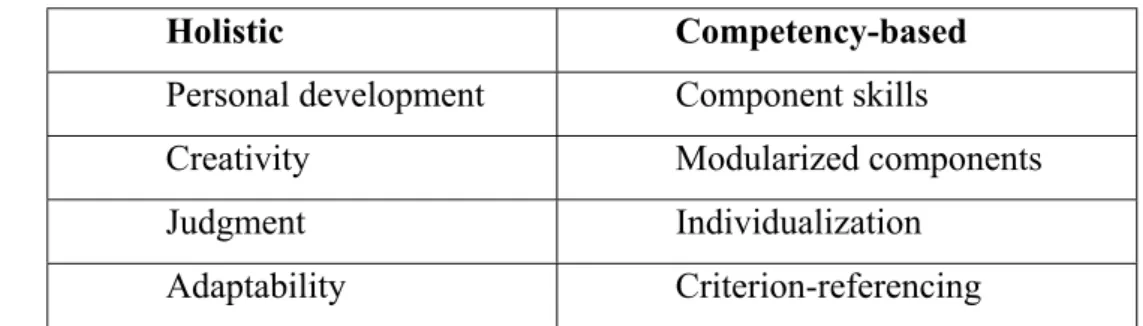
Another significant difference of TD from TT mentioned by Pennington (1989) is that it includes holistic elements, whereas competency-based teacher education is preferred in pre-service courses. Pennington (1989) compares holistic and competency-based approaches as shown in Figure 1.
Figure 1. Differing emphases in two approaches to teacher training (taken from Pennington, 1989:93)
TD, which includes holistic elements, promotes teachers’ creativity and improves the decision-making skills so as to help teachers have accurate judgments and fosters the adaptation of the decisions appropriate to teaching and learning situations. In contrast, competency-based approaches, which are generally chosen in pre-service teacher training programs, aim at improving teachers’ competency in
Holistic Competency-based Personal development Component skills
Creativity Modularized components
Judgment Individualization Adaptability Criterion-referencing
basic teaching skills. These skills are taught or transmitted in modules and decisions about teachers who will take part in the profession are made in a program focused on competency-based elements.
As TD depends on teachers’ needs it may take many forms such as
conferences, academic readings, classroom observation, and collaborative classroom research (Head & Taylor, 1997; Hiep, 2001). Since teachers are responsible for their own development, they choose the appropriate ways for themselves. Thus, any form of activities that result in development can be utilized for TD.
Woodward (1991) summarizes all the differences between TT and TD mentioned above clearly in a bi-polar scale in Figure 2.
Figure 2. Teacher training- teacher development associations (taken from Woodward, 1991:147)
TEACHER TRAINING TEACHER DEVELOPMENT
Compulsory Voluntary
Competency based Holistic
Short term Long term
One-off Ongoing Temporary Continual
External agenda Internal agenda
Skill/technique and knowledge based Awareness based, angled towards personal growth and the development of attitudes/insights
Compulsory for entry to the profession Non-compulsory
Top-down Bottom-up Product/certificate weighted Process weighted
Means you can get a job Means you can stay interested in your job
Done with experts Done with peers
Figure 2 displays two extreme ends in the bi-polar scale illustrated by
Woodward (1991). In-service training courses take their position between these two extreme ends. Course designers have to consider each parameter while making decisions about training courses as both of these parameters have different outcomes. However, in-service programs mostly include elements from the development
parameter, while the elements of teacher training parameter are preferred in pre-service programs.
Hiep (2001) mentions that TD has become a noteworthy requirement since training courses generally have shortcomings in preparing competent teachers in their field, cannot meet all teachers’ needs, and the theories which are learnt during the training courses differ from real classroom practice. He admits that
“ development fills the gap in training by giving teachers opportunities to reflect on classroom practice, gain insight into teaching experiences, view education as a long-term process, and deal with change and divergence” (p. 31). This means that novice teachers can familiarize themselves with real classroom situation and improve their decision-making skills with the help of TD.
In-service education and training courses are one method of on-going TD, and reflect the characteristics that are specific to TD. Although the programs include elements of TT, the courses are centered on the continuing development of teachers. As this study will focus on in-service education and training programs, more detailed information will be given below.
In-service Education and Training
In-service education and training (INSET) programs are considered important by many countries since these programs have the major role in increasing the quality of education (Hayes, 1997). These programs provide life-long support for teachers when appropriately designed. In this sense, INSET programs offer a way for ongoing teacher development, which can find remedies for the problems resulting from first-year stress or later burnout (Ur, 1996). Moreover, these programs are seen as a prerequisite for job satisfaction and career development (Coşkuner, 2001, Ur, 1996).
Dubin and Wong (1990), who made a study of INSET program design in Hungary, mention that INSET programs have specific purposes and focus on situational requirements.
Bolam (as cited in Roberts, 1998, p. 221) defines INSET as “ …education and training activities engaged in by … teachers, following their initial professional certification, and intended primarily or exclusively to improve their professional knowledge, skills and attitudes in order that they can educate children … more effectively.” According to this definition, the emphasis is on maximizing the effectiveness of teaching and teachers at every point in their careers.
Koç (1992, p. 48) makes a broader definition of INSET programs as: …creating an atmosphere in which teachers share and exchange their experience in their teaching, discuss their problems and practical solutions to their problems with academic help from educators in improving their skills in applying recent methodology, approaches, classroom management strategies, gain experience in developing and applying an effective curriculum, in evaluating the effectiveness of their teaching as well as their students’ performance on courses they teach and according to the feedback they get, they make necessary changes in their style of teaching...
As can be understood from the definition made by Koç (1992), INSET
programs usually include elements of teacher development shown in Figure 2 earlier. INSET programs are generally designed to create changes in teachers’
teaching practice and keep institutions, programs and individual teachers up to date (Mariani, 1979, Palmer, 1993). These changes can be offered by schools, local authorities or the national authorities, which are known as ‘outside agents’, or by the ‘ inside agents’ such as institutions that will be involved in the change (Kennedy, 1987, Palmer, 1993). Inside agents are directly affected by the change when it occurs whereas outside agents are indirectly influenced by the change.
The participants of INSET courses are practicing teachers, novice or experienced, and the courses are designed as a part of their teaching activity (Mariani, 1979). Although trainers are mostly the experts in the field, participant teachers are responsible for their own professional development (Kennedy, 1987, Mariani, 1979, Nunan, 1989).
Teachers attend INSET courses for several reasons. Rinvolucri (1987) lists some of these reasons that he realized in his own work. Some of his findings give clear understanding for the purpose of INSET courses. According to him people attend INSET courses:
to improve their command of English to cope with professional crisis to learn theory
to learn techniques
to experience new approaches to teaching (p. 14)
These findings imply that teachers have these kinds of expectations from INSET programs. They expect courses to deliver innovations in the EFL field, offer remedies for the problems that they face in their teaching, improve their teaching skills with new techniques and theories, and so on. Therefore, these expectations should be taken into consideration by course designers in the process of planning INSET courses.
INSET programs, as the name indicates, are generally implemented during the service or in special periods, such as summer schools. They may take place in a target language country as refreshers, in the same institution where the participants work, or in another institution in the country that provides required resources for the
program (Mariani, 1979, Palmer, 1993), depending on what purpose they are designed for or the participants’ expectations, as mentioned above. The program is delivered through workshops, conferences, courses, or lectures, by combining theory and practice (Mariani, 1979).
Content of INSET Programs
Richards (1990) states that the content of INSET programs includes linguistic and methodological elements as well as opportunities for practice. The theoretical basis is drawn from disciplines such as linguistics and second language acquisition and theory is supported by practice. Mariani (1979), and Bressadola, Frascari and Pantaleoni (1979) mention that information about latest research in methodology, classroom applications and teaching techniques, and language improvement elements should be covered in INSET programs. Moreover, England (1998) recommends that INSET programs should cover
opportunities for learning and sharing ideas: on one’s own, with colleagues, and with supervisor. The inservice program should contain a core set of requirements with a list of elective options selected by the teacher… It should contain opportunities for brainstorming, planning, and sharing ideas; identifying ways of meeting the needs of a specific student or group; and building on individual teacher strengths (p. 18).
Thus, participants have the main role, and their expectations and the previous knowledge that they bring to the course provide significant information for the course design.
Most frequently, INSET courses include elements of methodological innovations derived from theories of second language acquisition in the United Kingdom, United States, and Australia (Wolter, 2000). These elements are presented generally in two phases as Wolter (2000) mentions:
a) a “why” phase which seek to establish the theoretical basis of the innovation through carefully structured rhetoric and the presentation of relevant empirical research, and
b) a “how” phase designed to demonstrate the ways in which the theory can be incorporated into practical classroom activities (p. 311).
While the first phase focuses on theory underlying the presented innovation, the second phase gives more importance to the practical use of it by offering ways for how to implement it in class. Recently, INSET courses have included
methodological components which aim to improve teachers’ attitudes, knowledge, and skills (Morrow and Schoker, 1993).
Characteristics of Good INSET Programs
INSET programs should have some essential features to improve the quality of education, meet teachers’ needs, and improve classroom practice. Breen, Candlin, Dam, and Gabrielsen (1989) make some deductions about these features after their experience in Denmark in terms of INSET program development and suggest them to future program designers. Some of them are listed below:
An in-service training course or program is likely to be most useful if it grows directly out of the experiences, assumptions and perceived problems of the trainees.
The trainee’s own classroom and the learners within it are major source of information on the nature of the language- learning process. The training course or program could offer teachers ways of investigating that process. In that way theory and research may benefit and, more important perhaps, teachers can explore the potential of classroom language learning in order subsequently to relate those findings to outside theoretical and research developments.
In-service training should focus on what is done in the daily life of the language class, the decisions, activities, tasks and learning experience.
Any innovation premised on training is most usefully introduced by building on what teachers currently know and do and what occurs in class.
Training should encourage a three-way interaction and interdependence between trainers, teachers, and learners.
… whatever the specific initial focus of the in-service training, once a dialogue is established between trainer and trainee the focus of concern will expand from the particular to more general and underlying aspects of the management of classroom language learning… the trainer needs to be open to the likelihood that the program may lead in unexpected directions. (p. 134-5).
These suggestions clearly illustrate the importance of participants’ roles in INSET courses. Participants are the main source of content with their in-class experiences, beliefs, assumptions, and needs. For this reason, INSET programs take their place on the teacher development side, instead of the teacher training side, in the aforementioned bi-polar scale.
Similarly, after having analyzed the INSET experience in Malaysia and Thailand, Hayes (1995) offers some principles for INSET programs:
Change is a slow process (It should not be expected from teachers to change their teaching strategies that they are comfortable with overnight.)
All the activities should be seen as having direct relevance to teachers’ everyday school situations.
Teachers should be involved in the preparation of courses. Trainers should themselves be teachers.
Training/development sessions should value participants existing knowledge.
Sessions should enable teachers to form generalizable conclusions about topic under review
Sessions should give participants an opportunity to put into practice what they have learnt in a non-threatening environment
Sessions should offer opportunities for participants to share knowledge and ideas.
Every effort should be made to provide follow-up for courses in participant’ own schools. (p. 257-60).
As Hayes’ suggestions indicate, participants of INSET courses have a vital role in the design and implementation of the program. In addition, theories
underlying innovations should be connected with practice. Models of INSET Programs
The models used in INSET courses vary according to the purposes and participants’ needs. Three types of these models are considered major models: transmission, problem solving, and exploratory (Palmer, 1993). These models were used in the study of Breen, Candlin, Dam, and Gabrielsen (1989) who developed an INSET program in Denmark.
1. Transmission Model: In this model trainers are considered as experts and knowledge transmitters as the name suggests. Trainees have passive roles in general and accept or refuse the knowledge transmitted. As trainees have low investment in the process of transmission, the likelihood of using the knowledge provided by trainers may be low.
2. Problem-Solving Model: Trainees identify the specific classroom problems that they face during their teaching practice and trainers offer remedies for these problems. Although this model requires more investment on the part of teachers, trainers are still in the role of experts or knowers.
3. Exploratory Model: This model is called “training as classroom decision-making and investigation” by Breen et al (1989, p. 125). In the exploratory approach, trainers take the position of facilitators and they try to help trainees to explore their own classrooms and resources. Teachers’ investment is at the highest level in the exploratory model. Breen et al (1989) suggest that an INSET program should start
from this model. If it is difficult to set up necessary conditions for exploratory model, a problem-solving approach can be the first step to begin an INSET program.
Palmer (1993) points out that the choice of models depends on the program’s aims and the teachers who are involved in it. For instance, less experienced teachers may need background information about the practice, so a transmission model can be more effective with them. Experienced teachers may need to focus on specific
problems that they face instead of background knowledge or theory, thus a problem-solving approach would brings about better results.
Wallace (1991), on the other hand, suggests three different models, which are the craft model, applied science model, and reflective model.
The Craft Model: This is a traditional model in which trainees learn from master teachers by observing and imitating them. Teaching is considered a craft and expertise passes from generation to generation. However, the contemporary
developments in education requires more than a master teacher. More background knowledge and more practice are necessary for implementation of new curricula.
The Applied Science Model: Trainers inform trainees about the results of studies in applied linguistics or similar theoretical subjects and trainees are expected to apply the deductions in their classrooms. However, there is a danger in presenting theoretical knowledge. Many teachers may not have adequate background to
understand more technical articles and the conclusions that they draw from them may be misleading. As this situation will directly affect the classroom implementation, the model should be treated carefully.
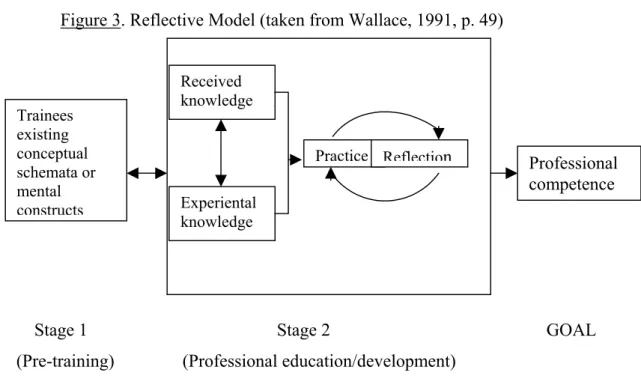
Reflective Model: Wallace proposes this model as a remedy for the
experience and theoretical information. Trainees observe or teach lessons and then reflect upon them individually or in a group discussion. In this model two kinds knowledge are required: ‘received knowledge’ which refers to the required
components of scientific research, and ‘experiential knowledge’ which results from continuing experience. Trainees’ previous knowledge, experiences, and beliefs play an important role in the reflective model. Noting that many INSET courses deal with received knowledge, i.e., theories, facts, and research outcomes, Wallace states
The effectiveness of such courses will obviously depend on how well they relate to the trainees’ own reflection and practice. In other words, the trainees (the in-service teachers) may evaluate the inputs in terms of their own practice and either decide to change their teaching in some way, or not. (p. 52)
Therefore, trainees are not considered as passive knowledge receivers in this model, they are expected to analyze and reflect on the proposed innovations, and decide whether to use it in their actual classroom setting, or not.
Figure 3. Reflective Model (taken from Wallace, 1991, p. 49)
Stage 1 Stage 2 GOAL
(Pre-training) (Professional education/development)
The craft model and the applied science model reflect a separation between practice and theory. While the craft model is emphasizing practice and imitation, the applied science model centers on research and its outcomes. In this sense, there occurs a gap between practitioners and experts. As Schön (as cited in Wallace, 1991) indicates, it was scholars’ business to create theory for teachers to implement and this reflects a hierarchical status. Most frequently researchers are blamed of being away from the real classroom situation and teachers are criticized as they do not know underlying theories of the techniques and methods they are practicing.
However, the reflective model proposed by Wallace gives equal importance to both practice and theory. Although it provides demonstration lessons as in the craft model, they are used for analysis and reflection. In addition, the scientific knowledge is utilized as in applied science model, but trainees’ existing knowledge is also highlighted. Trainees existing conceptual schemata or mental constructs Received knowledge Experiental knowledge
Practice Reflection Professional competence
As a result, different approaches in INSET models suggest that program designers should pay attention to the objectives of the courses and the needs and expectations of the participants. The programs designed considering teachers’ needs and expectations create more successful results. The participants of INSET programs should be provided with opportunities to reflect on the changes offered by the
programs and to analyze them based on their existing knowledge and their own teaching contexts as suggested in reflective model. Also, teachers’ own classrooms and experiences should be the starting point and teachers should be given a chance to explore their own classrooms and resources as mentioned by Breen et al in the exploratory model. Both of these models have similarities since they give priority to teachers’ investment, needs, and expectations in the organization of the
developmental courses.
Why INSET Programs Fail
INSET programs, which are considered significant ways for professional development, have many advantages when they are appropriately designed. England (1998) mentions that teachers who participate INSET courses become professionally more satisfied and this directly affects students and institutions positively. Teachers who are professionally satisfied have more commitment to their profession.
Moreover, institutions can take the advantage of INSET courses to deal with student dissatisfaction, teacher frustration, or any other specific problems occur. However, most INSET courses, the major aim of which is to create some kind of change in teachers’ classroom practice, have a low rate of achievement in spite of the efforts of course designers (Wolter, 2000).
1- One-shot workshops are widespread but are ineffective, and in these one-shot sessions teachers cannot be encouraged to synthesize the offered innovations and adapt them into their own settings.
2- Topics are frequently selected by people other than those for whom in-service is intended.
3- Follow-up support for ideas and practices introduced in in-service programs occurs in only a very small minority of cases.
4- Follow-up evaluation occurs infrequently. Many INSET programs do not incorporate teachers’ feedback to evaluate or develop the program.
5- In-service programs rarely address the individual needs and concerns. 6- The majority of programs involve teachers from many different schools and/or school districts, but there is no recognition of the differential impact of positive and negative factors within the systems to which they must return.
7- There is a profound lack of any conceptual basis in the planning and implementing of in-service programs that would ensure their effectiveness.
Tomlinson (as cited in Lamb, 1995) agrees with Fullan that short-term INSET courses without follow-up activities can create demotivation and frustration for teachers when they try to apply the things that they have learnt. Generally short-term courses provide only the theoretical knowledge without giving the opportunities to practice or they just focus on the practical issues without giving underlying
theories. Teachers who attempt to apply the things they have learnt without synthesizing and internalizing them may be demotivated.
To sum up, INSET programs should be planned carefully considering the dangers mentioned above. If not, INSET programs may turn into disasters for teachers, students and institutions.
In-Service Training and Development Programs in the World
In-service teacher training and development programs have been designed in many countries to raise the quality of education and to provide on-going support for teachers. Many countries see these programs as an indispensable part of education.
INSET in USA
INSET programs in USA are described by Collinson and Ono (2001) and they state that USA pays more attention to rhetoric (standards and policies) than practice. After the first year in the classroom, teachers are expected to continue to work with little support and professional collaboration and to improve their teaching by themselves.
Collinson and Ono (2001) indicate that as teaching has lost its prestige in America because of predictable reasons such as low salaries, the main concern of teacher education programs is to attract teachers and keep them in the field.
However, teacher education programs show differences from state to state and these programs are generally “decentralized and location-specific” (p. 225).
Because of the teacher shortage resulting from retirements and increasing number of immigrants and growth of the school-aged population, many states offer alternative certification programs or hire people who do not have degrees in the field. In the first years of teaching, novice teachers are generally given little professional assistance. They are expected to cope with the heavy load of their job instantly. Collinson and Ono (2001) support this proposition by citing a 1999 report of US
Department of Education. The report states that only one-third of novice teachers participated in training programs in their first year. The situation is quite similar in the following years. Teachers are expected to improve their teaching personally without having professional collaboration.
Joyce and Showers (as cited in Collinson & Ono, 2001) mention that
workshops, conferences, and lectures by experts constituted the format of the training programs during 1970s and 1980s. However, they were unsuccessful in providing connection between theory and classroom practice as no follow-up support was provided for teachers.
In 1990s, the number of INSET activities increased a great deal, and they were perceived as resources for career-long development. Five models were decided in these programs: individually guided learning, observation/assessment,
involvement in a development/improvement process, training and inquiry (Sparks & Louck-Horsley, as cited in Collinson & Ono, 2001). Instead of being experts, teacher trainers’ roles changed and they served as facilitators and consultants. Moreover, some standards were published by the National Staff Development Council to increase the quality of INSET programs.
Nevertheless, change is a slow process (Hayes, 1995) and it would be inappropriate to expect success overnight. Although positive improvements have taken place in terms of INSET programs in the USA, Corcoran (1995) states in a CPRE (Consortium for Policy Research in Education) Policy Brief that most districts still continue offering teachers traditional ways for professional development. He indicates professional development is provided in terms of formal education
courses are not designed. For instance, half or full day sessions with experts several times a year are held, but these sessions may be inappropriate for teachers’ needs.
Corcoran (1995) points out that
The current arrangements for the professional development of teachers too often lead to unfocused, fragmented, low-intensity activities that do not lead to significant changes in teaching practice. A different mindset is needed if professional development is to contribute to strengthening the profession and improving the schools (p. 10).
Thus, systematic professional development programs with ongoing support for teachers and follow-up sessions are required in USA.
INSET in Spain
Cerezal and Jimenez (1990) report in their study the organization and implementation of INSET activities in the Encuentro Project which started in 1987. This project started with the determination of primary and high school teachers’ needs and the analysis of foreign language teaching situation in Guadalajara, Spain. These analyses revealed the problems that teachers face. Teachers’ initial training was not adequate and language improvement was required. There was a lack of INSET activities, and also resources were extremely limited.
In the second step, they prepared some criteria for the INSET program. According to these criteria, INSET activities should combine theory and practice to let teachers evaluate their own teaching through reflection. These activities should encourage classroom research and evaluation to provide autonomy. The participants should work collaboratively and share ideas and experiences.
Based on the results of analyses at the beginning of the program and the criteria, “Foreign Language Teachers Conferences” were organized during 1987. The aims of the conferences are to offer a forum for ideas and experiences, to answer
teachers’ problems, and to establish teacher development on classroom and
curriculum research. The conferences are supported by workshops, work groups and
panels, and particular classroom research depending on teachers’ needs. INSET in Hungary
Simon Gooch (2002) describes the process of developing a series of INSET workshops in Eastern Hungary. He explains this program development in two phases. In the first phase (February-June, 1994), the topic areas covered and the characteristics of previous INSET programs were assessed. In addition to this assessment, the results of a questionnaire sent to the teachers were used to organize initial workshops. However, attendance to these workshops was very irregular, and no real direction or aim achieved. As a result of this experience, a need for more integrated INSET program at regional, local, and individual level emerged. Thus, in the second phase (September, 1994- June, 1995) the program was advertised before summer holiday through various media. To increase the amount of regular
attendance teachers were offered a British Council-recognized certificate, which would be given after 80% attendance. Moreover, it was decided that the meetings would be held monthly or every two weeks so as not to make a burden for teachers and trainers. It was agreed to organize these meetings in different towns that teachers preferred.
The aim of INSET programs is to provide change in teachers’ classroom practices and the best way to do this is to promote reflection. Gooch (2002) states that if the change in practice comes together with other changes such as deeper knowledge of principles behind classroom practice, it will occur less difficulty, but this is not a fast process. Based on these ideas, Wallace’s (1991) reflective model
was adopted. Following this model, teachers evaluated the tasks that they were using in class and discussed or reflected upon their own classroom experiences to apply methodological principles and to reach a consensus. Trainers and trainees chose the content of the program together. The trainers chose the broad topics such as
communicative classroom tasks, development of skills, testing, and the trainees chose more specific topics such as teaching grammar for lower levels, warm up activities, using pictures. Language awareness tasks were not used in the program.
The mid-course feedback questionnaire revealed that 85% of the participants implemented at least one activity that they learned in the program. The course generally met the teachers’ needs and satisfied them through the organization of workshops.
Consequently, it is clear that when teachers’ demands, perceptions, and needs were taken into consideration, the program developed in Eastern Hungary pleased its participants. Thus, it can be inferred that participants demands, perceptions, and needs play a vital role in the success of an INSET program.
INSET in Denmark
The INSET program developed in Denmark from 1978 to 1985 is considered very important in the ELT field, because it highlighted many aspects of INSET courses and provided an example for similar studies. It is a significant study in that not only teachers and trainers, but also language learners were playing a vital role in the program. During the program, more than a hundred language teachers were trained with their students.
Breen et al (1989), who reported the evolution of the program, were the tutors in the program and they state that the program was started based on the teachers’
local demands and interests. It was not planned to be a long-term program, but the continuing demand of teachers and trainers created this result. Participation was on a voluntary basis and the teachers who attended the courses were coming from schools that were close to the training centers.
The program included three phases in which it evolved: 1- Training as transmission
2- Training as problem-solving
3- Training as classroom decision making and investigation
Breen et al. (1989) state that the initial workshops had two main purposes. First, the trainers aimed at presenting some features of communicative language teaching. Second, teachers were not happy with the textbooks they had chosen and needed to learn how to use them effectively.
The authors of the report explain that in the first phase of the program, which was training as transmission, trainers intended to “convince the trainees of the ‘rightness’ of communicative language teaching” and to help them evaluate their own teaching activities and materials in the light of this approach. Long lectures and textbook evaluation workshops were the modes in the first phase. However,
transmission model had some weaknesses. For example, the trainers were dominant in the phase and they made decisions instead of teachers in the program. Teachers’ own experience, knowledge, experience, and beliefs were not considered. Moreover, teachers were not provided with follow-up activities for classroom practice.
Teachers’ problems were not paid attention to. Therefore, the second phase, training as problem-solving, was designed to compensate the weaknesses of the transmission model.
In the problem-solving phase, the trainers took the role of consultants and tried to offer solutions to the problems identified by teachers in a communicative way. Teachers designed lessons and implemented them in their own classrooms, and then these lessons were evaluated in the post-workshop meetings. Again, certain weaknesses of the problem-solving process were realized. Trainers were still
considered as experts and a real direct link between theory and practice could not be established.
Finally, a more appropriate approach, training as classroom decision making and investigation, was designed in the third phase. The trainers were considered facilitators and trainees were the decision makers about the classroom procedures. The workshops aimed at informing teachers about recent language learning research and to motivate them to be researchers themselves. Breen et al. (1989) mention according to their experience that classroom decision making and investigation process should actually be the first step in INSET programs.
To sum up, the Denmark experience provides a wide range of information about the design of an INSET program and the evolution of it according to the participants’ needs.
INSET in Turkey
INSET in Turkey has a great importance for several reasons. Doğuelli (1992) reports that the proficiency levels of learners are lower than expected to study
content through English as a foreign language. Besides, teachers in ELT field are working in limited time with limited sources and inflexible curricula. Most of the teachers who try to implement the innovations are not supported by their colleagues
or superiors. In this context, ELT teachers require the “time, space and professional guidance” that can be provided by INSET programs (Doğuelli, 1992, p.103).
INSET programs are held by the Department of In-service Training, which is functioning in the Ministry of Education, and some other institutions such as INGED (İngilizce Eğitimi Derneği / English Language Education Association), British Council, and Office of English Language Programs of U. S. Department of State. These institutions generally design courses for language teachers at the secondary or tertiary level and a few for university level. Publishing companies such as Longman, Heinemann, and Oxford sponsor conferences and seminars on ELT together with universities and other educational institutions. Also, some universities, such as Hacettepe, Boğaziçi, Çukurova, and Middle East Technical University, have their own training units.
In the study done by Birer (2000), it is stated that most language teachers in private high schools in Ankara consult the British Council for their INSET activities, or contact experts in universities. On the other hand, teachers working at state high schools generally participate in the courses offered by the Department of In-service Training.
As Koç (1992) indicated, the Department of In-service Training organizes approximately 400 INSET courses for a month during summer holiday for all
branches of study. For ELT teachers, 20 INSET activities have been planned in 2002 academic year. The eighth of these activities were held in the fall term of the year in different cities of Turkey (Bursa, Eskişehir, Amasya, Çorum, Sivas, Samsun,
İstanbul) and totally 452 teachers participated in these programs.12 activities are going to be held in the spring and summer term (Hizmetiçi Eğitim Planı, 2002). In
the process of designing INSET courses for language teachers, however, no
procedure is applied to identify their needs or to select the teachers to participate in INSET courses. The teachers are not selected according to their needs and wants but according to their application. The applicants who have 5 to 15 years of experience and have A or B degrees in KPDS exam (Kamu Personeli Dil Sınavı/Language Exam for Civil Personnel) are given priority in the selection. Some teachers resist joining in these courses while others try to participate every year.
In some cases, school administrators send teachers they select to join the INSET courses designed by British Council by paying their expenses. At the end of the courses these teachers are asked to share their knowledge with other teachers working in their institutions. Also, teacher trainers in British Council are invited to schools to give seminars or to recommend remedies for local problems (Birer, 2000).
British Council offers courses such as Certificate in English Language Teaching (CERTELT), Diploma in English Language Teaching (DIPELT), or short courses such as using computers for ELT, teaching young learners, and language awareness for teachers in secondary or tertiary level. Besides, CELTA (Certificate in English Language Teaching to Adults) and DELTA (Diploma in English Language Teaching to Adults) are the programs that are designed for teachers at the university level. Teachers can participate in these courses on the condition that they pay the course fees (English Language Teacher Training, n. d.).
In addition, INGED (İngilizce Eğitimi Derneği / English Language Education Association), which was founded in 1995, organizes conferences, seminars, and workshops for professionals from all levels of education in Turkey. INGED aims to assist English teachers and professionals in terms of the
developments in the ELT field. The contents of the conferences organized by INGED are kept quite general to cover a variety of participants, although no systematic needs analysis procedure is used to determine the needs and expectations of teachers and professionals in ELT. Also, the association organizes INSET seminars in
collaboration with the Ministry of Education and publishes a quarterly newsletter that includes articles, descriptions of conferences and seminars and information on ELT events for members (Hancıoğlu, personal communication).
Moreover, Turkey has an English Language Office attached to the U. S. Embassy Office of English Language. The major aim of this office is to create curricular changes and changes in policies in the educational programs, which will provide opportunities for future teacher training. The English Language Officer (ELO) in Turkey organizes and takes part in INSET seminars and workshops. The ELO also works in collaboration with the Ministry of Education and teacher-training officials to give lectures and present workshops on ELT (Office of English Language Programs, n. d.).
In addition to the aforementioned INSET activities, a few universities, such as Hacettepe, Boğaziçi, Çukurova, and Middle East Technical University, have their own teacher training units. These units organize local seminars and workshops for the teachers working in these institutions to cope with local problems and to provide assistance for the teachers. Also, publishing companies sponsor and organize
conferences, seminars, and workshops in collaboration with universities and other programs.