ÇANKAYA UNIVERSITY
THE GRADUATE SCHOOL OF SOCIAL SCIENCES ECONOMICS AND ADMINISTRATION SCIENCES
MASTER THESIS
INTERNATIONALIZATION METHODS OF COSMETICS COMPANIES IN TURKEY: A DESCRIPTIVE STUDY
GÜL ŞENGÜN
iv ABSTRACT
INTERNATIONALIZATION METHODS OF COSMETICS COMPANIES IN TURKEY: A DESCRIPTIVE STUDY
Gül ŞENGÜN
M.B.A, Master of Business Administration Supervisor: Assoc. Prof. Dr. İrge ŞENER
September 2019, 135 Pages
In today’s global environment internationalization is inevitable for many companies. Internationalized companies use different methods which differ in terms of risk encountered and rewards gained. Being one of the ancient industries, cosmetics industry is affected from international competition. There exists many well-known brands of Turkish cosmetics companies, and the demand for the products is growing internationally. In line with increasing demand for Turkish cosmetics products internationally, this study focuses on internationalization methods of selected cosmetics companies. Within this frame, the aim of the study is to determine and compare the internationalization methods of cosmetics companies. Based on secondary analysis of data from 20 cosmetics companies, the study is conducted as a descriptive research. As the findings indicate, all of 20 cosmetics companies prefer exporting, regardless of their size and product groups. Besides, according to the findings, most of the companies use direct exporting. Since internationalization is a key factor for the success in the industry, it was noticed that one of the companies use export method since its establishment. It was also found out that some companies use other internationalization methods which are franchising, contract manufacturing and foreign direct investment. The
v
companies that are engaged in such more riskier internationalization methods are large-scaled and older companies. Furthermore, there exists differences in terms of foreign direct investment between Turkish and foreign companies. It was determined that foreign company preferred brownfield investment and acquired the shares of one of the well-known Turkish cosmetics company, whereas greenfield investment was preferred by Turkish company.
vi ÖZET
TÜRKİYE'DEKİ KOZMETİK ŞİRKETLERİNİN
ULUSLARARASILAŞMA YÖNTEMLERİ: BETİMLEYİCİ BİR ÇALIŞMA
Gül ŞENGÜN
İşletme Yönetimi Yüksek Lisansı (M.B.A) Danışman: Doç. Dr. İrge ŞENER
Eylül 2019, 135 Sayfa
Günümüzün küresel ortamında uluslararasılaşma birçok şirket için kaçınılmazdır. Uluslararasılaşan şirketler, karşılaşılan riskler ve elde edilen ödüller bakımından değişiklik gösteren farklı yöntemler kullanırlar. Eski endüstri alanlarından biri olan kozmetik sektörü de uluslararası rekabetten etkilenmektedir. Türk kozmetik şirketlerinin tanınmış birçok markası vardır ve bu ürünlere olan talep de uluslararası olarak artmaktadır. Türk kozmetik ürünlerine uluslararası alanda artan talep doğrultusunda; bu çalışma, seçilen kozmetik şirketlerinin uluslararasılaşma yöntemlerine odaklanmaktadır. Bu çerçevede, çalışmanın amacı kozmetik şirketlerinin uluslararasılaşma yöntemlerini belirlemek ve karşılaştırmaktır. 20 kozmetik şirketinden elde edilen verilerin ikincil analizine dayanarak, çalışma betimsel bir araştırma olarak yürütülmüştür. Bulguların belirttiği gibi, 20 kozmetik şirketinin tümü, büyüklüklerine ve ürün gruplarına bakılmaksızın ihracat yapmayı tercih etmektedir. Ayrıca, bulgulara göre, şirketlerin çoğu doğrudan ihracat yapmaktadır. Uluslararasılaşma, sektördeki başarı için kilit bir faktör olduğundan, şirketlerden bir tanesinin kuruluşundan bu yana ihracat yöntemini kullandığı tespit edilmiştir. Ayrıca bazı şirketlerin uluslararasılaşma yöntemlerinden; franchising, fason üretim ve doğrudan yabancı yatırım yöntemlerini kullandığı da tespit edilmiştir. Bu yöntemler gibi daha riskli olan
vii
uluslararasılaşma yöntemlerinden faydalanan şirketler büyük ölçekli ve daha eskiden kurulan şirketlerdir. Bunun yanı sıra, Türk ve yabancı şirketler arasında doğrudan yabancı yatırım açısından farklılıklar bulunmaktadır. Yabancı şirketin kahverengi alan yatırımını tercih ettiği ve tanınmış Türk kozmetik şirketlerinden birinin hisselerini satın aldığı, Türk şirketinin ise yatırım yaparken yeşil alan yatırımını tercih ettiği tespit edilmiştir.
viii
ACKNOWLEDGEMENTS
First of all, I thank God who gave me all that I had and made me live.
I would like to thank my precious and loving family for 29 years, giving me all the material and spiritual things they have. Without their support, love, and patience, it would be very difficult for me to be where I am now, I feel it.
Throughout my thesis process, I would like to thank my precious supervisor Assoc. Prof. Dr. İrge Şener for her guidance, efforts, and support. Also I would like to thank to my dear professors, Prof. Dr. Alaeddin Tileylioğlu and Assoc. Prof. Dr. Aykut Göksel who have valuable experience and knowledge that I benefited from them.
I would like to thank my beloved and dear friends for their support, who have not lost their spiritual support from me during my study, who have believed in my hopes that I will succeed, and who have supported me when my motivation has fallen.
This performance would not have been possible without all of you.
ix
DEDICATION
This thesis is dedicated to my family, to my deceased grandfather Müştak Hayri ŞENGÜN and to everyone who is with me on this long and
x
TABLE OF CONTENTS
STATEMENT OF NON-PLAGIARISM ... iii
ABSTRACT ... iv
ÖZET... vi
ACKNOWLEDGEMENTS ... viii
DEDICATION ... ix
LIST OF TABLES ... xii
LIST OF FIGURES ... xiii
CHAPTER I ... 1
INTRODUCTION ... 1
CHAPTER II ... 4
LITERATURE REVIEW... 4
2.1. The Definition of Internationalization ... 4
2.2. Motivations for Internationalization ... 8
2.3. International Trade Theories ... 10
2.4. Internationalization Strategies ... 17
2.4.1. Export-Based Internationalization Strategies ... 18
2.4.2. Types of Collaborative Arrangements ... 19
2.4.2.2. Franchising ... 21 2.4.2.3. Contract Manufacturing ... 23 2.4.2.4. Management Contracts ... 25 2.4.2.5. Joint Venture ... 25 2.4.2.6. Consortium ... 27 2.4.2.7. Turnkey Projects ... 28 2.4.2.8. Build-Operate-Transfer Contracts ... 29
2.4.3. Foreign Direct Investment... 30
2.5. The Studies Conducted in Turkey about Internationalization... 32
CHAPTER III ... 34
xi
3.1. Historical Development of Cosmetics Industry ... 34
3.2. Classification of Cosmetics Products ... 36
3.3. Importance of Cosmetics in Our Life... 38
3.4. Cosmetics Sector in the World ... 39
3.5. Cosmetics Sector in Turkey ... 41
3.6. Studies Conducted about Cosmetics ... 50
CHAPTER IV ... 52
RESEARCH METHODOLOGY AND FINDINGS ... 52
4.1. Research’s Aim and Scope... 52
4.2. Research Method ... 53
4.3. Information about the Companies in the Sample ... 54
4.4. Internationalization Methods of Cosmetics Companies ... 73
CHAPTER V ... 86
CONCLUSION AND DISCUSSION ... 86
REFERENCES ... 91
WEBSITES REFERENCES ... 110
APPENDIX ... 114
A: SOME STUDIES CONDUCTED IN TURKEY ABOUT INTERNATIONALIZATION ... 114
B: SOME STUDIES CONDUCTED IN TURKEY ABOUT INTERNATIONALIZATION IN THESIS ... 127
xii
LIST OF TABLES
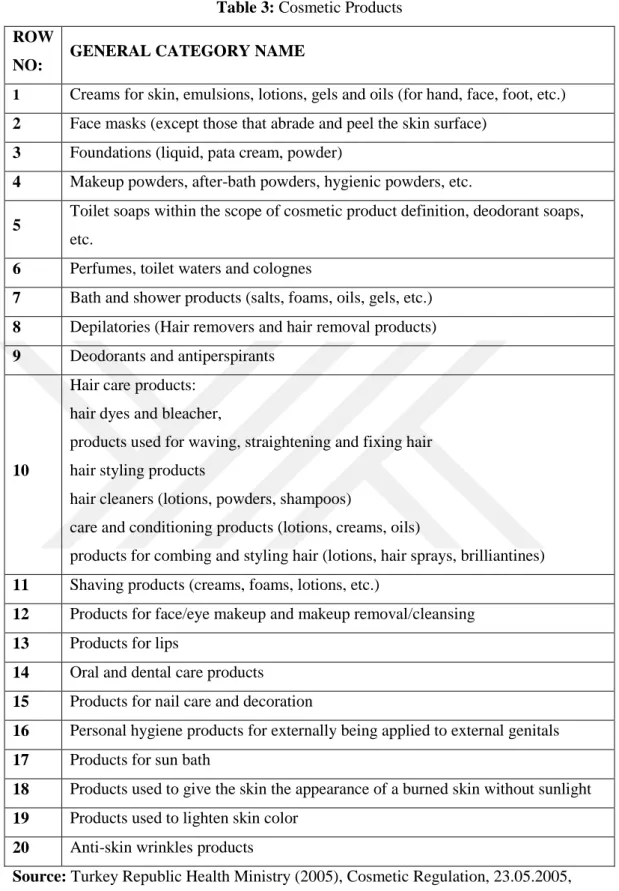
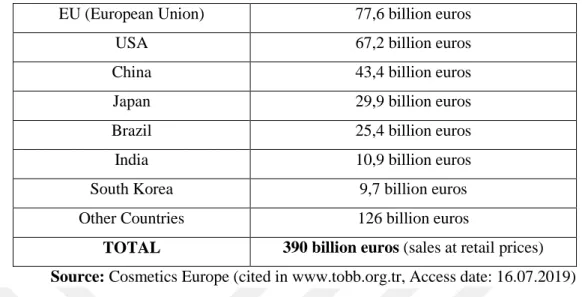
Table 1: Definition of Internationalization According to Its Focus ... 7 Table 2: Major Motives for Starting to Export ... 10 Table 3: Cosmetic Products ... 37 Table 4 : Consumption of Cosmetic Products in the World According to 2017 Data ... 41 Table 5 : Historical Development of the Cosmetic Industry in Turkey ... 42 Table 6 : NACE Codes on Cosmetic Products ... 44 Table 7 : Number of Cosmetics Manufacturing Facilities and Their Employees in Turkey (March 2018) ... 45 Table 8 : Provincial Distribution of Cosmetics Production in Turkey ... 47 Table 9 : Sales of Total Cosmetics from Production (Estimated values - Million TL)... 48 Table 10 : Turkey's Total Foreign Trade of Cosmetics ... 49 Table 11 : General Information about 20 Cosmetics Company Based in Turkey 64 Table 12 : Companies Size by Number of Employees... 69 Table 13 : Internationalization Strategies of 20 Turkish Cosmetics Companies . 74 Table 14 : Companies Using Other Strategies Along with Export ... 79
xiii
LIST OF FIGURES
Figure 1: Development of International Trade Theories ... 11
Figure 2 : Porter’s Diamond Model ... 14
Figure 3 : Porter's Competitive Diamond ... 16
Figure 4 : International Market Entery Strategies ... 17
Figure 5 : The Relationships between Firm’s Internationalization Level and Risk/Reward ... 18
Figure 6 : Markets Evyap Company is Strong At ... 62
Figure 7 : Distribution of Companies in the Sample according to their Scale... 69
Figure 8 : Companies Producing 1 Product Group ... 70
Figure 9 : Companies Producing 2 Product Group ... 71
Figure 10 : Companies Producing 3 Product Group ... 71
Figure 11 : Companies Producing 4 Product Group ... 72
1
CHAPTER I INTRODUCTION
Along with the world that has begun to globalize, economic, political and cultural changes have started to take place between the countries. As a matter of fact, this change has affected existing enterprises. With the globalization of the world, the displacement of labor, capital, and information has become easier and this has increased the competitive environment among enterprises. Companies that want to make their brand to be known more in the world, to have more market share and to make more profits have turned to internationalization. For this reason, developing countries are trying to gain a place in the globalizing world by becoming international. A company that achieves internationalization gains competitive power in the market, which gives it a number of advantages. Therefore, internationalization activities have rapidly gained importance along with globalization.
Internationalization is a process in which enterprises increase their participation in international activities. This process includes not only the activities of the enterprises but also their relationships, environments and resources (Johanson & Vahlne, 1977: 23, Calof, 1993: 60, Albaum et al., 1998: 1, Ruzzier, Hisrich, Antoncic, 2006: 479). The rapid change in world markets has led enterprises to turn to internationalization not only for growth but also to survive. The main reason why businesses turn to international markets is to make a profit. In addition, many reasons stemming from the characteristics of the national and international market play a role in the internationalization of enterprises. However, the real purpose underlying each of these reasons is to increase profitability (Albaum et al., 1998: 40). There are various entry strategies for businesses opening up to international markets. Each strategy has different advantages and disadvantages. Therefore, entry strategy choices of enterprises are
2
one of the important and complex decisions they face in the process of internationalization. Entering international markets with the right strategies increases their market potentials and benefits such as profit and entering with the right strategy saves them both time and money. For these reasons, companies' entry strategies to the international markets are vital for companies. There are some factors that affect the strategic choices of enterprises. These factors can be listed as the sources of the enterprises, the degree of control they desire, the level of risk they can bear and their purposes other than profit (Kotler, 1994: 417, Hollensen, 2007: 296). There are many studies in domestic and foreign literature on the subject of internationalization. In general; these studies were directed towards business groups, small and medium-sized enterprises, retail sales firms, and it is determined that the majority of these studies were carried out about construction sector, pharmaceutical sector, automotive sector, textile sector, telecommunications sector, food sector, beverage sector and higher education sector, but it can be said that the studies conducted for the internationalization of cosmetics companies is limited. However, the cosmetics industry in terms of export volume, as well as Turkey has an important place in the world. From this point of view, the cosmetic sector which has not been extensively studied in previous studies in terms of internationalization has been selected within the framework of this study.
The origin of cosmetics goes back to ancient times. Since ancient people have resorted to cosmetics to flourish and change their appearance. As a result of the excavations in ancient Egypt, it was understood that cosmetics were used for a long time (Yapar & Ölgen, 2014: 253). Sometimes; they painted their faces due to protect from some external factors such as animals, insects, evil spirits, sometimes they applied paints to their faces to look more beautiful and they used the essential oils of various plants and flowers to smell better. Cosmetic useage has several purposes. These can be classified as skin, hair, and beautify, protect, clean, camouflage. Nowadays, with the globalizing world, the desire of people to look beautiful has gradually increased. Companies produce a wide range of products for this purpose. These products are classified as perfumes, colored cosmetics, skin care products, hair care products and products for special purposes, such as
3
sun protection products. These cosmetic products have both physical and psychological benefits for humans. By using cosmetics, people both physically provide hygiene and are psychologically confident. Cosmetics sector has developed very much since past times and has gained an important international meaning. In the last 20 years, the annual growth rates of cosmetics sector ranged from 3% to 5,5% and grew by an average of 4,5% per year (Łopaciuk & Łoboda, 2013: 1079-1080). Today, the largest cosmetic market is the European Union. Since cosmetics became an important industry, this study focuses on the determination and comparison of the Turkey-based cosmetic companies’ internationalization methods. In line with its aim, this study consists of five parts. In the introductory part, the aim, scope and research question of the study is given and the issues that are prominent in the study are explained briefly. In the second chapter of the study; the definition of internationalization, the internationalization of motivation, the theory of international trade, and internationalization strategy and the details of the Turkey-based companies from previously conducted studies on the internationalization strategy, are mentioned. In the third chapter of the study; the definition of cosmetics, the history of cosmetics, the aim of cosmetics, the classification of cosmetics, importance of cosmetics, the industrialization of the cosmetics industry, the place in the world of cosmetic industry, the place of the cosmetic industry in Turkey, in place of the cosmetic industry in Turkey, have been mentioned. The fourth chapter of the study covers the research methods and findings. In this context, in this part, the purpose and importance of the study, the scope, assumptions, and limitations of the study, the type, method and data collection tools and findings of the study are mentioned. The collected data related with this study and the analysis made using these data are included in this section as well. In the fifth and final chapter of the study, conclusion, and discussion are given. In this section, various findings and inferences are made based on the findings.
4
CHAPTER II LITERATURE REVIEW
This chapter discusses the existing literature about internationalization and internationalization process. The chapter is divided into six sections. The first presents the definitions of internationalization, the second presents the motivation of internationalization, the third section discusses international trade theories and the fourth section discusses internationalization strategies and the fifth part is about the studies conducted in Turkey about internationalization.
2.1. The Definition of Internationalization
Internationalization is defined in many studies. According to Clark et al. (1997), some researchers adopt a static approach to internationalization, while others focus on it as an increasing and cumulative process. For example, Dunning (1981, 1988); Hennart (1982); Hill et al. (1990); Hymer (1960, 1976) and Teece (1981) (As cited by: Ulaş, 2003: 29; 2009: 18) usually examine the external expansion of a firm as a set of static options determined by productivity appraisals and relative costs and benefits. On the contrary, others view internationalization as a process of increasing participation in national markets and within the country (i.e. Johanson and Wiedersheim-Paul, 1975; Johanson and Vahlne, 1977, 1990; Clark et al., 1997: 605-606).
Some of the other definitions focus on “process and firm’s operations”. Accordingly, internationalization is defined as the degree to which a firm's sales proceeds or transactions are carried out outside its own country (Sun, 2009: 130). It comprises “a wide variety of activities including exporting, licensing, original equipment manufacturing (OEM), and foreign direct investment” (Liu et al., 2010: 2). Internationalization is regarded as the process of adopting customs and adapting the
5
exchange process to international methods (Gemser et al., 2004: 129) or the process of raising the awareness of companies about the future impact of international activities and establishing and managing relationships with other countries (Beamish et al., 1997: 3). Calof and Beamish (1995: 116) defined internationalization as a process of adapting the activities of companies to the international environment (strategy, structure, resources, etc.). Some authors define internationalization by suggesting a broader definition, including both sides of the process; as an increase in participation in international operations (Welch and Luostarinen, 1988: 36). According to another percspective, Melin (1992) has defined internationalization which can be considered as part of the ongoing strategy process of most business firms (Andersen, 1997: 29). The internationalization process was described as a set of decisions of firms which change both the area and type of control of a firm's international marketing and production activities (Ellis, 2008: 351). Internationalization has been defined as a time-dependent continuum by Hunt (1991) and it is the sequencing of behaviors and trends related to the development of international operations (Wind et al., 1973:14), so that internationalization is a continuum which is included in the enterprises' external activities and progressively involving in businesses' international activities (Bell, Crick, Young, 2004: 23).
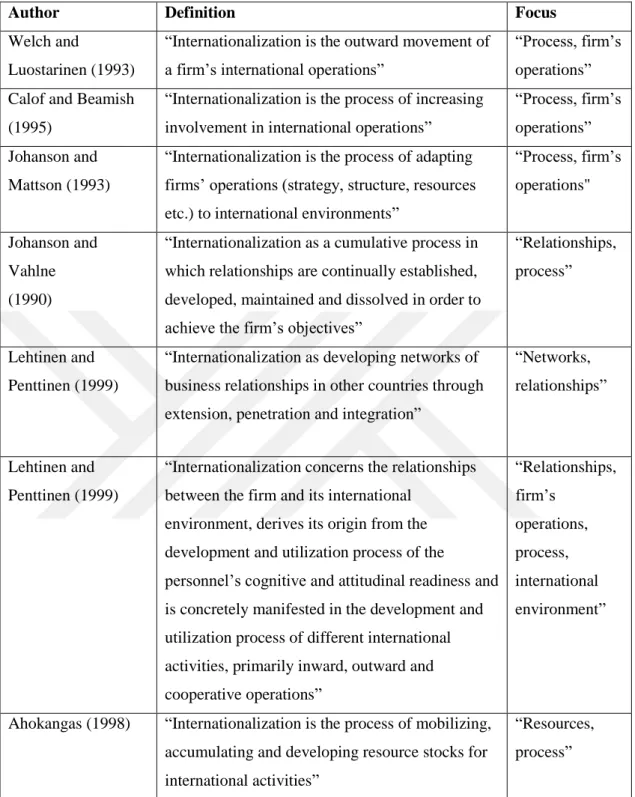
Furthermore, internationalization has the same meaning as the geographical enlargement of economic operations across the national borders (Ruzzier, Hisrich; Antoncic, 2006: 477). Some authors have focused on the type of internationalization. For instance, according to Welch and Luostarinen (1993) “internationalization is the outward movement of a firm’s international operations”, this definition focuses on “process and firm’s operations” (Ruzzier, Hisrich & Antoncic, 2006: 479). In a similar way, Calof and Beamish (1995) defined internationalization as “the process of increasing involvement in international operations”, this definition has also focused on “process and firm’s operations” (Ruzzier, Hisrich & Antoncic, 2006: 479). Another definition by Johanson and Mattson (1993), pointed out “internationalization as the process of adapting firms’ operations (strategy, structure, resources etc.) to international environments”, so that this definition has revolved around “process and firm’s operations” (Ruzzier, Hisrich & Antoncic, 2006: 479).
6
While the authors have grouped the definitions as “process and firm’s operations”, Johanson and Vahlne (1990) described internationalization as “relationships and process” and internationalization has been defined as “a cumulative process in which relationships are continually established, developed, maintained and dissolved in order to achieve the firm’s objectives” (Ruzzier, Hisrich & Antoncic, 2006: 479). Lehtinen and Penttinen (1999) have discussed mainly “networks and relationships” and they defined “internationalization” as developing networks of business relationships in other countries through extension, penetration, and integration (Ruzzier, Hisrich & Antoncic, 2006: 479). Lehtinen and Penttinen (1999) have also focused on “relationships, firm’s operations, process and international environment” and they described internationalization as “concerns of the relationships between the firm and its international environment, deriving its origin from the development and utilization process of the personnel’s cognitive and attitudinal readiness and is concretely manifested in the development and utilization process of different international activities, primarily inward, outward and cooperative operations” (Ruzzier, Hisrich & Antoncic, 2006: 479). Ahokangas (1998) focused on “resources and process” and defined internationalization as a process of activating, collecting and improving reserve of source for international activities (Ruzzier, Hisrich & Antoncic, 2006: 479).
These definitions of internationalization summarized by Ruzzier, Hisrich and Antoncic, (2006: 479) is presented in Table 1.
7
Table 1: Definition of Internationalization According to Its Focus
Author Definition Focus
Welch and
Luostarinen (1993)
“Internationalization is the outward movement of a firm’s international operations”
“Process, firm’s operations” Calof and Beamish
(1995)
“Internationalization is the process of increasing involvement in international operations”
“Process, firm’s operations” Johanson and
Mattson (1993)
“Internationalization is the process of adapting firms’ operations (strategy, structure, resources etc.) to international environments”
“Process, firm’s operations"
Johanson and Vahlne (1990)
“Internationalization as a cumulative process in which relationships are continually established, developed, maintained and dissolved in order to achieve the firm’s objectives”
“Relationships, process”
Lehtinen and Penttinen (1999)
“Internationalization as developing networks of business relationships in other countries through extension, penetration and integration”
“Networks, relationships”
Lehtinen and Penttinen (1999)
“Internationalization concerns the relationships between the firm and its international
environment, derives its origin from the development and utilization process of the
personnel’s cognitive and attitudinal readiness and is concretely manifested in the development and utilization process of different international activities, primarily inward, outward and cooperative operations” “Relationships, firm’s operations, process, international environment”
Ahokangas (1998) “Internationalization is the process of mobilizing, accumulating and developing resource stocks for international activities”
“Resources, process”
8 2.2. Motivations for Internationalization
The rapid change of world markets has led not only large but also all small enterprises to move towards internationalization not only for growth but also to survive (Czinkota et al., 2009: 225). The factors underlying internationalization are discussed in the literature with different topics (internal-external causes, proactive and reactive reasons, pushing and pulling factors). Some authors define the motivations for internationalization as internal and external motivators (i.e. Çavuşgil and Nevin, 1981: 114; Kaynak and Kothari, 1984: 67; Hutchinson et al., 2007), some authors have used proactive and reactive reasons (i.e. Piercy, 1981: 29; Leonidou, 1985: 133; Albaum et al., 1998, Hollensen, 2007: 50; Czinkota and Ronkainen, 2007), and the other authors have classified them as reasons for pushing and pulling (i.e. Kacker, 1985, Treadgold, 1988, Alexander and Quinn, 2002). Each of these classifications is similar in the context of internationalization (Hollensen, 2007: 50).
Businesses tend to internationalize due to various reasons and these reasons can be listed as (Çavuşgil and Knight, 2009: 6; Hodgetts, 1997: 422):
(1) Searching for ways to grow through market diversification, (2) Obtaining new product ideas from foreign influence,
(3) Utilization of economies of scale in production and marketing, (4) Gaining high profits from profitable foreign markets,
(5) Facing competitive impact in the international market more than in the local markets,
(6) Paying the costs of marketing and product development in many markets, (7) Forcing the business to become international by senior executives.
According to Dunning (2000), there are four main different categories of motivations for international investment. These are strategic asset research, resource search, rationalized search and market research. According to his research, it has been founded that the market research and resource search motives are two most known categories of motives before internationalization. These two categories are still used by companies initially during internationalization. Overall, rationalized search and strategic asset search motivations were gaining importance and were more common as motivation for companies that already had multinational activities. Besides, closer
9
relationships with customers and long-term relationships with suppliers are important motives. He also argues that internationalization is driven by opportunities rather than threats (Dunning, 2000: 164-165). From a strategic asset search perspective, companies are investing not only for their own advantages to foreign countries but also for obtaining strategic assets in the host country. From this perspective, companies which intend to gain advantage through foreign investment tend to use the opportunity to invest in a particular host country where the strategic assets they need are available (Makino et al., 2002: 406). According to the traditional dualism of the firm's internationalization, businesses behave in accordance with market search approaches or market orientation and asset search approach or entrepreneurial orientation towards internationalization or multinationalism. The market search approach is based on the assumption of overseas or multinational corporations in order to optimize transaction costs for the use of company-specific high-level assets originating from their own countries in offshore countries. On the other hand, the asset search approach is based on the proposal by firms to open up overseas to maximize value creation opportunities by acquiring new resources and competencies (Wang and Suh, 2009: 449).
In sum, Ghoshal (1987) observes that innovation, learning, and adaptation are important strategic goals for companies expanding internationally. It was argued that firms learn from social differences in organizational and managerial processes and systems (Ghoshal, 1987: 428; as cited by: Zahra, et al., 2005:132). The basic standard for moving businesses to international markets is profit and this is the basis of internationality and international market characteristics, but still, this reason exists (Albaum et al., 1998: 40).
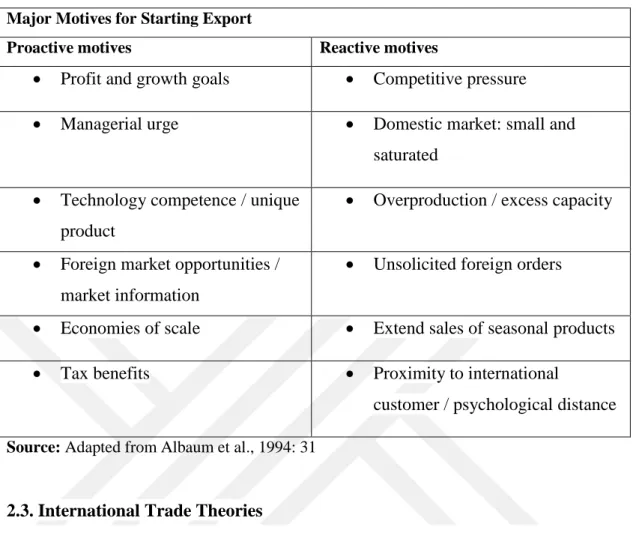
The basis of internationalization is exports and the major motives for starting to export are indicated in Table 2 below:
10
Table 2: Major Motives for Starting to Export Major Motives for Starting Export
Proactive motives Reactive motives
Profit and growth goals Competitive pressure Managerial urge Domestic market: small and
saturated Technology competence / unique
product
Overproduction / excess capacity Foreign market opportunities /
market information
Unsolicited foreign orders
Economies of scale Extend sales of seasonal products Tax benefits Proximity to international
customer / psychological distance
Source: Adapted from Albaum et al., 1994: 31
2.3. International Trade Theories
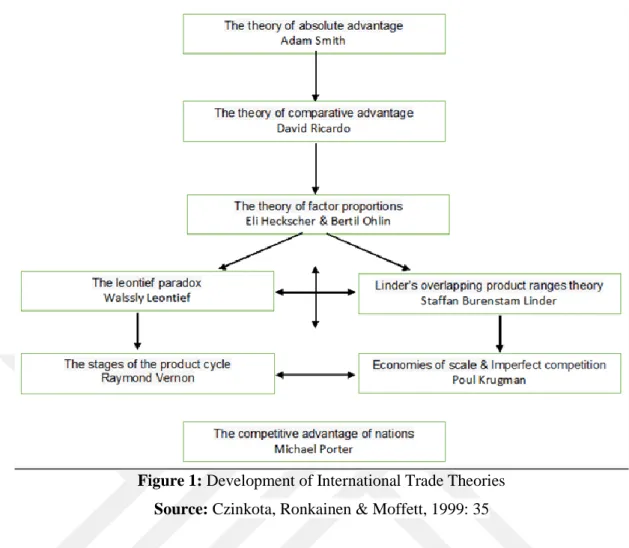
After the second half of the 18th century, the academicians have tried to understand the benefits of international trade and why some countries are more prosperous and richer than the other countries. Some theories have been put forward in the last two centuries (Mutlu, 2017: 31). Some of these are (1) mercantilism, (2) the theory of absolute advantage, (3) the theory of comparative advantage, (4) the theory of factor proportions, (5) the Leontief paradox, (6) Linder’s overlapping product ranges theory (7) the stages of the product cycle, (7) economies of scale and imperfect competition, (8) the competitive advantage of nations (Mutlu, 2017: 38).
The development of international trade theories is shown in Figure 1 below (Czinkota, Ronkainen, & Moffett, 1999: 35):
11
Figure 1: Development of International Trade Theories Source: Czinkota, Ronkainen & Moffett, 1999: 35
Mercantilism is a trade theory, which forms the basis of economic thinking from around 1500 to 1800. According to mercantilism, countries should import less than they export (Daniels and Radebaugh, 2000). According to the mercantilists, the wealth of a nation depends on the number of precious metals such as gold, silver, etc., while the industrial and agricultural wealth-enhancing sectors don't provide wealth. Therefore, the main policy of the national states in foreign trade is to increase their precious metal stocks to the extent possible. If there are no gold or silver mines in a country, the way to increase it is through foreign trade, increasing foreign exports and reducing imports, will increase precious metal output (Mutlu, 2017: 36-37).
Absolute advantage theory was revealed by Adam Smith. In 1776, Smith indicated that what determine the real prosperity of a country is the goods and services that the citizens of that country can reach (Daniels and Radebaugh, 2000). According to this theory, every nation should be specialized in a product that can be produced quickly
12
and efficiently under free-market conditions. Some of these produced goods must also be exported in the same way as goods produced in another country. This relationship will increase the welfare of both countries, which is the basis of this theory (Mutlu, 2017: 39).
Later, Ricardo sought answers to issues that the theory of absolute advantage could not answer. In his "Principles of Political Economy" book published in 1819, he took Adam Smith's ideas a step further (Mutlu, 2017: 40). According to Ricardo, if a country is more specialized in producing a product than other countries, global productivity can be achieved from trade, regardless of whether other countries produce the same product more efficiently (Daniels and Radebaugh, 2000). This view is not based on whether countries have absolute superiority in the production of goods, but rather on which goods are more productive in terms of opportunity costs (Mirze, 2018: 54).
According to the theory of factor proportions, the fact that countries have comparative advantages over other countries in some goods and services depends on the extent to which they have the production factors involved in the production of these goods or the ease of access to them (Mirze, 2018: 57). Products vary according to the variety of factors and quantities (labor, natural resources, and capital) required for their production. Countries vary according to the type and quantity of production factors they have (Çavuşgil et al., 2017: 150). According to this theory, the main reason behind the different relative costs between countries is the differences arising from the distribution of the production factors among the countries (Mutlu, 2017: 42).
The Heckscher-Ohlin model has been considered as the backbone of traditional trade theory. This model defines matching from externally supplied factor supplies and externally given external product prices to internal factor prices, output levels and consumption levels, as determined in the international market; the difference between these last two items is international trade (Leamer, & Levinsohn, 1995: 1345). The results of the study, which was performed by Wassily W. Leontief to confirm Heckscher-Ohlin (H-O) in the US, were not consistent with the findings of
13
H-O (Mirze, 2018: 57). The Leontief paradox revealed the need to add a factor of technology to the theory of factor proportions and subsequent theories of foreign trade (Mutlu, 2017:45). The suggestion of the Leontief paradox is that international trade is complicated and cannot be clarified by a single theory (Çavusgil et al., 2017: 150).
On the other hand, Linder’s Overlapping Product Ranges Theory is an alternative theory produced by Linder (1961) to replace the theory of factor proportion. It argues that international trade will take place between countries with certain income levels. Countries with similar income levels will make similar demands based on-demand approach, international trade will be shaped depending on similar income levels (Mutlu, 2017:46). The trade between the similar sectors of similar countries was examined and it was tested that the similar demands of the societies arose in the case of differentiated varieties of the same goods, not as a result of comparative factor advantages of the countries (Mirze, 2018:60).
The theory of stages of the product cycle shows that how a product is produced and exported (Mutlu, 2017:48). Raymond Vernon, who developed this theory, claimed that international trade between the countries of the world took place depending on the life of goods and services, and that comparative advantages had shifted over time between countries according to the product life stages (Mirze, 2018:60). There are 3 steps in the product cycle. These are “new product stage, mature product stage and standardized product stage” (Çavuşgil et al., 2017: 151).
The economies of scale theory was developed by Paul Krugman (1979) which was developed in the late 1970s and early 1980s and according to this theory, the average production costs in some goods depend on the production scale or production volume. In the same way, if the production scale costs are decreasing, in production, decreasing costs or increasing returns according to scale can be mentioned (Mutlu, 2017: 50). In some sectors, economies of scale are provided with large scale production; however, low prices can be provided (Çavuşgil et al., 2017: 149).
14
The imperfect competition theory is a new theory which explains why a country both exports and imports is due to that the goods imported/exported are different types of the same product (Mutlu, 2017:51). In this type of competition, there are many enterprises in the market. Some firms make differences from their rivals for example in their products, activities, and behaviors (brand, patent, image, design, quality, etc.) and so behave freer to control the prices of their products and to shape their behavior (Mirze, 2018:142).
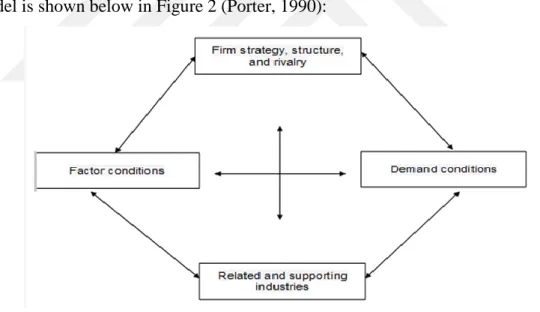
The competitive advantage of nations is the best theory to explain international trade and today’s conditions. In this theory, the studies of Michael E. Porter are considered essential. Porter had started this study in 1980 which reveals that the international competition model has changed from industry to industry. Porter's diamond indcates the competitive advantage factors of nations (Mutlu, 2017:52). These factors are “(1) demand conditions, (2) firm strategy, structure, and rivalry, (3) factor conditions, (4) related and supporting industries” (Çavuşgil et al., 2017: 154). Porter’s Diamond model is shown below in Figure 2 (Porter, 1990):
Figure 2 : Porter’s Diamond Model
Demand conditions which are the first factor in international competitive advantage
theory can be explained as follows; regional demand is more important when the domestic market is higher than the demand in external markets for a product. It brings a competitive advantage when this product is exported. As the name suggests, demand conditions refer to variables of demand for goods and/or services produced.
15
These can be defined as qualified demand, export, and new market opportunities. Because the more demanding domestic market gives rise to competitive advantage. At the same time, the strong and up-to-date market conditions has enforced regional firms to monitor global changes (Barca et al, 2006: 40).
Firm strategy, structure, and rivalry which is the second factor in international
competitive advantage theory can be explained as follows; regional conditions affect the strategies of firms and/or sectors. Low competition in the sector makes it attractive. From this perspective, firms prefer low competition, but regional competition forces firms to innovate, that is, to produce and develop something new. As a result, high regional competition leads to low global competition. Factor
conditions which is the third factor in international competitive advantage theory can
be explained as follows; a country can reveal its important inputs such as resources and technology. At the same time, regional input disadvantages enforce organizations to innovate and develop new methods that can create a national relative advantage. In general, raw materials and labor are included under the basic variable of input conditions. Related and supporting industries which is the fourth factor in international competitive advantage theory can be explained as follows; if regional supporting industries are competitive, organizations experience the convenience of cost-effective and innovative inputs. This effect is strengthened when suppliers experience global competition. Relevant and supportive industries are the most important fundamental changes in a competitive and exporter industry. In other words, the existence and activities of such institutions and organizations affect the competitiveness of the sector and/or the sectors and hence the ability to export (Barca et al, 2006: 40).
Porter’s classic Diamond Model has been revised by adding two new factors which is shown in Figure 3 below (Gürpınar & Sandıkçı, 2008:113). Two more external variables are added to the interaction of the four factors. These variables are (5) the state and its policies and (6) the opportunities and chances encountered (Gürpınar & Sandıkçı, 2008:112).
16
Figure 3 : Porter's Competitive Diamond Source: Gürpınar & Sandıkçı, 2008:113
The state and its policies is the fifth factor in international competitive advantage
theory. Porter (1990) believes that the role of the state in developing a sector's international competitiveness is important but it is indirect. According to Porter, what the government needs to do is not to try to create a competitive advantage, but to support the industry within the framework of the main elements described above that form the four main components of the diamond model. The involvement of the state as a part of market or a market guide affects firms' chances of global competition. Both opportunities and state policies are effective in determining the global competition in the form of mutual interaction within the system as a whole (Gürpınar & Sandıkçı, 2008: 119-120).
The opportunities and chances is the sixth factor of international competitive
advantage theory. According to the theory, uncontrollable conditions but still affecting the sector and change the relative positions in the competitive environment are called events. For example; these are wars, natural disasters, etc. Indirect
Firm’s Structure, Strategy and,
Competition
Factor
Conditions Conditions Demand
Related and Supporting Factors -Appropriate environment for the creation and development of sustainable competitive advantage
-Availability of the suppliers and related firms with competitive advantage
-Sectoral clustering
-Local competition
-Basic and advanced factors
-General and sector-specific factors Chance
-Large and growing domestic market
-Sophisticated and demanding buyers
17
opportunities affecting global competition are generally: innovation; sudden changes in input (raw material etc.) costs; changes in the financial markets, suspensions in the world and local demands; policies and wars applied by foreign countries (Aktan and Vural, 2004: 62).
2.4. Internationalization Strategies
The risk involved in each internationalization strategy is different. The profit potential of the company and the control area are different according to the selected method. For example, establishing a production facility in the foreign country itself is riskiest among internationalization strategies. However, all control is in the hands of the firm and the profit potential is very high (Cengiz et al., 2007: 23). The strategies of entering the international market entry could be categorized as in Figure 4 below (Mutlu, 2017:103):
Figure 4 : International Market Entery Strategies Source: Mutlu, 2017: 103
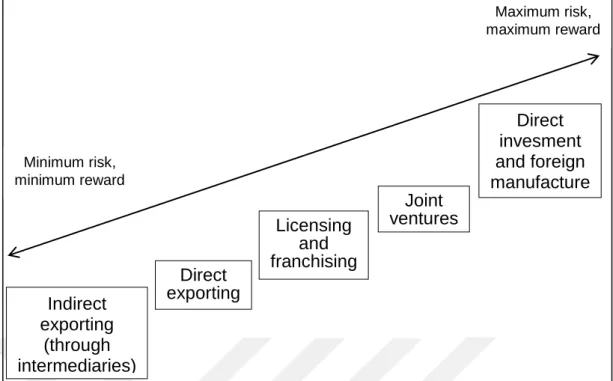
The relationship between the level of internationalization of firms and their risk and reward expectations is shown in Figure 5 below (Wall, Minocha & Rees, 2010):
18
Figure 5 : The Relationships between Firm’s Internationalization Level and Risk/Reward Source: Wall, Minocha & Rees, 2010.
2.4.1. Export-Based Internationalization Strategies
Export based internationalization strategies are one of the internationalization strategies which is least risky. Export-based internationalization strategies consist of indirect export and direct export strategies. The easiest and most frequently preferred outside country activity is export. At the same time, the oldest form of international trade is exports. Export is the strategy of selling and distributing goods and services from one country to another country (Çavuşgil et al., 2017:376). According to Leeman (2010: 12), export is defined as marketing, selling, distributing goods or services from one country to another country or countries. The easiest way to internationalize is to sell the goods or services belonging to the owner or someone else abroad. The firm can also sell the existing products, usually without changing them outside of the package or by changing them according to the wishes of the recipient country (Tek, 1990: 188-189). For this reason, export is the most commonly used strategy for internationalization (Douglas and Craig, 1995: 155).
Export-based internationalization strategies consist of indirect export and direct export strategies. For direct exports, enterprises perform their export activities
Indirect exporting (through intermediaries) Direct exporting Licensing and franchising Joint ventures Direct invesment and foreign manufacture Minimum risk, minimum reward Maximum risk, maximum reward
19
through intermediaries in foreign markets. In the case of direct export activity, the entity must have more than one relation in the country in which it intends to enter. In order to carry out direct export activities, the enterprise must have attained a certain level of expertise, and by selecting such a way of entry to the market, the entity obtains significant control over the distribution channel. Successful direct export activity depends on the vitality of the relationship between the exporting entity and the local distributor or importer. With the establishment of good relationships, the exporting enterprise saves significant investment costs (Hennessy, 1995: 298-299). According to Kotler and Armstrong (2005: 483); for direct exports, the enterprise which wishes to carry out its own export activity must have reached sufficient size. There are some investment and risk, but there is a potential incentive (Kotler, 1991: 413).
When the exporting company sells to the domestic market, this export is called
indirect exporting. The business is not related to international marketing because its
products are sent abroad by others. This type of export approach is suitable for businesses with limited export targets. Indirect exports are a viable option if overseas sales are seen as a means to dissolve surplus production or as a very rare activity (Hollensen, 2008: 218). Indirect exports are much easier than direct exports. Because it does not require much expense nor is it a special area of expertise. Exporters or intermediaries in the main country only give orders (Mutlu, 2008: 102).
2.4.2. Types of Collaborative Arrangements
There are various internationalization strategies based on contracts. In this section, these strategies which are Licensing, Franchising, Contract Manufacturing, Management Contracts, Joint Venture, Consortium, Turnkey Projects, and Build-Operate-Transfer Modeled Strategies, will be mentioned.
20 2.4.2.1. Licensing
License agreements are one of the ways of entery to foreign countries (Aydoğmuş et al., 2005: 15). There are two parties in license agreements, which are licensor and licensee. The licensor is a company which grants the use of the rights of intangible properties to another company, the licensee is a company which has the right to use of the other company’s intangible rights for a specified area and time (Daniels and Radebaugh, 2001:489). Licensing is a term which means to authorize or grant license (Warren, 1998: 375). In the license agreements, the manufacturer or the supplier grants the rights to the licensee to use; these rights are trademark, design, marketing techniques, know-how, patents, copyright and others. The enterprise has the right to use the branding, product and store design, marketing techniques and management systems of the licensee manufacturer or supplier as well as technical information and consultancy on production (İlker, 2010: 206). The transfer of the rights which are patent of a domestic product, production know-how, trade mark rights for bid price and the right of distribution of the goods to a foreign company in a foreign country (Aydoğmuş et al., 2005: 15).
An enterprise offers trademark, patent, trade secret or other similar intellectual property value for a royalty (license fee) or another fee, with licensing agreements (Berkowitz et al., 1994: 659). A company that undertakes a licensing agreement grants to other companies the rights that are tangible. There are also some intangible rights besides these tangible rights. These intangible rights are divided into five categories by Daniels and Radebaugh (2000). These categories are “(1) patents, inventions, formulas, processes, designs, models; (2) copyrights, literary, musical or artistic arrangements, (3) marks, brand names, stamp names; (4) concessions, authorities, contracts and (5) methods, programs, procedures, systems, etc”.
The licensor grants the licensee permission to produce the firm’s own product, so the firm also provides information on management services, technical information or production processes. It is a risk in terms of business because there are risks such as not being able to produce in desired quality and not being able to fully populate the market and potential to create an individual or company who/which will be a competitor in the future due to the transfer of information. Some reasons make
21
licensing arrangements restrictive. These issues are (1) boundaries of agreement, (2) compensation, (3) rights, privileges, and restrictions, (4) resolution of disputes, (5) duration of agreement (Griffin & Pustay, 1996: 394).
License agreements often have many advantages; some of them are as follows (Sherman, 2011: 371):
Spread the cost of risk, development, and distribution, Penetrate faster,
Earning from the initial licensing fee and continuing with royalty (license fee) revenues,
Increase customer loyalty,
Does not offer the opportunity to test existing and tested new technologies. Disadvantages of the license agreement are also presented by Bradley (1995) as follows:
Ease of transfer of technology, knowledge, and experience Difficulty in controlling the activity of the licensee
Inability to enter the market actively Difficulty of the form of agreement
2.4.2.2. Franchising
The word "franchising" originates from the English word of “free” which means “to release, to let free, to allow, etc.” (Can, 2012:111). Franchising is a contractual relationship between franchisee and franchisor, between the two legally independent parties (Nart, 2005: 124). There is a continuous debt relationship between franchisee and franchisor with franchising agreement (Aslanoğlu, 2007: 77-78).
Franchising is a form of licensing in which the use of a business system is provided (Anderson and Gatignon, 1986: 5). Although it is similar to license agreement, it is called franchising, which differs from it by covering the whole market program, including the business image, marketing techniques, brand name, and business methods, and providing the most efficient access to the products and / or services from the producer to the consumer. Franchising is a term that one company grants
22
another company the right to use certain privileges for a specific period of time and in a particular area (Mutlu, 2017: 113).
Franchising is a specialized form of licensing that the franchisor not only give to use the right of intangible asset of the company but also operationally helps the franchisee. These operational assistances could be training and sales promotion (Daniels and Radebaugh, 2001:492). According to Warren (1998: 257) franchising means providing concession. Franchising allows a local company to successfully enter a foreign market with a period of capital sharing and by offering an international service success and product brand (Paliwoda and Buckley, 1994: 29). The franchisor which grants the franchise receives a fee on his behalf, or receives a percentage of the sales, which is called royalty (Cengiz et al., 2007: 69).
There are basically four elements of franchising agreements. These are franchisors (real or legal person who sells trade names, marketing and production technical rights), franchisees (who use the stated rights for a certain period of time), a
franchising agreement (an independent commercial agreement that establishes the
nature of the relationship between a franchisor and a franchise), and a franchise (the subject of a franchise agreement) (Göksu and Canıtez, 1999: 18). The franchise provides moderate control, because typical agreements include incentives to comply with system rules and ensure that franchise owners' activities are monitored at a high level (Anderson and Gatignon, 1986: 5).
In essence, if a franchisee proven product and service success is not well-known and well-recognized, then the franchisee risks introducing a product or service that is ultimately tiny. In some countries, the franchise contract is not easily applied. Since the product has already been developed in the host country, the franchising is considered as domestic research & development cost. As a result, franchising provides international, off-the-shelf benefits for honest companies, but when working for a private company in a franchise, care must be taken to evaluate and make decisions on specific costs and benefits (Mendenhall et al., 1995: 262).
23
The franchise agreement must regulate all other aspects of interests and responsibilities of the parties, without any ambiguity. Important issues that must be included in the agreement are (Cebeci, 2005: 13):
The rights granted to the franchisor and the franchisee, Goods and services to be offered to individual franchisees, Obligations of the franchisor and individual franchisee,
The conditions of the payments to be made by the individual franchisee, The length of the agreement, which should be long enough for the individual
franchisee to take out the first investment, The renewal conditions of the treaty,
Conditions that entitle the individual franchisee to transfer and sell the franchisee and the first possible purchase right of the franchisor,
The terms of the individual Franchisee's use of the Franchisor's distinguishing marks, trade names, trademarks, service marks, shop signs, logos and other distinguishing marks,
The right of the franchisor to adapt the franchise system to new and changing methods,
The conditions of the end of the treaty,
Terms of delivery of material or non-material items belonging to the franchisor or other persons following the end of the treaty.
2.4.2.3. Contract Manufacturing
Another alternative internationalization strategy for businesses that prefer production abroad is contract manufacturing. Contract manufacturing is a mid-way between licensing and production and direct investment. An enterprise wishing to enter international markets has a contract with the production of a foreign manufacturer's products. Contract manufacturing is a form of outsourcing. Products are marketed and distributed by the parent company in the country of production or in another international market. The contract usually includes technology transfer and technical assistance from abroad (Albaum et al., 1998: 285).
24
Contract manufacturing is defined as the production of a product by the local producer enterprise that the company wishes to enter into the market. It is suitable if the company can find a local company that can produce the goods in the desired quality and quantity (Özcan, 2000: 178). Contract manufacturing is a type of partnership that does not require the entity to invest in production activity in the host country. Aiming entry to international market, the firm has the product made by a local manufacturer in the foreign market and carries out its marketing activities itself (Mutlu, 2017: 116).
Products produced under contract in one country can be offered to the home market where the production is realized or sold to other countries. In contract manufacturing, an agreement is generally made per unit produced. Although the quantity is understood as a fee, it is an important element in quality. For this reason, an enterprise that follows the strategy of entry to the foreign market through contract manufacturing should pay attention to the quality standards, financing and labor force structure of the local enterprise. The contract manufacturing method is generally preferred for entry to host markets that have a low volume market potential and are protected by high tariffs. In this case, local production provides an advantage in overcoming high tariff barriers, but the market volume is not large enough to require direct investment. The countries where contract manufacturing is generally preferred are those with technological competence and where marketing activities has a high importance. Examples include small countries in the Americas, some African and Asian countries (Jeannet, 1992: 300).
The advantages of contract manufacturing include that it does not require investment costs, ensures branding and protection of the brand, being able to gain market experience and does not carry price and production problems due to the standards set by the agreement. In addition to these advantages, there is a significant disadvantage that the company can create its own competitor as a result of providing the technical knowledge to the manufacturer. Other disadvantages include lack of technology or profit, and problems with quality (Akat, 2004: 159). In general, contract manufacturing offers opportunities such as low risk for entry, loss of control, low risk of exchange rates and low financial problems. In addition to all of these, the
25
difficulties of transferring information, the need for additional training support, and the difficulty of quality control are problems (Hollensen, 1998: 259). However, it can sometimes be difficult to find a manufacturer with sufficient qualifications in the local market and training a local manufacturer can take years (Toyne and Walters, 1989: 339).
2.4.2.4. Management Contracts
Management contracts, which are one of the methods of international market entry, are the mutual agreements of an international company with a foreign company to manage some or all of its activities. A local business is able to transfer information about management of foreign investors who provide capital. Local businesses export administrative or management services rather than their own products. This strategy has a relatively low risk for foreign market entry (Kotler and Armstrong, 1994: 563-564).
One of the most important management assets a firm can have is the management contract. Despite the huge gains in capital and technology, inadequate quality management is a challenge that many governments and entrepreneurs face (Daniels and Radebaugh, 1989: 471). Management contract has a very low risk for international business. As for some other internationalization strategies, there is no promise to build fixed facilities (McCarthy and Perreault, 1988: 384). As an example, Hilton uses this method for the management of hotel chains all over the world (Kotler & Armstrong, 1994: 623).
2.4.2.5. Joint Venture
Joint ventures are one of the internationalization strategies in the form of production and marketing of goods or services in a foreign country with the participation of a foreign business (Kotler and Armstrong, 1994: 623). It is a group of companies that are specialized in a certain area of business, independent from each other, formed by merging in the framework of a contract in order to make a certain job and gain a profit (Çelik, 2002: 72-77). In a joint venture, a kind of strategic partnership is being carried out among the enterprises. Stocks and business controls are shared. In the
26
joint venture approach, companies from at least two different countries (usually the local operation of the country in which an enterprise is established) work together and set up a new business to co-produce or provide services. Joint ventures can be classified as a partnership venture based on expertise or a joint venture based on creation of a common value addition. Initially, the enterprise was organized around specific functions such as marketing and production. Each partner adds something unique that creates added value; for example, when one company design a common product, the other produces them. In the second type, partners are equally involved in value-added activities, for example a common design team is being created (Albaum et al., 1998: 288).
As with any internationalization strategy, the joint venture has both advantages and disadvantages. The benefits of joint ventures for international business can be listed as follows (Mutlu, 2017: 120-121):
The entire capital of the international business is not endangered, and the current risk is shared with the local business,
All valuable information that the local business owner has about the host country is shared with the international business,
International business can make good relations with the host country government by taking advantage of the relations established by the local partner, and political advantages can be achieved in this way,
Costs can be reduced,
Technological superiority can be achieved against rivals, Competitive advantage can be achieved in the market, Resources are easier to reach,
Political pressures may be reduced, It may be easier to enter new markets.
As well as the advantages of joint ventures, they also have disadvantages in terms of international businesses. These disadvantages are as follows (Mutlu, 2017: 121):
Due to the reduced availability of control, international business may loose control,
27
As the profits need to be shared with the local partner, the international enterprise may have to settle for less profit.
At this stage, there is a method that the businesses in international markets also use this method. This method is "joint ownership". Joint ownership is the consolidation of an entity's ability to share common ownership and control with a foreign investor to create a national business. Joint property is created especially for economic and political reasons. The entity may not have sufficient financial, physical, or managerial resources to make the necessary initiative alone, or the government may impose joint ownership conditions for the condition of entry (Kotler and Armstrong, 1994: 593).
2.4.2.6. Consortium
Consortium is the co-operation of two or more operators in order to carry out the work required for large capital. These projects are usually those that use large capital such as ports, railways, bridges, and dams (Şimşek, 2009: 81). Companies with different areas of expertise from various countries work together on a contractual basis, without establishing a capital-based firm under a new identity, for a large international project, and ensure that the project is carried out in certain parts of the project. Each firm works with its own identity. The firm is responsible for completing the part specified by the project contract in the area of its own expertise. The consortium ends with the completion of the project (Mirze, 2018: 233).
There are some advantages of consortiums (Fletcher & Wheeler, 1989: 33), which are listed below:
The consortium is more prominent in the foreign market.
It is more likely to benefit from the support of export promotion organizations at home.
Form a basis for mobilizing different export-related skills in the consortium. Produces the economy through the joint use of domestic and foreign export
opportunities.
Provides the spread of export risks and costs.
28
However, there are also some weaknesses in a consortium (Fletcher & Wheeler, 1989: 33):
Many companies are not prepared to reduce their autonomy. This alone is an important reason for the failure of the consortium.
There should be a strong reason for firms to work together, such as adding the resources of a firm deemed inadequate for international trade or taking advantage of an external market opportunity.
2.4.2.7. Turnkey Projects
In this method, the main international trading company provides a service for the construction and installation of a production facility, training of personnel and initial operation of the factory for a local producer in a foreign market. The customer then acquires all the operating system and the necessary knowledge and skills to operate it (Albaum et al., 1998: 287). Turn-key projects include typical projects such as airports, ports, power plants, dams or very large factories. Due to the size of turn-key projects, it can generate substantial revenue for service providers (Mendenhall et al., 1995: 236). Turnkey projects are common for all of the expensive and complex manufacturing technologies such as chemistry, medicine, oil refining, and metal processing industries (Hill, 2008: 406).
Turn-key projects have some benefits for international businesses, and it is possible to list these benefits as follows (Paul, 2011: 397):
It provides the firm opportunity to benefit from special technical know-how. It makes possible to benefit from the collective financial resources and
experiences gathered by the companies involved in the projects in the consortium.
The main benefit for the host countries is that they provide a more convenient and faster option for establishing capital infrastructures and financial assistance and low-cost projects provided by foreign governments and international organizations.
Information can be gained.
29
In addition to the advantages of turn-key projects, there are some disadvantages for international businesses (Paul, 2011: 397):
The relatively short turnover of some of the turnkey projects and the interest of governments means that long-term relationships with the host country cannot be established, but success in one country may attract contracts to be made by other countries.
Local firms can benefit from the technology that the firm has transferred, and in the future, the company may be the biggest competitor on similar projects. When the firm transfers its technology and other resources, it actually transfers
some of its competitive advantages and does not provide any long-term benefit to it.
It is not long term in a foreign country. It can create an opponent.
The process of selling technology may become the process of selling competitive advantage.
2.4.2.8. Build-Operate-Transfer Contracts
Build-Operate-Transfer contracts are strategies aiming at providing business financing and realization of basic infrastructure investments of a country by private sector. With the help of this method, it is aimed to realize big investment projects such as power plants, dams, airports, highways and underground in the country (Mutlu, 2008: 121). Build-operate-transfer strategy is a turnkey project in which the design, equipment and construction of the entire plant or production system belongs to the agreed company and then returns to the buyer for a predetermined price (Steers and Nardon, 2006: 209).
This cooperation is a further extension of turn-key contracts. As in turnkey agreements, plant investments are carried out by a foreign business or consortium in the same way, and facilities are made available. However, customers do not make any payment to the international production company; instead international company operates the existing facility with a minimum guaranteed income for a certain period of time and collects the payment it needs to receive. At the end of this period, the