Evaluation agronomic traits of canola (Brassica napus L.)
under organic, bio- and chemical fertilizers
Kuzey Mısır Deltasında, biyo, organik ve mineral azotta yetiştirilen
kanolanın (Brassica napus L.) agronomik özelliklerinin değerlendirilmesi
Ayman El Sabagh1, Abd Elhamid Omar1, Hirofoumi Saneoka2, Celaleddin Barutçular3A B S T R A C T
Ö Z E T A R T I C L E I N F O
1Department of Agronomy, Faculty of Agriculture, Kafrelsheikh University, Egypt
2Department of Plant Nutritional Physiology, Graduate School of Biosphere Science, Hiroshima University, Japan 3Department of Field Crops, Faculty of Agriculture, University of Cukurova, Turkey
Received: 5 June 2015
Received in Revised Form: 30 July 2015 Accepted: 4 August 2015
Available Online: 14 March 2016 Printing: 4 April 2016
Corresponding address: Ayman El Sabagh E-mail: [email protected]
This study was carried out to evaluate the effect different sources and rates of nitrogen fertilizers on yield traits of canola under Egyptian conditions. The experiment was conducted at the Experimental Farm of Faculty of Agriculture, Kafr El-Sheikh University, Egypt during the two successive winter season of 2004/2005 and 2005/2006. The experimental design was a strip - split plot with four replicates, Bio-fertilizer was in horizontal plots: without bio-fertilizer and with bio-fertilizer. Compost was in vertical plots: control, 6, 12 and 18 ton ha-1. Nitrogen was arranged in sub vertical plots: (control, 36, 72 and 108 kg N ha-1). Result revealed that, the bio fertilizer effects on seed yield and yield traits was significant as compare to control. Compost significantly improved yield and yield components of canola and the rate up to 18 ton ha-1 was more effective. Chemical nitrogen significantly improved on yield parameters and the rate of 108 kg ha-1 produced the highest seed yield and yield traits. The findings clearly showed that combined application of bio-fertilizer plus 108 kg N ha-1 adding with 18 ton compost ha-1 has resulted in obtaining highest seed yield and yield components. While, according to the results, bio-fertilizer could be increased the nitrogen uptake efficient and could be helpful with compost rate (<12 ton compost ha-1) or moderated chemical nitrogen (>72 kg N ha-1). So, using bio-fertilizer combined with organic and inorganic nitrogen could be improve seed yield and reducing the need for chemical fertilizers and that will lead to sustainable agriculture.
Keywords: Canola, Bio-fertilizer, Compost, N-fertilizer, Yield
Bu çalışma, Kuzey Mısır Deltasında, farklı kaynaklı ve miktardaki azotlu gübrelerin kanolanın verim özelliklerine etkisini araştırımak amacıyla yapılmıştır. Deneme, Mısır’ın Kafr El-Sheikh Üniversitesi, Ziraat Fakültesinin Deneme Çiftliğinde 2004/2005 ve 2005/2006 iki kış sezonunda yürütülmüştür. Deneme, şerit bloklarında bölünmüş parsellerde dört tekrarlamalı tesadüf parseller olarak, biyo-gübre dikey parseller (Biyo-biyo-gübresiz ve biyo-biyo-gübreli) olarak planlanmıştır. Kompost, yatayda: kontrol, 6, 12 ve 18 kg compost ha-1 olarak düzenlenmiştir. Mineral azot, dikey alt parseller: kontrol, 36, 72 ve 108 kg N ha-1 olarak düzenlenmiştir. Biyo-gübre uygulamasının, bitkide dal sayısı, bitkide harnup sayısı, harnupta tohum sayısı, 1000-tohum ağırlığı, bitkide veya hektarda tohum verimi, biyolojik verim ve hasat indeksine etkileri önemli bulunmuştur. Verim özellikleri, compost ve azot düzeyindeki yükselişlerle birlikte iyileşmiştir. Biyo-gübrenin verime etkisi, mineral gübre artışı ile önemli etkileşim yaparak yüksek tohum verimini sağlamıştır. Sonuçlar, biyo-gübre, organik azotun sınırlı (<12 ton compost ha-1) veya mineral azotun yüksek olduğu (>72 kg N ha-1) alanlarda azot alımını artırmış olduğunu göstermiştir. Biyo-gübrenin, organik veya inorganik azot ile birlikte kullanımı dikkate alındığında, verimi önemli düzeyde artırmış ve çevre konusunda da yeni bir bakış açısı sağlamıştır.
Anahtar sözcükler: Kanola, Biyo-gübre, Kompost, Azotlu gübre, Verim
Dicle University Institute of Natural and Applied Science Journal
1.Introduction
Canola (Brassica napus L.) is one of the most important annual oil and protein crops in the world. Generally, Canola plant oil has lowest saturated fatty acids content among vegetable oils and thus presents an increasing demand for consumers of diet conscious. Moreover, the residue left after oil extraction is rich in proteins and can be used for animal feeding (1). Canola Cultivation in Egypt may provide an opportunity to overcome some of deficiency of edible oil production in Egypt. In addition to, Canola could be successfully grown in newly reclaimed land outside the old land of Nile valley in order to avoid the competition with other crops occupied the old cultivated area (2,3). Canola Suitability growing under Egyptian conditions, compared with other oil crops, may be due to the tolerance of canola to harsh environmental influences frequently prevailing in such newly reclaimed land like, salinity and drought (4). Several studies show that canola is very responsive to N (5) and N is a critical limiting factor for the yield (6).Canola Characteristics such as plant height, number of branches per plant, number of pods per plant, seed yield and oil content are positively correlated with soil N level (7). Canola yield traits is affected indirectly by N as a result of increased stem length, higher number of flowering branches, total plant weight, seeds per pod, and number and weight of pods and seeds per plant (8).
Currently, the Intensive use of chemical fertilizers a significant problem to environmental and increasing of production cost. Moreover, There environmental problems has raised interest in environmental friendly sustainable agricultural practices, which can reduce input costs (9).Concerning application of bio-fertilizers on soils has decreased the pH, which had led to increase the availability of trace elements that enhance plant growth. In addition to, bio-fertilizers are eco-friendly and have been proved to be effective and economical alternate of chemical fertilizers with lesser input of capital and energy (10). Also, adding of compost improves soil fertility by increasing both the quantity and the quality of soil organic matter (11). Therefore, keeping in view the importance of this technique the present study was planned to improve and maximizing the productivity of Canola under North Delta of Egypt by studying the effect of bio - organic and nitrogen fertilizers on yield and its traits.
2. Materials and Methods
Two field experiments were carried out in the Farm of the Faculty of Agriculture, Kafr El-Sheikh University,
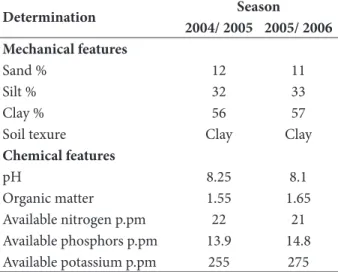
Egypt during the two successive winter season of 2004/2005 and 2005/2006, to study the effect of different sources and rates of nitrogen fertilizers on yield of Canola (Brassica napus L. var. serw4) under North Delta of Egypt. All treatments were arranged in a strip spilt plot design with four replications. The Horizontal plots were as follows: without bio-fertilizer and with bio-fertilizer. The vertical plots were devoted to the four soil application of compost fertilizer rates as follows; control, 6, 12 and 18 ton ha-1. Sub vertical plots were devoted to the nitrogen fertilizer treatments in the form ammonium sulphate (20.6%) which distributed randomly in sub-sub plots as follows; control, 36, 72 and 108 kg N ha-1. Before soil preparation, soil samples of the experimental sites were taken at the depth of 0- 30 cm. Mechanical and chemical analysis was determined according to Cohenie et al. (12) and Page et al. (13) (Table1).
Each plot area was 10.5 m2 and each plot included 6 rows (3.5 m long and 50 cm. apart) with 20 cm between hills. Compost is manufactured using rice hay (60%), farmyard manure (25%), poultry manure (10%) and fertile soil (5%). Farmyard manure, poultry manure and soil were thoroughly mixed. Seeds were sown on 15th and 10th of November in the first and the second seasons, respectively. Seeds of canola were successively washed and soaked for 30 minute in culture of efficient strain of Azotobacter according treatments. Bacterial strain was obtained from microbiology departmen. Soil and Water Res. Inst., ARC, Giza, Egypt. Nitrogen fertilizers in the form of ammonium sulfate (20.5 % N) was applied in two doses, one third at planting time and the residual after thinning just before the first irrigation. Phosphorus and potassium fertilizers were added before sowing at the rate
Table 1: Mechanical and chemical analysis of the
experimental soils. Determination 2004/ 2005 2005/ 2006Season Mechanical features Sand % 12 11 Silt % 32 33 Clay % 56 57
Soil texure Clay Clay
Chemical features pH 8.25 8.1 Organic matter 1.55 1.65 Available nitrogen p.pm 22 21 Available phosphors p.pm 13.9 14.8 Available potassium p.pm 255 275
of (200) and (100) kg ha-1 of calcium supper phosphate (15.5% P2O5) and potassium sulphate (48% K2O), respectively.
2.1. Measurements
Branches plant-1: branches plant-1 was determined at maturity by counting on the main stem per ten randomly selected plants from each plot.
Pods plant-1: Ttotal number of pods per ten randomly selected plants from each plot were counted and then averaged.
Seeds pod-1: Number of seeds in 100 pods were counted and then averaged per pod.
1000 seed weight (g): Three samples each of 1000- seeds, were taken at random from the seed lot of each plot, weighed and their average was calculated.
Seed yield plant-1 (gm): This trait was determined by weighting the average of seed weight of ten plants in grams (after natural dryness).
Seed yield kg ha-1: Harvesting was carried out at 160 and 170 days after sowing in two growing seasons, respectively. Plants of two square meters from the middle part of each plot were harvested and estimated the seed yield plot-1 and then converted to ton/fad-1.
Biological yield (ton ha-1): Crop was harvested at maturity, sun dried and then weighed with the help of spring balance to determine the total biomass plot-1 and then converted to kg ha-1.
Harvest index (%): Harvest index was estimated according to Yoshida (14) by subdividing weight of dry grain yield in (kg) on the total dry weight (Weight of grains and straw).
H. I %= Biological yieldSeed yield x100
2.2. Statistical analysis
The analysis of variance was carried out according to Gomez and Gomez (15). Treatment means were compared by Duncan’s Multiple Range Test (16). Stastical analysis was performed using analysis of variance technique by means of “MSTATC” computer software package.
3. Results and Discussion
3.1. Number of Branches
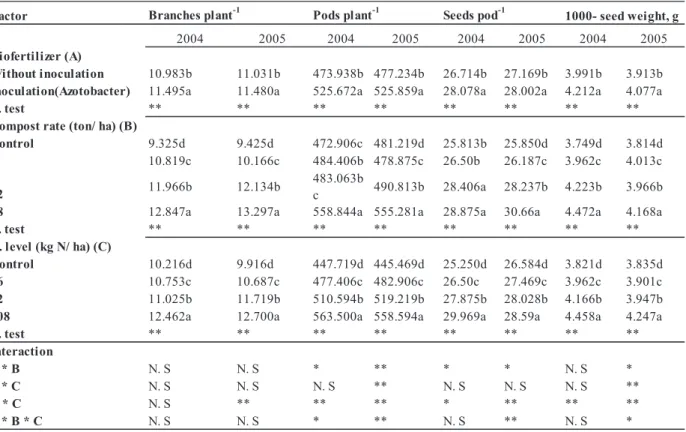
Number of branches per plant significantly increased in bio-fertilizer inoculated plant in both seasons (Table. 2). This finding was supported by Yasari and Patwardhan (17). Performance of bio-fertilizers could be explained by the fixation of sufficient atmospheric nitrogen, production of plant growth promoters, decreasing the ethylene production in plants and solubilization of minerals such as phosphorus (18,19).
The application of 18 ton compost per hectare was produced the highest number of branches per plant in both seasons (Table 2). Similar results were reported by Premi et al. (20, 21). Number of branches per plant was significantly increased with increasing nitrogen levels gradually from zero up to 108 kg N ha-1 (Table 2). This increase may be due to the basis that nitrogen is essential for building up protoplast and proteins which induce cell division and elongation which reflected on the progress happened in branches plant-1.These results harmony with these of Sharief and Keshta; Leilah et al. (22, 23). Several other studies have also been reported by Butter et al. and Ozer (24, 25) with the positive effects of the rate of N-fertilization on the number of branches in canola, which is not far from expectation as N fertilizers stimulate better plant growth and development.
3.2. Number of Pods Per Plant
Number of pods plant-1 was statistically increased by the application of bio-fertilizer (Table. 2). The results are in agreement with the findings of Gupta and Samnotra (26) who concluded that simultaneous application of Azotobacter had a significant effect on yield traits. Yasari et al., (27,28) reported that treatment canola with bio-fertilizer resulted in maximum seed yield coinciding with maximum number of pods plant-1.
Application of 18 ton ha-1 of compost produced the highest of number of pods plant-1 (Table 2). These might be due to the improvement in plant growth and could help in increasing nutrient availability from applied and native sources and mineralization of macro and microelements particularly nitrogen, which may increase the minerals availability to the plants. The results are in agreement with the results of Premi et al. and Eghball (20,21,29).
Number of pods plant-1 increased significantly with increasing nitrogen levels in the two seasons. Each increment of applied nitrogen resulted in a significant
increase in number of pods plant-1. The increase in amount of metabolites synthesized by plant under nitrogen fertilization treatments could possibly be due to more transformation of photosynthates to reproductive parts. Similar results were also reported by Bali et al. (30); Taha (31, 32); Singh and Singh (33).
3.3. Number of Seeds Per Pod
Number of seeds pod-1 was significantly increased by inoculation with Azotobacter bio-fertilizer in both seasons (Table.2). Similar results were reported by Sushlila and Giri (34).
Number of seeds per pod was significantly increased by each increment of applied compost fertilizer in both seasons (Table. 2). Such increase could be due to availability to growing plants as well as on improving soil physical properties and provide plant with different nutrient elements. Premi et al. (20,21) and Maamoun (35) also found the similar results in Indian mustard. Higher number of pods and bolder seeds as a result of availability of major and minor nutrients at all the essential stages of growth and development. According to Edwards et al. (36) vermi-compost had significant effects on plants
germination, growth, flowering, fruiting and yields. Seed number per pods influenced by bio fertilizer treatments.
Number of seeds pod-1 also significantly increased with increase of applied nitrogen fertilizer (Table 2). Similar findings were reported by Bali et al. (30), Taha (31,32), Momoh et al. (37). Several workers like Ozer (25) have also reported positive response of canola by increasing level of N fertilization.
3.4. Weight of 1000-Seed
Weight of 1000-seed was significantly increased by seed inoculation with bio-fertilizer (Table 2). Bio- fertilizers improved photosynthesis may be by increasing water and nutrients absorption leading to produce more assimilate and improve plant growth and thus, 1000-seed weight increased in compared with non-inoculation treatment. The results are in agreement with the results of Hamidi et al. (38).
Weight of 1000-seed was also significantly increased by each increment of applied compost fertilizer in both seasons (Table 2). It might be due to the increased available nutrient elements in the soil and improve soil
Table 2: Means of number of brances and pods per plant, seeds per pod and 1000-seed weight as as affected by
different nitrogen sources and rates during 2004 and 2005 season.
**: highly significant at the 1% level of probability .means within the same column of each factor followed by a common latter is not significantly different at 5% level, by DMRT.
Factor Branches plant-1 Pods plant-1 Seeds pod-1 1000- seed weight, g
2004 2005 2004 2005 2004 2005 2004 2005
Biofertilizer (A)
Without inoculation 10.983b 11.031b 473.938b 477.234b 26.714b 27.169b 3.991b 3.913b
Inoculation(Azotobacter) 11.495a 11.480a 525.672a 525.859a 28.078a 28.002a 4.212a 4.077a
F. test ** ** ** ** ** ** ** **
Compost rate (ton/ ha) (B)
Control 9.325d 9.425d 472.906c 481.219d 25.813b 25.850d 3.749d 3.814d
6 10.819c 10.166c 484.406b 478.875c 26.50b 26.187c 3.962c 4.013c
12 11.966b 12.134b 483.063bc 490.813b 28.406a 28.237b 4.223b 3.966b
18 12.847a 13.297a 558.844a 555.281a 28.875a 30.66a 4.472a 4.168a
F. test ** ** ** ** ** ** ** **
N. level (kg N/ ha) (C)
Control 10.216d 9.916d 447.719d 445.469d 25.250d 26.584d 3.821d 3.835d
36 10.753c 10.687c 477.406c 482.906c 26.50c 27.469c 3.962c 3.901c
72 11.025b 11.719b 510.594b 519.219b 27.875b 28.028b 4.166b 3.947b
108 12.462a 12.700a 563.500a 558.594a 29.969a 28.59a 4.458a 4.247a
F. test ** ** ** ** ** ** ** ** Interaction A * B N. S N. S * ** * * N. S * A * C N. S N. S N. S ** N. S N. S N. S ** B * C N. S ** ** ** * ** ** ** A * B * C N. S N. S * ** N. S ** N. S *
structure. Some researchers such as Allen and Morgan (39) suggest that at this short time window, the supply of assimilates to the pod and eventually to the seed has a crucial role in the seed development.
Increasing nitrogen level application from 36 to 108 kg N ha-1 had significantly increased 1000-seed weight in the two seasons (Table 2). Similar results were also reported by Sharief and Keshta (22), Taha (31,32) and Momoh et al. (37) in rape and mustard. Ahmadi and Bahrani (7) did not find any significant effect for increased N levels on 1000-seed weight.
3.5. Seed Yield Per Plant
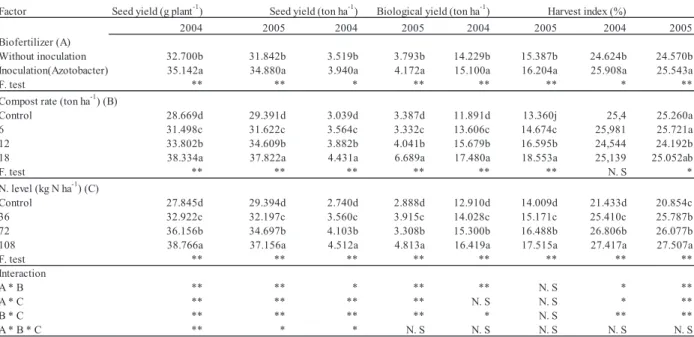
Inoculation with bio-fertilizer was highly significant on the seed yield per plant in both seasons (Table 3). This may be due to N2- fixation, which improves plant growth, and reflected on seed yield plant-1. These results are in agreement with Mohamed (40). Compost application significantly increased seed yield per plant in both seasons (Table 3). Compost amended soil, improved organic matter content which enhanced the seed yield. Compost can provide all nutrients in readily available form and also enhance uptake of nutrients by crops as reported Nagavallemma et al. (41).
Increasing nitrogen levels up to 108 kg N ha-1 significantly increased seed yield per plant in both seasons (Table 3). This might be due to the increase in
different yield components and improvement of growth parameters, thus led to maximum of yield plant-1. Similar result was obtained by (Singh and Singh (33).
3.6. Seed Yield Per Hectar
Adding bio-fertilizer significantly increased seed yield ha-1 and this fact is true in the two seasons (Table 3). These results are in agreement with those obtained by Ahmed (42), Farag (43), and Mohamed (40). Yasari et al. (27) reported that treatment of canola with bio-fertilizer resulted in maximum seed yield coinciding with maximum number of pods plant-1.
Application of compost fertilizer potentially improved seed yield per hectare in both seasons (Table 3). The positive effects of adding compost fertilizer (18 ton ha-1) on seed yield was mainly due to the role of organic manure in increasing the contents of organic matter which increase the biological activities of soils. Similar results were reported by Subbiah and Kumaraswamy (44) in rice and Leilah et al. (45) in mustard. Organic matter improves soil structure, beside its role in increasing water holding capacity and exchange capacity. It also decreases susceptibility to erosion, lead to an increase in the availability of nutrient. In addition, to increase the activity of macro and trace elements and this was reflected in increasing seed yield ha-1 as reported by Haikle et al. (46), Maamoun (35) and Abdel-Ati (47).
Table 3: Means of seed yield (g plant-1) and seed yield (kg ha-1), biological yield (kg ha-1) and harvest index (%) as
influenced by different nitrogen sources and rates during 2004 and 2005 season.
* and **: ignificant at the 5% and 1%, respectively.
Means within the same column of each factor followed by a common latter is not significantly different at 5% level, by DMRT.
Factor Seed yield (g plant-1) Seed yield (ton ha-1) Biological yield (ton ha-1) Harvest index (%)
2004 2005 2004 2005 2004 2005 2004 2005
Biofertilizer (A)
Without inoculation 32.700b 31.842b 3.519b 3.793b 14.229b 15.387b 24.624b 24.570b
Inoculation(Azotobacter) 35.142a 34.880a 3.940a 4.172a 15.100a 16.204a 25.908a 25.543a
F. test ** ** * ** ** ** * **
Compost rate (ton ha-1) (B)
Control 28.669d 29.391d 3.039d 3.387d 11.891d 13.360j 25,4 25.260a
6 31.498c 31.622c 3.564c 3.332c 13.606c 14.674c 25,981 25.721a
12 33.802b 34.609b 3.882b 4.041b 15.679b 16.595b 24,544 24.192b
18 38.334a 37.822a 4.431a 6.689a 17.480a 18.553a 25,139 25.052ab
F. test ** ** ** ** ** ** N. S *
N. level (kg N ha-1) (C)
Control 27.845d 29.394d 2.740d 2.888d 12.910d 14.009d 21.433d 20.854c
36 32.922c 32.197c 3.560c 3.915c 14.028c 15.171c 25.410c 25.787b
72 36.156b 34.697b 4.103b 3.308b 15.300b 16.488b 26.806b 26.077b
108 38.766a 37.156a 4.512a 4.813a 16.419a 17.515a 27.417a 27.507a
F. test ** ** ** ** ** ** ** ** Interaction A * B ** ** * ** ** N. S * ** A * C ** ** ** ** N. S N. S * ** B * C ** ** ** ** * N. S ** ** A * B * C ** * * N. S N. S N. S N. S N. S
Increasing nitrogen fertilizer up to 108 kg N ha-1 significantly increased seed yield (ton ha-1) (Table 3). This increment in seed yield might be due to the application of nitrogen influenced and improved growth attributes and seed components. Similar results were reported by Mahal and Singh (48), Taha (31,32), Singh and Singh (33), El-Kholy et al. (49). Similar studies opined by Ahmadi, Bahrani (7) and Butter et al. (24) that canola seed yield increase as a result of high rate application of N fertilizer.
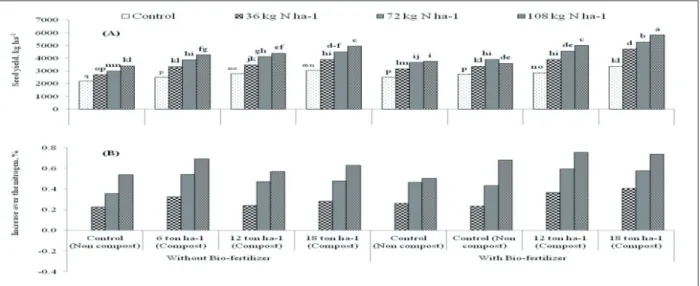
Regarding the combination among chemical fertilizer, organic and bio-fertilizer were positive on seed yield (Figure 1). The highest seed yield was obtained from combined application of bio-fertilizer plus 108 kg N ha-1 adding with 18 ton compost ha-1 has resulted in obtaining highest growth and seed yield. While, Moderate nitrogen (72 kg ha-1) and compost application (12 tha-1) with combining Azotobacter inoculated can be more effective and beneficial to improve seed yield of canola plants. Ram et al. (50) and Mohamed (51) observed the similar results in rice. These results are in a good harmony with those reported by Yadav et al. (52) for wheat.
3.7. Biological Yield
Data presented in (Table. 3) indicated that inoculation of bio-fertilizer had a highly significant effect on biological yield. These results are in harmony with the finding of Ahmed (42) and Farag (43). It seems that bio-fertilizers had the highest effect on economical and biological yield compared to without bio fertilizer (53). The increase in biological yield might be due to the increase in yield
component of canola with bio-fertilizer inoculation and bacteria produce plant growth regulators in N-free media which improved plant growth, Ibiene et al (54).
Application of compost exhibited on biological yield (Table 3).The best value of biological yield were obtained at application of 18 ton compost ha-1 in both seasons. These results are in agreement with by Ram et al. (50). Organic manure plays a very vital role in the process of grain filling, increase leaf area of the crop and may result in increased dry matter production by intercepting more sun light Wu et al. (55).
Increasing nitrogen fertilizer from 36 to 108 kg N ha-1 was highly significant on the increasing biological yield in the two seasons (Table 3). This may be due to the role of nitrogen in increasing the growth parameters and this in turn led to an increase in biological yield. Similar results were obtained by Singh and Singh (33).
3.8. Harvest Index
Adding bio-fertilizer significantly influenced on the harvest index canola in the consecutive two years (Table 3). Brown and Walker (56) supported the results. Brown (57) indicated the beneficial impacts on plant growth of canola. Moreover, its main function is N2 fixation that leads to the improvement of canola yield and yield attributes as reported by Bali et al. (30) in brown sarson, Farag (43) in wheat and Kumar et al. (58) in Brassica species.
The data in (Table 3) showed that compost fertilizer application significantly improved harvest index. Similar results were reported by Sedeek (59). Organic matter
Figure 1: Effects of organic and chemical nitrogen fertilizer with and without bio-fertilizer on seed yield (kg ha-1) (A)
play role in decreasing susceptibility to erosion, lead to an increase in the availability of nutrient and increasing the activity of macro and trace elements and this was reflected in increasing seed yield ha-1 ,these results were obtained by Haikle et al. (46), Maamoun (35) and Abdel-Ati (47).
Nitrogen fertilizer levels had a highly significant influence on harvest index and HI increased with increasing nitrogen levels. The highest value of HI was obtained at the application of 108 kg N ha-1 in both seasons (Table 3). Similar results were reported by Mahal and Singh (48). Increasing the rate of fertilizer application was shown to increase the HI in other studies such as Faramarzi et al. (60), Cheema et al. (61) in the same species.
4. Conclusion
The findings of this study have clearly showed that combined application of bio-fertilizer plus 108 kg N ha-1 adding with 18 ton compost ha-1 has resulted in obtaining highest seed yield. While, bio-fertilizer could be increased the efficiency of nitrogen uptake and its helpful with compost rate (<12 ton compost ha-1) or moderated chemical nitrogen (>72 kg N ha-1). So it could be considered using bio-fertilizer combined with organic and inorganic nitrogen significantly improved the productivity of canola and a suitable substitute from the environmental point of view.
Acknowledgements
Sincere thanks to all staff members in the Department Agronomy, Faculty of Agriculture, Kafr-El Shikh University, Egypt.
References
1. J. Din, S.U. Kans, J. Ali, and A.R. Gurmani, (2011). Physiological and agronomic response of canola varieties to drought stress. J. Animal Plant Sci., 21: 78-82.
2. K.H. Ghallab and A.N. Sharaan, (2002). Selection in canola (Brassica napus L.) germplasm under conditions of newly reclaimed land. II. Salt tolerant selections. Egypt. J. Plant Breed. 6(2):15-30.
3. A.N. Sharaan and K.H. Gallab, (2002). Selection in canola (Brascia napus L.) germplasm under conditions of newly reclaimed land. 1. Variability and genetic parameters in the base lines Egypt J. Plant Breed, 6 (2): 1- 13.
4. E.A. Weiss, (1983). Sesame. In: Oilseed Crops, Longman, London. pp. 282– 340.
5. C.E. Lewis, C.W. Knight, (1987). Yield response of rapeseed to row spacing and rates of seeding and N- fertilization in interior Alaska. Can. J. Plant Sci. 67: 53-57.
6. M.L. Jackson, (1967). Soil chemical Analysis. Printic. Hall of India, p. 144.
7. M. Ahmadi, M.J. Bahrani, (2009). Yield and yield components of rapeseed as influenced by water stress at differentgrowth stages and nitrogen levels. Am-Euras J. Agric. Environ. Sci. 5 (6): 755-761.
8. A.J. Taylor, C.J. Smith, I.B. Wilson, (1991). Effect of irrigation and nitrogen fertilizer on yield, oil content, nitrogen accumulation and water use of canola (Brassica napus L.). Fert. Res. 29: 249-260.
9. A. Salantur, A. Ozturk, S. Akten, F. Sahin, F. Donmez, (2005). Effect of inoculation with non-indigenous and indigenous rhizobacteria of Erzurum (Turkey) origin on growth and yield of spring barley. Plant Soil. 275: 147-156. 10. F.Y. Hafeez,, S. Hameed, A.H. Zaidi, K.A. Malik, (2002).
Biofertilizers for Sustainable Agriculture.In: Techniques for Sustainable Agriculture. F. Azam, M.M. Iqbal, C. Inayatullah and K.A. Malik, (eds.). NIAB, Faisalabad, Pakistan. pp. 67-73.
11. C. Rivero, L. Tchirenje, Q. Ma, G. Martinez, (2004). Influence of compost on soil organic matter quality under tropical conditions. Geoderma. 123: 355-361.
12. A. Cottenie, M. Verloo, L. Kiekens, G. Velghe and R. Camerlynch, (1982). Chemical analysis of plants and soils. Laboratory of Analytical and Agro. Chemistry State University, Ghent. Belgium.
13. A.L. Page, R.H. Miller and D.R. Keeney, (1982). Method of soil Analysis- part 2. Amer. Sco. Agric. Inc. Madison. 14. S. Yoshida, (1981). Fundamentals of rice crop science. IRRI,
Lose Banos, Philippines.
15. K.A. Gomez and A.A. Gomez, (1984). Statistical Procedures for Agricultural Research, 2nd Ed. Johwiley and Sons, Inc. New York.
16. B.D. Duncan, (1955). Multiple Range and Multiple F. Test. Biometrics, II: 1- 42.
17. E. Yasari, and A.M. Patwardhan, (2007). Effects of aztobacter and azospirillium inoculations and chemical fertilizers on growth and productivity of canola. Asian J. Plant. Sci., 6(1):77-82.
18. B. Karthikeyan, C.A. Jaleel, C.X. Zhao, M.M. Joe, J. Srimannarayan and M. Deiveekasundaram, (2008a). The effect of AM fungi and phosphorus levels enhances the biomass yield and ajmalicine production in Catharanthus roseus. Eur. Asia J. Biosci. 2: 26-33.
19. B. Karthikeyan, C.A. Jaleel, G.M. Lakshmanan and M. Deiveekasundaram, (2008b). Studies on rhizosphere microbial diversity of some commercially important medicinal plants. Colloids Surf. B. Biointerf, 62: 143–145. 20. O.P. Premi, A. Kumar, M. Kumar and B.S. Sinsinwar, (2004).
Effect of organics on Indian mustard (Brassica Juncea (L.) Czern & Coss). J. Oils Seeds Res. 21(1): 180.??
21. O.P. Premi, R.S. Sinsinwar, M. Kumar and A. Kumar, (2005). Influence of organics and inorganics on yield and quality of Indian mustard, (Brassica Juncea (L.) Czern & Coss) in semi-arid region. Rajastan J. Oil Seeds. Res. 22(1): 45- 46.
22. A.E. Sharief and M.M. Keshta, (2000). Response of some canola cultivars (Brassica napus, L.) to different sources and levels of nitrogen fertelizer in soil affected by salinity. Zagazig J. Agric. Res. 27(3): 603-616.
23. A.A. Leilah, S.A. Al Khateeb, S.S. Al- Thabet and K.M. Al-Barrak, (2003). Influence of sowing dates and nitrogen fertilizer on growth and yield of canola. Zagazig J. Agric. Res., 30(3): 591- 605.
24. G.S. Buttar, H.S. Thind, M.S. Aujla, (2006). Methods of planting and irrigation at various levels of nitrogen affect the seed yield and water use efficiency in transplanted oilseed rape (Brassica napus L.). Agric. Water Mangt 85: 253- 260.
25. H. Ozer, (2003). Sowing date and nitrogen rate effects on growth, yield and yield components of two summer rapeseed cultivars. Europ. J. Agron. 19: 453-463.
26. A.K. Gupta and R.K. Samnotra, (2004). Effect of biofertilizers and nitrogen on growth, quality and yield of cabbage (Brassica napus). Environ. Ecol. 22: 551-553. 27. E. Yasari, E.A.M. Azadgoleh, H. Pirdashti and S. Mozafari,
(2008). Azotobacter and azospirllum inoculants as biofertilizers in canola (Brassica napus L.) cultivation. Asian J. Plant Sci., 7(5): 490-494.
28. E. Yasari, M.A.E.Azadgoleh, S. Mozafari and M.R. Alashti, (2009). Enhancement of growth and nutrient uptake of rapeseed (Brassica napus L.) by applying mineral nutrients and biofertilizers. Pak. J. Biol. Sci., 12(2): 127-133.
29. B. Eghball, (2000). Nitrogen mineralization from field-applied beef Nelson, cattle feedlot manure or compost. Soil. Sci. Soc. Am. J. 64: 2024-2030.
30. A.S. Bali, M.H. Shah, A.S. Bali and H. Badrul, (2000). Effect of plant density on brown sarson (Brassica campestris subsp oleifera var. brown sarson) under different levels of nitrogen and phosphorus. Indian J. Agron., 45(1): 174- 178.
31. K.A. Taha, (2001a). Effect of nitrogen and phosphorus fertilizer on growth, yield and quality of canola crop (Brassica. napus). An M. Sc. thesis, Fac. Agric., Asyoot Univ. where?
32. M.A. Taha, (2001b). Response of some oilseed rape (B. napus L.) genotypes to different levels of nitrogen fertilizer and salnity. An M.Sc. thesis, Fac. Agric; Cairo Univ. Egypt. 33. S.K. Singh and G. Singh, (2002). Response of Indian mustard
(Brassica Juncea) varieties to nitrogen under varying sowing dates in eastern Utter Pradesh. Indian J. Agron., 47(2): 242-248.
34. R. Sushila and G. Giri, (2000). Influence of farmyard manure, yield attributes and yield of wheat (Triticum aestivum L.) under limited water supply. Indian J. Agron., 45(3): 590-595.
35. H.A. Maamoun, (2004) Effect of biogass manure on two Brassica compestris (L.) varieties under saline stress condition. J. Agric. Sci. Mansoura Univ., 29(12): 6741- 6752. 36. C.A. Edwards,, J. Dominguez and N.Q. Arancon, (2004).
The influence of vermi composts on plant growth and pest incidence. In: Zoology for Sustainable Development in the 21st century. pp: 12-24.
37. E.J. Momoh, W.J. Song, H.Z. Li and W.J. Zhou, (2004). Seed yield and quality responses of winter oil seed rape (Brassica napus) to plant density and nitrogen fertilization. Indian. J. Agril. Sci. 74(8): 420- 424.
38. A. Hamidi, A. Asgharzadeh, R. Choukan, S.M. Dehghan, A. Ghalavand, M.J. Malakouti, (2007). Study on plant growth promoting rhizobacteria (PGPR) biofertilizers application in maize (Zea mays L.) cultivation by adequate input. Environ. Sci., 4(4):1-19.
39. E.J. Allen, D.G. Morgan, (1972) A quantitative analysis of the effects of nitrogen on the growth, development and yield of oilseed rape. J. Agri.. Sci. 78: 315-324.
40. A.A.E. Mohamed, (2003). Response of sunflower to phosphorine and cerealin inoculation under low NP- fertilizer levels. J. Agric. Res. Tanta Univ., 29 (2): 236- 249. 41. K.P. Nagavallemma, S.P. Wani, S. Lacroix, V.V. Padmaja, C.
Babu, M. Rao, K.L. Sahrawat, (2004). Vermicomposting: Recycling wastes into valuable organic fertilizer, Global Theme on Agrecosystems. In: International Crops Research Institute for the Semi-Arid Tropics. Report no. 8., Patancheru 502-324, Andhra Pradesh, India p. 20
42. M.K.A. Ahmed, (2001). Effect of biofertilizers and sulfur on yield of two barley cultivars grown in newly reclaimed sandy soils. J. Agric. Sci. Mansoura Univ., 26(5): 2611- 2615. 43. A.M.H. Farag, (2003). Response of wheat plants to some treatments of soil leveling and fertilization wheat with both nitrogen and biological fertilizers. A Ph.D. thesis, Fac. Agric. Mansoura Univ., Egypt.
44. S. Subbiah and K. Kumaraswamy, (2000). Effect of different manure fertiliser schedules on the yield and quality of rice and on soil fertility. Fertiliser News, 45: 10:61-62.
45. A.A. Leilah, S.A. Khateeb, A.A. Naiem and S.S. Al-Thabet, (2002). Response of some canola (Brassica napus,L.) cultivars to drought. Agricultural and Water Resources Development Symposium in the Reign of the two Holy Mosques King Fahad Bin AbdulAziz-God Protect Him, 14 - 16 D. Qadah, 1422H (28 - 30 Jan., 2002 G).
46. M.A. Haikel, M.A.H. Samira and A.M. El-Melegy, (2000). Effect of organic and mineral nitrogen on maize and its residual effect on wheat as a successive crop in sand soil under new irrigation systems. J. Agric. Sci. Mansoura Univ., 25(7): 3803- 3816.
47. A.A. Abdel-Ati, (2006). Sowing method of Canola under different levels of organic and mineral fertilization in calcareous soils. J. Agric. Sci. Mansoura Univ., 31(4): 1861-1873.
48. S.S. Mahal and K.S. Singh, (2000): Response of hybrid gobhisarason (Brassica napus L.) to different levels of irrigation and nitrogen. Environ. . Ecol., 18(3): 722- 725. 49. M.H. El-Kholy, (2004). Physiological and chemical studies
on some rape seed varietes grown under different levels of nitrogen fertilization. Egypt. J. Biotechnol. 17(7): 486- 498. 50. S. Ram, R.P.S. Chauhan, B.B. Singh and V.P. Singh, (2000).
Integrated use of organic and fertilizer nitrogen in rice (Oryza sativa) under partially reclaimed sodic soil. Indian J. . Agril. Sci., 70(2): 114- 116.
51. A.A.A. Mohamed, (2001). Response of rice to Bio, organic and mineral fertilizers and its combinations under two irrigation intervals., An M. Sc. thesis, Fac. Agric., Tanta Univ., Egypt.
52. J. Yadav, S. Yadav and S.G. Singh, (2011). Plant growth promotion in wheat crop under environmental condition by PSB as bio-fertilizer. Res. J. . Agril. Sci. 2(1): 76-78. 53. S. Mubassara, U.M. Zahed, R.M. Motiur, F.K. Patwary and
M.A. Akond, (2008). Seed inoculation effect of Azospirillum spp. on growth, biomass and yield parameter of wheat. Acad. J. Plant Sci. 1 (4): 56-61.
54. A.A. Ibiene, J.U. Agogbua, I.O. Okonko and G.N. Nwachi, (2012). Plant growth promoting rhizobacteria (PGPR) as biofertilizer: Effect on growth of Lycopersicum esculentus. J. Am. Sci. 8: 318-324.
55. S.C. Wu, Z.H. Cao, Z.G. Li, K.C. Cheung and M.H. Wong, (2005). Effects of biofertilizer containing N-fixer, P and K solubilizers and AM fungi on maize growth: a greenhouse trial. Geoderma. 125: 155-166.
56. M.E. Brown and N. Walker, (1970). Indolyl-3-acetic formation by Azotobacter chroococcum. Plant Soil. 32: 250-253.
57. M.E. Brown, (1974). Seed and roots bacterization. Ann. Rev. Phytopathol. 12: 181- 197.
58. R. Kumar, D. Singh and H. Singh, (2002). Effect of nitrogen and sowing dates on productivity of Brassica species. Indian J. Agron. 47(3): 411- 417.
59. S.E.M. Sedeek, (2001). Studies of morphological and agronomical characteristics of some early varieties and lines of rice. An M. Sc. thesis, Fac. Agric., Kafr El-Sheikh, Tanta? Univ., Egypt.
60. A. Faramarzi, A. Barzegar, H.H. Zolleh, H. Mohammadi, M.R. Ardakani, G. Normohammadi, (2009). Response of canola (Brassics napus) cultivars to rate and split application of nitrogen fertilizer. Aust. J. Basic Appl. Sci. 3(3): 2030-2037.
61. M.A. Cheema, M.A. Malik, A. Hussain, S.H. Shah, S.M.A. Basra, (2001). Effects of time and rate of nitrogen and phosphorus application on the growth and the seed and oil yields of canola (Brassica napus L.). J. Agron. Crop Sci. 186(2): 103-110.