JHEP01(2011)069
Published for SISSA by SpringerReceived: November 8, 2010 Revised: December 14, 2010 Accepted: December 20, 2010 Published: January 18, 2011
Double-lepton polarization asymmetries and branching
ratio in B → K
∗0
(1430)l
+l
−transition from universal
extra dimension model
B.B. S¸irvanlı,a K. Azizi,b and Y. Ipeko˘gluc
aDepartment of Physics, Faculty of Arts and Science, Gazi University,
Teknikokullar, 06100 Ankara, Turkey
bPhysics Division, Faculty of Arts and Sciences, Do˘gu¸s University, Acıbadem-Kadık¨oy,
34722 Istanbul, Turkey
cPhysics Department, Middle East Technical University,
Cankaya, 06531 Ankara, Turkey
E-mail: [email protected],[email protected],[email protected]
Abstract: We investigate the B → K∗
0(1430)l +
l− transition in the Applequist-Cheng-Dobrescu model in the presence of a universal extra dimension. In particular, we calculate double lepton polarization asymmetries and branching ratio related to this channel and compare the obtained results with the predictions of the standard model. Our analysis of the considered observables in terms of radius R of the compactified extra-dimension as the new parameter of the model show a considerable discrepancy between the predictions of two models in low R1 values.
Keywords: Rare Decays, Beyond Standard Model, B-Physics
JHEP01(2011)069
Contents1 Introduction 1
2 Branching ratio and double lepton polarization asymmetries in B → K∗ 0l +l− transition 2 3 Numerical results 5 4 Conclusion 10 1 Introduction The B → K∗
0(1430)l+l− transition proceeds via flavor changing neutral current (FCNC)
transition of b → sl+l− at loop level. Such transition can be used in constraining the standard model (SM) parameters as well as gaining useful information about new physics effects such as extra dimensions, fourth generation of the quarks, supersymmetric particles and light dark matter , etc. The SM of particle physics can explain almost all known collider data and is in perfect agreement with the experiments so far. However, there are some problems such as, the origin of the matter in the universe, gauge and fermion mass hierarchy, number of generations, matter- antimatter asymmetry, unification, quantum gravity and so on, which can not explained by the SM. Hence, the SM can be thought to be a low energy manifestation of some underlying more fundamental theory or, to solve the aforementioned problems, some alternative theories are needed.
The extra dimension (ED) model with a flat metric [1–4] or with small compactification radius is one of the alternative theories. The ED is categorized as universal extra dimension (UED), where the SM fields containing gauge bosons and fermions can propagate in the extra dimensions and non-universal extra dimension (NUED), where the gauge bosons propagate into the extra dimensions, but the fermions are confined to the usual three spatial dimensions (D3 brane). The simplest example of the UED where just a single universal
extra dimension is taken into account is called the Appelquist, Cheng and Dobrescu (ACD) model [5]. Compared to the SM, this model has one extra parameter called compactification radius, R. Hence, this model is a minimal extension of the SM in 4 + 1 dimensions with the extra dimension compactified to the orbifold S1/Z
2 and the fifth coordinate, y running
between 0 and 2πR, and y = 0 and y = πR are fixed points of the orbifold. The zero modes of fields propagating in the extra dimension correspond the SM particles. The higher modes with momentum propagating in the extra dimension are called Kaluza-Klein (KK) modes. The mass of KK particles and interactions among them and also their interactions with the SM particles are explained in terms of the compactification scale, 1/R. One of the important properties of the ACD model is conservation of the KK parity, (−1)KK number
JHEP01(2011)069
(for details about the method see also [6–9]). Such conservation entails the absence of tree level contributions of KK mods to processes occur at low energies, µ ≪ R1, requiring the
production of a single KK particle from the interaction of th SM particles. This allows us to use accurate electroweak measurements to supply a lower bound to the compactification scale, R1 ≥ (250 − 300) GeV [9,10]. As these excitations can affect the loop level processes, especially FCNC transitions, investigation of B → K∗
0(1430)l+l−channel in the framework
of the ACD model can be useful for constraining the parameters related to this new physics scenario.
The ACD model has been applied widely to calculate many observables related to the radiative and semileptonic decays of hadrons (for some of them see for example [6–9,11–14]. In the present work, we calculate double lepton polarization asymmetries and branching ratio related to the rare semileptonic B → K∗
0(1430)l
+l− transition in terms of radius R
of the compactified extra-dimension as the new parameter of the model in the framework of the ACD model. We compare the obtained results with the predictions of the standard model. The outline of the paper is as follows. In section 2, we introduce the effective Hamiltonian responsible for the b → sl+l− transition. Using the effective Hamiltonian,
we obtain the branching ratio as well as the various related double lepton polarization asymmetries in terms of form factors also in this section. Using the fit parametrization of the form factors obtained using QCD sum rules, we numerically analyze the considered observables in section 3. This section also includes a comparison of the results obtained in ACD model with that of predicted by the SM and our discussions.
2 Branching ratio and double lepton polarization asymmetries in B → K∗
0l
+l− transition
At quark level, the B → K∗
0l+l−transition proceed via FCNC transition of the b → sl+l−.
The effective Hamiltonian responsible for this transition at quark level can be written as:
Heff = GFαemVtbV ∗ ts 2√2π " C9effsγ¯ µ(1 − γ5)b ¯ℓγµℓ + C10sγ¯ µ(1 − γ5)b ¯ℓγµγ5ℓ − 2mbC7eff 1 q2siσ¯ µνq ν(1 + γ 5)b ¯ℓγµℓ # , (2.1)
where GF is the Fermi constant, αem is the fine structure constant at Z mass scale, Vij are
elements of the Cabibbo-Kobayashi-Maskawa (CKM) matrix and Ceff
7 , C
eff
9 and C10are the
Wilson coefficients, which are the main source of the deviation of the ACD and SM models predictions on the considered observables. The Wilson coefficients can be expressed in terms of the periodic functions, F (xt, 1/R) with xt= m2t/MW2 and mtbeing the top quark
mass. Similar to the mass of the KK particles described in terms of the zero modes (n = 0) correspond to the ordinary particles of the SM and extra parts coming from the ACD model, the functions, F (xt, 1/R) are also written in terms of the corresponding SM functions,
JHEP01(2011)069
fi(0) ai bi
f+ 0.31 ± 0.08 0.81 −0.21
f− −0.31 ± 0.07 0.80 −0.36
fT −0.26 ± 0.07 0.41 −0.32
Table 1. Parameters entering the fit parametrization of the form factors for B →K∗ 0ℓ
+
ℓ−transition.
F0(xt) and extra parts which are functions of the compactification factor, 1/R, i.e.,
F (xt, 1/R) = F0(xt) + ∞ X n=1 Fn(xt, xn), (2.2) where xn= m2 n M2 W and mn = n
R. The Glashow-Illiopoulos-Maiani (GIM) mechanism guar-antees the finiteness of the functions, F (xt, 1/R) and satisfies the condition, F (xt, 1/R) →
F0(xt), when R → 0. As far as 1/R is taken in the order of a few hundreds of GeV , these
functions and as a result, the Wilson coefficients differ considerably from the SM values. For explicit expressions of the Wilson coefficients in ACD model see [6,7,9].
To obtain the amplitude for the B → K0∗l +
l− transition, we need to sandwich the effective Hamiltonian between the initial and final states. As a result of this procedure, the matrix elements, hK∗
0|¯sγµ(1 − γ5)b| Bi and hK0∗|¯siσµνqµ(1 + γ5)b| Bi are obtained which
should be calculated in terms of some form factors. Due to the parity considerations, the vector (sγµb) and tensor (siσµνqνb) parts of the transition current have no contributions.
The matrix elements related to the axial-vector and pseudo-tensor parts of the transition currents are parameterized in terms of the form factors, f+, f−, and fT in the following way:
K∗ 0(p′) |¯sγµγ5b| B(p) = f+(q2)Pµ+ f−(q2)qµ (2.3) K∗ 0(p′) |¯siσµνqµγ5b| B(p) = fT(q2) mB+ mK∗ 0 [Pµq2− (m2B− m 2 K∗ 0)qµ] (2.4)
where P = p + p′ and q = p − p′. These form factors have been calculated in [16] in the
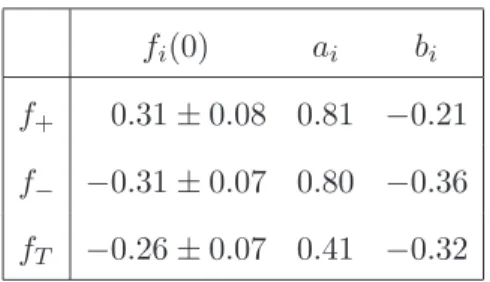
framework of the three-point QCD sum rules. The fit parametrization of the form factors is given as: fi(ˆs) = fi(0) 1 − ais + bˆ isˆ2 , (2.5) where i = +, − or T and ˆs = q2/m2
B. The values of the parameters fi(0), ai and bi are
given in table 1.
Now, we proceed to calculate the differential decay rate for the considered transition. Using the amplitude and definition of the transition matrix elements in terms of the form
JHEP01(2011)069
factors, we get the following expression for the 1/R-dependent differential decay rate:
dΓ dˆs(ˆs, 1/R) = G2α2 emm5B 3072π5 |VtbV ∗ ts| 2 vqλ(1, ˆm2 K∗ 0, ˆs) (" C eff 9 (ˆs, 1/R)f+(ˆs)+ + 2 ˆmb 1 + ˆmK∗ 0 C7eff(1/R)fT(ˆs) 2 + |C10(1/R)f+(ˆs)|2 # (3 − v2)λ(1, ˆm2K∗ 0, ˆs) + (2.6) +12 ˆm2ℓh(2+2 ˆm2K∗ 0−ˆs)|f+(ˆs)| 2 +2(1− ˆm2K∗ 0)Re[f+(ˆs)f ∗ −(ˆs)]+ ˆs |f−(ˆs)|2 i |C10(1/R)|2 ) , where, v = q 1 −4 ˆm 2 ℓ ˆ s , ˆmb = mb mB, ˆmℓ = mℓ mB, ˆmK0∗ = mK∗ 0 mB and λ(a, b, c) = a 2+ b2+ c2 − 2ab − 2ac − 2bc is the usual triangle function. Integrating out the above equation in the allowed physical region of the ˆs (4 ˆm2
ℓ ≤ ˆs ≤ (1 − ˆmK∗ 0)
2), one can get the 1/R-dependent
total decay rate and branching ratio.
At the end of this section, we focus our attention to obtain the double-lepton po-larization asymmetries. We calculate these asymmetries when popo-larizations of both lep-tons simultaneously are considered. Using the definitions of the double-lepton polarization asymmetries expressed in [17–19], we obtain the 1/R-dependent polarizations,
PLL(ˆs, 1/R) = −4m 2 B 3∆(ˆs, 1/R)Re[−24m 2 Bmˆ 2 l(1 − ˆrK∗ 0)C ∗D + λm2 B(1 + v 2 )|A|2 (2.7) − 12m2Bmˆ 2 ls|D|ˆ 2 + m2B|C| 2 (2λ − (1 − v2)(2λ + 3(1 − ˆrK∗ 0) 2 ))], (2.8) PLN(ˆs, 1/R) = −4πm 3 B √ λˆs ˆ s∆(ˆs, 1/R) Im[−mBmˆlsAˆ ∗ D − mBmˆl(1 − ˆrK∗ 0)A ∗C], (2.9) PN L(ˆs, 1/R) = −PLN(ˆs, 1/R), (2.10) PLT(ˆs, 1/R) = 4πm3 B √ λˆs ˆ s∆(ˆs, 1/R)Re[mBmˆlv(1 − ˆrK0∗)|C| 2+ m BmˆlvˆsC∗D], (2.11) PT L(ˆs, 1/R) = PLT(ˆs, 1/R), (2.12) PN T(ˆs, 1/R) = − 8m2 Bv 3∆(ˆs, 1/R)Im[2λm 2 BA∗C], (2.13) PT N(ˆs, 1/R) = −PN T(ˆs, 1/R), (2.14) PT T(ˆs, 1/R) = 4m2 B 3∆(ˆs, 1/R)Re[−24m 2 Bmˆ2l(1 − ˆrK∗ 0)C ∗ D − λm2B(1 + v2)|A|2− 12m2Bmˆ2lˆs|D| 2 + m2B|C|2{2λ − (1 − v2)(2λ + 3(1 − ˆrK∗ 0) 2 )}], (2.15) PN N(ˆs, 1/R) = 4m2 B 3∆(ˆs, 1/R)Re[24m 2 Bmˆ 2 l(1 − ˆrK∗ 0)C ∗ D − λm2B(3 − v 2 )|A|2+ 12m2Bmˆ2ls|D|ˆ 2 + m2B|C|2{2λ − (1 − v2)(2λ − 3(1 − ˆrK∗ 0) 2 )}] (2.16)
re-JHEP01(2011)069
200 400 600 800 1000 1R@GeVD 1.6 1.8 2 2.2 2.4 2.6 2.8 3 10 7´ BR H B -> K0 *e +e -L UED SM 200 400 600 800 1000 1R@GeVD 1.6 1.8 2 2.2 2.4 2.6 2.8 3 10 7´ BR H B -> K0 *Μ +Μ -L UED SM 200 400 600 800 1000 1R@GeVD 1.6 1.8 2 2.2 2.4 2.6 2.8 3 10 9´ BR H B -> K0 *Τ +Τ -L UED SMFigure 1. The dependence of the branching ratio for B → K0l∗+l−on the compactification factor, 1/R for different leptons.
spectively, ˆrK∗ 0 = ˆm 2 K∗ 0, λ = λ(1, ˆrK ∗ 0, ˆs) and ∆(ˆs, 1/R) = 4m 2 B 3 Re[24m 2 Bmˆ 2 l(1 − ˆrK∗ 0)D ∗ C + λm2B(3 − v 2 )|A|2+ 12m2Bmˆ 2 lˆs|D| 2 + m2B|C|2{2λ − (1 − v2)(2λ − 3(1 − ˆrK∗ 0) 2 )}] A = A(ˆs, 1/R) = 2C9eff(ˆs, 1/R)f+(ˆs) − 4C7eff(1/R)(mb+ ms)
fT(ˆs) mB+ mK∗ 0 , B = B(ˆs, 1/R) = 2C9eff(ˆs, 1/R)f−(ˆs)+4C7eff(1/R)(mb+ms) fT(ˆs) (mB+mK∗ 0)ˆsm 2 B (m2B−m2K∗ 0), C = C(ˆs, 1/R) = 2C10(1/R)f+(ˆs), D = D(ˆs, 1/R) = 2C10(1/R)f−(ˆs) . (2.17) 3 Numerical results
In this section, we numerically analyze the expressions of the branching ratio and double-lepton polarization asymmetries and discuss their dependence and sensitivity on the com-pactification factor, 1/R. Some input parameters of the SM used in the numerical analysis are: mt = 167 GeV , mW = 80.4 GeV , mZ = 91.18 GeV , mc = 1.46 GeV , mb = 4.8 GeV ,
mu = 0.005 GeV , mB = 5.28 GeV , mK∗
0 = 1.425 GeV , sin
2θ
W = 0.23, αem = 1371 ,
αs(mZ) = 0.118, |VtbVts∗| = 0.041, GF = 1.167 × 10⁻⁵ GeV−2, me = 5.1 × 10⁻⁴ GeV ,
mµ= 0.109 GeV , mτ = 1.784 GeV , and τB = 1.525 × 10⁻¹²s. As we previously mentioned,
the branching ratio is obtained integrating the differential decay rate over ˆs in the physical region of the square of the momentum transfered, q2, hence the obtained expression for the
branching ration only depends on the compactification factor. In figure 1, we present the dependence branching ratio of the B → K∗
0l+l− transition on compactification parameter,
1/R in the interval, 200 GeV ≤ 1/R ≤ 1000 GeV for different leptons. From this figure, we deduce the following results:
• There are considerable discrepancies between the predictions of the ACD and SM models for low values of the compactification factor, 1/R. As 1/R increases, the difference between the predictions of the two models tends to diminish. The result of ACD approaches the result of SM for higher values of 1/R (1/R ≃ 1000 GeV ). Such a discrepancy at low values of 1/R can be a signal for the existence of extra dimensions.
JHEP01(2011)069
200 400 600 800 1000 1RHGeVL -1 -1 -0.999999 -0.999999 -0.999999 -0.999999 -0.999999 PLL H B ® K0 *e +e -L SMHs` =0.2L SMHs`=0.5L UEDHs`=0.2L UEDHs`=0.5L 200 400 600 800 1000 1RHGeVL -0.98 -0.978 -0.976 -0.974 PLL H B ® K0 *Μ +Μ -L SMHs`=0.2L SMHs`=0.5L UEDHs` =0.2L UEDHs`=0.5L 200 400 600 800 1000 1RHGeVL 0.6 0.65 0.7 0.75 PLL H B ® K0 *Τ +Τ -L SMHs` =0.45L SMHs`=0.5L UEDHs` =0.45L UEDHs`=0.5LFigure 2. The dependence of the PLL polarization in two models for B → K0l∗+l− on the compactification factor, 1/R at different fixed values of ˆs and different leptons.
200 400 600 800 1000 1RHGeVL 0 0.00002 0.00004 0.00006 PLN H B ® K0 *e +e -L SMHs`=0.2L SMHs`=0.5L UEDHs`=0.2L UEDHs` =0.5L 200 400 600 800 1000 1RHGeVL 0 0.0025 0.005 0.0075 0.01 0.0125 0.015 PLN H B ® K0 *Μ +Μ -L SMHs`=0.2L SMHs`=0.5L UEDHs`=0.2L UEDHs`=0.5L 200 400 600 800 1000 1RHGeVL 0.06 0.062 0.064 0.066 0.068 0.07 0.072 PLN H B ® K0 *Τ +Τ -L SMHs`=0.45L SMHs`=0.5L UEDHs`=0.45L UEDHs` =0.5L
Figure 3. The same as figure2, but for PLN polarization.
200 400 600 800 1000 1RHGeVL 0.0006 0.00065 0.0007 0.00075 0.0008 PLT H B ® K0 *e +e -L SMHs`=0.2L SMHs`=0.5L UEDHs`=0.2L UEDHs`=0.5L 200 400 600 800 1000 1RHGeVL 0.12 0.13 0.14 0.15 0.16 PLT H B ® K0 *Μ +Μ -L SMHs`=0.2L SMHs`=0.5L UEDHs`=0.2L UEDHs`=0.5L 200 400 600 800 1000 1RHGeVL 0 0.05 0.1 0.15 0.2 PLT H B ® K0 *Τ +Τ -L SMHs`=0.45L SMHs`=0.5L UEDHs` =0.45L UEDHs`=0.5L
Figure 4. The same as figure2, but for PLT polarization.
200 400 600 800 1000 1RHGeVL -0.1 -0.08 -0.06 -0.04 -0.02 0 PNT H B ® K0 *e +e -L SMHs` =0.2L SMHs`=0.5L UEDHs`=0.2L UEDHs` =0.5L 200 400 600 800 1000 1RHGeVL -0.1 -0.08 -0.06 -0.04 -0.02 0 PNT H B ® K0 *Μ +Μ -L SMHs`=0.2L SMHs` =0.5L UEDHs`=0.2L UEDHs`=0.5L 200 400 600 800 1000 1RHGeVL -0.008 -0.007 -0.006 -0.005 -0.004 -0.003 PNT H B ® K0 *Τ +Τ -L SMHs`=0.45L SMHs`=0.5L UEDHs`=0.45L UEDHs`=0.5L
Figure 5. The same as figure2, but for PN T polarization.
• As it is expected, an increase in the lepton mass results in a decrease in the branching ratio. The branching ratios for the e and µ are approximately the same.
• The order of magnitude of the branching ratio, specially for the e and µ, depicts a possibility to study such channels at the LHC.
Now, we proceed to show the results of the double-lepton polarization asymmetries. As it is clear from their explicit expressions, they depend on both the compactification factor, 1/R and the ˆs. The dependence of different polarization asymmetries on the compactification
JHEP01(2011)069
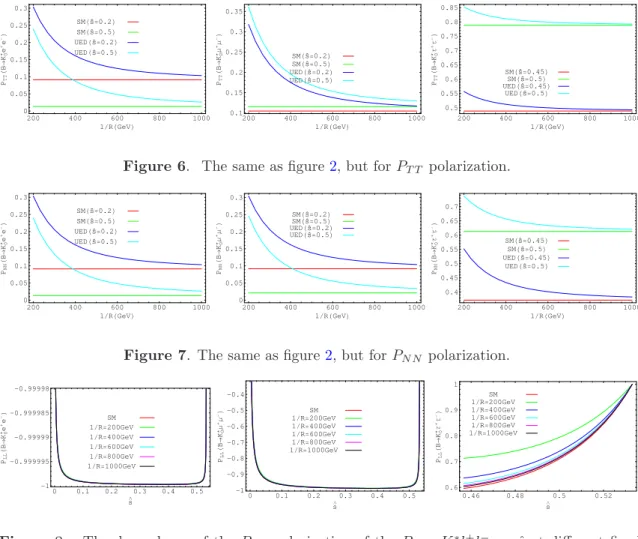
200 400 600 800 1000 1RHGeVL 0 0.05 0.1 0.15 0.2 0.25 0.3 PTT H B ® K0 *e +e -L SMHs`=0.2L SMHs` =0.5L UEDHs`=0.2L UEDHs`=0.5L 200 400 600 800 1000 1RHGeVL 0.1 0.15 0.2 0.25 0.3 0.35 PTT H B ® K0 *Μ +Μ -L SMHs`=0.2L SMHs` =0.5L UEDHs` =0.2L UEDHs`=0.5L 200 400 600 800 1000 1RHGeVL 0.5 0.55 0.6 0.65 0.7 0.75 0.8 0.85 PTT H B ® K0 *Τ +Τ -L SMHs`=0.45L SMHs` =0.5L UEDHs` =0.45L UEDHs`=0.5LFigure 6. The same as figure2, but for PT T polarization.
200 400 600 800 1000 1RHGeVL 0 0.05 0.1 0.15 0.2 0.25 0.3 PNN H B ® K0 *e +e -L SMHs`=0.2L SMHs` =0.5L UEDHs`=0.2L UEDHs`=0.5L 200 400 600 800 1000 1RHGeVL 0 0.05 0.1 0.15 0.2 0.25 0.3 PNN H B ® K0 *Μ +Μ -L SMHs`=0.2L SMHs`=0.5L UEDHs` =0.2L UEDHs` =0.5L 200 400 600 800 1000 1RHGeVL 0.4 0.45 0.5 0.55 0.6 0.65 0.7 PNN H B ® K0 *Τ +Τ -L SMHs`=0.45L SMHs`=0.5L UEDHs`=0.45L UEDHs`=0.5L
Figure 7. The same as figure2, but for PN N polarization.
0 0.1 0.2 0.3 0.4 0.5 sß -1 -0.999995 -0.99999 -0.999985 -0.99998 PLL H B ® K0 *e +e -L SM 1R=200GeV 1R=400GeV 1R=600GeV 1R=800GeV 1R=1000GeV 0 0.1 0.2 0.3 0.4 0.5 sß -1 -0.9 -0.8 -0.7 -0.6 -0.5 -0.4 PLL H B ® K0 *Μ +Μ -L SM 1R=200GeV 1R=400GeV 1R=600GeV 1R=800GeV 1R=1000GeV 0.46 0.48 0.5 0.52 s ß 0.6 0.7 0.8 0.9 1 PLL H B ® K0 *Τ +Τ -L SM 1R=200GeV 1R=400GeV 1R=600GeV 1R=800GeV 1R=1000GeV
Figure 8. The dependence of the PLL polarization of the B → K∗ 0l
+l− on ˆs at different fixed values of 1/R and the SM for different leptons.
factor, 1/R at different fixed values of ˆs and different leptons are shown in figures2–7. A quick glance at these figures leads to the following conclusions:
• As it is expected, all polarization asymmetries lie between −1 and 1. There are also discrepancies between the predictions of two models for small 1/R values, except the PLL, PLN and PN T for e and µ cases for which the differences between the ACD and
SM models are very small. At high values of 1/R, two models have approximately the same predictions.
• All double-lepton polarization asymmetries have the same sign for all leptons, except the PLLat which the sign for the τ mode is different than those for the e and µ cases.
• In contrast with the branching ratios, some of the polarization asymmetry predictions are different for the e and µ cases.
• In PN N for e and µ and PT T for e, the SM gives zero for ˆs = 0.5, while we see
JHEP01(2011)069
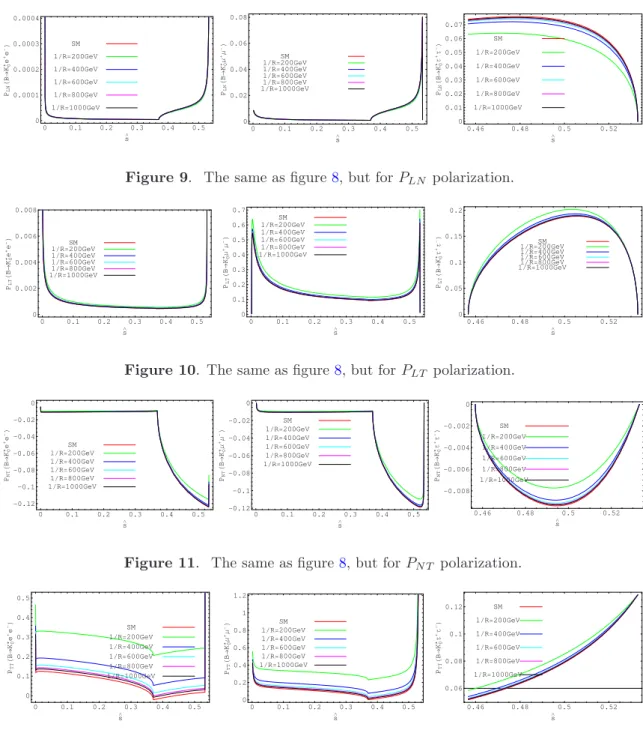
0 0.1 0.2 0.3 0.4 0.5 sß 0 0.0001 0.0002 0.0003 0.0004 PLN H B ® K0 *e +e -L SM 1R=200GeV 1R=400GeV 1R=600GeV 1R=800GeV 1R=1000GeV 0 0.1 0.2 0.3 0.4 0.5 sß 0 0.02 0.04 0.06 0.08 PLN H B ® K0 *Μ +Μ -L SM 1R=200GeV 1R=400GeV 1R=600GeV 1R=800GeV 1R=1000GeV 0.46 0.48 0.5 0.52 sß 0 0.01 0.02 0.03 0.04 0.05 0.06 0.07 PLN H B ® K0 *Τ +Τ -L SM 1R=200GeV 1R=400GeV 1R=600GeV 1R=800GeV 1R=1000GeVFigure 9. The same as figure8, but for PLN polarization.
0 0.1 0.2 0.3 0.4 0.5 s ß 0 0.002 0.004 0.006 0.008 PLT H B ® K0 *e +e -L SM 1R=200GeV 1R=400GeV 1R=600GeV 1R=800GeV 1R=1000GeV 0 0.1 0.2 0.3 0.4 0.5 sß 0 0.1 0.2 0.3 0.4 0.5 0.6 0.7 PLT H B ® K0 *Μ +Μ -L SM 1R=200GeV 1R=400GeV 1R=600GeV 1R=800GeV 1R=1000GeV 0.46 0.48 0.5 0.52 sß 0 0.05 0.1 0.15 0.2 PLT H B ® K0 *Τ +Τ -L SM 1R=200GeV 1R=400GeV 1R=600GeV 1R=800GeV 1R=1000GeV
Figure 10. The same as figure8, but for PLT polarization.
0 0.1 0.2 0.3 0.4 0.5 s ß -0.12 -0.1 -0.08 -0.06 -0.04 -0.02 0 PNT H B ® K0 *e +e -L SM 1R=200GeV 1R=400GeV 1R=600GeV 1R=800GeV 1R=1000GeV 0 0.1 0.2 0.3 0.4 0.5 sß -0.12 -0.1 -0.08 -0.06 -0.04 -0.02 0 PNT H B ® K0 *Μ +Μ -L SM 1R=200GeV 1R=400GeV 1R=600GeV 1R=800GeV 1R=1000GeV 0.46 0.48 0.5 0.52 sß -0.008 -0.006 -0.004 -0.002 0 PNT H B ® K0 *Τ +Τ -L SM 1R=200GeV 1R=400GeV 1R=600GeV 1R=800GeV 1R=1000GeV
Figure 11. The same as figure8, but for PN T polarization.
0 0.1 0.2 0.3 0.4 0.5 sß 0 0.1 0.2 0.3 0.4 0.5 PTT H B ® K0 *e +e -L SM 1R=200GeV 1R=400GeV 1R=600GeV 1R=800GeV 1R=1000GeV 0 0.1 0.2 0.3 0.4 0.5 sß 0 0.2 0.4 0.6 0.8 1 1.2 PTT H B ® K0 *Μ +Μ -L SM 1R=200GeV 1R=400GeV 1R=600GeV 1R=800GeV 1R=1000GeV 0.46 0.48 0.5 0.52 sß 0.06 0.08 0.1 0.12 PTT H B ® K0 *Τ +Τ -L SM 1R=200GeV 1R=400GeV 1R=600GeV 1R=800GeV 1R=1000GeV
Figure 12. The same as figure8, but for PT T polarization.
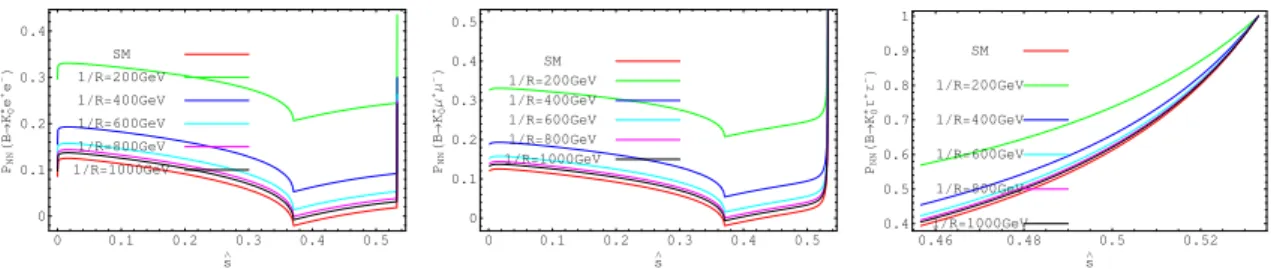
We depict the dependence of the different double-lepton polarization asymmetries on ˆs at different fixed values of 1/R and the SM for different leptons in figures8–13. From these figures, we infer the following information:
• The longitudinal-longitudinal polarization asymmetry, PLL, remains approximately
unchanged in whole physical region except the end points for the e and µ. This asymmetry grows as ˆs increases and reaches its maximum at the upper bound of the allowed physical region for τ .
JHEP01(2011)069
0 0.1 0.2 0.3 0.4 0.5 sß 0 0.1 0.2 0.3 0.4 PNN H B ® K0 *e +e -L SM 1R=200GeV 1R=400GeV 1R=600GeV 1R=800GeV 1R=1000GeV 0 0.1 0.2 0.3 0.4 0.5 sß 0 0.1 0.2 0.3 0.4 0.5 PNN H B ® K0 *Μ +Μ -L SM 1R=200GeV 1R=400GeV 1R=600GeV 1R=800GeV 1R=1000GeV 0.46 0.48 0.5 0.52 s ß 0.4 0.5 0.6 0.7 0.8 0.9 1 PNN H B ® K0 *Τ +Τ -L SM 1R=200GeV 1R=400GeV 1R=600GeV 1R=800GeV 1R=1000GeVFigure 13. The same as figure8, but for PN N polarization.
• The PLN is zero in the interval, 4 ˆm2l ≤ ˆs ≤ 0.37, but after ˆs = 0.37 it starts to
increase up to the upper limit for ˆs ((1 − ˆmK∗ 0)
2) for e and µ. For τ case, this
asymmetry remains approximately unchanged in the interval 4 ˆm2
l ≤ ˆs ≤ 0.50, but
after this point it starts to diminish and becomes zero at the endpoint.
• The PLT slightly decreases as ˆs increases for the e and µ cases and has a very small
value for the e case compared to that of the µ. This asymmetry for τ , first increases then it decreases after reaching a maximum as ˆs increases in the allowed physical region.
• The normal-transversal polarization asymmetry, PN T remain also unchanged in the
interval, 4 ˆm2
l ≤ ˆs ≤ 0.37, for e and µ, but it grows after this interval and has negative
sign. In the case of τ , this asymmetry also has negative sign and it increases to reach a maximum then decreases as ˆs increases.
• For the e and µ, the PT T and PN N start to decrease as ˆs increases. The values of
these asymmetries in the SM and higher values of the compactification factor become zero around ˆs = 0.37 then they start to increase as ˆs increases. They have minimums at low 1/R values at the same ˆs. For τ case, the PT T and PN N grow as ˆs increases
and the PN N reaches its maximum at the upper bound.
At the end of this section, we would like to quantify the uncertainties of our predictions associated with the errors of the hadronic form factors. In this connection, we show the dependence of the differential branching ratios for µ and τ on ˆs in figure14and dependence of PLL, PT T and PN N on ˆs only for µ in figure 15. These figures contain our predictions
(a) in ACD model at 1/R = 200 GeV when the errors presented in table 1 are added to the central values of the form factors, (b) the same model and 1/R, but when the errors of form factors are subtracted from the central values and (c) in SM when central values of the form factors are considered. From figure14, we see that the results of SM lies between the cases (a) and (b) but close to the case (b). In the case of µ, the maximum deviation from the SM is in lower values of ˆs and belongs to the case (a) and has the value about two times grater than that of the SM. For τ case, the maximum deviation of the ACD prediction lies at middle of the allowed physical region for the ˆs. At this point, the ACD prediction in the case (a) is approximately six times greater than the SM prediction. The similar deviations from the SM model has also been observed for instance in [20] for Λb→ Λl+l−,
JHEP01(2011)069
0.0 0.1 0.2 0.3 0.4 0.5 0.0 0.2 0.4 0.6 0.8 1.0 1.2 1.4 s ß 10 6´ d BR ß ds HB ® K0 *Μ +Μ -L 0.46 0.47 0.48 0.49 0.50 0.51 0.52 0.53 0.0 0.2 0.4 0.6 0.8 1.0 1.2 s ß 10 7´ d BR ß ds HB ® K0 *Τ +Τ -LFigure 14. The dependence of differential branching ratio for µ and τ on ˆs. The red color shows the results at 1/R = 200 GeV when the errors of form factors are added to the central values, the green one shows the predictions at the same value of 1/R, but when the errors are subtracted from the central values and the blue color shows the result of the SM, when the central value of the form factors are considered
0.0 0.1 0.2 0.3 0.4 0.5 -1.0 -0.5 0.0 0.5 1.0 s ß PLL HB ® K0 *Μ +Μ -L 0.0 0.1 0.2 0.3 0.4 0.5 0.0 0.5 1.0 1.5 2.0 s ß PTT HB ® K0 *Μ +Μ -L 0.0 0.1 0.2 0.3 0.4 0.5 0.0 0.2 0.4 0.6 0.8 1.0 s ß PNN HB ® K0 *Μ +Μ -L
Figure 15. The same as figure14, but for PLL, PT T and PN N polarizations and only for µ.
the cases (a) and (b) has approximately the same predictions, but ignoring the end points at which two models have same predictions, the ACD model predictions are 1/5, 5 and approximately 9 times of the SM predictions for PLL, PT T and PN N, respectively.
4 Conclusion
We have calculated some observables such as the branching ratio and double-lepton polar-ization asymmetries associated with the B → K0∗(1430)l
+
l− channel in the framework of the ACD model with a single universal extra dimension. We discussed the sensitivities of these observables to the compactification parameter, 1/R. We compared the results ob-tained from the ACD model with the predictions of the standard model. The predictions of the two models approach each other at around 1000 GeV for the value of the compact-ification parameter, 1/R. However the results for the two models differ significantly at lower values of the compactification parameter. This difference grows specially when the errors of the form factors calculated from the QCD sum rules in table 1 are taken into account. The maximum deviation from the predictions of SM for the considered quanti-ties, obtained using the central values of form factors, belongs to the case of ACD model predictions, where the errors of the form factors are added to the central values of the form factors. This deviation also increases as 1/R decreases, such that at low 1/R, the
discrep-JHEP01(2011)069
ancy between predictions of the SM and ACD models reaches to approximately one order of magnitude for some observables. These results beside the other evidences for deviation of the ACD model predictions from the SM obtained via investigating many observables related to the B and Λb channels, which due to the heavy bottom quark have large range
of q2, in [6, 7, 9, 11–14, 20–26], can be considered as a signal for the existence of extra
dimensions in the nature which should we search for in the experiments.
The order of magnitude for the branching ratio shows a possibility to study B → K∗
0(1430)l+l− channel at the LHC. Any measurements on the branching ratio as well
as the double-lepton polarization asymmetries and determination of their signs and their comparison with the obtained results in this paper can give valuable information about the nature of the scalar meson K∗
0(1430) as well as the possible extra dimensions.
References
[1] N. Arkani-Hamed, S. Dimopoulos and G.R. Dvali, The hierarchy problem and new
dimensions at a millimeter,Phys. Lett. B 429 (1998) 263[hep-ph/9803315] [SPIRES].
[2] N. Arkani-Hamed, S. Dimopoulos and G.R. Dvali, Phenomenology, astrophysics and
cosmology of theories with sub-millimeter dimensions and TeV scale quantum gravity,
Phys. Rev. D 59 (1999) 086004[hep-ph/9807344] [SPIRES].
[3] I. Antoniadis, N. Arkani-Hamed, S. Dimopoulos and G.R. Dvali, New dimensions at a
millimeter to a Fermi and superstrings at a TeV,Phys. Lett. B 436 (1998) 257
[hep-ph/9804398] [SPIRES].
[4] I. Antoniadis, A Possible new dimension at a few TeV,Phys. Lett. B 246 (1990) 377
[SPIRES].
[5] T. Appelquist, H.-C. Cheng and B.A. Dobrescu, Bounds on universal extra dimensions,
Phys. Rev. D 64 (2001) 035002[hep-ph/0012100] [SPIRES].
[6] A.J. Buras, M. Spranger and A. Weiler, The Impact of Universal Extra Dimensions on the
Unitarity Triangle and Rare K and B Decays,Nucl. Phys. B 660 (2003) 225
[hep-ph/0212143] [SPIRES].
[7] A.J. Buras, A. Poschenrieder, M. Spranger and A. Weiler, The impact of universal extra
dimensions on B → X/s gamma, B → X/s gluon, B → X/s µ+
µ−, K(L) → pi0 e+
e− and
ǫ′/ǫ,Nucl. Phys. B 678 (2004) 455[hep-ph/0306158] [SPIRES].
[8] A.J. Buras and M. M¨unz, Effective Hamiltonian for B → X(s) e+
e− beyond leading
logarithms in the NDR and HV schemes,Phys. Rev. D 52 (1995) 186[hep-ph/9501281]
[SPIRES].
[9] P. Colangelo, F. De Fazio, R. Ferrandes and T.N. Pham, Exclusive B → K(*) ℓ+ℓ−
, B → K(*) nu anti-nu and B → K* gamma transitions in a scenario with a single universal extra
dimension,Phys. Rev. D 73 (2006) 115006[hep-ph/0604029] [SPIRES].
[10] T. Appelquist and H.-U. Yee, Universal extra dimensions and the Higgs boson mass,
Phys. Rev. D 67 (2003) 055002[hep-ph/0211023] [SPIRES].
[11] V. Bashiry, M. Bayar and K. Azizi, Double-lepton polarization asymmetries and polarized
forward backward asymmetries in the rare b → sℓ+ℓ− decays in a single niversal extra
JHEP01(2011)069
[12] M.V. Carlucci, P. Colangelo and F. De Fazio, Rare Bs decays to η and η′ final states,Phys. Rev. D 80 (2009) 055023[arXiv:0907.2160] [SPIRES].
[13] T.M. Aliev, M. Savci and B.B. Sirvanli, Double-lepton polarization asymmetries in
Lambda/b → Lambda ℓ+ℓ− decay in universal extra dimension model,
Eur. Phys. J. C 52 (2007) 375[hep-ph/0608143] [SPIRES].
[14] I. Ahmed, M.A. Paracha and M.J. Aslam, Exclusive B → K1l+l− decay in model with single
universal extra dimension,Eur. Phys. J. C 54 (2008) 591[arXiv:0802.0740] [SPIRES].
[15] M. Misiak, The b → s e+e−
and b → s gamma decays with next- to-leading logarithmic
QCD corrections,Nucl. Phys. B 393 (1993) 23[SPIRES].
[16] T.M. Aliev, K. Azizi and M. Savci, Analysis of rare (B → K0∗ (1430)l+l− decay) within
QCD sum rules,Phys. Rev. D 76 (2007) 074017[arXiv:0710.1508] [SPIRES].
[17] T.M. Aliev, V. Bashiry and M. Savci, Double-lepton polarization asymmetries in the B → K
ℓ+ℓ− decay beyond the standard model,Eur. Phys. J. C 35 (2004) 197[
hep-ph/0311294]
[SPIRES].
[18] V. Bashiry, S.M. Zebarjad, F. Falahati and K. Azizi, The effects of fourth generation on the
double lepton polarization in B → Kℓ+ℓ− decay,J. Phys. G 35 (2008) 065005
[arXiv:0710.2619] [SPIRES].
[19] S. Fukae, C.S. Kim and T. Yoshikawa, A systematic analysis of the lepton polarization
asymmetries in the rare B decay, B → X/s tau+ tau-,Phys. Rev. D 61 (2000) 074015
[hep-ph/9908229] [SPIRES].
[20] Y.-M. Wang, M.J. Aslam and C.-D. Lu, Rare decays of Λb→ Λγ and Λb→ Λl+l− in
universal extra dimension model,Eur. Phys. J. C 59 (2009) 847[arXiv:0810.0609]
[SPIRES].
[21] P. Colangelo, F. De Fazio, R. Ferrandes and T.N. Pham, Spin effects in rare B → X/s tau+
tau- and B → K* tau+ tau- decays in a single universal extra dimension scenario,
Phys. Rev. D 74 (2006) 115006[hep-ph/0610044] [SPIRES].
[22] P. Colangelo, F. De Fazio, R. Ferrandes and T.N. Pham, FCNC Bs and Lambdab
transitions: Standard model versus a single universal extra dimension scenario,
Phys. Rev. D 77 (2008) 055019[arXiv:0709.2817] [SPIRES].
[23] U. Haisch and A. Weiler, Bound on minimal universal extra dimensions from anti-B → X/s
gamma,Phys. Rev. D 76 (2007) 034014 [hep-ph/0703064] [SPIRES].
[24] R. Mohanta and A.K. Giri, Study of FCNC mediated rare Bs decays in a single universal
extra dimension scenario,Phys. Rev. D 75 (2007) 035008[hep-ph/0611068] [SPIRES].
[25] G. Devidze, A. Liparteliani and U.-G. Meissner, Bs,d → γγ decay in the model with one
universal extra dimension,Phys. Lett. B 634 (2006) 59[hep-ph/0510022] [SPIRES].
[26] I.I. Bigi, G.G. Devidze, A.G. Liparteliani and U.G. Meissner, B → γγ in an ACD model,