Eastern Anatolian Journal of Science
Volume V, Issue II, 2019, 36-39 Eastern Anatolian Journal of Science
Determination of antimutagenic properties of Helichrysum plicatum DC. subsp.
plicatum by Micronuclei and COMET Methods
Selçuk ÇEKER1
1Ağrı İbrahim Çeçen University, Faculty Of Pharmacy, Department Of Basic Sciences Of Pharmaceutics, Ağrı, Turkey,
Abstract
Helichrysum plicatum DC. subsp. plicatum (Asteraceae) is a medicinal plant and natural product. This plant is commonly found in Anatolia and has been used in folk medicine for thousands of years. There are many studies in the literature investigating the biological properties of this plant, but few studies have investigated anti-mutagenic activities. In this study, the antimutagenic of different concentrations of Helichrysum plicatum DC. subsp. plicatum methanol extract (5, 10, 25, 50, 100, 200 and 300 µgr / mL) was investigated using the micronuclei and the single cell gel electrophoresis test systems. Aflatoxin B1 was used as positive control and pure water was used as negative control. As a result, Helichrysum plicatum DC. subsp. plicatum was found to have antimutagenic activity in both test systems and the most effective results were obtained from 100 ugr / mL concentration.
Keywords: Helichrysum plicatum, aflatoxin B1, anti-mutagenic activity, comet assay, micronuclei assay.
1. Introduction
Plants, thanks to their rich content and secondary metabolites; It has been used for different purposes in various fields such as medicine, food and cosmetics. Today, biological properties of many plants and products are being investigated. In this context, Helichrysum species, which have been used in traditional treatment in countries such as Europe, Egypt, North America, China, Australia and South Africa for thousands of years, have recently been the
Received: 26.07.2019 Revised: 04.11.2019 Accepted: 06.12.2019
Cite this article as: S. Çeker, Determination of antimutagenic properties of Helichrysum plicatum DC. subsp. plicatum by Micronuclei and COMET Methods, Eastern Anatolian Journal of Science, Vol. 5, Issue 2, 36-39, 2019
focus of interest for scientific research (EROĞLU et al. 2009). Helichrysum species commonly found in the world; in Turkey's flora, 15 of which are endemic, located in 27 taxa (ALBAYRAK et al. 2010). Helichrysum species are known in Anatolia by their local names such as “Ölmez çiçek”, “altın çiçek”, “sarı çiçek”, “solmaz çiçek”, “altınotu”, “mantuvar”, “kudama çiçeği”, “daz çiçeği”, “arı çiçeği” (BAYTOP 1999; ALBAYRAK et al. 2010; ÖZTÜRK et al. 2014). H. plicatum DC. subsp. plicatum is spread in the Palandöken Mountains of Erzurum in our region and it is used to reduce kidney stones (BAYIR et al. 2011).
A number of in vitro and in vivo studies have been conducted to evaluate the biological effects of several Helichrysum species; namely, antiviral (MEYER et al. 1997), anti-inflammatory (SCHINELLA et al. 2002), anti-oxidant (TEPE et al. 2005), antimalarial (VAN VUUREN et al. 2006), antibacterial (KOTAN et al. 2007) and antidiabetic (ASLAN et al. 2007) activities. However, there are few reports in literature about the antigenotoxic and antimutagenic effects of Helichrysum species. Therefore, the aim of this study is to determine whether Helichrysum plicatum DC. subsp. plicatum has antigenotoxic and antimutagenic properties. For this purpose, Helichrysum plicatum DC. subsp. plicatum methanol extract (HPME) was prepared and the short-time test systems were examined in the micronuclei (MN) and the single cell gel electrophoresis (Comet).
2. Materials and Methods 2.1. Preparation of HPME
Helichrysum plicatum DC. subsp. plicatum was collected from the locality of Mount Palandoken in Turkey (Erzurum) in July 2018. Dried plant at room temperature was ground to powder with a grinder. Then the powdered plant material (10 g) was extracted in a Soxhlet extractor with 100 mL methanol (MeOH) at 60 °C for 6 h. The extract was filtered and concentrated to dryness under reduced
Determination of antimutagenic properties of Helichrysum plicatum DC. subsp. plicatum by Micronuclei and COMET Methods
EAJS, Vol. V Issue II | 37 pressure at 40 °C with a rotary evaporator. Finally,
the extracts were kept at 4 °C until tested. 2.2. In Vitro MN and Comet Tests
For MN and Comet tests, peripheral blood from healthy men and women whom aged 23-25, that not smoking and drinking alcohol, non-infectious disease, not exposed to any physical agent such as X-ray was used. 0.5 mL of heparinized whole blood samples were cultured in 7 mL of chromosome medium B contained 15% heat-inactivated fetal calf serum, 1% streptomycin, 1% penicillin, 2% glutamine and 2% phytohemagglutinin (ORHAN et al. 2016). To this solution, different concentrations (5, 10, 25, 50, 100, 200 and 300 µgr / mL) of HPME was added and cultured at 37 °C for 72 h in a 5% CO2 moist atmosphere (ORHAN et al. 2016). After preparing the culture media, Comet method was applied in Ceker (2017) and MN method was performed in Orhan et al. (2016).
3. Results
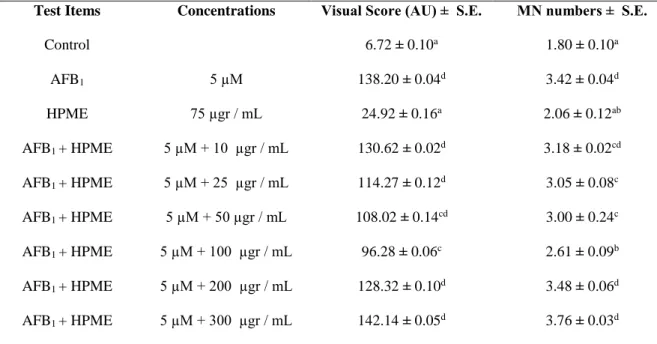
In this study, the anti-genotoxicity of different concentrations of HPME (5, 10, 25, 50, 100, 200 and 300 µgr / mL) was investigated using MN and Comet test systems. Aflatoxin B1 (AFB1) was used as positive control and pure water was used as negative control. Table 1 shows the MN frequency and DNA damage occurring in human peripheral blood lymphocytes by the administration of different concentrations of AFB1 and HPME to human peripheral blood lymphocytes.
When the data in Table 1 is evaluated; it is understood that AFB1 increases MN frequency and DNA damage, whereas HPME at different concentrations added to culture media reduces this mutagenic effect of AFB1. In both test systems, it was determined that the most effective result was obtained especially from the 100 µgr / mL concentration of HPME (p < 0.05).
Table 1. The effects of AFB
1and HPME on MN and Comet in human peripheral lymphocytes
Test Items Concentrations Visual Score (AU) ± S.E. MN numbers ± S.E.
Control 6.72 ± 0.10a 1.80 ± 0.10a AFB1 5 µM 138.20 ± 0.04d 3.42 ± 0.04d HPME 75 µgr / mL 24.92 ± 0.16a 2.06 ± 0.12ab AFB1 + HPME 5 µM + 10 µgr / mL 130.62 ± 0.02d 3.18 ± 0.02cd AFB1 + HPME 5 µM + 25 µgr / mL 114.27 ± 0.12d 3.05 ± 0.08c AFB1 + HPME 5 µM + 50 µgr / mL 108.02 ± 0.14cd 3.00 ± 0.24c AFB1 + HPME 5 µM + 100 µgr / mL 96.28 ± 0.06c 2.61 ± 0.09b AFB1 + HPME 5 µM + 200 µgr / mL 128.32 ± 0.10d 3.48 ± 0.06d AFB1 + HPME 5 µM + 300 µgr / mL 142.14 ± 0.05d 3.76 ± 0.03d
Aflatoxin B1 (AFB1) was used as positive controls for humanperipheral lymphocytes.
a, b, c, d, Statistically significant differences in the same column are indicated by the different superscripts (α = 0.05).
4. Discussion
Genotoxicity tests; since there is a strong relationship between mutagenicity and carcinogenicity, it has started to be used as screening tests to investigate the
carcinogenic risks of substances used by industrial organizations (JENA et al. 2002). Genotoxicity studies are gaining importance due to the use of new substances in different fields, especially in the food and health fields, and the exposure of people to these
38 | S. Çeker EAJS, Vol. V Issue II
substances. Comet test; it is used as a powerful genetic test for the analysis of DNA damage in eukaryotic cells (TICE et al. 2000). The Comet test is based on the principle that the damaged DNA is released from the nucleus by electrophoresis (KURTULMUS and AYDIN 2007). The aim of the Comet test is to determine the effects of genotoxic and cytotoxic agents caused by chemical and physical factors on living cells by examining the DNAs of the cells one by one (KURTULMUS and AYDIN 2007). In MN test system; the addition of the appropriate concentration of cytokalazine B to lymphocyte cultures, the nucleus has completed the division but not able to perform cytoplasmic division of the nucleus, the ratio of cells containing MN is determined (DEMIREL and ZAMANI 2002). In this study, the antimutagenic effect of HPME against AFB1 in human lymphocyte cells was investigated with Comet and MN test systems.
According to the findings (Table 1); AFB1 increases the Comet and MN frequencies in human lymphocyte cells and HPME shows antigenotoxic properties by inhibiting the mutagenic effect of AFB1. Among the applied concentrations of HPME, the most effective results were obtained from a concentration of 100 µgr / mL. In previous studies have reported the presence of apigenin, naringenin, kaempferol, quercetin and luteolin glycocytes as well as free apigenin, naringenin, kaempferol and luteolin in H. plicatum content (KULEVANOVA et al. 2000; BIGOVIĆ et al. 2011). Apigenin, naringenin, kaempferol and luteoline have also been studied in the literature on biological activities (ROMANAVA et al. 2001; CHEN and CHEN 2013; ÇEKER et al. 2019). The determined antimutagenic property makes this plant important and it is thought that this property is caused by phenolic compounds of Helichrysum plicatum DC. subsp. plicatum. In this context, it would be beneficial to carry out new studies in order to obtain the substances in the plant in pure form and to be able to use them as active pharmaceutical ingredients. Acknowledgment
The author wish to thank Tuba AYDIN, assistant professor, for her help in the preparation of plant extracts.
References
ALBAYRAK, S., AKSOY, A., SAGDIC, O., BUDAK, U. (2010), Phenolic compounds and antioxidant and antimicrobial properties of Helichrysum species collected from eastern Anatolia, Turkey, Turkish Journal of Biology; 34(4), 463-473.
ASLAN, M., ORHAN, D.D., ORHAN, N., SEZIK, E., YESILADA, E. (2007), In vivo
antidiabetic and antioxidant potential of Helichrysum plicatum ssp. plicatum capitulums in streptozotocin-induced-diabetic rats, Journal of ethnopharmacology; 109(1), 54-59.
BAYIR, Y., HALICI, Z., KELES, M.S., COLAK, S., CAKIR, A., KAYA, Y., AKCAY, F. (2011), Helichrysum plicatum DC. subsp. plicatum extract as a preventive agent in experimentally induced urolithiasis model, Journal of ethnopharmacology; 138(2), 408-414.
BAYTOP, T. (1999), Türkiye'de bitkiler ile tedavi: geçmişte ve bugün, Nobel Tıp Kitabevleri. BIGOVIĆ, D., ŠAVİKİN, K., JANKOVİĆ, T.,
MENKOVİĆ, N., ZDUNİĆ, G.,
STANOJKOVİĆ, T., DJURİĆ, Z. (2011), Antiradical and cytotoxic activity of different Helichrysum plicatum flower extracts, Natural product communications; 6(6), 1934578X1100600617.
CHEN, A.Y., CHEN, Y.C. (2013), A review of the dietary flavonoid, kaempferol on human health and cancer chemoprevention, Food chemistry; 138(4),2099-2107.
ÇEKER, S., (2018), Ektoinin İnsan Lenfosit Hücrelerinde Genotoksik Potansiyeli, Karaelmas Science and Engineering Journal; 8(1),317-323.
DEMIREL, S., ZAMANI, A.G. (2002), Mikronükleus tekniği ve kullanım alanları, Genel Tıp Dergisi; 12(3),123-127.
EROGLU, H.E., AKSOY, A., HAMZAOGLU, E., BUDAK, U., ALBAYRAK, S. (2009), Cytogenetic effects of nine Helichrysum taxa in human lymphocytes culture, Cytotechnology; 59(1),65-72.
JENA, G., KAUL, C., RAMARAO, P. (2002), Genotoxicity testing, a regulatory requirement for drug discovery and development: impact of ICH guidelines, Indian journal of pharmacology; 34(2),86-99.
KOTAN, R., DADASOGLU, F., KORDALI, S., CAKIR, A., DIKBAS, N., CAKMAKCI, R. (2007), Antibacterial activity of essential oils extracted from some medicinal plants, carvacrol and thymol on Xanthomonas axonopodis pv. vesicatoria (Doidge) Dye causes bacterial spot disease on pepper and tomato, Journal of Agricultural Technology; 3(2), 299-306.
KULEVANOVA, S., STEFOVA, M., STAFILOV, T. (2000), HPLC identification and determination of flavone aglycones in Helichrysum plicatum DC.(Asteraceae), Die Pharmazie; 55(5),391. KURTULMUS, S., AYDIN, A. (2007), Dental
Determination of antimutagenic properties of Helichrysum plicatum DC. subsp. plicatum by Micronuclei and COMET Methods
EAJS, Vol. V Issue II | 39 mutajenisite ve karsinojenisitesi, Selçuk
Üniversitesi Dişhekimliği Fakültesi Dergisi;16,73-78.
MEYER, J., AFOLAYAN, A., TAYLOR, M., ERASMUS, D. (1997), Antiviral activity of galangin isolated from the aerial parts of Helichrysum aureonitens, Journal of ethnopharmacology; 56(2),165-169.
ORHAN, F., CEKER, S., ANAR, M., AGAR, G., ARASOGLU, T., GULLUCE, M. (2016), Protective effects of three luteolin derivatives on aflatoxin B 1-induced genotoxicity on human blood cells, Medicinal chemistry research; 25(11), 2567-2577.
OZTURK, B., OZEK, G., OZEK, T., BASER, K.H.C. (2014), Chemical diversity in volatiles of Helichrysum plicatum DC. subspecies in Turkey, Records of Natural Products; 8(4), 373.
ROMANOVA, D., VACHALKOVA, A., CIPAK, L., OVESNA, Z., RAUKO, P. (2001), Study of antioxidant effect of apigenin, luteolin and quercetin by DNA protective method, Neoplasma; 48(2), 104-107.
SCHINELLA, G., TOURNIER, H., PRIETO, J., DE BUSCHIAZZO, P.M., RIOS, J. (2002), Antioxidant activity of anti-inflammatory plant extracts, Life sciences;70(9),1023-1033. TEPE, B., SOKMEN, M., AKPULAT, H.A.,
SOKMEN, A. (2005), In vitro antioxidant activities of the methanol extracts of four Helichrysum species from Turkey, Food Chemistry; 90(4), 685-689.
TICE, R.R., AGURELL, E., ANDERSON, D., BURLINSON, B., HARTMANN, A., KOBAYASHI, H., MIYAMAE, Y., ROJAS, E., RYU, J.C., SASAKI, Y. (2000), Single cell gel/comet assay: guidelines for in vitro and in vivo genetic toxicology testing, Environmental and molecular mutagenesis; 35(3), 206-221. VAN VUUREN, S., VILJOEN, A., VAN ZYL,
R.,VAN HEERDEN, F., BASER, K.H.C. (2006), The antimicrobial, antimalarial and toxicity profiles of helihumulone, leaf essential oil and extracts of Helichrysum cymosum (L.) D. Don subsp. cymosum, South African Journal of Botany; 72(2),287-290.