SELÇUK ÜNİVERSİTESİ
SOSYAL BİLİMLER ENSTİTÜSÜ
YABANCI DİLLER EĞİTİMİ ANABİLİM DALI
İ
NGİLİZCE ÖĞRETMENLİĞİ BİLİM DALI
TEACHING PHRASAL VERBS TO FRESHMAN STUDENTS
AT UNIVERSITIES BY USING COMMUNICATIVE APPROACH
Danışman
Yrd. Doç. Dr. ECE SARIGÜL
Hazırlayan
Kağan BÜYÜKKARCI
ACKNOWLEDGEMENTS
I would like to express my deep gratitude to the head of Foreign Language Department, Prof. Dr. Selçuk Ünlü, who has been a profound source of academic sup-port and encouragement from the beginning of my academic carrier.
I am most grateful to Assistant Professor Dr. Ece Sarıgül, who has supervised and helped me from the beginning of my thesis to the end and who has given me her valuable academic advices.
I am so deeply thankful to Associate Professor Dr. Ali Murat Sünbül for his precious and academic advice and suggestions, especially for his help for the statistic part of my thesis.
I would like to express my great thanks to Assistant Professor Dr. Abdülkadir Çakır, Hasan Çakır and Abdulhamit Çakır, who were my instructors during my under-graduate study in Konya, for the support to me. Also, I would like to send my thanks to Associate Professor Dr. Fatih Tepebaşılı who has helped me for my thesis.
I am deeply indebted to Mr. Hüseyin Kavasoğlu, Mr. Hayri Şenol, Mr. Türker Şenol, Mr. Erdinç Yücel, Mr. Hasan Yılmaz, Mr. Gökhan Şimşek for their valuable support.
Finally, I would like to express my sincere thanks to my father, my mother, my brother, my sister and Mr. Osman Dülger, who has always backed me up whenever needed and who has always been a friend, an advisor to me.
ABSTRACT
In our age the necessity of vocabulary teaching, especially phrasal verb teach-ing, has gained more importance than ever. Not only scholars but foreign language teachers have realized that neither grammar nor vocabulary teaching can be ignored.
The aim of this study is investigating the effects of communicative approach on teaching phrasal verbs to university students. This study gives a chance to under-stand how phrasal verbs differ from the other words, and moreover it provides us with an opportunity to compare the traditional methods with communicative approach.
This study has been carried out on two groups, experimental and control, consisting of fifty four students. These students are freshmen students of Seljuk Uni-versity English Teaching Department. During the study, the experimental group has been taught the phrasal verbs by using communicative approach. The control group has been taught by traditional methods.
In the first chapter, I have introduced some background to the study. More-over, goal and scope of this study, statement of the problem, method of the study, and limitations has been introduced in this first chapter.
The second chapter introduces vocabulary and its teaching and importance in language teaching. Also, vocabulary teaching in different methods, sense relations have been introduced in this chapter.
In the third chapter, phrasal verb types, prepositions and prepositional types of English have been introduced.
The fourth chapter gives information about the communicative approach and other old and traditional methods in language teaching. Moreover, communicative competence and its bases have been explained in a detailed way.
The fifth chapter shows the evaluations results of my experimental study. The pre-test and post-test results have been explained.
In the conclusion part, the summary, findings and suggestions are presented.
ÖZET
Çağımızda kelime öğretimini özellikle deyimsel fiillerin öğretiminin gereklili-ği daha çok önem kazanmıştır. Uzmanlar ve yabancı dil öğretmenleri, ne dilbilgisi ne de kelime öğretiminin göz ardı edilemeyeceğinin farkına varmışlardır.
Bu çalışmanın amacı, iletişimsel yöntemin üniversite öğrencilerine deyimsel fiillerin öğretimindeki etkilerini araştırmaktır. Bu çalışma deyimsel fiillerin diğer ke-limelerden farkını anlama ve klasik yöntemler ve iletişimci yöntem arasındaki farkları anlama şansı vermektedir.
Çalışma kontrol ve deney grubu olmak üzere iki grup ve elli dört öğrenciyi kapsamaktadır. Bu öğrenciler Selçuk Üniversitesi İngiliz Dili Eğitimi birinci sınıf öğ-rencileridir. Çalışma süresince deney grubuna deyimsel fiiller iletişimsel yöntem kul-lanılarak öğretilmiştir. Kontrol grubunda ise geleneksel yöntemler kullanılmıştır.
Birinci bölümde, bu konuda yapılan çalışmalar tanıtılmıştır. Aynı zamanda ça-lışmanın amaç ve kapsamı, problemin tanıtılması, çaça-lışmanın yöntemi ve sınırlılıklar bu bölümde anlatılmıştır.
İkinci bölümde yabancı dil öğretiminde kelime, kelime öğretimi ve önemi tanı-tılmıştır. Ayrıca farklı yöntemlerde kullanılan kelime öğretim yolları ve algı ilişkileri anlatılmıştır.
Üçüncü bölümde deyimsel fiiller ve bunların çeşitleri, İngilizcede bulunan e-datlar ve çeşitleri anlatılmıştır.
Dördüncü bölümde dil öğretiminde iletimci yöntem, eski ve geleneksel yön-temler anlatılmıştır. Ayrıca iletişimsel yetenek ve bunun temelleri anlatılmıştır.
Beşinci bölüm çalışmanın deneysel sonuçlarını, ön test ve son test sonuçlarını kapsamaktadır.
LIST OF TABLES
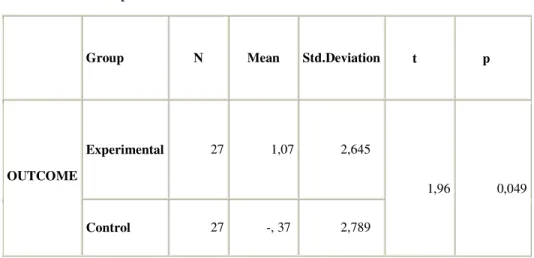
Table 1: Group Statistics of Pre-test………47 Table 2: Group Statistics of Post-test………..47 Table 3: Group Statistics of the Results.……….48
TABLE OF CONTENTS
Page ACKNOWLEDGEMENTS ... i ABSTRACT... ii ÖZET ... iii LIST OF TABLES ... iv TABLE OF CONTENTS... v CHAPTER I... 1 INTRODUCTION... 11.1. General Background to the Study... 1
1.2. Goal and Scope of the Study ... 2
1.3. Statement of the Problem ... 3
1.4. Method of the Study ... 4
1.5. Limitations... 4 CHAPTER II ... 5 VOCABULARY TEACHING ... 5 2.1. Vocabulary... 5 2.2. Denotative Meaning ... 6 2.3. Connotative Meaning ... 6
2.4. Vocabulary in Second Language ... 7
2.5. Semantics... 9
2.6. Vocabulary Teaching in Different Methods and Approaches ... 11
2.7. Sense Relations... 14 2.7.1. Synonymy... 14 2.7.2. Antonymy... 15 2.7.3. Polysemy... 166 2.7.4. Hyponymy... 177 2.7.5 Homonymy... 17 2.7.6. Homography... 18 CHAPTER III ... 19 PHRASAL VERBS ... 19 3.1. Presentation ... 19 3.2. Prepositions in English ... 20
3.3. Prepositional Phrases and Verbs... 22
3.4. Phrasal Verbs... 24
3.4.1 Grammar of the Phrasal Verbs... 25
3.4.1.2. Inseparable Phrasal Verbs... 26
3.4.1.3 Transitive Phrasal Verbs... 28
3.4.1.4 Intransitive Phrasal Verbs... 28
3.4.2. Native Speakers Knowledge of Phrasal Verbs... 28
CHAPTER IV... 30
COMMUNICATIVE APPROACH... 30
4.1. Presentation ... 30
4.2. Background to Approaches ... 30
4.2.1. Old and Classical Methods... 32
4.3. Communicative Approach ... 38 4.4 Communicative Competence... 40 4.4.1. Grammatical Competence... 41 4.4.2. Discourse Competence... 42 4.4.3. Sociolinguistic Competence... 42 4.4.4. Strategic Competence... 43 CHAPTER V ... 45
METHOD OF DATA COLLECTION, ANALYSIS, AND INTERPRETATION OF THE RESULTS ... 45
5.1. Presentation ... 45
5.2. Subjects... 45
5.3. Procedures ... 45
5.4. Evaluation Instruments ... 46
5.5. The Analysis and Interpretation of the Experimental Study... 477
CONCLUSION... 49
Summary and Findings... 49
Suggestions for the Teachers of English ... 50
BIBLIOGRAPHY ... 52 APPENDICES ... 56 Appendix 1 ... 56 Appendix 2 ... 59 Appendix 3 ... 67 Appendix 4 ... 69 Appendix 5 ... 72 Appendix 6 ... 72 Appendix 7 ... 74 Appendix 8 ... 75
CHAPTER I
1. INTRODUCTION
1.1. General Background to the Study
The second language has been the center of the interest of linguists and researchers. Large number of people can never acquire a second language at a high level of proficiency. This has had two interrelated consequences for work on second language acquisition.
First, it has led to the supposition that learning second language is different from learning, or we can say acquiring, the first language in some sense, and second, it has led to the institutionalization of second language learning to a much greater extent than the first language. (Brumfit; 1984: 33)
We can say that there are two ways in which the acquisition is in some sense simultaneous progress of the facility of language as well as of the structure of a language, and it is in fact a natural and automatic product of the process of socialization with human beings. However, although neither of these features may appear at first sight to be applicable to second language development, we need to be so careful not to be the prisoners of our own constructs. (Brumfit; 1984: 34)
These differences can be said to be inevitable in communities which are isolated. While first language learning of a person occurs in a natural environment, it is not the same in the second language learning.
Learning a second language is a long and troublesome process. The student has to be equally taught all the four basic skills: listening, reading, writing, and speaking. To acquire all these skills, the student must have one thing that can be said to be the basis of language: vocabulary.
“Knowing a language is to know the certain sound sequences signifying certain concepts or meanings. Speakers of English know what ‘boy’ means, and it means something different from toy or girl. When you know a language, you know the words in that language, that is, the sound units that are related to specific meanings.” (Fromkin and Hyams; 2003: 5)
So it wouldn’t be wrong to say that vocabulary is one of the most important components of the language.
One of the main parts of the vocabulary learning is a phrasal verb. A phrasal verb is a verb, which is formed from two or three parts such as a verb and an adverb or preposition. Most of these verbs are formed from a number of common verbs such as go, get, come, put, set, and a number of different prepositions and adverbs such as in, out, up, on, off.
When one of the components that form a phrasal verb changes, most of the ti-me, the meaning also changes. For example, however, ‘turn on’ means to switch on something, when changed into ‘turn off’, it means to switch off, which means learning phrasal verbs is really hard and complicated.
In our time, the most common approach that is used to teach English or any other foreign language is the “Communicative Approach”. It focuses on the language as a tool, which recognizes that all communication has a social purpose.
According to Howart (1984: 279.), there is, in a sense, a ‘strong’ side of communicative approach and a ‘weak’ side. The weak side which has become more or less typical practice in the last ten years, stresses the importance of proving learners with opportunities to use their English for outgoing purposes, and characteristically, attempts to combine such activities into a wider program of language teaching.
The ‘strong’ side of communicative teaching, then again, advances the state that language is acquired through communication, so that it is not merely a question of activating an accessible but inert knowledge of the language itself. If the former could be described as ‘learning to use’, the latter entails ‘using English to learn it’.
1.2. Goal and Scope of the Study
The most challenging part of a language for the second language learners, as it is not the mother tongue of them, is vocabulary, and it would not be wrong to say that learning the phrasal verbs is one of the most difficult parts of it.
Teaching phrasal verbs to university students in the best way is really tiring, and also, learning these verbs for students is difficult. The goal of this study is to investigate the affects of communicative approach on learning and teaching phrasal verbs.
There are many studies on communicative approach in learning English, but nearly no study the affects of communicative approach has been done in learning a specific subject of English: phrasal verbs. This study does not aim to argue, but it simply tries to set out the facts observed in the classrooms.
Another goal of this study is to provide English teachers information about how to teach phrasal verbs in the best way with a scope of teaching by the help of communicative approach by considering the real needs and expectations of the learner.
The supposition that “teaching English phrasal verbs through communicative approach, instead of the traditional ones, is more affective and enjoyable, and teaching phrasal verbs by using this approach can be easier and powerful” will be considered throughout this study.
1.3. Statement of the Problem
In our time, one of the most challenging subjects in teaching English is learning the new vocabulary, and one of the most difficult parts of the new vocabulary is phrasal verbs.
Phrasal verbs consist of two or three parts, which are verbs and adverb or preposition. Phrasal verbs sometimes have meanings easily guessed such as ‘sit down’ meaning be seated. However, in daily life, they have really different meanings from the verb forming the phrasal verb such as ‘hold up’ meaning causing to be late or robbing someone.
Due to the differences between the meanings of the individual verbs and those of phrasal verbs, teaching phrasal verbs are hard and troublesome. Looking up the dictionary for the meanings of the new words will not be enough for the real meaning. These kinds of verbs can be best learned in daily conversations, which make communicative approach the best way of teaching phrasal verbs. As, the traditional English teaching methods will not be enough for teaching phrasal verbs.
1.4. Method of the Study
In this study, the researches, articles, books, theses, which were done in our country and the world, will be examined carefully. After a detailed literature scanning, the study’s theoretical part will be completed.
In addition to the literature scanning part, two English classes, whose age and class levels are the same, from our faculty will be chosen. One of them will be experimental group and the other will be the control group, and they will be applied a pre-test separately.
Some materials such as filling in the blanks, puzzels, discussion questions (appendix:56) will be used in classroom sessions. When the education period is over, the same classes will be applied a post-test formed by the same questions. Whether there is any change occurring in the experimental group will be determined, and the results will be considered carefully.
All the measurement in this study will be shown on charts. In findings part of the study, there will be some suggessions for the English teachers.
1.5. Limitations
This study will be carried out at Seljuk University Faculty of Education English Teaching Department. The students of the chosen classes are the freshman students. Each class has nearly 27 students, and the total will be almost 54.
The students will be taught the phrasal verbs by the researcher for four weeks. During the research, communicative approach will be used in the experimental group, and the experimental class students will learn the phrasal verbs in context and they will use them as if they are in a daily conversation. Classical teaching methods will be used in the control group.
The subjects of this study are all from Seljuk University Education Faculty English Teaching Department. The data collected from these students may not reflect the students at other universities. The data collection is mostly based on the written work of these students.
CHAPTER II
VOCABULARY TEACHING
2.1. Vocabulary
It is impossible to learn a language and communicate accurately without learning the vocabulary in that language. It is the same with learning a foreign language. So it will not be wrong to say that vocabulary learning is the most necessary part of learning a foreign language. Students’ knowledge of vocabulary relates directly to their comprehension.
The word ‘vocabulary’ means listing of the words used in some enterprise, or the system of techniques or symbols serving as a means of expression. Vocabulary is a difficult experience that most of the English teachers face while teaching. No matter how well the students learn the grammar, or no matter how well the sounds of the second language are studied, communication cannot occur in a meaningful way without the words to express a wide range of meanings. Moreover, vocabulary often seems to be the least systematized and the least well catered for of all the aspects of learning a foreign language. (McCarthy; 2003: viii)
While the natives of a language may add new words to their vocabulary by reading, occupation, and other activities without paying much attention, the foreign language learners have a need to pay more attention for the learning of new vocabulary.
Foreign Language learners seem to rely more on word meaning than on knowledge of the subject or syntax. Shira (1999) states that a certain size of vocabu-lary has to be known by the learners before they approach a text comfortably. Fur-thermore, in order to understand a text, readers should be familiar with 95 per cent of the words in the text at any level. The 'bottom line' for reading English at an academic level is 3,000 words, or 5,000 lexical units. But in view of the evidence that the vo-cabulary size of a native speaking university undergraduate is in the range of 14,000-17,000 words. Therefore it makes sense to assume that FL teachers should do every-thing they can, to ensure that their students enlarge the size of their vocabulary.
Kızıltan (Kızıltan; 1988: 44) states that vocabulary learning includes a troublesome process and causes some problems to the learner as it involves learning the denotative and connotative meanings of the words, as well as the semantic and syntagmatic relations between words.
2.2. Denotative Meaning
Denotation refers to the literal meaning of a word, or we can say that denotative meaning is dictionary meaning of a word. There is a relationship between the words and objects and activities.
There is a suitable word for each object which is used for one or more members of objects. This relationship is generally described as the denotative or referential meaning.
For example, if you look up the word snake in a dictionary, you will discover that one of its denotative meanings is "any of numerous scaly, legless, sometimes venomous reptiles, having a long, tapering, cylindrical body and found in most tropical and temperate regions."
2.3. Connotative Meaning
Connotation, on the other hand, refers to the associations that are connected to a certain word or the emotional suggestions related to that word. The connotative meanings of a word exist together with the denotative meanings. The connotations for the word snake could include evil or danger.
Some definitions of words are less definite or factual. They derive their mean-ings from the circumstances in which the words are used. They suggest quality or emotional tone. These are some words that follow this pattern:
DENOTATION CONNOTATION
Average mediocre Childlike childish Saliva spit
Antique old-fashioned; passe’
Drunk intoxicated; under the influence; pie-eyed; soused, stinko Reporter journalist; news hawk; legman
Slender thin; skinny; sylph-like; svelte
A speaker is able to reveal the connotation of a word from the context of the passage because the speaker is able to alter his or her tone, change facial expressions,
or gesture. But a writer must select words, which are denotatively and connotatively accurate.
In propaganda, writers or speakers intentionally misrepresent connotations. For example, the superlative ALL is implied when MANY is really accurate. "ALL of my friends are going to the party; therefore, I should also go."
This kind of meaning is similar to phrasal verbs in the way of different meanings.
2.4. Vocabulary in Second Language
It is vital for second language learners to acquire enough vocabulary to communicate and understand what is said.
Anjel and James (2004: 474) states that vocabulary has characteristically been ignored in foreign or second language instruction. Partly, this may be due to the fact that many teachers assume that vocabulary instruction amounts to telling students to make guesses about the meaning of a word with regard to the grammatical and pragmatic context in which the word is found. However, several recent studies have showed that contextual guessing by second language learners can be very problematic. For example, one problem is that second language learners sometimes misunderstand word forms and this misunderstanding results in failure of contextual guessing. If readers think they have successfully identified a word-form, they will naturally access the standard meaning for that form and not necessarily consider the context for confirmation. Therefore, word-form identification has an important role even before the contextual guessing starts.
Our vocabulary consists of the individual words we understand or know the meanings of. Our reading vocabulary consists of words that we understand as we read. It is possible to know the meaning of a word when we hear it spoken but still not be able to read it in print. This is common for beginning readers, whose oral vocabulary, their speaking and listening vocabulary, is often larger than their reading vocabulary.
Words come in two forms which are oral and print. Oral vocabulary includes those words that we recognize and use in listening and speaking. Print vocabulary includes the words that we recognize and use in reading and writing.
In addition, word knowledge also comes in two forms, receptive and productive. Receptive vocabulary includes words that we recognize when we hear or see them. Productive vocabulary includes words that we use when we speak or write. Receptive vocabulary is typically larger than productive vocabulary, and may include many words to which we assign some meaning, even if we don’t know their full definitions and connotations. (Lehr, & et al; 2004: 5)
The depth of our knowledge for individual words can also vary. We may have a deep understanding for words that we use a lot, knowing all of the different definitions given for a word in a dictionary, for example. Or our knowledge may be shallow when we know only one of the several meanings for a word, or when we have heard a word only a few times but have never used it ourselves or checked on its definition (McKeown & Curtis; 1987).
For learning the vocabulary of a language it is necessary to learn the semantic and lexical systems of that language. Students may know most of the words in their mother tongue, but they often have difficulties in finding the meanings of the words of the foreign language. As the students have very insufficient knowledge of the words they fail to communicate with others and explain their ideas, or read daily newspapers or magazines.
Lin (2003: Abstract) states that vocabulary learning is the building block of overall language proficiency. Successful second language learning hinges very much on target vocabulary acquisition. Vocabulary knowledge is multi-dimensional. It requires multiple encounters with the target vocabulary in various contexts to fully gain the word knowledge. The process of learning words is accumulative and recursive. A supportive learning environment and direct instruction are necessary for effective vocabulary acquisition.
Semantics has some findings that may help learning a language. However, there is not only one single term containing semantics, vocabulary, and developing the vocabulary. The term ‘semantics’ means the study of meaning and the systematic ways in which those meanings are expressed. The term ‘vocabulary’ refers to a set or a list of the words of a particular language. And developing vocabulary is putting the concepts of the words in a better order.
2.5. Semantics
Semantics is simply the study of meaning. (Hurford, & Brendan; 1983:1) Semantics is the study of the meaning of linguistic expressions. The language can be a natural language, such as English or Turkish, or an artificial language, like a computer programming language. Meaning in natural languages is mainly studied by linguists. In fact, semantics is one of the main branches of contemporary linguistics.
Theoretical computer scientists and logicians think about artificial languages. In some areas of computer science, these divisions are crossed. In machine translation, for instance, computer scientists may want to relate natural language texts to abstract representations of their meanings; to do this, they have to design artificial languages for representing meanings. There are strong connections to philosophy. Earlier in this century, much work in semantics was done by philosophers, and some important work is still done by philosophers.
To know the meaning of a set of words (like desk, chair, and orange) would seem to entail knowing that the first two are more closely related to each other than the third. That is, individual word meanings exist within systems of related meanings, and knowledge of the meaning relations among a set of words would seem to follow from knowledge of the constituent meanings. There is sufficient psychological evidence that supports this supposition. Adults are better at remembering words from lists that contain semantically related subsets than words from lists of unrelated words.
In addition, if the semantically related words are separated in the list, adults tend to cluster them by meaning in output. On the other hand, speech errors made by native speakers (slip of the tongue) show that most wrong words used come from the same semantic field as the intended word. (Amer; 2002)
Amer (2002) also states that in addition to learning the basic sense of each new word, second language learner should recognize its relation to other words with similar meaning. In practice, very few words in any language are interchangeable in all contexts. Thus the term synonym used in foreign language teaching is often confusing and inaccurate. Therefore, it is pedagogically desirable to provide the learner with vocabulary richness activities that incorporate various semantic sets.
Falk (1978: 262) states that semantics is the relationships among the noun phrases, as agent and instrument. He explains this statement by such an example:
- John opened the door. - The key opened the door.
In the first sentence, John is the subject; but in the second one the subject is the key. It would be wrong to explain these sentences only by syntactic functions. In the first sentence, John is the agent, doer of the action. But in the second one, the key is not the agent but the instrument by means of which some unspecified agent has accomplished the action.
3- John opened the door with the key.
Here John is the agent, but now the key is the object of the preposition; nevertheless, the key remains the instrument. And such relationships are called semantic relations.
Anyone who speaks a language has a truly amazing capacity to reason about the meanings of texts. Take, for instance, the sentence
(S) I can't untie that knot with one hand.
Even though you have probably never seen this sentence, you can easily see things like the following:
1) The sentence is about the abilities of whoever spoke or wrote it. (Call this person the speaker.)
2) It's also about a knot, maybe one that the speaker is pointing at.
3) The sentence denies that the speaker has certain ability. (This is the contribution of the word `can't'.)
4) Untying is a way of making something not tied.
5) The sentence doesn't mean that the knot has one hand; it has to do with how many hands are used to do the untying.
2.6. Vocabulary Teaching in Different Methods and Approaches
In Grammar-Translation Method, vocabulary selection is based most on the reading texts used, and the words are taught through bilingual word lists, dictionary study, and memorization. This method presents the grammar rules and gives a list of vocabulary items with their translation equivalents. (Richard and Rodgers; 2000: 6)Classes are taught in the students’ mother tongue, but the target language is allowed only for little active use. Vocabulary is taught in the form of isolated word lists. Elaborate explanations of grammar are always provided. Grammar instruction provides the rules for putting words together; instruction often focuses on the form and inflection of words.
Reading of difficult texts is begun early in the course of study. Little attention is paid to the content of texts, which are treated as exercises in grammatical analysis. Often the only drills are exercises in translating disconnected sentences from the target language into the mother tongue, and vice versa. Little or no attention is given to pronunciation.
Direct Method represents only everyday vocabulary and sentences. Concrete vocabulary is taught through demonstration, objects, and pictures. Conceptual vocabulary is taught by connection of ideas. Questions are answered in the target language. Verbs are used first and systematically conjugated only much later after some oral mastery of the target language.
Advanced students read literature for comprehension and pleasure. Literary texts are not analyzed grammatically. The culture associated with the target language is also taught inductively. Culture is considered an important aspect of learning the language.
In this Method, lessons usually begin with a dialogue using a modern conversational style in the target language. Material is first presented orally with actions or pictures. The mother tongue is never used. There is no translation. The ideal type of exercise is a series of questions in the target language based on the dialogue or an anecdotal narrative.
For Audio-lingual Method, the meanings of the words of a language can only be learned in a linguistic and cultural context not in isolation. Teaching a language involves the characteristics of that cultural system of the people speaking the language. Vocabulary is strictly limited to pronunciation.
New material is presented in the form of a dialogue. Based on the principle that language learning is habit formation, the method fosters dependence on mimicry, memorization of set phrases and over-learning. Structures are sequenced and taught one at a time. Vocabulary is strictly limited and learned in context. Teaching points are determined by contrastive analysis between the first and the second language.
The Silent Way uses some materials as a set of rods, small colored rods of varying lengths, and a series of colorful wall charts. The rods are used to introduce vocabulary such as colors, numbers, adjectives, verbs, and syntax. The teacher gives single-word stimuli, or short phrases and sentences, once or twice, and then the students improve their understanding and pronunciation among themselves. (Brown. 2001: 29)
Richards and Rogers (2001: 82) states that vocabulary is seen as a central dimension of language learning and choosing the vocabulary as crucial. The most important vocabulary for the learner is the most useful and flexible words of the language. Moreover, this functional vocabulary can be accepted as the spirit of the language.
James Asher, who developed Total Physical Response, claims that successful second language learning is like first language acquisition. The speech directed to learner consists of primarily of commands that learner responds to physically before they begin to produce verbal responses. This is a method involving game like movements that mainly teach the basic vocabulary. (Richard and Rodgers; 2001: 6) This method uses psycho-motor systems to teach vocabulary.
In another method, Suggestopedia, vocabulary is acquired through a subconscious period. Some characteristics of Suggestopedia are the giving over of complete control and authority to the teacher who sometimes can appear to be some kind of "instructional hypnotist" using this method and the encouragement of learners to act as childishly as possible, often even assuming names and characters "in" the target language. All of these principles in combination were seen to make the students
"suggestible", and therefore be able to utilize their maximum mental potential to take in and retain new material.
In Communicative Approach, meaning is dominant. The teacher is a facilitator and guide, not an all-knowing person. Thus students are encouraged to build meaning through genuine linguistic interaction with others (Brown; 2001: 43). One of the most important aspects of this method is that all the grammar and the vocabulary learned grows naturally out of the range of the functional and situational contexts, which are a part of the lesson.
Brown (1993: 245) explains the characteristics of Communicative Approach which give us some ideas about vocabulary learning through this approach in four interconnected principles:
- The goals of the classroom mainly focus on the components of communicative competence, and they are not restricted to grammatical and linguistic competence.
- Language techniques are designed to connect learners in the pragmatic, authentic, functional use of language for meaningful aims.
- Fluency and accuracy are seen as the complementary principles that underlie communicative techniques. At times fluency may have to take on more importance than accuracy in order to keep learners meaningfully engaged in language use.
- In the classroom where the communicative approach is used, learners ultimately have to use the language, effectively and openly, in unrehearsed contexts.
Bloser (4) says that in reviewing the research related to the importance of the methodologies associated with quality vocabulary instruction, it is clear that vocabulary learning should not be left to chance. Experts in the field support the use of a systematic and principled approach, incorporating both direct and indirect teaching and learning practices. “Vocabulary instruction that improves comprehension generally has the following characteristics:
• Multiple exposures to instructed words • Exposure to words in meaningful contexts • Rich or varied information about each word
students’ own experience and prior knowledge
• An active role by students in the word-learning process”
Those who have experience in learning a foreign language must know that at the beginning or in the end, vocabulary is always one of the biggest problems in language learning. So the choice for teaching vocabulary has vital importance.
2.7. Sense Relations
Sense can be determined by how the expression relates to other expressions in the same language. As in the classical example shows here: the planet has two different names, namely morning star and evening star. They share the same referent but differ in their sense.
McCarthy (2003: 15) says that every time we use a vocabulary item, we always choose it rather than any other, which shows us there is a relationship between these items: how they are related to the other in terms of meaning; how they are similar or different from each other.
Sense relations makes vocabulary more meaningful and necessary to compre-hend the new textes and understand what is said in a new context. The relations be-tween the words, if understood right, may help learning the new kind of vocabulary and phrasal verbs better.
2.7.1. Synonymy
There are two ways in which one may speak of synonymy. Generally, when one speaks of synonymy, it is with reference to the relationship between two predicates, which have the same sense. The word “synonymy” derives from Greek in two parts “syn” + “nymy”, meaning same name. As this would suggest synonymy deals with the sameness of meaning, that is, more than one word having the same meaning or alternatively the same meaning being expressed by more than one name.
McCarthy (2003: 16) explains that synonymy means that two or more words having the same meaning. Synonymy is said to be identity of meaning. Two lexical
items may be said to be synonyms if they have the same meaning. Many English words appear to be very close in meaning to each other. For example:
Broad – wide Hide – conceal Cab – taxi
Liberty – freedom Answer – reply
However it is not wrong to say that there is not exact synonymy, for in a sen-tence while a word is appropriate but its synonym becomes very odd. For example, in this sentence “answer” fits: - He answered 22 questions out of 30. But its synonym ‘reply’ would be odd.
Synonymy, the sub-title of sense relations, is an important part of the language as if the wrong synonym is used that context or converstaion can be unmeaningful, so the teachers of English should have enough knowledge on the synonyms for a better teaching.
2.7.2. Antonymy
Another sense relation is anthonymy, which broadly means the words that have opposite meanings. But this explanation is not adequate for the words may be opposite in meaning in different ways. The words ‘poor and rich’ are antonyms, but a person’s not being rich does not show that he is poor. That is why we can classify antonyms in some types:
Simple: sick - healthy, or dead - alive Gradable: hot – cold, or tall – short Reverses: take – give, or come – go
Converses: teacher – student, or king – subject.
Antonymy is also important for vocabulary teaching, and the usage of these words help students understand the context and is helpful in their learning period.
2.7.3. Polysemy
We can say that polysemy means multiple meaning. It is a term in linguistic for words or items that have two or more senses. It refers to the phenomenon that one and the same word acquires different, but surely related, meanings, often with respect to a particular context. For example:
I have a terrible headache. – I have headed for learning English. Her neck is bleeding. – The neck of the bottle is broken.
The goal of our company is to produce more. – Alex scored 3 goals today. Tom drives his car carelessly. – I drove her to her house.
It is generally agreed that in each case only one word is being discussed, not two that happen to have the same form (to which the name homonym is given). Senses of the same word are seldom ambiguous in context, but the less specific the context, the greater the possibility of ambiguity; for example, if someone who is looking at a picture says “what big cranes!” It may not be immediately clear to someone who can not see the picture whether the comment refers to birds or machines.
The existence of polysemy has obvious dangers: it can make language rather slippery, so that in the course of a piece of reasoning we may be led astray because a key word in our argument is used with different meanings in different places. This often happens in political or moral disputes, where words like freedom and natural get thrown around in ill-defined and shifting senses. On the other hand, the kind of "play" that polysemy gives to language makes it easier to use: communication would really be too difficult if, in every utterance, we had to practice the strictness of definition demanded by mathematics or by symbolic logic. (http://www.wordfiles.)
Reasoned demonstration is only one of the many functions of language; in some uses, polysemy plays an essential part, enabling us to achieve a complexity and a compression that would otherwise be impossible. The kind of impact Shakespeare produces in his major works would be impossible without the richness given to the language by polysemy because every word is clustered around with associations, derived from the different types of context in which it can be used.
2.7.4. Hyponymy
Hyponymy can be compared to synonomy. While synonomy is meaning identity, hyponymy is meaning inclusion. When the meaning of a form is included in the meaning of the other, this relationship is called hyponymy. For example, sister is hyponomous with female.
The relation of hyponymy captures the idea of “a kind of something”, for when you explain the meaning of a lexical item such as: “tiger is a kind of animal.”, and it would not be wrong to say that hyponymy is one of the several types of relationships by which language users organize the lexicon.
The upper term is called super ordinate, and the lower term is called hyponym. The member of a class is called co-hyponyms. In spite of some exceptions, it is sometimes necessary to give some explanations for the learner. For example, ‘rose is a kind of flower.’ Or ‘cat is a kind of animal.’ If the students know the super ordinate term for the word, they can easily understand the meaning of the hyponym.
That’s to say, if we, as the language teachers, teach the upper hyponyms before teaching the lower ones such as animal and flower before rose and ant, the students may learn the latter ones easily.
2.7.5 Homonymy
Two words are homonyms if they sound alike but have different spellings, or at least different meanings, and two words are synonymous if they have different sounds, or at least spellings, but the same meaning. From a modern philosophical viewpoint, this at once raises questions about whether it is words or occurrences of words that are homonymous or synonymous and what the identity conditions are for words.
'Homonymous' really means 'like-named’ and 'synonymous' means 'named together.' Things are homonymous, in Aristotle's sense, if the same word applies to them both but not in virtue of the same definition, and things are synonymous if the same word applies to them in virtue of a single definition. Under this term, there are two form called homophone meaning similar pronunciation but different writing and
meaning and homograph that means same writing but different meanings. For example:
- Here – hear (homophone) - Bare – bear (homophone) - Meat – meet (homophone) - Flour – flower (homophone)
2.7.6. Homography
These are the words that are written in the same way but that are pronounced differently and have a different meaning. There are some types of homography such as.
1. The case where what is intuitively a single noun (for example) has several different readings.
2. The case where one has related items of different categories which are written alike. For example, button can be either a noun or a verb.
3. The case where one has what appears to be unrelated items which happen to be written alike. The classic example of this is the noun bank, which can designate either the side of a river, or a financial institution. (http://clwww.essex)
- Live – live (homograph) - Read – read (homograph) - Polish – polish (homograph) - Bow - bow (homograph)
All of these sense relations have a role of meking the language more meaning-ful. A second language learner cannot use that language accurately and effectively without acquiring and understanding these relations.
CHAPTER III
PHRASAL VERBS
3.1. Presentation
Making students learn the terms with phrasal verbs is a continuous challenge. The fact of the matter is that phrasal verbs are just rather difficult to learn. Learning phrasal verbs out of the dictionary can help, but students really need to read and hear phrasal verbs in context for them to be able to, beyond doubt, understand the correct usage of phrasal verbs.
Schneider (2004: 229) states that particle verbs have a special historical and sociolinguistic status in English. A very large number of these combinations arose during the Early Modern English period, when they constituted an unmarked, native alternative to the exploding number of Latinisms, allowing less educated speakers an encoding of subtle semantic nuances for which the educated classes had Latinisms at their disposal.
Phrasal verbs are more informal, and are found in informal texts and in spoken language. Many phrasal verbs have a Latinate equivalent. When students decide on this equivalent, they sound more formal. Conversely, a student who uses an informal phrasal verb in a formal situation (like a business letter) can sound out of place or wrong.
The meaning of one single word, if unknown or unclear, can make a whole, perfectly grammatical sentence incomprehensible. Phrasal verbs are elements of the English lexicon that are especially problematic for Turkish speakers learning English as a foreign language, mainly because the meaning of already known verbs changes drastically when combined with different particles.
For the learner of English, one of the most annoying and provoking aspects of the language is forming of the special expressions and idioms. When the students begin to get in to that language, they discover that there are dozens of word combinations whose meanings have very little or no relationship with the individual words they are composed of.
They learn, for example, the words ‘call’ and ‘off’, and then after sometime they discover that there is a special expression call off which means ‘cancel’, but another time they can meet the expression ‘off’ and ‘on’ and be surprised to learn that
this phrase is an expression of time, not one of place or location or direction. (Macmillan 1964: 1)
In a sociolinguistic investigation of the usage constraints of expressions for improving weather conditions in the eastern US they find out that there is a consistent class and education difference between those who say it’s clearing/fairing (typically higher-status speakers) and those who prefer it’s clearing up/fairing off, etc. (mostly those with less education and lower status) (Schneider; 2004: 229).
In our time, English prepositions have, for sure, gained importance in helping us determine the word’s meaning, which they precede or follow. Due to the fact that the functioning word changes the meaning as a consequence of different prepositional usages, this matter becomes more important. When we use ‘look’ by itself only, it may have plenty of meanings, but if we use it with ‘at, or for’, the meaning becomes clearer. (Özaydınlı; 1994: 3)
3.2. Prepositions in English
A preposition is a word showing a relationship between a noun or a pronoun object and some other words in a sentence. Nouns or pronouns always follow them. They are called ‘the biggest little words’ in English because they have very important functions. (Şeremet and Öztuna; 1999: 29) Among the prepositions, words like "on" or "before" is rather meaningless and hard to describe in simple words. For instance, when you do try to define a preposition like "in" or "between" or "on," you habitually use your hands to show how something is situated in relationship to something else.
The structure of the preposition connecting a noun structure to some other word in the sentence may be:
1- a noun: The jeweler showed the diamond ring to his wife. 2- a pronoun: The jeweler showed the diamond ring to her.
3- a gerund phrase: The jeweler did not object to showing the diamond ring
to her.
4- a noun clause: The jeweler showed the diamond ring to whoever might be
a potential buyer.” (Frank; 1972: 181)
a) “Part of verb (verb preposition combinations): keep on (continue), get up (get out of bed).
b) Adverb (mostly place, direction, and conjunctions): He went down. (Down is an adverb)
He went down the stairs. (Down is a preposition)
I will see you after dinner is served. (After is a conjunction) I will see you after dinner. (After is a preposition)
c) Position (A preposition may appear in a final position) Which house does he live in? (A question)
There is the house (which) he lives in. (An adjective clause) I don’t know which house he lives in. (A noun clause)
d) Form (A preposition may be composed of one, two or three parts. Of, at, in, by, from. (One part)
Because of, according to, apart from, as for. (Two parts)
By means of, with reference to, on account of, in regard to. (Three parts)” (Frank; 1972: 181)
SOME COMMON PREPOSITIONS
PLACE POSITION DIRECTION TIME OTHER
Above Across Along Among At Away from Behind Below Beside Between Beyond By Down From In front of Inside Into Near Off In On Opposite Out (of) Outside Over Around Through To Towards Under Up After Before At By For During From In Except As Like About With Without By For
(Şeremet and Öztuna; 1999: 29)
3.3. Prepositional Phrases and Verbs
Prepositional verbs are verb-preposition combinations, for example look at or remind of, in which prepositional functions of the second constituent are still pre-served strongly, so with a following noun phrase a construction an be construed either as “(simple) verb + prepositional phrase (consisting of preposition + noun phrase)” or as “(complex) verb (consisting of verb + preposition) + noun phrase (as object). For example:
- He looked at the book.
- She had to cope with it. (Schneider; 2004: 230)
Prepositions are nearly always combined with other words in structures called prepositional phrases. Prepositional phrases can be made up of a million different words, but they tend to be built the same: a preposition followed by a determiner and an adjective or two, followed by a pronoun or noun which is called the object of the preposition. This whole phrase, in turn, takes on a modifying role, acting as an adjec-tive or an adverb, locating something in time and space, modifying a noun, or telling when or where or under what circumstances something happened.
There are different types of phrases such as:
a) Noun Phrase: This is a phrase whose head is noun. It may consist of couple of words or just a single word.
- Most of the university students in Turkey are between the ages of 18-25. - Ahmet gave me a book.
b) Verb Phrase: It is a phrase whose head is a verb. It often consists of one or two compliments.
- I saw him on the roof. - He offered me a good job.
c) Adjectival Phrase: An adjective is used as head. - They are enthusiastic.
- He is happy.
d) Adverbial Phrase: This is a phrase whose head is an adverb. - He ran too fast.
- Jimmy opened the door quite easily.
Prepositional phrase is different from the other types of phrases (noun phrase, adjective phrase, adverb phrase, and verb phrase) in that it does not have head tion that can realize the whole function, because prepositions cannot realize any func-tion without their obligatory complements.
Prepositions cannot stand alone. In prepositional phrase, we can differentiate two-phrase internal function. The one that is realized by preposition and the other one realized by obligatory complement. The function realized by preposition is called prepositional. The function realized by obligatory complement is called prepositional complement. For example:
- He cut the rope with his knife.
Prep. - Prepositional comp. - Last night, he fell from the tree.
3.4. Phrasal Verbs
Schneider (Schneider; 2004: 230) says that phrasal verbs for example find out or call off, are verb-particle combinations which are frequently semantically not trans-parent at all and strongly idiomatic, so the fusion of two words to a new, complex lexical unit is practically complete.
The phrasal verb is curious in a way. It is often made up of a content word and one or more particles. Phrasal verbs are especially rich in oral communication. Al-though native speakers of English have no difficulty with them, the learners of English as a second language find them complicated, difficult and hard to learn or memorize. (Bowen, & et al.; 1985: 203)
A phrasal verb is a verb and a preposition or an adverb creating a meaning dif-ferent from the original verb. “Phrasal verbs are structural units like prepositional phrases.” (Wallace; 1982: 121) The main difference between them is that preposi-tional verbs cannot be separated. For example:
- Jimmy waited for her for two hours.
However, most of the time, we can separate phrasal verbs and put the nouns or pronouns between the main verb and the preposition or adverb. For example:
- He turned on the lights. Or - He turned the lights on.
When a personal pronoun is the direct object of the phrasal verb, it should be used between the verb and the prepositional particle. For example:
- This is the woman who brought me up. - That music drives me crazy. Please turn it off. Phrasal verbs sometimes take no object:
- I woke up very late.
- When I finish reading this book, I’ll go on to the next one.
Britten and Dellar (1995: 1) state that the same phrasal verb may have several different meanings. This is because each of the commonest adverb particles (such as up, down, on, off, etc.) has a lot of different meanings apart from its basic position or movement meaning. For example:
- He put down the box.
- This grocery store put down the prices. - I’ve put down my name on the list.
- Jerry put down the boy who was bothering him.
3.4.1 Grammar of the Phrasal Verbs
The meanings of phrasal verbs are often difficult to remember, because they seem to have no connection with the words that they consist of (the verb and the particle). In fact many phrasal verbs are metaphorical, and if you understand the metaphors they use, it will be easier to understand and remember their meanings.
Brown (2004: 1) states that students’ struggling with phrasal verbs has three main reasons. First, complete numbers: currently there are over 4,000 phrasal verbs, many of which are everywhere in the written and spoken forms, and the formal and informal registers of British, American and Australian English. Knowledge of the most common of these is essential if one wants to understand and speak English well.
A second challenge is that their meanings are often totally different to the meanings of the individual words of which they are composed, i.e. many are non-compositional and thus non-literal (idiomatic). Moreover, they may have multiple meanings, e.g. a phrasal verb such as put out can have many meanings.
A final learning problem is the actually unpredictable grammar of phrasal verbs, mostly the conditions governing the separation of the verb and particle. The rules relating to word order, transitivity, passive constructions, and whether a verb is followed by gerund or infinitive also need to be considered.
3.4.1.1. Separable Phrasal Verbs
Separable phrasal verbs are the phrasal verbs whose two parts can be sepa-rated, and the object can be placed between them. For example:
- His mother brought up his son with great difficulties. Or - His mother brought his son up with great difficulties. - The boss turned down the offer. Or
However, if the direct object is a pronoun, we must certainly separate these two parts and put the pronoun between them. For example:
- My father turned on the radio. - My father turned it on. - I picked up Ahmet. - I picked him up.
3.4.1.2. Inseparable Phrasal Verbs
Inseparable phrasal verbs are the phrasal verbs whose parts cannot be sepa-rated, and we cannot put the object between these two parts. It does not matter whether we use a noun or a pronoun. Gilman (1998: 4) shows these kinds of words in a daily context:
Narrator: It is night. Pat is under a street lamp looking for his car key. His friend Al sees him.
Al: Hi, Pat. What are you doing?
Pat: I’m looking for my car key. I can’t believe I lost it! I can’t do without my car. I’ve got to have it to go get my mother at the airport in a few hours.
Al: Let me help you. I’m usually good at finding things. My family always de-pends on me to find things they lose.
Narrator: It is a short time later. Al and Pat are still looking for the key when their friends Jackie and Donna arrive.
Jackie: Hi, what are you two doing in the street on your hands and knees?! Donna: Yes. Aren’t you afraid of a car will run over you?
Al: We are looking for Pat’s car key. Pat: I hate to ask for more help, but…
Jackie: No problem. We’ll be glad to help you look. Donna: Sure. I bet we find it right away.
Donna: I don’t understand. Why can’t we find it?
Jackie: I don’t understand either. I think we should stop and talk about another plan of action.
Al: That’s a good idea. Pat, let’s go over everything you did today. Donna: yes. Try to remember where you last had the key.
Pat: OK. Let’s see… When I returned from shopping, I put the car in the ga-rage. That’s the last place I remember having it.
Al, Jackie& Donna: In the garage!
Al: Then why were you looking for it out it HERE!? Pat: Look at the garage.
Al, Jackie& Donna: Yes? What about it?
Pat: Well, there’s light here. There isn’t any in the garage. Al, Jackie& Donna: OH! NO!
Jackie: Look at all the time we wasted! Don’t you have a flashlight? Pat: yes, but it is locked in the trunk of the car.
Donna: You know, trying to help you is really asking for trouble. Jackie: Next time remind me to ask more questions first.
Donna: Don’t worry. I’ll definitely remind you. You cannot count on it.
Jackie: When we get over the fact that we spent half the night looking for a key in the wrong place, we’ll probably laugh.
Al: Yeah, when we get over it.
Jackie: Well, as my mother says, “LIVE and LEARN.”
In this context we can easily see that these underlined phrasal verbs cannot be separated and it is not possible to put the noun or pronouns between the verb and ad-verbs or prepositions.
3.4.1.3 Transitive Phrasal Verbs
These are the phrasal verbs, which take a direct object. An object can follow the verb. These types of verbs have two types mentioned before under the name of separable and inseparable phrasal verbs. Meanwhile, the object, whether it is a noun or a pronoun, may be after the adverb or between the verb and the adverb.
- I talked into my father letting me borrow the car. Or I talked my father into letting me borrowing the car.
- I looked the phone number up. Or I looked up the phone number.
- They really have very difficult problems among themselves. They need to talk them over like adults.
3.4.1.4 Intransitive Phrasal Verbs
Intransitive phrasal verbs do not take any object after the adverb or between the verb and the adverb. This makes the structure very simple. There is no passive form with the intransitive phrasal verbs.
- When we were in Antalya, we loved to eat out in sidewalk cafes. - After this chapter, I went on to the next one.
- I woke up with a loud baby cry.
3.4.2. Native Speakers Knowledge of Phrasal Verbs
Armstrong (2004: 214-215) states that included in the native speaker’s linguistic competence is a great deal of information concerning the surface behavior of Phrasal Verbs in English, behavior that is visible on the written page or audible in the utterances of native speakers. This information includes the transitivity of the particles involved and the possible word order of the elements of the Phrasal Verbs and their objects.
This information is unconscious and not readily retrievable, except perhaps in grammaticality judgment tests. The native speaker unconsciously knows that in (1) and (2), below, the particle is intransitive: it belongs to, or patterns with, the verb and not the following noun.
(1) John tore up the contract. (2) John came across the letter.
The native speaker unconsciously knows that the flexible word order shown by the Phrasal Verb in (3) is possible, but that (4) is not, and that the pronoun cannot come after the particle in (6) and cannot be placed between the verb and the particle in (8).
(3) John tore the contract up. (4) *John came the letter across. (5) John washed them up. (6) *John washed up them. (7) John came across it. (8) *John came it across.
Such knowledge is part of the linguistic competence of the native speaker of English. Although it is not readily retrievable, the native speaker can, in certain circumstances, be made consciously aware of it.
A second language learner, however, can only be aware of these phrasal verbs and their usages by spending more time on them, and if possible, use these phrasal verbs in their conversations in classroom sessions.
CHAPTER IV
COMMUNICATIVE APPROACH
4.1. Presentation
It is vital that teachers provide a safe learning environment, treat language learning as a social process where clear input is an obligation when expecting logical output. Most importantly, foreign language teachers must provide students with ade-quate teaching methodology and time, as well as appropriate vocabulary and practice activities that will allow for the development of verbal skills.
Language teaching gained its importance as a profession in the twentieth cen-tury. The basis of modern language teaching has began to develop in the beginning years of twentieth century when the linguists, applied linguists, and others were look-ing for the new materials ad methods that would be beneficial for more effective teaching methods.
Richards and Rogers stated (2001: 1) that frequent change and modernization and the development of sometimes-competing language teaching ideologies characterized language teaching in the twentieth century. They also said that the method concept in teaching – the idea of systematic set of teaching practices based on a particular theory of language and language learning – is a powerful one and searching for better methods was a worry of many teachers and applied linguists throughout the twentieth century.
4.2. Background to Approaches
It has been estimated that nearly sixty percent of the world today is multilin-gual. From the perspectives of both contemporary age and history, multilingualism and bilingualism is a norm rather than exception. So, it will not be wrong to say that foreign language learning has been a really important issue for ages.
Before this century, language teaching methodology was indecisive between two types of approaches: one type of approach focusing on using a language (i.e., speaking and understanding), the other type focusing on analyzing (i.e., learning the grammatical rules.) (Celce-Murcia. 1991: 3)
Whereas today English is the most widely spoken and studied language, in early times it was Latin that was the dominant language in education, religion and the government in the Western world. However, English, French Italian, and German gained importance as a result of political changes in Europe. Then, Latin displaced as a spoken and communication language. (Richard&Rogers; 1986: 1)
Celce-Murcia (1991: 3) assumes that the classical languages, first Greek and then Latin that were characterized by emphasis on teaching people to use foreign lan-guages, were used as lingua francas. They were used very widely in philosophy or religion, politics, and business. Therefore, the educated elite became fluent speakers, readers, and writers of these appropriate classical languages.
Today the economical, political, military, and commercial relations among the countries in the world have greatly increased and become more important. For these relations to be carried out, the subject of language teaching has gained great impor-tance. Thus, lots of linguists put plenty of approaches and methods forward for a bet-ter language teaching system. Hengirmen (1993: 11) states in his book that the number of the approaches has reached to forty; however, most of these are very similar to each other but only different in one or two ways.
After 1950s linguistics has been connected to some science disciplines having some effects on language teaching such as “sociology, psychology, anthropology”. As a result of this interaction, some mixed science disciplines such as society linguistics, psycholinguistics, anthropological linguistics, and educational linguistics has ap-peared.
It is not possible to abstract and separate language teaching from these science disciplines. Hengirmen (1993: 11) claims that most of the approaches in language teaching have to choose not only linguistic theories but also learning theories. For example, audio-lingual method takes structuralism as a base from linguistics, and it takes behaviorism as a base from learning theory.
We can say that language teaching is not a subject that only one of the linguis-tic disciplines can study itself. Most of these methods have become common in our time, and some of them were tried and found useless.
Freeman (2000: ix) states in her book that a study of methods is very useful in teaching a foreign language in some ways. Firstly, Methods serve up as a foil for
re-flection that may help teachers in bringing to conscious awareness the thinking that underlies the learners’ actions.
Secondly, teachers can choose to teach differently from the way they were taught. They can resist the imposition of a particular method by authorities. In some other situations, when a method is not useful or imposed, methods offer teachers and learners different alternatives for learning or teaching the language. Knowing the methods is a part of knowledge which is a vital part of learning.
4.2.1. Old and Classical Methods
As we have mentioned before, language teaching methods, whether traditional or not, have their own vocabulary teaching ways. To understand, decide and use the right method for teaching phrasal verbs, it is necessary to look them over in a more general way.
Steele (Steele: 2005) states that there are therefore various ways in which multi-word verbs can be approached in the classroom. An approach which combines frequent and contextualized exposure with work on awareness rising may work best. Ultimately though, words are learned by the individual, but through memorable pres-entation, personalization tasks, and importantly, recycling, we can work to create in learners a "sense of need for a word", which thus may lead to vocabulary acquisition.
a) Grammar Translation Method
When the new and modern languages began to take place in the European schools’ curriculums, the method used for teaching was same as the method used for Latin. Richard and Rogers stated (Richard&Rogers; 2001: 5) that textbooks were con-sisting of statement of grammatical rules, vocabulary list and some sentences for translation. Speaking in the target language was the goal, and speaking or oral com-munication was very limited. The main aim was to apply the given rules for the stu-dent.
Celce-Murcia (1991: 6) states that grammar translation Method is an extension of the approach used to teach classical languages to the teaching of modern languages.