MISCELLANEOUS
INTRODUCTION
The clinician has three aims in the preoperative evaluation: to determine the risk of preoperative complications, to decrease the risk of perioperative complications, and to eliminate the risk factors in patients who have a risk of complica-tions in the postoperative period. For this purpose, an accurate preoperative evaluation would allow the patient to be operated on with minimum risk.
TABLE OF CONTENTS
1. Perioperative Respiratory Physiology
1) Anesthesia-Related Changes in Pulmonary Functions 2) Surgery-Related Changes in Pulmonary Functions 2. Patient-Related Risk Factors
1) Age
2) Chronic Obstructive Pulmonary Disease 3) Asthma
4) Smoking
5) General Health Status 6) Obesity
7) Obstructive Sleep Apnea 8) Pulmonary Hypertension 9) Heart Failure
10) Metabolic Condition
11) Upper Respiratory Tract Infection
3. Risk Factors Associated With Surgical Intervention 1) Site and Type of surgery
2) Elective/Emergency Surgery 3) Surgical Technique 4) Duration of Surgery
5) Type of Anesthesia/Type and Duration of Neuromuscular Block
Summary of Consensus Report on Preoperative
Evaluation
Metin Özkan1, Gamze Kırkıl2, Aslı Görek Dilektaşlı3, Ayhan Söğüt4, Bünyamin Sertoğullarından5, Erdoğan Çetinkaya6, Funda Coşkun3, Gaye Ulubay7, Hasan Yüksel8, Murat Sezer9, Ömer Özbudak10, Sevinç Sarınç Ulaşlı11, Sulhattin Arslan12, Tezay Kovan13
1Memorial Hospital, Ankara, Turkey
2Department of Chest Diseases, Fırat University Faculty of Medicine, Elazığ, Turkey 3Department of Chest Diseases, Uludağ University Faculty of Medicine, Bursa, Turkey
4Division of Pediatric Allergy and Immunology, Ondokuz Mayıs University Faculty of Medicine, Samsun, Turkey 5Department of Chest Diseases, Yüzüncü Yıl University Faculty of Medicine, Van, Turkey
6Department of Chest Diseases, Karabük University Faculty of Medicine, Karabük, Turkey 7Department of Chest Diseases, Başkent University Faculty of Medicine, Ankara, Turkey 8Division of Pediatric Chest Diseases, Celal Bayar University Faculty of Medicine, Manisa, Turkey 9Department of Chest Diseases, Bezmialem Vakif University Faculty of Medicine, İstanbul, Turkey 10Department of Chest Diseases, Akdeniz University Faculty of Medicine, Antalya, Turkey 11Department of Chest Diseases, Afyon Kocatepe University Faculty of Medicine, Afyon, Turkey 12Department of Chest Diseases, Cumhuriyet University Faculty of Medicine, Sivas, Turkey 13Clinic of Chest Diseases, Beyşehir State Hospital, Konya, Turkey
Address for Correspondence: Metin Özkan; Memorial Hospital, Ankara, Turkey.
Phone: +90 532 427 65 50 E-mail: [email protected]
©Copyright 2015 by Turkish Thoracic Society - Available online at www.toraks.dergisi.org
Received: 02.10.2014 Accepted: 04.11.2014
4. Preoperative Pulmonary Evaluation 1) Anamnesis and Physical Examination 2) Chest X-ray
3) Arterial Blood Gases 4) Pulmonary Function Test 5) Cardiopulmonary Exercise Test 6) Pulmonary Risk Indexes
5. Preoperative Evaluation in Special Situations 1) Asthma
2) Chronic Obstructive Pulmonary Disease 3) Obstructive Sleep Apnea Syndrome 4) Lung Transplantation
6. Preoperative and Postoperative Risk Reduction Strategies 1) Smoking Cessation
2) Control of Chronic Obstructive Pulmonary Disease and Asthma
3) Preoperative Antibiotic and Mucolytic Therapy 4) Patient Education
5) Prophylaxis for Deep Vein Thrombosis and Thromboembolism
6) Pulmonary Rehabilitation and Breathing Exercises 7. Postoperative Complications and Risk Reduction
Strategies
1) Lung Expansion Maneuvers 2) Pain Control
3) Early Mobilization Protocol 4) Glycemic Control
5) Selective Nasogastric Decompression 6) Nutritional Support
8. Approach in Thoracic Surgery 1) Preoperative Pulmonary Functions
2) Predicted Postoperative Pulmonary Functions 3) Arterial Blood Gases
4) Exercise Tests
5) Concurrent Volume Reduction Surgery 6) Cardiovascular Risk
9. Things To Do When Consultation Is Requested for the Patient
1) Multifactorial Risk Index for Postoperative Respiratory Failure
2) Risk Index for Estimating Postoperative Pulmonary Complication
10. Preoperative Evaluation in Pediatric Patients with Chest Diseases
1) Aim
2) Preoperative Risk Assessment Upper Respiratory Tract Infections Asthma
Bronchopulmonary Dysplasia Obstructive Sleep Apnea Syndrome
Cystic Fibrosis
Neuromuscular Diseases Primary Ciliary Dyskinesia
1. PERIOPERATIVE RESPIRATORY PHYSIOLOGY
Respiratory physiology in patients undergoing surgery can be investigated under two topics:
1) Anesthesia-Related Changes in Pulmonary Functions Inhaled or intravenous anesthetic agents cause a reduction in functional residual capacity (FRC) by up to 20% by means of decreasing respiratory muscle tone. The reasons for the decrease in FRC include pain, abdominal distension, pulmo-nary venous congestion, and posture [1]. Reduction in func-tional residual capacity results in atelectasis. Atelectasis leads to ventilation/perfusion imbalance. A reduction in all lung volume components during anesthesia leads to a decrease in airway diameter and an increase in airway resis-tance. Decreased mucociliary clearance is caused by low inspired air temperature, inflation of the endotracheal tube cuff, and use of anesthetic agents, like halothane. All of these changes contribute to the development of hypoxia. Attention should be paid to the inhalation of a high concentration of oxygen during anesthesia. High levels of oxygen cause respi-ratory depression by inhibiting the respirespi-ratory center response to hypoxia.
Anesthesia-related hypercarbia may also be seen. The mech-anisms of hypercarbia development include increased dead space ventilation with the anesthesia devices used, along with hypoventilation and an increase in oxygen consump-tion due to catecholamine release during superficial anesthe-sia. The elevation of partial pressure of carbon dioxide in arterial blood (PaCO2) to high levels causes respiratory depression. It increases intracranial pressure, leading to cere-bral vasodilation. Hypercarbia, which develops during gen-eral anesthesia, particularly during halothane use, causes serious arrhythmias. In addition to hypercarbia, hypocarbia may be seen as well during anesthesia; if the patient is hyper-ventilated, hypothermia, hypotension, and hypocarbia may be encountered during deep anesthesia.
2) Surgical Procedure-Related Changes in Pulmonary Functions
The site, duration, and technique of surgical intervention have different effects on respiratory functions. During upper abdominal and thoracic surgeries, lung volumes decrease, leading to atelectasis and hypoxia [2]. The impairment in pulmonary functions is more pronounced in cardiac surgery. After pulmonary resection, a loss of 30% can be observed in forced expiratory volume in 1 second (FEV1) and forced vital capacity (FVC) in the early postoperative period [3].
2. PATIENT-RELATED RISK FACTORS 1) Age
In general, the incidence of postoperative complications (POPCs) was determined to be higher in cases at and over the age of 65 years [4,5].
2) Chronic Obstructive Pulmonary Disease
The incidence of POPCs increases approximately twice in the presence of COPD; however, there is no pulmonary func-tion parameter that poses an absolute contraindicafunc-tion for surgery [6,7].
3) Asthma
Asthma is not a serious risk factor for pulmonary complica-tions. The incidence of complications was determined to be higher in elder patients and in patients with uncontrolled asthma [8].
4) Smoking
The risk of complications is determined to be 1.4-4.3 times higher in smokers [9,10]. There is no definite consensus on the time of smoking cessation. In general, smoking cessation is recommended 8 weeks before surgery.
5) General Health Status
General health status is usually evaluated using the American Society of Anesthesiologists (ASA) classification. There is a good correlation between ASA classification and POPCs. While the odds ratio is 7.1 in ASA Class II and higher patients, it was found to be 3.34 in ASA Class I patients [5]. The Cardiopulmonary Risk Index (CPRI), made up of the Goldman Cardiac Risk Index and Pulmonary Risk Index, is also used, along with this classification (Table 1). Complications were determined to be 17 times higher in patients with a cardiopulmonary risk index higher than 4 as compared to patients with a cardiopulmonary risk index lower than 4 [11].
6) Obesity
It has been demonstrated that complication rates are not higher, even in morbidly obese patients, than in healthy indi-viduals [12,13].
7) Obstructive Sleep Apnea
Obstructive sleep apnea (OSA) is a serious risk factor for POPCS [14].
8) Pulmonary Hypertension
Patients with pulmonary hypertension (PH) undergoing non-cardiac surgery (right ventricular systolic pressure >35 mm Hg) have higher risks for postoperative congestive heart fail-ure, cardiac ischemic events, arrhythmias, stroke, respiratory failure (the most common cause of morbidity), hepatic dys-function, renal dysdys-function, or the need for postoperative positive inotropic or vasopressor agent [11].
9) Heart failure
The odds ratio for POPCs was found to be 2.93 (95% CI 1.02-8.43) in patients with heart failure [15].
10) Metabolic Condition
Both low albumin (<3 g/dL) (odds ratio=2.53) and high BUN (>30 mg/dL) (odds ratio=2.29) were determined to be sig-nificant indicators of pulmonary complications [16]. 11) Upper Respiratory Tract Infection
Postponing elective surgery would be appropriate in patients with URTI.
3. RISK FACTORS ASSOCIATED WITH SURGICAL INTERVENTION
1) Site and Type of Surgery
Upper abdominal and thoracic surgeries cause significant impairments in pulmonary functions. The rate of postopera-tive complications is inversely proportional to the distance of the incision to the diaphragm [17] but varies depending on the surgical intervention. The rate is very high in esophageal surgery, and it was found to be 3.24 times higher in those operated on due to malignant tumor [18,19]. The type of in-cision, as well as the type of surgery, is important in pre-dicting the development of POPCs. It has been reported that laparotomy performed through a transverse incision causes pulmonary complications less frequently [20].
2) Elective/Emergency Surgery
Emergency surgery is an important marker in estimating the risk of mortality; the odds ratio was reported to be 2.21 for emergency surgery [15,21].
3) Surgical Technique
Laparoscopic methods are recommended, as they reduce postoperative morbidity and shorten postoperative hospital stay [22].
4) Duration of Surgery
The risk of POPCs is 1.6-5.2-fold higher in surgeries that last for more than 3-4 hours [23].
5) Type of Anesthesia/Type and Duration of Neuromuscular Blockade
Epidural anesthesia allows better suppression of surgical stress, maintains more stable cardiovascular hemodynam-ics, and provides better peripheral vascular circulation and better postoperative pain control [24]. Epidural anesthesia performed in the upper regions of the spinal column (T1-T5 dermatomes) causes more significant impairments in pulmo-nary functions [25].
The agents that are used for anesthesia affect pulmonary functions. The risk of POPCs was found to be 3 times higher Table 1. Cardiopulmonary risk index [2]
Variable Points
Cardiac risk index (CRI)
Age over 70 years 5 Right heart failure (S3, jugular venous distension, 11 left ventricular ejection fraction <40%
Myocardial infarction within the last 6 months 10 Premature ventricular contractions more than 5/minute 7 Premature atrial contractions or rhythm other than 7 sinus rhythm on preoperative ECG
Significant aortic stenosis 3 Impaired general health status 3
Grading of CRI (Total 4 points)
1=3-5 2=6-12 3=12-25 4≥25
Pulmonary risk index (PRI)
Obesity (body mass index >27 kg/m2) 1
Smoking within the last 8 weeks 1 Diffuse rhonchi or rales 5 days prior to the surgery 1 Productive cough for the last 5 days 1 FEV1/FVC <70% 1 PaCO2 >45 mm Hg 1
PRI score 6 points
CPRI score=CRI+PRI (10 points)
in patients receiving long-acting neuromuscular blockers (pancuronium) as compared to those receiving short-acting neuromuscular blockers (atracurium, vecuronium) [26]. The duration of anesthesia, as well as the agents used in anesthe-sia, is important for the development of POPCs. It was stated that the duration of anesthesia was observed to be longer in patients that developed postoperative complications (300 minutes vs. 198 minutes) [27].
4. PREOPERATIVE PULMONARY EVALUATION 1) Anamnesis and Physical Examination
Pulmonary symptoms that have to be questioned include dyspnea, wheezing, chest pain, hemoptysis, cough, and spu-tum. In addition, age, history of smoking and drug use, occu-pational exposure, immobilization, and concomitant diseas-es also need to be qudiseas-estioned.
The physical examination should focus on information obtained from the anamnesis. All patients should undergo a cardiovas-cular and respiratory system examination, and underlying dis-ease should be investigated in the presence of signs of exces-sive secretion, obstruction, emphysema and respiratory failure, hypertension, dysrhythmia, and tachycardia. The presence of pathology during the preoperative respiratory system examina-tion increases the risk of POPCs by 5.8-fold [28].
2) Chest X-ray
Chest x-ray is recommended in those with cardiopulmonary disease, those over the age of 50 years, and those who undergo upper abdominal, thoracic, or abdominal aortic aneurism surgery [15].
3) Arterial Blood Gasses
Arterial blood gas analysis is recommended in patients who undergo abdominal, thoracic, or cardiovascular surgery in the presence of dyspnea or a history of smoking [29]. 4) Pulmonary Function Test
The superiority of spirometric values to anamnesis and physi-cal examination has not been shown [15]. Spirometry is indi-cated in patients who undergo lung resection surgery in order to determine the postoperative FEV1 and the suitability for resection. Moreover, spirometry is indicated in all patients over the age of 60 years; with ≥20 pack-years of smoking his-tory; with known pulmonary disease, respiratory system symp-toms, and complaint of shortness of breath, together with a history of smoking; and in patients scheduled for upper abdominal or long-lasting lower abdominal surgery.
5) Cardiopulmonary Exercise Test
Cardiopulmonary exercise testing might be beneficial in elderly patients with cardiac or pulmonary disease in esti-mating whether the patient can tolerate surgery [30]. Routine use is not recommended, except for thorax surgery.
6) Pulmonary Risk Indexes
The rate of postoperative complications was found to be 22 times higher in those with a cardiopulmonary risk index score higher than 4 as compared to those with a cardiopul-monary risk index score lower than 4. It was observed that complications do not develop in those with a cardiopulmo-nary risk index score ≤2 [31].
5. PREOPERATIVE EVALUATION IN SPECIAL SITUATIONS 1) Asthma
The first thing to do in the preoperative evaluation is to assess whether the patient’s asthma is under control or not. It is not necessary to perform pulmonary function tests in an asymp-tomatic patient with controlled asthma. Control of arterial blood gases during attacks is important.
The drugs received by the patient are reviewed, and the pul-monary functions of the patient are aimed to be brought to baseline or close to it. In newly diagnosed or non-compliant patients, 40 mg of oral methyl prednisolone may be given for 5 days prior to surgery [32]. Prophylactic systemic steroid therapy is also recommended in patients with a history of systemic steroid therapy within the last 6 months [33]. The recommended inhaled anesthetic agent is sevoflurane [34]. A laryngeal mask airway may be preferred, since tracheal intubation can lead to a reversible increase in airway resis-tance [35]. The patient should be hydrated over the course of the surgery, keeping in mind that overhydration might lead to pulmonary congestion and bronchospasm.
2) Chronic Obstructive Pulmonary Disease
Things to do in the preoperative period in the case of COPD include smoking cessation at least 8 weeks prior to surgery, correction of mineral and electrolyte deficiency, providing additional nutrition in those with serious malnutrition, com-mencing bronchodilators in those with airway obstruction, and starting patient education, including lung expansion maneuvers. In COPD patients, initiation of bronchodilator inhalation as premedication, limiting the duration of surgery to 3 hours, preferring less invasive interventions if possible, and using spinal-epidural or troncular anesthesia are recom-mended. In the postoperative period, extubation and sponta-neous ventilation should be provided as soon as possible, inhaled bronchodilators should be used, deep breathing exercises or incentive spirometry (IS) should be performed, bronchial secretions should be removed, and epidural or troncular analgesia should be used [36].
3) Obstructive Sleep Apnea Syndrome
In the preoperative period, patients with suspected OSAS should be either referred to surgery by considering them at “high risk for OSAS” or transferred to a sleep center for fur-ther analysis and treatment, based on the urgency of the surgery. The patients that have been diagnosed with OSAS via polysomnography are usually treated with preoperative CPAP [37]. Regional anesthesia can be preferred to general anesthesia in patients with OSAS. Short-acting agents should be preferred for ideal general anesthesia. Emergency airway intervention tools should be easily accessible. The most important postoperative problems are hypoxemia and hyper-capnia. Therefore, performing CPAP in the early period would be beneficial [38].
4) Lung Transplantation
Candidates of transplantation need to be in adequate physical condition to tolerate the expected perioperative and postoperative complications and the toxicity of immu-nosuppressive drugs, in addition to having the psychosocial
power and support necessary to adopt major changes in their lifestyles that transplantation brings along. They are not supposed to have uncontrollable or untreatable serious cardiac, liver, kidney, and bone marrow, problems [39]. The patient should have a certain level of exercise and rehabili-tation potential before transplanrehabili-tation. A body mass index over 30 is considered a relative contraindication for trans-plantation [40].
6. PREOPERATIVE AND POSTOPERATIVE RISK REDUCTION STRATEGIES
1) Smoking Cessation
The idea of smoking cessation at least 8 weeks before surgery to reduce the rate of complications in patients undergoing elective surgery has been supported by many studies [41,42]. Medical therapy (nicotine replacement therapy, bupropion, or varenicline) may be recommended for smoking cessation in patients with a history of smoking [43]. Initiation of incen-tive spirometry in the preoperaincen-tive period and bronchodila-tors in suitable cases, based on PFT, may be recommended. 2) Chronic Obstructive Pulmonary Disease and Asthma Control
Appropriate bronchodilators (preferably a long-acting beta-2 agonist, long-acting anticholinergic, and theophylline) and inhaled corticosteroid therapies need to be given to COPD cases, as recommended in the guidelines. Nevertheless, short-term oral corticosteroids may be added to the treatment in COPD cases that have moderate-severe obstruction in the spirometry. Breathing exercises and respiratory physiothera-py should be performed in suitable patients. It may be appro-priate for patients with moderate or severe impairments in pulmonary function testing to switch to nebulizer treatment from the inhaled form in their on-going treatment before surgery [44]. The surgery is postponed in the event of pulmo-nary infection or acute exacerbation of COPD. Treatment for respiratory tract infection should be performed with an anti-biotic of the appropriate spectrum for the appropriate time. Oxygen should be given if the patient has hypoxemia, and non-invasive mechanical ventilation should be performed if PaCO2 is high, particularly in patients in type 2 respiratory failure [45].
Optimal treatment should be arranged to keep FEV1 or peak flow rate (PEF) over 80% in asthmatic patients who undergo elective surgery. Inhaled bronchodilator use in asthmatic patients should continue until just before the surgery. It is convenient for patients with asthma that is not under ade-quate control to switch from the inhaled form to the the nebule form of the drug that they have been receiving 1-2 days before surgery [44]. In addition, intravenous steroids reduce perioperative bronchospasm in such patients [46]. In asthmatic patients with an FEV1 of less than 80%, 0.5-1 mg/ kg prednisone should be given for 5-7 days preoperatively and discontinued on the first postoperative day. If the patient has a history of systemic steroid use for longer than 2 weeks within the last 6 months or on-going systemic steroid use, 100 mg hydrocortisone should be initiated at 8-hour inter-vals 24 hours before surgery and then continued by gradu-ally decreasing the dose until oral therapy is initiated [45].
3) Preoperative Antibiotic and Mucolytic Therapy
Preoperative antibiotic use is not beneficial for the preven-tion of pneumonia in patients with stable COPD or con-trolled asthma, unless other disorders, such as acute bron-chitis, bronchiectasis, or immune deficiency, are present. Elective surgery should be cancelled until the completion of treatment in patients with purulent sputum or a change in character sputum and in those having an underlying disease, like COPD. Regular treatment with mucolytic agents and fluid intake may be recommended in patients with under-lying hypersecretory diseases, such as chronic bronchitis or bronchiectasis. N-acetylcysteine can be given regularly for the excretion of postoperative secretions more easily [44]. 4) Patient Education
If possible, patients should be educated 2-3 days before sur-gery. The importance of coughing, respiratory physiology, and patient compliance during weaning from the ventilator should be explained to the patient. In patients with hypersecretion before surgery, secretion drainage should be provided by teaching the techniques, including postural drainage, vibration, percussion, coughing, flutter use, huffing, and humidification. Rapid mobilization should be provided after the surgery. [47]. 5) Prophylaxis for Deep Vein Thrombosis and Pulmonary Thromboembolism
Prophylactic interventions to prevent postoperative deep vein thrombosis (DVT) include leg elevation; use of elastic bandages, compression socks, and pneumatic compression devices; lower extremity exercises; and early mobilization. Moreover, attention should be paid to bed sheet-cloth folds, cross-legged positioning, catheter contacts, and compres-sion, which impair blood circulation.
The agents that are most commonly used in venous thrombo-embolism (VTE) prophylaxis include:
Unfractionated heparin: It is recommended to be initiated at a dose of 5000 IU 2 hours before surgery and at a dose of 5000 IU at 12-hour intervals thereafter.
Low-molecular-weight heparin and fondaparinux: Enoxaparin is recommended to be started just before surgery and then used at 12-hour intervals at a dose of 40 mg; dalteparin is recommended to be used at a dose of 500 IU/day, nadroparin is recommended to be used at a dose of 3500 IU/day; and fondaparinux is recommended to be used at a dose of 2.5 mg/ day via subcutaneous route [48].
6) Pulmonary Rehabilitation and Breathing Exercises a) Pulmonary rehabilitation in the preoperative period Preoperative pulmonary rehabilitation should include chest physiotherapy, an aerobic exercise program, and smoking cessation [49]. In general, the exercise program that is rec-ommended in the preoperative period consists of multi-dimensional aerobic and strengthening exercises, including lower and upper extremity exercises, that are performed 2-3 times weekly for 6-8 weeks.
b) Pulmonary rehabilitation in the postoperative period Early mobilization, along with breathing control, to provide normal FRC and alveolar ventilation should be started in the
47
early postoperative period unless there is any condition that might be a contraindication. Moreover, coughing and deep breathing exercises should be performed hourly to increase alveolar volume and regulate the distribution of ventilation [50]. Postoperative hypoxemia and atelectasis can be pre-vented by incentive spirometry devices, which enable effec-tive coughing by increasing inspiratory capacity. Inceneffec-tive spirometry is particularly recommended in patients who are unable to perform breathing exercises and have a risk of atel-ectasis. It has been proven that CPAP prevents atelectasis and pneumonia development more than deep breathing exercis-es, incentive spirometry, and coughing techniques [51]. 7. POSTOPERATIVE COMPLICATIONS AND RISK REDUCTION STRATEGIES
1) Lung Expansion Maneuvers
Lung expansion maneuvers consist of incentive spirometry, deep breathing exercises, postural drainage, percussion/ vibration, mobilization, and positive airway pressure thera-pies, such as CPAP, bi-level positive airway pressure (BiPAP), and intermittent positive pressure breathing (IPPB). Implementation of these methods should be decided on an individual patient basis, considering accessibility, cost, and experience regarding the method that would be preferred in moderate- and high-risk patients for postoperative pulmo-nary complications. CPAP could be the primary method in high-risk patients and particularly in patients who can not adhere to other methods.
2) Pain control
Postoperative epidural and “patient-controlled analgesia” (PCA) and intravenous analgesia are more successful than conventional opioid therapy in preventing postoperative pul-monary complications [52].
3) Early Mobilization Protocol
The early mobilization protocol consists of shorter preopera-tive fasting, patient-controlled epidural analgesia via epi-dural catheter, starting enteral feeding on the night of surgery, and patient mobilization.
4) Glycemic Control
Providing glycemic control in the medical and surgical patient population is associated with a decrease in the dura-tion of mechanical ventiladura-tion. However, the effect of glyce-mic control on postoperative complications is not known. What the optimal blood glucose level should be in effective glycemic control is another issue being discussed [53]. 5) Selective Nasogastric Decompression
It is thought that bowel function returns to normal more rap-idly and that the risk of aspiration is reduced via routine nasogastric (NG) decompression after abdominal surgery. 6) Nutritional Support
The presence of hypoalbuminemia and malnutrition enhanc-es postoperative complications. It has been demonstrated that total parenteral nutrition (TPN) does not provide any additional contribution as compared to total enteral nutri-tion (TEN) except for the presence of severe malnutrinutri-tion (>10% weight loss in 6 months) or prolonged inadequate
enteral nutrition (longer than 10-14 days) [52]. Further stud-ies that evaluate the effects of enteral formulas, which are considered to strengthen the immune system, are needed. Intestinal villus atrophy and related bacterial translocation from the intestinal mucosa and sepsis might develop due to inadequate oral intake after surgery. Starting oral intake immediately after surgery should be targeted to prevent these complications.
8. APPROACH IN THORACIC SURGERY 1) Preoperative Pulmonary Functions
It was observed that postoperative mortality was 40% in cases having a maximum voluntary ventilation (MVV) of less than 50% and an FVC of less than 70% [54]. The fact that maximum voluntary ventilation is an individual effort-depen-dent test prevents its use in the routine examination. Forced expiratory volume in 1 second has become the primary spi-rometric measurement in the preoperative evaluation. Current guidelines report that cases with an FEV1 of 2 L (or >80% of predicted) could tolerate pneumonectomy and that those with an FEV1 of 1.5 L could tolerate lobectomy [55,56]. Nevertheless, measuring DLCO levels has also been recom-mended in patients with severe exercise dyspnea or intersti-tial lung disease. It was reported that further physiological tests are not necessary in cases with a preoperative FEV1 and DLCO >80% of the predicted values for each [56].
2) Predicted Postoperative Pulmonary Functions
Postoperative pulmonary function is predicted by determin-ing perioperative FEV1 or DLCO values and their contribu-tion to lobar or total funccontribu-tion of the whole lung by means of quantitative pulmonary perfusion scintigraphy or quantitative computed tomography (CT) of the lungs. Alternatively, pre-dicted postoperative FEV1 can also be calculated by the fol-lowing formula:
Predicted postoperative FEV1=preoperative FEV1 X (number of remaining lung segments/total number of lung segments) [57]. Increased risk for pulmonary resection has been reported in those with a postoperative FEV1 and DLCO ≤ 40% than the predicted values for each [56]. Preoperative exercise tests are recommended for such cases to determine the surgical risk level. The 2009 ERS/ESTS guidelines recommend using 30% instead of 40% as the cut-off value for predicted postopera-tive FEV1 and DLCO. Moreover, an evaluation by cardiopul-monary exercise test before deciding surgery was deemed to be necessary [58].
3) Arterial Blood Gases
Preoperative baseline PaO2 value is not an important criteri-on for the development of postoperative complicaticriteri-ons and mortality. Hypercapnia is generally considered an important risk factor for pulmonary resection [59].
4) Exercise tests
The use of exercise tests in the preoperative evaluation of patients undergoing thoracotomy has recently become a cur-rent issue. Stair-climbing test is a traditional test that has been used for a long time for the evaluation of patients. Although its
standardization is thought to be poor, this test enables the iden-tification of high-risk patients for pulmonary resection [60]. The measurement that best correlates with postoperative complications in cardiopulmonary exercise test is the level of achieved work, which is measured as VO2max. It was observed that cases with a VO2max<10 mL/kg/min have a substantially high risk for perioperative complications and mortality [61]. It has been reported that cases with a VO2max<10 mL/kg/min or 15 mL/kg/min and predicted postoperative FEV1 and DLCO values <40% of expected values have a high risk for periop-erative mortality and cardiopulmonary complications [56]. If predicted postoperative FEV1 or DLCO level is <30%, then the predicted postoperative VO2max is calculated. If the predicted postoperative VO2max is <10 mL/kg/min or <35% of the expect-ed value, options other than surgery should be preferrexpect-ed. Surgery is not absolutely contraindicated when the estimated postoperative VO2max is >10 mL/kg/min or >35% of the expect-ed value. Nevertheless, the patients should clearly understand these increased risks while making decisions because of the increased risk that might be brought along with low predicted postoperative FEV1 and DLCO values [58].
5) Concurrent Volume Reduction Surgery
This surgery is recommended in cases with a tumor located in an emphysematous upper lobe and in those with both the predicted postoperative FEV1 and DLCO levels >20% of the expected values [56].
6) Cardiovascular Risk
The cases with lung cancer and COPD risk generally have a coronary heart disease risk that might require a preoperative evaluation. Therefore, a detailed cardiac examination should be performed in cases who undergo surgery for lung cancer. 9. THINGS TO DO WHEN CONSULTATION IS REQUESTED FOR THE PATIENT
Examination for chest diseases begins with a detailed anam-nesis and physical examination. Laboratory analyses that investigate pathological conditions are requested based on the anamnesis and physical examination findings. Chest x-ray should be considered for high-risk patients over the age of 50 years and for patients thought to have cardiac or pul-monary disease [62]. Pulpul-monary function test is recom-mended before all kinds of surgery in patients having dys-pnea and exercise intolerance. Routine spirometry is not recommended for risk assessment in asymptomatic patients undergoing surgery other than cardiothoracic surgery [6]. Pulmonary risk indexes can be used for the assessment of postoperative risks.
1) Multifactorial Risk Index for Postoperative Respiratory Failure
The multifactorial risk index has been defined for the estima-tion of postoperative respiratory failure (Table 2) [16]. Among procedure-related risk factors, the types of surgery and emer-gency surgery are introduced as the most important predic-tors. It is not suitable to be used in daily practice, as it is complex and contains 28 independent risk factors.
2) Risk Index for the Estimation of Postoperative Pulmonary Complications
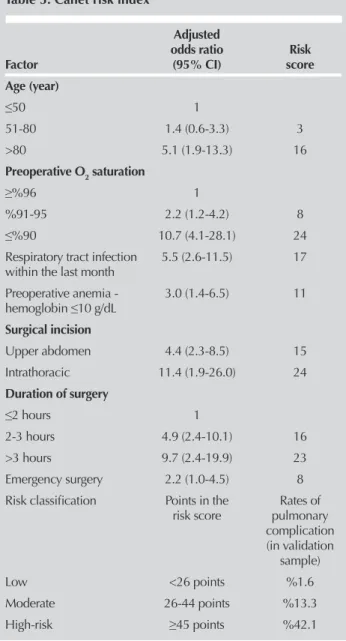
The Canet Risk Index can be used (Table 3) [63]. Being eas-ily applicable and containing already existing clinical infor-mation are among the advantages of this index.
Perioperative therapeutic approaches should be implemented to reduce the risk in patients considered to be at moderate risk. It is not appropriate to make recommendations on the anes-thesia technique that is going to be performed. Another issue is refraining from the issues that are irrelevant to the proce-dure. The consulting clinician should evaluate the patient in terms of surgery, perioperative risk, and necessity for further analysis and intervention. Other issues (patient education, immunization, etc.) can be planned after surgery or on admis-sion to the outpatient clinic. After consultation, some patients may ask questions about whether surgery could be performed. The patient may be informed about perioperative pulmonary complications, stating that the last decision needs to be made by the surgeon, together with the patient.
10. PREOPERATIVE EVALUATION IN PEDIATRIC PATIENTS WITH CHEST DISEASE
1) Aim
The aim of the preoperative pulmonary evaluation is to deter-mine the risk of postoperative pulmonary complications, which is approximately 9.6% in children with pulmonary problems, and to minimize the potential problems [64]. Clinically significant postoperative pulmonary complications include atelectasis; infections, like bronchitis and pneumo-nia; prolonged mechanical ventilation and respiratory fail-ure; exacerbation of underlying chronic pulmonary disease; and bronchospasm [65]. Patient-related risk factors for peri-operative pulmonary complications include general health status, age, upper respiratory tract infection, asthma, chronic pulmonary disease, and obstructive sleep apnea syndrome. Surgery-related known risk factors include thoracic and upper abdominal surgeries and surgical procedures lasting longer than 3 hours [4,66].
Table 2. Arozullah respiratory failure risk index [10]
Preoperative risk factors Score
Type of surgery
Abdominal aortic aneurysm 27 Thorax 21 Brain surgery, upper abdomen, peripheral vascular surgery 14
Neck 11
Emergency surgery 11 Albumin <3.0 g/dL 9 BUN >30 mg/dL 8 Dependent functional status 7 History of COPD 6 Age
>70 years 6
60-69 years 4
2) Preoperative Risk Assessment
Anamnesis and physical examination are the keystones of the preoperative risk assessment. Measurement of oxygen saturation by a pulse oximeter is beneficial in assessing the risk before high-risk surgical interventions. Laboratory tests that could be requested in the preoperative period include pulmonary function test, arterial blood gases, and chest x-ray [67]. Criteria that are suggestive of enhanced risk in the pre-operative period include [68] FEV1 <70% (of the predicted value), FVC <70% (of the predicted value), and FEV1/FVC <65% (of the predicted value). It has been emphasized that the risk of postoperative pulmonary complications is high in patients with PaCO2 >45 mm Hg [69].
Upper respiratory tract infections: In patients with a body tem-perature >38.5°C, purulent nasal discharge, and symptoms of a lower respiratory tract infection (productive cough, rales, rhon-chi, and positive chest x-ray finding), surgery should be post-poned for 4-6 weeks until the disappearance of symptoms [70]. Asthma: Frequent use of bronchodilators, acute asthma attacks in recent times, and hospital admissions pose
impor-tant risks for perioperative bronchospasm. The primary goal in an asthmatic patient is to perform the surgical procedure during the asymptomatic period [71]. The patient has to be free of wheezing, and peak expiratory flow should be at the best personal value or higher than 80% of the predicted value before surgery [72]. An inhaled beta-2 adrenergic ago-nist can be used 1-2 hours before the surgery in patients with controlled asthma. Inhaled corticosteroid and regular use of inhaled beta-2 agonists 1 week before the surgery are appro-priate in patients with moderately controlled asthma. In patients with poorly controlled asthma, one of the following should be added to the treatment that is given to patients with moderately controlled asthma: oral prednisone (1 mg/ kg/day, maximum dose: 60 mg/day) or oral dexamethasone (0.6 mg/kg/day, maximum dose: 16 mg/day) 3-5 days before surgery or oral methylprednisolone (1 mg/kg/day) for 2 days before surgery [73].
Bronchopulmonary Dysplasia: Room air oxygen saturation, PaCO2, blood gas, baseline oxygenation, and acid/base bal-ance should be analyzed. The probability of pulmonary hypertension should be kept in mind, and electrocardiogra-phy and an echocardiographic examination should be requested when necessary [74]. BPD patients with airway hyperactivity may benefit from short-acting beta-2 agonists given 1-2 hours before the induction of anesthesia.
Obstructive sleep apnea syndrome: In the preoperative period, serum electrolytes, blood gases (high bicarbonate levels may be encountered as a metabolic response to chronic hypercarbia), room air oxygen saturation measured by a pulse oximeter, and hematocrit level (hematocrit levels may be elevated as a response to chronic hypoxia) should be analyzed in such children [75].
Cystic Fibrosis: In the preoperative period, chest x-ray, pul-monary function test, blood glucose, sputum culture and antibiogram, hepatic function tests, serum electrolyte levels, and complete blood count should be requested [76]. If needed, coagulation tests, blood gases, and an echocardio-graphic examination should be considered. Signs of active infection in the preoperative period necessitate hospitaliza-tion and preoperative intensive pulmonary treatment [77]. Neuromuscular Diseases: Oxygen saturation (pulse oxime-ter), blood gas (PaCO2), respiratory function test (the risk increases if FVC is <50%), and echocardiography should be requested [78,79]. Education on non-invasive mechanical ventilation should be given to patients with a risk of hypoventilation in the preoperative period, and education on the mechanical insufflation-exsufflation device should be given to patients who can not cough effectively [79,80]. Primary Ciliary Dyskinesia: In the preoperative preparation of primary ciliary dyskinesia, the active pulmonary infection is treated, and the presence of any organ inversion (inverted location) is investigated [73].
REFERENCES
1. Spence AA. Postoperative Complications. In: Nunn JF, Utting JE, Brown Jr BR (eds). General Anaesthesia. 5th ed. London: Butterworths, 1989:1149-60.
Table 3. Canet risk index
Adjusted
odds ratio Risk
Factor (95% CI) score
Age (year) ≤50 1 51-80 1.4 (0.6-3.3) 3 >80 5.1 (1.9-13.3) 16 Preoperative O2 saturation ≥%96 1 %91-95 2.2 (1.2-4.2) 8 ≤%90 10.7 (4.1-28.1) 24 Respiratory tract infection 5.5 (2.6-11.5) 17 within the last month
Preoperative anemia - 3.0 (1.4-6.5) 11 hemoglobin ≤10 g/dL Surgical incision Upper abdomen 4.4 (2.3-8.5) 15 Intrathoracic 11.4 (1.9-26.0) 24 Duration of surgery ≤2 hours 1 2-3 hours 4.9 (2.4-10.1) 16 >3 hours 9.7 (2.4-19.9) 23 Emergency surgery 2.2 (1.0-4.5) 8 Risk classification Points in the Rates of
risk score pulmonary complication (in validation sample) Low <26 points %1.6 Moderate 26-44 points %13.3 High-risk ≥45 points %42.1
50
2. Dureuil B, Cantineau JP, Desmonts JM. Effects of upper or lower abdominal surgery on diafragmatic functions. Br J Anaesth 1987;59:1230-5. [CrossRef]
3. O’Donohue W. Postoperative pulmonary complications. Postgrad Med 1992;91:167-75.
4. McAlister FA, Khan NA, Straus SE, et al. Accuracy of the preope-rative assessment in predicting pulmonary risk after non thoracic surgery. Am J Respir Crit Care Med 2003;167:741-4. [CrossRef]
5. Qaseem A, Snow V, Fitterman N, et al. Risk Assessment forand Strategies To Reduce Perioperative Pulmonary Complications for Patients Undergoing Noncardiothoracic Surgery: A Guideline from the American College of Physicians. Ann Intern Med 2006;144:575-80. [CrossRef]
6. Smetana GW. Preoperative pulmonary evaluation: Identify in gandreducing risks for pulmonary complications. Cleveland Clinic Journal of Medicine 2006;73:36-41. [CrossRef]
7. Kroenke K, Lawrence VA, Theroux JF, et al. Postoperative complications after thoracic and major abdominal surgery in patients with and without obstructive lung disease. Chest 1993;104:1445-51. [CrossRef]
8. Warner DO, Warner MA, Barnes RD, et al. Perioperative respi-ratory complications in patients with asthma. Anesthesiology 1996;85:460-7. [CrossRef]
9. Barrera R, Shi W, Amar D, et al. Smoking and timing of cessati-on. Impact on pulmonary complications after thoracotomy. Chest 2005;127:1977-83. [CrossRef]
10. Wetterslev J, Hansen EG, Kamp-Jensen M, et al. PaO2 during anaesthesia and years of smoking predictlate postoperative hypoxaemia and complications after upper abdominal surgery in patients without preoperative cardiopulmonary dysfunction. Acta Anaesthesiol Scand 2000;44:9-16. [CrossRef]
11. Bapoje SR, Whitaker JF, Schulz, et al. Preoperative evaluation of the patient with pulmonary disease. Chest 2007;132:1637-45. [CrossRef]
12. Meyers JR, Lembeck L, O’Kane H, Baue AE. Changes in functi-on alresidual capacity of thel ungafter operatifuncti-on. Arch Surg 1975;110:576-83. [CrossRef]
13. Craig DB. Postoperative recovery of pulmonary function. Anesth Analg 1981;60:46-52. [CrossRef]
14. Gross JB, Bachenberg KL, Benumof JL, et al. Practice guidelines for the perioperative management of patients with obstructive sleep apnea: a report by the American Society of Anesthesiologists Task Force on Perioperative Management of patients with obstructive sleep apnea. Anesthesiology 2006;104:1081-93. [CrossRef]
15. Smetana GW, Lawrence VA, Cornell JE. Preoperative Pulmonary Risk Stratification for Noncardiothoracic Surgery: Systematic Review for the American College of Physicians. Ann Intern Med 2006;144:581-95. [CrossRef]
16. Arozullah AM, Daley J, Henderson WG, Khuri SF. Multifactorial risk index for predicting postoperative respiratory failure in men after major noncardiac surgery. The National Veterans Administration Surgical Quality Improvement Program. Ann Surg 2000;232:242-53. [CrossRef]
17. Smetana GW. Peroperative pulmonary evaluation. N Engl J Med 1999;340:937-44. [CrossRef]
18. Bailey SH, Bull DA, Harpole DH, et al. Outcomes after esopha-gectomy: a ten-year prospective cohort. Ann Thorac Surg 2003;75:217-22. [CrossRef]
19. Fuso L, Cisternino L, Di Napoli A, et al. Role of spirometri can darterialgas data in predicting pulmonary complications after abdominal surgery. Respir Med 2000;94:1171-6. [CrossRef]
20. Becquemin JP, Piquet J, Becquemin MH, et al. Pulmonary function after transverse or midlineincision in patients with obstructive pul-monary disease. Intensive Care Med 1985;11:247-51. [CrossRef]
21. Pedersen T, Eliasen K, Henriksen E. A prospective study of mortality associated with anaesthesia and surgery: risk indicators of mortality in hospital. Acta Anaesthesiol Scand 1990;34:176-82. [CrossRef]
22. Rezaiguia S, Jayr C. Prevention of respiratory complications after abdominal surgery. Ann Fr Anesth Reanim 1996;15:623-46. [CrossRef]
23. Tarhan S, Moffitt EA, Sessler AD, et al. Risk of anesthesia and surgery in patients with chronic bronchitis and chronic obstruc-tive pulmonary disease. Surgery 1973;74:720-6.
24. Enquist A, Brandt MR, Fernandes A, et al. The blocking effect of epidural analgesia on the adrenocorticaland hyperglyce micres-ponse to surgery. Acta Anaesth Scand 1977;21:330-5. [CrossRef]
25. Sundberg A, Wattwil M, Arvill A. Respiratory effects of high thoracic epidural anaesthesia. Acta Anaesthesiol Scand 1986;30:215-7. [CrossRef]
26. Berg H, Viby-Mogensen J, Roed J, et al. Residual neuromuscu-lar block is a risk factor for postoperative pulmonary compli-cations: a prospective, randomised, and blinded study of postoperative pulmonary complications after at racurium, vecuronium, and pancuronium. Acta Anaesthesiol Scand 1997;41:1095-103. [CrossRef]
27. Mitchell CK, Smoger SH, Pfeifer MP, et al. Multivariate analysis of factors associated with postoperative pulmonary complications follo-wing general elective surgery. Arch Surg 1998;133:194-8. [CrossRef]
28. Sweitze BJ, Smetana GW. Identification an devaluation of the patient with lung disease. Anesthesiology Clin 2009;27:673-86. [CrossRef]
29. Milledge JS, Nunn JF. Criteria of fitness for anaesthesia in patients with chronic obstructive lung disease. BMJ 1975;3:670-3. [CrossRef]
30. Vintch JRE, Hansen JE. Preoperative evaluation and andrelation-to posandrelation-toperative complications. In: Crapo JD, Glassroth J, Karlinsky J, King TE (eds). Baum’s Text book of Pulmonary Disease. 7th ed. Lippincot Williams&Wilkins 2004:113-32. 31. Epstein SK, Falling LJ, Daly BD, Celli BR. Predicting
complica-tions after pulmonary resection: preoperative exercise testing vs a multifactorial cardiopulmonary risk index. Chest 1993;104:694-700. [CrossRef]
32. Silvanus MT, Groeben H, Peters J. Corticosteroids and inhaled salbutamol in patients with reversible airway obstruction mar-kedly decrease the incidence of bronchospasm after tracheal intubation. Anesthesiology 2004;100:1052-7. [CrossRef]
33. Ie K, Yoshizawa A, Hirano S, et al. A survey of perioperative asthmatic attack among patients with bronchial asthma under-went general anesthesia. Arerugi 2010;59:831-8.
34. Rooke GA, Choi JH, Bishop MJ. The effect of isoflurane, halot-hane, sevoflurane, and thiopental/nitrousoxide on respiratory system resistance after tracheal intubation. Anesthesiology 1997;86:1294-9. [CrossRef]
35. Kim ES, Bishop MJ. Endotracheal intubation, but not laryngeal mask airway insertion, produces reversible bronchoconstricti-on. Anesthesiology 1999;90:391-4. [CrossRef]
36. Dureuil B. Management of the COPD patient undergoing sur-gery. In: Similowski T, Whitelaw WA, Durenne JP (eds). Clinical management of chronic obstructive pulmonary disease. Basel, Marcel Dekker, 2002:871-94.
37. Gross JB, Bachenberg KL, Benumof JL, et al. American Society of Anesthesiologists Task Force on Perioperative Management. Practice guidelines for the perioperative management of pati-ents with obstructive sleep apnea: a report by the American Society of Anesthesiologists Task Force on Perioperative Management of patients with obstructive sleep apnea. Anesthesiology 2006;104:1081-93. [CrossRef]
38. Adesanya AO, Lee W, Greilich NB, Joshi GP. Perioperative management of Obstructive Sleep Apnea. Chest 2010;138:1489-98. [CrossRef]
39. Bağ R. Akciğer transplantasyonu: Genel Bakış ve Endikasyonlar. In: Özlü T, Metintaş M, Karadağ M, Kaya A (eds). Solunum Sistemi ve Hastalıkları. İstanbul Tıp Kitapevi, İstanbul. 2010:2573-85.
40. Orens JB, Estenne M, Arcasoy S, et al. International guidelines for the selection of lung transplant candidates: 2006 update-a consensus report from the Pulmonary Scientific Council of the International Society for Heart and Lung Transplantation. J Heart Lung Transplant 2006;25:745-55. [CrossRef]
41. Theodoma A, Cropley MPrevettoni G, Webb G. The effective-nes of smoking cessations interventions prior to surgery: A systemic review. Nicotine Tob Res 2008;10:407-12. [CrossRef]
51
42. Zaki A, Abrishami A, Wong J, Chung FF. Interventions in the perioperative clinic for long term smoking cessation: a quanta-tive systemic revew. Can J Anasth 2008;55:11-21. [CrossRef]
43. Wong J, Abrishami A, Yang Y, et al. Perioperative smoking cessation intervention with varenicline: A double-blind, randomized, placebo-controlled trial. Anesthesiology. 2012;117:755-64. [CrossRef]
44. Eyüpoğlu FÖ. Operasyon öncesi hazırlık. İn: Zamani A (ed). Perioperatif pulmoner değerlendirme. İstanbul. Toraks Kitapları, 2006:65-71.
45. Gülbay B, Çelik G. Özel durumlarda preoperatif pulmoner değerlendirme. İn: Zamani A (Ed). Perioperatif pulmoner değer-lendirme. İstanbul. Toraks Kitapları, 2006;17-40.
46. Stoller JK. Clinical practice. Acute exacerbations of chronic obstructi-ve pulmonary disease. N Engl J Med 2002;346:988-94. [CrossRef]
47. Carrie LES, Simpson PJ, Popat MT. Preoperative preperation. Practical procedures. Update in Anesthesia 1997;7:2-12. 48. Kaboli P, Henderson MC, White RH. DVT prophylaxis and
anticoagulation in the surgical patient. Med Clin North Am 2003;87:77-110. [CrossRef]
49. Regan K, Kleinfeld ME, Eric PC. Physical therapy for patients with abdominal or thoracic surgery. In: İrwin S, Tecklin JS, (eds). Cardiopulmonary phyisical therapy 2st ed. St. Louis, Mosby, 1990:323-41.
50. Özalevli S. Preoperatif ve postoperatif pulmoner rehabilitasyon. İn:Erk M, Ergün P (eds). Pulmoner Rehabilitasyon. İstanbul, Toraks kitapları, sayı 8:179-93.
51. Denehy L, Berney S. The use of positive pressure devices by physiotherapy. Eur Resp J 2001;17:821-9. [CrossRef]
52. Lawrence VA, Cornell JE, Smetana GW. Strategies to reduce postoperative pulmonary complications after noncardiothora-cic surgery: systematic review for the American College of Physicians. Ann Intern Med 2006;144:596-608. [CrossRef]
53. van den Berghe G, Wouters P, Weekers F, et al. Intensive insu-lin therapy in the critically ill patients. N Engl J Med 2001;345:1359-67. [CrossRef]
54. Gaensler EA, Cugell DW, Lindgren I, et al. The role of pulmo-nary insufficiency in mortality and invalidism following surgery for pulmonary tuberculosis. J Thorac Surg 1955;29:163-87. 55. British Thoracic Society, Society of Cardiothoracic Surgeons of
Great Britain and Ireland Working Party. BTS guidelines: guide-lines on the selection of patients with lung cancer for surgery. Thorax 2001;56:89. [CrossRef]
56. Colice GL, Shafazand S, Griffin JP, et al. Physiologic evaluation of the patient with lung cancer being considered for resectional surgery: ACCP evidenced-based clinical practice guidelines (2nd edition). Chest 2007;132:161-77. [CrossRef]
57. Beckles MA, Spiro SG, Colice GL, et al. The physiologic evalu-ation of patients with lung cancer being considered for resecti-onal surgery. Chest 2003;123:105-14. [CrossRef]
58. Brunelli A, Charloux A, Bolliger CT, et al. ERS/ESTS clinical guidelines on fitness for radical therapy in lung cancer patients (surgery and chemo-radiotherapy). Eur Respir J 2009;34:17-41. [CrossRef]
59. Marshall MC, Olsen GN. The physiologic evaluation of the lung resection candidate. Clin Chest Med 1993;14:305-20. 60. Olsen GN, Bolton JW, Weiman DS, Hornung CA. Stair climbing as
an exercise test to predict the postoperative complications of lung resection. Two years’ experience. Chest 1991;99:587-90. [CrossRef]
61. Bolliger CT, Jordan P, Solèr M, et al. Exercise capacity as a pre-dictor of postoperative complications in lung resection candi-dates. Am J Respir Crit Care Med 1995;151:1472-80. [CrossRef]
62. Archer C, Levy AR, McGregor M. Value of routine preoperative chest X-rays: a meta-analysis. Can J Anaesth 1993;40:1022-7. [CrossRef]
63. Canet J, Gallart L, Gomar C, et al. Prediction of postoperative pulmonary complications in a population-based surgical cohort. Anesthesiology 2010;113:1338-55. [CrossRef]
64. Lawrence VA, Hilsenbeck SG, Mulrow CD, et al. Incidence and hospital stay for cardiac and pulmonary complications after abdominal surgery. J Gen Intern Med 1995;10:671-8. [CrossRef]
65. Hall JC, Tarala RA, Hall JL, Mander J. A multivariate analysis of the risk of pulmonary complications after laparotomy.Chest 1991;99:923-7. [CrossRef]
66. Brooks-Brunn JA. Predictors of postoperative pulmonary complicati-ons following abdominal surgery. Chest 1997;111:564. [CrossRef]
67. Lawrence VA, Page CP, Harris GD. Preoperative spirometry before abdominal operations. A critical appraisal of its predicti-ve value. Arch Intern Med 1989;149:280. [CrossRef]
68. Gass GD, Olsen GN. Preoperative pulmonary function testing to predict postoperative morbidity and mortality. Chest 1986; 89:127. [CrossRef]
69. Tisi GM. Preoperative evaluation of pulmonary function. Validity, indications, and benefits. Am Rev Respir Dis 1979;119:293-310.
70. Folkerts G, Busse WW, Nijkamp FP, et al. Virus-induced airway hyperresponsivemenss and asthma. Am J Respir Crit Care Med 1998;157:1708-20. [CrossRef]
71. Tirumalasetty J, Grammer LC. Asthma, Surgery, and General Anesthesia: A Review. Journal of Asthma 2006;43:251-4. [CrossRef]
72. Sharif al-ruzzeh, Vıjı Kurup. Respiratory diseases. In: Roberta L. Hines, Katherine E. Marschall eds. Stoelting’s anesthesia and co-existing disease, 6th ed. Philadelphia: Elsevier Saunders, 2012;181-217.
73. NAEPP Expert Panel Report, Guidelines for the Diagnosis and Management of Asthma-Update on Selected Topics 2002. 74. Lauer R, Vadi M, Mason L. Anaesthetic management of the
child with co-existing pulmonary disease. Br J Anaesth 2012;109 Suppl 1:i47-i59. [CrossRef]
75. Abman S. Pulmonary hypertension in chronic lung disease in infancy; pathogenesis, pathophysiology and treatment. In: Bland R, Coalson J, eds. Chronic Lung Disease of Early Infancy. New York, NY: Marcel Dekker; 1999.[CrossRef]
76. Walsh TS, Young CH. Anaesthesia and cystic fibrosis. Anaesthesia 1995l;50:614-22. [CrossRef]
77. Smith TB, Stonell C, Purkayastha S, Paraskevas P. Cardiopulmonary exercise testing as a risk assessment method in non cardio-pulmonary surgery: a systematic review. Anaesthesia 2009;64:883-93. [CrossRef]
78. Birnkrant DJ, Panitch HB, Benditt JO et al. American college of chest physicians consensus statement on the respiratory and related management of patients with Duchenne muscular dystrophy undergoing anesthesia or sedation. Chest 2007;132:1977-86. [CrossRef]
79. American Academy of Pediatrics Section on Cardiology and Cardiac Surgery. Cardiovascular health supervision for indivi-duals affected by Duchenne or Becker muscular dystrophy. Pediatrics 2005;116:1569-73. [CrossRef]
80. Birnkrant DJ, Ferguson RD, Martin JE et al. Noninvasive ventila-tion during gastrostomy tube placement in patients with severe Duchenne muscular dystrophy: case reports and review of the literature. Pediatr Pulmonol 2006;41:188-93. [CrossRef]
![Table 2. Arozullah respiratory failure risk index [10]](https://thumb-eu.123doks.com/thumbv2/9libnet/3979778.52936/7.914.466.814.127.435/table-arozullah-respiratory-failure-risk-index.webp)