Endovascular treatment of an iliac artery rupture
caused by invasive Salmonella spondylodiscitis
Correspondence: Ebru Kursun, MD. Başkent Üniversitesi Hastanesi
Dadaloğlu Mah. Serinevler 2591 Sk. 4/A, 01250, Yuregir, Adana, Turkey. Tel: +90 533 – 268 10 68 e-mail: [email protected]
Submitted: November 11, 2012 Accepted: June 10, 2013 ©2014 Turkish Association of Orthopaedics and Traumatology
Available online at www.aott.org.tr doi: 10.3944/AOTT.2014.3107 QR (Quick Response) Code
CASE REPORT Acta Orthop Traumatol Turc 2014;48(4):459-462 doi: 10.3944/AOTT.2014.3107
Ebru KURŞUN1, Tuba TURUNÇ1, Uğur ÖZKAN2, Yusuf Ziya DEMİROĞLU1
1Department of Infectious Diseases, Adana Practice and Research Center, Faculty of Medicine, Başkent University, Adana, Turkey; 2Department of Radiology, Adana Practice and Research Center, Faculty of Medicine, Başkent University, Adana, Turkey
The rate of non-typhoid Salmonella infections has increased remarkably in recent years. Endovascular system infection is one of the most serious forms of extraintestinal Salmonella infection. The abdomi-nal aorta is frequently involved, while bone and joint involvement are rarely seen. We present a rare case of successful endovascular treatment of a left iliac artery rupture and pseudoaneurysm both oc-curring due to the direct invasion of lumbar spondylodiscitis caused by Salmonella typhimurium. Key words: Endovascular treatment; pseudoaneurysm; Salmonella typhimurium; spondylodiscitis; stent graft.
The rate of non-typhoid Salmonella infections has grad-ually increased worldwide. Salmonella bacteria usgrad-ually originate from food and cause gastroenteritis, bactere-mia and focal infections.[1] Advanced age, changes in
en-dogenous intestinal flora, diabetes, cancer, autoimmune disorders, HIV infection, and therapeutic immunosup-pression are risk factors for non-typhoid salmonellosis
and bacteremia.[2] Endovascular system infection is one
of the most serious forms of extraintestinal infection and endovascular Salmonella infections usually result in
mycotic abdominal aortic aneurysms.[3] While
success-ful endovascular treatment of Salmonella mycotic
aneu-rysms has been reported,[4-9] endovascular treatment of
iliac artery ruptures and pseudoaneurysms caused by
Salmonella invasion have not.
We present a rare case in which an iliac artery rup-ture caused by S. typhimurium spondylodiscitis received successful endovascular treatment.
Case report
A 57-year-old hypertensive and diabetic male patient presented to our emergency service with walking diffi-culty. The patient had experienced back pain and numb-ness in his left leg for 15 days. His anamnesis revealed that he had used various antibiotics due to high fever. During follow-up treatment for a urinary infection in another center, an aortic aneurysm was detected on his abdominal ultrasonography and he was transferred to our hospital.
On physical examination, the patient’s body tem-perature was 38°C, blood pressure was 130/70 mmHg and pulse was 112 beats/min. His overall condition was stable and he was conscious, cooperative and oriented. Paresthesia was observed in the left lower extremity and no pulse was present. Laboratory results were as follows;
white blood cell count: 10,700/mm3; hemoglobin: 9.0
Acta Orthop Traumatol Turc
460
protein: 205 mg/L; erythrocyte sedimentation rate: 72 mm/hour; and creatinine: 0.7 mg/dL. Abdominal con-trast-enhanced computed tomography images revealed a ruptured left main iliac artery and a 6x10 cm left retro-peritoneal pseudoaneurysm (Fig. 1a). Lumbar magnetic resonance imaging (MRI) was performed on the patient to confirm spondylodiscitis. The lumbar MRI revealed pathological signal change and contrast uptake on the anterior aspect of the L4 and L5 vertebral corpus and an approximately 10x6 cm hematoma in the left psoas muscle (Fig. 1b).
Implantation of a stent graft was performed in the angiography unit by interventional radiologists. Single-wall punctures of the bilateral common femoral arteries (CFA) were performed with an 18-G needle under ul-trasound guidance. After the first puncture, 6-F vascu-lar sheaths were inserted. The patient received a bolus of 5000 IU of heparin, and diagnostic angiograms were obtained. After placing the sutures of the Prostar XL closure devices (Abbott Vascular, Redwood, CA, USA), large vascular sheaths, compatible with the stent graft system, were introduced into the common femoral
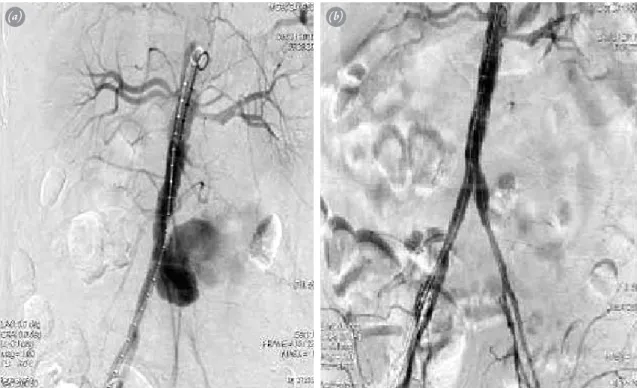
arter-Fig. 2. (a) Preoperative abdominal aortography reveals left iliac artery rupture and pseudoaneurysm. (b) After implantation of
aortoiliac stent graft, abdominal aortography shows successful treatment of left iliac artery rupture and pseudoaneurysm.
(a) (b)
Fig. 1. (a) Abdominal contrast-enhanced CT image shows left iliac artery rupture and pseudoaneurysm (arrow). (b) Lumbar
contrast-enhanced MR image shows contrast enhancement of corpus of L4 and L5 vertebras due to spondylodiscitis (arrows).
(b) (a)
Kurşun et al. Endovascular treatment of an iliac artery rupture caused by invasive Salmonella spondylodiscitis 461
ies. The left iliac artery rupture and related pseudoan-eurysm were successfully closed by placing a bifurcated aortoiliac stent graft (The Gore® Excluder®; W.L. Gore & Associates, Inc., Flagstaff, AZ, USA). After deploy-ment of the stent graft system, the suture knot was pre-pared. Preoperative and postoperative angiographies are shown in Figure 2. A drainage catheter was placed into the pseudoaneurysm in the same session.
Empirical treatment with intravenous teicoplanin was commenced at a dose of 800 mg/day after the hema-toma and blood cultures were obtained and maintained at 400 mg/day in combination with a 3 g/day dose of intravenous meropenem. The hematoma and blood cul-tures revealed S. typhimurium growth. Antibiotic treat-ment was halted in response to culture antibiogram results and treatment with intravenous ciprofloxacin was applied at a dose of 2x400 mg. A consultation was requested from the physical therapy and rehabilitation department and the patient was enrolled in an exercise program to build strength in the left leg and improve his ability to walk. By the seventh day of his hospital stay, the patient’s condition improved and body temperature decreased and he was discharged with 750 mg cipro-floxacin tablets to be taken twice daily. The patient was kept on antibiotics for six months. After five months, a lumbar MRI was performed which confirmed a consid-erable decrease in the dimensions of the hematoma, now approximately 83x47 mm in the left psoas muscle. A CT scan showed that the aortoiliac stent graft was patent.
Discussion
Non-typhoid Salmonella bacteria originate from con-taminated food and cause gastroenteritis, bacteremia and focal infections.[1] The prevalence of these bacteria has
been gradually increasing worldwide. Local bone infec-tions account for less than 1% of Salmonella infecinfec-tions. According to the literature, spondylodiscitis is a rare local manifestation of Salmonella infection.[10-15] However, S.
typhimurium should still be considered as a possible
caus-ative agent in bone and joint infections. Local Salmonella infections are rarely seen in those with normal immune systems. Advanced age, changes in endogenous intestinal flora, sickle cell anemia, diabetes mellitus, cancer, autoim-mune disorders, HIV infection, and therapeutic immu-nosuppression are the main risk factors for non-typhoid salmonellosis and bacteremia.[2,10] In the current case, the
patient’s sole risk factor was diabetes mellitus.
Endovascular system infection is one of the most se-rious forms of extraintestinal Salmonella infection and frequently involves the abdominal aorta.[3] Salmonella is a
common causative bacteria for inducing infectious aortic
aneurysm and spondylodiscitis at the contiguous spine.
[16] When the spine or aorta is the first to be infected, the
septic embolus settles in the vasa vasorum and the infec-tion travels along the outside of the neighboring blood vessels to the neighboring organs. Infectious aortic an-eurysms and spondylodiscitis occur simultaneously in
many cases.[13] When Salmonella cases with vascular
in-volvement were analyzed, it was observed that antibio-therapy was generally commenced together with surgical intervention. However, endovascular interventions have also been reported in case reports.[4-10] Two cases with
mycotic aneurysm have been reported in the literature. Mahlfeld et al.[12] reported three spondylodiscitis cases
caused by S. typhimurium and detected an abdominal aortic aneurysm in one. Since the other case Mahlfeld et al. reported had undergone an operation due to an aortic aneurysm three years prior, either the aneurysm or the spine could have been the source of infection. Learch et al.[17] reported a case of spondylodiscitis associated with
an abdominal aortic aneurysm and paravertebral abscess caused by S. enteritides. The patient in their case under-went antibiotherapy and exploratory laparotomy with mycotic aneurysm resection, closure of the proximal aorta and common iliac arteries and insertion of an axil-lary bifemoral bypass.
The present case is the first reported case of a S.
ty-phimurium infection causing spondylodiscitis and iliac
artery rupture. Our patient had diabetes and hyperten-sion, which may have led to vascular pathologies. Unlike the surgical interventions performed on a few number of cases with iliac artery involvement in the literature, our patient underwent successful endovascular intervention. Weber and Pirovino reported successful surgical inter-vention and antibiotic treatment of a right iliac artery aneurysm caused by S. typhimurium.[18] Ben et al.[19]
re-ported an aneurysm of the right common iliac artery in-fected by Salmonella group C1. Antibiotic treatment and surgical intervention with an aneurysmectomy and su-prapubic crossover femorofemoral artery graft resulted in a good recovery and outcome. Despite limited expe-rience, antibiotherapy together with endovascular inter-vention might provide a lower-risk alternative to conven-tional surgery while similarly retaining normal vascular anatomy. We are of the opinion that the present report contributes to the literature a unique and intriguing case.
In conclusion, S. typhimurium may result in spondy-lodiscitis and vascular involvement and should be kept in mind as a causative agent given such clinical condi-tions. Medical treatment combined with endovascular stent grafts may serve as an alternative option to surgical treatment.
Acta Orthop Traumatol Turc
462
Conflicts of Interest: No conflicts declared.
References
1. Hohmann EL. Nontyphoidal salmonellosis. Clin Infect Dis 2001;32:263-9.
2. Hsu RB, Tsay YG, Chen RJ, Chu SH. Risk factors for primary bacteremia and endovascular infection in patients without acquired immunodeficiency syndrome who have nontyphoid salmonellosis. Clin Infect Dis 2003;36:829-34.
3. Drinković D, Taylor SL, Lang S. Five cases of non-ty-phoidal Salmonella endovascular infection. Intern Med J 2004;34:641-5.
4. Berchtold C, Eibl C, Seelig MH, Jakob P, Schönleben K. Endovascular treatment and complete regression of an infected abdominal aortic aneurysm. J Endovasc Ther 2002;9:543-8.
5. Koeppel TA, Gahlen J, Diehl S, Prosst RL, Dueber C. Mycotic aneurysm of the abdominal aorta with retroperi-toneal abscess: successful endovascular repair. J Vasc Surg 2004;40:164-6.
6. Ting AC, Cheng SW, Ho P, Poon JT. Endovascular repair for multiple Salmonella mycotic aneurysms of the thoracic aorta presenting with Cardiovocal syndrome. Eur J Car-diothorac Surg 2004;26:221-4.
7. Forbes TL, Harding GE. Endovascular repair of Salmo-nella-infected abdominal aortic aneurysms: a word of cau-tion. J Vasc Surg 2006;44:198-200.
8. Kam MH, Toh LK, Tan SG, Wong D, Chia KH. A case report of endovascular stenting in Salmonella mycotic aneurysm: a successful procedure in an immunocompro-mised patient. Ann Acad Med Singapore 2007;36:1028-31.
9. Hartman V, Jiang H, Thomas B. Succesful [Successful] endovascular repair of an abdominal mycotic aneurysm. A case report. Acta Chir Belg 2009;109:788-90.
10. Hook EW. Salmonella species (including typhoid fever). In: Mandel GL, Douglas RG, Bennett JE, editors. Prin-ciples and practice of infectious diseases. Edinburgh: Churchill Livingstone; 1990. p. 1700-10.
11. Tautenhahn J, Fahlke J, Halloul Z, Grasshoff H, Bürg-er T. Single intBürg-ervention for treatment of Salmonella typhimurium-induced symptomatic abdominal aortic aneurysm with spondylitis. [Article in German] Vasa 2001;30:293-6. [Abstract]
12. Mahlfeld K, Franke J, Grasshoff H. Spondylitis due to Sal-monella typhimurium. [Article in German] Unfallchirurg 2003;106:334-8. [Abstract]
13. Chang IC. Salmonella spondylodiscitis in patients without sickle cell disease. Clin Orthop Relat Res 2005; 430:243-7.
14. Winkelmann W, Schulitz KP. Spondylitis caused by Sal-monella typhimurium (author’s transl). [Article in Ger-man] Z Orthop Ihre Grenzgeb 1977;115:6-8. [Abstract] 15. Choukroun G, Quint L, Amoura Z, Boudes P, Guillevin
L. Salmonella typhi murium spondylodiscitis in system-ic lupus. [Artsystem-icle in French] Ann Med Interne (Paris) 1988;139:446-7. [Abstract]
16. Kim JM, Park YH, Kim D, Park MJ, Ahn HJ, Ryoo BY, Yang SH. Salmonella vertebral osteomyelitis with sepsis in healthy adult. Korean J Med 2005;69:1003-8.
17. Learch TJ, Sakamoto B, Ling AC, Donovan SM. Salmo-nella spondylodiscitis associated with a mycotic abdomi-nal aortic aneurysm and paravertebral abscess. Emerg Ra-diol 2009;16:147-50.
18. Weber E, Pirovino M. Mycotic aneurysm of the iliac artery caused by Salmonella infection. A case report. [Article in German] Helv Chir Acta 1992;58:601-7. [Abstract] 19. Ben RJ, Peng MY, Hsu GJ, Chen SG, Lee FY, Chou MY,
et al. Infected common iliac aneurysm due to Salmonella: a case report. [Article in Chinese] Zhonghua Yi Xue Za Zhi (Taipei) 1993;52:62-5. [Abstract]