SELÇUK ÜNİVERSİTESİ
SOSYAL BİLİMLER ENSTİTÜSÜ
YABANCI DİLLER EĞİTİMİ ANABİLİM DALI
İNGİLİZCE ÖĞRETMENLİĞİ BİLİM DALI
TEACHING ENGLISH TO PRIMARY SCHOOL STUDENTS
THROUGH GAMES (İLKÖĞRETİM OKULU
ÖĞRENCİLERİNE İNGİLİZCEYİ OYUNLARLA ÖĞRETME)
YÜKSEK LİSANS TEZİ
HAZIRLAYAN
Ece Cimcim
DANIŞMAN
DOÇ. DR. Hasan ÇAKIR
Sosyal Bilimler Enstitüsü Müdürlüğü
BİLİMSEL ETİK SAYFASI
Bu tezin proje safhasından sonuçlanmasına kadarki bütün süreçlerde bilimsel etiğe ve akademik kurallara özenle riayet edildiğini, tez içindeki bütün bilgilerin etik davranış ve akademik kurallar çerçevesinde elde edilerek sunulduğunu, ayrıca tez yazım kurallarına uygun olarak hazırlanan bu çalışmada başkalarının eserlerinden yararlanılması durumunda bilimsel kurallara uygun olarak atıf yapıldığını bildiririm.
T.C.
SELÇUK ÜNİVERSİTESİ Sosyal Bilimler Enstitüsü Müdürlüğü
YÜKSEK LİSANS TEZİ KABUL FORMU
Ece Cimcim tarafından hazırlanan Teaching English To Primary School Students Through Games ( İngilizceyi İlköğretim Okulu Öğrencilerine Oyunlarla Öğretme) başlıklı bu çalışma 04/11/2008 tarihinde yapılan savunma sınavı sonucunda oybirliği ile başarılı bulunarak, jürimiz tarafından yüksek lisans tezi olarak kabul edilmiştir.
Doç. Dr. Hasan Çakır Başkan Yardımcı Doç. Dr. Ece Sarıgül Üye
Yardımcı Doç. Dr. Abdülhamit Çakır Üye
I would like to express my thanks to all those who have helped and contributed to the preparation of my thesis.
First I am grateful to my advisor Assoc. Professor Dr. Hasan Çakır for his guidance during the preparation of this study.
I am also grateful to Assistant Professor Dr. Ece Sarıgül, at the ELT programme for encouraging me and making considerable contributions to my studies. I am grateful to Assistant Professor Dr. Abdülhamit Çakır and Abdülkadir Çakır.
I have a special thanks to my best friends Ayşegül İşgin and Tuba Ayyürek. They always support me during the whole process. Ayşegül is there whenever and wherever I needed her. Tuba always comforts me when I become pessimistic with her encouragement and smile.
I owe special thanks to my friend Nihat Sarıalioğlu who trusted me.
I also would like to send my thanks to my colleague Hüseyin Korkmaz for his suggestions and assistance with statistical procedures carried out for this study.
My thanks also go to my pretty students who joined this study.
My greatest thanks is for my wonderful grandmother and grandfather, İsmet Edalı and Nüzhet Edalı. I can not be the person I am today if you have not stood by me throughout my life. I am forever grateful to you.
ÖZET
Bu çalışma, ilköğretim okullarında, ingilizceyi iletişimsel yöntemi kullanarak öğretirken, ingilizce dil oyunlarının ne derece önemli olduğunu ortaya çıkarmak amacıyla sürdürülmektedir.
Çalışma kontrol ve deney grubu olmak üzere iki grup ve seksen öğrenciyi kapsamaktadır. Bu öğrenciler Dumlupınar Mah. Ahmet Haşhaş İlköğretim okulu öğrencileridir. Çalışma süresince deney grubuna vücudumuzun parçaları oyunlar ve iletişimsel yöntemle öğretilmiştir. Kontrol grubuna ise sadece iletişimsel yöntem kullanılmıştır. Çalışmanın birinci bölümünde, çalışmanın zemini, amacı, problemin tanıtılması, çalışmanın yöntemi ve çalışmada kullanılan sınırlılıklar belirtilmiştir.
Çalışmanın ikinci bölümünde ingilizce öğretimi, iletişimsel dil öğretiminde kullanılan metotlar, dört beceri, dil bilgisi, kelime bilgisi ve telaffuz konularının öğretimi üzerinde durulmuştur.
Üçüncü bölümde ise ingilizce öğretiminde kullanılan oyunlar ele alınmıştır. Dördüncü bölüm ise çalışmanın deneysel sonuçlarını, ön test ve son test sonuçlarını ve sonucu kapsamaktadır.
SUMMARY
This study is carried out for the purpose of discussing the significant function of the language games in teaching English by using communicative approach in primary schools.
The study has been carried out on two groups, experimental and control, consisting of eighty students. These students are students of Dumlupınar Mah. Ahmet Haşhaş Primary School. During the study, the experimental group has been taught the parts of the body by using games and communicative approach. The control group has been taught by using only communicative approach.
The first chapter aims to present the background to the study as well as the purpose of the study, statement of the problem, method of the study and limitations.
The second chapter concerned with teaching English, approaches and methods in language teaching, teaching four skills, teaching grammar, teaching vocabulary and teaching pronunciation.
Chapter three is concerned with games. Chapter four shows the evaluations results of my experimental study. The pre-test and post-test results have been explained.
TABLE OF CONTENTS
BİLİMSEL ETİK SAYFASI……… i
TEZ KABUL FORMU ………...……….. ii
ACKNOWLEDGEMENTS ……….. iii
ÖZET ……….. iv
ABSTRACT ………... v
TABLE OF CONTENTS ……….. vi
CHAPTER 1 INTRODUCTION ………. 1
1.1. General Background to the Study ………... 1
1.2. The purpose of the Study ……...………..……… 2
1.3. Statement of the Problem ……….…… 2
1.4. Method of the Study ………. 3
1.5. Limitations ………... 3
CHAPTER II REVIEW OF LITERATURE ………. 4
2.1. What is a language? ………..…….……….. 4
2.2. How people learn …………..………..………..………...……… 6
2.3. Language Acquisition and Language Learning ………...…… 7
2.4. Learner’s Motivation and Interest ………...……...…….. 10
2.4.1. Extrinsic Motivation ……… 11
2.4.2. Intrinsic Motivation and Interest ………. 12
2.4.3. Ways of Arousing Interest In Tasks ……… 13
2.5. Multiple Intelligence Effects on Learning ………..……..……….. 14
2.6.1. Grammar Translation Method ………. 16
2.6.2. Direct Method ………..………,……….. 17
2.6.3. Audio-Lingual Method ……… 19
2.6.4. Silent Way ……….…… 20
2.6.5. Total Physical Response ……… 21
2.6.6. Community Language Learning ……… 22
2.6.7. Natural Approach ………..…… 23
2.6.8. Suggestopedia ……… 24
2.6.9. Communicative Approach ………. 25
2.7. Teaching Four Skills ………... 30
2.7.1. Teaching Speaking ……….……… 30
2.7.1.1. Characteristics of a successful speaking activity …..……. 32
2.7.1.2. Problems with Speaking Activities ………...……...….. 32
2.7.1.3. Solutions of Some of the Problems for the teachers .….... 33
2.7.1.4. Types of Oral Fluency Activities ……….………...…..…. 34
2.7.2. Teaching Reading ………...………... 35
2.7.2.1. The Principles behind the Teaching of Reading …..…….... 36
2.7.2.2. Reasons for Teaching Reading ………...…... 37
2.7.2.3. Reading Skills that Students Acquire………..… 37
2.7.3. Teaching Writing ……….………..…....…. 38
2.7.3.1. Advantages of Writing ……….………..………...….…… 39
2.7.4. Teaching Listening ………..………... 40
2.7.4.2. Types of Listening Students should do …...…...…..…….. 41
2.8. Teaching Grammar ………..……….……..……. 42
2.8.1. The definition of Grammar ……..……….….…... 42
2.8.2. How to Teach Grammar …………...……….……. 44
2.8.3. Grammar and Methods ………...………..…….. 45
2.9. Teaching Pronunciation ………...……….. 46
2.10. Teaching Vocabulary ……….………….…….. 48
2.10.1. The definition of Vocabulary ……….….…………. 48
2.10.2. Presenting New Vocabulary ……….………... 48
2.10.2.1. Techniques for Creating Interest …...……….……….….. 51
CHAPTER III GAMES ……….…... 53
3.1. Definition and Characteristics of The Game ……… 53
3.2. The Properties Game Include ………...…… 54
3.3. Advantages of Games ………...………... 55
3.4. Limitations of Games ………...……….... 63
3.5. Types of Games ………..………... 63
3.6. How to Choose a Game ………..……….………... 73
3.6.1. Deciding Which Game to Use ………...……..… 75
3.7. When to Use Games ……….………..…………... 75
3.8. Learning Styles ……….………..……….. 77
3.9. Preparation of the Games ……….…………...…………... 78
3.10. Classroom Management ……….…………...…………... 79
3.12. Timing ………...………....…. 81
3.13. Competition and Scoring ………...………... 82
3.14. Correction of Students ………...………. 82
3.15. Class, Individual, pair ad group work ………...………..…... 82
3.16. Mistakes ………...………..… 83
3.17. The Teacher’s Role ………..………... 84
3.18. Hints and Suggestions ………...…..………... 85
3.18.1. Suggestions for Organizing Games ………..………. 85
3.18.1.1. General Ideas on Using Games ………..……….... 85
3.18.1.2. Tips to Stay in Control of a Large Class ………...………. 86
3.18.1.3. Building Interest in the Class ………...…... 89
18.1.4. Putting Language in Useful and Meaningful Context ……... 90
3.18.1.5. Giving students a break ………...………..…. 90
3.18.1.6. Teaching Real World Skills ………..……….……… 90
3.18.1.7. Creating a student/teacher bond ...………...……….…….. 90
3.18.1.8. Some Extra Practical Considerations …...…...…………... 91
CHAPTER IV METHOD OF DATA COLLECTION, ANALYSIS, AND INTERPRETATION OF THE RESULTS ……….……… 94
4.1. Presentation ………...………... 94
4.2. Subjects ………...………..………..…. 94
4.3. Evaluation Instruments ………. 94
4.4. The Analysis and Interpretation of the Experimental Study ……… 94
CONCLUSION ……….……..……...………….……….….. 97
APPENDICES ………... 105 ÖZGEÇMİŞ ………..………..……….……….. 134
CHAPTER 1
1.INTRODUCTION
1.1. General Background to the Study
Today there are various ways to teach a foreign language. As the importance of being a bilingual person has been understood, many theories have been developed. Teachers, as the director of the lesson should be careful about choosing the true way of teaching the target language. If the way is chosen correctly, it will most probably result in a great success for students and the teacher, himself or herself. In developing world, teaching ways are developing and changing according to the new world. Old techniques are disappearing and leaving their place to the new and approvable techniques.
English has become the worldwide second language for all the nations around the world. This increasing importance in learning English led people to design and apply new techniques in teaching. Especially everyone realized that it is vital for children to start learning language at a very early age. Of course, it is clear that children cannot learn in the same way like adults. Teacher should follow different ways while engaging with lessons for children.
Level and age are the main elements which are shaping the lesson. Teachers teach according to the level, age and interest of the students. In order to be successful, every teacher and learner should obey certain rules related to the level, age and interest issue as much as they allot some time to recreational techniques about teaching target language.
Language is acquired by the help of application of different and effective theories which are suitable to the learners. If the teacher wants to teach communication in second language, he/she should recognize the importance of alternative techniques for teaching writing, speaking, listening, reading, grammar, vocabulary and pronunciation. All these should be combined in activities aiming at teaching the target language more effectively.
In our study, one of the most effective and appropriate ways of teaching language is analyzed in detailed. Teaching English to primary school students
through games are elaborated and its significant part in learning the language is given in detail.
1.2. The Purpose of the Study
The purpose of the study is to reveal the vital effect of games on teaching language to primary school students. Primary school learners need special care, they cannot pay their attention on the subject during the lesson. They can get bored easily so recreational activities should be introduced in the class by the teacher so that the young learners can refresh again and start to listen to the lesson again.
As the students ages are not appropriate for theoretical lessons, they should learn the language in a funnier and more enjoyable way. When the teacher adds different and funny games to the lesson process, the young learners become not only more willingly to learn the new language even they do not want to quit to lesson but also they want to take part in the lesson more than ever. In our study we prove that without games, teaching language in primary schools would not be so enjoyable and sufficient as young learners need refreshment and motivating lesson so that they can love to learn second language and become enthusiastic about learning new subjects of English.
1.3. Statement of the Problem
Although primary school students need colorful and funny games, foreign language teachers try to teach the language in a more theoretical way. This attitude of teachers results in unsuccessful and unwilling young learners who hate English lesson and never want to take foreign language courses. They get bored during the lessons because they cannot always pay their attention to what teacher tells. At one point, they lose their attention and as the pedagogical theorists urged that they do not attend the courses in which they feel themselves insufficient and bored. So the teachers should find interesting games to add their activities. When applying different and funny games in teaching a specific subject, teacher will realize that the subject can be comprehended much more easily and the lesson goes on without any obstacle as the learners never think about stopping the lesson and having a break. Thanks to games, the lesson which is very efficient and enjoyable can be treated.
1.4. Method of the Study
First of all, some sources about teaching English and games are searched and read. After that two 5th grade class whose age and levels are the same from Dumlupınar Mah. Ahmet Haşhaş Primary School will be chosen. One of them will be experimental group and the other will be the control group, and they will be applied a pre-test separately.
Control group will be treated in the same way as the experimental group except for game application. Control group will be taught parts of the body with communicative approach but no game will be used during the lesson. On the other hand, experimental group will be taught parts the body with communicative approach, too, but they will play a language game and sign song about parts of the body to practice what they have just learnt. Game application is supposed to make the students pay their attention to the lesson again and practice the parts of the body in a motivating and funny way. When the subject is taught totally, the same classes will be applied a post-test formed by the same questions to understand the effect of game using in teaching English.
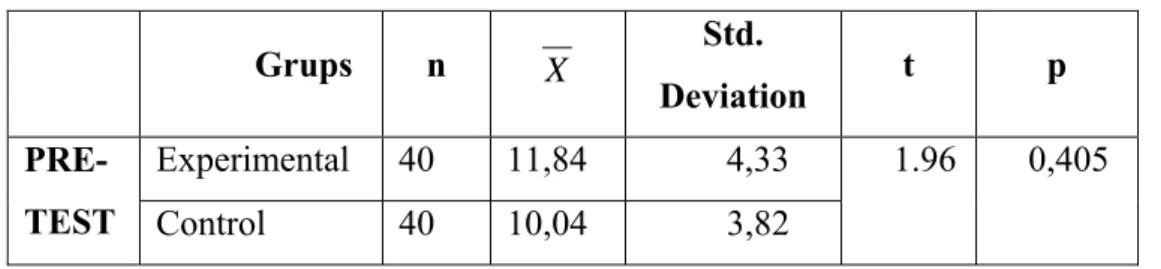
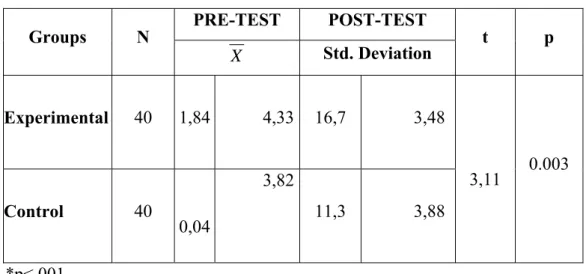
The measurement in this study will be shown on charts.
1.5. Limitations
This study will be carried out in Dumlupınar Mah. Ahmet Haşhaş Primary School. There are two 5th classes; 5-A and 5-B. This study will be carried out on
these two 5th classes. Each class has nearly 40 students, and the total will be 80. 5-A
will be chosen as control group and 5-B will be chosen as experimental group.
Communicative approach will be used for both two classes during the research. The students will be taught the parts of the body by the researcher. The experimental group will make practice through games and songs.
Another thing is that the data collected from these students may not reflect the students at other primary schools since the subjects of this study are all from Dumlupınar Mah. Ahmet Haşhaş Primary School.
CHAPTER II
2 REWIEV OF LITERATURE 2.1. What is language?
Language is a very complex thing, and it cannot yet be fully accounted for by anyone within one wholly consistent and comprehensive theory. Certainly linguists have found it so. For this reason, when asked the question What is language? the linguist is likely to reply by asking another question Why do you want to know? If we teach language, the way we approach our task will be influenced, or even determined, by what we believe language to be. There are some definitions about what language is:
Language is a system of arbitrary, vocal symbols which permit all people in a given culture, other people who have learned the system of that culture, to communicate or to interact (Finoncchiaro 1964:8).
Language is a system of communication by sound, operating through the organs of speech and hearing, among members of a given community, and using vocal symbols possessing arbitrary conventional meanings (Pei 1966:141).
Language is any set or system of linguistic symbols as used in a more or less uniform fashion by a number of people who are thus enabled to communicate intelligibly with one another (Random House Dictionary of the English Language 1966:806).
Language is a system of arbitrary vocal symbols used for human communication (Wardhaugh 1972:3).
Language is any means, vocal or other, of expressing or communicating feeling or thought…. a system of conventionalized signs, especially words, or gestures having fixed meanings (Webster’s New International Dictionary of the English Language 1934:1390).
Language is a systematic means of communicating ideas or feelings by the use of conventionalized signs, sounds, gestures, or marks having understood meanings (Webster’s Third New International Dictionary of the English Language 1961:1270).
A consolidation of the definitions of language yields the following composited definition.
1. Language is systematic and generative. 2. Language is a set of arbitrary symbols.
3. Those symbols are primarily vocal, but may also be visual.
4. The symbols have conventionalized meanings to which they refer. 5. Language is used for communication.
6. Language operates in speech community or culture.
7. Language is essentially human, although possibly not limited to humans. 8. Language is acquired by all people in much the same way (Brown 1994:5). Corder (1973: 19-21) states that there is generally a close connection between the way we talk about something and the way we regard it. If we want to know what someone believes language is, we must listen to the language he uses to talk about it. For example, we regularly hear people talking about ‘using language’: He used some awful language; He used a word I didn’t understand; What use is French? This suggests that language is an object like a tool, which we can pick up, use for some purpose and put down again. People sometimes even actually call language a tool. We also talk about people ‘possessing’ a language. Shakespeare was reported by Jonson as having ‘small Latin and less Greek’. Children are said to ‘acquire’ language. Apparently we sometimes ‘lose’ it: I can’t find the right word.
Linguists, especially, often talk about how language works, as if it were an object like an alarm clock, whose functioning could be understood from a study of its internal structure of springs and cogwheels. We speak about the ‘birth’ of a language, of its ‘growth’, ‘development’ and ‘decline’. Languages have periods of ‘blossoming’ and ‘flowering’ (always in the past); they are ‘related’ to each other in ‘families’, or ‘descended’ from each other. They are ‘living’ or ‘dead’. They also have physical and moral qualities: they are ‘beautiful’, ‘ugly’…
We also find people talking about language as an ‘event’. A conversation ‘takes place’, words ‘crop up’ in a discussion. We even speak about someone’s speech as ‘the event of the evening’.
Language is something we ‘know’. We ask someone if he ‘knows’ French or German, or if he ‘knows’ some word or other. It is also something we ‘do’. We write, read, speak well or badly.
We just have to admit that language is such a complex phenomenon that no one viewpoint can see it as a whole. The question we really need to ask is not which view is ‘right’, but which view is useful, which view is relevant to language teaching. Teaching cannot be apart from learning. Nathan Gage (1964:269) noted that “to satisfy the practical demands of education, theories of learning must be ‘stood on their head’ so as to yield theories of teaching.” Teaching sets the conditions for learning.
2.2. How People Learn
*Work out objectives in advance *Work from the known to the unknown *Work in short, simple, logical steps
*Success *Give feedback
*Give practice and reinforcement
*Encourage learning by activity: let learners learn at their own pace.
Roger (1976: 25-28) states that It is surprising how much education of all sorts still trundles along on the ‘hole-in-the-head’ theory. This is the one where teachers behave as if they thought students had a space in their heads which could be filled simply by pouring knowledge inside. Such teachers may teach energetically away without their students learning anything. Most of us have experienced the results of this method when we sit through lectures with politely interested expressions on our faces while our minds are busily engaged elsewhere. Learning is not a passive process. For students are to learn, they must be actively engaged in doing, not just listening but comprehending.
In language classes, this will mean each student spending a maximum of time using new vocabulary, speaking, listening to and reading the language.
Most students will make much greater progress if they work individually, in groups or pairs on materials the teacher has already prepared.
Students often relish working through a ‘problem-solving’ but the majority respond to opportunities for working out basic principles, doing projects and research and other similar activities which fully engage their intelligence and interest.
2.3. Language Acquisition and Language Learning
Yule (2001:191) states that the primary difficulty for most people can be captured in terms of a distinction between acquisition and learning. The term “acquisition”, when used of language, refers to the gradual development of ability in a language by using it naturally in communicative situations. The term “learning”, however, applies to a conscious process of accumulating knowledge of the vocabulary and grammar of a language.
We can say that the first language is acquired and the second language is learned. Language acquisition takes place in a constantly stimulating environment: children are exposed to their first language from the very beginning and they are literally bombarded with language all the time (House 1997:7). If we consider the child’s acquisition of language between the ages of about twelve months and five years, the first thing we might observe is that quantity of language involved is enormous. The child may well be in contact with language for most of his waking hours. The contact will take different forms. Some of it will be language directed at the child by other people, particularly parents. A strong effort will be made to ensure that this language is meaningful to the child. This may be done by demonstrating relevant objects and actions in the surroundings, by an intuitive attempt at simplification of the language, or, in the later stages, by actual explanations.
There will be other language that the child is exposed to, in the sense that it is produced in his presence, but which will not be addressed to him and most of which will not be meaningful to him, at least in the early stages of his language acquisition.
Finally, there will be language that the child himself produces. Part of this will be addressed to other people, but it would be a mistake to think that such language represents all or even most of the child’s language production. At a certain stage in his language development he is likely to spend many hours in monologue and imaginative dialogue, regardless of whether there is anyone else present to stimulate him.
There are some other significant factors about the language that the child is exposed to. In the first place it is, of course, spoken language. Secondly, what the child hears is also linguistically-uncontrolled language. By this is meant that there is nothing like the isolation and repetition of a single sentence structure that is
characteristic of much language teaching. The child acquires his language without having it predigested for him in this way. Adults do often make the attempt to simplify their language for the benefit of the child, but what they produce remains structurally varied and, it is sometimes suggested, even makes things more complicated for the child. One observation that has been made is that the child may play language games with himself which involve repeating the same type of sentence perhaps with minimal alterations, and that this does resemble some productive exercise in language teaching.
The language in the child’s environment is also uncontrolled in the sense that it is not made up of perfect samples of grammatical speech. It is never a direct reflection of the somewhat idealized form of language that is described in grammars. In spite of this the child has the capacity to learn from it and to learn to understand it.
More interesting perhaps than the language to which the child is exposed is his reaction to it. We have already seen that when he is adequately exposed to language he will produce language himself. In part, what he produces is an imitation of what he has heard and this is a process which adults often try to stimulate, but, contrary to what has generally been thought, a good deal of his language production is not imitative at all. Not only does he have the ability to take words and phrases that he has heard and use them in new combinations; he also actually produces pieces of language that he could not have heard from the other people in his environment.
The feedback that is provided by other people does more than simply inform the child whether or not his message is correctly formed. It also demonstrates to him that his language has an effect on the behaviour of others. Rather than being at the mercy of the environment under his own control. It would be fairly meaningless to say that this motivates him to learn the language. What it does mean is that he is becoming aware of the regulatory function of language. Through language, he learns, his needs can be met. At first the needs will be material, but later they may include the need for information, advice, permission and so on.
As long as adequate exposure to language is provided, the process of language acquisition that has just been described will be followed by all children who do not suffer some physiological or psychological defect. The rates of learning will not be identical, but they will not be wildly different either. By the age of five a substantial
proportion of the grammatical system of the language will have been mastered by all children. Given that children may have very different intellectual endowments, it is similarities not the dissimilarities in their linguistic development that are so striking.
Although we cannot reproduce these circumstances, we should try to provide our students with at least some of the stimuli which are present in language acquisition in order to facilitate language learning such as games. As House (1997:7) mentioned for young children, learning is still a question of experiencing rather than committing information to memory so we need to provide our students with the possibility of experiencing to ensure successful learning. Because children learn from experience, they do not distinguish learning situations from non-learning ones. We have to remember this and see the fact that every moment of our time with them, learning time. Moreover Yule (2001:192) says that the optimum age may be during the years from ten to sixteen when the “flexibility” of the language faculty has not been completely lost, and the maturation of cognitive skills allows a more effective working out of the regular features of the L2 encountered. As English teacher we should take the advantages of this. We can apply this by using language games in our courses. By this way our students learn the language unconsciously. They are not aware of the fact that they are getting something new. The process seems them just a game that is not boring opposite the situations in which they get really bored and learn consciously. To summarize, the term “second language acquisition” refers to the subconscious or conscious processes by which a language other than the mother tongue is learned in a natural or a tutored setting. It covers the development of phonology, lexis, grammar, and pragmatic knowledge. The study of SLA is directed at accounting for the learner’s competence. (Ellis 1985:6). In relatively simple terms, there has been a change of emphasis from presenting language as a set of forms which have to learned and practiced, to presenting language as a functional system which is used to fulfill a range of communicative purposes. The ability to use a language should be described as communicative competence (Yule 1989:17). Key components of communicative competence, as presented by Canale and Swain (1980) and later in Canale’s (1983) definition, four different components, or subcategories, make up the construct of communicative competence. The first two subcategories reflect the use of the linguistic system itself.
The first one is grammatical competence which encompasses “knowledge of lexical items and of rules of morphology, syntax, sentence-grammar semantics, and phonology (Canale and Swain 1980: 29). It is also the linguistic competence Hymes and Paulston referred to. The second subcategory is discourse competence, the complement of grammatical competence in many ways. It is the ability we have to connect sentences in stretches of discourse and to form a meaningful whole out of a series of utterances (Brown 1994:228). Discourse competence concerns mastery of how to combine grammatical forms and meanings to achieve a unified spoken or written text in different genres (Richards&Schmidt 1986:9).
The last two subcategories define the more functional aspects of communication. Sociolinguistic competence is the knowledge of the socio-cultural rules of language and of discourse. It requires an understanding of the social context in which language is used: the roles of participants, the information they share, and the function of the interaction (Brown 1994: 228). Sociolinguistic competence, allows the language user to select which utterance form, from any number of possible correct forms, is considered appropriate within a language community on a particular interactive occasion (Yule 1989:19). This component included both socio-cultural rules of use and rules of discourse (Richards&Schmidt 1986:7).
The fourth subcategory is strategic competence which is the ability to successfully get one’s message across (Yule 1989:19).
Terrel (1977: 334) argues strongly that communication strategies are crucial at the beginning stages of second language learning. In teaching a second language learners should be given more opportunities to use this competences in order to learn more effectively and communicate better.
2.4. Learners Motivation and Interest
Motivation is important to language learning because it helps determine the extent of involvement in learning. One comprehensive definition of language learning motivation is that of Crookes and Schmidt (1991), who state that such motivation consists of seven elements: 1) interest, 2) relevance, 3) expectancy of success or failure, 4) belief in forthcoming rewards, 5) decision to be involved, 6) persistence, and 7) high activity level.
Psychologists have distinguished two major attitudinal factors which play an important role in determining how willing the learner is to persevere with the task. On the one hand, there are foreign language learners who view the language as a key to social and cultural enrichment through the opportunities it provides for association with members of a different culture. This type of integrative motivation is characteristic of many successful language learners. On the other hand, the learner may simply be studying the language for an immediate short-term goal which does not involve his wanting to be accepted by and integrated into a target culture group. Simply learning a language to acquire course credits, or to carry out a limited range of tasks that do not involve the learner in close face-to-face interaction as an equal does not generally lead to a high degree of accomplishment in learning. Foreign language or second language learning in such cases is typically poor, characterised by acquisition of only the rudiments of grammar and by tolerance of a relatively low standard of achievement.
The abstract term ‘motivation’ on its own is rather difficult to define. Ur (1976:274) claims that it is easier and more useful to think in terms of the ‘motivated’ learner: one who is willing or even eager to invest effort in learning activities and to progress. Learner motivation makes teaching and learning immeasurably easier and more pleasant, as well as more productive: hence the importance of the topic for teachers.
Harmer (1993: 154) states that motivation is some kind of internal drive that encourage somebody to pursue a course of action. There are two types of motivation. The first one is extrinsic motivation, which is concerned with factors outside the classroom, and intrinsic motivation, which is concerned with what takes place inside the classroom.
2.4.1. Extrinsic Motivation
Extrinsic motivation is that which derives from the influence of some kind of external incentive, as distinct from the wish to learn for its own sake or interest in tasks. Many sources of extrinsic motivation are inaccessible to the influence of the teacher: for example, the desire of students to please some other authority figure such as parents, their wish to succeed in an external exam, or peer-group influences. There
are two main types of this motivation which are integrative and instrumental motivation. In the first one students need to be attracted by the culture of the target language community. On the other hand in the latter a student believes that mastery of the target language will be instrumental in getting them a better job, position or status. In other words the language is an instrument in their attainment of such a goal.
2.4.2. Intrinsic Motivation and Interest
Global intrinsic motivation – the generalized desire to invest effort in the learning for its own sake – is largely rooted in the previous attitudes of the learners: whether they see the learning as worthwhile, whether they like the language and its cultural, political and ethnic associations.
Such global motivation is important when the course is beginning, and as general underlying orientation during it; but for real-time classroom learning a more significant factor is whether the task in hand is seen as interesting. It is in the arousing of interest, perhaps, that teachers invest most effort, and get most immediate and noticeable pay-off in terms of learner motivation (Ur: 1996).
Some students do not bring extrinsic motivation to the classroom. They might have negative feelings about the language. Because of this reason what will happen in the classroom is of vital importance in order to change their attitudes to the language. There are four factors affecting intrinsic motivation the first one is physical condition that have a big effect on learning language. The second one is the method which affects the learners’ motivation. If they confidence in it, he will de-motivated. On the other hand if they find it interesting, they will find it motivating, too. The teacher is among the most important factors that affects the students’ motivation. His personality, his appearance, his knowledge of the subject are the factors that affect the students’ attitude to the language. The last one is success. Not only success but also lack of it plays an important part in the motivation of the students.
Harmer (1993) states that there are motivational differences between a child and an adult. Children are curious and its motivating in itself whereas their concentration is less than adults. They need changes of activity. By playing different kind of games, a teacher can motivate them easily because they need activities which
are interesting and funny; they need to be appreciated by their teacher; they need to be involved something active and be successful.
Stipek (1988: 124,125) focuses on the advantages of intrinsic motivation. The first one is learning activities outside of school. Intrinsically motivated achievements behaviour is desirable partly because external reinforcement is not always available. The second one is preference for challenge. Studies have shown that individuals are more likely to select challenging tasks when intrinsically motivated than when motivated to obtain an extrinsic reward. The third one is conceptual understanding. Students read the text that interests them and this process help them to remember better. The forth one is creativity. Studies have found that conditions supporting intrinsic motivation also foster greater creativity. The last one is pleasure and involvement. Intrinsic interest or motivation also is associated with greater pleasure and more active involvement than extrinsic motivation.
2.4.3. Ways of Arousing Interest in Tasks
Ur (1976: 280-281) shows us some ways of arousing interest in task. These are: 1. Clear goals
Learners should be aware of the objectives of the task – both language-learning and content. For example, a guessing-game may have the language-learning goal of practising questions, and the content goal of guessing answers.
2. Varied topics and tasks
Topics and tasks should be selected carefully to be as interesting as possible. 3. Visuals
It is important for learners to have something to look at that is eye-catching and relevant to the task in hand.
4. Tension and challenge: games
Game-like activities provide pleasurable tension and challenge through the process of attaining some ‘fun’ goal while limited by rules. The introduction of such rules can add spice to almost any goal-oriented task.
Entertainment produces enjoyment, which in its turn adds motivation. Entertainment can be teacher-produced (jokes, stories, perhaps songs, dramatic presentations) or recorded (movies, video clips, television documentaries.)
6. Play-acting
Role play and simulations that use the imagination and take learners out of themselves can be excellent; though some people are inhibited and may find such activities intimidating at first.
7. Information gap
A particularly interesting type of task is that based on the need to understand or transmit information.
8. Personalization
Learners are more likely to be interested in tasks that have to do with them . 9. Open-ended cues
A cue which invites a number of possible responses is usually much more stimulating than one with only one right answer.
2.5. Multiple Intelligence Effects on Learning
According to Gardener intelligence is not a single construct, nor is it considered static. Gardener’s MI theory is very important to ESL/EFL teachers because we work with such diverse learners. MI theory helps educators create and individualized learning environment (Reid 1998:4). Conceived by Howard Gardner Multiple Intelligences are seven different ways to demonstrate intellectual activity.
* Linguistic-Verbal Intelligence: The ability the use words effectively, both orally and in writing. Sample skills are remembering, convincing others to help, and talking about language itself (Reid 1998:4).
Their skills include: Listening, speaking, writing, story telling, explaining, teaching, using humour, understanding the syntax and meaning of words, remembering information, convincing someone of their point of view, analyzing language usage.(Kurt, Sayıner, Sarandal, Çoban, Buldur and Tekin 2008:52)
* Musical-Rhythmic Intelligence: Sensivity to rhythm, pitch and melody. Sample skills are recognizing simple songs and being able to vary speed, tempo and rhythm in sample melodies. (Reid 1998:4).
Their skills include: Singing, whistling, playing musical instruments, recognizing tonal patterns, composing music, remembering melodies, understanding the structure and rhythm of music. (Kurt, Sayıner, Sarandal, Çoban, Buldur and Tekin 2008:53).
* Logical-Mathematical Intelligence: The ability to use numbers affectively and reason well. Sample skills are understanding the basic properties of numbers, the principle of cause and effect, and the ability to predict (Reid 1998:4).
Their skills include: Problem solving, classifying and categorizing information, working with abstract concepts to figure out the relationship of each to the other, handling long chains of reason to make logical progression, doing controlled experiments, questioning and wondering about natural events, performing complex mathematical calculations, working with geometric shapes (Kurt, Sayıner, Sarandal, Çoban, Buldur and Tekin 2008:53).
* Spatial-Visual Intelligence: Sensitivity to form, space, colour, line and shape. Sample skills include the ability to represent visual or spatial ideas graphically. (Reid 1998:4).
Their skills include: Puzzle building, reading, writing, understanding charts and grabs, a good sense of direction, sketching, painting, creating visual metaphors and analogies, manipulating images, constructing, fixing, designing practical objects, interpreting visual images (Kurt, Sayıner, Sarandal, Çoban, Buldur and Tekin 2008:52).
* Bodily-Kinesthetic Intelligence: The ability to use the body to express ideas and feelings and to solve the problems. Sample skills are coordination, flexibility, speed, balance (Reid 1998:4).
Their skills include: Dancing, physical co-ordination, sports, hands on experimentation, using body language, crafts, acting, miming, using their hands to create or build, expressing emotions through the body (Kurt, Sayıner, Sarandal, Çoban, Buldur and Tekin 2008:52).
* Interpersonal Intelligence: The ability to understand another person’s moods, feelings, motivations, and intentions. Sample skills are responding effectively to other people, problem solving and resolving conflict (Reid 1998:4).
Their skills include: Saying things from other perspectives, listening, using empathy, understanding other people’s feelings, counselling, co-operating with groups, noticing people’s moods, motivations and intensions, communication both verbal and non-verbally, building trust (Kurt, Sayıner, Sarandal, Çoban, Buldur and Tekin 2008:53).
* Intrapersonal Intelligence: The ability to understand yourself, your strengths, weaknesses, moods, desires and intensions. Sample skills are understanding how one is similar to or different from others, reminding oneself to do something, knowing about oneself as a language learner, and knowing how to handle one’s feelings (Reid 1998:4).
Their skills include: Recognizing their own strengths and weaknesses, reflecting and analyzing themselves, awareness of their inner feelings, desires and dreams, evaluation their thinking patterns, reasoning with themselves, understanding their role in relationship to others (Kurt, Sayıner, Sarandal, Çoban, Buldur and Tekin 2008:53).
* Naturalist Intelligence: The ability to recognize species of plants or animals in one’s environment. (Reid 1998:4) MI has great potential for helping to revolutionize our concept of student language-learning capabilities in the ESL classroom. As language teachers we know that our students learn differently. IM theory can help us develop language learning materials to address these differences. For example if your student has kinaesthetic intelligence, games are indispensable for teaching English.
2.6. Approaches and Methods in Language Teaching 2.6.1. Grammar Translation Method
Whether traditional or not, language teaching methods have their own way for teaching English. It is useful to look over these methods in a general way in order to decide and use the right method for teaching English through games.
In the nineteenth century the Classical Method came to be known as the Grammar Translation Method. There was little to distinguish Grammar Translation from what had gone on in foreign language classrooms for centuries beyond a focus on grammatical rules as the basis for translating from the second to the native
language. (Brown, 2001:18) Prator and Celce-Murcia listed the major characteristics of Grammar Translation:
1-Classes are taught in the mother tongue, with little active use of the target language.
2- Much vocabulary is taught in the form of lists of isolated words. 3- Long, elaborate explanations of the intricacies of grammar are given.
4- Grammar provides the rules for putting words together, and instruction often focuses on the form and inflection of words.
5- Reading of difficult classical texts is begun early.
6- Little attention is paid to the content of texts, which are treated as exercises in grammatical analysis.
7- Often the only drills are exercises in translating disconnected sentences from the target language into the mother tongue.
8- Little or no attention is given to pronunciation.
This method was so popular because it requires few specialized skills on the part of teachers. Richards and Rodgers (1986: 5) pointed out, “it has no advocates. It is a method for which there is no theory. There is no literature that offers a rationale or justification for it or that attempts to relate it to issues in linguistics, psychology, or educational theory.”
In a grammar-translation class, students study the grammar and the vocabulary. The goal is to develop the ability to translate between the target language and the students’ primary language (Freeman&Freeman 1998:7). Therefore it is not a method that teachers prefer nowadays. There is no real language. There is only translation from one language to another. This method is not an appropriate method to teach English permanently, funny and easily.
2.6.2. Direct Method
The Direct Method gets its name from the fact that students are encouraged to make direct associations between objects or concepts and the corresponding words in the target language (Freeman&Freeman 1998:9).
In the 1920s, the Direct Method of teaching foreign language became popular in the United States as an alternative to the previous century’s reliance on grammar-translation techniques to teach classical languages.
Today’s classrooms teachers can benefit from this method by seeing how to use of English is a part of our culture. Even the words are determined, to a great extend, by the cultural constructions of our world (Kottler 1994:38).
The basic premise of Direct Method is second language learning should be more like first language learning – lots of oral interaction, spontaneous use of the language, no translation between first and second language, and little or no analysis of grammatical rules.
In practice it stood for the following principles and procedures:
1-Classroom instruction was conducted exclusively in the target language. 2- Only everyday vocabulary and sentences were taught.
3- Oral communication skills were built up in a carefully graded progression organized around question-and-answer exchanges between teachers and students in small, intensive classes
4- Grammar was taught inductively.
5- New teaching points were introduced orally.
6- Concrete vocabulary was taught through demonstration, objects, and pictures; abstract vocabulary was taught by association of ideas.
7- Both speech and listening comprehension were taught.
8- Correct pronunciation and grammar were emphasized (Richards Rodgers 1986:8).
The Direct Method did not take well in public education, where the constraints of budget, classroom size, time, and teacher background made such a method difficult to use. Moreover, the Direct Method was criticized for its weak theoretical foundations. Its success may have been more a factor of the skill and personality of the teacher than of the methodology itself.
2.6.3. Audio-Lingual Method
Rivers( 1964: 19-22) states the features of ALM as:
1-Foreign language learning is basically a process of mechanical habit formation. Good habits are formed by giving correct responses rather than by making mistakes. By memorizing dialogues and performing pattern drills the chances of producing mistakes are minimized. Language is verbal behaviour – that is, the automatic production and comprehension of utterances – and can be learned by inducing the students to do likewise.
2- Language skills are learned more effectively if the items to be learned in the target language are presented in spoken form before they are seen in written form. Aural-oral training is needed to provide the foundation for the development of other language skills.
3- Analogy provides a better foundation for language learning than analysis. Analogy involves the processes of generalization and discrimination. Explanations of rules are therefore not given until students have practiced a pattern in a variety of contexts and are taught to have acquired a perception of the analogies involved. Drills can enable learners to form correct analogies. Hence the approach to the teaching of grammar is essentially inductive rather than deductive.
4- The meanings that the words of a language have for the native speaker can be learned only in linguistic and cultural context and not in isolation. Teaching a language thus involves teaching aspects of the cultural system of the people who speak the language.
Prator and Celce-Murcia (1979) summed up the characteristics of the ALM as: 1- New material is presented in dialogue form.
2- There is dependence on mimicry, memorization of set phrases, and over learning.
3- Structures are sequenced by means of.
4- Structural patterns are taught using repetitive drills.
5- There is little or no grammatical explanation. Grammar is taught by inductive analogy rather than by deductive explanation, contrastive analysis and taught one at a time.
6- Vocabulary is strictly limited and learned in context. 7- There is much use of tapes, language labs, and visual aids. 8- Great importance is attached to pronunciation.
9- Very little use of the mother tongue by teachers is permitted. 10- Successful responses are immediately reinforced.
11- There is a great effort to get students to produce error-free utterances. 12- There is a tendency to manipulate language and disregard content.
The ALM was firmly rooted in respectable theoretical perspectives of the time. Materials were carefully prepared, tested, and disseminated to educational institutions. “Success” could be overtly experienced by students as they practiced their dialogues in off-hours. But the popularity was not to last forever. Challenged by Wilga Rivers’s (1964) eloquent criticism of the misconceptions of the ALM and by its ultimate failure to teach long-term communicative proficiency, ALM’s popularity waned. We discovered that language was not really acquired through a process of habit formation and overlearning, that errors were not necessarily to be avoided at all costs, and that structural linguistics did not tell us everything about language that we needed to know.
2.6.4. Silent Way
The Silent Way is the name of a method of language teaching devised by Caleb Gattegno’s. The Silent Way represents Gattegno’s venture into the field of foreign language teaching. It is based on the premise that the teacher should be encouraged to produce as much language as possible. Elements of the Silent Way, particularly the use of colour charts and the coloured Cuisenaire rods, grew out of Gattegno’s previous experience as an educational designer of reading and mathematics programs.
The Silent Way shares a great deal with other learning theories and educational philosophies. Very broadly put, the learning hypotheses underlying Gattegno’s work could be stated as follows:
1- Learning is facilitated if the learner discovers or creates rather remembers and repeats what is to be learned.
3- Learning is facilitated by problem solving involving the material to be learned.
The Silent Way has had its share of criticism. In one sense, it was too harsh a method, and the teacher too distant, to encourage a communicative atmosphere. Students often need more guidance and overt correction than the Silent Way permitted.
As English language teachers we can find games to play in the classroom by using this method.
2.6.5. Total Physical Response
Total Physical Response is a language teaching method built around the coordination of speech and action; it attempts to teach language through physical (motor) activity. Developed by James Asher, a professor of psychology at San Jose State University, California, it draws on several traditions, including developmental psychology, learning theory, and humanistic pedagogy, as well as on language teaching procedures by Harold and Dorothy Palmer in 1925. He actually began experimenting with TPR in the 1960s, but it was almost a decade before the method was widely discussed in professional circles.
Total Physical Response is linked to the “trace theory” of memory in psychology, which holds that the more often or the more intensively a memory connection is traced, the stronger the memory association will be and the more likely it will be recalled. Retracing can be done verbally and/or in association with motor activity. Combined tracing activities, such as verbal rehearsal accompanied by motor activity, hence increase the probability of successful recall.
In a developmental sense, Asher sees successful adult second language learning as a parallel process to child first language acquisition. He claims that speech directed to young children consists primarily of commands, which children respond to physically before they begin to produce verbal responses. Asher feels adults should recapitulate the processes by which children acquire their mother tongue.
Asher's emphasis on developing comprehension skills before the learner is taught to speak links him to a movement in foreign language teaching sometimes
referred to as the Comprehension Approach (Winitz 1981). This refers to several different comprehension-based language teaching proposals, which share the belief that (a) comprehension abilities precede productive skills in learning a language; (b) the teaching of speaking should be delayed until comprehension skills are established; (c) skills acquired through listening transfer to other skills; (d) teaching should emphasize meaning rather than form; and (e) teaching should minimize learner stress.
Asher (1977: 43) noted that children, in learning their first language, appear to do a lot of listening before they speak, and that their listening is accompanied by physical responses. He also gave some attention to right-brain learning. According to Asher, motor activity is a right-brain function that should precede left-brain language processing. Asher was also convinced that language classes were often the locus of too much anxiety, so he wished to devise a method that was as stress-free as possible, where learners would not feel overly self-conscious and defensive. The TPR classroom, then, was one in which students did a great deal of listening and acting. The teacher was very directive in orchestrating a performance: “The instructor is the director of a stage play in which the students are the actors”
In TPR, students listen and respond to a series of comments. At the beginning are given simple comments such as “Raise your right hand.” Students than indicate their comprehension by raising their hands. As students progress through TPR lessons, the comments become more complex (Freeman&Freeman 1998: 17).
As English language teachers, we can take the advantage of this method during the game process.
2.6.6. Community Language Learning
This method advises teachers to consider their students as “whole persons.” Whole-person learning mean that teachers consider not only their students’ feelings and intellect but also have some understanding of the relationship among students physical reactions, their instinctive protective reactions and their desire to learn. The Community Language Learning Method takes its principle from the more general Counseling Learning approach developed by Charles A. Curran. Curran studied adult learning for many years. He discovered that adults often feel threatened by a new
learning situation. They are threatened by the change inherent in learning and by the fear that they will appear foolish. By understanding students’ fears and being sensitive to them, the teacher can help students overcome their negative feelings and turn then into positive energy to further their learning. (Larsen-Freeman, 1986)
The primary aim of CLL is to create a genuinely warm and supportive community among the learners and gradually to move them from complete dependence on the teacher to complete autonomy (Nunan 1998:236).
In a typical CLL lesson, students who have previously come to know each other sit in a small circle. The teacher facilitator stands behind one of the students. This student makes a statement or asks a question in his or her native language. In a gentle, supportive voice the teacher translates what the student said from the student’s native language to the language being learned. The student repeats what the teacher says until he or she is comfortable enough to record the new phrase or sentence on a tape recorder. This procedure is repeated with others in the circle until a short conversation has been recorded. Then students listen to their conversation, and the teacher writes it on the board. The textbook actually becomes what the students say in their recorded conversation. Students often copy the written conversation from the board to take home and study. As time goes on students use more complex language and eventually come to need the teacher- facilitator less and less (Freeman&Freeman 1998:17).
2.6.7. Natural Approach
One of the most widely-used methods of teaching a second or a foreign language is The Natural Approach, developed by Krashen and Terrell (1983). The method puts into practice the theory of second language acquisition Krashen (1982) developed. A central tenet of his theory is that we acquire rather than learn a second language. Acquisition occurs in a natural order when students receive comprehensible input, messages they understand (Freeman&Freeman 1998:19).
Krashen and Terrell see communication as the primary function of language, and since their approach focuses on teaching communicative abilities, they refer to the Natural Approach as an example of communicative approach. The Natural Approach “is similar to other communicative approaches being developed today”
(Krashen and Terrell 1983:17) They reject earlier methods of language teaching, such as the Audiolingual Method, which viewed grammar as the central component of language. According to Krashen and Terrell, the major problem with these methods was that they were built not around “actual theories of language acquisition, but theories of something else; for example, the structure of language”. Language is viewed as a vehicle for communicating meanings and messages. Hence Krashen and Terrell state that “acquisition can take place only when people understand messages in the target language (Krashen and Terrell 1983: 19).
In the Natural Approach, learners presumably move through what Krashen and Terrell defined as three stages: (a) The preproduction stage is the development of listening comprehension skills. (b) The early production stage is usually marked with errors as the student struggles with the language. The teacher focuses on meaning her, not on form, and therefore the teacher does not make a point of correcting errors during this stage (unless they are gross errors that block or hinder meaning entirely). (c) The last stage is one of extending production into longer stretches of discourse involving more complex games, role-plays, open-ended dialogues, discussions, and extended small-group work. Since the objective in this stage is to promote fluency, teachers are asked to be very sparse in their correction of errors.
Games are in the Natural Approach not a frill but an important element in the acquisition process. They qualify as an acquisition activity because of their value in providing comprehensible input. It is simple in many games to focus on particular words. One common technique is to make up illogical combinations and ask the students to figure out what is wrong with the combination (Nunan 1998:243).
2.6.8. Suggestopedia
Suggestopedia was a method that was derived from Bulgarian psychologist Georgi Lozanov’s (1979) contention that the human brain could process great quantities of material if given the right conditions for learning, among which are a state of relaxation and giving over of control to the teacher.
Several characteristics of Suggestopedia distinguish it from other second language teaching methods. First, the physical settings is extremely important. Classes are small and students sit in comfortable armchairs in a semicircle. On the
walls of the room hang posters from countries where the target language is spoken as well as posters with grammatical information such as verb conjugations (Freeman&Freeman 1998:13).
In applications of Suggestopedia to foreign language learning, Lozanov and his followers experimented with the presentation of vocabulary, readings, dialogs, role-plays, drama, and a variety of other typical classroom activities. Students were encouraged to be as “childlike” as possible, yielding all authority to the teacher and sometimes assuming the roles (and names) of native speakers of the foreign language. Students thus became “suggestible”. Lazanov (1979: 272) described the concert session portion of a Suggestopedia language class:
At the beginning of the session, all conversation stops for a minute or two, and the teacher listens to the music coming from a tape-recorder. He waits and listens to several passages in order to enter into the mood of the music and then begins to read or recite the new text, his voice modulated in harmony with the musical phrases. The students follow the text in their textbooks where each lesson is translated into the mother tongue. Between the first and second part of the concert, there are several minutes of solemn silence. In some cases, even longer pauses can be given to permit the students to stir a little. Before the beginning of the second part of the concert, there are again several minutes of silence and some phrases of the music are heard again before the teacher begins to read the text. Now the students close their textbooks and listen to the teacher’s reading. At the end, the students silently leave the room. They are not told to do any homework on the lesson they have just had except for reading it cursorily once before going to bed and again before getting up in the morning.
This is an humanistic approach so we can also take the advantage of this method during the teaching process.
2.6.9. Communicative Approach
For a long time the learning of language was seen as the mastery of a set of structures. The then current theories of learning linked well with his notion and the learning of language became that of linguistic habits. This had given way in the late 1960s to a concern with rule-learning and what, following Chomsky (1965), became
known as transformational rules of syntax. A poorly linguistic concept of language had become psycholinguistic. But still there was the notion of language as a set of something to be learnt. It is important to remember too that the rules were those of form or grammar. There was no concern as yet with the purposes to which people put language and the divorce patterns of performance or use.
Then in 1970s begun to move towards language as communication. People became interested in the individual utterances. Discussions on the nature of language, its acquisition, development, pedagogy and techniques. The salient notions of the Communicative Approach:
1- Focus on message rather than medium. 2- The information gap
3- Focus on process rather than product
4- Emphasis on negotiation rather than pre-determination 5- Use of the learner’s own resources (Garvie 1990: 3,4,5)
When we communicate, we use the language to accomplish some function, such as arguing, persuading, or promising. Moreover, we carry out these functions within a social context. A speaker will choose a particular way to express his argument not only based upon his intent and his level of emotion, but also on whom he is addressing and what his relationship with that person is.
Furthermore, since communication is a process, it is insufficient for students to simply have knowledge of target language forms, meanings, and functions. Students must be able to apply this knowledge in negotiating meaning. It is through the interaction between speaker and listener that meaning becomes clear. The listener gives the speaker feedback as to whether or not he understands what the speaker has said. In this way, the speaker can revise what he has said and try to communicate his intended meaning again, if necessary. (Larsen-Freeman, 1986)
Brown (2001: 43) offers the following six interconnected characteristics as a description of CLT:
1- Classroom goals are focused on all of the components (grammatical, discourse, functional, sociolinguistic, and strategic) of communicative competence.
2- Language techniques are designed to engage learners in the pragmatic, authentic, functional use of language for meaningful purposes. Organizational language forms are not the central focus, but rather aspects of language that enable the learner to accomplish those purposes.
3- Fluency and accuracy are seen as complementary principles underlying communicative techniques. At times fluency may have to take on more importance than accuracy in order to keep learners meaningfully engaged in language use.
4- Students in a communicative class ultimately have to use the language, productively and receptively, in unrehearsed contexts outside the classroom. Classroom tasks must therefore equip students with the skills necessary for communication in those contexts.
5- Students are given opportunities to focus on their own learning process through an understanding of their own styles of learning and through the development of appropriate strategies for autonomous learning.
6- The role of the teacher is that of facilitator and guide, not an all-knowing bestower of knowledge. Students are therefore encouraged to construct meaning through genuine linguistic interaction with others.
According to Larsen-Freeman there are some principles of this method. Whenever possible, “authentic language” – language as it is used in a real context – should be introduced. Being able to figure out the speaker’s or writer’s intention is part of being communicatively competent. The target language is a vehicle for classroom communication, not just the object of the study. One function can have many different linguistic forms. Since the focus of the course is on real language use, a variety of linguistic forms are presented together. Students should work with language at the discourse or suprasentential (above the sentence) level. They must learn about cohesion and coherence, those properties of language which bind the sentences together. Games are important because they have certain features in common with real communicative events – there is a purpose to the exchange. Also, the speaker receives immediate feedback from the listener on whether or not she has successfully communicated. Having students work in small groups maximizes the amount of communicative practice they receive. Students should be given an opportunity to express their ideas and opinions. Errors are tolerated and seen as a
natural outcome of the development of communication skills. Students’ success is determined as much by their fluency as it is by their accuracy. One of the teacher’s major responsibilities is to establish situation like to promote communication. Communicative interaction encourages cooperative relationships among students. It gives students an opportunity to work on negotiating meaning. The social context of the communicative event is essential in giving meaning to the utterances. Learning to use language forms appropriately is an important part of communicative competence. The teacher acts as an advisor during communicative activities. In communicating activities, a speaker has a choice not only about what to say, but also how to say it. The grammar and vocabulary that the students learn follow from the function, situational context, and the roles of the interlocutors. Students should be given opportunities to develop strategies for interpreting language as it is actually used by native speakers (Littlewood, 1981).
The communicative approach in language teaching starts from a theory of language as communication. The goal of language teaching is to develop what Hymes (1972) referred to as “Communicative Competence.” Communicative competence is the ability not only to apply to grammatical rules of a language in order to from grammatically correct sentences but also to know when and where to use these sentences and to whom. Hymes coined this term in order to contrast a communicative view of language and Chomsky’s theory of competence. Chomsky held that linguistic theory is concerned primarily with an ideal speaker-listener in a completely homogeneous speech community, who knows its language perfectly and is unaffected by such grammatically irrelevant conditions as memory limitation, distractions, shifts of attention and interest, and errors in applying his knowledge of the language in actual performance (Chomsky, 1965:3).
Dell Hymes (1967) who was convinced that Chomsky’s notion of competence was too limited coined the term communicative competence.
Hymes’s theory of communicative competence was a definition of what a speaker needs to know in order to be communicatively competent in a speech community. In Hymes’s view, a person who acquires communicative competence acquires both knowledge and ability for language use with respect to