Int J Clin Exp Med 2014;7(9):3072-3075
www.ijcem.com /ISSN:1940-5901/IJCEM0001690
Original Article
Effect of pre-operative red blood cell distribution
on cancer stage and morbidity rate in
patients with pancreatic cancer
A Yilmaz1, FU Malya2, G Ozturk1, B Citgez2, Y Ozdenkaya1, C Ersavas1, AF Agan3, H Senturk4, O Karatepe1
1Department of Surgery, Medipol University, Turkey; 2Department of Surgery, Bezmialem University, Turkey; 3
De-partment of Gastroenterology, Medipol University, Turkey; 4Department of Gastroenterology, Bezmialem University,
Turkey
Received August 4, 2014; Accepted August 28, 2014; Epub September 15, 2014; Published September 30, 2014 Abstract: Background: The red blood cell distribution (RDW) is a test measure of erythrocyte variation and the volume level which shows the heterogeneity and it is a proven test in literature for the determination of survival on cardiovascular diseases. The main purpose of this research is to investigate the relationship between the RDW level and postoperative morbidity as well as its stages in diagnosed pancreatic cancer patients. Methods: In this study we covered 104 diagnosed pancreatic cancer patients who have been operated in 2011-2014. The RDW levels were separated into two groups. Group 1 contains higher level RDW patients (> 14) whereas group 2 contains only lower level RDW patients. We compared both groups in terms of the patients’ demographic data, duration of hospitaliza-tion, ratio of pancreatic fistula, disease period, and the mortality rates. Results: In group 1 contains 39 patients whereas group 2 contains only 65 patients. We determined the positive correlation between stages of disease with RDW levels as well as the correlation between low level of blood albumin and Ca 19.9 levels (p = 0001). However we did not observe statistically important difference in postoperative morbidity. Conclusions: Based on this study we report that RDW levels can be use as a marker to show the stages of pancreatic cancer in diagnosed patients. Keywords: Pancreatic cancer, stage, red cell distrıbution
Introduction
RDW is one of the main parameters in whole blood count assay. Recently there have been numerous researches ongoing regarding this [1, 2]. For instance the RDW levels were found very high in patients with cardiovascular dis-eases, neurovascular complications, sepsis, COPD and hepatitis [3, 4]. Moreover in these disorders a direct relation between the mortal-ity rate and level of the disease was deter-mined. However it could not be identified a direct relationship mechanism of high RDW lev-els with the mortality rate in these diseases but it was suspected on other parameters such as the chronic inflammation in erythrocytes, low levels of nutrition, and age of the patients. Pancreatic cancer is 4th most frequent cancer
disease leading to deaths in US [5]. Mostly the patients were discovered and diagnosed at
later stages of this disease, which leaves us the only choice as surgery. Even after surgery the survival rate is only 5% within 5 years. Although there is still no effective test to show post-oper-ative morbidity and mortality rates for these patients, the most important indicator for the survival is the stages of the deathly disease as well as rate for resection after surgery. Even though for now there is no direct pre-operative biochemical assay parameter, it has been shown that there is relationship between the studies of high levels of CA 19.9 with stages and recurrence of the disease [5, 6]. Therefore in this study we aim to investigate the effect of high RDW levels between the stages of the dis-ease and the rate of post-operative morbidity. Methods
In this study we evaluated the data of 104 pro-spective patients who went sequentially under
Preoperative RBC and pancreatic cancer
3073 Int J Clin Exp Med 2014;7(9):3072-3075
the pancreatic duodenectomy surgery in our clinic between the years of 2011 and 2014. The patients were previously diagnosed to pan-creatic cancer using endoscopic ultrasound system with CT and ERCP as well as with clini-cal examination. The stages of pancreatic can-cer were determined by TNM classification. Before the surgery WBC, hemoglobin, and MCV levels were determined by XXX instrument, albumin, creatinine, CRP levels were deter-mined by AAA instrument, and finally CA 19.9 levels were determined by YYY instrument. The patients with high RDW levels (group 1, N = 39) and low RDW levels (group 2, N = 64) were sep-arated in two groups. These groups were com-pared in their pre-operation nutrition levels, TNM stages, and CA 19.9 degrees. After the surgery their pancreatic leakage rate, duration of their hospitalization and the mortality rate were compared. Before and during the surgery patients with determined extra-pancreatic metastasis were outlined on this study.
Statistical analyses
Continuous variables were expressed as mean value ± standard deviation (SD). We used SPSS 16.0 for windows to perform statistical proce-dures. Differences in categorical factors were determined with Fisher’s exact test. Differences in continuous values between two groups were assessed with student’s t test for normally dis-tributed variables, and non-parametric Mann-Whitney U tests for non-normally distributed variables as appropriate. Differences in contin-uous variables among three or more groups were assessed with one-way analysis of
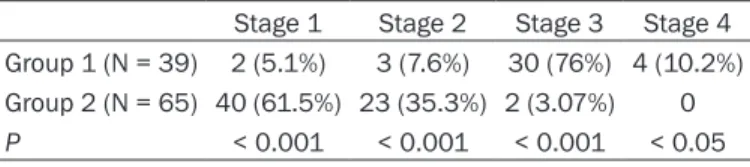
vari-(76%) with level-3, and 4 patients (10.2%) with level 4, while in group 2 there were 40 patients (61.5%) with level-1, 23 patients (35.3%) with level-2, 2 patients (3.07%) with level-3, and none with level-4. When statistically compared with group 1 we have found that in group 2 there were fewer patients at higher levels, which showed a significant difference. Table 1 shows that RDW levels and preoperative stage. When we compared the biochemical parame-ters during the patients’ pre-operation term the high RDW levels and low albumin levels are related to post-operative morbidity (Table 2). The biochemical data, morbidity rate, and stag-es of the disease comparison rstag-esults were shown on Table 2. Another comparison was conducted with Pancreatic Fistula (PF) and post-operative RDW levels whether they are related to each other or not and it was conclud-ed that there is no relationship on PF and pre-operative RDW levels when statistically compared.
Discussion
Pancreatic cancer is the deathliest of all intra-abdominal cancers. Most of the patients are admitted to clinic at later stages and because of this morbidity rates after surgery and compli-cations on nutrition are pretty high. Although the most abundant therapeutic treatment in pancreatic cancer is surgery, the survival rate within five [5] years after surgery is still around 5%, which makes one of the hardest targets for treatment and chance of survival. The survival rate for this disease varies based on the level of the cancer. Even though there are several methods to identify the level of the disease dur-Table 1. The comparison between RDW level and
preop-erative stage, in group 1 RDW < 14, in group 2 RDW > 14 Stage 1 Stage 2 Stage 3 Stage 4 Group 1 (N = 39) 2 (5.1%) 3 (7.6%) 30 (76%) 4 (10.2%) Group 2 (N = 65) 40 (61.5%) 23 (35.3%) 2 (3.07%) 0
P < 0.001 < 0.001 < 0.001 < 0.05
Table 2. Biochemical parameters and satage
Stage N RDW Albumin (g/dl) Ca 19.9 (ng/ml) I 42 12.54 + 0.68 4.5 + 0.3 14.67 + 5.85 II 26 13.98 + 0.87 3.99 + 0.55 35.76 + 4.6 III 32 17.2 + 2.5 3.6 + 0.5 58.84 + 5.67 IV 4 19.2 + 1.6 2.9 + 0.45 91.17 + 4.86
ance for normally distributed variables and Kruskal-Wallis for non-normally dis-tributed variables. A p-value < 0.05 was considered statistically significant. Results
The patients’ demographic data where high RDW levels (group 1, N = 39) and low RDW levels (group 2, N = 65) were shown on Table 1. As indicated there are 39 patients in group 1 and 65 in group 2. The age medium in group 1 is 68.25 (45-80) while in group 2 is 67.56 (38-82). In group 1, there were only 2 patients (5.1%) with disease level-1, 3 patients (7.6%) with level-2, 30 patients
Preoperative RBC and pancreatic cancer
3074 Int J Clin Exp Med 2014;7(9):3072-3075
ing the post-operative term, high level of CA 19.9 can also demonstrate where the patient’s level on cancer and help understand the sur-geon how/when to operate. In addition to that in one of the meta-analysis shows that CA 19.9 levels could play an important role to identify and diagnose the pancreatic cancer at earlier stages [6]. There is still no appropriate blood test or assay to show morbidity and mortality rates before the pancreatic tumor operations. For this reason RDW lately is one of the most studied parameter and under investigation to be used on a daily basis. RDW is also being extensively studied in various areas such as coroner artery disease, lung and breast cancer [7-9]. However our study is the first its kind that shows RDW levels which is correlated with mor-bidity and mortality on pancreatic cancers after the operation. Based on this study we have determined that basic RDW levels are definitely related and proportional with the levels of dis-ease and the duration of hospitalization after the surgery. RDW levels higher group is statisti-cally much more different than RDW levels lower group when compared on their duration of hospitalization after the surgery. We also found that high RDW levels are related to chron-ic inflammation and nutritional complchron-ications. In literature it was determined that the eleva-tion of pre-operative inflammaeleva-tion parameters increases post-operative complications [10-12]. When we searched in the literature we have also found that high levels of RDW is espe-cially related to oxidative stress as a result of this it has been determined that there are some changes on RBC membrane glycoproteins and RBC morphology. Again on another study with breast cancer patients the RDW levels are found meaningfully higher than the normal group [12, 13]. The existence of pre-operative inflammation also increases the post-operative complications. However on these studies there is no clear evidence and understanding why RDW levels are related to inflammation. But potential mechanisms include impairing iron metabolism, inhibiting the response to erythro-poietin, and decreasing red blood cell survival via production of inflammatory markers [13-15]. The overproduction of selective cytokines such as interleukin-6, tumor necrosis factor α, and CRP has been shown to play a key role in inducing chronic inflammation in cancer patients [16]. In addition, chronic inflammation is also reported to lead to a poor response to
chemotherapy [17, 18]. Hence the poorer sur-vival in patients with higher RDW values might be due to chronic inflammation itself, or the poor response to chemotherapy; however, fur-ther investigation is needed to explain the rela-tionships of RDW with inflammation and the response to cancer treatment. Therefore it was concluded that in our study also supported the hypothesis which is the elevation of RDW levels play crucial role at post-operative term in devel-opment of pancreatic fistula not in pre-opera-tive term.
Another question on this matter whether the elevation of RDW levels is directly related to dis-ease stages. On one of studies for lung cancer patients, it has been determined that there is strong correlation on the elevation of RDW lev-els with disease prognosis and its stages [18]. In our study we have also found strong correla-tions between high RDW levels and disease lev-els as well as duration of the hospitalization after surgery due to post-operative complica-tions at the hospital.
So the scientific approach and hypothetical question could be for this how the measure-ment of RDW levels at pre-operative stage could help the patients with pancreatic cancer. The answer to this hypothetical question could be actually found in the clinical episodes where they are either resectable or borderline patients to whom we might need to plan on the surgery after careful neoadjuvant (chemotherapy) treat-ment. Because their RDW levels could be high-er thhigh-erefore the patient can be at lathigh-er stages of the disease. In spite of low levels of mortality and morbidity rates observed after careful operation for pancreatic tumors, the existence of pre-operative inflammation and nutrition complications can be directly related to devel-oping post-operative complications. Therefore the timing for the surgery could be determined based on the RDW levels. For this reason the determination of RDW levels before the surgery could give several advantages to help pancre-atic cancer patients. We also have demonstrat-ed that there is strong correlation with RDW levels and disease stages. However, to fully understand this phenomenon there is a need to have more meaningful studies with large populations.
Finally in pancreatic cancer patients it is highly important to obtain the information beforehand in regards to really understand the stages of
Preoperative RBC and pancreatic cancer
3075 Int J Clin Exp Med 2014;7(9):3072-3075
disease and development of post-operative complications which would help the determine surgery time and neoadjuvant treatment plan. In order to obtain that information measuring RDW levels could be ideal, which is a simple, cheap, and clinically practical way during pan-creatic cancer treatment. In future it is evident that there needs to be more comparative stud-ies to understand this issue.
Address correspondence to: Oguzhan Karatepe, General Surgery Clinic, Medipol Kosuyolu Hospital, Istanbul 34718, Turkey. Tel: +90 216 5446666-6633; Fax: +90 216 3394444; E-mail: drkaratepe@ yahoo.com
References
[1] Simel DL, DeLong ER, Feussner JR, Weinberg JB, Crawford J. Erythrocyte anisocytosis. Visual inspection of blood films vs. automated analy-sis of red blood cell distribution width. Arch Intern Med 1988; 148: 822-824.
[2] van Kimmenade RR, Mohammed AA, Uthamalingam S, Van Der Meer P, Felker GM, Januzzi JL Jr. Red blood cell distribution width and 1-year mortality in acute heart failure. Eur J Heart Fail 2010; 12: 129-136.
[3] Ye Z, Smith C, Kullo IJ. Usefulness of red cell distribution width to predict mortality in pa-tients with peripheral artery disease. Am J Cardiol 2011; 107: 1241-1245.
[4] Patel KV, Semba RD, Ferrucci L, Newman AB, Fried LP, Wallace RB, Bandinelli S, Phillips CS, Yu B, Connelly S, Shlipak MG, Chaves PH, Launer LJ, Ershler WB, Harris TB, Longo DL, Guralnik JM. Red cell distribution width and mortality in older adults: a meta-analysis. J Gerontol A Biol Sci Med Sci 2010; 65: 258-265.
[5] Eltawil KM, Renfrew PD, Molinari M. Meta-analysis of phase III randomized trials of mo-lecular targeted therapies for advancedpan-creatic cancer. HPB (Oxford) 2012; 14: 260-8. [6] Hayman AV, Stocker SJ, Baker MS, Bentrem DJ,
Prinz RA, Marsh RD, Talamonti MS. CA 19-9 Nonproduction Is Associated With Poor Survival After Resection of Pancreatic Aden- ocarcinoma. Am J Clin Oncol 2013; [Epub ahead of print].
[7] Jamieson NB, Carter CR, McKay CJ, Oien KA. Tissue biomarkers for prognosis in pancreatic ductal adenocarcinoma: a systematic review andmeta-analysis. Clin Cancer Res 2011; 17: 3316-31.
[8] Combs SE, Habermehl D, Kessel KA, Bergmann F, Werner J, Naumann P, Jäger D, Büchler MW, Debus J. Prognostic Impact of CA 19-9 on Outcome after Neoadjuvant Chemoradiation in Patients with Locally Advanced Pancreatic Cancer. Ann Surg Oncol 2014; 21: 2801-7. [9] Kim J, Kim YD, Song TJ, Park JH, Lee HS, Nam
CM, Nam HS, Heo JH. Red blood cell distribu-tion width is associated with poor clinical out-come in acute cerebral infarction. Thromb Haemost 2012; 108: 349-356.
[10] Grant BJ, Kudalkar DP, Muti P, McCann SE, Trevisan M, Freudenheim JL, Schünemann HJ. Relation between lung function and RBC distri-bution width in a population-based study. Chest 2003; 124: 494-500.
[11] Mantovani A, Allavena P, Sica A, Balkwill F. Cancer-related inflammation. Nature 2008; 454: 436-444.
[12] Seretis C, Seretis F, Lagoudianakis E, Geme- netzis G, Salemis NS. Is red cell distribution width a novel biomarker of breast cancer activ-ity? Data from a pilot study. Clin Med Res 2013; 5: 121-126.
[13] Gupta D, Lis CG. Pretreatment serum albumin as a predictor of cancer survival: a systematic review of the epidemiological literature. Nutr J 2010; 9: 69.
[14] Ishizuka M, Nagata H, Takagi K, Horie T, Kubota K. Inflammation-based prognostic score is a novel predictor of postoperative outcome in patients with colorectal cancer. Ann Surg 2007; 246: 1047-1051.
[15] Siddiqui A, Heinzerling J, Livingston EH, Huerta S. Predictors of early mortality in veteran pa-tients with pancreatic cancer. Am J Surg 2007; 194: 362-366.
[16] Boonpipattanapong T, Chewatanakornkul S. Preoperative carcinoembryonic antigen and albumin in predicting survival in patients with colon and rectal carcinomas. J Clin Gastro- enterol 2006; 40:
592-595.-[17] Ho SY, Guo HR, Chen HH, Peng CJ. Nutritional predictors of survival in terminally ill cancer pa-tients. J Formos Med Assoc 2003; 102: 544-550.
[18] Gibbs J, Cull W, Henderson W, Daley J, Hur K, Khuri SF. Preoperative serum albumin level as a predictor of operative mortality and morbidi-ty: results from the National VA Surgical Risk Study. Arch Surg 1999; 134: 36-42.