T.C.
ISTANBUL AYDIN UNIVERSITY INSTITUTE OF SOCIAL SCIENCES
ENHANCEMENT OF HUMAN RIGHTS IN USA DURING OBAMA’S PRESIDENCY
THESIS Aydan RAHIMLI
Department of Political Science and International Relations
Political Science and International Relations Program
Thesis Advisor. Assist. Prof. Dr. Gülay Uğur GÖKSEL
T.C.
ISTANBUL AYDIN UNIVERSITY INSTITUTE OF SOCIAL SCIENCES
ENHANCEMENT OF HUMAN RIGHTS IN USA DURING OBAMA’S PRESIDENCY
THESIS Aydan RAHIMLI
(Y1412.110011)
Department of Political Science and International Relations
Political Science and International Relations Program
Thesis Advisor. Assist. Prof. Dr. Gülay Uğur GÖKSEL
DECLARATION
I hereby declare that all information in this document has been obtained and presented in accordance with academic rules and ethical conduct. I also declare that, as required by these rules and conduct, I have fully cited and referenced all material and results that are not original to this work.
FOREWORD
Accordingly, in the political thinking of the twentieth century, the main philosophical concept was the concept of human rights, which “unites” people today much more strongly than any other worldview that existed so far. All the differences, all the boundaries that people have had among themselves, are the secondary importance. USA plays significant role for the world in this issue. To my mind, Obama is one of USA presidents, who made evolution regarding Human Rights subject. That is the reason why I have chosen this thesis topic for research. I’m going to support my idea by facts, and will continue to do research about this topic in future as well.
I would like to express my deepest gratitude to my supervisor Assist. Prof. Dr. Gulay Ugur Goksel, for her excellent teaching skills, support and motivating behavior. I also would like to thank all my friends supported me.
Finally, I am very appreciative for the great support and endless belief I got from my fiancé, and my family.
TABLE OF CONTENT
Page FOREWORD ... V TABLE OF CONTENT ... VI ABBREVIATIONS ... VII LIST OF FIGURES ... VIII ABSTRACT ... IX ÖZET ... X
1. INTRODUCTION ... 1
2. HUMAN RIGHTS ... 7
2.1. THE CONCEPT OF HUMAN RIGHTS IN GENERAL ... 7
2.2. HUMAN RIGHTS PAST TO PRESENT ... 10
3. TRADITIONS OF DECLARATION AND PROTECTION OF HUMAN RIGHTS AND FREEDOMS IN USA ... 13
3.1. HISTORY OF IMPROVEMENT ... 13
3.2. REGULATION ... 14
3.3. FEDERALISM ... 15
3.4. PERSONAL IMMUNITY ... 17
3.5. FREEDOM OF RELIGION ... 18
3.6. JUDICIAL PROTECTION OF RIGHTS AND FREEDOM ... 20
3.7. LGBT ... 23
3.8. IMMIGRATION ... 26
3.9. W.BUSH'S PRESIDENCY AND THE SEPTEMBER 11 OF 2001ATTACK ... 34
4. LGBT RIGHTS BEFORE AND DURING OBAMA ERA ... 37
4.1. LGBTRIGHTS PROTECTION BEFORE OBAMA ERA ... 37
4.2. LGBTRIGHTS PROTECTION DURING OBAMA ERA... 41
5. IMMIGRATION RIGHTS PROTECTION BEFORE AND DURING OBAMA ERA ... 52
5.1. IMMIGRATION RIGHTS PROTECTION BEFORE OBAMA ERA ... 52
5.2. IMMIGRATION RIGHTS PROTECTION DURING OBAMA ERA ... 60
5.3. IMMIGRATION RIGHTS PROTECTION WITHIN LGBTCASES DURING OBAMA’S PRESIDENCY PERIOD ... 68
6. CONCLUSION ... 73
REFERENCES ... 79
ABBREVIATIONS
ABD : Amerika Birleşik Devletleri CIA : Central Intelligence Agency
DAPA : Deferred Action for Parents of Americans DHS : Department of Homeland Security DOMA : Defense of Marriage Act
ENDA : Employment Non-Discrimination Act
EU : European Union
FSS : Federal Security Service
IRCA : Immigration Reform and Control Act IRS : Internal Revenue Service
LGBT : Lesbian Gay Bisexual Transsexual NATO : North Atlantic Treaty Organization
NGLCC : National Gay & Lesbian Chamber of Commerce PRC : People's Republic of China
UN : United Nations
USA : United States of America
USSR : Union of Soviet Socialist Republics WMD : Weapons of mass destruction
LIST OF FIGURES
Page
Figure 4.1: USA - Laws relating to same-sex partnerships map ... 43
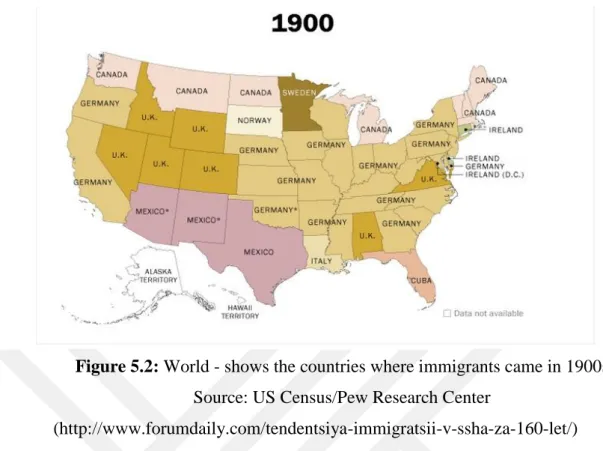
Figure 5.2: World - shows the countries where immigrants came in 1900s ... 57
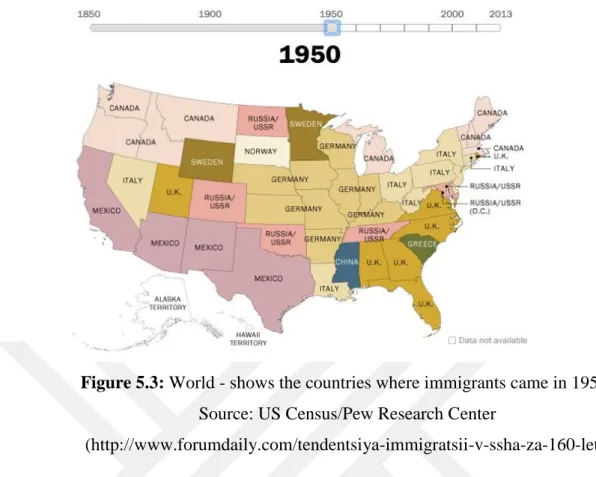
Figure 5.3: World - shows the countries where immigrants came in 1950s ... 58
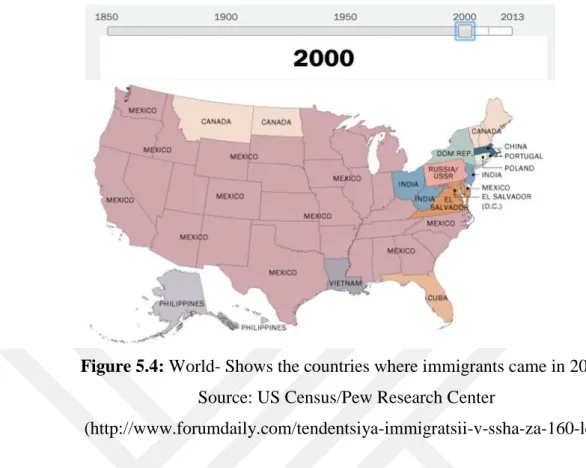
Figure 5.4: World- Shows the countries where immigrants came in 2000s ... 59
Figure 5.5: USA - the resettlement of Hispanics. ... 60
Figure 5.6: Mexico 1800 year – red color shows the lands captured by US ... 61
Figure 5.7 Mexico - the new Aztlan according to the forecasts of nationalists by 2080 ... 62
ENHANCEMENT OF HUMAN RIGHTS IN USA DURING OBAMA’S PRESIDENCY
ABSTRACT
My research question is: Were human rights improved during president Obama’s period? I’m going to analyze human rights conformability by historical order in USA. It is obvious that, we can’t skip the incident on 11 September as well; because this is the most large-scale terrorist attack for the history of America. 9/11 attacks affected not only US, but also whole world. My thesis argument is about development of human rights during the Obama era. Especially, I emphasize LGBT and Immigration rights. My point of view is that the rights of immigrants and trans-genders were improved during Obama’s presidency. I conduct historical research; support my argument by facts and the mixed cases as well. To illustrate transgender immigrants and their treatment while they are inside US borders is one of among many. I’ll support my argument by comparing presidency periods of other US presidents with Obama. Then I’m going to compare valuable facts about human rights throughout the US history and conclude my argument. As a result in a final stage my goal is to prove correctness of my argument.
OBAMA BAŞKANLIĞI DÖNEMİNDE ABD'DE İNSAN HAKLARININ GELİŞTİRİLMESİ
ÖZET
Araştırma sorum şu: Başkan Obama'nın döneminde insan hakları gelişti mi? Bu çalışmada Amerika'daki tarihsel açıdan insan hakları yasaları ve uygulamaları analiz edilecektir. Açıktır ki, 11 Eylül Amerika’nın insan hakları uygulamalarını derinden etkilemiştir; çünkü bu Amerika'nın tarihinde en büyük terör saldırısı. 9/11 saldırıları yalnızca ABD'yi değil tüm dünyayı da etkiledi. Benim tez argümanım Obama döneminde insan haklarının geliştirilmesi ile ilgili. Özellikle vurgu yaptığım kısım LGBT ve Göçmenlik Hakları. Yapmış olduğum çalışma göçmenlerin ve transgenderlerin haklarının Obama'nın başkanlık döneminde geliştirildiğini desteklemektedir. Çalışmamda Amerika içerisinde insan haklarındaki değişiklikleri tarihsel açıdan araştırıyorum: argümanları gerçekler ve karışık davalarla destekliyorum. Transgender göçmenleri ve onların ABD sınırları içersindeyken hal ve davranışlarını araştırmak bunlardan bir kaçı. Diğer ABD başkanlarının başkanlık dönemlerini Obamanınkı ile karşılaştırarak argümanımı destekleyeceğim. Daha sonrasında ABD tarihi boyunca insan haklarıyla ilgili değerli faktörleri karşılaştıracağım ve argümanımı bu gerçeklerle destekleyeceğim. Nihai aşamada amacım, argümanımın doğruluğunu kanıtlamaktır.
Anahtar Kelimeler: İnsan Hakları, ABD, Obama dönemi, LGBT-Göçmenlik
1. INTRODUCTION
To prevent and act against human rights violations, we need to know that, what represents human rights. It is not enough simply to read the Universal Declaration of Human Rights for this. Only after understanding how these rights are applied in specific situations and taking part in the discussion of how they should be applied, one can imagine what is behind the expression "human rights".
July 4, 1776, the US Congress approved the Declaration of Independence. Its author, Thomas Jefferson wrote, “The Declaration as an explanation of why on July 2 the Congress voted to proclaim independence from Britain, more than a year after the beginning of the American War of Independence, and as a statement that 13 American colonies were no longer belong to the British Empire.” Declaration of Independence was issued by Congress in several forms. Initially, it was printed on large sheets and widely distributed among the population. (http://ru.humanrights.com/, 2017)
From the philosophical point of view, the Declaration focused on two topics: personal rights and the rights of the revolution. These ideas received wide support among Americans, and also became known throughout the world, having especially strong influence on the French revolution. (http://ru.humanrights.com/, 2017)
The constitutional system of the United States has attracted and continues to attract the attention of historians due to its uniqueness. For many in the world, this country continues to be synonymous with democratic constitutional ideals. It is the United States that holds the first place in the creation of a written Constitution, which was adopted in 1787. The “Bill of Rights” – “the first ten amendments to the US Constitution, regulating the fundamental rights and freedoms of citizens, laid the legal foundation for the practical implementation of the American concept of civil rights and freedoms, which, in turn, is unique among other concepts.” (Manevskaya 2007)
“The American concept of civil rights and freedoms is characterized by a large number of sources. The original "foundations" on which it is based are not only the the ancient teachings on the state and the rights of citizens but also, the philosophy of the Enlightenment, and religious and ethical norms and ideals. The principles of Roman law, English common law, particularly, such monuments of the history of British law as the “Magna Carta”1 of 1215, the “Habeas Corpus Act”2 of 1678, the English “Bill of Rights” of 1689, and the French “Declaration of the Rights of Man and of the Citizen” of 1789 are also lead to formation of the concept of American civil rights and freedoms.” (Holsinger 2002, p.4)
American law developed from the English law system, as the United Kingdom exercised sovereignty over American lands before the outbreak of the War of Independence of 1775. It is therefore not surprising that British law sources exerted a great influence on the formation of the American concept of civil rights and freedoms. (Geyevsky & Mishin 1987, pp.7-9)
For example, “the Magna Carta of 1215 was the first written legal act in world history, from which the basic freedoms of the individual flow. The Charter contained a list of liberties and guarantees that restrained the arbitrariness of the royal power. It also regulated the collection of taxes and fees and the establishment of certain guarantees of justice; this was the most important for American colonists.” (Geyevsky & Mishin 1987, pp.7-9)
As the chairman of the US Supreme Court, W. Berger, wrote, “this document had particular importance to the Americans in 1776, expressed in that it was a solid legal basis for the demands of the colonists to grant them all the rights that the British enjoy under the Great Charter Liberties: They demanded only what was legally theirs.” And nowadays the “Magna Carta” is considered to be an informal historical source of constitutional law in the United States. This is confirmed by the fact that its copy is kept in the National Archives of the United States along with the originals of American constitutional documents. (Randall 2015)
Another historically important document that became the forerunner of the American "Bill of Rights" was the British “Bill of Rights” of 1689, which limited the power of
1 The “great charter” of English liberties sealed at Runnymede, June 15, 1215.
2Institute of English procedural law. It received its name from the initial words of the judge's order to
deliver the person deprived of liberty to the court "Habeas corpus ad subjiciendum" ("You have to bring a person to court")
the monarch and proclaimed a number of rights and freedoms of his lieges. It also said that parliamentary elections should be free, and its members should not be punished for their speeches in the debate. Adopted in 1789, the United States “Bill of Rights”, in contrast to the British “Bill of Rights” of 1689, which is the law of the parliament, made the inclusion of guarantees of individual rights a constitutional document, mandatory for the legislature. (Sogrin 1987, p.17)
Great contribution to the formation and development of the American concept of civil rights and freedoms was made by the French “Declaration of the Rights of Man and of the Citizen” of 1789, which, according to many authors, is rightly considered a philosophical and legal source of the “Bill of Rights” of the USA. The fact is that Thomas Jefferson - the main creator of the “Bill of Rights” - was inspired by ideas that dominated revolutionary France of that time. (Kalensky 1983, p.78)
“The teachings of famous philosophers - the Englishmen John Milton, Edward Cock, John Locke, Thomas Hobbes and the Frenchmen Jean-Jacques Rousseau, Voltaire, Charles Montesquieu - played a significant role in the formation of the American concept of citizens' rights and freedoms.” (Kalensky 1983, p.78)
It should be mentioned that the supporters of the natural-legal concept of individual rights and freedoms were such outstanding American thinkers as J. Adams, B. Franklin, A. Hamilton, T. Jefferson, and it was reflected in a number of the most important constitutional documents adopted in the North American Colonies and later - within the framework of the United States, formed as a state. (Kalensky 1983, p.78)
As Abraham Lincoln said about the Declaration, more than half a century after its adoption, those who signed it “simply wanted to declare the rights so that they could be implemented as soon as circumstances allow. They wanted to define a standard of the principles of a free society that would be familiar to everyone and were revered by everyone, to which everyone would be equal, for which all would fight and try to approach them, never, however, reaching them, and thereby constantly expanding and deepening their significance, bringing even more happiness and value to life of
people of any color in any place.”
("https://www.nps.gov/liho/learn/historyculture/declaration.htm, 2017)
The Constitution of the United States, written during the summer of 1787 in Philadelphia, became the fundamental law of the federal system of public administration of the United States and a significant document for the entire Western
world. This is the oldest national constitution, which continues to this day. It defines the main state bodies and their powers and the basic rights of citizens. (http://ru.humanrights.com/what-are-human-rights/brief-history/declaration-of-independence.html, 2017)
Adopted in 1787, the US Constitution opened a new milestone in the development of American rights and freedoms. According to some authors of the Soviet school, by the time of its adoption, the US Constitution allegedly contained no provisions concerning human rights and freedoms, which "fully met its compromise spirit and the general desire of all conservative forces not to allow deepening of radical social transformations in the country." (Mishin 1965) However, this statement cannot be accepted. From the analysis of the US Constitution, we can conclude that it contains a number of specific prohibitions against the violation of the rights and freedoms of citizens. For example, speaking of the legislative branch of government, Article I prohibits the suspension of the privilege of the order of habeas corpus3, as well as the adoption of bills of opals and laws having retroactive effect. Article III on the judicial branch of government provides that all criminal cases are reviewed by a jury, and also establishes the need for strict rules of evidence in the conviction of high treason. Article IV guarantees that "the citizens of each state are granted all the privileges and benefits of citizens of other states," and Article VI prohibits the application of the verification of religiosity as a condition for holding public office and posts. (Mishin 1965)
Other scholars of the Soviet school (for example, V.V. Sogrin) argued that ranting about the American Constitution as a "container of all and all freedoms and human rights" is nothing more than a propagandistic stretch of the bourgeois ideologists of the United States.
“The first ten amendments to the Constitution (Bill of Rights) came into force on December 15, 1791, limiting the power of the US federal government and protecting the rights of all citizens, residents and visitors in the US territory.” (Schwartz 1992) “The Bill of Rights protects freedom of speech, freedom of religion, the right to possess and bear arms, freedom of assembly and freedom to file petitions.”
3 “This means that people who have committed a crime of rebellion (or even suspected on it) can be arrested without an arrest warrant, and the objects that were used in the commission of the mutiny crime can be seized without a search warrant” ,
(Schwartz 1992) It also prohibits unsubstantiated searches and arrests, cruel and unusual punishments and testimony against yourself under duress. “The Bill of Rights, in particular, prohibits Congress from issuing any laws on the creation of religion and prohibits the federal government from depriving any person of life, liberty or property without due process.” (Schwartz 1992) In the case of criminal cases at the federal level, it demands the indictment of a large jury for all particularly grave or disgraceful crimes, guarantees a quick public trial by an impartial jury in the district where the crime was committed, and prohibits the recourse to criminal liability for the same crime. (Schwartz 1992)
The Institute of Civil Rights and Freedoms in the United States plays a vital and ambiguous role in the constitutional law of its country. The basis of it was a rich historical, political and legal European heritage.
The rules leading civil rights and freedoms are in constant flux, and the decisions and interpretations of the US Supreme Court play a major role here. This is due to the fact that the constitutional and legal norms adopted almost three hundred years ago have ceased to meet the demands of a dynamically developing society, and therefore they are supplemented by legislative means and, above all, by judicial interpretations.
It should be noted that, despite the almost three hundred years of the history of the United States, in the science of constitutional law, the issue of the concept and list of civil rights under the American concept is still a subject of debate.
“The most important norms regulating civil rights and freedoms are contained in the First Amendment to the US Constitution, which regulates freedom of religion, speech, press, assembly. It acts as a legal, or rather constitutional, basis for the formation and functioning of all non-state bodies and organizations, as the initial legal basis for the development and publication of various legal acts regulating the internal life and activities of these institutions. Being an important form of protection of civil rights and freedoms, the First Amendment reflects the principles of natural law and free government, which played a huge role in shaping the concept of American civil rights and freedoms.” (Geyevsky & Mishin 1987, pp.7-9)
First chapter of my thesis consists of theoretical knowledge. As 1st chapter is entrance to the thesis, here I’m analyzing human rights as a concept in general.
Accordingly, my research continues by evaluating human rights from past times since to present.
Second chapter is related to traditions of declaration and protection of human rights and freedoms in USA. Firstly, I explore the history of improvement and regulation the rights and freedoms in USA. Secondly, I survey human Rights protection and rights and freedoms during federalism period. Thirdly, I talk about variety types of rights and freedoms in USA, such as: Personal immunity, Freedom of religion, judicial protection of rights and freedoms, rights of LGBT and Immigrants.
In third section of my thesis I specified specially in evolution of LGBT and Immigration rights during presidency of Obama. I do believe that, the status of such people has aroused while Obama’s presidency period. I analyze this in 3rd and 4th chapters. Third chapter is about the LGBT rights before Obama era and the during Obama era. Main goal of this chapter is comparison of two periods, and evaluating of which period was satisfactory for them.
The most important and mixed chapter is 4th. Here I compare immigration rights before Obama period, and during Obama period. I support my argument by decrees and decisions what Obama gave while his presidency. Then I do survey about the people who are immigrants and belongs to non-traditional orientation as well. I have investigated such cases while my US visit. In January of 2017 I went to Washington DC, and stayed there for 2 months. While this period I got a chance to meet with Roman Morozov(belongs to LGBT) and his spouse. They got married after Obama’s “gay marriage” decision. It was nice friend meeting which took part in “Momiji” café in Monumental area. This meeting helped me to think widely on this issue. They talked about their immigration experience and were glad to hear that I’m going to talk about them on my research work. So, Roman suggested me to look at his interview on www.forumdaily.com. He said that on that website I also can reach easily the interview of other people like them. Consequently, it helped me to improve my thoughts.
It should be noted that the unforgettable incident of US history against human rights was 9/11. So, I couldn’t skip it. As George W. Bush was the predecessor of Barack Obama it is directly related to my research for look to this issue in a wide aspect.
Therefore, 9/11 terrorist attack and its aftermath and the presidency period of George W. Bush should be analyzed.
In conclusion, I conclude all knowledge and information I provided. I support my argument by facts I got by studying and comparing presidency periods of other presidents, even Donald Trump with Barack Obama. I do believe that, I follow the right way on the road map of my thesis, and approved accuracy by facts.
2. HUMAN RIGHTS
2.1. The Concept of Human Rights in General
Universal values can be seen as a guide for the development of the world community as a whole and for an individual. Human values are reflected in international standards, which not only provide the development of human and societies, but also suppress actions that, if implemented on a large scale, can damage humanity. Especially on the basis of universal human values and mutual common interests, which is valuable and important for any society and state, regardless of the form of government, state structure, political regime, level of socio-economic development, culture and traditions, should be built by states as members of International community. The people living on the territory of different states are differ in language, culture, traditions, but they are united by the fact that they are all people, and therefore life, rights and freedoms are valuable for each of them. The latter, referring to universal values, act as "elementary particles, from which the security of mankind as a whole develops." (Kovalev 2014, p.549). Therefore, in the political thinking of the twentieth century, the main philosophical concept was the concept of human rights, which "unites people today much more strongly than any other worldview that existed so far. All the differences, all the boundaries that people have had among themselves, are the secondary importance. As S.V. Kovalev remarks, “primordial for social life is the simple fact that all of us belong to a higher order community-the human race. Human rights and freedoms recognized by the international community today have become officially recognized as universal human values, designed to provide citizens with a decent life.” (Kovalev 2014, p.549).
If the former (post-war) world order was based on the primacy of state sovereignty, then the new order, formed after the fall of the bipolar world, will based on human rights. Over the past decade, the trend of actualization of international human rights standards, a departure from authoritarianism, manifested in the institutionalization and constitutionalization of public life, giving a legal character to the relations between the state and the individual, has clearly emerged. Human rights have
become even more asserted as an institution that determines relations in the world community, which allows us to speak of "globalization of human rights". The globalization of human rights confirms the universalism of human rights, the manifestation of which has been the formation of international human rights standards and their implementation in the domestic legislation of most countries of the world. (Elias 2000, p.20)
In political thinking, the ideas of human rights and freedoms were asserted hard and difficult. As the human rights concept had the important roots in Soviet Union, I’m curious about how America looks like from their side.
From the late 80's - early 90's, the Soviet and American sides began to consider cooperation in the field of human rights as compatible with national interests (each side for its own internal reasons). The essence of the new political thinking is clearly indicated in Gorbachev's report to the UN in 1988: only by placing human rights as universal values "at the center of all problems" inside the country and abroad security and lasting peace can be achieved. Recognition of the priority of universal values by the Soviet Union and then by the post-Soviet states made it possible to radically overestimate approaches to many issues of domestic and foreign policy. (Salitan 2007, p.21)
At the same time, in the basis of various approaches to human rights, according to A. Eide, conflicts of interest are found, concentrated mainly in three main spheres: the struggle between individualistic liberalism and (more or less collectivist) egalitarianism; the struggle between pluralistic democracy and authoritarian regimes, both left and right, both modernistic and traditional, including those based on religious fundamentalism; The struggle between developed and developing countries (in the "North-South" plane). In each of these spheres, there were periods of acute struggle, mutual adaptation and conflict resolution. The ways to resolve these conflicts are important from the point of view of the realization of human rights. (Eide 2001, p.121)
The problem of formulating common goals for the harmonization of interests and their active protection is being actualized with the expansion of the diversity of the international community. In recent years, the ratio of individual and common interests of states has significantly changed in favor of the latter. For example, a clear mechanism for decision-making, taking into account the national interests of all states, is the European Union, where the European Commission expresses common
interests, the Council of Ministers - the interests of states, the European Parliament - the interests of citizens. By virtue of the high level of integration processes, all citizens of the European Union have the right to participate in local government elections in the EU member states. A citizen of any EU member state is recognized as an EU citizen. So, both general and national interests of states require a higher level of cooperation, international legal regulation and protection. (Ramcharan 2011, p.145)
Human rights and freedoms have a primary importance among the system of values of the international community, enshrined in the United Nations. Currently, there are more than 70 international acts in international law that reflect the universal concept of human rights and freedoms and legally binding norms for states in various fields of human rights protection. (Salitan 2007, p.21)
“Most States have acceded to international human rights covenants with a number of significant reservations, to which certain provisions of the Covenants are not binding. To date, not all members of the Security Council are parties to the Covenants on Human Rights (for example, the United States has not ratified the International Covenant on Economic, Social and Cultural Rights). There are also facts of denunciations of pacts by one of the UN member states. So, in 1997, North Korea withdrew from the parties to these treaties, arguing that their provisions are often used to exert political pressure by individual states.” (Bailey & Daws 1998, p.228) International practice shows that the general pattern of improvement of international cooperation in the field of human rights and freedoms increased the desire of states to participate actively in it. However, the pace of such participation depends on the actual socio-economic and political conditions at the national level human rights. In modern conditions, the concept of human rights has increasingly become associated with the state's responsibility to the international community for its policies. States, being full-fledged subjects of the international political process are obliged to proceed from international human rights standards while implementing the foreign policy. It is necessary to recognize that significant impact on the implementation and protection of human rights provide the national, historical, economic, geopolitical, religious, cultural and other features of the development of each particular state. (Ruggie 1983, pp.105-107)
The international human rights standards developed by the community contain valuable ideas for rights and freedoms, the observance of which makes the links
between the system and subsystems (both nationally and internationally) and different subsystems (between states) more stable and sustainable. The more states adhering to international standards, the more stable the system is (the international community, the world community), and the more favorable conditions for the development of subsystems are for the states. (Ruggie 1983, pp.105-107)
The fundamental principle of harmonization of any system is the principle of preserving the integrity and capacity of the system, which can be presented in more detail in the form of two principles for harmonizing the system: 1) the priority of the system before the subsystem; 2) the need for a subsystem in the system. Applying this principle to public systems, we can consider that international human rights standards are a system, and national standards and concepts of human rights in a particular country are subsystems that must function in harmony with the elements of their subsystem and the system as a whole. The stability of the system (the international community with international human rights standards) is based on harmony with subsystems (individual states with their national concept of human rights). So, on the basis of what can a harmonious relationship be built? What can unite all states as a common idea? This is the idea of human rights and freedoms. (Ruggie 1983, pp.105-107)
2.2. Human Rights Past to Present
In different historical epochs the concept and scope of human rights and freedoms were not the same. Until relatively recently, right up until the beginning of this century, human rights were regulated exclusively by domestic law. The states-participants in international relations proceeded from the fact that these issues are related to their internal jurisdiction.
The boundaries of the internal jurisdiction of states are historically mobile, and the states themselves set limits to such restrictions, subjecting international law to certain aspects of internal relations.
Human rights are increasingly recognized as fundamental and inalienable in a international conventions and constitutions of many countries of the world asserted in the Charter of the United Nations. (Eliadis 2014, pp.70-76)
In international relations there are given special attention to human rights, some countries that are on the front line on this issue even say that establishing ties with
states that do not respect human rights will serve as a factor that might effect their international image. In a word, the world community, international organizations, as well as interstate organizations and institutions began to pay great attention to this issue. In different countries there are civil society and non-governmental organizations engaged in human rights activities. (Brown 2012, pp.30-38)
The list and content of human rights and freedoms are enshrined in the Universal Declaration of Human Rights, which is called the conscience of the world, and the moral standard of humanity. In this historical document, as in the UN Charter states that, all people are born free and equal in their human dignity and basic, natural rights. The Universal Declaration affirms the right of everyone to live without need and fear, personal inviolability, “freedom of speech and belief, the right to a just and universal peace, regardless of race, color, sex, language, religion, political or other opinion, national or social origin, property or other status.” (Universal Declaration of Human Rights 2017)
There are dozen international covenants, conventions or protocols have been developed on the basis of the Universal Declaration that has legal force. These covenants persistently pursue the idea that democracy and tolerance, that is, tolerance for people's opinions, beliefs, behavior, human rights and freedoms, peace and progress have the status of universally recognized universal values. The role of education in the assertion and protection of human rights is emphasized in many international documents. (Brown 2012, pp.30-38)
The foundation of modern (or, as is often said, new international) law was laid by the UN Charter. This provision is widely recognized in the doctrine. It was repeatedly pointed out by authoritative representatives of Russian science (G.I. Tunkin, D.B. Levin, A.P. Movchan, and others). The corresponding opinions were also expressed by official representatives of states (such as United Kingdom, Soviet Union and the United States). (Tunkin et al. 1993, pp.7-11) Certainly, the UN Charter did not appear in an empty place. It relies on the previous experience of regulating international relations. But the main thing is that its content reflected the special conditions that arose on the eve of the victory of democratic forces in the Second World War, the belief of people in the ability of states to unite their efforts in the name of victory not only in war, but also in the struggle for peace and prosperity of all peoples. Socially, the UN Charter has embodied universal human interests and hopes that by joint efforts of the state peace and prosperity will be ensured. It took
centuries for the dream of the ancestors of the idea of international law to begin to be realized. F. de Vittorio in 1532 wrote that the norms of the law of nations must be derived from "the consent of the greater part of the whole world, primarily for the common good of all." Appeal to social problems is one of the characteristic features of modern international law. (Tunkin et al. 1993, pp.7-11)
Politically, the provisions of the UN Charter reflected a new way of thinking. The basis of international law was the principle of cooperation. The whole mechanism of the operation of the norms of international law was to be transferred to the rails of cooperation. It can be safely asserted that both the emergence of modern international law and its development became possible owing to multilateral cooperation. (Tunkin et al. 1993, pp.7-11)
The charter prescribed the rejection of the dominant concept of the rule of force over the centuries and its replacement by the concept of the rule of law. Despite all the difficulties, on the basis of the UN Charter it was possible to achieve considerable in this direction. The charter broke with the legalization of colonial oppression, characteristic of classical international law. The role of the United Nations in the elimination of the colonial system is well known, as a result of which the factor determining the international law - the system of its subjects - has fundamentally changed. (UN Draft Committee 1996, pp.5-8)
The assertion of human rights in it is one of the most typical features of modern international law. The democratization of national systems creates suitable conditions for the functioning of international law.
The UN Charter defined common goals and principles of international law, which are the main system-forming factors. From the set of norms, law has become a system based on common goals and principles. If in the past these principles are often only declared, then after the adoption of the Charter they become an increasingly real category. (UN Draft Committee 1996, pp.5-8)
The goals and principles proclaimed in this document are vested with the highest legal force. This is primarily related to Article 103 of the UN Charter, which provides that, in the event of a contradiction in the obligations of States under any agreement, their obligations under the Charter will prevail over the latter. The position of the Charter speaks also about the special force of the principles, according to which the UN ensures that states that are not members of the UN act in
accordance with its principles, when it is necessary to maintain peace (Clause 6, Article 2). (UN Draft Committee 1996, pp.5-8)
The mechanism of the functioning of international law has changed significantly. The creation of a developed system of international organizations led to the institutionalization of the process of law-making and law enforcement. Without these organizations, modern international law could not perform its complex functions. Many other new, time-appropriate moments appeared both in law-making and in the implementation of law. (Castel 1965, pp.460-465)
Active development of national mechanisms has the particular importance for the implementation of international law. An increasing number of these norms are intended for the ultimate implementation within the framework of national legal systems. In conclusion, it should be noted that the distinctive characteristics of this type of international law are:
1. Anti-war orientation; 2. Anticolonial nature;
3. Significant quantitative growth of contractual norms, "second birth" of old branches of international law (subjects of international law, international legal responsibility, maritime law, the law of external relations, the law of international treaties, etc.);
4. The emergence of new industries conditioned by the scientific and technological revolution (the law of international security, space, economic, environmental law, the law of international organizations, human rights, etc.);
5. A sharp expansion of the spatial scope of international law (the entire globe, its land and subsoil, the World Ocean, the bottom and subsoil, as well as air, outer space, celestial bodies). (Castel 1965, pp.460-465)
3. TRADITIONS OF DECLARATION AND PROTECTION OF HUMAN RIGHTS AND FREEDOMS in USA
3.1. History of Improvement
As an independent country United States of America was promulgated in 1776. It took seven years of hard war with England for the defense of their independence. Only in 1783, under Versailles peace England recognized sovereignty of transatlantic republic. The conflict was brewing between colonies and metropolis gradually. As known, the colonization of North America began in the early seventeenth century. The majority of white settlers moved from Europe, mainly from England. There were about 2.5 million people living in the 13 colonies by the beginning of the War of Independence and 500 thousand of them were Negros-slaves from Africa. Attempts of turning Indians into the slaves were unsuccessful. Attempts by the government of England to restrain, suspend the rapid economic growth of the American colonies and their aspiration for complete independence encountered strong resistance of the American people. (Baglay et al. 2009, pp.125-129)
Despite the fact that colonies had a legitimate broadcasters Assembly chosen by England governor could put veto to the decision of the Assembly. In 1773 "Boston Tea Party" was the beginning of open conflict the colonists and the metropolis. The country was split in two camps: the supporters and opponents of the King. (Baglay et al. 2009, pp.125-129)
April 19, 1775 between colonists and British troops began open warfare. The Second Continental Congress opened in Philadelphia on May 10th, which intermittently continued till 1779. It began to perform the function of federal representation. Colonel George Washington was appointed chief commander. The creation of a regular army was announced on June. The most important decision of the Second Continental Congress was the adoption of Declaration of Independence of USA on July 4, 1776. An important constitutional act issued during the war for independence, are the Articles of C on federation entered into force on 1 March 1781. In essence, this treaty is about of alliance and cooperation among 13 independent states. In that treaty former colonies are called states, each of them retains its sovereignty. For the
management of common affairs of the Union was planned to convene a unicameral Congress every year. Each state had one vote, but the number of delegates ranged from 2 to 7 people. (Friedman 1984, pp.21-23)
The final stage of democratic development was the adoption of the US Constitution in 1787. September 17, 1787 Convention approved the project of Constitution and it entered into force after its ratification by three fourths of the states. (Friedman 1984, pp.21-23)
3.2. Regulation
“The United States Constitution provides that all national legislative power granted to Congress, consisting of two chambers - the Senate and the House of Representatives. The power of Congress in the legislation is sufficiently comprehensive and it covers almost all aspects of life of the American people. Even while ratifying the Constitution, legislative assemblies of states required to supplement its articles of rights and freedoms of citizens under the pressure of the American people. They put these requirements as a mandatory condition of entry into force of the Constitution.” (US Constitution 2012, pp.9-12) The pressure of the population, also well as the impact of the French Revolution forced the legislator to adopt the first twelve amendments to the constitution ("Bill of Rights"), which entered into force in 1789. (US Constitution 2012, pp.9-12) “The individual right to equal treatment for all citizens, regardless of their individual characteristics is also protected by the US Constitution, federal laws and state laws. These protective measures are usually summarized under the name of "civil rights" committed to the fact that certain critical decisions affecting the individual capabilities and material well-being are not accepted on the basis of individual characteristics, which are whatever and are not a fair basis in dealing with separate individuals.” (US Constitution 2012, pp.9-12)
These measures protect of the civil rights of such discrimination exists in both the US Constitution and the constitutions of the several States as well as in a variety of federal and state laws that have been adopted in response to certain types of discrimination over the years. We have a look to the basic human rights, enshrined in the first ten amendments to the US Constitution.
3.3. Federalism
American federalism arose 200 years ago. It has undergone a significant evolution since then. Nowadays the bodies of state power at all levels - central, state, local play a big role in the lives of citizens than before. People's demands to the government and idea about their rights have changed.
“The authors of the Constitution rejected the confederation and unitary model of government. Instead of it, they proposed a completely new principle as the basis for governing the state: federalism.” (Tindall & Shi 2009, p.352) The Confederation is a union of states. The states retain their sovereignty in this case, and the inhabitants are citizens of the respective states, not the country in general. On the contrary, in a unitary system, a national state has sovereignty, and the states, if they exist at all, are administrative branches of the central government. In the American federal system, the sovereign is the people, who delegate certain powers to the central government and leave all other powers to the state authorities. Each person is a citizen of both the country as a whole and the state concerned.
Many questions of federalism were removed as a result of the Civil War in America (1860-1865). “The victory of the North and the subsequent adoption of the 13th, 14th and 15th amendments to the Constitution put an end to slavery, gave a clear definition of the concept of citizenship, and limited the powers of states in the field of civil rights and freedoms.” Periodically, conflicts arose on the question of federalism. There were two events that led to the expansion of the powers of the federal government. (Katz 1997, pp.85-88)
First, as a result of the "New Deal" of President Franklin Roosevelt, the functions of the federal government have drastically expanded. “In the framework of the New Deal, social security systems, unemployment benefits, federal social protection programs, programs for stabilizing prices for industrial and agricultural products, and a system of collective agreements with trade unions have emerged. Although, many of these programs have been financed from the federal budget, it was implemented by the state authorities in practice, which led to the emergence of a system of federal grants.” The US Supreme Court upheld the expanded role of the federal authorities in its decisions, and beginning from 1937, it practically permitted the federal government to determine the limits of its power. (Jackson & Bloch 2013, pp.255-278)
Secondly, in the 50's and 60's of this century, “the federal government was regarded as the main guarantor of civil rights and freedoms. The US Supreme Court adopted a number of important decisions that abolished racial segregation in the states, state laws that infringed on women's rights and state criminal procedures that did not comply with the 14th Amendment to the Constitution in due process. Thus, citizens turned their attention to federal institutions (especially the US Supreme Court) when it was required to protect their rights in conflict with the state authorities.” (Jackson & Bloch 2013, pp.255-278)
These two phenomena required a revision of the concept of federalism. Prior to the "New Deal", the concept of federalism was based on the notion of "double federalism", according to which the responsibilities and powers of the central and state governments did not overlap. Thus, the issues of foreign policy and national security were the prerogative of the federal government, while the issues of education and family legislation were in the exclusive jurisdiction of the states. Alex de Tocqueville saw the value of federalism in the relationship between self-government and freedom. He saw the importance of education of citizen participation: local resident is practicing the art of management in a narrow, achievable for it area. Local governance, therefore, is a school of citizenship. Another link between federalism and personal freedom lies in the influence of federalism on the distribution of power at different levels of government. It is noted that federalism works as long as there exists separation of powers. Federalism equally reflects and encourages pluralism. The boundaries of the state are nearly of arbitrary degree. But the mood and reactions differ from one another in different parts of the country. As a free society permits the individual to flourish idiosyncrasy, as well federalism is the opposite of consistency and homogeneity. (Katz 1997, pp.85-88)
This is especially true of the modern period. I would formulate six basic questions that are currently facing America: 1.Unfunded mandates, 2. Constitutional issues, 3. Public funding, 4. Reform of public administration, 5. International trade, 6. States as research laboratories. American federalism has never been just a set of frozen rules, fixed in the American Constitution. American federalism is a dynamic multidimensional process, in which not only constitutional aspects can be identified, but also economic, administrative and political. (Friedman 2005, p.158)
3.4. Personal Immunity
The right of Personal Immunity means that no one has the right to arbitrarily force or threaten to use one's actions, to subject a person to arrest or search, to damage his health, etc. Deprivation of liberty in a democratic society and state is allowed only on the verdict of the court, and temporary deprivation of liberty (arrest or police detention) only for a certain period (usually 2-3 days) and in compliance with the procedures established by law. The "habeas corpus” institution, existing in most democratic countries, plays an especially important role here, according to which every detainee has the right to demand that he be brought immediately to a judge so that he can decide on the validity of the deprivation of liberty. In its original form, the “US Constitution did not consolidate the rights and freedoms of citizens, as they were contained in the constitutions of the states, and the goal of the US Constitution was limited to the creation of a system of public authorities. But this situation caused widespread dissatisfaction of the people”, which put under threat the process of ratification of the Constitution. (Baglay et al. 2005, pp.881-997)
An essential element in the government's relationship with its citizens is the maintenance and functioning of the criminal proceedings. Protecting the integrity and fairness of legal proceedings are the necessary elements of the rule of law. Magna Carta and the many bills of rights in the course of human history testify to the importance of such justice. Certainly, the Fourth, Fifth, Sixth and Eighth Amendments of the Bill of Rights to the United States Constitution are directly related to the question of justice during the criminal proceedings, it is vital. An important fact is that criminal proceedings cannot be politicized or used to punish political dissidents. Amendments of the Bill of Rights are the requirements relating to the search and seizure (Fourth Amendment); protection against punishment for the same offense and against self-incrimination (Fifth Amendment); the right to a speedy and public trial with the assistance of an impartial jury, right to be informed of all the charges, the right to confront hostile witnesses, the right to due process for the attendance of witnesses and the right to legal counsel (Sixth Amendment); prohibition of excessive bail or fines, as well as gross and unusual punishment (Eighth Amendment). (Baglay et al. 2005, pp.881-997)
Perhaps the most important guarantee of the protection of individual rights from the state in a criminal court is a presumption of innocence. Similarly, the right of Habeas
Corpus - of Appeal proceedings sentence in a criminal case and a fair sentencing, and subsequent treatment of prisoners. “To deprive a person of life, liberty and property is possible only through an independent court; the protection of rights is the primary duty of the state. (Baglay et al. 2005, pp.881-997)
3.5. Freedom of Religion
“The preservation of religious freedom is one of the oldest and most important components of personal freedom.” January 16 in 1786, the Virginia General Assembly adopted the Virginia Statue on Religious Freedom. (Ragosta 2017)
Thomas Jefferson formulated the foundations of this legislative act, which was subsequently regarded as his most outstanding merit. In virtue of Jefferson Law, the practice of taxing citizens by local clergy was terminated, and it also created the protection of the civil rights of people to express their religious beliefs without fear of discrimination. The position of Jefferson also created the prerequisites and influenced the adoption of the First Amendment to the US Constitution guaranteeing freedom of religion. This is the first thing mentioned in the Bill of Rights, which opens with the words that Congress cannot issue laws that establish religion or restrict freedom of religion. “Thus, the guarantee of freedom of religion (First Amendment) is a vital component of civil rights. The importance of this freedom is proven by the history of mankind from the beginning with the Magna Carta (1215).” (Clinton 1997, p.15)
There are two of national mottos in USA, “Unity in diversity” and “In God we Trust." The phrase "In God We Trust" is the national motto of the United States since 1956. In 1864 it was first minted on a dime of the USA, and since 1957 it can be seen on all coins and bills of the United States of America. (http://www.religioustolerance.org/nat_mott.htm, 07.01.2017)
In the conduct of US public censuses, the question of religious affiliation is not asked, so information on the number of believers in the US is obtained from surveys conducted by non-governmental organizations and may differ slightly depending on the source.
Christianity - about 78% of the US population
Atheists or agnostics - about 15% of the US population Judaism - about 2% of the US population
Islam - about 1.5% of the US population Buddhism - about 0.8% of the US population
Hinduism - about 0.4% of the US population (http://prousa.info/religion, 2011-2016)
“Religious freedoms contain at least two important and overlapping principles - freedom of religion and unprovability of religion. To avoid interference with religious freedom and at the same time maintain compatibility with the main reasons for the unprovability of religion, it is important that the Government does not give preference to both non-religious doctrine and a particular religion. Complete protection of religious freedom may require strong and effective norms of civil law, which protect against discrimination for political reasons.” (Beale 1951, p.61)
We also can mention American secularism among other religious groups listed above.
Secularism is the most misunderstood "ism" of the American political lexicon. Secularism must be distinguished from atheism for a variety of reasons. First, these two "isms" are simply not synonymous. One of them primarily deals with political issues, while the second (anti) is metaphysical. They have different areas of interest, different intellectual bases and different histories (although it is entirely possible that the emergence of both was associated with Christian theological search). (Berlinerblau 2017)
Secularism is interested in the relationship between the church and the state. This is a flexible doctrine, within which various political decisions can be made. The rigid separation of church and state is one option, but not the only one. Nevertheless, at its core, it is deeply suspicious of any intertwining of the state and religion. (Berlinerblau 2017)
Secularism was engendered by religious thinkers such as Martin Luther, John Locke, Thomas Jefferson and James Madison. In the history of America, groups such as Baptists, Jews and progressive Catholics, as well as many less significant religious minorities, advocated secularist political ideas. (Berlinerblau 2017)
Annually, January 16 is celebrated in the United States as the Religious Freedom Day. On this day, the President of the United States calls on all Americans to remember the history of their country and the difficulties of fighting for civil rights to freedom of religion of various religions, as well as to celebrate this date by
appropriate activities in families, schools and higher education institutions and business institutions.
Practically today you can meet people professing all world religions in USA. The ratio of the number of believers to the total population in different states of the United States is not homogeneous.
Currently the Day of Religious Freedom in the United States, according to the leadership of the country, should serve as an example of the fact that everyone has the right to freely accept and practice religion, as well as express their faith in worship, teaching and observance of religious rites. Therefore, traditionally, this holiday is timed for holding festive concerts and performances in many educational institutions in America, where students depict historical personalities and events corresponding to the day. (Littel1989, p.223)
3.6. Judicial Protection of Rights and Freedom
It is quite easy to describe the main features of a typical judicial system, despite the existence of local differences, unique technical details. It can be imagined as a form of a pyramid. Below, at the first step of the pyramid, there are the lower courts scattered across the state. Such courts, as a rule, refer to municipal districts. These courts deal with the least serious misconduct and the least serious suits. “They have different names: world courts, transport police, municipal, etc. Some of them specialize in a narrow area: transport courts consider road accidents, police courts deal only with minor offenses (you cannot file a lawsuit against the homeowner or get a divorce in a police court); Claims courts never concern transport violations or cases of drunkenness.” (Bryden 1994, pp.5-12)
The base of justice is the courts. They act their activities informality. Some of them refuse to take part in the process of attorneys. Some add to the case the jury only then if one of the parties strongly insists on it. Others do not have a jury at all, and if one of the parties insists on considering their case by a jury, the case is referred to a higher court. Another reason is that, usually the judges of these lower courts are highly professional. They have a good juristic practice. (Sadurski 2002, p.286) In the lower courts there is more debate about the justice quality. In 1970 Maureen Mileski studied the lower criminal court in a medium-sized city. 72% of cases were resolved in one minute in that court. It means that, the usual clash of citizens with the
police lasts much more than full time spent in court. The courts of the claims are also taking place in the judicial system. In 1913 the first such court was founded in Cleveland. The idea spread quickly. These courts served as courts for poor people. It was cheap, without lawyers and easy to use. In a sense, these courts are quite effective so, hundreds suits pass through such courts every year. Whether they are courts for the poor or not is another issue. US law scholars made serious accusations against them in 1990s. Such courts have become another example of the fact that justice is increasingly considered not to the benefit of the poor people. These were the courts, not for, but against the working people. In essence, they represented the interests of properties rich citizens. "Courts for the poor" phrase meant only that poor citizens were arrested before the trial and in a frightening situation were forced to confront with government apparatus or homeowners. (Mileski 1971, p.488)
The main procedural courts of society are coming in the next level of the pyramid. They are related to the general jurisdiction. There are also such courts that deal with more serious cases that are "worth" more than cases of lower courts (drunkenness). Such as, serious criminal offenses, willful killing, rape, robbery and so on. Judges sitting in such courts have to have a legal law education. The atmosphere of the court is majestic. The staff of the court are mainly consists of permanent employees. (Bryden 1994, pp.5-12)
Jurisdiction of procedural courts usually covers a wider area of law and a larger number of people than municipal courts. There is one main procedural court per district in most states. Court can be divided into "branches” in the places with a large population. “There is no uniform name for the main United States procedural courts. They are called regional courts in some states, district courts in others. Such court named a senior court in California. The names are rather oddly interwoven in New York: the main procedural court is called the Supreme Court; and the highest court in the state is Appellate Court.” (http://www.courts.ca.gov , 2017)
In states with a small population, the loser can directly appeal to the state's highest court, called the Supreme Court. Idaho and Rhode Island are the examples. If we accept that the procedural court is in the first level, it means these states have "two-level" systems. If an appeal is filed against it, Supreme Court will contemplate any case in such small states; the court does not rank these cases for their importance. (https://www.courts.ri.gov/Courts, 2014)
A higher court shows hideous legibility in choosing cases for consideration in “three-level” systems. It has the right to decide which cases are confirmed for hearing and which ones are not. At least once without leaving the system levels the loser has the right to appeal. But practically he has no right to demand referring the case to hearing in the Supreme Court. If you can convince the court of the importance of your case some exceptions can occur. (Strashun 2001, pp.169-172)
Federal courts are also referring to a three-tier system. There are no federal lawsuits (the exception is District of Columbia, it has litigation and conciliation in its upper court). This is the main federal procedural court in states where the lower federal level is the regional court. (Strashun 2001, pp.169-172)
The Supreme Court of the United States and district courts are limited with their activities to appeals.
In fact, district courts are the last instance in most situations. Above them stands the Supreme Court. “Supreme Court stays on the top of the pyramid of federal courts. It can review cases that have come from the highest state courts, if they concern important federal issues, issues that are usually covered by the federal Constitution. The Supreme Court consists of nine judges. It must zealously fulfill his duties, and it fulfills them. Only a few cases from a huge crowd, knocking at its door, get inside.” (Djankov et al. 2003, p.477)
“The US Supreme Court is provided by the Constitution as an independent body, but the lower federal courts depend on the congress both on the issue of its existence and on the proceedings. In order to avoid the situation in which judges feel obligated to the executive body, the founders of the Constitution have provided for independent judiciaries, having appointed judges to serve in them for life. Thus, if judges already occupy their posts, they feel completely free to take decisions that they consider best for each particular case, regardless of the opinion of the president who appointed them.” (Strashun 2001, pp.169-172)
“In the protection of human and civil rights and freedoms, the Supreme Court has enormous power, since it represents the only body that determines the final meaning of many broad and indefinite terms in the Constitution, as well as the manner in which this document can be used in each individual case. The interpretation of the Constitution adopted by the Supreme Court can be revoked only by the Court itself or through a complex process of adopting amendments to the Constitution. This power is especially important, since the Constitution is the main law of the country
and Congress and the President take an oath to protect it, and legislation that does not coincide with it will not be implemented.” (https://www.supremecourt.gov, 2017)
3.7. LGBT
Social and political movements of lesbian, gay, bisexual and transgender people in the United States of America was originated by the beginning of the 20th century. The movements also influenced the achievement of social progress for lesbian, gay, bisexual, transgender and transsexual people around the world.
LGBT people have a long history in these movements, of agitating for what is now commonly called LGBT rights, sometimes also called gay rights or the rights of gays and lesbians. Although there is no primary or central organization representing all LGBT people and their interests, but several LGBT human rights organizations are represented around the world.
A widely stated goal among these movements is social equality for LGBT people. Some of them also focus on the creation of LGBT communities or work towards the liberation of broad sections of society from biphobia, homophobia and transphobia. “LGBT movements today represent a wide range of political activism and cultural activities, including lobbying, street processions, social groups, media, art and research.” (Canaday 2014, pp.11-17)
One of the founding fathers of the United States, Benjamin Franklin, said: “Without continual growth and progress, such words as improvement, achievement and success have no meaning.”(https://due.com/blog/benjamin-franklin-growth-and-progress/, 08.01.2017) Supporting growth and progress, discussions and disagreements on pressing social issues play a vital role for the future of the United States. On the wave of the American movement for the rights of the LGBT community, a recent national dialogue on this topic helped to ensure these rights and preserve the American ideals of equality and freedom for all US residents.
“LGBT movements often adopt a kind of identity politics that sees gay, bisexual and / or transgender people in the form of a single and a fixed class of people in the form of a group or minority groups. Those who use this approach seek liberal political goals, freedom and equality of opportunity and strive to enter the political arena at the same level as other groups in society. Claiming that sexual orientation and gender identity are innate and cannot be deliberately changed, attempts to change gays,