http://journals.tubitak.gov.tr/agriculture/ © TÜBİTAK
doi:10.3906/tar-1606-144
Effects of high temperature stress on enzymatic and nonenzymatic
antioxidants and proteins in strawberry plants
Sergül ERGİN1, Hatice GÜLEN2,*, Müge KESİCİ2, Ece TURHAN1, Ahmet İPEK3, Nezihe KÖKSAL4
1Department of Agricultural Biotechnology, Faculty of Agriculture, Eskişehir Osmangazi University, Eskişehir, Turkey 2Department of Genetics and Bioengineering, Faculty of Engineering and Natural Sciences, İstanbul Bilgi University, İstanbul, Turkey
3Department of Horticulture, Faculty of Agriculture, Uludağ University, Bursa, Turkey 4Department of Horticulture, Faculty of Agriculture, Çukurova University, Adana, Turkey
1. Introduction
In recent years, the temperature stress caused by global warming is one of the major causes of losses of yield and dry matter content, particularly in temperate climates (Wahid et al., 2007; Hancock et al., 2014). Relative to 1850– 1900, global surface temperature change for the end of the 21st century (2081–2100) is projected to likely exceed 1.5 °C (IPCC, 2014). When plants are exposed to heat stress, inhibition of photosynthesis, damage to cell membranes, senescence, and cell death may occur (Xu et al., 2006). Plants can acquire thermotolerance (heat acclimation) to lethal high temperatures if they are first exposed to mild nonlethal heat stress (He et al., 2005).
Reactive oxygen species (ROS) are produced as normal products of plant cellular metabolism. Various environmental stresses such as heat lead to excessive production of ROS, causing oxidative stress in plants (Ergin et al., 2012; Krishnamurthy and Rathinasabapathi, 2013). The ROS inhibit enzymes and have harmful
effects on important cellular components (Ershova et al., 2011; Sharma et al., 2012). Major ROS-scavenging mechanisms include enzymatic systems consisting of superoxide dismutase (SOD) (EC 1.15.1.1), catalase (CAT), peroxidases (POD) (EC 1.11.1.x), ascorbate peroxidase (APX), and glutathione reductase (GR) and nonenzymatic systems consisting of ascorbic acid (AsA) and glutathione (GSH) (Foyer and Noctor, 2005; Kaushik and Roychoudhury, 2014). Previous studies indicated that changes in antioxidant enzymes and antioxidants contributed to plant resistance to high temperatures (Yin et al., 2008; He and Huang, 2010).
The protection of protein structures and functions are vital for the survival of the cell under stress (Wang et al., 2004). Proline may interact with enzymes to preserve protein structure and activities (Kishor et al., 2005). Heat stress has a negative effect on protein structure and activity (Hasanuzzaman et al., 2013). The most common molecular response of plants submitted to heat stress is the expression
Abstract: The mechanism of tolerance to high temperatures was investigated in two strawberry (Fragaria × ananassa Duch) cultivars, ‘Redlands Hope’ (‘R. Hope’, heat tolerant) and ‘Cal. Giant 3’ (‘CG3’, heat sensitive). Leaves were collected from plants that were exposed to gradual heat stress and heat-shock stress separately. The contents of nonenzymatic antioxidants such as ascorbic acid (AsA) and glutathione (GSH) and the activities of enzymatic antioxidants such as ascorbate peroxidase (APX) (EC 1.11.1.11), catalase (CAT) (EC 1.11.1.6), and glutathione reductase (GR) (EC. 1.6.4.2) were measured followed by heat treatments. Additionally, proline content was determined, and heat shock proteins (HSPs) were analyzed with an immunoblotting method to investigate protein markers involved in the heat-stress tolerance of strawberry plants. The contents of AsA and GSH did not change depending on heat stress type, temperatures, or cultivars. While APX and CAT activities increased with high temperatures, GR activity was almost unchanged. The proline content of the cultivars increased in both treatments. Anti-HSP60 immunoblots revealed that a 23 kDa polypeptide was detected during the heat acclimation of strawberry cultivars. The intensity of the heat shock protein in ‘R. Hope’ plants was more than in ‘CG3’ plants. Thus, the accumulation of 23 kDa heat shock protein was correlated with the heat tolerance of the cultivars. In conclusion, strawberry leaf tissues of ‘R. Hope’ were found to enhance the structural stability of cellular membranes under high temperature by increasing both the activity of such enzymes as CAT and APX to activate the antioxidative systems and the expression of 23 kDa HSP.
Key words: Antioxidative enzyme, Fragaria × ananassa, heat stress, HSP60
Received: 29.06.2016 Accepted/Published Online: 03.12.2016 Final Version: 14.12.2016 Research Article
of heat shock proteins (HSPs) (Wahid and Close, 2007). The HSPs are responsible for protein folding, assembly, translocation, and destruction in many normal cellular processes, and they prevent denaturation of proteins when under stress (Wang et al., 2004; Hartl et al., 2011).
The high temperatures associated with global climate change are expected to be a limiting factor for the cultivation and yield of strawberry plants as well as many other plant species in the future. Kesici et al. (2013) reported on the heat stress tolerance of 15 strawberry cultivars (‘Aromas’, ‘Camarosa’, ‘Carmine’, ‘Cal. Giant 3’, ‘Cal. Giant 5’, ‘Elsanta’, ‘Fern’, ‘Festival’, ‘Honeoye’, ‘Kabarla’, ‘Redlands Hope’ (‘R. Hope’), ‘Ruby Gem’, ‘Selva’, ‘Sweet Charlie’, and ‘Whitney’). The cultivars ‘Elsanta’, ‘R. Hope’, and ‘Camarosa’ were determined to be relatively heat-tolerant, whereas ‘Whitney’, ‘Fern’, ‘Festival’, and ‘Cal. Giant 3’ (CG3) were relatively heat-sensitive among the cultivars. However, based on our current understanding, the enzymatic and nonenzymatic antioxidant defense mechanisms and the role of HSPs that develop under high temperature stress of strawberry plants have not been fully clarified. The objective of the present study was to evaluate the effects of high temperature stress and heat acclimation on the antioxidative defense mechanisms and HSPs using two strawberry cvs., ‘CG3’ and ‘R. Hope’, categorized as heat-sensitive and heat-tolerant, respectively.
2. Materials and methods 2.1. Plant material
‘R. Hope’ (heat tolerant) and ‘CG3’ (heat sensitive) strawberry seedlings (Kesici et al., 2013) were planted in 140 × 120 mm pots using a perlite, peat, and garden soil (1:1:1) mixture. The plants were grown for 8 weeks (6th–7th leaf stage) in a greenhouse with day/night temperatures of 30/15 °C and average relative humidity of 65%. The plants were watered on a need basis to avoid any water stress and were provided with Actagro (7-7-7) nutrient solution (Actagro LLC, Biola, CA, USA) weekly.
2.2. Heat stress applications
The controlled heat tests were applied to the leaf samples based on the method of Arora et al. (1998), with some modifications. Third leaves from the top of the plants were collected and five plants were used for each treatment. Some part of the collected leaves was used as control (kept in greenhouse at 30/15 °C day/night temperature) and the other part was placed into Pyrex tubes with caps, which were placed into a temperature controlled water bath. The temperature was increased stepwise (1 °C per 10 min) to 35, 40, 43, 46, 49, 52, 55, and 60 °C to impose gradual heat stress (GHS), and the leaves were exposed to each temperature step for 2 h. Additional leaf samples were also placed into test tubes and put directly into the water bath at each temperature step to impose heat-shock stress (HSS).
2.3. Cell membrane injury
The membrane thermostability using leaf discs was measured according to the procedure of Arora et al. (1998), with some modifications (Gulen and Eris, 2003). Ion leakage was measured with a conductivity meter (WTW TetraCon 325 model, InoLab Cond Level 1, Weilheim, Germany). The percentage of injury at each temperature was calculated from ion leakage data using the equation
Injury % = [(L(t)% − L(c)%)/(100 − L(c)%)] × 100, where L(t) and L (c) are the percentage ion leakage for the heat applications or control samples, respectively (Arora et al., 1992).
2.4. Analyses of nonenzymatic antioxidants
The total ascorbic acid level (AsA) was determined according to Law et al. (1983). For this purpose, 1 g of leaf sample was homogenized in 5% metaphosphoric acid and was centrifuged at 22,000 × g for 15 min. The reaction mixture contained 0.2 mL of the supernatant and 150 mM Na-PO4 buffer (pH 7.4) and 10 mM dithiothreitol (DTT). Following incubation for 15 min at room temperature, 0.5% N-ethylmaleimide was added. After addition of the following reagents: 10% trichloroacetic acid (TCA), 44% ortho-phosphoric acid, 4% 2,2´-bipyridyl, and 0.2 mL of 3% FeCl3 the mixtures were incubated for 40 min at 40 °C. The absorbance was read at 525 nm using a spectrophotometer (Beckman Coulter, Inc., Fullerton, CA, USA).
Using the method of Ellman (1959), GSH contents of samples were determined in supernatants described as above.
2.5. Analyses of enzymatic antioxidants
The enzymes were extracted at 0–4 °C from 0.5 g of leaves in 1.0% polyvinylpyrrolidone-40 (PVP-40) and extraction solution (for APX, 50 mM K-PO4 buffer, pH 7.8, and 50 mM ascorbate; for CAT, 100 mM K-PO4 buffer, pH 7.0, 0.1 mM (EDTA), and 0.1% Triton; and for GR, 50 mM K-PO4, pH 7.6, and 0.1 mM EDTA) (Turhan et al., 2008). The homogenates were centrifuged at 15,000 × g for 20 min at 4 °C and the supernatants were used for the enzymatic assays. The APX activity was determined by decreasing in the absorbance of the oxidized ascorbate at 290 nm (Beckman Coulter, Inc., Fullerton, CA, USA) according to Nakano and Asada (1980). The CAT was assayed by the consumption of H2O2 at 240 nm (Rao et al., 1996). The GR activity was determined by following the oxidation of β-nicotinamide adenine dinucleotide phosphate (NADPH) at 340 nm (Cakmak and Marschner, 1992).
2.6. Protein analyses
To determine free proline level, 0.5-g leaf samples were homogenized in 3% sulfosalicylic acid and centrifuged at 5000 × g at 4 °C for 15 min (Bates et al., 1973). The mixture was heated at 100 °C for 1 h in a water bath after the addition of acid ninhydrin and glacial acetic acid. The reaction was then stopped by ice bath. The mixture was
extracted with toluene and the absorbance of the fraction with toluene aspired from the liquid phase was read at 520 nm (Beckman Coulter, Inc., Fullerton, CA, USA). Proline concentration was determined by calibration curve and expressed as µmol proline g−1 FW.
Total soluble proteins (TSPs) were extracted from leaf tissues using the methods described by Arora et al. (1992). Leaf tissues (1 g) were homogenized at 4 °C in borate buffer (50 mM sodium tetraborate, 50 mM ascorbic acid, 1% β-mercaptoethanol, and 1 mM PMSF, pH 9.0). The homogenates were centrifugated at 26,000 × g for 1.5 h at 4 °C. TSP content of supernatant was measured with the Bradford assay as described by Arora and Wisniewski (1994).
The proteins were precipitated with trichloroacetic acid (TCA) (Lim et al., 1999; Gulen et al., 2005). The protein pellets were washed three times with cold acetone. Dried protein pellets were rehydrated with 100 µL of SDS-PAGE sample buffer. Equal amounts of total protein (30 µg) were loaded into the wells and separated by SDS-PAGE and the gels were visualized via Coomassie stain (Arora et al., 1992).
For immunoblots, the proteins were probed with a 1:1500 dilution of the antibody directed against HSP60 and HSP70 [Monoclonal Anti-Heat Shock Protein 60 and 70 antibody produced in mice (Sigma)]. The immunoreactive bands were detected with the alkaline phosphatase assay using a ProtoBlot Western Blot AP Kit (Promega). The band images on the membranes were compared densitometrically using the Public Domain NIH Image program (available on the internet at http://rsb.info.NIH. gov/nih-image/).
2.7. Statistical analyses
The experiment was arranged in a randomized block design with three replications. Each replicate consisted of 10 plants. The data were tested with SPSS 13.0 for Windows, and mean separation was determined with Duncan’s test at P ≤ 0.05.
3. Results
3.1. Cell membrane injury
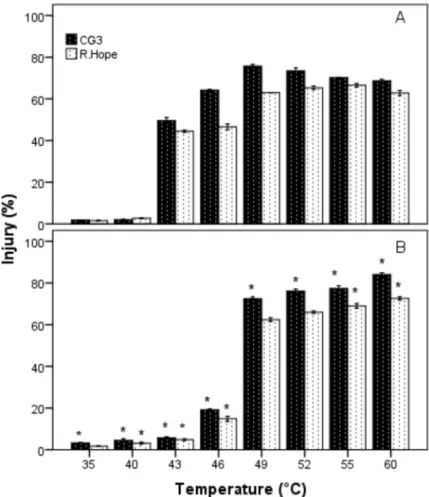
In general, injury (expressed by reference to controls) was higher in HSS than in GHS (Figure 1). The lowest average
Figure 1. Effect of high temperature on injury in leaves of strawberry cultivars. Exposed to gradual heat stress (GHS) (A), exposed to heat-shock stress (HSS) (B). Values are means from three replications and vertical bars indicate ± SE. *Significant difference between GHS and HSS at a given cultivar (P ≤ 0.05).
injury was observed at 35 °C in both applications, whereas the highest one was at 49 °C in GHS (76% ‘CG3’ and 63% ‘R. Hope’) and 60 °C (84% in ‘CG3’ and 72% in ‘R. Hope’) at 60 °C in HSS applications. The highest injury was observed in ‘CG3’ at all temperatures for both applications. No significant difference was detected among interaction of heat stress type and cultivars (Table).
3.2. Nonenzymatic antioxidants
The highest total AsA content was observed in ‘CG3’ (3.47 mg g–1 FW) at 40 °C in HSS and the lowest in ‘CG3’ (0.50
mg g–1 FW) at 55 °C in GHS (Figure 2). The effects of heat
stress type, temperature, cultivar, and interactions on AsA were statistically significant (Table). In general, the total GSH content of ‘CG3’ plants was higher than that of ‘R. Hope’ plants (Figure 2). Despite this result, the effects of all independent variables and interactions on GSH were statistically significant (Table).
3.3. Enzymatic antioxidants
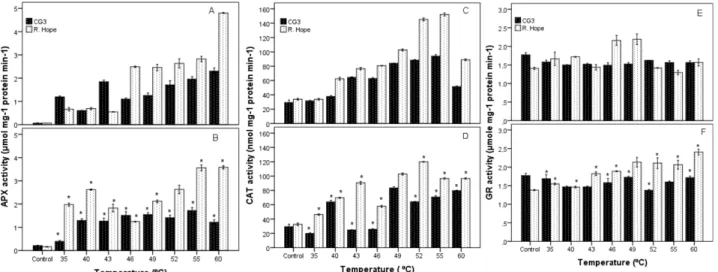
The APX activities of both cultivars indicated significant differences between GHS and HSS (Figure 3). The APX activity was significantly greater in GHS than in HSS. The highest and the lowest enzyme activity were detected in GHS application in ‘R. Hope’ at 60 °C (4.80 µmol mg–1
protein) and in HSS application in ‘CG3’ at 35 °C (0.39
µmol mg–1 protein), respectively. Thus, the effects of heat
stress type, temperature, cultivar, and interactions on APX activity were found statistically significant (Table).
Similar results were obtained for CAT activity (Figure 3). The highest and the lowest enzyme activity were detected in GHS application in ‘R. Hope’ at 55 °C (152.19 nmol mg–1 prot.) and in HSS application in ‘CG3’ at 35 °C
(19.81 nmol mg–1 prot.), respectively. The results of the
analysis of variance (Table) indicated that the effects of all independent variables and interactions on CAT activity were statistically significant.
Effect of high temperature on GR activity is shown in Figure 3. In terms of GR activity, no significant differences were detected between interactions of heat stress type and temperatures or interactions of heat stress type and cultivars (Table).
3.4. Protein analysis
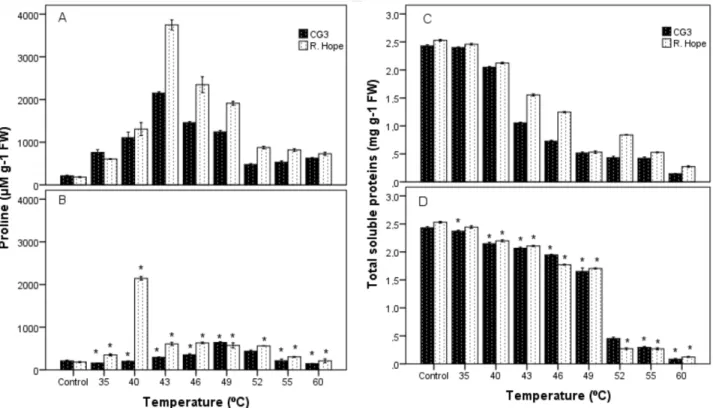
The proline contents of cultivars were significantly higher in GHS application than in HSS application (Figure 4). The highest proline content was measured in ‘R. Hope’ (3748.68 µM g–1 FW) at 43 °C in GHS application and the lowest
in ‘CG3’ (145.64 µM g–1 FW) at 60 °C in HSS application.
However, no significant difference was detected between the interaction of heat stress type and cultivars (Table).
Table. Results of analysis of variance (ANOVA) on the effects of heat stress type (H), temperature (T), cultivar (Cv.), and the interactions on injury, ascorbic acid (AsA), glutathione (GSH), ascorbate peroxidase (APX), catalase (CAT), glutathione reductase (GR), proline, and total soluble proteins (TSP). Numbers represent F values relative to a significance level of 0.05.
Dependent variable Independent variable
H T Cv. H × T H × Cv. T × Cv. H × T × Cv. Injury 706.182(P < 0.001) 5758.764(P < 0.001) 491.820(P < 0.001) 643.835(P < 0.001) 0.966NS 29.906(P < 0.001) 14.251(P < 0.001) AsA 1259.795(P < 0.001) 130.306(P < 0.001) 34.193(P < 0.001) 122.342(P < 0.001) 105.825(P < 0.001) 223.500(P < 0.001) 74.537(P < 0.001) GSH 317.213(P < 0.001) 57.512(P < 0.001) 674.476(P < 0.001) 16.894(P < 0.001) 81.855(P < 0.001) 46.658(P < 0.001) 18.267(P < 0.001) APX activity 188.792(P < 0.001) 335.119(P < 0.001) 350.216(P < 0.001) 27.051(P < 0.001) 66.236(P < 0.001) 22.512(P < 0.001) 23.479(P < 0.001) CAT activity 2607.480(P < 0.001) 858.944(P < 0.001) 1451.229(P < 0.001) 354.300(P < 0.001) 127.234(P < 0.001) 192.442(P < 0.001) 83.453(P < 0.001) GR activity 14.816(P < 0.001) 15.866(P < 0.001) 30.626(P < 0.001) 3.118NS 3.094NS 8.871(P < 0.001) 19.864(P < 0.001) Proline 1406.975(P < 0.001) 301.727(P < 0.001) 404.814(P < 0.001) 195.856(P < 0.001) 8.233NS 48.125(P < 0.001) 54.191(P < 0.001) TSP 1542.484(P < 0.001) 8283.217(P < 0.001) 258.563(P < 0.001) 737.745(P < 0.001) 14.542(P < 0.001) 272.387(P < 0.001) 53.369(P < 0.001) NS Nonsignificant
Heat stress decreased TSP content in both GHS and HSS applications (Figure 4). The TSP contents decreased depending on the temperature, with it being highest (2.53 mg g–1 FW) in leaf tissues from control (unstressed) plants
in ‘R. Hope’ and lowest (0.08 mg g–1 FW) in leaf tissues
from HSS plants in ‘CG3’ at 60 °C. The analysis of variance indicated that the effects of all independent variables and interactions on TSP content were significant (Table).
Figure 2. Effect of high temperature on nonenzymatic antioxidants in leaves of strawberry cultivars. Total ascorbic acid (AsA) content exposed to gradual heat stress (GHS) (A), total AsA heat-shock stress (HSS) (B), Total glutathione (GSH) content exposed to GHS (C), Total GSH content exposed to HSS (D). Values are means from three replications and vertical bars indicate ± SE. *Significant difference between GHS and HSS at a given cultivar (P ≤ 0.05).
Figure 3. Effect of high temperature on antioxidant enzyme activities in leaves of strawberry cultivars. The activity of ascorbate peroxidase (APX) exposed to gradual heat stress (GHS) (A), the activity of APX exposed to heat-shock stress (HSS) (B), the activity of catalase (CAT) exposed to GHS (C), the activity of CAT exposed to HSS (D), the activity of glutathione reductase (GR) exposed to GHS (E), the activity of GR exposed to HSS (F). Values are means from three replications and vertical bars indicate ± SE. *Significant difference between GHS and HSS at a given cultivar (P ≤ 0.05).
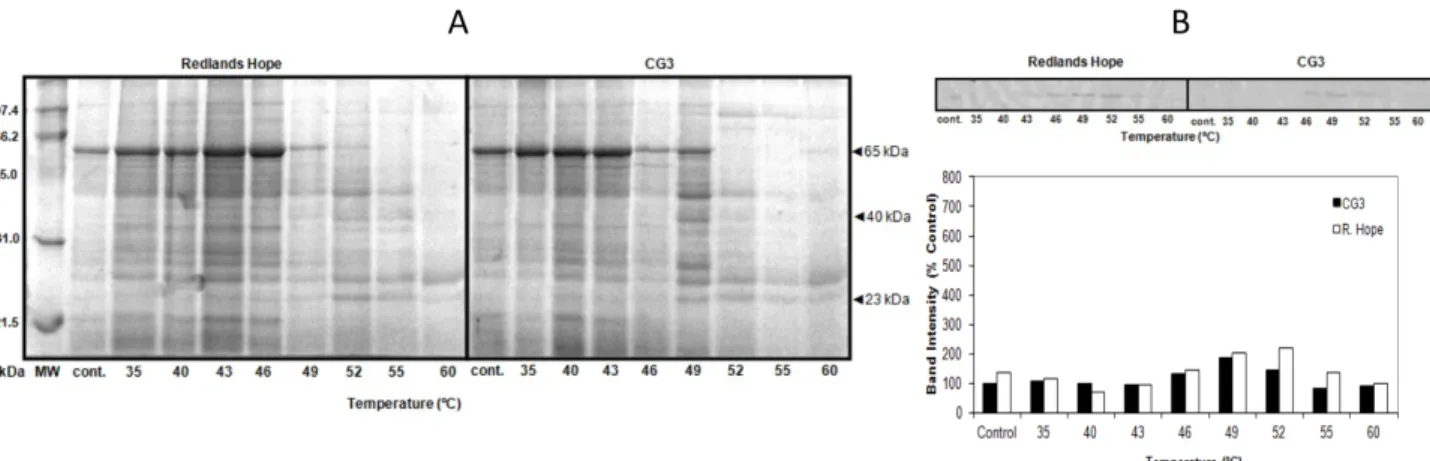
Immunoblotting analysis was performed against HSP60 and HSP70 of leaf tissues subjected to high temperatures. The bands on the immunoblot of HSP60 were sharp and detectable, whereas the bands on the immunoblot of HSP70 were faint and barely visible. Therefore, only the results of HSP60 are presented. The immunoblotting results for HSP60 indicated only the 23 kDa protein band
with different band intensities according to cultivars and temperatures with GHS and HSS applications (Figures 5 and 6). The highest and the lowest intensity of HSP60 were measured in ‘CG3’ (Figure 5) at 46 °C and at 40 °C in GHS application, respectively. Generally, the synthesis of the 23 kDa HSP was more intense in ‘R. Hope’ than in ‘CG3’ at all temperatures of GHS and HSS (Figures 5 and 6).
Figure 4. Effect of high temperature on proline and total soluble protein (TSP) contents in leaves of strawberry cultivars. Proline content exposed to gradual heat stress (GHS) (A), proline content exposed to heat-shock stress (HSS) (B), TSP content exposed to GHS (C), TSP content exposed to HSS (D). Values are means from three replications and vertical bars indicate ± SE. *Significant difference between GHS and HSS at a given cultivar (P ≤ 0.05).
Figure 5. SDS-PAGE protein profiles obtained from strawberry cultivars exposed to gradual heat stress (GHS). In each lane, 30 µg of protein was loaded. Molecular weight markers (MW) and the molecular mass (kDa) are shown on the left-hand side. The arrow on the right mark indicates the position of proteins that changed under heat stress (A). Anti-HSP60 immunoblots of the 23 kDa leaf proteins and band intensities were based on quantitative measurements. For immunoblotting, 30 µg of protein was loaded in each lane (B).
4. Discussion
Following high temperature exposure, cellular injury was significantly increased in both GHS and HSS leaf tissues in the current study. In addition, exposure to HSS increased the injury of leaves compared with exposure to GHS (Figure 1). In other words, GHS application might play a role in gaining heat acclimation due to longer exposure time. Similarly, it was reported that GHS increased heat stress tolerance of strawberry and lablab bean plants in previous studies (Gulen and Eris 2003, 2004; D’Souza and Devaraj, 2013). Plants can acquire thermotolerance when exposed to sublethal high temperatures for a short time or mild high temperatures for a longer time (Yarwood, 1961; Sung et al., 2003; He et al., 2005; Carvalho et al., 2015). The sensitive cultivar, ‘CG3’, showed the highest injury at all temperatures for both applications. Previously, Kesici et al. (2013) also reported that more cellular injury occurred to ‘CG3’ than to ‘R. Hope’, which was in agreement with the current study.
In the present experiment, the highest total AsA content was observed in ‘CG3’ at 40 °C in HSS. Similarly, the total GSH content of ‘CG3’ was higher than that of ‘R. Hope’ in both applications and almost all temperatures (Figure 2). Plants exposed to extreme temperatures use many nonenzymatic antioxidants such as AsA and GSH to manage the injury caused by oxidative stress (Aksoy et al., 2015). AsA is a scavenger of ROS because of the ability to donate an electron and GSH prevents oxidation of –SH groups of enzymes by reacting with free radicals formed in the event of stress (Mullineaux and Rausch, 2005). Ergin et al. (2014) reported that high-temperature stress increased AsA contents in strawberry plants especially in tolerant genotypes. Similarly, heat acclimated turf grass had lower ROS production as a result of increased synthesis of AsA and GSH (Xu et al., 2006). However, in the current
study, AsA and GSH were not effective for gaining thermotolerance in strawberry plants, possibly because of the other defense mechanisms that are responsible for the destruction of ROS in the cell.
The APX and CAT activity were significantly greater in GHS than in HSS and the activity increased with temperature in ‘R. Hope’. Heat stress applications and temperatures did not affect the GR activity of cultivars (Figure 3). The significant increase in APX and CAT enzyme activities in the GHS application indicated that GHS application is more efficient in gaining thermotolerance in strawberry plants. The APX and CAT activities of ‘CG3’ did not increase with increasing temperatures in either application. This could be due to the nonacclimatization of the ‘CG3’ plants to increasing temperatures.
APX reduces H2O2 to water by using two molecules of AsA, while CAT catalyzes two molecules of H2O2 into water and oxygen (Sharma et al., 2012). Glutathione reductase catalyzes the reduction of glutathione disulfide (GSSG) to glutathione (GSH), which is a critical molecule in resisting oxidative stress (Arora et al., 2002). The absence of change in GR activity in response to temperatures and applications indicated that there was not a role for this enzyme in the antioxidant defense mechanism of strawberry plants. Similar to the current study, the APX activity of various plant species increased with temperature and time of application under high temperature stress (Almeselmani et al., 2006; Yin et al., 2008; He and Huang, 2010). By contrast, it was reported that the CAT activity of cool season grass species and peppers was reduced at high temperatures, and loss of CAT activity may be a consequence of membrane dysfunction (Jiang and Huang, 2001; Anderson, 2002). It was determined that GR activity was variable in many plant species during high temperature stress; for example, it can be increased (Kurganova et al., 1999; Chaitanya et
Figure 6. SDS-PAGE protein profiles obtained from strawberry cultivars exposed to heat-shock stress (HSS). In each lane, 30 µg of protein was loaded. Molecular weight markers (MW) and the molecular mass (kDa) are shown on the left-hand side. The arrow on the right mark indicates the position of some proteins that changed under heat stress (A). Anti-HSP60 immunoblots of the 23 kDa leaf proteins and band intensities were based on quantitative measurements. For immunoblotting, 30 µg of protein was loaded in each lane (B).
al., 2001; Kocsy et al., 2004), unchanged (Yin et al., 2008), or reduced (Jiang and Huang, 2001).
In the present study, the proline contents of cultivars were significantly higher in GHS than in HSS. Generally, the proline content in ‘R. Hope’ was higher than in ‘CG3’ at all temperatures (Figure 4). Similar to the findings of the current study, proline accumulation is more often observed in stress-tolerant plants than in sensitive ones (Chaitanya et al., 2001; Kumar et al., 2011; Naji and Devaraj, 2011). The proline content of cultivars, especially in ‘R. Hope’, was significantly increased at 43 °C and after it was decreased in GHS. The amino acid proline acts as ROS scavenger and protein stabilizer and is effective in stress tolerance (Xiong et al., 2012; Roychoudhury et al. 2015). Decrease in proline accumulation has been reported to have a role in activating the heat shock transcription factors for inducing the expression of HSPs in response to differential heat stress (Kumar et al., 2012). In this respect, reduction of the proline content might be the reason for HSP synthesis induction at 46 °C; thus strawberry plants can gain adaptation to high temperatures.
Regarding TSP content, it was reduced by high temperature in both GHS and HSS applications (Figure 4). This might be due to protein denaturation and inhibition of the protein synthesis at higher temperatures (Levitt, 1980). The decrease in TSP was greater in the GHS application, suggesting that longer exposure time might have increased the degradation of proteins. Moreover, as some researchers noted, lower long-term temperatures can cause more damage than short-term higher temperatures (Willits and Peet, 1998). Previous studies also showed that TSP content of strawberry cultivars decreased, whereas newly synthesized proteins increased in response to stress (Gulen and Eris, 2003, 2004; Ledesma et al., 2004; Gulen et al., 2006). According to SDS-PAGE, the two proteins of approximately 40 kDa and 23 kDa that accumulated at higher temperatures could be responsible for a considerable gain in thermotolerance in GHS.
Immunoblotting analysis revealed that the HSP70 antibody did not react with any of the HSPs in ‘R. Hope’ and ‘CG3’. The HSP60 antibody, however, reacted with the 23 kDa HSP in both cultivars. The intensity of 23 kDa HSP60 in GHS was prominently more than in HSS and more intense in ‘R. Hope’ than in ‘CG3’ at almost all temperatures (Figures 5 and 6). The 23 kDa HSP60 was detected even at control temperature, but it was significantly increased at 46 °C. When subjected to nonoptimal temperatures, plant cells preferentially
upregulate the expression of specific proteins called HSPs that function as molecular chaperones. The HSPs help to protect cells against the deleterious effects of stress (Miller and Stillman, 2012; Qu et al., 2013). It has been reported that plants such as potato, arabidopsis, and rice begin to synthesize HSPs if they are exposed to heat stress (Savic et al., 2012; Zhong et al., 2013; Chen et al., 2014). Ledesma et al. (2004) identified the presence of 26 kDa small HSP in leaf tissues of strawberry plants using peaHSP antibody 17.7. Possibly, there is another HSP belonging to different classes in strawberry plants; this HSP was visible in the SDS-PAGE gels (40 kDa) (Figures 5 and 6). To the best of our knowledge, there is no previous study related to heat stress in strawberry plants that found evidence for HSP60. However, under heavy metal stress, Wang et al. (2011) reported the accumulation of HSP60 and HSP70 proteins in spinach (Spinacia oleraceae L.). In the current study, the HSP60 contents of ‘R. Hope’ demonstrated that this cultivar responded to high temperatures with better use of protein metabolism and had a more powerful defense mechanism.
In conclusion, GHS application might play a role in enabling heat acclimation due to longer exposure time in strawberry plants. Nonenzymatic antioxidants such as AsA and GSH and enzymatic antioxidant such as GR were not effective in enabling thermotolerance in strawberry plants, possibly because other defense mechanisms were responsible for the destruction of ROS like APX and CAT in the cell. Reduction of the proline content might be the reason for HSP synthesis induction at 46 °C; thus strawberry plants can gain adaptation to high temperatures. The higher enzyme activity and more proline and TSP content and accumulation of HSP60 of ‘R. Hope’ in comparison with ‘CG3’ at all temperatures indicate that this cultivar responded to high temperatures with better use of protein metabolism and had a more powerful defense mechanism. The 23 kDa HSP60 determined is the first HSP60 in strawberry plants and can be used as a marker. These differences will be useful for identifying differently expressed genes under high temperature and it will allow the development of tolerant strawberry varieties.
Acknowledgments
Grants from the Scientific and Technological Research Council of Turkey (TÜBİTAK-TOVAG, 108O063) supported the current research. The authors are thankful to Yaltir A.S. for their material support regarding strawberry seedlings.
References
Aksoy E, Demirel U, Öztürk ZN, Çalışkan S, Çalışkan ME (2015). Recent advances in potato genomics, transcriptomics, and transgenics under drought and heat stresses: a review. Turk J Bot 39: 920-940.
Almeselmani M, Deshmukh PS, Sairam RK, Kushwaha SR, Singh TP (2006). Protective role of antioxidant enzymes under high temperature stress. Plant Sci 171: 382-388.
Anderson JA (2002). Catalase activity, hydrogen peroxide content and thermotolerance of pepper leaves. Sci Hortic 95: 277-284. Arora R, Pitchay DS, Bearce BC (1998). Water-stress-induced heat
tolerance in geranium leaf tissues: a possible linkage through stress proteins. Phsiol Plantarum 103: 24-34.
Arora A, Sairam RK, Srivastava GC (2002). Oxidative stress and antioxidative system in plants. Curr Sci 82: 1227-1238.
Arora R, Wisniewski ME (1994). Cold acclimation in genetically related (sibling) deciduous and evergreen peach (Prunus persica [L.] Batsch) (II. A 60-kilodalton bark protein in cold-acclimated tissues of peach is heat stable and related to the dehydrin family of proteins). Plant Physiol 105: 95-101. Arora R, Wisniewski ME, Scorza R (1992). Cold acclimation in
genetically related (sibling) deciduous and evergreen peach (Prunus persica L. Batsch). 1. Seasonal changes in cold hardiness and polypeptides of bark and xylem tissues. Plant Physiol 99: 1562-1568.
Bates LS, Waldren RP, Teare ID (1973). Rapid determination of free proline for water stress studies. Plant Soil 39: 205-207. Cakmak I, Marschner H (1992). Magnesium deficiency and
high-light intensity enhance activities of superoxide dismutase, ascorbate peroxidase and glutathione reductase in bean leaves. Plant Physiol 98: 1222-1227.
Carvalho LC, Coito JL, Colaco S, Sangiogo M, Amancio S (2015). Heat stress in grapevine: the pros and cons of acclimation. Plant Cell Environt 38: 777-789.
Chaitanya KV, Sundar D, Masilamani S, Ramachandra Reddy A. (2001). Variation in heat stress-induced antioxidant enzyme activities among three mulberry cultivars. Plant Growth Regul 36: 175-180.
Chen X, Lin S, Liu Q, Huang J, Zhang W, Lin J, Wang Y, Ke Y, He H (2014). Expression and interaction of small heat shock proteins (sHsps) in rice in response to heat stress. Biochim Biophys Acta 1844: 818-828.
D’Souza MR, Devaraj VR (2013). Induction of thermotolerance through heat acclimation in lablab bean (Dolichos lablab). Afr J Biotechnol 12: 5695-5704.
Ellman GL (1959). Tissue sulfhydryl groups. Arc Biochem Biophys 82: 70-77.
Ergin S, Kesici M, Gülen H (2012). Changes in H2O2 and peroxidase
activities in strawberry plants under heat stress. Harran Journal of Agricultural and Food Science 16: 25-35.
Ergin S, Aydogan C, Ozturk N, Turhan E (2014). Effects of ascorbic acid application in strawberry plants during heat stress. TURKJANS Special Issue (2): 1486-1491.
Ershova AN, Popova NV, Berdnikova OS (2011). Production of reactive oxygen species and antioxidant enzymes of pea and
soybean plants under hypoxia and high CO2 concentration in
medium. Russ J Plant Physiol 58: 982-990.
Foyer CH, Noctor G (2005). Redox homeostasis and antioxidant signaling: a metabolic interface between stress perception and physiological responses. Plant Cell 17: 1866-1875.
Gulen H, Eris A (2003). Some physiological changes in strawberry (Fragaria x ananassa ‘Camarosa’) plants under heat stress. J Hortic Sci Biotech 78: 894-898.
Gulen H, Eris A (2004). Effect of heat stress on peroxidase activity and total protein content in strawberry plants. Plant Sci 166: 739-744.
Gulen H, Kuden A, Postman J, Arora R (2005). Total protein and SDS-PAGE in pear scions grafted on quince and pear seedling rootstocks. Turk J Agric For 29: 91-96.
Gulen H, Turhan E, Eris A (2006). Changes in peroxidase activities and soluble proteins in strawberry varieties under salt-stress. Acta Physiol Plant 28: 109-116.
Hancock RD, Morris WL, Ducreux LJM, Morris JA, Usman M, Verrall SR, Fuller J, Simpson CG, Zhang R, Hedley PE, Taylor MA (2014). Physiological, biochemical and molecular responses of the potato (Solanum tuberosum L.) plant to moderately elevated temperature. Plant Cell Environ 37: 439-450.
Hartl FU, Bracher A, Hartl MH (2011). Molecular chaperones in protein folding and proteostasis. Nature 475: 324-332. Hasanuzzaman M, Nahar K, Alam MM, Roychowdhury R, Fujita M
(2013). Physiological, biochemical, and molecular mechanisms of heat stress tolerance in plants. Int J Mol Sci 14: 9643-9684.
He Y, Liu X, Huang B (2005). Protein changes in response to heat stress in acclimated and non acclimated creeping bentgrass. J Am Soc Hortic Sci 130: 521-526.
He Y, Huang B (2010). Differential responses to heat stress in activities and ısozymes of four antioxidant enzymes for two cultivars of Kentucky bluegrass contrasting in heat tolerance. J Am Soc Hortic Sci 135: 116-124.
IPCC, 2014. Climate Change 2014. Synthesis Report. Contribution of Working Groups I, II and III to the Fifth Assessment Report of the Intergovernmental Panel on Climate Change [Core Writing Team, R.K. Pachauri and L.A. Meyer (eds.)]. IPCC, Geneva, Switzerland, 151 pp.
Jiang Y, Huang B (2001). Effects of calcium on antioxidant activities and water relations associated with heat tolerance in two cool season grasses. J Exp Bot 52: 341-349.
Kaushik D, Roychoudhury A (2014). Reactive oxygen species (ROS) and response of antioxidants as ROS-scavengers during environmental stress in plants. Front Environ Sci 2: 1-13. Kesici M, Gulen H, Ergin S, Turhan E, Ipek A, Koksal N (2013).
Heat-stress tolerance of some strawberry (Fragaria × ananassa) cultivars. Not Bot Horti Agrobo 41: 238-243.
Kishor PBK, Sangam S, Amrutha RN, Laxmi PS, Naidu KR, Rao KRSS, Rao S, Reddy KJ, Theriappan P, Sreenivasulu N (2005). Regulation of proline biosynthesis, degradation, uptake and transport in higher plants: its implications in plant growth and abiotic stress tolerance. Curr Sci 88: 424-438.
Kocsy G, Szalai G, Sutka J, Paldi E, Galiba G (2004). Heat tolerance together with heat stress-induced changes in glutathione and hydroxymethylglutathione levels is affected by chromosome 5A of wheat. Plant Sci 166: 451-458.
Krishnamurthy A, Rathinasabapathi B (2013). Oxidative stress tolerance in plants: novel interplay between auxin and reactive oxygen species signaling. Plant Signal Behav 8: 10.
Kumar RR, Karajol K, Naik GR (2011). Effect of polyethylene glycol induced water stress on physiological and biochemical responses in pigeonpea (Cajanus cajan L. Millsp.) Recent Res Sci Technol 3: 148-152.
Kumar RR, Goswami S, Sharma SK, Singh K, Gadpayle KA, Kumar N, Rai GK, Singh M, Rai RD (2012). Protection against heat stress in wheat involves change in cell membrane stability, antioxidant enzymes, osmolyte, H2O2 and transcript of heat shock protein. Int J Plant Physiol Biochem 4: 83-91.
Kurganova LN, Veselov AP, Sinitsina YV, Elikova EA, Kulaeva ON (1999). Lipid peroxidation products as possible mediators of heat stress response in plants. Russ J Plant Physiol 46: 181-185.
Law MY, Charles SA, Halliwell B (1983). Glutathione and ascorbic acid in spinach (Spinacia oleracea) chloroplasts: the effect of hydrogen peroxide and of paraquat. Biochem J 210: 899-903. Ledesma NA, Kawabata S, Sugiyama N (2004). Effect of high
temperature on protein expression in strawberry plants. Biol Plantarum 48: 73-79.
Levitt J (1980). Responses of Plants to Environmental Stresses, Vol. I. New York, NY, USA: Academic Press, pp: 347-370.
Lim CC, Krebs SL, Arora RA (1999). 25-kDa dehydrin associated with genotype and age-dependent leaf freezing-tolerance in Rhododendron: a genetic marker for cold hardiness? Theor Appl Genet 99: 912-920.
Miller NA, Stillman JH (2012). Physiological optima and critical limits. Nature Edu Know 3: 1.
Mullineaux PM, Rausch T (2005). Glutathione, photosynthesis and the redox regulation of stress responsive gene expression. Photosynth Res 47: 459-474.
Naji KM, Devaraj VR (2011). Antioxidant and other biochemical defense responses of Macrotyloma uniflorum (Lam.) Verdc. (Horse gram) induced by high temperature and salt stress. Braz J Plant Physiol 23: 187-195.
Nakano Y, Asada K (1980). Spinach chloroplasts scavenge hydrogen peroxide on illumination. Plant Cell Physiol 21: 1295-1307.
Qu AL, Ding YF, Jiang Q, Zhu C (2013). Molecular mechanisms of the plant heat stress response. Biochem Biophy Res Commun 432: 203-207.
Rao MV, Paliyath G, Ormrod DP (1996). Ultraviolet-B- and ozone-induced biochemical changes in antioxidant enzymes of Arabidopsis thaliana. Plant Physiol 110: 125-136.
Roychoudhury A, Banerjee A, Lahiri V (2015). Metabolic and molecular-genetic regulation of proline signaling and its cross-talk with major effectors mediates abiotic stress tolerance in plants. Turk J Bot 39: 887-910.
Savic J, Dragicevic I, Pantelic D, Oljaca J, Momcilovic (2012). Expression of small heat shock proteins and heat tolerance in potato (Solanum tuberosum L.). Arch Biol Sci 64: 135-144.
Sharma P, Jha AB, Dubey RS, Pessarakli M (2012). Reactive oxygen species, oxidative damage, and antioxidative defense mechanism in plants under stressful conditions. Journal of Botany doi: 10.1155/2012/217037.
Sung DY, Kaplan F, Lee KJ, Guy CL (2003). Acquired tolerance to temperature extremes. Trends Plant Sci 8: 179-187.
Turhan E, Gulen H, Eris A (2008). The activity of antioxidative enzymes in three strawberry cultivars related to salt-stress tolerance. Acta Physiol Plant 30: 201-208.
Wahid A, Close TJ (2007). Expression of dehydrins under heat stress and their relationship with water relations of sugarcane leaves. Biol Plantarum 51: 104-109.
Wahid A, Gelani S, Ashraf M, Foolad MR (2007). Heat tolerance in plants: an overview. Environ Exp Bot 61: 199-223.
Wang C, Gu X, Wang X, Guo H, Geng J, Yu H, Sun J (2011). Stress response and potential biomarkers (Spinacia oleraceae L.) seedlings exposed to soil lead. Ecotox Environ Safe 74: 41-47. Wang W, Vinocur B, Shoseyov O, Altman A (2004). Role of plant
heat-shock proteins and molecular chaperones in abiotic stress response. Trends Plant Sci 9: 244-253.
Willits DH, Peet MM (1998). The effect of night temperature on greenhouse grown tomato yields in warm climate. Agr Forest Meteorol 92: 191-202.
Xiong J, Zhang L, Fu G, Yang Y, Zhu C, Tao L (2012). Drought-induced proline accumulation is uninvolved with increased nitric oxide, which alleviates drought stress by decreasing transpiration in rice. J Plant Res 125: 155-164.
Xu S, Li J, Zhang X, Wei H, Cui L (2006). Effects of heat acclimation pretreatment on changes of membrane lipid peroxidation, antioxidant metabolites, and ultrastructure of chloroplasts in two cool-season turfgrass species under heat stress. Environ Exp Bot 56: 274-285.
Yarwood CE (1961). Acquired tolerance of leaves to heat. Science 134: 941-942.
Yin H, Chen Q, Yi M (2008). Effects of short-term heat stress on oxidative damage and responses of antioxidant system in Lilium longiflorum. Plant Growth Regul 54: 45-54.
Zhong L, Zhou W, Wang H, Ding S, Lu Q, Wen X, Peng L, Zhang L, Lu C (2013). Chloroplast small heat shock protein HSP21 interacts with plastid nucleoid protein pTAC5 and is essential for chloroplast development in Arabidopsis under heat stress. Plant Cell 25: 2925-2943.