986
|
wileyonlinelibrary.com/journal/ccr3 Clin Case Rep. 2021;9:986–989.1
|
INTRODUCTION
Genital herpes is one of the most commonly reported sexually transmitted infections (STI) that is associated with a greater incidence of recurrence and does not respond to conventional treatments. Type I and II viruses are involved in the patho-genesis of the disease where it affects lips, face, and genitals.1
The infection begins with irritation and itching followed by pain up to 24 hours, after which the virus widespread to sensory nerves.2 Due to the weakening of the immune
sys-tem, the virus in the sensory nerves returns to the surface of the skin to cause reinfection. Factors that can worsen the infection include stress, fatigue, cold wind, burn, loss of immunity, infection, fever, and cold, to name few.3 The
symptoms usually last 4-7 days after the first contact with the virus carrying virus or virus-containing secretions.4 The
most common symptom of the disease is the appearance of small blisters in the genital area that when puncture, produce painful ulcers. Some people may find only red or prominent lesions, and some are likely to be presented with painful uri-nation.5 In women, vaginal vesiculate secretions may also
be observed. Urination, with clear watery secretions from the urethra, is often a known complication of the infection. Ulceration usually occurs 4-7 days after the first infection, and the symptoms are similar to that of cold, such as fever, sore throat, and lumbago swelling.6
Conventional treatment for herpes includes antiviral drugs, which inhibit the replication of viral RNA.4 These
drugs include acyclovir, ganciclovir, valaciclovir, and penci-clovir. The overuse of drugs has led to drug resistance.7 On
the other hand, they are not cost-effective, owing to the long course of treatment.8 Currently, two herbal remedies, Melissa
and Myrtoplex, are used in Iran.9 Herbal medicine is currently
under investigation for its effectiveness in the treatment of the herpes virus. Studies have indicated that plants and derived compounds can be used to treat herpes viruses.10,11
Olive extracts are reported to be effective against various pathological conditions. Polyphenolic compounds, including oleuropein (OLE) and hydroxytyrosol (HT), are active ingre-dients in olive leave extracts. In this report, we present a case of acyclovir-resistant herpes that was reported to our center, due to the severity of the symptoms. Olive leaf extract oint-ment led to the patient recovery in 48 hours.
2
|
OLIVE LEAF EXTRACTION
METHOD
Olive leaves were collected in Mid-November and dried at ambient room temperature, and the powdered extract was stored in dark until further usage. The powder was dissolved in 100 mL of extraction solvent that was made of 80% ethanol
Received: 15 December 2019
|
Revised: 22 October 2020|
Accepted: 16 December 2020 DOI: 10.1002/ccr3.3723C A S E R E P O R T
Treatment of genital herpes using olive leaf extract
Nahid Lorzadeh
1|
Yasaman Kazemirad
2|
Nastran Kazemirad
3This is an open access article under the terms of the Creative Commons Attribution-NonCommercial-NoDerivs License, which permits use and distribution in any medium, provided the original work is properly cited, the use is non-commercial and no modifications or adaptations are made.
© 2020 The Authors. Clinical Case Reports published by John Wiley & Sons Ltd. 1Department of Obstetrics and Gynecology,
Faculty of Medicine, Lorestan University of Medical Sciences, Khorramabad, Iran
2Faculty of Dentistry, Medipol University,
Istanbul, Turkey
3Faculty of Medicine, Tehran University of
Medical Sciences, Tehran, Iran
Correspondence
Nahid Lorzadeh, Lorestan University of Medical Sciences, Khorramabad, Iran. Email: [email protected]
Abstract
Genital herpes is one of the sexually transmitted diseases that is reported with a greater incidence of primary and secondary recurrence. In this study, olive leaf ex-tract was used for its antiviral properties to treat the infection. The randomized-clin-ical trials using such a therapeutic approach are required in this field.
K E Y W O R D S
|
987LORZADEH EtAL.
at 60°C. The mixture was filtered using Whatman filter paper NO: 1. The extract was evaporated at room temperature under vacuum conditions. The leaves were obtained at the best pos-sible time of the year, which had the highest amount of active ingredients; washed, dried, and hydroalcoholic extract was extracted. The extract analysis using the HPLC showed that the active ingredient, oleuropein, was 0.475 mg/g of the total extract. The ointment was prepared in 2% and was provided to the patient.
3
|
CASE REPORT
The patient was a married 19-year-old woman with multi-ple mucocutaneous, round polycyclic lesions in the perineal region, dysuria and had severe burning sensations and pain, especially during defecation and her vulva was inflamed with swollen and tender inguinal lymph node. She reported that the appearance of the lesion started a week before her re-ferral. Her husband (only sexual partner) did not have any such lesions, and she did not have any travel history for past 6 months. She visited her gynecologist for pap test 4 months ago. No other body part had lesions or rashes. The patient was healthy otherwise and did not have any medical or sur-gical history. The patient was referred to Asali Women's Hospital. During this period, the patient underwent multiple visits to general practitioners and general surgery specialists with a primary diagnosis of anal fissure. Her blood chemistry did not show any abnormality in exception to increased white blood cell counts: 15 000/mm3. During her referral to
derma-tologist, she was diagnosed with herpes infection from lesion
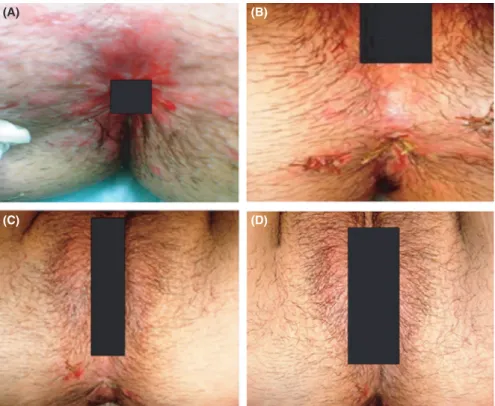
biopsy, PCR test, and serologic tests for herpes glycoprotein (ELISA) and was treated with acyclovir ointment. At this time, her husband was not tested positive for the infection. Nonetheless, the patient did not respond to the treatment and was known to be a case of acyclovir-resistant herpes infec-tion. She was thereby, treated with the localized application of topical olive leaf extract, twice a day, owing to the lesion biopsy reports. The response to this treatment was evalu-ated on day 3 and 6, and 2 weeks after treatment. Following 3 days of the treatment, the pain and wounds completely dis-appeared whereas the lesions of the perineal and rectal areas were completely recovered on day 6, and after 2 weeks of follow-up, no relapse was observed (Figure 1).
Written consent of the patient was obtained from the pa-tient for this study.
4
|
DISCUSSION
Herpes infection is one of the most common STI, world-wide. Acyclovir ointment and creams are usually used for the treatment of the infection. However, cases of acyclovir resistance and related agents have been reported widely, as a result of thymidine kinase deficiency. Hence, alternative drugs are used for the treatment. Some researchers, in ad-dition to direct antiviral effects, seek to boost the immune system against these viruses. Recently, Olea Europrae plant with antibacterial, antifungal, and antiviral effects has been reported for immune-boosting effects to treat HSV infec-tion.12,13 Similarly, imiquimod, as an immune-modifier, is
also used for the purpose.14
FIGURE 1 A, Indicates a first-day
lesion before treatment. B, indicates a third-day post-treatment lesion. C, indicates a lesion on day 6 after treatment. D, indicates a lesion 2 wk after treatment
(A) (B)
988
|
LORZADEH EtAL.In vivo studies have shown the efficacy of olive leaves extract against HSV-1.15 The application of olive leaf extract
is also indicated for the treatment of HSV.16 In a patent, it
has been pointed out that the olive leaf extract in six patients with herpes genitalis eliminated lesions in three of them after 48 hours and in a patient after 72 hours. The remaining two patients showed 66% improvement.17 Oleuropein is one of
the active phenolic compounds in olive leaves that is known for the treatment of cancer, microbes, viruses, and hyperlip-idemia. It is effective against rotavirus, hepatitis, parvovirus, influenza virus, herpes, and human immunodeficiency vi-ruses. Furthermore, anti-inflammatory and analgesic effects are also reported.18
In this case, we have reported the treatment of herpes sim-plex virus infection using olive leaf extract in an acyclovir-re-sistant patient. It was seen that the ointment with the 2% of the extract can control itching, bleeding, and pain. It was also effective against the lesions, similar to acyclovir. These out-comes are likely to direct cost-effective methods for treating herpes using herbal medicine with low-to-no adverse effects. Therefore, further clinical studies are recommended in the area.
5
|
CONCLUSION
Olive leaf extracts are the potential antiviral compounds that can be used to treat genital herpes.
CONFLICT OF INTEREST
The authors deny any conflict of interest in any terms or by any means during the study.
AUTHOR CONTRIBUTIONS
Dr NL: conceptualized and designed the study, drafted the in-itial manuscript, and reviewed and revised the manuscript. Dr NK: designed the data collection instruments, collected data, carried out the initial analyses, and reviewed and revised the manuscript. Dr YK: coordinated and supervised data collec-tion, and critically reviewed the manuscript for important in-tellectual content.
ETHICAL APPROVAL
All procedures performed in this study involving human par-ticipants were in accordance with the ethical standards of the institutional and/or national research committee and with the 1964 Helsinki Declaration and its later amendments or com-parable ethical standards.
CONSENT FOR PUBLICATION
Not applicable.
DATA AVAILABILITY STATEMENT
Data sharing is not applicable to this article as no datasets were generated or analyzed during the current study.
ORCID
Nahid Lorzadeh https://orcid.org/0000-0003-1492-8582
REFERENCES
1. Lorzadeh N, Sepavand F, Soleimaninezhad M, Kazemirad N. The effect of extract of oak gall for vaginal tightening and rejuvena-tion in women with vaginal relaxarejuvena-tion. Open J Obstet Gynecol. 2016;6(13):879-887.
2. Akbariasbagh F, Lorzadeh N, Azmoodeh A, Ghaseminejad A, Mohamadpoor J, Kazemirad S. Association among diame-ter and volume of follicles, oocyte maturity, and competence in intracytoplasmic sperm injection cycles. Minerva Ginecol. 2015;67(5):397-403.
3. Whitley RJ, Roizman B. Herpes simplex virus infections. Lancet. 2001;357(9267):1513-1518.
4. Lorzadeh N, Ghasem Nejad A, Mohmad Pour J. The effect of met-formin on outcome of intrauterine insemination (IUI) in insulin non-resistant infertile women with polycystic ovarian syndrome.
Iran J Obstet Gynecol Infertil. 2014;17(128):1-11.
5. Lorzadeh N, Kazemirad S, Lorzadeh M, Najafi S. Comparison of the effect of oral and intravenous fluid therapy on women with oli-gohydramnios. Res J Obstet Gynecol. 2008;1(1):25-29.
6. Lorzadeh N, Samimi S, Birjandi M. Association of fetal gender with maternal serum β-hCG and testosterone in normotensive and preeclamptic pregnancies. Iran J Obstet Gynecol Infertil. 2010;13(1):13-19.
7. Whitley RJ, Kimberlin DW, Roizman B. Herpes simplex viruses.
Clin Infect Dis. 1998;541-553.
8. Khan MTH, Ather A, Thompson KD, Gambari R. Extracts and molecules from medicinal plants against herpes simplex viruses.
Antiviral Res. 2005;67(2):107-119.
9. Lorzadeh N, Sepavand F, Soleimaninezhad M, Kazemi RN.The ef-fect of extract of internal layer of quercus (OAK GAL) in contrac-tion of vaginal smooth muscles in women with vaginal relaxacontrac-tion. 2016.
10. Chattopadhyay D, Khan MTH. Ethnomedicines and ethnome-dicinal phytophores against herpesviruses. Biotechnol Annu Rev. 2008;14:297-348.
11. Chattopadhyay D, Naik TN. Antivirals of ethnomedicinal origin: structure-activity relationship and scope. Mini Rev Med Chem. 2007;7(3):275-301.
12. Sudjana AN, D’Orazio C, Ryan V, et al. Antimicrobial activity of commercial Olea europaea (olive) leaf extract. Int J Antimicrob
Agents. 2009;33(5):461-463.
13. Lee O-H, Lee B-Y. Antioxidant and antimicrobial activities of in-dividual and combined phenolics in Olea europaea leaf extract.
Biores Technol. 2010;101(10):3751-3754.
14. Perkins N, Nisbet M, Thomas M. Topical imiquimod treatment of aciclovir-resistant herpes simplex disease: case series and literature review. Sex Transm Infect. 2011;87(4):292-295.
15. Motamedifar M, Nekooeian A, Moatari A. The effect of hydroal-coholic extract of olive leaves against herpes simplex virus type 1.
|
989LORZADEH EtAL.
16. Hsu PP. Natural medicines comprehensive database. J Med Libr
Assoc. 2002;90(1):114.
17. Fredrickson WR. Method and composition for antiviral therapy. 2002. Google Patents.
18. Omar SH. Oleuropein in olive and its pharmacological effects. Sci
Pharm. 2010;78(2):133-154.
How to cite this article: Lorzadeh N, Kazemirad Y,
Kazemirad N. Treatment of genital herpes using olive leaf extract. Clin Case Rep. 2021;9:986–989. https://doi. org/10.1002/ccr3.3723