AN EXPLORATORY STUDY OF A STUDENT-CENTERED
COURSE IN INTERNATIONAL BACCALAUREATE DIPLOMA
PROGRAMME (IBDP) SCHOOLS: HOW IS THEORY OF
KNOWLEDGE (TOK) IMPLEMENTED TO SUPPORT
INTERCULTURAL SENSITIVITY?
A MASTER’S THESIS
BY
TANSU ÖZAKMAN
THE PROGRAM OF CURRICULUM AND INSTRUCTION İHSAN DOĞRAMACI BILKENT UNIVERSITY
ANKARA APRIL 2017 T AN S U ÖZ AKM AN 2017
COM
P
COM
P
AN EXPLORATORY STUDY OF A STUDENT-CENTERED COURSE IN INTERNATIONAL BACCALAUREATE DIPLOMA PROGRAMME (IBDP) SCHOOLS: HOW IS THEORY OF KNOWLEDGE (TOK) IMPLEMENTED TO
SUPPORT INTERCULTURAL SENSITIVITY?
The Graduate School of Education of
İhsan Doğramacı Bilkent University by
Tansu Özakman
In Partial Fulfillment of the Requirements for the Degree of Master of Arts
in
Curriculum and Instruction
İhsan Doğramacı Bilkent University Ankara
İHSAN DOĞRAMACI BİLKENT UNIVERSITY GRADUATE SCHOOL OF EDUCATION
THESIS TITLE: AN EXPLORATORY STUDY OF A STUDENT-CENTERED COURSE IN INTERNATIONAL BACCALAUREATE DIPLOMA PROGRAMME
(IBDP) SCHOOLS: HOW IS THEORY OF KNOWLEDGE (TOK) IMPLEMENTED TO SUPPORT INTERCULTURAL SENSITIVITY?
TANSU ÖZAKMAN April 2017
I certify that I have read this thesis and have found that it is fully adequate, in scope and in quality, as a thesis for the degree of Master of Arts in Curriculum and
Instruction.
__________________________________ Asst. Prof. Dr. Robin Ann Martin
I certify that I have read this thesis and have found that it is fully adequate, in scope and in quality, as a thesis for the degree of Master of Arts in Curriculum and
Instruction.
___________________________________ Asst. Prof. Dr. Jennie F. Lane
I certify that I have read this thesis and have found that it is fully adequate, in scope and in quality, as a thesis for the degree of Master of Arts in Curriculum and
Instruction.
___________________________________ Prof. Dr. J. J. Thompson, The University of Bath
Approval of the Graduate School of Education ___________________________________ Prof. Dr. Alipaşa Ayas
iii ABSTRACT
AN EXPLORATORY STUDY OF A STUDENT-CENTERED COURSE IN INTERNATIONAL BACCALAUREATE DIPLOMA PROGRAMME (IBDP) SCHOOLS: HOW IS THEORY OF KNOWLEDGE (TOK) IMPLEMENTED TO
SUPPORT INTERCULTURAL SENSITIVITY?
Tansu Özakman
M.A., Program of Curriculum and Instruction Supervisor: Asst. Prof. Dr. Robin Ann Martin
April 2017
This study investigated the factors that affect students’ intercultural sensitivity scores and their self-rated Theory of Knowledge (TOK) aims along with their perspectives on the implementation of TOK. The participants were 305 International
Baccalaureate Diploma Programme (IBDP) year 1 students from six different schools in Turkey, one in Sweden and one in Lebanon. A questionnaire was used to collect data and was composed of four sections: open-ended and multiple-choice questions to collect demographic information; a Likert item scale to gather
information about participant school culture and international mindedness; another Likert item scale about TOK classrooms; and Intercultural Sensitivity Scale. Both qualitative and quantitative analysis were done in order to explore students’
perspectives on their school culture, implementation of TOK course, their self-rated intercultural sensitivity scores and TOK outcomes.
The qualitative analysis contributed to the exploration of the participant school cultures and differences between the participant students. In addition, quantitative analysis, a one-way ANOVA and independent samples t test, helped to explore students’ self-rated IS scores and TOK aims. The findings indicated that there is a statistically significant difference between students’ self-rated IS scores and their
iv
perceptions on TOK aims achieved. The results showed that students with higher IS scores have more positive attitudes about implementation of TOK course as they have higher self-rated TOK aims.
According to the findings, international experience and school type influence students’ IS scores. Even though it was assumed that students in international schools would have higher self-rated IS, it was discovered that students in national schools have relatively higher IS scores. However, in terms of students’ self-rated TOK aims, it was revealed that students’ international experience and the school type do not influence their self-rated TOK outcomes.
The study contributes to the existing literature by having studied IS level differences between students who have more international travel experience and those who have less international travel experience and students from schools with mostly national peers and those who have more international peers. It also contributes to TOK literature by exploring factors such as IS scores, international travel experience and school type, which may affect students’ self-rated TOK aims.
Key words: Theory of Knowledge, International Baccalaureate, Intercultural Sensitivity, Intercultural Communication Competence
v ÖZET
ULUSLARARASI BAKALORYA DİPLOMA PROGRAMI
OKULLARINDA BİLGİ KURAMI DERSİ KÜLTÜRLERARASI DUYARLILIĞI NASIL ETKİLER?
Tansu Özakman
Yüksek Lisans, Eğitim Programları ve Öğretim Tez Yöneticisi: Yrd. Doç. Dr. Robin Ann Martin
Nisan 2017
Bu çalışma öğrencilerin kültürlerarası duyarlılık puanlarını ve kendilerinin derecelendirdiği Bilgi Kuramı sonuçlarını etkileyen faktörleri ve Bilgi Kuramı dersinin uygulanması yönelik düşüncelerini incelemektedir. Araştırmaya Türkiye’den altı, İsveç’ten bir ve Lübnan'dan bir okul olarak toplamda 305 Uluslararası Bakalorya Diploma Programı (UBDP) öğrencisi katılmıştır. Veri toplamak için dört bölümden oluşan bir anket kullanılmıştır. Ankette demografik bilgi toplamak için açık uçlu ve çoktan seçmeli sorular; katılımcı okul kültürü ve kültürlerarası duyarlılık hakkında bilgi toplamak için bir Likert madde ölçeği; Bilgi Kuramı dersiyle ilgili bir başka Likert madde ölçeği; ve kültürlerarası duyarlılık ölçeği yer almaktadır. Araştırmada öğrencilerin okul kültürü, Bilgi Kuramı dersinin uygulanması, kendilerinin derecelendirdiği kültürlerarası duyarlılık puanları ve Bilgi Kuramı çıktıları ile ilgili bakış açılarını keşfetmek amacıyla nitel ve nicel veri analizi yapılmıştır.
Nitel analiz, katılımcı okul kültürlerinin araştırılmasına ve katılımcı öğrencilerin arasındaki farklara katkıda bulunmuştur. Ayrıca, nicel analiz, tek yönlü ANOVA ve bağımsız örneklem t-testi, öğrencilerin kendilerine özgü puanlarını ve Bilgi Kuramı sonuçlarını keşfetmede yardımcı olmuştur. Elde edilen bulgular, öğrencilerin
vi
kültürlerarası duyarlılık puanları ile Bilgi Kuramı puanları arasında istatistiksel olarak anlamlı bir fark olduğunu göstermektedir. Elde edilen sonuçlara göre
kültürlerarası duyarlılık puanları yüksek olan öğrencilerin Bilgi Kuramı puanlarının da yüksek olduğu saptanmıştır. Kültürlerarası duyarlılık puanları yüksek olan öğrencilerin Bilgi Kuramı sonuçlarının daha yüksek oranlara sahip olması, bu öğrencilerin Bilgi Kuramı dersinin uygulanmasına ilişkin daha olumlu tutumlara sahip olduklarını göstermektedir.
Elde edilen bulgulara göre, uluslararası deneyim ve okul türü, öğrencilerin
kültürlerarası duyarlılık puanlarını etkilemektedir. İlk olarak uluslararası okullardaki öğrencilerin kültürlerarası duyarlılık puanlarının daha yüksek olacağı varsayılsa da, ulusal okuldaki öğrencilerin kültürlerarası duyarlılık puanlarının daha yüksek olduğu bulunmuştur. Öğrencilerin uluslararası tecrübelerinin ve okul türlerinin onların kendilerini değerlendirdikleri Bilgi Kuramı başarı sonuçlarını etkilemediği keşfedilmiştir.
Çalışma, daha fazla uluslararası seyahat deneyimi olan öğrenciler ile daha az uluslararası seyahat deneyimi olanlar ve çoğunlukla ulusal akranları olan ve daha fazla uluslararası akranları olan öğrenciler arasındaki kültürlerarası duyarlılık sonuçları açısından farklar olduğunu göstererek mevcut literatüre katkı sağlamaktadır. Özetle, kültürlerarası duyarlılık puanları, uluslararası seyahat deneyimi ve okul tipi gibi faktörler öğrencilerin Bilgi Kuramı dersine olan bakış açılarını etkileyebilir.
vii
ACKNOWLEDGEMENTS
First of all, I would like to express my sincere gratitude to my supervisor Asst. Prof. Dr. Robin Ann Martin, who supported me and motivated me during this challenging process. She provided me with invaluable feedback and helped me in each step of the thesis. It was a precious experience to have worked with her.
I would like to thank Asst. Prof. Dr. Jennie F. Lane for her feedback and Asst. Prof. Dr. İlker Kalender for his support in SPSS analyses. Without their guidance, it would have been difficult to improve my thesis.
I am grateful to my friends in the MA CITE program, Gökçe Bala Bulut and Nazmiye Gür. They always supported me whenever I needed them and together we spent such valuable moments both in Ankara and in England. I would also like to thank my dearest friend Ezgi Ulusoy for helping me survive and not letting me give up. Sharing our memories and having similar experiences encouraged me to
successfully finish my thesis, and I believe she will finish hers this time next year.
I am truly grateful to my boyfriend who has always supported me during my most stressful moments. He has never lost his patience and helped me solve the problems that I encountered.
Last, but not least, I owe a lot to my dear family, my parents, my sister and my brother. Without their support, I would not be able to have bachelor’s degree and Master’s. They have always encouraged me during my education life and my life in general.
viii
TABLE OF CONTENTS
ABSTRACT ... iii
ÖZET... v
ACKNOWLEDGEMENTS ... vii
TABLE OF CONTENTS ... viii
LIST OF TABLES ... xii
LIST OF FIGURES ... xiii
CHAPTER 1: INTRODUCTION ... 1 Introduction ... 1 Background ... 1 International baccalaureate... 1 Theory of knowledge ... 3 International mindedness ... 5 Intercultural sensitivity... 6
Student-centered strategies in TOK classrooms ... 7
Problem ... 7
Purpose ... 9
Research questions ... 9
Significance ... 11
Definition of key terms ... 13
ix
Introduction ... 15
International mindedness ... 16
Intercultural communication competence ... 18
Three perspectives of intercultural communication competence ... 20
Instruments that assess intercultural communication competence... 21
A developmental approach to intercultural competence ... 22
Exploratory studies about intercultural sensitivity ... 26
Intercultural understanding ... 29
International education ... 30
Strategies to facilitate intercultural learning ... 32
Conclusion ... 34 CHAPTER 3: METHOD ... 35 Research design ... 35 Context ... 35 Participants ... 38 Instrumentation ... 38
Section 1: Demographic information ... 39
Section 2: School culture and international mindedness... 39
Section 3: TOK classroom and language development ... 41
Section 4: Intercultural understanding ... 42
Pilot study and reliability ... 43
Method of data collection... 46
x
CHAPTER 4: RESULTS ... 51
Introduction ... 51
Student characteristics that closely relate with international mindedness ... 52
Prior experiences in international schools... 52
Prior experiences in IB schools ... 54
Students’ perspectives ... 57
Teachers’ perspectives ... 58
Student characteristics that influence their intercultural sensitivity scores ... 59
School cultures in terms of supports for international mindedness ... 61
TOK courses in terms of supports for intercultural competence ... 69
Students’ perspectives ... 71
Teachers’ perspectives ... 72
Students’ and teachers’ perspectives on the cultural diversity of their TOK classes ... 73
Students’ perspectives ... 75
Teachers’ perspectives ... 77
Student characteristics that influence their perspectives on the implementation of TOK course ... 83
Conclusion ... 85
CHAPTER 5: DISCUSSION ... 87
Introduction ... 87
Overview of the study ... 88
xi
TOK courses in terms of supports for intercultural competence ... 89
Prior experiences in IB schools, international schools, international travel experience and differences among peers as students’ characteristics that closely relate with intercultural sensitivity ... 91
Student characteristics that influence their intercultural sensitivity scores ... 93
School cultures in terms of supports for global engagement and TOK aims... 95
Students’ and teachers’ perspectives on cultural diversity in their TOK classes ... 97
Aspects of intercultural understanding that influence perspectives on the TOK course ... 100
Implications for practice ... 101
Implications for further research ... 103
Limitations ... 104
REFERENCES ... 107
APPENDICES ... 112
Appendix A: TOK Practices: A Survey for IBDP Teachers ... 112
Appendix B: TOK Practices: A Survey for IBDP Students ... 122
Appendix C: Parent Permission for Students to Participate ... 132
Appendix D: Permission to Use the ISS ... 133
xii
LIST OF TABLES Table
1. Summary of participating schools ... 37
2. Realibility of the subscales in sections of survey ... 45
3. Schools pseudonym and numbers of participating students ... 52
4. Descriptives of international school years across schools ... 53
5. Descriptives of IB years across schools ... 55
6. Descriptives of prior experiences in other countries/cultures ... 56
7. Summary of distinguishing characteristics of students across schools ... 59
8. Descriptives of IS dimensions ... 60
9. Summary of IM-related features across schools ... 65
10. Mean scores and standard deviations of supports for global engagement ... 67
11. Mean scores and standard deviations of meeting the aims of TOK ... 68
12. Summary of the most emphasized aspects of TOK that foster IM across schools ... 75
13. Descriptives of student engagement and teacher support subscales ... 76
14. Means of students' self-rated TOK achievement ... 79
15. Descriptives of each school in number of AOKs perceived for supporting IS .... 80
16. Descriptives of each school in number of WOKs perceived for supporting IS ... 81
17. Students' perspectives on AOKs that develop intercultural understanding ... 82
xiii
LIST OF FIGURES Figure
1. Adapted from Bennett, 1993: The Developmental Model of Intercultural Sensitivity ... 25
1
CHAPTER 1: INTRODUCTION Introduction
Intercultural communication is one of the most significant aspects in our lives and its importance is increasing due to globalization. With technological advancements in transportation and media, more and more people from different cultural and national backgrounds have a chance to meet each other and communicate with each other. This interaction and communication requires having good relationships and being open to learn because people need to know how to be respectful towards other people who are culturally different or have different ways of thinking. The International Baccalaureate Programme (IBDP) aims to encourage students to accept differences and have a mutual respect in their relations. As a core subject of IBDP, Theory of Knowledge (TOK) has similar aims. TOK puts emphasis on the use of real life situations, and relating them to clear knowledge questions that help students to explore how people gain knowledge. This study will focus on how the TOK course and teachers support students’ intercultural understanding, with respect to
communicating with people who have perspectives different from their own.
Background
International baccalaureate
As it is stated in the official IB guides, the International Baccalaureate education aims to help people cross boundaries that separate languages, countries, and cultures (IBO, 2013). It provides an international education that features high-quality
2
programs for students. These programs aim to develop intercultural understanding and respect. The IB mission is “to develop inquiring, knowledgeable and caring young people who help to create a better and more peaceful world through
intercultural understanding and respect” (IBO, 2013, p. 5). The mission statement includes ten core values that students need to develop and these values are also included in the IB Learner Profile. The IB learners strive to be:
• Inquirers: curious, enthusiastic lifelong learners who ask questions. • Knowledgeable: exploring significant ideas both locally and globally. • Thinkers: critical/creative decision makers.
• Communicators: good listeners.
• Principled: honest, fair and responsible.
• Open minded: developing critical appreciation of cultures. • Caring: committed to service.
• Risk takers: courageous.
• Balanced: focused on well-being, of the people.
• Reflective: thoughtful and realistic. (IBO, 2013, p. 6-7).
These qualities set high expectations for students to be high achievers not only in terms of academic success but also being responsible citizens. The IB students need to improve themselves by considering these learner profile qualities, which also imply understanding diverse ways of knowing. In particular, being inquirers, communicators, open-minded and reflective are needed in order to develop international mindedness because the young learners should be enthusiastic about learning, listen to other people carefully, appreciate differences and be realistic about their comments. Therefore, the IB programmes aim to create opportunities to have healthy relationships with people from different cultures (or sub-cultures within a country) and develop an intercultural understanding.
3
The International Baccalaureate started in 1968 and it is an organization that includes four different educational programs. The Diploma Programme (DP) is a two-year program for the students aged 16-19, grades 11 and 12. The DP includes six subject groups, studies in language and literature, language acquisition, individuals and societies, sciences, mathematics and the arts. In addition to these subject groups, there are also three core elements. The first one is Theory of Knowledge (TOK) and it requires reflecting on the nature of knowledge. The second is the Extended Essay that students need to work independently to write a 4,000-word essay on a topic they choose. The last one is Creativity, Activity, Service, which requires students to complete a set of experiences and at least one project related to Creativity, Activity and/or Service. These components are important in terms of enabling students to explore local and global issues for developing an understanding of diverse cultures (IBO, 2013). In addition to the DP, the Primary Years Programme (PYP), the Middle
Years Programme (MYP) and the Career-related Programme are offered by IB and
they encourage personal development as well as academic achievement.
Theory of knowledge
As one of the core subjects of the IBDP, TOK focuses on how knowledge is constructed and how people acquire knowledge. The course combines Areas of
Knowledge (AOK) and Ways of Knowing (WOK) to convey the essential concepts of
the course. WOK include sense perception, reason, emotion, faith, imagination, intuition, memory, and language, and the AOK include mathematics, natural sciences, human sciences, history, religious knowledge systems, indigenous
knowledge systems, the arts, and ethics. The course encourages students to explore different ways of knowing how to know, and the students are required to use WOK
4
for discussing the AOK. They both require using critical thinking and interacting with other people. In order to acquire knowledge, students need to develop self-awareness and sense of identity that will help them to communicate with people from different cultures, and this is also among the aims of the course. When differences come to play, fostering international mindedness –the underlying aim of the course,– becomes more significant and meaningful. Students need to develop an
understanding of people from different cultures so that they can, without being prejudiced, interact with their culturally distinct counterparts and learn to appreciate different perspectives.
Recognizing differences rather than denying them is one of the most effective ways to appreciate diverse ways of knowing. Even though books are considered as main sources to find out information about a topic or a subject, people are also as effective as the books, especially in some ways of knowing such as reasoning and memory, because they have the first-hand experience. Since the mission of the IB is to “encourage students across the world to become active, compassionate and lifelong learners who understand that other people, with their differences, can also be right” (IBO, 2013, p. 5), giving them a chance to discuss differences with their classmates and exchange ideas will contribute to their developing intercultural understanding towards people from different cultural backgrounds.
The overall TOK aim includes questioning how people know. It encourages students to understand the importance of knowing and allows them to develop knowledge. Apart from the main aim, there are also five specific aims of TOK and within these five, three are directly related to the understanding of cultural differences and perspectives. The students, who take the TOK course, need to become aware of how
5
people construct knowledge, develop an interest in cultural diversity and reflect on their own beliefs (IBO, 2013, p.14). These specific aims of TOK stimulate students’ interest in discussing global issues and encourage them to be open to different cultural perspectives.
International mindedness
International mindedness (IM) is considered as one of the underpinning attributes of the IB learner profile. Even though it is not a course in itself and has no curriculum, IM is noted as an important principle underlying the IBDP core curriculum. The core components of IM include multilingualism, intercultural understanding and global engagement (Castro, Lundgren & Woodin, 2013). These core components are
significant to develop international mindedness because they require interaction with other people as well as learning about various methods of inquiry.
The first of these components, multilingualism, is related to the concept of identity because there is a likelihood that multilingualism helps people, who share the same history or experiences, to connect through languages (Castro, Lundgren & Woodin, 2013). The second component, intercultural understanding, puts an emphasis on accepting cultural differences and having positive relationships with other people. In addition, global engagement includes meaningful interaction with the world as a whole and encourages people to make a difference in the world. All of these three components, in general, help students improve in their understanding towards cultural differences and develop an international mindset.
As the world becomes more diverse in terms of cultural differences and more people from various backgrounds exchange views and thoughts, the need for developing
6
global competencies increases respectively. Consciously or unconsciously, people have stereotypes or prejudices against other groups who have different ways of living. These socially constructed ideas hold people back from having close
relationships with others. The IB encourages students to be inquirers, open-minded, communicators and reflective. The design of TOK supports these IB Learner Profile qualities and encourages students to understand the benefits of diverse ways of knowing. Since the students, who are at the center of the IB programme, are nurtured toward being internationally-minded people, they need to recognize their common humanity and live in harmony with people from different backgrounds.
Intercultural sensitivity
Intercultural sensitivity is a person’s desire to understand cultural differences and accept those differences among cultures. An interculturally sensitive person enjoys exploring cultural differences and shows ability to adapt to the cultures that are different from one’s own culture.
Intercultural sensitivity is a part of intercultural communicative competence because it contributes to developing effective communications in an intercultural context. In that sense, sensitivity and competency complement each other, which lead students to be more willing to learn about cultural differences by engaging in intercultural communications. Intercultural sensitivity also influences students’ intercultural understanding and global engagement. When students have a desire to learn about different cultures, which indicates that they develop intercultural sensitivity, they also improve knowledge and understanding that helps them to appreciate and value cultural differences. Therefore, intercultural sensitivity is a conceptual framework used in the present study because of how it is seen as an underlying influence on
7
intercultural communicative competence, intercultural understanding and global engagement.
Student-centered strategies in TOK classrooms
Educating teachers is highly important because teachers contribute to students’ academic achievement as well as personal development. The role of teachers in TOK classes includes guidance and teachers are the facilitators of learning in and outside of class. Even though many IBDP schools are situated in cultures where teacher-centered approaches are used, there are some classes where students have a critical role in constructing knowledge. In order to facilitate learning, student-centered strategies can be used and students are encouraged to share their ideas or
experiences. Some of these strategies consist of building up a welcoming classroom, providing equal engagement of all students, having students engage in discussions and assigning group activities (Crose, 2011). Since students have different learning styles, having a variety in class stimulates student interest and they become more active in class. These strategies also help students to share their experiences. When students express themselves and their ideas, a social environment within class is shaped as a result of student interactions. This creates a communicative environment in class that allow students to develop an understanding of each other (Mohsenin, 2010; Summers & Volet, 2008).
Problem
The TOK Guide emphasizes that fostering international mindedness is one of the coherent aims of the IBDP core curricula and it is closely related with “developing responsible global citizens” (IBO, 2013, p. 5). The guide includes information about
8
the construction of knowledge and states that different cultural perspectives and traditions help people make meaning out of their perceptions. The course, in general, encourages students to share their beliefs and examine different contexts so that they can develop an intercultural understanding. However, what is happening in TOK classrooms depends on the TOK teacher because the IBO gives teachers autonomy to choose the course materials and the type of activities students need to engage in. So, what the students learn in this course with respect to intercultural sensitivity and specific AOK are inherently not very clear. Therefore, the practical issues related to the implementation of TOK and the development of intercultural understanding can be considered as a problem for both the teachers and students.
Another problem is related to the research issues. TOK is core to the IBDP but still previous research about this topic has been limited. In their research, Singh and Qi (2013) focused on conceptualization and assessment of international mindedness but they did not explore the relationship between TOK and international mindedness. In 2014, another study examined the outcomes of TOK, yet again it did not provide much information about how teachers and students develop intercultural
understanding (Cole, Gannon, Ullman & Rooney). Similar to these, in their recent study, Bergeron and Rogers (2015) investigated the impact, perception and the implementation of TOK. Even though their research study was about the implementation, it did not specifically focus on how the students develop
intercultural understanding or how the teachers foster global competencies. These studies are not adequate enough to understand how TOK is implemented in IBDP schools to foster how students gain an understanding of different cultures. Therefore, the present research aims to identify the strategies that are used to lead TOK and how the course itself contributes to the broader goals of intercultural understanding.
9 Purpose
This is an exploratory survey study that will help to address the practical and investigative problems related to the implementation of TOK in IBDP schools. In order to explore the problems, a survey that collects qualitative and quantitative data will be used to understand the school cultures, course implementation, student and teacher perspectives about TOK and the intercultural sensitivity levels of TOK teachers and students. Demographic information will be collected to describe the student and teacher characteristics. Both TOK teachers and students will participate in the Intercultural Sensitivity Scale (Chen & Starosta, 2000), and their perspectives regarding the implementation of TOK and its support for intercultural understanding will be explored.
Research questions
1. Do student characteristics that closely relate with international mindedness differ across schools? If so, how?
1a. Do students’ prior experiences in international and IB schools differ across school?
1b. Do students’ prior experiences in other cultures/countries differ across schools?
1c. How do students describe themselves as being different from their peers? 2. What student characteristics influence their intercultural sensitivity scores?
2a. What were students’ overall self-ratings of intercultural sensitivity? 2b. Do students with more experience in a variety of cultures have higher IS scores than those with fewer experiences across cultures?
10
2c. Do students in schools with mostly international peers have higher IS scores than those with peers who are from similar backgrounds?
3. Do students describe their school cultures differently in terms of the supports for international mindedness?
3a. How do students describe their school culture?
3b. How do students describe their schools’ supports for intercultural pedagogy, including the development of intercultural understanding and intercultural competences?
3c. How do students describe their schools’ supports for global engagement? 3d. How do students describe their schools’ supports for the aims of TOK, which all closely relates to IM?
4. How do stakeholders (students and teachers) describe their TOK courses in terms of supports for intercultural competence?
4a. What are teachers’ relevant backgrounds for teaching TOK? 4b. What are the opportunities noted for developing intercultural competence?
5. Do students’ perspectives on the implementation of TOK differ across schools? If so, how?
5a. What aspects of TOK foster IM?
5b. Which student-centered strategies are used while implementing TOK? 5c. What are the students’ perspectives on achieving the aims of TOK? 5d. Which AOKs and WOKs guide discussions that develop students’ intercultural understanding?
6. Do student characteristics (that relate with IM) influence students’ perspectives on the implementation of TOK courses? If so, how?
11
6a. Do students who rate stronger in intercultural sensitivity have more positive attitudes about the implementation of TOK than the ones who rate weaker in intercultural sensitivity?
6b. Do students with more experience in a variety of cultures have more positive attitudes about the implementation of TOK courses than those with fewer experiences across cultures?
6c. Do students in schools with mostly international peers have more positive attitudes about the implementation of the TOK courses than those with peers who are from similar backgrounds? (i.e., schools with mostly local students versus schools with students from variety of cultural backgrounds)?
Significance
Communication and culture affect one another in a highly significant way. People express themselves as they learn from their family and culture. Many things such as people’s behaviors, ways of life, and even clothing give us some ideas about their culture. Since everybody is unique in their own sense, communication enables us to learn more about the other people and their culture as well. Throughout history, there have been too many unfortunate cases where people were denied the chance to interact with others who were culturally different. This has caused problems in terms of communication and some groups have been exposed to discrimination. In recent years, people have become more aware of these problems and they have started to engage in intercultural communications with people from different cultures. These interactions help them to realize that everyone has a different culture and some behaviors cannot be labeled as right or wrong.
12
One way of constructing knowledge is though communication, and schools are one of the most important places for adolescents to communicate. Whether they are national or international, schools serve students from different cultural backgrounds. In order to learn from each other, there should be interactive engagement among students, and they should communicate with each other in order to learn from one another. For that reason, this study aims to help schools to understand the importance of raising internationally minded students who value differences rather than seeing them as burdens. Another aim of this study is to inform administrators and teachers about notable opportunities for developing intercultural competence in IBDP
schools. The techniques that are used in the sample schools will be identified in order to see how different schools foster intercultural understanding in TOK classes.
In addition to the contributions to education, this study will also help the research area because it will provide some information about the factors that affect students’ intercultural understanding, specifically in relation to intercultural sensitivity, and their TOK outcomes. Even though studies about TOK provide information about the key concepts of the course and its benefits, the few studies conducted to date are primarily theoretical (Bergeron & Rogers, 2015; Cole, Gannon, Ullman & Rooney, 2014). This research will focus on a practical investigation of the TOK course. It will examine the attitudes of first year IBDP students and teachers taking TOK in order to yield practical information about its implementation. The findings of this study can be a basis for further research in terms of investigating more about teachers’ and students’ perspectives about their TOK course and how the IB mission statement is supported in TOK courses.
13
Definition of key terms
Global engagement: This is another key concept based on the IB’s notions of international mindedness. Unlike intercultural understanding, global engagement focuses on activities outside of school. These activities may include helping others in the community and civic engagement activities such as organizing events to raise awareness about global issues. Principles like dignity, ethics, human rights and justice are related with engagement because being aware of these principles enable people to value cultural differences and help them to develop IM (IBO, 2012).
Intercultural awareness: This concept is about understanding cultural conventions that affect the way people think and behave (Chen & Starosta, 2000).
Intercultural communication competence: This term refers to “individual’s ability to execute effective and appropriate communication behaviors in order to achieve one’s communication goal in an intercultural context” (Chen & Young, 2012, p. 176).
Intercultural sensitivity: It is defined by Chen and Starosta (2000) as a desire to understand and accept differences among cultures. Interculturally sensitive people enjoy cultural differences and show ability to adapt to new cultures. For this study, intercultural sensitivity is situated at the crossroads of intercultural understanding and global engagement, thus it can be seen as a notion that reflects on aspects of students’ international mindedness.
Intercultural understanding: This is one of the three key concepts of international mindedness and it is closely related to developing knowledge of different cultural groups. People who have intercultural understanding appreciate different cultural
14
perspectives and behaviors while being respectful and open to their culturally distinct peers (Castro, Lundgren & Woodin, 2015).
International mindedness: As a key IBO concept, IM is about being open-minded about humanity, accepting and respecting other cultures (Castro et al., 2015).
Internationally minded people collaborate with their culturally-distinct peers and aim to help to create a better world.
15
CHAPTER 2: REVIEW OF RELATED LITERATURE
Introduction
Schools are important places in terms of raising students who can use their ability to question and are able to gain a spectrum of knowledge by investigating more about other people around them. International schools enable students from different regional, cultural and even national backgrounds to come together and exchange ideas. In order to have effective communications, students need to grasp why
differences are important and how they can make use of them. Many factors such as having been abroad, speaking a second language, having foreign friends, a diverse school culture, having a teacher who facilitates cultural understanding can affect how people see each other and contribute to growing mutual respect.
Student and teacher perspectives can be explored with regard to intercultural
understanding and the relationships between being in a diverse cultural environment and having respect towards other people. This study aims to examine student and teacher perspectives about how TOK supports intercultural understanding as well as the specific aims of the course itself. It will also investigate if some characteristics related to intercultural understanding influence students’ perspectives on the implementation of TOK course and their intercultural sensitivity.
The IB discourse associated with international mindedness has centered on multilingualism, intercultural understanding, and global engagement (Castro,
Lundgren & Woodin, 2013). More than other IBDP curricula, TOK seems to address most directly issues overlapping with intercultural understanding, which
16
includes intercultural competence such as mutual understanding, respect for other cultures and equality. In the sections that follow, the related literature about international mindedness, intercultural sensitivity and intercultural understanding will be reviewed in order to discuss what these terms mean and how they are fostered in a TOK course.
International mindedness
International mindedness is a multi-faceted concept and it is about being open to cultural differences, accepting and respecting people from different cultural backgrounds. In its framework, it has also three conceptual tools that contribute to the development of international mindedness, and they are multilingualism,
intercultural understanding and global engagement. In their study, Castro, Lundgren and Woodin (2015) focused on how international mindedness is conceptualized in the IB documents and reviewed the concepts that are related to international mindedness. They analyzed a total number of 30 official IB documents in order to investigate how IM is framed in the IB.
Multilingualism is one of the tools that is being integral to international mindedness, and the IB (2012) defines multilingualism as “a reconfiguration of how we think about languages that takes into account the complex linguistic realities of millions of people in diverse sociocultural contexts” (as cited in Castro et al., 2015, p. 191). In clear terms, the IB conceptualizes multilingualism as speaking and learning
languages, which helps people to connect and exchange ideas. Multilingualism and plurilingualism are sometimes used interchangeably; however, Castro et al. state that plurilingualism is about taking an active participation in a society because it expands peoples’ perspectives not only in terms of cultural understanding but also developing
17
a global identity (2015, p. 191). This comparison indicates that multilingualism is more about understanding diverse social contexts while plurilingualism is about becoming a part of a diverse cultural context by avoiding misunderstanding. According to Castro et al. (2015), the relationship between multiculturalism and avoiding conflicts is largely missing in the analyzed IB documents. Therefore, the distinction between multilingualism and plurilingualism is important to improve the quality of the documents so that the concepts are better understood and fostered in the IB programmes.
Intercultural understanding is another tool that is essential for international
mindedness. Even though intercultural understanding is incorporated in intercultural competence, they are slightly different concepts. The IB documents recognize intercultural understanding as accepting and appreciating cultural differences. It requires exploring different cultural perspectives. However, intercultural competence describes how knowledge about other cultures is embodied within a person who is acting interculturally sensitive. For that reason, it can be said that intercultural understanding is more about exploring cultural differences while intercultural
competence is about interaction and negotiation between culturally different groups.
The last concept of international mindedness is global engagement. According to Castro et al. (2015), different interpretations can be delivered in classrooms
according to a specific cultural context and global engagement can be interpreted as global citizenship. Schattle (2008) defines global citizenship as an action that
includes living within multiple cross-cultural societies and being actively committed to the world as a citizen. Global citizenship includes knowledge about local, national and global aspects of citizenship, valuing cultural differences and having skills to
18
take action and responsibility about cultural diversity. However, in the IB documents global engagement is defined as undertaking activities outside of school, developing an understanding of cultural differences and accepting diverse cultures. Castro et al. argue that even though IB learners are encouraged to develop knowledge about rights and responsibilities, there is no explicit evidence that they recognize values and beliefs that are necessary to develop critical cultural awareness (2015, p. 193). Therefore, the differences between global engagement and global citizenship should be explored so that the missing features of these concepts are further developed to improve the understanding of international education.
These three core components of IM, multilingualism, intercultural understanding and global engagement, are re-conceptualized as a result of different interpretations by different institutions, such as schools and political institutions. Even though the IB learner profile and concepts embodied in IB programmes are universal, teachers have autonomy to be flexible in their implementation. Therefore, how different schools conceptualize IM should be investigated in order to identify issues covered in TOK classes that foster intercultural understanding.
Intercultural communication competence
Culture is a collection of behaviors and beliefs of a certain group of people that share similar experiences or history (“culture,” n.d.). Since culture shapes people’s way of living and thinking, people have different understanding, and that difference also affects the way they communicate with other people. In their study of intercultural communication competence, Chen and Young (2012) emphasize that culture and communication affect one another because people’s behaviors and communications
19
are shaped primarily by their culture. For that reason, each cultural group can have their own certain beliefs and behaviors that they follow. However, this does not mean that one cultural group is better than the other or the behaviors of one group are right while the other group’s are wrong.
Chen and Young define intercultural communication competence (ICC) as “an individual’s ability to execute effective and appropriate communication behaviors in order to achieve one’s communication goals in an intercultural context” (2012, p. 176). This competence includes four dimensions and each of these dimensions has four components that help people to have effective communication with others from different cultural backgrounds. The abilities of an interculturally competent person include personal attributes, communication skills, psychological adaptation and cultural awareness.
The first dimension is personal attributes and it means having a positive personality, as Chen and Young (2012) stated. People who possess this attribute have
self-disclosure, self-awareness, self-concept and social relaxation. The second dimension, communication skills, is about being able to interact with people from different cultural groups. People who have communication skills also have message skills, social skills, flexibility and interaction management. The third dimension,
psychological adaptation, refers to being able to deal with culture shock. People who are good at psychological adaptation can handle frustration, stress, alienation and ambiguity when they communicate with their culturally different peers. The last dimension, cultural awareness, means that people are able to recognize people from differing cultural groups, based on their social values, customs, norms and systems Chen & Young, 2012, p.177).
20
Three perspectives of intercultural communication competence
In addition to its four dimensions, according to Chen (2010), the ICC can be examined from three different perspectives; which are intercultural awareness, intercultural adroitness and intercultural sensitivity. Even though these concepts seem closely related, there are some slight differences among them.
The first one of these perspectives, intercultural awareness, is the cognitive perspective of ICC. It includes understanding of cultural differences of a person’s culturally distinct peers. In order to have intercultural awareness, people need to learn about the beliefs of different cultural groups. Without knowing cultural differences, people cannot adapt to their new cultural environment or cannot have effective communication with people from different cultural groups (Chen & Young, 2012, p. 178).
The second perspective of ICC is intercultural adroitness (or intercultural effectiveness) and it is the behavioral perspective of ICC. It is the ability to accomplish effective intercultural communication with different cultural groups through behavioral performance. Intercultural adroitness can consist of both verbal and non-verbal communication skills that facilitate fruitful intercultural
communication. Studies conducted by Cupach and Imahori (1993), Martin and Hammer (1989), and Wiseman (2003) show that effective intercultural
communication skills contain five features; which are message skills, interaction management, behavioral flexibility, identity management, and relationship
cultivation (as cited in Chen & Young, 2012, p. 180). As these features demonstrate, an effective intercultural communication includes performing verbal and non-verbal
21
behaviors, initiating conversations, using proper communication strategies with one’s culturally distinct peers.
The last perspective is intercultural sensitivity and it is the affective perspective of ICC. It includes developing positive feelings and emotions towards culturally distinct groups. In order to develop intercultural sensitivity, people need to have intercultural awareness so that they can identify the cultural characteristic first, and then become willing to accept and respect the values of different cultural groups. According to Bennett (1986), Triandis (1977) and Yum (1989), an interculturally sensitive person has six personal characteristics; which are self-esteem, self-monitoring,
open-mindedness, empathy, interaction involvement and suspending judgment (as cited in Chen & Young, 2012, p. 179). These characteristics mean that interculturally
sensitive people have a sense of self-value, behave in an appropriate way in their cultural interactions, open to differences, are responsive in their personal interactions and do not come to a conclusion without having adequate information about a
subject.
Instruments that assess intercultural communication competence Some instruments were developed to assess intercultural communication
competence. The first one of these instruments is the intercultural awareness scale that was developed by Chen (1995). It is a 20-item Likert scale that consists of statements about cultural values. There is not any right or wrong answers for the questions. Respondents need to express their feelings by giving numbers that indicate to what extent they agree or disagree with the statements.
22
The second one is the intercultural adroitness scale that was introduced by Portalla and Chen (2010). It is a 20-item Likert scale that includes statements about
behavioral flexibility, interaction relaxation, interactant respect (level of value placed upon the culturally different counterpart), message skills, identity maintenance and interaction management. Similar to the intercultural awareness scale, this scale also does not have any right or wrong answers. The respondents need to rate the
statements considering their personal views and behaviors. The last scale to assess ICC is the Intercultural Sensitivity Scale (ISS). This instrument was developed by Chen and Starosta (2000), and it includes 24-item Likert scale that involves
statements about interaction engagement, respect for cultural differences, interaction confidence, interaction enjoyment and interaction attentiveness.
A developmental approach to intercultural competence
A developmental model of intercultural sensitivity was introduced by Bennett (1986) as a framework to explain people’s reactions to cultural differences. According to Hammer, Bennett and Wiseman (2003) “the underlying assumption of the model is that as one’s experience of cultural differences becomes more complex and
sophisticated, one’s potential competence in intercultural relations increases” (p. 423). This means that developing cultural competence relates with experiencing cultural differences. In Bennett’s model (1986), developing intercultural sensitivity includes six stages extending from ethnocentrism to ethnorelativisim. This
developmental theory of intercultural competencies especially important for recognizing how people can grow and develop through education and training, to show the dynamic rather than static elements of ICC as a concept. Thus, it might also
23
be useful for interpreting how a course like TOK influences students in terms of developing intercultural understanding and more specifically intercultural sensitivity.
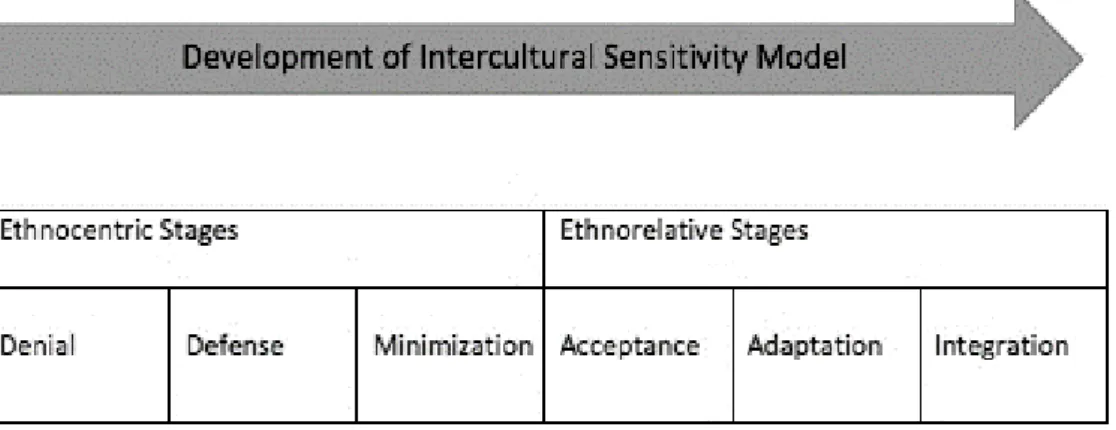
Ethnocentrism means that a person sees his/her own culture as a center of reality. People who are in the ethnocentric stage behave according to their cultural values because they think their views are superior in comparison to other cultures. The first stage of ethnocentrism is Denial and it includes two subsets, which are isolation and separation. People who are at the Denial stage are not able to identify the differences between cultures because they are not experienced in terms of cultural differences. The other subset, separation, is related to either physical or psychological distance between different cultural groups, and people at this stage search for a distance because they feel more comfortable in their own cultural zones. The second stage of ethnocentrism is Defense, and this stage comes after a person experiences a cultural difference. Since people at this stage feel insecure when they are initially exposed to a cultural difference, they defend their own culture after realizing the differences between their own culture and the other cultural group. This stage has three subsets; denigration, superiority and reversal. Denigration is about negative stereotyping of different cultural groups, superiority is about seeing one’s culture as superior and reversal is about adopting the new cultural values after spending considerable time in the new cultural environment. The last ethnocentric stage is Minimization. People at this stage minimize the cultural differences even though they are aware of the differences that they encounter because they pay more attention to the similarities between their own culture and the other culture. Minimization stage includes two subsets; physical universalism and transcendent universalism. The former of these subsets is about explaining life in terms of biological factors. This means that people in physical universalism stage know that everybody has common physical
24
characteristics, yet they are not aware of the fact that everybody acts in a different way because of the cultural context that they live in. The latter subset of
Minimization stage is about the belief that people have some common transcendental principles that they share despite their behavioral differences.
Moving beyond ethnocentrism, ethnorelativism means that people do not see the differences between cultures as a threat to their own cultural values. The first stage of ethnorelativism is Acceptance and it is about respecting cultural differences.
According to Bennett, there are two subsets for the Acceptance stage and they are respect for behavioral differences and respect for value differences. Even though people notice differences in language and behaviors before Acceptance stage, they start seeing them as worthy of respect in the respect for the Behavioral difference stage. For the next substage, people think that everybody has their own personal worldviews shaped by their cultural values. Therefore, there are some relative constructs that are formed by different cultural groups.
The second and final stage of ethnorelativism is Adaptation, and it is about
developing skills to communicate with people of other cultures. This stage includes two subsets, empathy and pluralism. The first one, empathy, is “the ability to experience some aspect of reality differently from what is ‘given’ by one’s own culture” (Bennett, 1993, p. 53). The other one, pluralism, is about having another cultural context than one’s own culture. People in this stage identify themselves with more than one cultural view because they have experiences in a different cultural context.
In the original theory, the last stage of ethnorelativism was Integration, but this stage was removed as a construct by later research (Hammer, 2012). People who have
25
multiple perspectives about cultures integrate their identity into a new culture and define their values according to cultural context; however, later research showed that this concept was not part of the continuum, but a separate construct.
Figure 1. Adapted from Bennett, 1993: The Developmental Model of Intercultural Sensitivity
In his research, Hammer (2012) focused on development of intercultural competence by underlining the importance of exchanges among people and how these exchanges can help people to gain a better understanding of the similarities and differences that people share (p. 115). He stated that research with the IDI highlighted important insights about the development of intercultural competence during a student’s study abroad experience. He used eight different components of the study abroad programs and analyzed which of these components significantly affect students’ intercultural competence. He found out that cultural mentoring, learning about patterns of cultural differences, reflection on intercultural experiences, active involvement in the cultural setting, pre-departure and reentry preparation, and onsite intercultural interventions are influential in terms of developing intercultural competence (p. 133). This means that duration and type of housing that students experience in their program do not significantly contribute to their development of intercultural sensitivity.
26
As a result of this developmental theory, an instrument that assesses intercultural competence was developed. The Intercultural Development Inventory (IDI) has been used in different fields including education and business in order to assess the
impacts of international programs. The IDI is a 50-item questionnaire and it can be completed in approximately 20 minutes. The questions are about participants’ cultural experiences and the respondents’ answers reflect their engagement in an intercultural experience.
Exploratory studies about intercultural sensitivity
Assessing intercultural sensitivity is one of the key issues in cross-cultural contexts. Since the world has become more globalized in recent years, IS and ICC have gained in significance within various disciplines such as education, health and business. Especially in education, exploratory studies were conducted to assess IS levels of students in order to explore the factors that contribute to their development of ICC and IS. Several of these studies are summarized below.
One of the exploratory studies with high school students attending international schools outside of the United States was conducted by Straffon in 2003. In this study, Straffon investigated the relationship between the length that students spend in international schools and their IS levels. He hypothesized that the longer the students attend international schools, the higher their IS levels are. He used a 60-item scale called the Intercultural Development Inventory (IDI) developed by Bennett and conducted the study with 336 high school students attending an international school in Southeast Asia. The students come from over 40 different national backgrounds, and they have cultural differences. The findings of this study show that none of these
27
students are in the Denial and Defense stages, which means that they do not ignore cultural differences and nor do they see their own culture as superior. In terms of ethnocentric stages, only 3% of the students were in Minimization stage and this shows that these students are aware of the cultural differences but pay more attention to the similarities in their interactions with culturally distinct groups.
Most of the students in Straffon’s study are in ethnorelative stages, which indicates that they are able to shift their perceptions according to the cultural differences. Notably, 71% of them are in Acceptance stage and they respect cultural differences. The remaining 26% are in Adaptation stage which shows that they are able to relate with their culturally distinct peers in their communications. These results are also validated with the interviews and the students’ responses indicate that they make use of cultural differences in a positive way because their culturally diverse school environment helps them learn more from each other. Therefore, this study shows that there is a positive correlation between the time that students spend in international schools and their IS levels.
Another study that focuses on assessing IS of students was conducted by Medina-Lopez-Portillo (2004). In order to investigate the relationship between the length of time spent in a different cultural environment and students’ IS levels, 28 students from the University of Maryland attended a study abroad program. Eighteen of these students spend seven weeks in Taxco while the other ten spend sixteen weeks in Mexico City. A 50-item Intercultural Development Inventory was given to the participants in order to measure their IS levels. Even though the pretest results of these two groups do not differ significantly, their posttest results, after attending the program, show that the IS levels of students in the Mexico City program were higher
28
than the other group of students who participated in a relatively shorter study abroad program. In addition to the posttest results, follow-up interviews with the participant students showed that Mexico City students gave more detailed examples when they talked about their cultural experiences while the Taxco program students remained more impersonal and abstract in their responses. Therefore, the results of this study show that spending more time in study abroad programs significantly affect students’ level of IS because the more the students experience a new culture, the more they improve their understanding towards their culturally distinct peers.
One of the recent studies about assessing the skills of intercultural sensitivity of high school students was carried out by Ruokonen and Kairavuori (2012). The
participants of this research were Finnish ninthgraders and 1214 students took the IDI as a part of a national evaluation project under the theme of “Cultural identity and internationalism” (2012, p. 36). Since Finnish national core curriculum fosters appreciating cultural inheritances, and being able to understand the roots of diversity and function in a multicultural community, this project aimed to assess learning outcomes of the Finnish curriculum design. Another aim of the study was to help students discover their own cultural identity and improve their intercultural
interactions with their culturally distinct peers. The findings of the study showed that 40% of the students were already at the Acceptance stage, 25% were at the
Adaptation stage and 6% were at the Integration stage. So, most of the students were at the ethnorelative stages, but many boys were still at the levels of Minimization and Defense (2012, p. 37). Even though the curriculum objectives were mostly met, the difference between boys’ and girls’ IS scores should be further investigated in order to help them improve their cultural understanding.
29
A most recent study that focuses on intercultural sensitivity and factors that affect students’ IS levels was conducted by Chocce, Johnson and Yossatorn (2015). In their study, the researchers investigated gender, nationality, field of study, foreign
language abilities, international travels, study abroad and foreign friends as
predictive factors of intercultural sensitivity. Survey participants were 209 freshmen students in an international college in Bangkok, Thailand. The hypothesis of the research was that at least one of these seven factors could predict the IS levels of the first-year undergraduate students. In order to test the hypothesis, all seven factors were combined to identify the ones that could influence intercultural sensitivity. The regression analysis showed that nationality had the highest influence on students’ IS scores and international friendships was the second highest influencing factor, while the other five variables (gender, field of study, foreign language ability, international travels, and study abroad) were not significant in terms of developing intercultural sensitivity.
Intercultural understanding
Intercultural sensitivity and intercultural understanding are very similar constructs. They both focus on the importance of developing competencies that help people to have more effective intercultural communications. In that sense, intercultural sensitivity was developed more broadly as a theoretical framework by researchers whereas intercultural understanding was presented more for an audience of international educators.
Intercultural understanding is one of the essential tools for developing international mindedness which gives values to cultures, languages, different viewpoints and experiences. As Rader (2015) stated, intercultural understanding includes knowledge
30
about similarities and differences among cultures. When people develop intercultural understanding, they have effective intercultural communications which leads to appreciation and respect for cultural diversity. Therefore, giving value to languages and cultures is essential for developing intercultural understanding.
According to Hill (2006), intercultural understanding contains both cognitive and affective domains. The cognitive domain refers to knowledge, and it means that people need to be knowledgeable about cultural differences. The affective domain refers to the positive attitudes such as empathy, curiosity and respect. These three components are very important for developing intercultural understanding because they enable people to have affective responses towards cultural differences.
After reviewing the domains of intercultural understanding, Hill discusses the factors that affect intercultural understanding. He emphasizes that intercultural
understanding depends on the nature of the school, such as implemented programs and location, and the type of the students in that school. The student types can be national and international, and their exposure to a different cultural environment depends on school type and program. The school types can be a national school or an international school and they can offer a national or an international program.
International education
International education can contribute to develop intercultural competences and help to raise students who are internationally minded. As Hill (2012) stated, “International mindedness is the key concept associated with an international education” (p. 246). Since there is a link between international mindedness and international education, exploring the factors that help students develop international mindedness and how
31
their international education experience provide them opportunities to become internationally minded individuals is invaluable.
A research project by Hayden and Thompson (1998) focused on international education by identifying the features of international schools. In order to explore the factors that lead to international education experience, they analyzed students’ and teachers’ perceptions in international schools. In the research, they used five groups and some categories which contribute to international education experience. These five categories included the influence of teachers, the formal curriculum, links with local community, informal aspects of school and exposure to other students within school (p. 549). These factors were analyzed and grouped according to the ratings of teachers and students.
When teachers’ perceptions were analyzed, it was identified that exposure to students within school (about mixing students with other students in the school environment), teacher factors and formal curriculum had high ratings. This means teachers believe that these three dimensions promote the international education experience (Hayden & Thompson, 1998). In the exposure to students within school category, two items had relatively higher ratings: admitting students of many different cultures into school and admitting students of many different countries into school (p. 560). In the teacher factors category, employing teachers from many different countries and employing teachers of many different cultures had higher ratings by the teachers (p. 555). In addition to these, in the formal curriculum category, items about learning in class to be tolerant and learning in class to consider issues from more than one perspectives contribute to the experience of international education were rated the highest (p. 556).
32
When teachers’ perspectives were compared to students’ perspectives, Hayden and Thompson (1998) showed that exposure to students within school, exposure to students outside school and informal aspects of school were rated high by the participant students and teachers. Even though some differences between students’ and teachers’ perspectives were identified, overall, among both sets of stakeholders, the exposure to other students was the highest among all the other categories, and it shows that having national and cultural differences in an international school promotes students’ international education experience.
Strategies to facilitate intercultural learning
As the world becomes globalized, the classrooms also become culturally diverse and the interactions between different cultures gain an importance. In order to have meaningful communications with culturally distinct peers, especially in classrooms, student-centered strategies are very important for student development.
According to Crose (2011), cross-cultural relationships allow intercultural learning among students. The classroom environment plays a significant role in terms of facilitating intercultural learning. In order to have students learn from one another, there should be an inviting classroom environment where students can have informal interaction with their peers without feeling uncomfortable. Crose suggests that international students can be paired up with host students to discuss different topics and this will help them to understand each others’ points of view. In addition to this, group oriented activities can be organized so that the students can explore different views and learn to appreciate the others’ viewpoints.