DEPARTMENT OF CHEMISTRY
SYNTHESIS OF NEW PHOSPHINITE LIGANDS AND THEIR
Ru(II) COMPLEXES: INVESTIGATION OF THEIR CATALYTIC
APPLICATION IN THE ASYMMETRIC TRANSFER
HIDROGENATION
Jalal Abdalla SAEED
M.Sc. Thesis
DEPARTMENT OF CHEMISTRY
DİYARBAKIR JUNE 2015
I
First, I would like to convey my cordial thanks to my supervisor, Assoc. Prof. Murat AYDEMİR, for his great caring, patience, guidance, and providing me with an exceptional medium for doing research and his expertise, understanding, and patience, added substantially to my master experience. I appreciate his massive knowledge and talent in many fields. He provided me with technical support, direction and became more of a mentor and friend, than a professor. His understanding, determination and politeness lead to easy completing of my master. He is the one professor/teacher who actually made a difference in my life. I doubt that I will ever be able to express my gratefulness fully, but I am indebted him my everlasting appreciation, without whose inspiration and enthusiasm I would not have considered a master career in chemistry research. Furthermore, special thanks go out to Prof. Dr. Akın BAYSAL and Assoc. Prof. Dr. Feyyaz DURAP, for their valuable suggestions.
I would also like to acknowledge my family for the support they introduced me through my whole life. I must also thank Dr. Nermin MERİÇ and Dr. Cezmi KAYAN without whose editing assistance and encouragement I would not have completed this study.
In addition, I would like to thank Prof. Dr. Yilmaz TURGUT and Prof Dr. Mehmet KARAKAPLAN to offer me starting materials in my study.
In conclusion, this research would not have been possible without the financial support of Dicle University Science and Technology Application and Research Center (Project no: 14-FF-78) and Technological Research Council of Turkey (TUBITAK-Project no: 113Z297). I would like to express my gratitude to those institutions.
II CONTENTS ACKNOWLEDGEMENTS ... I CONTENTS... II ABSTRACT ... IV TABLE LIST ... V FIGURE LIST ... VI SCHEME LIST ... VII APPENDICES LIST ... VIII SYMBOLS AND ABBREVIATIONS ... IX
1. INTRODUCTION ... 1
2.LITERATURE SURVEY ... 5
2.1.Organophosphorus Ligands ... 5
2.1.1.Phosphine Ligands and Their Catalysis ... 5
2.1.2.Phosphinite Ligands and Their Catalysis ... 6
2.2. Hydrogenation ... 6
2.2.1.Molecular Hydrogenation ... 6
2.2.2.Transfer Hydrogenation ... 7
2.2.3.Catalysts Used in Asymmetric Transfer hydrogenation ... 9
2.3.Development of Asymmetric Catalysis ... 9
3.PREVIOUS STUDIES ... 13
4.MATERIALS AND METHODS ... 29
4.1.Chemicals ... 29
4.2.Instrument Used For Characterization ... 29
4.3.Method ... 30
4.3.1.(S)-(+)-2-Hydroxypropyl p-toluenesulfonate ... 30
4.2.1.2.(S)-1-[N-(R)-α-Phenylethyl]amino-2-propanol, (1) ... 30
4.2.1.3. (2S)-1-{[(2S)-2-hydroxypropyl][(1R)-phenylethyl]amino}propan-2-ol, (2) ... 33
4.2.2.Synthesis and Characterization of Phosphinite... 35
4.2.2.1. (2S)-1-{[(1R)-1- phenylethyl]amino}propan-2-yl diphenylphosphinite, (3) ... 35
4.2.2.2. (2S)-1-{[(2S)-2-[(diphenylphosphanyl)oxy]propyl][(1R)-1-phenylethyl] amino}propan-2-yl diphenylphosphinite (4) ... 36
4.2.3.Synthesis and Characterization of Ruthenium(II) Complexes ... 37
4.2.3.1.(2S)-1-{[(1R)-1-phenylethyl]amino}propan-2-yldiphenyl phosphinito[dichloro(η6 -p-cymene) ruthenium (II)] (3a) ... 37
III
4.2.3.3.(2S)-1-{[(2S)-2-[(diphenylphosphanyl)oxy]propyl][(1R)-1-phenylethyl]amino}propan-2-yldiphenylphosphinitobis[dichloro( 6-p-cymene) ruthenium(II)], (4a)... 39
4.2.3.4.(2S)-1-{[(2S)-2-[(diphenylphosphanyl)oxy]propyl][(1R)-1-phenylethyl]amino}propan-2-yl 6-benzene)ruthenium(II)], (4b) ... 40
4.3.Catalytic Studies ... 41
4.3.1.Tables ... 42
5.RESULTS AND DISCUSSION ... 45
5.1.Synthesis of chiral ligands, 1 and 2 and their ruthenium(II) complexes ... 45
5.2.Asymmetric Transfer Hydrogenation of acetophenone derivatives ... 46
6.CONCLUSIONS ... 49
REFERENCES ... 51
APPENDICES ... 55
IV ABSTRACT
SYNTHESIS OF NEW PHOSPHINITE LIGANDS AND THEIR Ru(II)
COMPLEXES: INVESTIGATION OF THEIR CATALYTIC APPLICATION IN THE ASYMMETRIC TRANSFER HIDROGENATION
M.Sc. THESIS Jalal Abdalla SAEED
UNIVERSITY OF DICLE
INSTITUTE OF NATURAL AND APPLIED SCIENCES DEPARTMENT OF CHEMİSTRY
2015
In recent years, there has been vast attention to obtain enantiomerically pure compounds as building blocks for bioactive agents and pharmaceuticals. Homogeneous asymmetric catalysis is one of the most successful tools to prepare chiral compounds from inexpensive substrates. Hydrogen transfer reduction processes have been attracted considerable attention from synthetic chemists, since they are operationally simple and highly selective. Particularly, asymmetric transfer hydrogenation is one of the most efficient tools to gain secondary alcohols that are optically active from ketones. Furthermore, transfer hydrogenation reaction is very important because this method is environmentally benign, simple and easy to handle and reaction conditions are not so harsh.
The chemistry of phosphinites has also been extensively studied. Because these compounds are very interesting as potential ligands since different structural modifications are accessible via simple P-O formation. Numerous modified phosphinite ligands possess significant uses in organomatallic chemistry and catalysis, providing selective catalysts for hydroformylation, hydrosilylation and asymmetric transfer hydrogenation.
In the present work, firstly, (S)-1-[N-(R)-α-Phenylethyl]amino-2-propanol (1) and (2S)-1-{[(2S)-2-hydroxypropyl][(1R)-phenylethyl]amino}propan-2-ol, (2) aminoalcohols were synthesized as precursors for phosphinites. Then, phosphinite ligands (2S)-1-{[(1R)-1-phenyl ethyl]amino}propan-2-yldiphenylphosphinite, 3 and (2S)-1-{[(2S)-2-[(diphenylphosphanyl) oxy]propyl][(1R)-1-phenylethyl]amino}propan-2-yldiphenylphosphinite, 4 were obtained by the reaction of these compounds with Ph2PCl. Treatment of these ligands with [Ru(η
6 -p-cymene)Cl2]2 or [Ru(η
6
-benzene)Cl2]2 afforded new Ru(II) complexes 3a-b and 4a-b which were characterized by spectroscopic methods, such as NMR and IR, and elemental analysis. Finally, these complexes were employed as catalyst in transfer hydrogenation reaction of ketones. Generally, high conversions and with some complexes enantiomeric excess (ee) up to 98 % were obtained.
Key Words: Phosphinite, Homogenous Catalysis, Ruthenium, Asymmetric Transfer
V
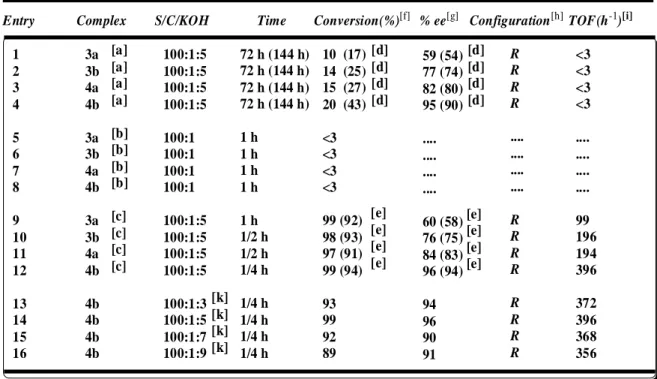
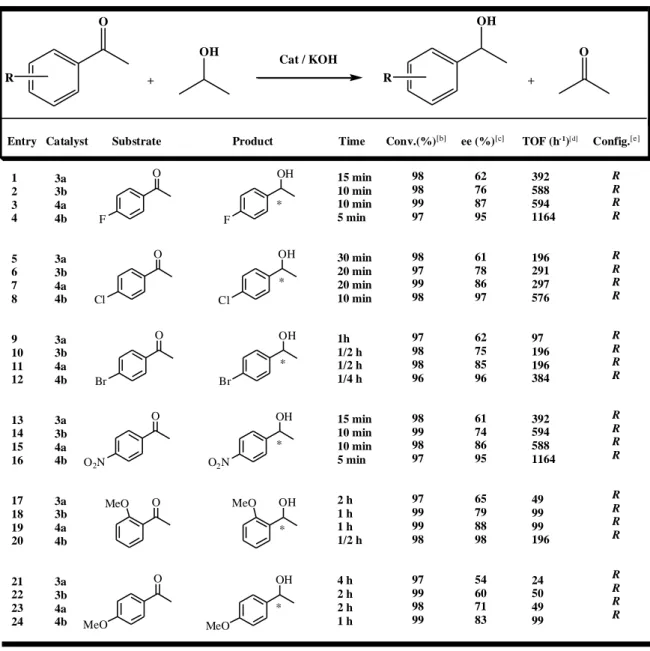
Table 3.1 “Asymmetric transfer hydrogenation of ketones in the presence of
Ru(II) catalyst” ... 25 Table 4. 1 “Transfer hydrogenation of acetophenone with iso-PrOH catalyzed by
Ru(II)-phosphinite complexes (3a, 3b, 4a and 4b).” ... 42 Table 4.2 “Asymmetric Transfer Hydrogenation results for substituted
acetophenones catalyzed by Ru(II)-phosphinite complexes, (3a, 3b, 4a and 4b).[a]” ... 43
VI FIGURE LIST
Figure No Page No
Figure 1.1 Several phosphorus based bidentate ligands used in asymmetric transfer
hydrogenation ... 3
Figure 2.1 Several examples of phosphinite ligands ………6
Figure 2.2 Reduction of unsaturated organic compounds by molecular hydrogenation ... 7
Figure 3.1 “Chiral tetrahydro-bis(oxazol) and tetrahydro-bioxazol” ... 15
Figure 3.2 “Synthesis of C2-symmetric bisphosphinites (3a-d), their 31P-{H}-NMR values and ee % values obtained by using the asymmetric hydrogenation of methyl α-asetamidocynamate” ... 16
Figure 3.3 “(R) and (S) -spirOP phosphinite ligands” ... 19
Figure 3.4 “DIMOP ligand” ... 19
Figure 3.5 “AMPP (12-14) and tLANOP (15 a-g) ligands” ... 21
Figure 4.1 A is accurate MS1 spectrum of (S)-1-[N-(R)-α-Phenylethyl]amino-2-propanol, (1), B and C are the spectra that show the measured and predicted exact mass of the compound (S)-1-[N-(R)-α-Phenylethyl]amino-2-propanol, (1) respectively, by LC-ESI-IT-TOF MS. At the bottom of the figure there is information about predicated elemental composition, measured accurate mass, theoretical mass, double bond equivalent (DBE) and mass errors of the compound (S)-1-[N-(R)-α-Phenylethyl]amino-2-propanol, (1). ... 32
Figure 4.2 A is accurate MS1 spectrum of (2S)-1-{[(2S)-2-hydroxypropyl][(1R)-phenylethyl]amino}propan-2-ol, (2), B and C are the spectra that show the measured and predicted exact mass of the compound (2S)-1-{[(2S)-2-hydroxypropyl][(1R)-phenylethyl]amino}propan-2-ol, (2) respectively by LC-ESI-IT-TOF MS. At the bottom of the figure there is information about predicated elemental composition, measured accurate mass, theoretical mass, double bond equivalent (DBE) and mass errors of the compound (2S)-1-{[(2S)-2-hydroxypropyl][(1R)-phenylethyl]amino}propan-2-ol, (2). ... 34
VII
Scheme 2.1 Hydride transfer from H donor DH2to A substrate, DH2: Hydrogen
donor; A: Hydrogen acceptor ... 8
Scheme 2.2 Reduction of multiple bonds by transfer hydrogenation, Catalyst: metal complex; Base: K2CO3, NaOH, KOH, tBuOK, Hydrogen donor: 2-Propanol, HCO2H/NEt3 ... 8
Scheme 3.1 “Synthesis of bis(2-diphenylphosphinite-1-naphthyl]methyl ligand 1, its dicalcogen derivatives and transition metal complexes” ... 13
Scheme 3.2 “Synthesis of α,ω-bis(phosphinite) polyether ligand 2” ... 14
Scheme 3.3 “Metal-templated synthesis of a few examples of vicinal diphenylphosphinites” ... 15
Scheme 3.4 “Synthesis of (R,R)-BDOPPEs” ... 17
Scheme 3.5 “Rh-catalyzed asymmetric hydrogenation of N-benzoyl-dehydroaminoacid derivatives and α-functionalized ketones” ... 17
Scheme 3.6 “Synthesis of camphinite 8” ... 18
Scheme 3.7 “Asymmetric hydrogenation of 2-acetoamidoacrylic acid catalyzed by cationic rhodium complex of DIMOP” ... 20
Scheme 3.8 “Asymmetric hydrogenation of 4-oxoisoforon enol acetate” ... 21
Scheme 3.9 “Asymmetric hydrogenation of cyclic iminium salts” ... 21
Scheme 3.10 “Preparation of Ru/BINOP/DPEN catalyst system” ... 22
Scheme 3.11 “Synthesis of [C6H4-1,3-(OPPh2{Ru(η6-p-cymene)CI2})2]” ... 23
Scheme 3.12 “Asymmetric transfer hydrogenation of ketones in the presence of Ru(II) catalyst” ... 23
Scheme 3.13 “Synthesis of chiral C2-symmetric (1S,8S)-3,6-[N-(S)-α-phenyl ethyl]diaza-1,8-diphenoxymethyl-1,8-octanebis(diphenylphosphinite), ligands.” ... 27
VIII
APPENDICES LIST
Spectrum No Page No Spectrum 1. 1H NMR spectrum of (S)-(+)-2-Hydroxypropyl p-toluenesulfonate ... 55 Spectrum 2. 1H, 13C-{1H} NMR and IR spectra of
(S)-1-[N-(R)-α-Phenylethyl]amino-2-propanol, (1) ... 56 Spectrum 3. 1H, 13C-{1H} NMR and IR spectra of
(2S)-1-{[(2S)-2-hydroxypropyl][(1R)-phenylethyl]amino}propan-2-ol, (2)... 57 Spectrum 4. 31P-{1H}, 1H, 13C-{1H} NMR and IR spectra of (2S)-1-{[(1R)-1-
phenylethyl] amino}propan-2-yl diphenylphosphinite, (3) ... 59 Spectrum 5. 31P-{1H}, 1H, 13C-{1H} NMR and IR spectra of
(2S)-1-{[(2S)-2-[(diphenyl
phosphanyl)oxy]propyl][(1R)-1-phenylethyl]amino}propan-2-yldiphenyl phosphinite (4) ... 61 Spectrum 6. 31P-{1H}, 1H, 13C-{1H} NMR and IR spectrums
(2S)-1-{[(1R)-1-phenylethyl]amino}propan-2-yldiphenylphosphinito[dichloro( 6
-p-cymene) ruthenium (II)] (3a) ... 63 Spectrum 7. 31P-{1H}, 1H, 13C-{1H} NMR and IR spectra
(2S)-1-{[(1R)-1-phenylethyl]amino}propan-2-yldiphenylphosphinito[dichloro( 6
-benzene) ruthenium (II)] (3b) ... 65 Spectrum 8. 31P-{1H}, 1H, 13C-{1H} NMR and IR spectra
(2S)-1-{[(2S)-2-[(diphenyl
phosphanyl)oxy]propyl][(1R)-1-phenylethyl]amino}propan-2-yldiphenyl phosphinitobis[dichloro( 6
-p-cymene)ruthenium(II)], (4a) ... 67
Spectrum 9. 31P-{1H}, 1H, 13C-{1H} NMR and IR spectra (2S)-1-{[(2S)-2-[(diphenyl
phosphanyl)oxy]propyl][(1R)-1-phenylethyl]amino}propan-2-yldiphenyl phosphinitobis[dichloro( 6 -benzene)ruthenium(II)], (4b) ... 69
IX
ATH Asymmetric Transfer Hydrogenation
CDCl3 Chloroform-d1
CH2Cl2 Dichlorometane
Cod 1,5-cyclooctadiene
Cy2PCl Monochlorodicyclohexylphosphine
Min Minute
DEPT Distortionless Enhancement by Polarization Transfer
DMF N,N'-Dimetylformamide
DMSO-d6 Dimethyl sulfoxide-d6
Con. Conversion
Ee Enantiomeric excess
Et3N Triethylamine
GC Gas Chromatography
HETCOR Heteronuclear correlation (13C-1H)
IR Infrared
J Coupling constant
NMR Nuclear Magnetic Resonance
Ph2PCl Monochlorodiphenylphosphine
Ppm Part Per Million
R Alkyl TH Transfer Hidrojenasyon THF Tetrahydrofuran H Hour ʋ Frequency (cm-1) Δ Chemical shift
1 1. INTRODUCTION
Alcohols are very important building blocks for the fine chemical and pharmaceutical industries. Even though a lot of applications need racemic alcohols, the require for enantiomerically pure products has been growing due to their importance as intermediates for the production of advanced materials and pharmaceuticals, atracting great attention in finding novel techniques for their manufacture. Furthermore, ketones are one of the most widespread families of unsaturated substrates; hence their enantioselective reduction resulting in optically pure secondary alcohols is a topic of significant attention from both the industrial and the academic standpoints (Malacea et al. 2010). Kinetic separation of racemic alcohols by chiral catalysts has also appealed industrial attention. Various perfumery ingredients, such as alcohols responsible for woody odour, are produced by hydrogenation of the corresponding carbonyl substrates. The success of hydrogenation relies mainly on the suitable combination of a metal and a ligand; thus significant efforts have been offered to the development of transition metal complexes as catalysts. The bulk of the study performed in this field has used ruthenium-based catalysts in combination with different phosphine and amine ligands. Among these, the most remarkable one is a transfer hydrogenation system which involves the Ru(II)–TsDPEN (TsDPEN = N-(p-toluenesulfonyl)-1,2-diphenyl ethylenediamine) catalyst, first reported by Noyori and co-workers (Malacea et al. 2010).
The reduction of multiple bonds with the help of a hydrogen donor in the existence of a catalyst is known as transfer hydrogenation or hydrogen-transfer reaction (H-transfer). In hydrogen-transfer reactions the hydrogen source must be different from dihydrogen. The employing of hydrogen donors has several advantages over the employing of molecular hydrogen because the risks and the constraints associated with this reagent are avoided and pressure vessels are unnecessary. Furhermore, rate and selectivity of the reaction can be favorably influenced by choosing the most suitable hydrogen donor (Zassinovich and Mestroni, 1992).
The study on novel chiral ligands is a continuing process in the area of asymmetric synthesis. In the current state, more than 1000 chiral nonracemic bis(phosphines) have been prepared; prominent examples of their practical uses involve
2
the produce of L-Dopa and L-menthol. Although the efficiency of catalysts derived from these ligands have been proved, the likelihood of discovering better usefulness, activity, and selectivity by the design of new ligand classes has maintained to encourage research (Hauptman et al. 1998). Since it provides large amounts of chiral products at lower cost, asymmetric synthesis is regarded as to be the most attractive method. Eminent procedures for the asymmetric conversion of ketones towards chiral alcohols are hydrosilylations, hydroborations, bio-reductions, and catalytic (transfer) hydrogenations. The success of the last approach can be attributed to exceptional study of Nobel Laureate R. Noyori.
From an industrial point of view, asymmetric catalytic transfer hydrogenation is an interesting alternative for high pressure catalytic hydrogenations with molecular hydrogen. Here, hydrogen donors such as secondary alcohols (e.g., 2-propanol) or formates are employed to transform carbonyl compounds to alcohols. Thus, the risk related with the employing of molecular hydrogen at high pressures is eliminated (Noyori and Hashiguchi, 1997). Catalytic asymmetric reduction of C=O bonds is a fundamental conversion in organic chemistry to form new stereocenters. Recently, highly successful developments in this field have been described and innumerable catalytic processesses are now accessible to accomplish this purpose. Of these, transfer hydrogenation of 2-propanol to prochiral ketones has arised as a very effective method (Everaere et al. 2003, Fan et al. 2002).
Chiral nonracemic hydrogen donors can be successfully used as chirality sources for inducing enantioselectivity in the product, thus introducing new ways to achieve an asymmetric process, which increases the potential of asymmetric transfer hydrogenation and renders it handier than asymmetric catalytic hydrogenation. There are two basic routes by which enantioselective hydrogen transfer can be accomplished: enantioface selection by means of a chiral catalyst on achiral (usually referred to as prochiral) substrates or enantiomer selection (usually referred to as kinetic resolution) of a chiral racemic compound (Zassinovich and Mestroni, 1992).
Asymmetric hydrogenation is usually catalyzed by a complex carrying Rh, Ru, or Ir, among which our attention has been Ru. There are two reasons for this choice: Ru catalysts possess outstanding performances, particularly when associated with the BINAP ligand, which Takasago was already employing in the Rh-mediated asymmetric
3
isomerization for an L-menthol process. Furthermore, Ru is cheaper than others, such as Ir (Shimizu et al. 2007).
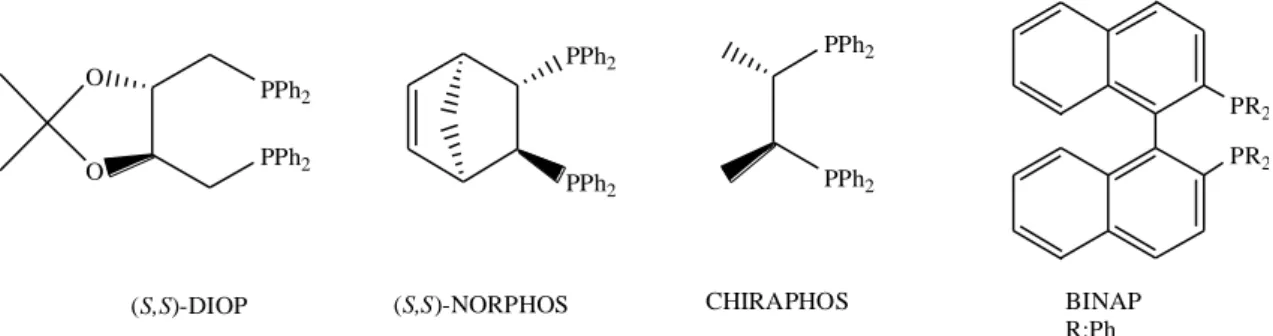
Chiral phosphines are certainly the most common ligands in asymmetric catalysis, and they have been used in transfer hydrogenation as ruthenium, rhodium, and iridium catalysts. Moreover, several tertiary monophosphines, chelating bidentate diphosphines such as DIOP, CHIRAPHOS, NORPHOS, and BINAP have been largely employed (Figure 1.1). The common property of some of these ligands is the existence of a C2 symmetry axis (Zassinovich and Mestroni, 1992).
PPh2 PPh2 (S,S)-NORPHOS PR2 PR2 BINAP R:Ph PPh2 PPh2 O O (S,S)-DIOP PPh2 PPh2 CHIRAPHOS
Figure 1.1 Several phosphorus based bidentate ligands used in asymmetric transfer hydrogenation
Particularly, phosphine and phosphinite ligands and their transition metal complexes have been widely used in asymmetric transformations. In many cases, phosphinites exhibit higher enantioselectivity than phosphines. Phosphinites have a stronger trans-effect than phosphines. Therefore, phosphinite-modified palladium complexes should exhibit intrinsically higher rates in reactions which involve the migration of a group trans to the ligand (Keim and Maas, 1996).
5 2.LITERATURE SURVEY
2.1.Organophosphorus Ligands
The study of ligands containing phosphorus atoms has been of great interest throughout organic and inorganic chemistry. These ligands have been investigated for the last several decades and found to be of substantial attention because of their wide range of applications in organometallic chemistry for the development of industrial processes including numerous catalytic reactions. Few ligands have been as extensively used as tertiary mono- and diphosphines throughout organic and inorganic chemistry. It is still probably correct to say that the most frequently employed diphosphine to date is bis(diphenylphosphino)ethane, Ph2PCH2CH2PPh2 (dppe), a molecule adept at forming
five-membered chelate rings. Over the past several decades its homologue bis(diphenylphosphino)methane, Ph2PCH2PPh2 (dppm), has come to be an increasingly
employed ligand. Further investigations demonstrated that several compounds analogous to dppm and dmpm could also act as monodentate ligands, binding to the metal through one phosphorus atom and leaving the other one pendant or uncoordinated (Zuburi and Woollins, 2003).
2.1.1.Phosphine Ligands and Their Catalysis
The synthesis and use of phosphine ligands is an ongoing central topic in molecular chemistry and has important implications in homogeneous catalysis, especially for the discovery of considerably selective catalytic reactions. For instance, asymmetric catalysis by transition metal complexes with chelating bisphosphines has introduced practical synthesis of a number of enantiomerically pure substances. The frequently employed ligands are 1,2-, 1.3- and 1,4-bisphosphines which result in chelates of five- six- and seven-membered rings. Optically active phosphines are employed as ligands in transition metal complexes possessing good catalytic activity. The preparation of such chelating phosphanes can be caused by the surprisingly easy resolution of the corresponding phosphine oxides with an ethanolic solution of L-(-)- or D-(+)-0,O-dibenzoyl-tartaric acid (DBT). The less soluble diastereoisomer is then reacted with KOH to remove DBT (Laurenti and Santelli, 1999).
6
2.1.2.Phosphinite Ligands and Their Catalysis
Although both phosphines and phosphinites are useful in asymmetric reactions, phosphinites are better ligands, because they have different structural, electronic and chemical features than phosphines. Therefore, they provide copious opportunities to design novel ligands for asymmetric catalysis (Galka et al. 2003). For instance, metal-phosphorus bond is usually stronger in phosphinites than phosphines, since the presence an electron-withdrawing P-OR group exists. Moreover, the vacant σ∗-orbital of the phosphinite P(OR)R2 becomes more stable, rendering the phosphinite a better acceptor
(Aydemir et al. 2010). Easy synthesis of phosphinites is their most significant advantage over phosphines (Chan et al. 1997). Several examples of phosphinite ligands are introduced as follows (Yang et al. 1995), (Venkatachalam and Ramesh, 2005).
O O PPh2 PPh2 O O P P Ph Ph Ph Ph N O P Ph Ph 22 23 24 OPPh2 OPPh2 25 Figure 2.2 Several examples of phosphinite ligands
Since a first synthetic application by Wilkinson and co-workers, homogeneous catalytic hydrogenation became nowadays one of the most important preparative methods in modern organic chemistry (Hobub et al. 2011).
2.2. Hydrogenation
2.2.1.Molecular Hydrogenation
Molecular hydrogenation is the addition of hydrogen gas (H2) to an organic
molecule in the presence of a catalyst, which is usually a transition metal (Bena, 2003). Hydrogenation is an important reaction, especially for unsaturated organic compounds (alkenes, alkynes, ketones, and nitriles) (Çetinkaya et al. 2010). This process is usually carried out under pressure and has a variety of applications in pharmaceutic and petrochemical industry (www.wikipedia.org)
7 R R' O R R R R' OH or or Catalyst H2(g)
Figure 2.3 Reduction of unsaturated organic compounds by molecular hydrogenation
This method is expensive and very risky special system since it generally require particularly developed equipments due to explosion risk that will occur because it needs high pressure
The basic steps that occur during the catalytic conversion in the hydrogenation reaction can be listed as follows
i. Leaving of the ligand from M ↔ its combination with M (18 e rule): Number of valence electrons changes from 18 to 16 in the transition stage from intermediates to products.
ii. Reduction oxidation of M center. iii. Oxidative addition↔ reductive leaving iv. Insertion ↔ Elimination
v. Attack to the coordinated ligand (Göktürk, 2008) 2.2.2.Transfer Hydrogenation
Catalytic asymmetric reduction of prochiral ketones to obtain chiral secondary alcohols is an important reaction in organic synthesis. This enantioselective conversion can be conducted in several manners, involving hydride reduction with an oxazaborolidine catalyst, hydrogenation with chiral diphosphane ligands, and transfer hydrogenation. Since the reducing agent is cheaper and the tecnique is operational simpler, transition-metal-catalyzed transfer hydrogenation either with 2-propanol or with an HCO2H/Et3N mixture as a hydride source has appeared as an interesting
alternative to asymmetric hydrogenation with H2 (Leautey et al. 2003). The catalytic
reduction of ketones to the corresponding alcohols can be performed by hydrosilylation followed by hydrolysis, by transfer hydrogenation, often in the presence of an alcohol as a hydrogen donor and a base, or by hydrogenation where the reducing agent is
8
molecular hydrogen. The reversibility of the process is a problem of the transfer hydrogenation reaction in 2-propanol. To optimize transformation in 2-propanol, the catalysis must be performed wiyh a very low substrate concentration. On the other hand, the reaction is irreversible with formic acid as hydrogen donor because of CO2 evolution
(Malacea et al. 2010).
General reaction of transfer hydrogenation is given as follows:
DH
2+
A
D
+
AH
2Scheme 2.1 Hydride transfer from H donor DH2to A substrate, DH2: Hydrogen donor; A: Hydrogen
acceptor R R' O R R' OH R H N R' R H HN R' Catalyst Base Hydrogen donor Ar NH2 Ar NO2
Scheme 2.2 Reduction of multiple bonds by transfer hydrogenation, Catalyst: metal complex; Base: K2CO3, NaOH, KOH, tBuOK, Hydrogen donor: 2-Propanol, HCO2H/NEt3
Transfer hydrogenation of 2-propanol to prochiral ketones has become as a considerably effective method. In this reversible reaction, referred also as the Meerwein-Pondorf-Verley reduction, 2-propanol behaves simultaneously as a safe, cheap, and facile to use solvent and reductant that is converted into acetone, which may be easily removed from the reaction mixture since its boling point is low. Transfer hydrogenation is operationally simple, its yield and enantiomeric excess are usually high enough for some specific ketones, which make it a useful complement/alternative to hydrogenation using molecular hydrogen, especially for small- to medium-scale processess. Recently, several important progresses have been achieved in designing effective hydrogen transfer catalyst systems with some transition metal and lanthanide
9
complexes. Undoubtedly, one of the most significant revolutions, reported by Noyori et al., is “the use of chlororuthenium(II)arene precursors with chiral monoaryl sulfonylated-1,2-diamine or -amino alcohol ligands” (Everaere et al. 2003).
Importance of the exact control of molecular chirality is increasing in material science, life science and chemistry. Of the characteristic properties of an ideal catalyst for asymmetric synthesis, selectivity, high activity and stability, readily accessible ligands and enzyme-like stereocontrol are important ones (Herseczki et al. 2004).
2.2.3.Catalysts Used in Asymmetric Transfer hydrogenation
The application of organometallic complexes as catalysts in asymmetric transfer hydrogenation has been a topic of continuing investigation for several decades. Among the effective catalysts for the asymmetric transfer hydrogenation of ketones, “Evans‟ samarium complexes with chiral amino alcohol ligands and Noyori‟s ruthenium complexes containing arene and N-(p-toluenesulfonyl)-1,2-diphenylethylenediamine (TsDPEN) ligands” are prominent examples. Complexes of the type trans-RuCl2(diamine)(diphosphine) with matching configurations of the chiral diphosphine
and diamine, e.g. (S)-BINAP/(S,S)-DPEN, display high activity as well as enantioselectivity. Numerous other important catalysts have been reported. For instance, diphosphinite ligands obtained from the reaction of 1,19-bi-2-naphthol (BINOL) with chlorodiarylphosphine are widely used as chiral auxiliaries in rhodium, iridium and palladium asymmetric catalytic reactions since they are easily prepared and modified. Although efficiency of catalysts derived from these ligands has been proved, research has continued to discover better ones with improved utility, activity, and selectivity (Guo et al. 2005).
2.3.Development of Asymmetric Catalysis
Asymmetric catalysis is a growing area of study because the demand for more enantiomerically pure compounds increases. Owing to the specificity required for efficient drugs, mainly the pharmaceutical industry demands for these types of compounds. The asymmetric reduction of unsaturated compounds is one of the most popular tools in asymmetric synthesis and has been used in the synthesis of different organic compounds possessing biological interest and having various functional groups, because it offers good opportunities for the simultaneous introduction of new
10
functionalities and new stereogenic elements into the structure of organic compounds (Gladiali and Alberico, 2006). In the asymmetric catalysis processes, it is necessary to employ a chiral catalyst to transfer its chirality to the substrate. An efficient asymmetric catalyst will easily produce a chiral compound in good yield with and enantiomeric purity of the desired enantiomer will be high enough (Ghent et al. 2007). Homogeneous asymmetric catalysis has been one of the most important tools to produce chiral compounds from inexpensive substrates (Carbo et al. 2006), since chiral alcohols are very important building blocks and synthetic intermediates in the pharmaceutical industry and organic synthesis. The reduction of prochiral ketones to give chiral alcohols is one of the most important topics in modern synthetic chemistry. Noyori and co-workers introduced a well-designed solution for the asymmetric catalytic hydrogenation of simple aryl ketones (Guo et al. 2005).
Among the most significant developments in catalytic asymmetric synthesis, asymmetric transfer hydrogenation is an interesting tecnique for the synthesis of optically active alcohols (Xie and Zhou, 2008). In this reaction, 2-propanol is a proper hydrogen source possessing advantageous features: it is stable, cheap, nontoxic, and facile to use. Nevertheless, a strong base such as NaOH, KOH or KOtBu is necessary to stimulate the reduction smoothly in many earlier reports of asymmetric transfer hydrogenation in 2-propanol (Dong et al. 2005). The area of asymmetric catalytic technologies has developed owing to the increasing demand to obtain enantiomerically pure agrochemicals, pharmaceuticals, flavors and other fine chemicals. Out of asymmetric catalytic tecniques, asymmetric hydrogenation using molecular hydrogen to reduce prochiral olefins, ketones, and imines, is one of the most effective methods to construct chiral compounds. After the discovery of well-known Wilkinson‟s catalyst [RhCl(PPh3)3], homogeneous asymmetric hydrogenation was developed by Knowles
and Horner in the late 1960s. Knowles and Horner reported the initial examples of enantioselective hydrogenation, though with low enantioselectivity by replacing triphenylphosphine of the Wilkinson‟s catalyst with chiral monophosphines. Further investigation by Knowles with an improved monophosphine CAMP yielded 88% ee in hydrogenation of dehydroamino acids. Then, two important developments were achieved in asymmetric hydrogenation by Kagan and Knowles, respectively. Kagan reported “the first bisphosphine ligand, DIOP, for Rh catalyzed asymmetric
11
hydrogenation.” The successful use of DIOP caused to some important instructions for ligand design in asymmetric hydrogenation. Chelating bisphosphorus ligands could result in excellent enantioselectivity cin comparison with monodentate phosphines. Furthermore, chiral phosphorus ligands were not essential for attaining high ee‟s, and ligands with backbone chirality could also introduce superior enantioselectivity in asymmetric hydrogenation. Additionally, C2 symmetry was a significant structural
property to develop novel effective chiral ligands. Kagan‟s ground-breaking study easily resulted in the rapid development of chiral bisphosphorus ligands. Knowles made his important discovery of a C2-symmetric chelating bisphosphine ligand, DIPAMP.
DIPAMP was immediately used in the industrial synthesis of L-DOPA because of its high catalytic efficiency in Rh-catalyzed asymmetric hydrogenation of dehydroamino acids. The success of practical synthesis of L-DOPA via asymmetric hydrogenation was a milestone work and for this study Knowles was awarded the Nobel Prize in 2001. This study caused to chemists to realize the importance of asymmetric hydrogenation for the preparation of chiral compounds. After these important contributions by Knowles and Kagan, thousands of chiral phosphorus ligands were developed for asymmetric hydrogenation. The mechanism of Rh-catalyzed asymmetric hydrogenation was mainly studied by Halpern and Brown, which brought a deep insight into the reaction. Nonetheless, the developments in the early 1980s were primarily concentrated on chiral Rh catalysts, and the substrate scope was confined to R-dehydroamino acids. Noyori‟s investigation on BINAP-Ru catalysts for asymmetric hydrogenation led to opportunities for effective hydrogenations of various substrates. The early use of Noyori‟s BINAP-Ru system was related with olefin reduction, but soon afterward the system was also found to be beneficial for hydrogenation of ketones. Hence a wide variety of prochiral olefin and ketone substrates were hydrogenated with outstanding enantioselectivity. Noyori was awarded the Nobel Prize in 2001 due to this beautiful work. In the 1990s, important advances were also accomplished in Rh catalyzed asymmetric hydrogenation and several effective chiral bisphosphorus ligands such as DuPhos and BPE were developed by Burk et al. Brilliant enantioselectivities were accomplished in the hydrogenation of different functionalized olefins, thus the scope of asymmetric hydrogenation extended significantly.
12
have been designed, and applied in asymmetric hydrogenation in both industry and academic research. The development of countless efficient chiral phosphorus ligands also enables the discovery of new mechanistic insight of Rh- or Ru-catalyzed asymmetric hydrogenation. These catalysts are not limited to those with Rh or Ru metals; complexes of other transition metals such as Ir, Pt, Ti, Zr, and Pd are efficient as well. Many unsaturated compounds can be hydrogenated in excellent enantioselectivities employing a metal catalyst associated with a suitable chiral ligand.
Even though some homogeneous hydrogenation catalysts do not include chiral phosphorus ligands (e.g., catalysts with chiral cyclopentadienyl ligands or N-heterocyclic carbene ligands), transition metal complexes associated with chiral phosphorus ligands are the dominant selection of catalysts for asymmetric hydrogenation.
The catalytic reduction of ketones to the corresponding alcohols may be conducted by hydrosilylation followed by hydrolysis, by transfer hydrogenation, often in the existence of an alcohol as a hydrogen donor and a base, or by hydrogenation where the reducing agent is molecular hydrogen. However, the reversibility of the reaction is a problem of the transfer hydrogenation reaction in 2-propanol. To optimize transformation in 2-propanol, the catalysis must be carried out employing considerably low substrate concentrations. On the other hand, the reaction is irreversible with formic acid as hydrogen donor owing to CO2 evolution (Leautey et al. 2003). Many catalytic
systems with different levels of effectiveness have been developed including, for instance, ruthenium complexes modified by different di- or tridentate ligands such as diamines, amino alcohols, amidates, oxazolines/amines, phosphanes/amines, or phosphane oxides. One of the most effective systems is based on the RuII TsDPEN complex reported by Noyori, who proposed that the existence of an NH moiety in the ligand structure can lead to a cyclic transition state through hydrogen bonding to the ketone substrate. Furthermore, the formation of a metal-ligand bifunctional complex may result in high enantioselectivity due to a greater affinity of the substrate to the active site of the catalyst. Regardless of these developments, so far there is no ubiquitous catalyst for the transfer hydrogenation of all prochiral ketones; actually, although, it is very desirable to have access to different catalysts for optimizing the reaction when applied to a wide range of substrates (Leautey et al. 2003).
13 3.PREVIOUS STUDIES
Balakrishna et al. (2002) reacted “bis(2-hydroxy-1-naphthyl)methane with chlorodiphenylphosphine to obtain the bis(phosphinite), Ph2P{(-OC10H6
)(μ-CH2)(C10H6O-)}PPh2 (1) in good yield.” They reacted “1 with elemental sulfur or
selenium to afford the disulfide or diselenide derivatives; the structure of the selenium derivative was confirmed by X-ray crystal structure analysis. Treatment of the ligand 1 with platinum metal derivatives formed ten-membered chelate complexes with the ligand having a η2-mode of coordination.”
O O O O P P PPh2 PPh2 O O P P M Cl Cl O O P P Ph Ph Ph Ph Ru Cl Ph Ph Ph Ph Ph Ph Ph Ph [M(cod)Cl2] [Cp*Ru(cod)Cl] [CpRu(cod)Cl] E (O, S, Se) 1 M=Pt,Pd E E O O P P Ph Ph Ph Ph Ru Cl
Scheme 3.1 “Synthesis of bis(2-diphenylphosphinite-1-naphthyl]methyl ligand 1, its dicalcogen derivatives and transition metal complexes”
14
Hariharasarma et al. (1999) “synthesized α,ω- bis(phosphorus-donor)-polyether ligand, 2 by the reaction of chlorodiphenylphosphine with 2-hydroxy-2‟-(1,4-bisoxo-6-hexanol)-1,1‟- biphenyl.” They “reacted this ligand with Mo(CO)4(nbd) to form the
monomeric metallacrown ether, cis-Mo(CO)4{2-Ph2PO(CH2CH2O)2–C12H8-2‟-OPPh2}
and in good yield.” They found that “this metallacrown ether underwent cis–trans isomerization in the presence of HgCl2 and that phenyl lithium reacted with cis-complex
to form the corresponding benzoyl complexes but did not react with trans-complex.”
O O OH OH 2 PPh2Cl Et3N O O O O PPh2 PPh2 2
Scheme 3.2 “Synthesis of α,ω-bis(phosphinite) polyether ligand 2”
Bergamini et al. (2003) reported “the metal-templated synthesis of a few examples of vicinal diphenylphosphinites when they reacted the corresponding vicinal diols with the diphenylchlorophosphane complexes cis-[MCl2(PPh2Cl)2] (M = Pt, Pd) in
anhydrous THF.” They proposed “this process was as a new synthetic route for PtII and PdII complexes of the new ligands 1,2-bis(diphenylphosphinito)butane, 2,3-bis(diphenylphosphinito)butane, and 2,3-bis(diphenylphosphinito)diisopropyl-L-tartrate, containing seven-membered chelate rings possessing stereogenic carbons.” They also obtained “the new chiral phosphane-phosphinite (R)-3-(diphenylphosphanyl)-2-(diphenylphosphinito)propanol as a PtII six-membered chelate.” They reported “the X-ray crystal structure of some of the described complexes and NMR evidence of the possibility of removing the ligands from the metal.”
15
Scheme 3.3 “Metal-templated synthesis of a few examples of vicinal diphenylphosphinites”
Müller et al. (1991) “synthesized a series of enantiomerically pure C2 symmetric
ligands where chiral centers were very close to the coordination center.” They found that “copper complexes with anionic tetrahydromethylenebis[oxazole] ligands are efficient catalysts for the enantioselective cyclopropane formation from olefins and diazo compounds (up to 96% ee in the reaction of styrene with menthyl diazoacetate).” “Tetrahydrobis(oxazole)iridium(I) complexes were found to catalyze transfer hydrogenations of aryl alkyl ketones with i-PrOH (up to 91 % ee).” “Tetrahydrobis(oxazole)palladium complexes were used as enantioselective catalysts for allylic nucleophilic substitution (up to 77% ee in the reaction of PhCH=CHCH(OAc)Ph with NaHC(COOMe).” They also reported “that by proper selection of the substituents at the stereogenic centers, and by changing the chelate ring size and the electron donor and acceptor properties, the ligand structure can be adjusted to the requirements of a particular application.” “In this way, it should be possible to develop efficient enantioselective catalysts for many other metal-mediated processes.”
N O O N R R N O R N O R R-substituted-tetrahydro-bis(oksazole) R-substituted-tetrahydro-bioxazole Figure 3.1 “Chiral tetrahydro-bis(oxazol) and tetrahydro-bioxazol”
16
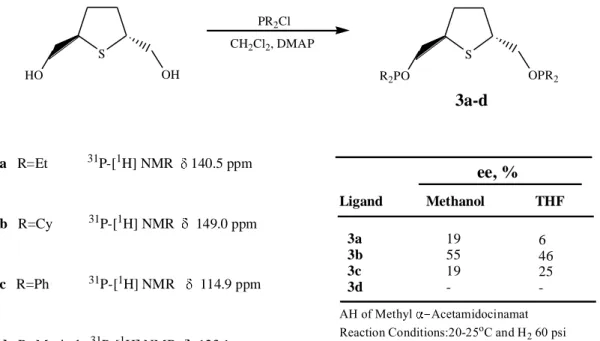
Hauptman et al. (1998) prepared “a series of chiral nonracemic bis(phosphinites) derived from (R,R)-trans-2,5-tetrahydrothiophenedimethanol.” “Reaction of these ligands, (3a-d) with Rh(cod)2X (X=OS(O)2CF3, SbF6) afforded rhodium complexes
which were tested in the asymmetric hydrogenation of methyl R-acetamidocinnamate, providing enantioselectivities of up to 55%.” They found that “the racemic bis(diphenylphosphinite) ligand 3c binded in an unusual tridentate mode, forming the thioether-bridged species ((3c)Rh)2(OTf)2, which was characterized by conventional
spectroscopic methods and by single-crystal X-ray analysis.”
Ligand Methanol THF 3a 3b 3c 3d 19 55 19 -6 46 25 ee, % S OH HO S OPR2 R2PO 3a R=Et 31P-[1H] NMR 140.5 ppm 3b R=Cy 31P-[1H] NMR 149.0 ppm 3c R=Ph 31P-[1H] NMR 114.9 ppm 3d R=Mesityl 31P-[1H] NMR 123.1 ppm PR2Cl CH2Cl2, DMAP AH of Methyl Acetamidocinamat Reaction Conditions:20-25oC and H
2 60 psi
substrate solution containing 2 % mol catalyst (1.3 M)
3a-d
Figure 3.2 “Synthesis of C2-symmetric bisphosphinites (3a-d), their 31P-{H}-NMR values and ee %
values obtained by using the asymmetric hydrogenation of methyl α-asetamidocynamate”
Gong et al. (2007) “focused on the construction of optically active C2-symmetric
AMPP ligand to increase rigidity of AMPP.” For this purpose, they “designed bicyclic compounds and a four cyclic compound (4-7) carrying nitrogen and oxygen to make these new ligands not only electron-rich but also C2 symmetric from readily available
amino alcohols.” They found that “Rh complexes with these ligands were highly enantioselective catalysts for asymmetric hydrogenation of N-benzoyldehydroamino acid derivatives and α-functionalized ketones in 99% and 98% ee, respectively.” They also reported that “this new class of (R,R)-BDOPPE (1,2-bis{di[(R,R)-1,3,2-oxaphosphilidine]phosphino}ethane) (4-7) afforded much more effectivity and
17
enantionselectivity than their corresponding non-C2-asymmetric aminophosphine
phosphinite.” N P O O P N R R Me Me NH OH R Me Cl2PCH2CH2PCl2 NEt3 N OH H N O N O P P Cl2PCH2CH2PCl2 NEt3 (R)-Amino alkol
R=Me, Ph,Bn R=Me (R,R)-Me-BDOPPE 4
R=Ph (R,R)-Ph-BDOPPE 5 R=CH2Ph (R,R)-Bn-BDOPPE 6
(R)-Prolinol (R,R)-Pro-BDOPPE 7
+
+
Scheme 3.4 “Synthesis of (R,R)-BDOPPEs”
R H COOR' NHCOPh [Rh(COD)(R,R)-BDOPPE]BF4 R H COOR' NHCOPh * O N(CH3)2.HCl OH N(CH3)2.HCl * H3C O N(CH3)2.HCl H3C OH N(CH3)2.HCl * [Rh(COD)(R,R)-BDOPPE]BF4 [Rh(COD)(R,R)-BDOPPE]BF4 H2/THF H2/THF R = H R' = H R = Ph R' = H R = H R' = CH3 R = Ph R' = CH3
Scheme 3.5 “Rh-catalyzed asymmetric hydrogenation of N-benzoyl-dehydroaminoacid derivatives and α-functionalized ketones”
18
Johnson et al. (1979) “explored the rhodium-catalyzed hydrogenations of olefinic acids with both camphos and camphinite 8.” Likewise, they “studied the hydrogenations of the corresponding methyl esters with both ligands.” They found that “the phosphine ligand, camphos, was better than or equal to the phosphinite ligand, camphinite, in the asymmetric reductions of olefinic acids.” “On the other hand, camphinite was the superior ligand when reducing olefinic esters unless an acetamido group was also present.” “So, they also reported that the phosphine analogue has proven to be an equal or better chiral ligand when a carboxylic acid or an acetamido group was present. When an ester group was present, the analogous phosphinite ligand gave greater asymmetric induction.”
COOH COOH CH2OPPh2 CH2OPPh2 CH2OH CH2OH LiAlH4 PPh2Cl Pyridine Camphinite 8 Scheme 3.6 “Synthesis of camphinite 8”
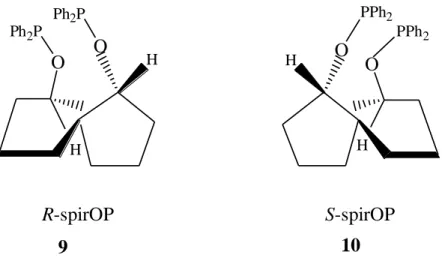
Chan et al. (1997) reported that “since the spiro backbone is totally rigid, the small amount of conformational flexibility in the C-O-P bond in 9 (or 10) is not expected to cause too many problems and this rationale was strongly supported by their findings.” They “conveniently prepared R-spirOP (1(R), 5(R), 6(R)-1,6-bis(diphenylphosphinoxy)spiro[4,4]noran) and S-spirOP (1(S), 5(S), 6(S)-1,6- bis(diphenylphosphinoxy)spiro[4,4]noran) phosphinite ligands and found that their rhodium complexes catalyzed asymmetric hydrogenation of prochiral enamides with a high activity and enantioselectivity.”
19 H O Ph2P O Ph2P R-spirOP H O O PPh2 PPh2 S-spirOP 9 10 H H
Figure 3.3 “(R) and (S) -spirOP phosphinite ligands”
Chen et al. (1999) reported that “the use of carbohydrates and derivatives as starting materials in the synthesis of chiral ligands had several advantages such as the raw materials are of high optical purity and are readily available; the multifimctional property makes it possible to design various structures through a series of modifications.” For this purpose, they reported “the synthesis of DIMOP (11) and the use of it in the hydrogenation of amidoacrylic acid derivatives.” They found that “the bulky ketal groups on the chiral backbone of DIMOP significantly increased the rigidity of the phosphinite ligand in its transition-metal complexes. This effect was found to lead to positive influence on the enantioselectivity of the catalyst of this ligand.”
O O OPPh2 O OPPh2 O DIMOP: 1,2,5,6-di-isopropylidene-3,4-bis(diphenylphosphino)-D-mannitol (11)
20 NHCOCH3 COOH H2 H3C COOH NHCOCH3 H [Rh(COD)(11)BF4] S/C=100, 15 da. 500 psi, 25oC, acetone (R) % 96.7 ee % 100 conv. Scheme 3.7 “Asymmetric hydrogenation of 2-acetoamidoacrylic acid catalyzed by cationic rhodium
complex of DIMOP”
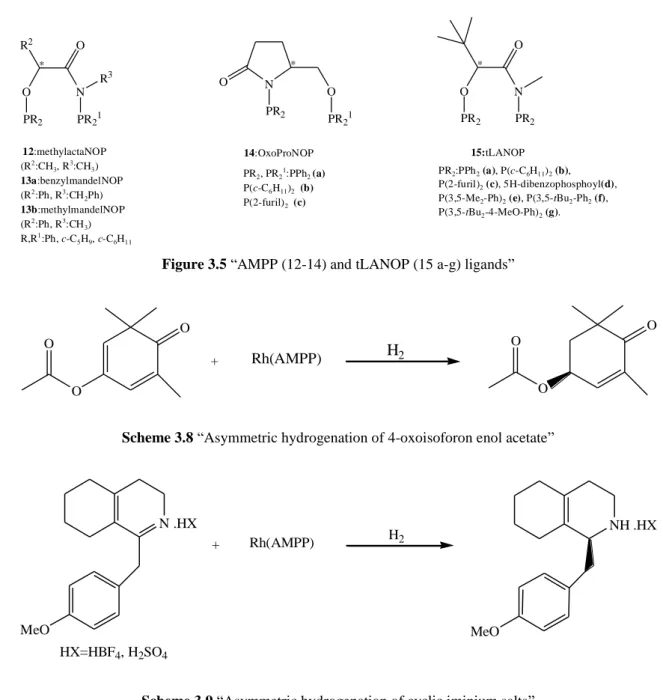
Broger et al. (1998) prepared “the new amidophosphine-phosphinite (AMPP) ligands 12 a-g (called tLANOP ligands) derived from the chiral hydroxy amide (R)- or (S)-2-hydroxy-3,3-N-trimethylbutyramide in 48–83% yield.” They reported that “the crystal structures of the square planar complexes [(SP-4-3)-Pd((R)-dmphea)((S)-12a)]BF4 and [Rh((R)-12a)(COD)]BF4 allowed the absolute configurations of the
ligands to be assigned.” “In both complexes the 7-membered chelating ring of 12a had virtually the same twist-boat conformation.” “With this class of ligands, Rh-catalyzed asymmetric hydrogenation of 4-oxoisophorone enol acetate yielding (S)-phorenol acetate in up to 71% ee.” “The iridium catalyzed asymmetric hydrogenation of the cyclic iminium salts gave after work-up the corresponding cyclic secondary amine in up to 86% ee, when bulky groups existed on the phenyl substituents on the two phosphorus atoms.” They “reasoned that the 7-membered chelate ring could be made more rigid by replacing the methyl or the phenyl substituent of ligands a t-butyl group.” “Indeed, molecular modelling calculations on cationic rhodium complexes supported this hypothesis.” Furthermore, they demonstrated that, “after coordination to a metal, the chelate ring of 13a and 14a as well as 13b and 14b would have very similar preferred twistboat conformations, thus suggesting a similar rigidity of the backbone in these two ligand families.” Consequently, they synthesized “the new tLANOP ligands 15a–g and tested them in two asymmetric hydrogenation reactions.”
21 O N R2 O PR21 PR2 R3 * N O O PR21 PR2 * O N O PR2 PR2 * (R2:CH 3, R 3:CH 3) 13a:benzylmandelNOP (R2:Ph, R3:CH 2Ph) 13b:methylmandelNOP (R2 :Ph, R3 :CH3) R,R1 :Ph, c-C5H9, c-C6H11 PR2, PR2 1 :PPh2 (a) P(c-C6H11)2 (b) P(2-furil)2 (c) PR2:PPh2 (a), P(c-C6H11)2 (b), P(2-furil)2 (c), 5H-dibenzophosphoyl(d),
P(3,5-Me2-Ph)2 (e), P(3,5-tBu2-Ph2 (f),
P(3,5-tBu2-4-MeO-Ph)2 (g). 15:tLANOP 12:methylactaNOP 14:OxoProNOP
Figure 3.5 “AMPP (12-14) and tLANOP (15 a-g) ligands”
O O O O O O Rh(AMPP) H2 +
Scheme 3.8 “Asymmetric hydrogenation of 4-oxoisoforon enol acetate”
N .HX MeO NH .HX MeO HX=HBF4, H2SO4 Rh(AMPP) H2 +
22
Guo et al. (2005) reported “the convenient, modular synthesis and characterization of complexes of the type trans-RuHCl(diphosphinite)(diamine) 16 and their use in the asymmetric transfer hydrogenation of ketones.” They stated that “this approach allowed the opportunity for rapid tuning of the catalyst structure due to the modular nature of the ligands and precatalysts.” “The trans-RuHCl(phosphinite)(diamine) complexes were carried out in a „„one-pot‟‟ procedure in high yield.” “The enantioselectivity of the catalyst could be tuned by modifying the diphosphinite ligand.” OH OH O PAr2 O PAr2 Ph3P Ru PPh3 PPh3 Cl H H N H H N H O P O P N H H N H H Ru H Cl 16 A B C PAr2Cl THF 65oC Ar2 Ar2 a) diphosphinite = (R)-BINOP diamine = (R,R)-DPEN b) diphosphinite = (R)-BINOP diamine = (S,S)-DPEN c) diphosphinite = (R)-xylBINOP diamine = (R,R)-DPEN d) diphosphinite = (R)-xylBINOP diamine = (S,S)-DPEN RT
Scheme 3.10 “Preparation of Ru/BINOP/DPEN catalyst system”
Ceron-Camacho et al. (2006) reported that “the reaction of the potentially tridentate phosphinite PCP pincer type ligand [C6H4-1,3-(OPPh2)2] with
[(η6-p-cymene)RuCl2]2 gave the bimetallic species [C6H4-1,3-(OPPh2
{Ru(η6-p-cymene)Cl2})2] (17)possessing a phosphinite PCP ligand as a bridging ligand between
the two ruthenium centers.” “This compound was proved to be an efficient catalyst in the transfer hydrogenation reaction of ketones in the presence of PriOH and NaOH.” They found that “several attempts, including the change of the ruthenium starting material (e.g. [(η6-benzene)RuCl2]2) and reflux conditions to achieve the coordination
of the diphosphinite [C6H4-1,3-(OPPh2)2] in a tridentate PCP pincer fashion failed.”
They tested “complex [C6H4-1,3-(OPPh2{Ru(η6-p-cymene)Cl2})2] for the transfer
23 O O PPh2 Ph2P Ru Ru CI CI CI CI 17 O O PPh2 PPh2 Ru Ru Cl Cl Cl Cl CH2Cl2, RT
Scheme 3.11 “Synthesis of [C6H4-1,3-(OPPh2{Ru(η6-p-cymene)CI2})2]”
“Aydemir et al. (2011) were synthesized phosphinite based chiral Ru(II) complexes (18 ve 19).” “They employed the ruthenium(II) phosphinite complexes as catalysts in the asymmetric transfer hydrogenation of acetophenone derivatives.” “Under optimized conditions, aromatic ketones were reduced in good conversions and in moderate to good enantioselectivities (up to 85% ee).”
N OPR2 Ru Cl Cl R2PO Ru Cl Cl R: Ph 18; Cy 19 O iso-PrOH acetone 18 or 19 / NaOH OH
Scheme 3.12 “Asymmetric transfer hydrogenation of ketones in the presence of Ru(II) catalyst”
They obtained “high conversion and moderate to good enantioselectivity in this reaction.” Furthermore, they reported that “the performance of these catalysts rather surprising, since conversions and enantioselectivities are not significantly affected in the absence of base.” “Amazingly, the conversion of the reactionwas also not changed in the air or with the addition of water.”
24
Ak et al. (2014) “screened a variety of phosphinite based on ferrocenyl moiety possessing central chirality as ligands in ruthenium(II)-catalyzed transfer hydrogenation of acetophenone derivatives employing iso-PrOH as the hydrogen source to give the corresponding product, (R) or (S)-1-phenylethanol derivatives with high conversions and good enantioselectivities.” They used “these complexes employed in the asymmetric reduction of different prochiral ketones (up to 85% ee) as well”. Furthermore, they also formed “organic–inorganic hybrid heterojunctions by forming thin films of ruthenium(II) complexes on n-Si and evaporation of Au as front contact.” “Current-voltage (I-V) characteristics of the structures exhibited excellent rectification properties.” “They determined “electrical parameters including ideality factor, barrier height and series resistance using I–V and capacitance–voltage (C-V) data.” Finally, they studied “photoelectrical properties of the structures by means of a solar simulator with AM1.5 global filter.”
Fe NH Ph2PO Ru Cl Cl * R R: D-isopropyl 20; L-isopropyl 21 R: D-isobutyl 22; L-secbutyl 23
25
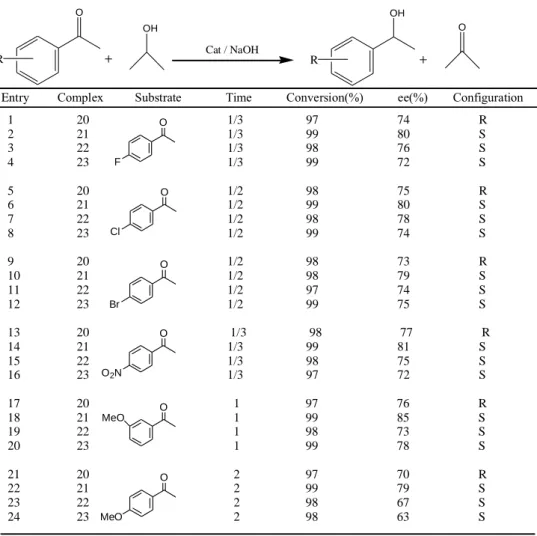
Table 3.1 “Asymmetric transfer hydrogenation of ketones in the presence of Ru(II) catalyst”
R O OH R OH O Cat / NaOH
Entry Complex Substrate Time Conversion(%) ee(%) Configuration 1 20 1/3 97 74 R 2 21 1/3 99 80 S 3 22 1/3 98 76 S 4 23 1/3 99 72 S 5 20 1/2 98 75 R 6 21 1/2 99 80 S 7 22 1/2 98 78 S 8 23 1/2 99 74 S 9 20 1/2 98 73 R 10 21 1/2 98 79 S 11 22 1/2 97 74 S 12 23 1/2 99 75 S 13 20 1/3 98 77 R 14 21 1/3 99 81 S 15 22 1/3 98 75 S 16 23 1/3 97 72 S 17 20 1 97 76 R 18 21 1 99 85 S 19 22 1 98 73 S 20 23 1 99 78 S 21 20 2 97 70 R 22 21 2 99 79 S 23 22 2 98 67 S 24 23 2 98 63 S F O Cl O Br O O2N O O MeO O MeO
They reported that “choice of base, such as KOH and NaOH, had little influence on the conversion and enantioselectivity (entries 9 and 10,e).” “Optimization studies of the catalytic reduction of acetophenone in iso-PrOH showed that good activity was obtained with a base/ligand ratio of 5:1 (Table 1).” “Reduction of acetophenone into (S)- or (R)-1-phenylethanol could be achieved in high yield by increasing the temperature up to 82 oC (Table 1, entries 9–12).” “These encouraged results show that the ferrocenyl based monodendate phosphinite ligands with amino (NH) moiety show much higher activity and enantioselectivity.” “Similar tendency was reported in earlier studies indicating that the NH functional moiety in ligand plays an important role in Ru(II)-ligand catalytic system.”
“Higher activity and enantioselectivity of amino containing phosphinite ligand also may be due to the fact that NH moiety can stabilize the catalytic transition state.”
26
“Furthermore, it is noteworthy that the catalytic system, 20–23 displays the differences in reactivity. These results indicate that the structure of the monodenate ferrocenyl-phosphinite ligands is a crucial factor for acceleration of the reaction. In the context of the results, it could be reasonably argued that the absolute configuration of the product is governed by the carbon centered chirality. Our study reveals that the activity and enantioselectivity of the catalyst is sensitive to substrate structures. So, the complexes 20-23 were further investigated in transfer hydrogenation of substituted acetophenone derivatives, and the results of this transformation are presented in Table 2. The catalytic reduction of acetophenone derivatives was all tested with the conditions optimized for acetophenone. The results in Table 2 demonstrate that a range of acetophenone derivatives canbehydrogenatedwith goodenantioselectivities. Complex 23 showed the highest activity with good enantioselectivity for most of the ketones listed in Table 1. Furthermore, the position and electronic property of the ring substituents also influenced hydrogenation results. The highest enantioselectivity was found for transfer hydrogenationof o-methoxyacetophenone (85% ee),while the lowest enantioselectivity was observed in transfer hydrogenation of p-methoxyacetophenone. From the results, the introduction of an electron-donating group such as methoxy group to the p-position decelerates the reaction, but that to the o-position increases the rate and improves the enantioselectivity. The introduction of electron withdrawing substituents, such as F or NO2, to the para positions of the aryl ring of the ketone, resulted in improved activity
with good enantioselectivity (entries 1-4 and 20-23, Table 1). The introduction of electron withdrawing substituents to the para position of the aryl ring of the ketone decreased the electron density of the C=O bond so that the activity was improved giving rise to easier hydrogenation.”
Durap et al. (2014) “successfully synthesized a new chiral bis(phoshinite) ligand from optically active (1S,8S)-3,6-[N-(S)-α-phenylethyl]diaza-1,8-diphenoxymethyl-1,8-octanediol in high yield.” They prepared “its ruthenium(II) complex in situ from [Ru(η6
-p-cymene)(μ-Cl)Cl]2, bis(phosphinite) ligand and KOH, which acted as an active
catalyst for asymmetric transfer hydrogenation (ATH) of acetophenone derivatives in isopropyl alcohol (IPA) as both solvent and hydrogen source.” They found that “the catalytic reaction proceeded cleanly to give enantiomerically enriched secondary alcohols up to 90% or 89% ee‟s at 50 or 82 °C, respectively.”
27
Scheme 3.13 “Synthesis of chiral C2-symmetric (1S,8S)-3,6-[N-(S)-α-phenyl
29 4.MATERIALS AND METHODS 4.1.Chemicals
4.2.Instrument Used For Characterization
1. FT-IR Spectrometer (Mattson 1000 ATI UNICAM) 2. Elemental analysis (Fisons EA 1108 CHNS-O) 3. NMR Spectrometer (Bruker AV400)
4. Gas chromatograph (Shimadzu GC 2010 Plus) 5. Melting points (Gallenkamp MPD 350 BM 2.5) 6. Polarimeter (Perkin Elmer 341)
7. IT-TOF MS ([M+H]+)
1. (S)-2-propanediol 12. Chloroform-d 23. Toluene
2. Dichloromethane 13. Chloroform 24. Petroleum ether
3. (S)-propylene oxide 14. Pyridine 25. THF
4. p-toluenesulfonylchloride 15. Ethyl acetate 26. Potassium hydroxide
5. HCl 16. MgSO4 27. Acetone
6. NaHCO3 17. Na2CO3 28. 2-Propanol
7. (R)-α-Phenylethylamine 18. Na2SO4 29. Acetophenone
8. Chlorodiphenylphosphine 19. Methanol 30. 4-Fluoroacetophenone
9. Triethylamine 20. di-fosforpentaoksit 31. 4-Bromoacetophenone
10. “[Ru(η6-p-cymene)(µ-Cl)Cl]2” 21. Benzophenone 32. 4-Chloroacetophenone
30 4.3.Method
The study can be outlined with three main titles: i. Ligand design;
Synthesis of starting materials for phosphinite ligands, Synthesis of phosphinite ligands,
ii. Synthesis of Ru(II) complexes of the ligands,
iii. Use of “Ru(II) complexes as catalyst in transfer hydrogenation reactions” and determining their catalytic activity.
All experimental studies, i.e. ligand design, synthesis of phosphinites and their Ru(II) complexes, and use of them in catalytic investigations were accomplished according to the literature (Ak et al. 2014).
4.3.1.(S)-(+)-2-Hydroxypropyl p-toluenesulfonate
OH
HO HO OTs TsO OTs
+
(1.70 g, 56 %) M.p: 33–35 ºC (34–35 ºC), 1H NMR (CDCI3, ppm): δ 7.80 (d, 2H, J = 8.0
Hz), 7.36 (d, 2H, J = 8.0 Hz), 3.97–4.05 (m, 2H, -CHCH3-+CH2Ts (a)), 3.83–3.88 (m,
1H, CH2Ts (b)), 2.45 (s, 3H, -CH3Ts), 2.39 (s, 1H, OH), 1.15 (d, J = 6.4 Hz, 3H,
-CHCH3), assignment was based on the 1H-13C HETCOR and 1H-1H COSY spectra.
4.2.1.2.(S)-1-[N-(R)-α-Phenylethyl]amino-2-propanol, (1
)
OTs HO + Ph NH2 N H HO Ph 131
“(0.56 g, 72 % as white solid)5. M.p: 53-54 oC, [ ]D20= +83.4o (c 1, CHCl3). 1H NMR
(CDCI3, ppm): δ 7.25-7.38 (m, 5H, Ar-H), 3.80-3.84 (m, 2H, -CHOH+-CHPh), 2.62
(m, 1H, -CH2N (a)), 2.52 (br, 2H, NH+OH), 2.27 (m, 1H, -CH2N,(b)), 1.40 (d, J = 6.8
Hz, 3H, CH3CHPh), 1.11 (d, J = 6.0 Hz, 3H, CH3CHOH); 13C NMR (CDCI3, ppm): δ
20.46 (CH3CHPh), 24.41 (CH3CHOH), 54.40 (-CH2N), 57.68 (-CHPh), 65.79
(HOCHCH3), 126.54, 127.09, 128.56 (o-, m-, p-carbons of phenyl), 144.98 (i-carbon of
phenyl) assignment was based on the 1H-13C HETCOR and 1H-1H COSY spectra; IR (cm-1): ν 3157 (NH+OH), 3086, 3026 (aromatic H), 2967, 2917, 2884 (aliphatic C-H) cm-1; Anal. Calc. for C11H17NO (179.26 g/mol): C 73.70, H 9.56, N 7.81; found C
32
Figure 4.1 A is accurate MS1 spectrum of (S)-1-[N-(R)-α-Phenylethyl]amino-2-propanol, (1), B
and C are the spectra that show the measured and predicted exact mass of the compound (S)-1-[N-(R)-α-Phenylethyl]amino-2-propanol, (1) respectively, by LC-ESI-IT-TOF MS. At the bottom of the figure there is information about predicated elemental composition, measured accurate mass, theoretical mass, double bond equivalent (DBE) and mass errors of the compound
33 4.2.1.3. (2S)-1-{[(2S)-2-hydroxypropyl][(1R)-phenylethyl]amino}propan-2-ol,(2) O + N + Ph NH2 N H HO Ph Ph HO OH 2 1 “[ ]D20= +65.8o (c 1, CHCl3). 1H NMR (CDCI3, ppm): δ 7.26-7.36 (m, 5H, Ar-H), 4.01 (m, 1H, -CHPh), 3.77-3.85 (m, 2H, -CHCH3), 3.21 (yayvan, 2H, -OH), 2.40-2.43 (m, 4H, -CH2N), 1.49 (d, J = 7.0 Hz, 3H, CH3CHPh), 1.12 (d, J = 6.2 Hz, 6H, CH3CHOH); 13 C NMR (CDCI3, ppm): δ 18.74 (CH3CHPh), 20.38 (CH3CHOH), 58.78 (-CH2N),
60.05 (CHPh), 64.18 (HOCHCH3), 127.36, 128.11, 128.29 (o-, m-, p-carbons of
phenyl), 141.04 (i-carbon of phenyl) assignment was based on the 1H-13C HETCOR and
1
H-1H COSY spectra; IR (cm-1): ν 3365 (OH), 3028 (aromatic C-H), 2968, 2932 (aliphatic C-H) cm-1; Anal. Calc. for C14H23NO2 (237.34 g/mol): C 70.85, H 9.77, N
34
Figure 4.2 A is accurate MS1 spectrum of
(2S)-1-{[(2S)-2-hydroxypropyl][(1R)-phenylethyl]amino}propan-2-ol, (2), B and C are the spectra that show the measured and predicted exact mass of the compound
(2S)-1-{[(2S)-2-hydroxypropyl][(1R)-phenylethyl]amino}propan-2-ol, (2) respectively by LC-ESI-IT-TOF MS. At the bottom of the figure there is information about predicated elemental composition, measured accurate mass, theoretical mass, double bond equivalent (DBE) and mass errors of the compound (2S)-1-{[(2S)-2-hydroxypropyl][(1R)-phenylethyl]amino}propan-2-ol, (2).
35
4.2.2.Synthesis and Characterization of Phosphinite 4.2.2.1. (2S)-1-{[(1R)-1- phenylethyl]amino}propan-2-yl diphenylphosphinite, (3) 3 N H OPPh2 Ph N H OH Ph PPh2Cl CH2Cl2 + Et3NHCl “(Yield: 0.19 g, 93.8 %). [ ]D20= +28.3 (c 1, CH2Cl2). 1H NMR (CDCI3, ppm): δ 7.19-7.62 (m, 15H, Ar-H), 4.24-4.31 (m, 1H, CHOP), 3.69 (q, J = 6.5 Hz, 1H, CHPh), 2.60 (d, J = 5.4 Hz, 2H, CH2N), 1.28 (d, J = 6.3 Hz, 3H, CH3CHOP), 1.17 (d, J = 6.6 Hz, 3H, CH3CHPh); 13C NMR (CDCI3, ppm): δ 20.38 (d, J = 5.0 Hz, CH3CHOP), 24.32 (CH3CHPh), 53.92 (d, J = 5.0 Hz, -CH2N), 57.44 (-CHPh), 76.60 (CHOP), 126.58,
126.85, 128.40 (o-, m-, p-carbons of phenyl), 129.67 (d, J = 10.1 Hz, m-carbons of OPPh2), 129.93 (s, p-carbons of OPPh2), 131.04 (d, J = 23.1 Hz, o-carbons of OPPh2),
142.81 (d, J = 36.2 Hz, i-carbons of OPPh2), 145.25 (i-carbon of phenyl), assignment
was based on the 1H-13C HETCOR and 1H-1H COSY spectra; 31P-{1H} NMR (CDCl3,
ppm): δ 109.35 (s, O-PPh2); IR (cm-1): υ 3292 (N-H), 3057 (aromatik C-H), 2968
(alifatik C-H), 1438 (P-Ph), 973 (O-P); Anal. Calc. for C23H26NOP (363.44 g/mol): C
36
4.2.2.2. (2S)-1-{[(2S)-2-[(diphenylphosphanyl)oxy]propyl][(1R)-1-phenylethyl] amino}propan-2-yl diphenylphosphinite (4)
4 + Et3NHCl N Ph OPPh2 OPPh2 N Ph OH OH PPh2Cl CH2Cl2 “(Yield: 0.23 g, 90.1 %). [ ]D20= -8.2 (c 1, CH2Cl2). 1H NMR (CDCI3, ppm): δ 7.27-7.62 (m, 25H, Ar-H), 4.06 (m, 2H, CHCH3), 3.923.94 (m, 1H, CHPh), 2.84 (m, 2H, -CH2N (a)), 2.43 (m, 2H, -CH2N (b)), 1.29 (d, J = 5.1 Hz, 3H, CH3CHPh), 1.15 (d, J = 6.1 Hz, 6H, CH3CHOP); 13C NMR (CDCI3, ppm): δ 12.68 (CH3CHPh), 20.75 (d, J = 5.0 Hz, CH3CHOP), 58.01 (d, J = 5.0 Hz, CH2N), 58.96 (CHPh), 76.30 (d, J = 19.1 Hz,
CHCH3), 127.82, 128.16, 128.25 (o-, m-, carbons of phenyl), 128.21 (d, J = 5.0 Hz,
p-carbons of OPPh2), 129.08 (d, J = 15.1 Hz m-carbons of OPPh2), 130.53 (d, J = 21.1
Hz, o-carbons of OPPh2), 142.75 (d, J = 33.2 Hz, i-carbons of OPPh2), 143.30 (i-carbon
of phenyl), assignment was based on the 1H-13C HETCOR and 1H-1H COSY spectra;
31
P-{1H} NMR (CDCl3, ppm): δ 106.47 (s, O-PPh2); IR (cm-1): υ 3056 (aromatik C-H),
2971, 2929 (alifatik C-H), 1438 (P-Ph), 970 (O-P); Anal. Calc. for C38H41NO2P2

![Figure 4.1 A is accurate MS1 spectrum of (S)-1-[N-(R)-α-Phenylethyl]amino-2-propanol, (1), B](https://thumb-eu.123doks.com/thumbv2/9libnet/3365118.12074/44.892.86.701.126.775/figure-accurate-ms-spectrum-s-phenylethyl-amino-propanol.webp)
![Figure 4.2 A is accurate MS1 spectrum of (2S)-1-{[(2S)-2-hydroxypropyl][(1R)-](https://thumb-eu.123doks.com/thumbv2/9libnet/3365118.12074/46.892.89.559.123.592/figure-accurate-ms-spectrum-s-s-hydroxypropyl-r.webp)