See discussions, stats, and author profiles for this publication at: https://www.researchgate.net/publication/45947683
Anatomy, Morphology, Palynology and Antimicrobial Activity of Amsonia
orientalis Decne. ( Apocynaceae ) Growing in Turkey
Article in International Journal of Botany · January 2006
DOI: 10.3923/ijb.2006.93.99 · Source: DOAJ CITATIONS 13 READS 72 3 authors, including: Hanife Akyalçin
Çanakkale Onsekiz Mart Üniversitesi 11PUBLICATIONS 88CITATIONS SEE PROFILE Fazıl Özen Kocaeli University 64PUBLICATIONS 167CITATIONS SEE PROFILE
All content following this page was uploaded by Hanife Akyalçin on 03 May 2016.
Intel. J. Bot., 2 (1): 93-99, 2006
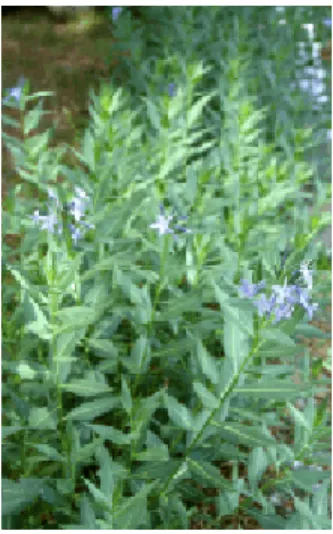
95 Fig. 1a: General appearence of amsonia orientalis
Fig. 1b: General appearence of amsonia
Fig. 2: Leaf morphology
Sclerenchyma forms a ring surrounding vascular system as clusters. Following this layer, there is phloem forming the mashed cells (Fig. 4) xylem forms a compherensive ring and consists of lignin. Parenchyma cells are located in centre.
Fig. 3a: Leaf anotomy
Fig. 3b: Amarllis type stomata
Fig. 3c: Leafe main vein
Inflorescence: Inflorescence is intense or loose, terminal.
Corymb has multiflower and 4-13 cm in length. Bracts are 1.0-8.0 mm in length. Tips of bracts are acut. Edge of bracts is pubescent.
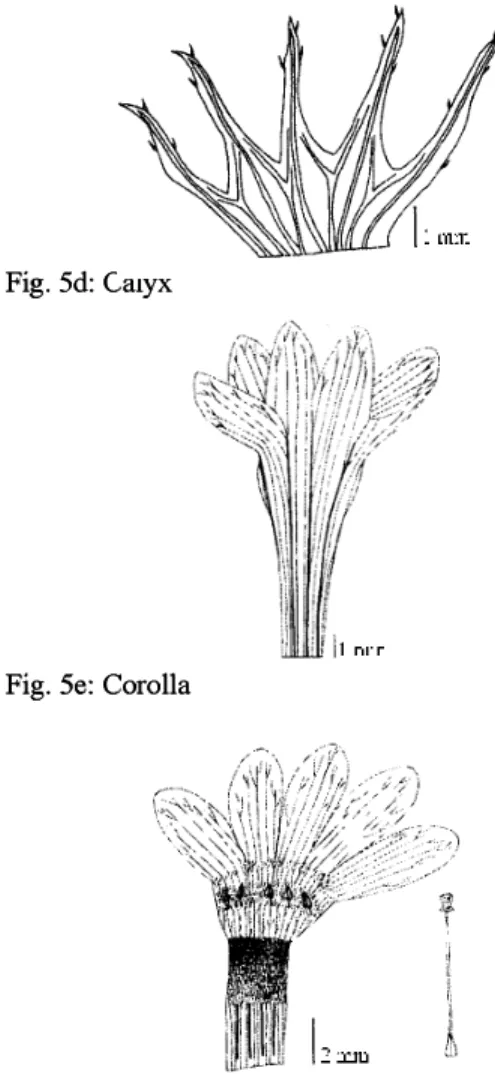
Floral morphology: Calyx is 3-6 mm in length. It is without
tubes, consisting of five calyx lobes, gamosepalous. Corolla is little, light blue, hypocrateriform, 13-21 mm in length. Corolla tube is 10-12 mm in length with tidy throat. Lobes (Petal) is 4-5.5 mm in length. The aestivation of the corolla lobes is convolute. Anther is acute and surrounds
dfgsd
Intel. J. Bot., 2 (1): 93-99, 2006
96 Fig. 4: Stem anatomy
Fig. 5a: General appearence of flower
Fig. 5b: The lontitudinal appearence af Amosonia 6-11 mm in length.
orientalis flower
Fig. 5c: Calyx Pore diameter is between 15-21 µm (W) and 10-14 µm (E),
Fig. 5d: Calyx
Fig. 5e: Corolla
Fig. 5f: Corolla and pistil
stigma but not adjacent to it. Stigma is 1-2 mm in length. Style is 6-8 mm in length. Carpel is 1-2 mm in length, covered with a disc and has many ovules (Fig. 5a-f).
Fruit is a follicle, 2-7, 5 cm in length. The opening of the fruit is secund cleavage. Seeds are tuberculate,
Pollen morphology: The pollen grains of Amsonia
orientalis are trizonaporate and in medium size. The P (Polar axis) value is 47.5-52.5 µm (W) and mean value is 50.36 µm. E (equatorial diameter) value is 56-60 µm (W) and mean value is 59.18 µm (W). Pollen shape is suboblatae and it is compressed in their polar areas. Because pollen grains were fixed only in polar area therefore P and E values couldn’t be measured (Fig. 6a-d). Exine is 2 µm (W, E). Ectexine and endexine are 1 µm (W,E). Mesoporium ranges from 37 to 42 µm (W) and from 31 to 42 µm (E) mean value is 40 µm (W) and 36.2 µm (E).
dfgsd
View publication stats View publication stats