1109 Ann Med Res 2020;27(4):1109-12
Annals of Medical Research
DOI: 10.5455/annalsmedres.2020.02.096
Original Article
Incidence of early postoperative ischemic stroke in lumbar
discectomy: A retrospective study
Ozkan Ozger1, Necati Kaplan2
1Istinye University, Faculty of Medicine, Department of Neurosurgery, Istanbul, Turkey 2Corlu Reyap Hospital, Clinic of Neurosurgery, Tekirdag, Turkey
Copyright © 2020 by authors and Annals of Medical Research Publishing Inc.
Abstract
Aim: Ischemic stroke (IS) is one of the leading causes of death worldwide. It may cause undesirable neurological sequels. This study
aims to determine the incidence of IS in the early postoperative period in patients operated for lumbar disc herniation.
Material and Methods: The electronic medical records of patients who underwent elective lumbar disc herniation surgery between
January 2017 and August 2019 were reviewed retrospectively. Patients with preoperative infection and neoplastic disease were excluded from the study. Patient demographics, pre and postoperative pain and disability levels, operated disc levels, duration of surgery and hospital stay, and complications were recorded.
Results: Of the 179 patients who underwent lumbar microdiscectomy for lumbar disc herniation, a total patient of one (0.55%)
patient developed IS in the right cerebellar region in the early postoperative period. The risk factors detected in the patient included hypertension, carotid artery stenosis and therefore irregular use of acetylsalicylic acid. Postoperative infection was detected in two patients (1.12%), peroperative cerebrospinal fluid leak in two patients (1.12%), and recurrent lumbar disc herniation in three patients (1.67%) in the late period. No mortality was observed.
Conclusion: In recent years, there has been an increase in minimally invasive spine surgeries, especially in elderly patients at risk
of ischemic stroke. It is important to identify and optimize these patients before surgery. While the incidence of ischemic stroke following lumbar microdiscectomy is low, it is necessary to be careful as a high risk of morbidity and mortality is in question. Keywords: Cerebral stroke; discectomy; incidence; ischemia
Received: 03.02.2020 Accepted: 30.03.2020 Available online: 16.04.2020
Corresponding Author: Ozkan Ozger, Istinye University, Faculty of Medicine, Department of Neurosurgery, Istanbul, Turkey E-mail: [email protected]
INTRODUCTION
Ischemic stroke (IS) is ranked as the second leading cause of death worldwide. Previous studies on spinal fusion and vertebroplasty have shown that they pose a similar risk of stroke in patients (1).
Severe neurological conditions such as hemiparesis, blindness and death have been reported. Postoperative IS, which is included in the informed consent we received from the patients, has been rarely discussed in the literature. Postoperative stroke may be associated with anesthesia, intraoperative maneuvers, or both. Its incidence is rarely reported. It is estimated to range from 2.5 in 1000 to 2 in 10,000 due to the variety of spinal surgery operations and patient age groups. A stroke may occur in the early postoperative period or long after the operation. Some published case reports have linked cerebrovascular events to cerebrospinal fluid (CSF) leak due to intraoperative dural injuries. On the other hand, there are also stroke reports where no CSF leak was observed, but the theory of excessive CSF drainage is more likely to be the cause
of hemorrhagic strokes than IS. Ischemic stroke is a matter of controversy in spinal surgery and it is difficult to determine the true incidence (2).
In operations other than cardiovascular surgery, the incidence of postoperative stroke is around 0.08-0.4%. Acute cerebral ischemia following lumbar surgery is extremely rare while its exact cause is still unknown (3). The aim of this study is to evaluate the incidence of IS in the early period following lumbar microdiscectomy (LMD), which is one of the minimally invasive spinal surgery methods, in the light of clinical parameters and demographic data.
MATERIAL and METHODS
Study DesignPatients who underwent LMD and operated by a single surgeon between January 2017 and August 2019 were examined retrospectively. All data were collected from electronic patient files. Preoperative diagnosis was made using lumbar magnetic resonance imaging (MRI) in all
1110 Ann Med Res 2020;27(4):1109-12
patients. The surgical techniques and risks to be applied were explained to the patients prior to the operation and their consent was obtained.
Inclusion and Exclusion Criteria
Patients who were diagnosed with single or multilevel lumbar disc herniation (LDH), presented with leg pain and neurological deficits unresponsive to treatment for six weeks and underwent LMD were included in the study after their informed consent was obtained.
Patients with preoperative spondylolisthesis, spinal fracture, spinal tumor, spine or disc infection, and follow-up time less than three months were excluded.
Surgical Technique
The operations were performed under a microscope in a single center by a single neurosurgeon. All patients received a single dose of prophylactic antibiotics before surgery. LMD was used as the surgical technique. The operations were performed under general or spinal anesthesia while the patients were in the prone position. Operative distance was determined by scopy. A 1.5-3 cm incision was made in the lumbar region for a single distance. A routine application of hemilaminectomy, microdiscectomy and foraminotomy was performed.
Evaluation Criteria
Patients’ age, gender, operated disc levels and sides, preoperative and postoperative visual analog scale (VAS) (leg pain) and Oswestry disability index (ODI) scores at month 1 and months 3, and complications occurring during and after surgery were recorded.
Statistical Analysis
In this study, VAS (leg pain) and ODI scores were evaluated preoperatively, in the postoperative 1st month and postoperative 3rd month. Statistical analysis was performed using SPSS version 22.0 software. A value of p<0.05 was considered statistically significant.
RESULTS
Patients’ Characteristics
A total of 179 patients and 193 intervertebral disc (IVD) levels were operated. 94 of the patients were male and 85 were female. The male/female ratio was 1.1:1. The mean age of patients was 52.41±14.47 years with a range of 25-88. All patients had at least one non-surgical neurological deficit or leg pain unresponsive to treatment for six weeks. Of the 193 LDHs treated with LMD, six (3.11%) were at the L1-2 levels, seven (3.63%) were at the L2-3 levels, 22 (11.40%) were at the L3-4 levels, 99 (51.29%) were at the L4-5 levels and 59 (30.57%) were at the L5-S1 levels (Table 1). 166 (92.74%) were operated at a single IVD level, 12 (6.70%) at two levels and one (0.56%) at three levels. The mean duration of operation and hospital stay was 176.15±31.05 minutes (106-240 minutes) and 1658.77±639.96 minutes (489-5777 minutes), respectively.
Table 1. Demographic data of the patients and levels operated on
Number of patients (n) 179
Number of male patients 94
Number of female patients 85
Mean age of the study population (years) 52.41±14.47
Levels operated n (%) L1-2 6 (3.11%) L2-3 7 (3.63%) L3-4 22 (11.40%) L4-5 99 (51.29%) L5-S1 59 (30.57%)
Postoperative Health Status Analysis
Table 2 shows the mean and standard deviation of VAS and ODI scores before surgery, 1 month after surgery and 3 months after surgery.
The mean VAS and ODI scores of the patients were 9.03±0.66 and 84.77±6.37 preoperatively, 2.76±1.23 and 29.93±12.26 at month 1, 1.59±1.09 and 16.78±11.36 at month 3 after surgery, respectively. A decrease was observed in the postoperative VAS and ODI scores. Such a decrease in VAS and ODI scores was found statistically significant (p <0.001).
Table 2. Mean and standard deviation of preoperative and postoperative VAS and ODI scores
Preoperative Postoperative 1st month Postoperative 3rd month
VAS 9.03±0.66 2.76±1.23 1.59±1.09
ODI (%) 84.77±6.37 29.93±12.26 16.78 ± 11.36
IS and Other Complications
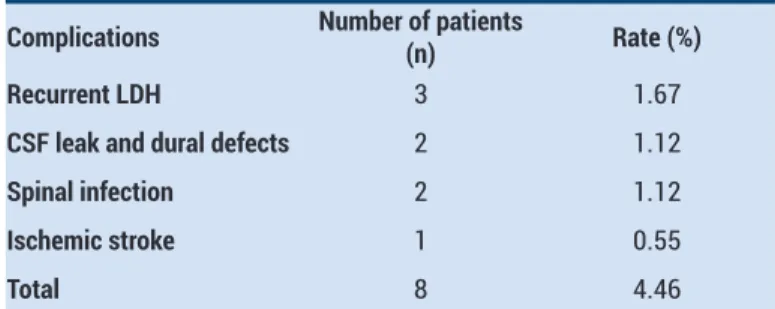
The complications encountered in 179 patients who underwent LMD are as follows: recurrent LDH (1.67%) in three patients in the late postoperative period, spinal infection in two patients (1.12%), peroperative dural defects and CSF leak in two patients (1.12%), and IS in one patient (0.55%) in the early postoperative period. The ratio of all complications to the total number of patients was 4.46%. No surgery-related mortality was observed (Table 3).
Table 3. Distribution of complications in patients undergoing LMD
Complications Number of patients (n) Rate (%) Recurrent LDH 3 1.67
CSF leak and dural defects 2 1.12
Spinal infection 2 1.12
Ischemic stroke 1 0.55
1111 Ann Med Res 2020;27(4):1109-12
The mean LDH recurrence time after the first operation was 1.67±0.58 (1-2) years in all patients with recurrent LDH. Fibrin sealant was used to treat peroperative CSF leakage in two patients. Tuberculosis was detected in one of the cases with spinal infection, while no pathogenic agents were detected in the other.
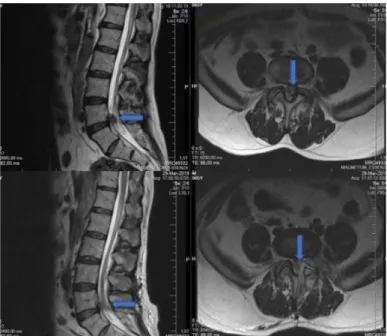
Our patient who developed IS was a 65-year-old male. His medical history included hypertension, carotid artery stenosis and therefore the use of acetylsalicylic acid (ASA). Preoperative diagnosis of LDH was made using lumbar MRI. An extruded left-sided L5-S1 LDH was detected in a patient with lumbarization (Figure 1).
The patient underwent a successful LMD surgery and was mobilized for the first time at the 6th postoperative hour. There was mild dizziness on standing up. No neurological pathology was considered in the first plan since successful mobilization was achieved. However, the patient did not want to be discharged the next morning and experienced worsening dizziness at the postoperative 24th hour; therefore he could not be mobilized. Lumbar MRI and brain diffusion MRI were planned urgently. Acute infarction was detected in the right cerebellar region.
Figure 1. Preoperative sagittal and axial lumbar MRI images
(upper figures) and early postoperative sagittal and axial lumbar MRI images (lower figures) of a 65-year-old male patient. Appearance of extruded disc fragment before and after LMD (blue arrows)
Figure 2. Early postoperative diffusion MRI images (left figure), postoperative 1st month diffusion MRI images (middle figure) and
postoperative 9th month diffusion MRI images (right figure) of a 65-year-old male patient. Right cerebellar acute infarction and healing stages are seen (arrows).
Antiembolic therapy was initiated. The patient recovered from dizziness on the second postoperative day and was discharged afterward. A follow-up brain diffusion MRI was performed at the postoperative month 1st and 9th (Figure 2). The patient did not develop any additional problems and presented with no active complaints at the 1.5-year follow-up.
DISCUSSION
Strokes can be pathologically classified into two major categories: ischemic and hemorrhagic. Hemorrhagic strokes are less common than ischemic strokes. Hemorrhagic strokes account for 15% of all strokes, but 40% of all stroke-related deaths. However, the scope of our study is IS (4).
Perioperative stroke is a cerebrovascular event that occurs within 30 days after surgery. It includes obvious (overt) stroke, transient ischemic attacks and silent (covert) stroke. The incidence of perioperative stroke has been reported as 0.05-4.4% in surgical interventions other than cardiovascular and cerebrovascular surgeries. The current study does not include silent strokes. While the incidence of obvious stroke is 0.4%, the incidence of silent stroke increases up to 7% following a non-cardiovascular surgery (5). The postoperative stroke rate was found to be 0.1% in another study with a large case series undergoing spinal stenosis surgery (6).
A recent retrospective study investigated the incidence of intraoperative IS in 5029 patients undergoing elective
1112 Ann Med Res 2020;27(4):1109-12
spinal surgery, in which seven patients were identified, with a rate of 0.15%. It was reported to be more common in women and more likely to occur in the pontine region. Diabetes, hypertension, dyslipidemia, smoking and intraoperative CSF leakage were identified as risk factors. Permanent neurological deficits occurred in 43% of patients with IS and death in 29% (7). It exhibits a high rate of mortality and morbidity, as seen in this study. On the other hand, our incidence was 0.55% and IS occurred in the right cerebellar region. Our patient was fully recovered and discharged in a short time.
There is a limited number of studies on perioperative stroke following spinal surgery. A large retrospective study conducted on 167106 patients in 2015 aimed to investigate the incidence of perioperative stroke during hospitalization in patients who underwent elective spinal surgery and to examine whether the incidence varied according to the surgical procedure. Perioperative stroke occurred in 0.22% of patients who underwent spinal surgery. Of these, 14.2% were hemorrhagic stroke and 85.7% were IS. The mortality rate of stroke was found to be 4.9%. It was concluded that advanced age, cervical spinal surgery, and long hospital stay increase the risk of perioperative stroke (8). In our patient, the risk factors included hypertension, carotid artery stenosis and therefore irregular use of ASA.
A retrospective study of geriatric patients undergoing lumbar spinal fusion surgery demonstrated that high levels of preoperative serum alkaline phosphatase (ALP) increased cardiac and cerebrovascular complications such as myocardial infarction and stroke within postoperative 30 days (9).
In 2017, a case of a 76-year-old female patient with lumbar spinal stenosis, who was a smoker with hypertension and diabetes, was presented. The patient developed an IS 60 minutes after the administration of general anesthesia for posterior lumbar stabilization although there were no peroperative complications. The left middle cerebral artery was successfully opened by performing early embolectomy. The patient was discharged after 39 days (10). Only antithrombotic therapy was applied for our patient whose complaints disappeared only 1 day after diagnosis.
The current study presented the postoperative clinical results and complications of patients who underwent LMD due to LDH. Our results are parallel to similar studies in the literature. The incidence of IS following LMD was determined and discussed in the light of other relevant studies in the literature. It was observed that more studies are needed since there are very few studies available on this subject.
CONCLUSION
LDH is still treated effectively and safely in many clinics in eligible patients. Although it requires a short duration of hospital stay and presents clinically satisfying outcomes
with a low complication rate, serious conditions such as IS may occur. The incidence of IS is 0.55% in our study. Although the incidence of IS is low, it is important to optimize patients with high risk of morbidity and mortality before surgery.
Competing interests: The authors declare that they have no competing interest.
Financial Disclosure: There are no financial supports.
Ethical approval: Permission from Chief Physicsian to use data (approval number: 18.01.2020/57).
Ozkan Ozger ORCID: 0000-0001-7257-8379 Necati Kaplan ORCID: 0000-0001-5672-0566
REFERENCES
1. Huang LC, Chung WF, Liu SW, et al. Lower Risk of Stroke after Deformity Surgery: Long Term Benefit Demonstrated by a National Cohort Study. Int J Environ Res Public Health 2015;12:12618-27.
2. Wu JC, Chen YC, Liu L, et al. Lumbar spine fusion surgery and stroke: a national cohort study. Eur Spine J 2012;21:2680-7.
3. Ermalai N, Amarouche M, Critchley G. Spinal epidural haematoma following thrombolysis for acute ischaemic stroke in patient within 48h of emergency lumbar microdiscectomy. Br J Neurosurg 2017;31:626-7.
4. Yang F, Zhao J, Xu H. Characteristics of Hemorrhagic Stroke following Spine and Joint Surgeries. Biomed Res Int 2017;2017:5390839.
5. Cui Q, Wang D, Zeng M, et al. Association of postoperative covert stroke and cognitive dysfunction among elderly patients undergoing non-cardiac surgery: protocol for a prospective cohort study (PRECISION study). BMJ Open 2020;10:034657. 6. Deyo RA, Hickam D, Duckart JP, et al. Complications
after surgery for lumbar stenosis in a veteran population. Spine (Phila Pa 1976) 2013;38:1695-702. 7. Ishak B, Abdul-Jabbar A, Singla A, et al. Intraoperative
Ischemic Stroke in Elective Spine Surgery: A Retrospective Study of Incidence and Risk. Spine 2020;45:109-15.
8. Ohya J, Chikuda H, Oichi T, et al. Perioperative stroke in patients undergoing elective spinal surgery: a retrospective analysis using the Japanese diagnosis procedure combination database. BMC Musculoskelet Disord 2015;16:276.
9. You AH, Han DW, Ham SY, et al. Serum Alkaline Phosphatase as a Predictor of Cardiac and Cerebrovascular Complications after Lumbar Spinal Fusion Surgery in Elderly: A Retrospective Study. J Clin Med 2019;8:1111.
10. Sun ZN, Meng XL, Wang J, et al. [Perioperative stroke effectively treated by an acute stroke team including anesthesia department: a case report]. Beijing Da Xue Xue Bao Yi Xue Ban 2017;49:1090-4.