Investigating Intercultural Elements in English
Coursebooks
Muzeyyen Nazli DEMIRBAS
1ABSTRACT
Intercultural communicative competence is defined to be at the heart of foreign language education more than communicative competence nowadays. Performing competently in intercultural communication requires certain dimensions in language education. One of them is integration of intercultural and target culture specific elements in coursebooks. In order to build up a picture of frequently used intercultural and target culture specific items in coursebooks, this study analyzes the contents of ‘My English 5, Unique 6, Spring 7 and Four Seasons English 8’ for English language instruction in Turkish primary schools. Key findings from the data highlight that the target culture specific items in conversations and visuals outweigh the intercultural ones. Besides, intercultural items are usually found in certain cultures like Japanese, French and German. It is concluded that although local coursebooks have improved in inclusion of cultural items it highly depends on teachers to adapt those items and use them communicatively and creatively.
Keywords: EFL coursebooks, intercultural communicative competence, intercultural
items.
İngilizce Ders Kitaplarında Kültürlerarası Unsurların
İncelenmesi
ÖZ
Kültürlerarası iletişimsel yeterlik yabancı dil öğretimi için son zamanlarda iletişimsel yeterliğe göre oldukça önem arz etmektedir. Kültürlerarasi iletişimde etkili olabilmek için yabancı dil eğitiminde bir takım kriterler söz konusudur. Bunlardan birisi yabancı dil kitaplarına çeşitli kültürlere ve hedef kültüre yönelik görsel ve metinsel içeriklerin eklenmesidir. Buna göre, ders kitaplarının metin ve görsellerinde sıklıkla kullanılan kültürel ve hedef kültüre yönelik unsurları belirlemek için, bu calişma ortaokullarda okutulan, Avrupa Ortak Başvuru Metni’ne göre hazirlanmis ve MEB tarafından onaylanmış My English 5, Unique 6, Spring 7 ve Four Seasons English 8 kitaplarını incelemiştir. Sonuç olarak metin ve görsellerde hedef kültüre yönelik unsurlara daha sık rastlanılmıştır. Ayrıca bulunan kültürlerarası unsurların ise genellikle Japon, Fransız ve Alman kültürlerine ait oldukları belirlenmiştir. Ancak, her ne kadar yerel ders kitapları kültürel unsurları içerse de, bunları iletişime yönelik ve yaratıcı biçimde düzenleyerek öğrencilere sunmak yine öğretmenin sorumluluğundadır.
Anahtar kelimeler: kültürlerarası iletişimsel yeterlik, ders kitabi, kültürel unsurlar.
INTRODUCTION
Culture is the system of shared beliefs, values, customs and behaviors which members of society use to deal with their world and each other, and which are transferred from generation to generation via learning (Bates & Plog, 1991, as cited in Bayyurt, 2006). According to Brown (2010), culture is considered a part of interaction between language and thought. Likewise, Byram (1998) acknowledges that although learners learn English as an International Language (EIL), they learn language and its cultural implications, which improves their
intercultural and communicative competence. As the intercultural
communicative competence (ICC) in language education no longer requires a native speaker competence but rather an intercultural competence (Guilherme, 2002), foreign language teachers need to have ICC so that they can help learners be involved in the interculturalization process by raising their intercultural awareness. What is meant by intercultural awareness in the current study is as follows (Baker, 2011);
Intercultural awareness is a conscious understanding of the role culturally based forms, practices, and frames of understanding can have in intercultural communication, and an ability to put these conceptions into practice in a flexible and context specific manner in real time communication. (p. 66). Accordingly, the concept ‘interculturalization’ is used in this study to refer to the process in which learners understand the role of cultural forms, practices and frames in conversations with either native or non-native speakers, and in which learners widen their repertorie of intercultural concepts and life styles. There are controversial views on the inclusion of intercultural versus target culture specific elements in ELT classes and materials (Bayyurt, 2006). The first view (Alptekin, 2002; Hyde, 1998; Kachru, 1986) supports developing ICC among EIL learners via linguistic and cultural behaviors to prepare them to be both global and local speakers of English and to feel at home in international and national contexts. In other words, this group is opposed to viewing English language as a monolingual or mono-cultural issue. Thus, they acknowledge that teaching English successfully depends on the language teachers who have a global view within a local perspective. The second view, on the contrary, believes in the fact that language and culture are inseparable, so target culture should be an indispensable part of foreign language teaching curriculum. Byram (1998) and McKay (2003) claim that teaching a foreign language with its culture provides learners with a holistic perspective about when and how to use that language. Moreover, McKay (2003), unlike Byram (1998), states that learners’ own culture should also be used in English language teaching classes.
This paper holds the view that teaching English should be from a global perspective by including intercultural elements as well as target culture specific ones. As McKay (2003) puts forth, learners’ own culture should be presented with the target culture as well as with intercultural items so that learners can compare their cultures with others, be broader minded, negotiate and communicate more tolerantly and sympathetically. Parallel to Cakir’s (2010)
view, widening learners’ cultural awareness should be the main goal rather than teaching them the target culture. In order to realize this goal, learners need to be familiar with the cultural items, expressions, signals and visuals in their language classes. In a global world, people need to view other communities, nations and cultures from a holistic perspective rather than as a single nation, religion or ethnicity, beacuse such a world requires us to welcome the aforementioned differences. Especially for coursebooks it is vital to include both target culture specific and intercultural items. There are several reasons for their being so significant. First, coursebooks carry considerable roles like presenting visual and audial materials, various activities, tasks, practice and communication opportunities, a previously prepared and approved syllabus, and being a resource book for individual learning as well as experienced and inexperienced language teachers; therefore, they are preferred in classes mostly as main materials. Second, based on this fact, it is thought that coursebooks should be designed to help learners communicate and learn a foreign language by interchanging cultural elements and experiences rather than focusing on solely the target culture specific cases. As Korkmaz (2009) pointed out, without the cultural themes and items in language learning process, learners are thought to suffer from the lack of variation which enables them to perceive the world from the shoes of others and this hinders students from fully understanding other people via using a common foreign language (Korkmaz, 2009). Third, writing coursebooks, however, is shaped by the social context where the writer lives (Alptekin, 2002). To be more specific, the White House may be a favorite topic for American EFL coursebook writers, while the British Royal Family is appealing to British coursebook writers. As most coursebooks are written by native speakers, they reflect their values, beliefs, feelings and attitudes towards their own English speaking country (Alptekin, 2002). Regarding all the factors and effects of coursebooks for language learners, it is crucial to be aware of the extent of intercultural and target culture specific items used and emphasized in local coursebooks.
Hence, in terms of analyzing cultural elements in various coursebooks, many studies have been conducted up to now to analyze cultural elements in various coursebooks. Risager (as cited in Lazar, 2003) evaluated recent tendencies in terms of cultural references in European coursebooks. Ozisik (2009) conducted a study to understand the transmission of language items of target culture to young learners by analyzing ‘A Modern English Course for Turks 7’. To summarize, it was concluded that target culture specific language items were not presented to learners in a sufficient way on account of the local coursebooks prepared for the fear of learners’ losing their own identities, of teachers who had not had enough cultural background, of the limited time to finish the units in the coursebook, and of the point of view which supported learning English with its structure rather than skills. Korkmaz (2009), on the other hand, aimed to show the variety of multicultural items in English language coursebooks. His scope consisted of New-Headway intermediate, New Cutting Edge intermediate, Face to Face intermediate with the classification of fictional texts, non-fictional texts, visual references, conversational items and listening parts. His research came up with
the result that those coursebooks had the similarity in the kind of multicultural items yet the number of target culture specific items outweighed the number of multicultural ones. Hamiloglu and Mendi (2010) conducted a content analysis study on cross-cultural or intercultural elements in EFL coursebooks as well. As a result, they concluded that cross-cultural topics are generally presented in reading texts to provide language input in context and to raise awareness of students’ familiarity with foreign cultures. Listening exercises are also frequently used to present cross-cultural issues showing how pronunciation, intonation and stress of people from different cultures differ. Similar to Hamiloglu and Mendi (2010), Cakir (2010) analyzed English language coursebooks (Spring 6, 7, and English net 8) used at the 6th, 7th and 8th grades of elementary education in terms of culture-specific expressions. Results suggest that foreign language teachers dealt with culture appropriately in order to raise learners’ cultural awareness.
Although different content analysis studies have been conducted to investigate the cultural elements within them, a limited number of studies has been carried out using through content analysis with the coursebooks published by Turkish Board of Education written in accordance with the CEF (Common European Framework) descriptors. Therefore, this content analysis-based study will contribute to the understanding of to what extent and how young language learners in the Turkish context are exposed to cultural elements. At this point, this study aims to investigate whether and how much intercultural or target culture specific (American or British) items CEF based local EFL coursebooks in Turkey include with respect to conversational and visual criteria. Acoordingly, the current study has eight research questions;
1. Do secondary coursebooks by Turkish Board of Education include target culture specific conversational items?
2. How many target culture specific conversational items do secondary coursebooks by Turkish Board of Education include?
3. Do secondary coursebooks by Turkish Board of Education include intercultural conversational items?
4. How many intercultural conversational items do secondary coursebooks by Turkish Board of Education include?
5. Do secondary coursebooks by Turkish Board of Education include target culture specific visual items?
6. How many target culture specific visual items do secondary coursebooks include?
7. Do secondary coursebooks by Turkish Board of Education include intercultural visual items?
8. How many intercultural visual items do secondary coursebooks by Turkish Board of Education include?
METHODOLOGY Data Collection
This study employed a descriptive content-analysis method, thus carried a qualitative feature. As Seliger and Shohamy (1990) state, descriptive content analysis method is preferred in order to understand and display the frequency of language elements depending on variables in coursebooks. Four randomly selected Common European Framework (CEF) based coursebooks designed and approved by the Ministry of National Education (MoNE) were analyzed. As there has been little consideration of and investigation into intercultural or target culture specific elements in these coursebooks, it was aimed in this study to understand how cultural elements were presented to young learners who met English for the first time formally in their classes. These coursebooks are used by many state schools in different parts of Turkey.
Researchers have put forth various criteria to assess the cultural content. For example, Byram (1998) formed his checklist for cultural content including cultural differentiation, social and regional identity, ethnic variety, social class, values and beliefs, leisure, daily routines, families, employment, social and political institutions, socializations, relationships, schools and rites of passage. Korkmaz (2009), on the other hand, categorized his research under four criteria fictional texts, non-fictional texts, visual references, conversational items and listening parts. Cakir (2010) analyzed three coursebooks by focusing on idioms, proverbs, superstitions, festivals and celebrations. The CEF (2000) listed its own criteria that should be included in foreign language teaching coursebooks. These are timetables, weekends, leisure, sports, daily life, cultural relations, life conditions, political & regional relations, art, music, body language, gifts, special days, letters, celebrations, customs, clothes, and food and drinks. On the basis of the aforementioned criteria, the current research was designed according to the perspectives of intercultural items and items belonging to the target cultures (British / American). The reasons for this choice were twofold. The first is that as it is intended to analyze coursebooks for young learners, it might not be appropriate to expect idioms or fictional/ non-fictional texts considering to their cognitive and emotional development. The latter is that demonstrating ethnic minority, regional identity or values and beliefs may cause racism or separation among those learners as Turkey has a multicultural profile. In light of this situation, the coursebooks investigated in this study are;
1. My English 5 by Lutfi Yalcinkaya, Lamia Bagdu, Ayse Beyhan Sezer. Ankara; Pasifik, 2012.
2. Unique 6 by Evrim Birincioglu. Ankara; Atlantik, 2012.
3. Spring 7 by Guler Silit, Yalcin Arslanturk. Ankara; Ozgun, 2012. 4. Four Seasons English 8 by Filiz Kara. Ankara; Dikey, 2012. Data Analysis
During the categorization of coursebook analysis, only visual and conversational items were considered. According to Korkmaz (2009), photos of people from a specific culture, landscapes, icons, drawings, signs and symbols can all be
considered as visuals to draw their attention and interest into the topic or the activity in each skill and structure. They guide learners to brainstorm or to negotiate ideas, to skim or scan the texts, to pay attention to audio recordings and to form various genres. Furthermore, they reflect the cultural features or details that may be challenging to imply and comprehend. As for conversational items, they provide learners with linguistic and cultural inputs in a combined way. There are dialogues, short texts, phone conversations, e-mails, letters or other genres that help them gain more insight into different cultural perspectives and keep conversation successfully.
RESULTS
This study aimed to investigate the frequency of inter/cultural elements in conversational and visual items presented to secondary levels. My English 5, Unique 6, Spring 7 and Four Seasons English 8 were prepared and approved by the MoNE and were written according to the CEF. As these learners meet English language instruction officially for the first time, their coursebooks consist of short and simple texts, dialogues that reflect daily use of English, and a lot of colorful visuals to lead them to start communicating in the target language by presenting different tastes, interests, jokes, pieces of information and characters. Hence, visual and conversational items were taken into consideration during the analysis of these coursebooks in terms of intercultural items and target culture specific items (British / American).
Table 1. Cultural Items in My English 5
My English 5 Intercultural Items Target culture specific
Items Conversational analysis Visual analysis Conversational analysis Visual analysis % 17.5% 17.39% 82.5% 82.6% f 19 4 90 19
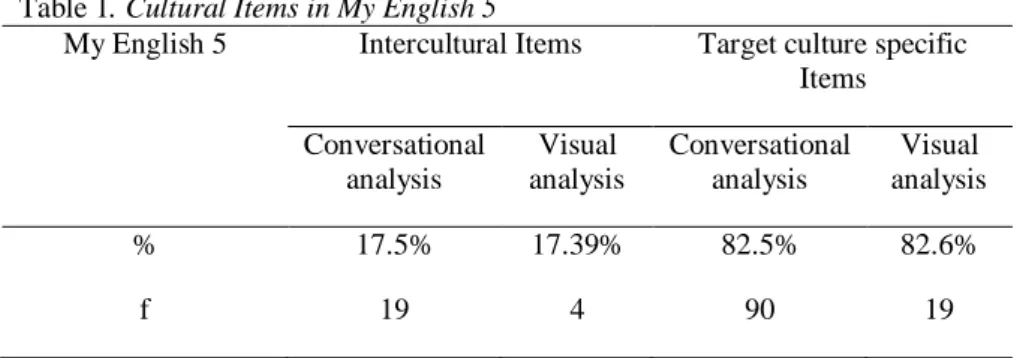
To start with My English 5, intercultural items in conversational analysis appeared to be 17,5%. Contents of the coursebook are on daily life (favorite activities, personal possessions and their tools, health problems, fun at the park and helping the family), pets, farm animals and wild animals –lion, giraffe, tiger, elephant from African continent-, cultural food and drinks –pizza, ayran-), special days and celebrations (birthday party), music (playing the guitar, flute), and in cultural relations (greetings, Heidi), different cities and countries (Agri, Paris, France).
Conversational items belonging to the target culture, on the other hand, were found to be 82,5%. They consist of British and American cultures, namely, target culture. These were observed mostly in greetings (names of characters in texts –
King George, Queen Elizabeth, Princess Anne, Prince Charles, Steven, Jill, Harry -), pets (the sounds of pets; woof woof, meow meow, chirp chirp, neigh, cluck, baa baa, moo moo), cartoon characters (Popeye, Lucky Luke, He-man, Tom & Jerry, Snoopy, Bugs Bunny, Smurfs, Garfield, Spiderman, Tweety, Sponge Bob, Inspector Gadget, Nemo, Flinstones) the order of the days (Sunday, Monday, -starting from Sunday just the opposite in our culture).
As for visual cultural items, the study revealed that young learners were introduced with 17,39% intercultural items of all the visuals. This percentage focused on animals (pets, farm and wild animals from African continent), characters (Pablo, Heidi), instruments and music (violin, guitar, tango) and drinks (ayran).
Parallel to the visual percentage of conversational items, the percentage of visual items belonging to specific culture was found to be 82,6%. These items were found mostly in cartoon characters and people (Popeye, Lucky Luke, He-man, Tom & Jerry, Snoopy, Bugs Bunny, Smurfs, Garfield, Spiderman, Tweety, Sponge Bob, Inspector Gadget, Nemo, Flinstones, Dirty Jack, Mickey Mouse), places (cinema), food and drinks (coke, sandwich), and music (tango).
Table 2. Cultural Items in Unique 6
Unique 6 Intercultural Items Target culture specific
Items Conversational analysis Visual analysis Conversational analysis Visual analysis % 48.2% 17.39% 51.7% 82.6% f 82 4 88 19
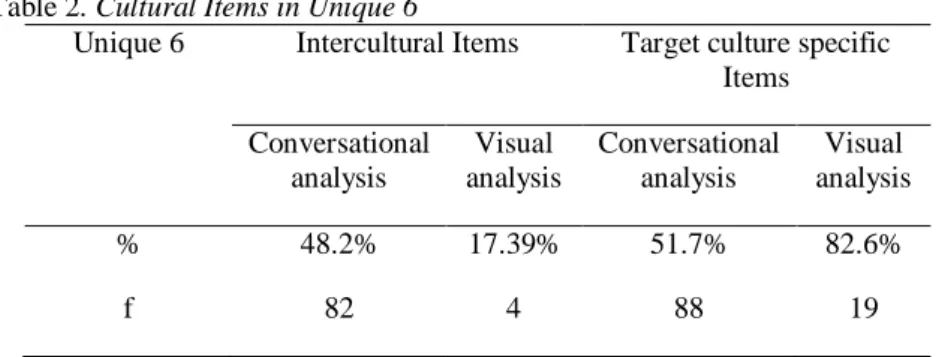
In the second coursebook ‘Unique 6’ the percentage of intercultural items and target culture specific items in conversation analysis were found to be similar. As a result, 48,2% of the conversation belonged to intercultural items. These were emphasized mainly in food and drinks (pizza, garlic bread, spaghetti, cheesecake, brownie, seafood spaghetti, fettucini, risotto, cappuccino, tea, coffee, baklava, kremali biscuits), weather conditions (cities - Istanbul, Athens, Aydin, Samsun, Erzurum, Ankara, Gaziantep, Antalya, Izmir, Bolu, Izmit, Helsinki, Cairo, Moscow-, regions –Black Sea Region, Central Anatolia, Eastern, Southeastern, Mediterranean, Agean, Marmara Region, Arctic Region- and lakes -Lake Van, Tuz-), national holidays (29th October Republic Day, 23rd April, 19th May, 31st August, Ramadan Feast, ), some places (Bosphorous tour, Kapali Carsi, Taksim Square, Kizilay Square, geisha houses, Kasai Rinkai Koen Park, Kagurazaka), specific names (Ataturk, Shika, Keiko, Deniz, Kenan Dogulu, Nil Karaibrahimgil, Melis, Selin, Turkish Lira, Sari Zeybek, Ursa Major, Inuktitut, Anyu, Pam) and games (backgammon, chess).
In terms of conversational items belonging to specific culture (British / American), the results displayed that 51,7% of the items belonged to the target culture. To exemplify, food & drinks (chips, coke, schnitzel, espresso, popcorn), geographical places (Yorkshire, Moon Café, Sun Street, London Zoo, Baker Street, Butterfly paradise, Blackburn Pavilion, Barclay Court, Oasis Café, Ragents Canal, New York, Waikiki Beach, Colorado, London, Ashford, California), names of children in texts or dialogues (Margaret, Sally, Janet, Jack, Sandy, Bob, Katie, Linda, Michelle, Coach Jackson, Jill, Susan, Miss Smith, Mr. Johnson, Mr. Young, Robert), celebrations (Easter) and specific names (pounds, hula dances) have items of the target culture.
Another category is the visuals belonging to intercultural items. The analysis revealed that 88,5% of the visuals of intercultural items was introduced to young learners in this coursebook. Visuals were placed in nearly each page of the book; however, especially some units have more intercultural visual items than the rest. These are observed in content such as family (a woman doing tango, Hadise, Kivanc Tatlitug, Ata Demirer, Naz Elmas, Ataturk, Zubeyde Hanim, Ali Riza Bey, Latife Hanim, a black man), daily life and routines (pizza, French fries, tango), school (Turkish flag, Ataturk portrait), weather conditions (Turkish map, Ankara, Gaziantep, Izmir, Istanbul, Samsun, Antalya, Ankara), animals (zebra, alligator, elephant, giraffe, tiger, red fox from African continent, ostriches – Australian-, deer), games and sports (female volleyball players, Turkish uniforms), different places and life styles (Disneyland, Ataturk stadium, Japanese and German flags, Tokyo Olympics, geisha houses, Istanbul, Bolu, Izmir, Zonguldak, Adapazari, Arctic region, Eskimo, North Poles, penguins, Japanese hostess, Turkish policeman).
As for visuals belonging to the target culture in Unique 6 were found to be 11,5%, which is much less than those in My English 5. These were frequently discovered in family (Julia Roberts, Michael Jackson), in food and drinks (hamburger, sandwich), daily life and routines (school bus), places (London Zoo map, California, Colorado, Hawaii), and holidays (Easter egg, Easter rabbit, bunnies).
Table 3. Cultural Items in Spring 7
Spring 7 Intercultural Items Target culture specific
Items Conversational analysis Visual analysis Conversational analysis Visual analysis % 39.13% 61.9% 60.87% 38.1% f 63 26 98 16
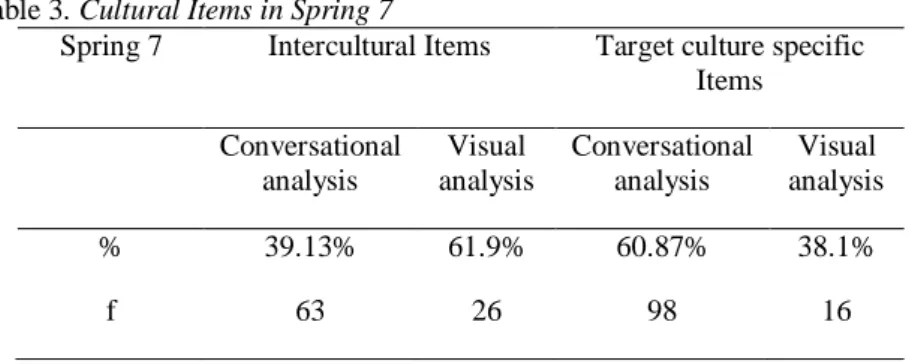
The third coursebook ‘Spring 7’ include 39,13% intercultural conversational items. These are frequently found in such contents; interesting beliefs (blue beads, fortunetelling, Altar, Meryem, Aysun, Kadikoy, Zeytinburnu, Burak), computers (Istanbul, Ankara, Ahmet, Sezen, Kizilirmak, Firat, Deniz, Turkish cookery), fashion (Mono Lisa, Picasso, Konya, Aysun Kaya), old days (Mount Agri, Kayseri, Antalya, Sevgi), tales and legends (Nasreddin Hodja, Musicians of Bremen), amazing history (Trojan War, Edirne, Murat II, Huma Hatun, Rumeli Fortress, Anadolu Fortress, Halic, Celal Bayar, Ismet Inonu), skills (pizza, macaroni, Ebru), life styles (Hacivat & Karagoz, Heidi, African elephant, Mountain gorilla, camel, cheetah).
Target specific cultural items in conversations were found to be 60,87% in Spring 7. These items were mainly met in characters’ names in some units (Anna, John Parker, Peter, Susan, Bob, Jack, Mr. Miller, Mrs. Corner, Cindy), horoscopes (horse shoe, walking under the ladder), tourist attractions (London, Buckingham Palace, London Zoo, Big Ben, Madam Tussaud, Manchester, Leeds, Birmingham, Hyde Park, National Theatre, York Road, Victoria Street, Westminster Bridge, Lincoln Kick Ski Center), computers (Jason, Mrs. Morgan, Mr. Bloom), TV programmes (Johanne Kidman, Casper, American Indians, Little Joe, Pamela Sue Anderson, Susan Heathrow, Daniel Milton, Pablo Correl, Mary Jane, Tom Stevenson, Austin, Texas, Hollywood, Arthur, Miss Parker, Miss Jackson), old days (Brad Pitt, New York, Uncle George, Kate, Ted, Sue, John, Miss Fisher), inventors and explorers (Samuel Morse, Martin Cooper, Alexander Graham Bell, Marie and Pierre Curie, Christopher Columbus, Alfred Nobel, Bill Gates, Ray Tomlinson), tales and legends (puss, beauty and the beast, snow white and 7 dwarves, Peter Pan, Cinderella), changing life styles (Chris, Janet, Mr. Pearson) and technology (Polly, Mr. Parker).
Intercultural visual items in this coursebook were 61,9%. These are mostly observed in contents such as interesting beliefs (witch, fortuneteller, black cat, blue beads), tourist attractions (Anitkabir, Cem Yilmaz), computers (Turkish cookery, Turkish kitchen), fashion (FIFA), TV programmes (a boy with Turkish flag), old days (Tarkan, Eiffel Tower, Sabiha Gokcen, Metin Oktay, Kemal Sunal), inventors and explorers (Mimar Sinan, Sultan Ahmet, Selimiye Mosque), tales and legends (Alaaddin and his magic, musicians of Bremen), amazing history (Ottoman flag, Hazarfen Ahmet Celebi, Trojan horse, Bandirma Vapuru, conquest of Istanbul) and modern medicine (a Japanese woman, an Eskimo). Target culture specific visual items in Spring 7 were 38,1%. These items were found in contents such as interesting beliefs (horse shoe, walking under the ladder), tourist attractions (London, Buckingham Palace, London Zoo, Big Ben, Madam Tussaud, London map, British policeman), tales and legends (beauty and the beast, snow white and the 7 dwarves, Peter Pan), and amazing history (Titanic).
Table 4. Cultural Items in Four Seasons English 8 Four Seasons
English 8
Intercultural Items Target culture specific
Items Conversational analysis Visual analysis Conversational analysis Visual analysis % 75.3% 96.5% 24.7% 3.5% f 61 4 20 1
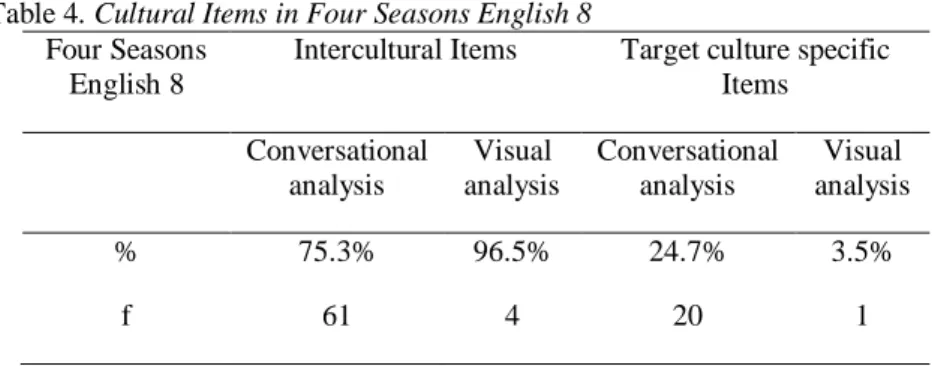
The last coursebook analyzed is Four Seasons English 8. Intercultural items in conversation analysis were found to be 75,3%. These items were observed in study skills (Zeynep), dreams (Yahya Kemal Beyatli, Van Gogh), independence war (Istanbul military Academy, Erzurum, Sivas, Zubeyde Hanim, Ali Riza Efendi, Sakarya River, Second Battle of Inonu, Dumlupinar, Yakup Satar, Serife Baci), places (Black Sea, Central Anatolia, Marmara, Mediterranean Region, Firat River, Duluk Forest, Tas Medrese, Canbolat Bey Complex, Kahramanmaras, Rizvaniye Mosque, Ulu Mosque, Cahit Sitki Taranci, Kasim Pasa Medrese, Isa bey medrese, Midyat, Kusadasi, Icmeler, Filiz, Pamukkale, Oludeniz, Bodrum, Ataturk’s Mausoleum, Amasya), success stories (Cerrahpasa Medicine Faculty, Ankara Science High School, Elazig Anatolian High School, Tunceli, Behcet, GATA, Budapest, French, German), reading for entertainment (Sait Faik Abasiyanik, Kemalettin Tugcu, Ayse Kulin, Gulten Dayioglu, Halide Edip Adivar, Nezihe Meric) and holiday activities (Katmandu, Seti Khola, Butterfly Valley, Blue Cave, Shipyard Island, Dalyan).
On the other hand, 24,7% target culture specific items were found in conversation analysis. These items were listed in contents like friendship (Whitney Houston, Cece Winans, Steven, Alice, Claire, Mr. Adams, Pam), detective stories (Mrs. Jackson), success stories (Isaac Newton, Albert Einstein, Marie Curie, Charles Darwin, Alexander Fleming, Ian Wilmut, Colin Pillinger) and language learning (Thomas, Jennifer, Tim, Laura).
Intercultural items in visuals were 96,5%. These items included content such as dreams (Ataturk, Galata Tower, Ottoman Empire, Harriet Tubman), independence war (Turkish Grand National Assembly, Anatolian soldiers, Turkish veterans, Turkish flag), personal experiences and places (Mount Nemrut, pistachios, baklava, shish kebab, Maras ice cream, olive oils, local rugs, cig kofte, dolma, Ataturk house, Sumela Manastry), success stories (Istanbul University, Mehmet oz, Aysegul Aygun, Umut Ozcan, Gokhan Hotamisligil, Levent Gurel), reading for entertainment (Ayse Kulin, Gulten Dayioglu) and holiday activites (Oludeniz). Target culture specific items in visuals were 3,5% in only unit 4 ‘dreams’ (Mark Twain).
DISCUSSION and CONCLUSION
Foreign language learners acquire the target language through culturally and linguistically integrated English language instruction (Cakir, 2010). Hence, it is of great importance to provide young learners with intercultural content and skills, which as a result they are able to behave appropriately when confronted with actions, attitudes and expectations of the target culture. The purpose of the current study was to understand how much intercultural and/or target culture specific items were present in the CEF based local EFL coursebooks, and how those items were presented to young learners in the Turkish context. Hence four randomly selected local coursebooks were investigated in terms of conversational and visual criteria from intercultural and target culture specific perspectives.
The findings from the data highlight that Four Seasons English 8 has the most intercultural items in conversational analysis among these four coursebooks. However, it is seen that these intercultural items consist of mostly Turkish culture and very few ones in Japanese, French and German cultures. Hence, this coursebook needs to add more varieties of cultural items belonging to other cultures like Asian, African, European, Australian. The reason for this may result from writers’ and students’ national identity. As Alptekin (2002) states, coursebooks may be shaped by its writers’ social environment. My English 5 was found to have less frequently used intercultural items in texts. This coursebook needs to be revised and updated due to the interculturalisation process (Guilherme, 2002) according to the changing world and technological developments. Unique 6 and Spring 7 also ought to be enriched in terms of intercultural items, topics and contents. Intercultural items are observed to be limited to some cultures heavily like Japanese, French and German. Content and conversations in dialogues should be widened to broaden young learners’ perspectives and to increase their tolerance with different views, people and life styles.
As for target culture specific conversational items, My English 5 seems to include the most items in texts. Byram (1998) and McKay (2003) claim that teaching foreign language with its culture provides learners a holistic perspective about when and how to use that language. Hence, introducing young learners with target culture specific items at this level help them develop their proficiency in listening, reading, speaking and writing to use English. Spring 7 and Unique 6 also include items from English culture to some extent. These two coursebooks may be developed in listening and pronunciation skills so that young learners can catch better native like skills. Four Seasons English 8 is the one that has the fewest target culture specific items. Therefore, unless the cultural aspect of the language is emphasized in foreign language teaching appropriately, learners may not use the language communicatively and culturally (Cakir, 2010). ‘No matter how foreign language learners are linguistically competent, they inevitably fail to understand some utterances specifically used by the native speakers for different purpose (p.188)’ (Cakir, 2010). With regard to this, there should be more cultural emphasis holistically.
When it comes to intercultural visual items, Unique 6 has the most varied intercultural items in texts such as Japanese, French, Antarctic cultures among others. Four Seasons English 8 and Spring 7, on the other hand, may include more variety from other cultures so that young learners can build different places, people, events and activities in their schema. My English 5 has the fewest intercultural items in visuals among these four coursebooks. It can be updated from this perspective since these types of visuals help young learners gain more familiarity with intercultural items better at this age and level. This enrichment may attract learners’ attention and awaken them during the course. In addition, this visual variety may be the unique source for some teachers when the lack of material and technology sources is considered throughout the country. Unlike the case in intercultural visual variety, My English 5 is found to possess the most target culture specific items in visuals, which provides young learners with more imagination and attraction towards English language learning. Not only Four Seasons English 8 but also Unique 6 and Spring 7 ought to vary their visuals by adding famous English people, places, celebrations and tourist attractions. This variety is vital to develop young learners’ familiarity with and tolerance towards English culture.
Overall, contents of these four coursebooks rank alongside Byram’s (1998) culture checklist criteria such as daily routines, relationships, schools, socialization, families and cultural differentiation (celebrations, places, history, people). As Risager (as cited in Lazar, 2003) suggests, coursebook writers may achieve the enrichment and development process by using authentic cultural and intercultural texts and by touching on intercultural games and names. Unlike some parts of his results carrying negative tendency, those coursebooks do not concentrate heavily on the Anglo-centric elements or stereotypical characters in texts and visuals. They provide learners with opportunities to use the target language via intercultural themes, names, places and characters to some extent. Hence, activities and tasks may be improved so that young learners can perform better in overall skills (McKay, 2003). In line with Korkmaz’s (2009) suggestions, learners are expected to be linguistically competent in the target culture as well as to communicate and negotiate ideas and solutions with others in real contexts by using English as an International Language.
To summarize, intercultural and target culture specific items serve as a bridge between learners and the world to succeed in the intercultural and linguistic competence in the target language. It should be noted that no matter how many cultural themes, activities or games a coursebook covers, it is at the same time in teachers’ hands to enrich the content, to adapt it to different intercultural situations, and to guide learners use the target language purposefully and creatively. To be able to realize this goal, teachers should be equipped with sufficient target culture specific and intercultural background.
The current study has some limitations. Coursebooks in this study belong to Turkish context and are investigated by visual and conversational criteria. This criterion list may be multiplied by adding audio recordings and e-mateials. Frequently used coursebooks belonging to international publishings may be investigated by following the aforementioned criteria. As for pedagogical
implications, future EFL coursebooks, unless it is possible to cover all target culture specific and intercultural items in a coursebook, may suggest e-solution towards the interculutralization process. For example, they may lead learners to digital platforms where they can pick up materials they want, need and fancy via this solution (Levrai, 2013). A coursebook may be a collection of inputs (video, audio, texts) supported by a variety of intercultural and target culture specific tasks and activities. For further studies, students can be asked to reflect on the ways they benefit from current coursebooks. This reflection may cover useful activities that help learners develop their perspectives. Teachers may also carry out action research or keep diaries on how well their teaching styles are refined via these coursebooks to broaden learners’ perspectives.
REFERENCES
Alptekin, C. (2002). Towards intercultural communicative competence in ELT. ELT Journal, 56(1), 57–65.
Baker, W. (2011). From cultural awareness to intercultural awareness; Culture in ELT. ELT Journal, 66(1), 62-70.
Bayyurt, Y. (2006). Non-native English language teachers’ perspective on culture in English as a foreign language classrooms. Teacher Development, 10(2), 233-247.
Brown, H. D. (2010). Teaching by principles; an interactive approach to language pedagogy. New York: Longman.
Byram, M. (1998). Teaching culture and language: towards an integrated model. In D. Buttjes and M. Byram (Eds.), In mediating languages and cultures: towards an intercultural theory of foreign language education (pp. 17-32). Clevedon: Multilingual Matters. Byram, M., & Feng, A. (2005). Teaching and researching intercultural competence. In E. Hinkel
(Ed.), Handbook of research in second language teaching and learning (pp. 911-930). London: Lawrence Erlbaum Associates.
Council of Europe. (2001). A Common European Framework of Reference for Languages: Learning, Teaching, Assessment. Cambridge University Press.
Çakır, İ. (2010). The frequency of culture-specific elements in the ELT coursebooks at elementary schools in Turkey. Novitas-ROYAL (Research on youth and language), 4(2), 182-189.
Guilherme, M. (2002). Critical citizens for an intercultural world: foreign language education as cultural politics. Clevedon: Multilingual Matters.
Hamiloğlu, K., & Mendi, B. (2010). A content analysis related to the cross-cultural/intercultural elements used in EFL coursebooks. Sino-US English Teaching, 7(1), 16-24.
Hyde, M. (1998). Intercultural competence in English language education. Modern English Teacher, 7(2), 7-11.
Kachru, Y. (1986). Cross-cultural texts, discourse strategies and discourse interpretation. In L. E. Smith (Ed.), Discourse across cultures: strategies in world Englishes (pp. 87–100). London: Prentice Hall.
Korkmaz, I. (2009). A descriptive study on the concepts of culture and multiculturalism in English language coursebooks. (Published master’s thesis), Trakya University, Edirne. Lazar, I. (2003). Incorporating Intercultural Communicative Competence in Language teacher
Education. Kapfenberg: Council of Europe.
Levrai, P. (2013). The coursebook as trainer. English Teaching Professional, 83, 4-7.
McKay, S. (2003). Teaching English as an international language, ELT Journal, 57(2), 139–148. Ozisik, C. (2009). Devlet okullarındaki yabancı dil derslerinde hedef kültüre ait
Seliger, H. W., & Shohamy, E. (1990). Second Language Research Methods. Oxford, Oxford University Press.