475 Research Article
A Morphological Study on Five Polygonum L. (Polygonaceae)
Species from Turkey
Ömer KILIÇa,*
a Department of Garden and Park Plants, Technical Vocational College, Bingöl University, Bingöl, TURKEY * Corresponding author’s e-mail address: [email protected]
A
BSTRACTIn this paper, five Polygonum L. (P. lapathifolium L., P. persicaria L., P. arenastrum Boreau, P. bellardii All., P. arenarium) species are examined morphologically for the systematic purposes by using trinocular microscope and Scanning Electron Microscope (SEM). With this study many morphological variations and properties were determined from studied samples and the results compared to the similar investigations done before and with Flora of Turkey. Moreover with this study new morphological properties for diagnostic purposes have determined and the description of studied Polygonum species have extended.
Keywords: Polygonum, Morphology, Systematic
Türkiye’den Beş Polygonum L. (Polygonaceae) Türü Üzerine
Morfolojik Bir Çalışma
Ö
ZETBu çalışmada trinoküler ve taramalı elektron mikroskobu kullanılarak beş Polygonum L. türü (P. lapathifolium L., P. persicaria L., P. arenastrum Boreau, P. bellardii All., P. arenarium) sistematik amaçlı morfolojik olarak araştırıldı. Bu çalışma ile çalışılan örneklerden birçok özellik ve varyasyon tespit edilerek, elde edilen sonuçlar Türkiye florası ve konuyla ilgili daha önce yapılmış çalışmalarla karşılaştırıldı. Ayrıca bu çalışma ile bitkilerin teşhisinin kolaylığı açısından yeni morfolojik özellikler tespit edilerek çalışılan Polygonum türlerinin deskripsiyonu genişletildi.
Anahtar Kelimeler: Polygonum, Morfoloji, Sistematik
Received: 18/07/2014, Accepted: 22/07/2014
Düzce University
Journal of Science & Technology
476
I. I
NTRODUCTIONHE PolygonaceaeJuss. family is a cosmopolitan family, which has about 48 genera and 1200 taxa [1] and geographically distributed from the tropics to the arctic regions [2]. Polygonaceae include eight genera (Atraphaxis L., Pteropyrum Jaub. & Spach., Calligonum L., Rheum L., Oxyria Hill.,
Polygonum L., Rumex L. and Emex Campd.); herbs, shrubs or climbers; leaves generally alternate and
simple; stipules usually united into a membraneous sheath (ochrea) around the stem (nodes are typically swollen); flowers in spikes, fascicles or panicles, hermaphrodite or unisexual, actinomorphic; pedicels with a marked articulation; petals absent; fruit a trigonous or lenticular nut, often enclosed in the persistent perianth in the Flora of Turkey. The genus Polygonum L. consist five sections: Aconogonon, Bistorta, Persicaria, Polygonum and Tiniaria and include thirty one taxa in Turkey [3-6].
Polygonum taxa are annual, perennial or suffrutescent herbs, perianth segments ± equal, free or united,
petaloid above. Stamens usually 8, stigmas 2 or 3, fruit a trigonous or lenticular nut, always at least partially enclosed in the persistent perianth. Polygonum is a taxonomically difficult genus that classification of Polygonum taxa in Turkey is made more difficult by the apparent under-collecting of the weedy species. In the description of the taxa, colour of the perianth refers to the upper petaloid part only, the lower parts being usually greenish [3].
The taxonomic researches about Polygonum taxa is especially based on morphological features such as vegetative anatomy and trichome features [7], chromosome propeties [8] and pollen morphology [9]. Woodehouse (1931) was the first to publish a comprehensive study on pollen morphology of the Polygonaceae family [10]. In later years palynological characters were examined in relation to classification of this family [11]. The identification keys of Polygonum taxa are especially based on homo or heterophylly, flower colour, indumentum structure and ochrea shape and texture [12]. Due to the high hybridization rate [13], phenotypic variability [14], apparent under-collecting of the weedy species, correct identification is definitely very complicated in Polygonum species. Classifying of Polygonaceae taxa has remained a problem to be solved among the taxonomists [12]. The infrageneric classifications of Polygonum have long been studied by various taxonomists [15,16]. The traits of the seed and achene morphology have been detected as illuminating traits in the identification of
Polygonum taxa [17]. With this study some morphological characters of five Polygonum species were
determined for the systematic purposes and the description of studied Polygonum species have extended.
II. E
XPERIMENTALPlant samples were dried according to standart herbarium techniques, and identified with second volume of Flora of Turkey [3] and stored in the Bingöl University Herbarium (BIN). Morphological characters of Polygonum species were determined by Trinocular Microscope (Leica) and scanning electron microscope (JEOL-JSM 6510) coated with gold, in Bingöl University central laboratory and with a Hitachi SU-1500 scanning electron microscope (SEM), coated with gold, in Wilfrid Laurier University (Canada) Herbarium (Biology). Studied samples collected below localities; P.
lapathifolium: South of Yelesen village (Bingöl), steppe, 10.07.2013, 1600-1700 m., Kılıç 5514
(BIN-1275). P. persicaria: Entrance of Dikme village (Bingöl), roadside, 03.08.2013, 1600-1700m., Kılıç 5582 (BIN-1276). P. arenastrum: Vicinity of Taşkesen village (Elazığ), grasslands, 05.08.2009, 980-1000 m., Kılıç 1502 (BIN-1321). P. bellardii: Vicinity of Güneytepe village (Elazığ), sandy and moist areas, 20.06.2009, 1250-1270 m., Kılıç 1362 (BIN-1322). P. arenarium: West of Dikme upland, steppe, 10.07.2013, 1600-1700m. Kılıç 5534 (BIN-1320).
477
III. R
ESULTS &D
ISCUSSIONGenus Polygonum is characterized by the presence or absence of climbing stem, ochrea and eight stamens; morphologically, species of Polygonum could be distinguished from each other generally by some characters which were showed in Tables 1-5 and Figs. 1-10. Studied Polygonum species had variation degree of yellow glands on peduncles, perianth tube, flowers and perianth lenght [3]. To some extent quantitative characters such as plant climbing or not, leaf, ochrea, inflorescence, perianth, flower, peduncle and pedicel length also proved to be taxonomically important characters in
Polygonum taxa (Tables 1-5).
1. P. lapathifolium L. (Syn: P. nodosum Pers.)
Table 1. Comparisons of examined specimen (P. lapathifolium) with Flora of Turkey.
P. lapathifolium in Flora of
Turkey P. lapathifolium in this study Plant Tall annual Annual herb, 33- 40 cm tall
Leaves
Lanceolate to very narrowly elliptic, cuneate at the base, usually glabrous, and always with pellucid,
yellowish glands beneath
Lanceolate alternate, 4-7.5 x 0.5-1 cm petiolate, narrowly elliptic, cuneate at the base, upper surface glabrous sometimes edge and midrib pubescent, lower surface ±
pubescent in midrib region
Stem Ascending to erect, branched
Erect or ascending, greenish brown, hollow-round and ridged, upper part leafy-lower ± woody, internodes 2-6 cm
long with sparse pillose hairs
Ochrea Brownish, entire Ochreae 2-5 mm, tubular, ovate, entire, brownish, glabrous
Peduncle and pedicel With subsessile yellow glands Peduncle 2-3.5 cm long, with subsessile yellow glands. Pedicel 1-1.2 mm long
Nut Nut dark brown and glossy Nut 1.5-2 × 0.5-1.5 mm, broadly ovate, biconvex, shining,
blackish brown
Inflorescence Inflorescence a dense, stout, oblong
spike
Inflorescence axillary raceme or spike with variable number of flowers
Flower Flowers usually pink Flower 2-3 × 1-1.5 mm, bright pink
Perianth c. 2 mm.
c. 2-2.5 mm., tepals 4, 1.5-2 × 0.5-1 mm, in two whorls, whitish, elliptic, 2 tepals with acute apex and 2 obtuse,
entire
Pollen class, shape
478
a b c
d e
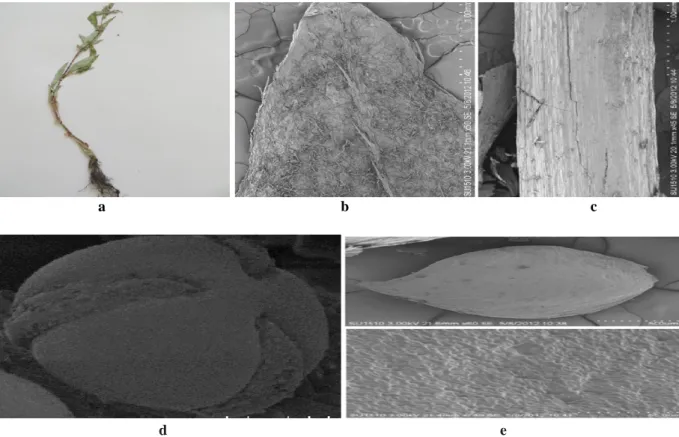
Figure 1. (a) General view, (b) leaf surface, (c) stem, (d) pollen (e) seed and seed surface of P. lapathifolium.
a b c
d e
Figure 2. (a) Lower surface of leaf, (b) upper surface of leaf, (c) stem, (d) ochrea, (e) seed of P. lapathifolium.
The ochrea, peduncle, pedicel, nut, inflorescence, flower, perianth and pollen properties of P. lapathifolium has showed some differences from Flora of Turkey. These characters can be seen in Table 1. P. lapathifolium very similar to P. persicaria, but in terms of some features sperated from P.
persicaria (Tables 1,2). So with this studynew morphological properties for diagnostic purposes have detected and the description of P. lapathifolium have extended.
479 2. P. persicaria L.
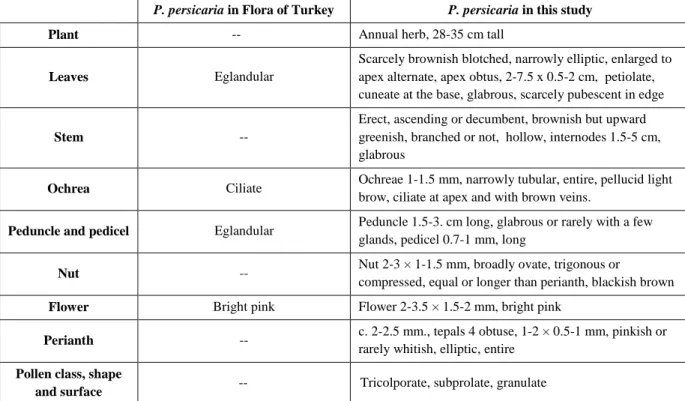
Table 2. Comparisons of examined specimen (P. persicaria) with Flora of Turkey.
P. persicaria in Flora of Turkey P. persicaria in this study
Plant -- Annual herb, 28-35 cm tall
Leaves Eglandular
Scarcely brownish blotched, narrowly elliptic, enlarged to apex alternate, apex obtus, 2-7.5 x 0.5-2 cm, petiolate, cuneate at the base, glabrous, scarcely pubescent in edge
Stem --
Erect, ascending or decumbent, brownish but upward greenish, branched or not, hollow, internodes 1.5-5 cm, glabrous
Ochrea Ciliate Ochreae 1-1.5 mm, narrowly tubular, entire, pellucid light brow, ciliate at apex and with brown veins.
Peduncle and pedicel Eglandular Peduncle 1.5-3. cm long, glabrous or rarely with a few glands, pedicel 0.7-1 mm, long
Nut -- Nut 2-3 × 1-1.5 mm, broadly ovate, trigonous or
compressed, equal or longer than perianth, blackish brown
Flower Bright pink Flower 2-3.5 × 1.5-2 mm, bright pink
Perianth -- c. 2-2.5 mm., tepals 4 obtuse, 1-2 × 0.5-1 mm, pinkish or rarely whitish, elliptic, entire
Pollen class, shape
and surface -- Tricolporate, subprolate, granulate
a b c
d e f
480
a b c
d e
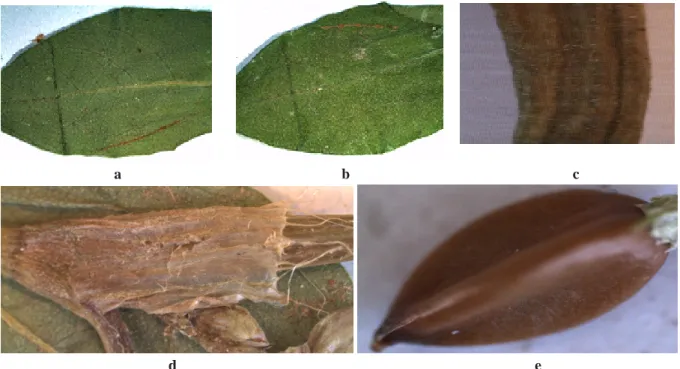
Figure 4. (a) Lower surface of leaf, (b) upper surface of leaf, (c) stem, (d) ochrea, (e) seed of P. persicaria.
In Flora of Turkey general properties, stem, nut, perianth and polen features of P. persicaria is unspecified; with this study these characters have determined and the descritions of the P. persicaria have extented.
3. P. arenastrum Bor., (Syn: P. aequale Lindm.)
Table 3. Comparisons of examined specimen (P. arenastrum) with Flora of Turkey.
P. arenastrum in Flora of Turkey P. arenastrum in this study
Plant Annual herb Annual herb, abundantly branched and rosette forming, 25 - 48 cm high
Leaves Elliptic
Alternate, 0.5-1.5 × 0.2-0.7 cm, petiole 1-1.5 mm long, lamina elliptic - oblong, entire, revolute, pinnat, both
surfaces glabrous.
Stem Usually procumbent or prostrate,
mat-forming
Stem prostrate, ascending or procumbent, glabrous, ± round, ridged, green to brownish with scarcely
brownish punctate
Ochrea
Ochrea much smaller than the internodes, brownish-based, with
faint nerves
Ochreae much smaller than the internodes, 5-10 mm, silvery, brownish-based, ovate, hyaline, lacerate, clearly
nerved
Nut Nut dull, 1.5-2 mm, not or scarcely
exerted from the perianth
Nut 2-2.5 × 1-1.2 mm, ovoid, trigonous, blackish and smooth, not or scarcely exerted from the perianth
Inflorescence -- Inflorescence is solitary, in fascicles, usually in the axil
ofupper leaves
Flower Borne in fascicles in the axils of the
upper leaves
Flower 2-3 × 1-1.5 mm, pedicel 1-1.5 mm, articulated at the end, tepals 5 parted, 1.5-4 × 0.5-1 mm, entire, elliptic
- oblong
Perianth Less than 3mm, pinkish or white 2-2.5 mm, greenish and pinkish at apex
Pollen class, shape
481 a b c
d e
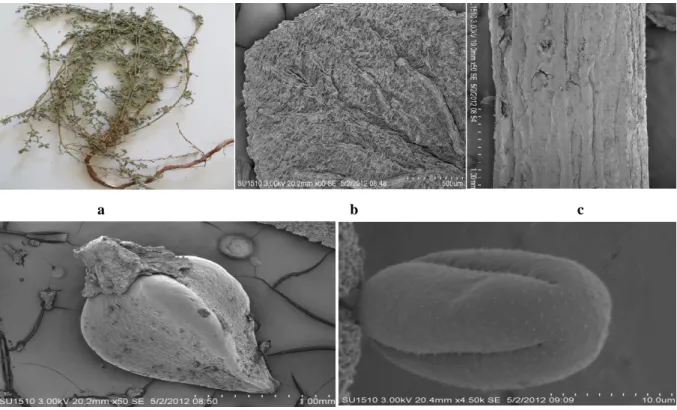
Figure 5. General view (a), leaf surface (b), stem (c), seed (d) and pollen (e) of P. arenastrum.
a b c
d e
Figure 6. (a) Lower surface of leaf, (b) upper surface of leaf, (c) stem, (d) ochrea, (e) seed of P. arenastrum.
P. arenastrum and P. arenarium were found to be closely related to each other but the presence
of prostrate stem, clearly nerved ochreae, structure of perianth tube and blackish-smooth nut in P.
arenastrum best distinguished it from P. arenarium. Moreover extensive descriptions of the
482 4. P. arenarium Waldst. & Kit.
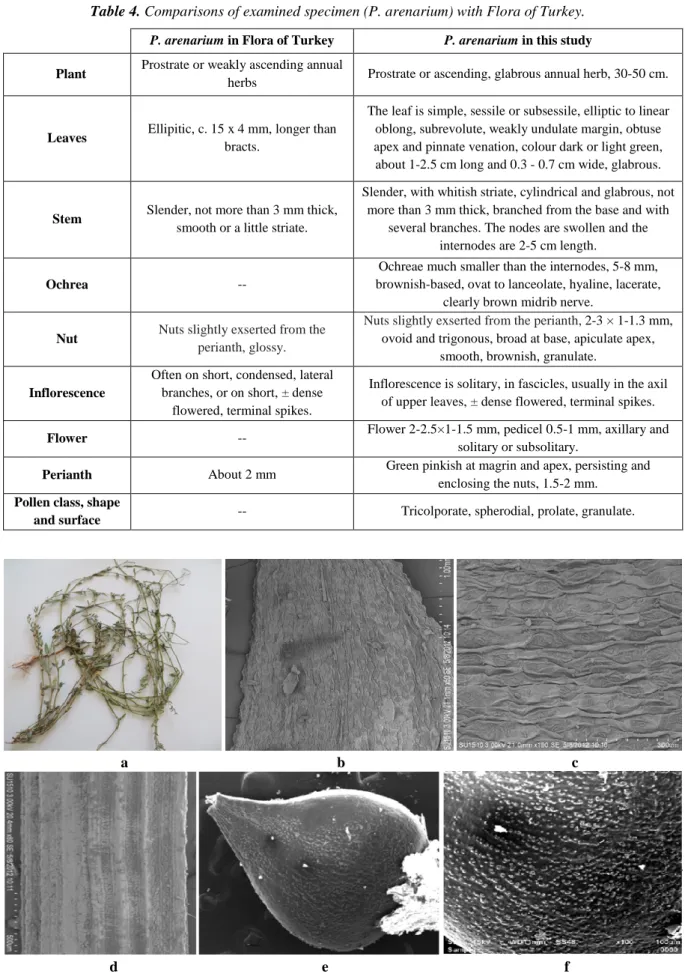
Table 4. Comparisons of examined specimen (P. arenarium) with Flora of Turkey.
P. arenarium in Flora of Turkey P. arenarium in this study
Plant Prostrate or weakly ascending annual
herbs Prostrate or ascending, glabrous annual herb, 30-50 cm.
Leaves Ellipitic, c. 15 x 4 mm, longer than
bracts.
The leaf is simple, sessile or subsessile, elliptic to linear oblong, subrevolute, weakly undulate margin, obtuse apex and pinnate venation, colour dark or light green, about 1-2.5 cm long and 0.3 - 0.7 cm wide, glabrous.
Stem Slender, not more than 3 mm thick,
smooth or a little striate.
Slender, with whitish striate, cylindrical and glabrous, not more than 3 mm thick, branched from the base and with
several branches. The nodes are swollen and the internodes are 2-5 cm length.
Ochrea --
Ochreae much smaller than the internodes, 5-8 mm, brownish-based, ovat to lanceolate, hyaline, lacerate,
clearly brown midrib nerve.
Nut Nuts slightly exserted from the
perianth, glossy.
Nuts slightly exserted from the perianth, 2-3 × 1-1.3 mm, ovoid and trigonous, broad at base, apiculate apex,
smooth, brownish, granulate.
Inflorescence
Often on short, condensed, lateral branches, or on short, ± dense
flowered, terminal spikes.
Inflorescence is solitary, in fascicles, usually in the axil of upper leaves, ± dense flowered, terminal spikes.
Flower -- Flower 2-2.5×1-1.5 mm, pedicel 0.5-1 mm, axillary and solitary or subsolitary.
Perianth About 2 mm Green pinkish at magrin and apex, persisting and enclosing the nuts, 1.5-2 mm.
Pollen class, shape
and surface -- Tricolporate, spherodial, prolate, granulate.
a b c
d e f
483
a b c
d e f
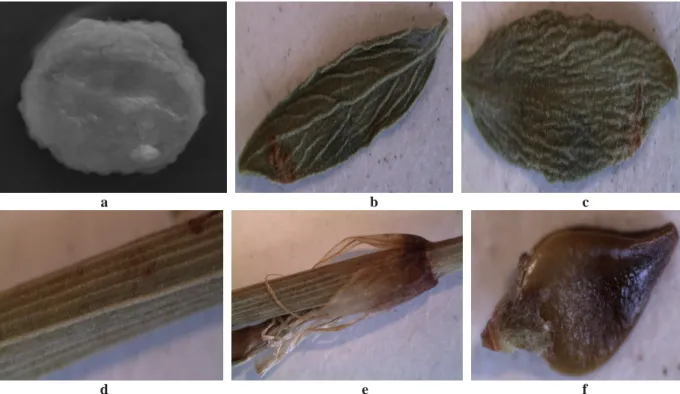
Figure 8. (a) Pollen (b) lower surface of leaf, (c) upper surface of leaf, (d) stem, (e) ochrea, (f) seed of P.
arenarium
The results obtained from morphological studies of P. arenarium were generally consistent with the description given in Flora of Turkey; but in respect to some morphological characters the results of P.
arenarium differ from Flora of Turkey; with this study flower and ochrea features of P. arenarium
were detected which were unspecified in Flora of Turkey (Table 4).
5. P. bellardii All., (Syn: P. patulum Bieb.)
Table 5. Comparisons of examined specimen (P. bellardii) with Flora of Turkey.
P. bellardii in Floraof Turkey P. bellardii in this study
Plant Glabrous annual, erect or
ascending, 20-60 cm. Glabrous annual herb, 20-30 cm, erect.
Leaves
Ellipitic, narrowly ellipitic or linear oblong, 12-45 x 2-12 mm,
caducous.
The leaf is simple, alternate, sessile - subsessile, elliptic to linear oblong with an entire margin, subacute to obtuse apex and pinnate reticulate venation. The colour of upper surface of leaves is dark green, the lower being paler, with hairs on both surfaces. The leaf is about 1.5-4.5 cm long and 0.3-0.5 cm wide, glabrous.
Stem Slender, with whitish striate, 3 mm
thick at most.
The stem is slender, with whitish striate, herbaceous, erect, cylindrical and glabrous. It measures about 20-40 cm in length and up to 2-3 mm thick. It is dichotomously or axially branched with several branches. The nodes are slightly swollen and the internodes are 2-6 cm in length.
Ochrea --
A membranous ochrea is present at the internodes as a sheath around the stem and measures about 3.5 - 6.5 mm long, tubular and brownish below, upper portion lacerate and silvery, lanceolate with acute apex.
484
Nut Usually glossy and punctate. Nut 1.3-1.4 × 0.7-1.1 mm, ovoid, broad at base, usually
gloossy, apiculate apex, smooth and brownish black.
Inflorescence Inflorescence lax, terminal, with 1-2
flowers at each node.
Inflorescence in axillary clusters with 1-2 flowers in each cluster or node.
Flower Flowers 3 - 4 cm Flower 3-3.5 × 2-2.3 mm, pedicel 0.5-1 mm.
Perianth Perianth persisting and enclosing
the nuts, trigonous-ovoid.
The perianth is green with reddish magrin, persisting and enclosing the nuts.
Pollen class, shape
and surface -- Tricolporate, suboblate-circular-lobate, granulate.
a b c
d e
485 a b c
d e
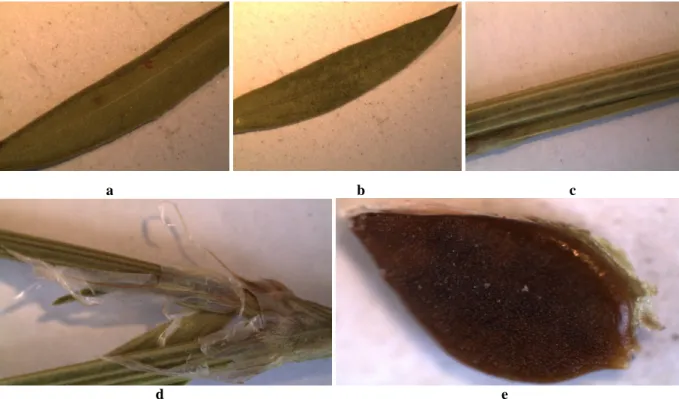
Figure 10. (a) Lower surface of leaf, (b) upper surface of leaf, (c) stem, (d) ochrea, (e) seed of P. bellardii. As seen in Table 5, some properties of studied sample has showed some differences from Flora of Turkey, so with this study ochrea and pollen features of P. bellardii have determined and new morphological characters have detected and the description of P. bellardiihave extended.
IV. C
ONCLUSIONAmong the 5 species examined, two basic morphological nut shapes were determined: trigonous, ovate or broady ovate, compressed and ovoid which are completely shiny or dull, brown or dark brown, and both show three range of nut surface; smooth-undulate, granulate and reticulate-papillae. Nutlets vary considerably in size, with the length ranging between 1.3 - 2.5 mm and the width from 0.5 - 1.5 mm, generally enclosed by the persistent perianth. (Figs. 1-5; Tables 1-5). Morphological and anatomical researchs with plants are still the most important and relatively easily studied characters of great significant among the plant taxonomist, but micromorphological characters of pollen are taxonomically potential features and play significant role in generic identification and classification in the Polygonaceae family [18]. In addition general plant morphology, pollen characters have been used for the identification of taxa [19], for number of phylogenetic studies [20] and proved to be valuable tool in solving taxonomic problems and supporting taxonomic suggestion [21]. In this study, using scanning electron microscopy the palynological study of 5 species belonging to Polygonum genus were investigated. This study bring to light the benefit of both qualitative and quantitative characters in taxonomic studies about Polygonum taxa.
In conclusion, qualitative and quantitative morphological features related to stem, leaves, ochrea, flower, inflorescence, perianth, nut and polen have been used for the delimitation of the studied taxa. As this study was based on both herbarium and personal collection, a great deal of morphological variations were discovered. This study help to make corrections in the previous published work and
486
with this study new morphological properties for diagnostic purposes have determined, the description of studied species have extended and also provide additional information for valid identification of
Polygonum taxa.
A
CKNOWLEDGEMENTS: This work is supported by Bingöl University Scientific Project (Project no: 2013.203.129).V. R
EFERENCES[1] I. Sanchez, KA. Kron Syst. Bot. 33 (2008) 87-96.
[2] VH. Heywood Flowering Plants of the World, Oxford University Press. (1978) 336.
[3] PH. Davis, Flora of Turkey and East Aegean Islands, Edinburgh University Press. 2 (1966). [4] N. Ozhatay, S. Kultur Ş Turk. J. Bot. 30 (2006) 281-316.
[5] N. Ozhatay, S. Kultur, MB. Gürdal MB Turk. J. Bot. 35 (2011) 589-624. [6] N. Ozhatay, S. Kultur, S. Aslan Turk. J. Bot. 33 (2009) 191-226.
[7] G. Yasmin, MA. Khan, N. Shaheen, MQ. Hayat Afr. J Biotech. 9 (2010) 3759-3768. [8] A. Fedorov, Chromosome Numbers of Flowering Plants. (1969).
[9] SP. Hong, IC. Oh, LP. Ronse De Craene Plant. Syst. Evol. 254 (2005) 13-30. [10] RP. Wodehouse Amer. J. Bot. 58 (1931) 749-764.
[11] ZZ. Zhou, HL. Tao, Q. Ban, RX. Xu, YC. Li Acta Phytotax. Sin. 40 (2002) 110-114. [12] J. Brandbyge Springer-Verlag, Berlin, Heidelberg. 2 (1993) 531-544.
[13] J. Timson Bot. J. Linn. Soc. 59 (1965) 155-161. [14] TM. Griffith, SE. Sultan SE Oiks. 114 (2006) 5-11.
[15] L. Anjen, B. Bojian, AE. Grabovskaya-Borodina, SP. Hong, J. McNeill, SL. Mosyakin, H. Ohba, CW. Park Sci. Beijing Missouri Bot. Garden Press. 5 (2003) 277-350.
[16] AS. Lamb Frye, KA. Kron Syst. Bot. 28 (2003) 326-332. [17] W. Barthlott W Nord. J. Bot. 1 (1981) 345-355.
[18] G. Yasmin Taxonomic studies of Polygonum and Rumex of Polygonaceae from Pakistan. (2009). [19] G. Erdtmann Pollen morphology and plant taxonomy. (1966).
[20] JW. Walker, JA. Doyle Annals of Miss. Bot. Garden. 62 (1975) 664-723. [21] WD. Clark, GK. Brown, RA. Mayer Amr. J. Bot. 67 (1980) 1391-1393.