TARIM BİLİMLERİ DERGİSİ 2005, 11 (4) 384-390
The Partial Sequence Comparison of lef-8 gene Obtained from a
Turkish SpliNPV–B with Several Baculoviruses
∗Umut TOPRAK1 İ. Alper SUSURLUK2 M. Oktay GÜRKAN 1 Geliş Tarihi: 19.07.2005
Abstract: Spodoptera littoralis Boisd. (Lepidoptera:Noctuidae) nucleopolyhedrovirus (SpliNPV) is a member of
Baculoviridae and belongs to the group II NPVs. Lef-8 is a well-conserved gene that is characterized in most of the lepidopteran NPVs. Nucleotide and aminoacid sequences of the encoded proteins and gene content may be phylogenetically informative. In this study, lef-8 gene in the Turkish SpliNPV-B (SpliNPV-TR1) genome was partially amplified by PCR and analyzed by amino-acid sequences with several baculoviruses. Amino-acid sequences of partial SpliNPV-TR1 lef-8 gene was 84 % identical to the lef-8 of SpltNPV while revealed it to have about only 57 %, 55 %, 51 %, 50 %, 50 %, 50 % and 49 % of its amino-acid sequence identity with AgipNPV, McNPV, RoNPV, HaNPV-G4, AcNPV, HzNPV and BufuNPV, respectively. The sequences between SpliNPV-TR1 and granuloviruses also produced low levels of sequence identities (maximum 46 %). Although group II NPVs were rather isolated from noctuid hosts, the low level identity values detected between these noctuid NPVs (except the high idendity value between SpliNPV-TR1 and SpltNPV) revealed that these isolates can not have a monophyletic origin.
Key Words: Baculovirus, spodoptera littoralis, noctuidae, spliNPV-TR1, lef-8, sequence, comparison.
Türk SpliNPV-B İzolatından elde edilen lef-8 Geninin diğer Bakulovirüslerle
Kısmi Sekans Karşılaştırması
Öz: Spodoptera littoralis Boisd. (Lepidoptera:Noctuidae) nukleopolihedrovirus (SpliNPV) Baculoviridae’nin bir
üyesi olup grup II NPV’leri arasında yer almaktadır. Lef-8 iyi korunmuş bir gen olup pek çok lepidopter NPV’sinde tanımlanmıştır. Kodlanan proteinlerin nükleotid ve aminoasit dizinleri ve gen içerikleri filogenetik olarak aydınlatıcı olabilmektedir. Bu çalışmada, Türk SpliNPV-B (SpliNPV-TR1) genomundaki lef-8 geni PCR’la kısmi olarak çoğaltılmış ve aminoasit dizinlerine göre bazı bakulovirüslerle analiz edilmiştir. SpliNPV-TR1 kısmi lef-8 geninin aminoasit dizinleri SpltNPV ile % 84 benzelik gösterirken AgipNPV, McNPV, RoNPV, HaNPV-G4, AcNPV, HzNPV ve BufuNPV ile sırasıyla sadece % 57, % 55 , % 51, % 50, % 50, % 50 ve % 49 aminoasit benzerliği göstermiştir. SpliNPV-TR1 ve granulovirüsler arasındaki sekanslar da düşük dizin benzerlikleri üretmiştir (en fazla % 46). Grup II NPV’leri esas olarak noctuid konukçulardan izole edilse de, bu noctuid NPV’leri arasında saptanan düşük dereceli benzerlikler (SpliNPV-TR1 ve SpltNPV arasındaki yüksek benzerlik oranı hariç), bu izolatların monofiletik bir orijine sahip olamayacağını göstermektedir.
Anahtar Kelimeler: Bakulovirüs, Spodoptera littoralis, Noctuidae, SpliNPV-TR1, lef-8, sekans, karşılaştırma.
1This research was funded by Biotechnology Institute of Ankara University (project number: 25).
1 University of Ankara, Faculty of Agriculture, Department of Plant Protection Ankara- Turkey.
2 Ins. for Phytopathology, Dept. of Biotechnology and Biological Control, Christian-Albrechts-Uni. Kiel, Klausdorfer St. 28-36,
24223 Raisdorf- Germany.
Introduction
The family Baculoviridae contains invertebrate specific pathogens and is characterized by rod-shaped, enveloped virions containing a dsDNA, 90-160 kb in size (Pang et al. 2001). The family is composed of two genera,
nucleopolyhedrovirus (NPV) and granulovirus (GV), based
on their distinct occlusion bodies (OBs) (Murphy et al., 1995). The virions are occluded in a polyhedral shaped occlusion body called polyhedra in the NPV genus and are protected against enviromental conditions for years (Toprak et al. 2005a). About 600 baculoviruses are described to infect insects that belong mostly to the insect orders Lepidoptera, Hymenoptera, and Diptera (Martignoni and Iwai 1981) and about 90 % were reported from 34 different families of Lepidoptera (Lange et al. 2004).
Gene expression in the baculoviruses has been extensively studied in the Autographa californica Speyer (Lepidoptera:Noctuidae) MNPV, and four phases of expression were classified: immediate-early, delayed-early, late and very late (Friesen and Miller 1986). Baculovirus early, late and very late genes are expressed in a temporally regulated cascade, and late gene expression is tightly linked to DNA replication (Thiem 1997). A possible candidate for a viral gene involved in late gene expression is one of the late expression factor genes of AcMNPV, lef-8, which has been shown to be necessary for the efficient expression of late and very late gene promotors in a transient expression assay (Passarelli et al., 1994). Lef-8 gene was
reported as a well-conserved gene (Wang et al. 2001; Herniou et al. 2003) and was shown to be highly useful for studying baculovirus phylogeny (Herniou et al. 2001, 2003). Additionally, lef-8 genes are present in all sequenced baculoviruses (Herniou et al. 2003) and compose one of the four subunits of the AcMNPV late RNA polymerase (Guarino et al. 1998).
SpliNPV, the native NPV isolate of Spodoptera littoralis Boisd. (Lepidoptera:Noctuidae), is a member of Baculoviridae and different SpliNPV isolates have been isolated to date. These isolates were designated as SpliNPV-A, SpliNPV-B (Cherry and Summers, 1985) and SpliNPV-C (Maeda et al. 1990) according to their restriction-fragment profiles. Especially, SpliNPV-B was reported as a suitable candidate for use as a microbial pest control agent (Faktor et al. 1997). SpliNPV-B variants have been isolated from diseased S. littoralis larvae collected in Israel, Egypt and Morocco and from diseased Spodoptera litura Fabricius larvae collected in Japan to date (Cherry and Summers 1985; Maeda et al. 1990; Kislev and Edelman 1982). The newest SpliNPV-B variant was recently isolated from field-infected S. littoralis larvae in Mersin, Turkey, and defined as the first Turkish isolate (TR1) and the fifth isolate of SpliNPV-B worldwide (Toprak and Gürkan 2004). Besides, lef-8 gene was also identified in the Egyptian SpliNPV-B (Faktor and Kamensky 1997) and in some of the NPV isolates of close pests of S. littoralis like in Spodoptera exigua Hübner NPV (Ijkel et al. 1999), Helicoverpa armigera Hübner (Lepidoptera: Noctuidae) NPV (Chen et al. 2001), S. litura (Wang et al., 2001) NPV and Helicoverpa zea Boddie NPV (Gen Bank accession No. U67265).
Traditionally, baculovirus phylogenies have been based on individual gene sequences (Herniou et al. 2003) and on the basis of single gene phylogenies, the lepidopteran-specific NPVs have been divided into two groups , group I NPVs and group II NPVs (Bulach et al. 1999; Zanotto et al., 1993). Noctuid NPVs are generally situated in group II NPVs in this classification. Specifically, SpliNPV-B, SpltNPV, AgipNPV, McNPV, HaNPV-G4, HzSNPV and BufuNPV exist in the group II NPVs while AcMNPV and RoMNPV exist in the group I NPVs (Lange et al. 2004, Herniou et al. 2003, 2004). Although this separation was first proposed on the basis of single gene phylogenies (Zanotto et al. 1993; Bulach et al. 1999), extensive comparisons of completely sequenced baculovirus genomes were performed to find genome regions of highly conserved genes that are present in all lepidopteran baculoviruses that can be used as targets for PCR amplification and phylogenetic studies (Lange et al. 2004). Therefore sequence analysis of single, well-conserved genes can help to understand of phylogenetic relations between the isolates and taxonomic positioning of these NPVs. In other words, nucleotide and aminoacid sequences of the encoded proteins and gene content may be phylogenetically informative (Rokas and Holland, 2000; Snel et al. 1999). Although, the biological characteristics of the Turkish SpliNPV-B were recently reported (Toprak et al. 2005b), no data is available on the sequence comparison and taxonomic positioning based on a conserved gene content of this isolate. Thus, we isolated the DNA of the SpliNPV-TR1 and amplified the lef-8 gene,
as a well-conserved gene, with the degenerate primers. Sequenced regions were then examined according to amino acid alignments and a taxonomic comparison was evaluated at the end of sequencing for SpliNPV-TR1 according to lef-8 gene.
Materials and Methods
S. littoralis was reared under controlled conditions with 16:8 h (L:D) photoperiod, 27±0.5˚ C temperature and 75 % relative humidity as described previously by Toprak et al. (2005c).
The wild type SpliNPV was isolated from field-infected S. littoralis larvae and defined as a Turkish isolate (TR1) of SpliNPV-B by Toprak and Gürkan (2004). SpliNPV-TR1 isolate was propagated in the third instar S.
littoralis larvae infected by feeding lettuce leaves
contaminated with virus occlusion bodies to a dose of 20,000 OBs. The OBs were isolated according to the isolation protocol of O’Reilly et al. (1992).
Viral DNA of SpliNPV-TR1 used in these experiments was extracted from occlusion derived virus according to the prepared DNA Tissue Kit, from the company Qiagen GmbH (Hilden, Germany). The concentration of DNA was determined by ethidium bromide agarose plate assay. (Christen and Montalbano, 1990). The partial lef-8 gene of SpliNPV-TR1 was amplified by the polymerase chain reaction (PCR) for characterization using an Eppendorf-Master-Gradient thermocycler. The degenerate primers used in PCR were prL8-1 and prL8-2 which were developed by Lange et al. (2004). PCR amplification of the partial lef-8 gene was carried out according to Toprak et al. (2005a). Following PCR, the PCR product was analyzed by 1 % agarose gel electrophoresis at 80 V, for 1 hour and the gel was stained with ethidium bromide and photographed under a UV light. After the amplification of partial lef-8 gene by PCR, the PCR product was purified with the “GFX PCR DNA and Gel Band Purification Kit (Amersham)”. Nucleotide sequence analysis of partial lef-8 of SpliNPV-TR1 was performed by MWG and nucleotide query sequences were translated to the protein database by using the "Nucleotide query - Protein db [blastx] in the GenBank database and the aminoacid sequences of partial lef-8 gene were shown. On the other hand, the aminoacid sequences were compared in the updated Gen Bank using BLAST network service programs (Altschul et al. 1997).
Results
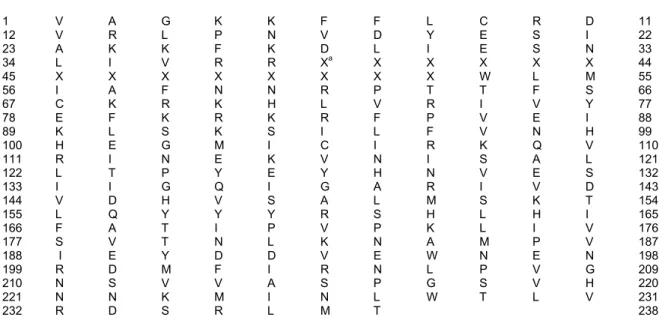
The estimated quantity of viral DNA (50 ng) was found to be sufficient for PCR by ethidium bromide agarose plate assay. Following the DNA extraction, lef-8 gene in the SpliNPV-TR1 genome was amplified by PCR (data not shown). The amplified partial lef-8 was analyzed according to amino acid sequences. 238 aminoacids that correspond to 714 nucleotides were aligned for the partial
lef-8 gene of SpliNPV-TR1. Predicted amino acid
sequences of the partial SpliNPV-TR1 lef-8 gene is shown on Figure 1.
386 TARIM BİLİMLERİ DERGİSİ 2005, Cilt 11, Sayı 4 1 V A G K K F F L C R D 11 12 V R L P N V D Y E S I 22 23 A K K F K D L I E S N 33 34 L I V R R Xa X X X X X 44 45 X X X X X X X X W L M 55 56 I A F N N R P T T F S 66 67 C K R K H L V R I V Y 77 78 E F K R K R F P V E I 88 89 K L S K S I L F V N H 99 100 H E G M I C I R K Q V 110 111 R I N E K V N I S A L 121 122 L T P Y E Y H N V E S 132 133 I I G Q I G A R I V D 143 144 V D H V S A L M S K T 154 155 L Q Y Y Y R S H L H I 165 166 F A T I P V P K L I V 176 177 S V T N L K N A M P V 187 188 I E Y D D V E W N E N 198 199 R D M F I R N L P V G 209 210 N S V V A S P G S V H 220 221 N N K M I N L W T L V 231 232 R D S R L M T 238
Figure 1. Deduced amino acid sequences of the SpliNPV-TR1 partial lef-8 gene.
a X is the result of automatic filtering of the query for low-complexity sequence that is performed to prevent artifactual hits.
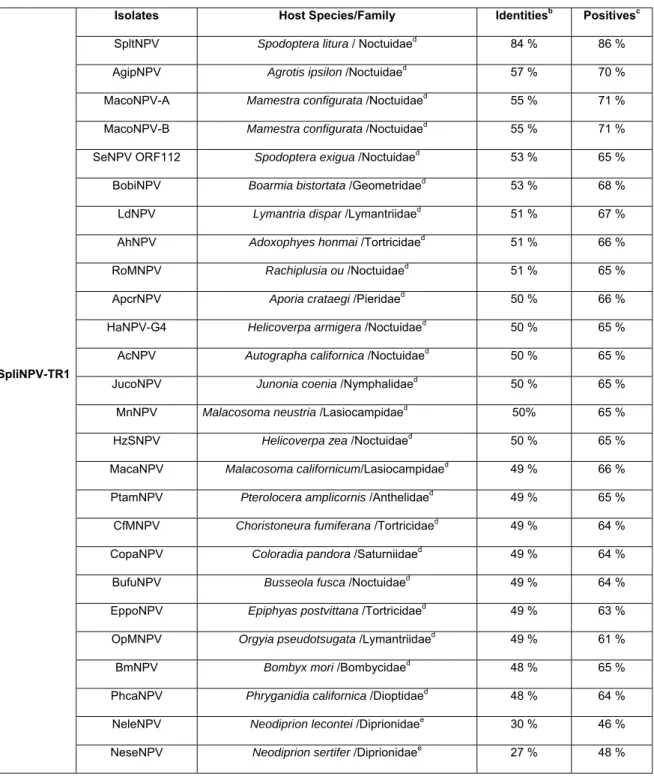
Table 1 shows the percentages of identical sequences between SpliNPV-TR1 and the other NPVs, based on the predicated amino acid sequences of lef-8 gene. BLAST analysis indicated that the predicated amino acid alignments of SpliNPV-TR1 lef-8 were 84 % identical with the lef-8 of SpltMNPV. On the other hand, a comparison of the lef-8 amino-acid sequence of SpliNPV-TR1 to that of AgipNPV, McNPV-A, SeNPV ORF112, BobiNPV and LdNPV revealed it to have about 57 %, 55 %, 53 %, 53 % and 51 % respectively of its amino-acid sequence identical to polypeptides of lef-8 (Table 1).
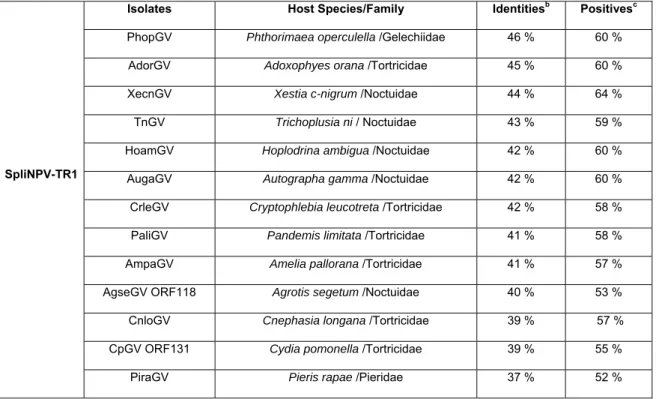
An evaluation was also performed between the SpliNPV-TR1 and the granulosis viruses. These sequences produced low levels of sequence identities (maximum 46 %). The predicated aminoacid sequence of the SpliNPV-TR1 lef-8 gene produced identities 46 % with PhopGV, 45 % with AdorGV , 44 % with XecnGV, 43 % with TnGV and 42 % with HoamGV (Table 2).
Discussion
Herniou et al. (2003) reported that analyzing each gene separately is a potential approach for the inference of phylogeny based on either nucleotide or amino acid sequences. Although the phylogeny of baculoviruses has been inferred using DNA and aminoacid sequences from individual genes (Zanotto et al., 1993, Bulach et al., 1999), the use of single genes for phylognetic analyses is restricted and the use of several carefully selected genes concenated in one data set may be more confidential to reflect the phylogenetic relationships of baculoviruses (Lange and Jehle, 2003). Moreover, Herniou et al. (2001) recently inferred the phylogenetic relationships of nine baculoviruses using a combined data set of 63 conserved genes and the topology of this tree was identical to individual gene phylogenies from ac22, ac81, ac119,
ac142, ac145, lef-8 anf lef-9. Thus, lef-8 gene was
suggested as particularly useful to meet as targets for
PCR amplification and phylogenetic studies as one of these seven homologues of the AcMNPV genes in the baculovirus genome (Herniou et al. 2001). Besides, a high level of conservation of lef-8 was recently reported by Wang et al. (2001) and this suggests that sequence data of this highly conserved gene locus are available for a large number of baculoviruses.
A nucleotide sequence and an open reading frames (ORFs) map of the lef-8 gene of SpliNPV was recently published and the sequence analyses of the lef-8 gene revealed an ORF of 2730 nucleotides (Faktor and Kamensky 1997). In our study, 238 aminoacids that correspond to 714-nt fragments of the lef-8 sequences were achieved by PCR from isolated Turkish SpliNPV-B DNA using primers capable of partially amplifying the lef-8 gene. A further requirement for the potential target genes was that they needed highly conserved sequence patterns over a distance of 200-700 nucleotides that admitted for the annealing of degenerate primers and this fragment size provided not only an avoidance of the short sequence fragments with low information content, but also a supply for a single sequencing reaction to cover the complete PCR fragments (Lange et al. 2004). Thus, such evaluations based on sequence of partial regions of the well-conserved genes could be possibly performed among NPV isolates and these could provide ideas for identifying similarities or differences between the isolates. On the other hand, Herniou et al. (2001) previously reported that they were aware that a phylogeny based only on a single gene may not reflect the true evolutionary relationships of all baculoviruses. However, sequence analyses of the lef-8 gene is a useful and reliable method for describing the relationship of most baculoviruses because of its high conservation. In addition, lots of researchers citing not only Wang et al. (2001) but also El-Salamouny et al. (2003) have recently used only one of the several genes for performing baculovirus phylogeny. On the other hand, partial sequences have also been used in several studies
Turkish SpliNPV-B wuth several baculoviruses
Table 1. Blasta search results showing regions of highest similarity between the predicted amino acid sequences of the lef-8
gene of SpliNPV-TR1 and other NPVs and percentage identity between these amino acid sequences.
Isolates Host Species/Family Identitiesb Positivesc
SpltNPV Spodoptera litura / Noctuidaed 84 % 86 %
AgipNPV Agrotis ipsilon /Noctuidaed 57 % 70 %
MacoNPV-A Mamestra configurata /Noctuidaed 55 % 71 %
MacoNPV-B Mamestra configurata /Noctuidaed 55 % 71 %
SeNPV ORF112 Spodoptera exigua /Noctuidaed 53 % 65 %
BobiNPV Boarmia bistortata /Geometridaed 53 % 68 %
LdNPV Lymantria dispar /Lymantriidaed 51 % 67 %
AhNPV Adoxophyes honmai /Tortricidaed 51 % 66 %
RoMNPV Rachiplusia ou /Noctuidaed 51 % 65 %
ApcrNPV Aporia crataegi /Pieridaed 50 % 66 %
HaNPV-G4 Helicoverpa armigera /Noctuidaed 50 % 65 %
AcNPV Autographa californica /Noctuidaed 50 % 65 %
JucoNPV Junonia coenia /Nymphalidaed 50 % 65 %
MnNPV Malacosoma neustria /Lasiocampidaed 50% 65 %
HzSNPV Helicoverpa zea /Noctuidaed 50 % 65 %
MacaNPV Malacosoma californicum/Lasiocampidaed 49 % 66 %
PtamNPV Pterolocera amplicornis /Anthelidaed 49 % 65 %
CfMNPV Choristoneura fumiferana /Tortricidaed 49 % 64 %
CopaNPV Coloradia pandora /Saturniidaed 49 % 64 %
BufuNPV Busseola fusca /Noctuidaed 49 % 64 %
EppoNPV Epiphyas postvittana /Tortricidaed 49 % 63 %
OpMNPV Orgyia pseudotsugata /Lymantriidaed 49 % 61 %
BmNPV Bombyx mori /Bombycidaed 48 % 65 %
PhcaNPV Phryganidia californica /Dioptidaed 48 % 64 %
NeleNPV Neodiprion lecontei /Diprionidaee 30 % 46 %
SpliNPV-TR1
NeseNPV Neodiprion sertifer /Diprionidaee 27 % 48 %
a Database search done with the Blast network service identified lef-8 gene of the NPVs which produced high scoring segment
pairs with SpliNPV-TR1 lef-8.
b Percentage of identical amino acids in the aligned lef-8 gene.
c Positives refers to the sum of identical and similar amino acids which aligned in the lef-8. 0 to 7 % gaps were created in the
alignments.
d Families exist in Lepidoptera. e Families exist in Hymenoptera.
388 TARIM BİLİMLERİ DERGİSİ 2005, Cilt 11, Sayı 4
Table 2. Blasta search results showing regions of highest similarity between the predicted amino acid sequences of the lef-8 gene
of SpliNPV-TR1 and other GVs and percentage identity between these amino acid sequences.
Isolates Host Species/Family Identitiesb Positivesc
PhopGV Phthorimaea operculella /Gelechiidae 46 % 60 % AdorGV Adoxophyes orana /Tortricidae 45 % 60 %
XecnGV Xestia c-nigrum /Noctuidae 44 % 64 %
TnGV Trichoplusia ni / Noctuidae 43 % 59 %
HoamGV Hoplodrina ambigua /Noctuidae 42 % 60 %
AugaGV Autographa gamma /Noctuidae 42 % 60 %
CrleGV Cryptophlebia leucotreta /Tortricidae 42 % 58 % PaliGV Pandemis limitata /Tortricidae 41 % 58 %
AmpaGV Amelia pallorana /Tortricidae 41 % 57 % AgseGV ORF118 Agrotis segetum /Noctuidae 40 % 53 % CnloGV Cnephasia longana /Tortricidae 39 % 57 %
CpGV ORF131 Cydia pomonella /Tortricidae 39 % 55 %
SpliNPV-TR1
PiraGV Pieris rapae /Pieridae 37 % 52 %
a Database search done with the Blast network service identified lef-8 gene of the GVs which produced scoring segment pairs
with SpliNPV-TR1 lef-8.
b Percentage of identical amino acids in the aligned lef-8 gene.
c Positives refers to the sum of identical and similar amino acids which aligned in the lef-8. 0 to 11 % gaps were created in the
alignments.
to date. Thus, Huang and Levin (2001) used the partial sequences of the SpltNPV dnapol in their study for identifying percentages of similarity between the isolates while El Salamouny et al. (2003) used the partial sequences of the polyhedrin gene for their phylogenetic analysis between Agrotis NPVs. Herniou et al. (2001, 2004) and Lange et al. (2004) also used partial sequences in their study to compare isolates.
In our study, the maximal identical sequencing was achieved in the alignment of the amino acid sequence of the partial SpliNPV-TR1 lef-8 with the amino acid sequences of SpltNPV with a value of 84 %. This result indicated that SpliNPVs and SpltNPVs are closely related. Wang et al. (2001) previously reported that SpltNPV lef-8 amino acid sequence showed high identities to homologs of other baculoviruses, with the maximal identity reaching 86 % to SpliMNPV, which is similar to our result. On the other hand, a minimum level of sequence conservation equivalent to 50 % identity was detected between SpliNPV-TR1 and the main NPV, AcNPV according to the partial lef-8 gene amino-acid sequence. Analysis based on the published sequences of the lef-8 gene suggests that the NPVs cluster into at least two groups as specified above, with distinct evolutionary rates. Our study suggests that SpliNPV and AcMNPV can not belong to the same group because of this low level of similarity. Previous
investigations have also shown that the genomes of SpliNPV-B and AcMNPV are not closely related (Croizier et al. 1989). Phylogenetic analyses based upon both polh (Levin et al. 1997) and egt (Hu et al., 1997) suggest that SpliNPV-B is only distantly related to AcMNPV. Huang et al. (1999) reported that SpliNPV-B isolate is an unusual NPV that appears distantly related to AcMNPV. Furthermore, the SpliNPV-B belongs to phylogenetic group that is distinct from that of AcMNPV based on the level of nucleotide sequence divergence between the lef-3 gene of SpliNPV-B and AcMNPV (Wolff et al. 1998).
It was not a goal to perform a parsimony tree in our study, thus the alignments of partial lef-8 gene would also contribute to the phylogenetic positioning of SpliNPV-TR1. Nevertheless, a phylogenetic tree based on only lef-8 aminoacid sequencing was recently constructed to estimate evolutionary relationships by Wang et al. (2001).
Based on the phylogenetic tree, the baculoviruses were divided into GV and NPV groups and the NPV group included two clades. The first clade was comprised of two closely related subclades: SpltMNPV and SpliMNPV (Wang et al. 2001). The second clade also had two subclades: Group I (AcMNPV, BmNPV, OpMNPV) and Group II (HaSNPV, HzSNPV, SeMNPV, LdMNPV)
Turkish SpliNPV-B wuth several baculoviruses
(Zanotto et al. 1993). According to our study, high identity percantages between SpliNPV-TR1 and SpltNPV based on lef-8 amino acid sequences indicate that these isolates can be evaluated in the same clade, but the others such as AgipNPV, MacoNPV, SeNPV, etc. in the different clades. Needless to say that, SpliNPVs and SpltNPVs can be thus clustered in neither group I nor group II of the other clade because of the low level amino-acid similarity detected between the other NPVs or GVs according to the
lef-8 gene sequence. This classification also coincides
with the result found using polyhedrin sequences (Zanotto et al., 1993) and the study of Levin and Whittome (2000), since phylogenetic analyses based on nucleotide and amino acid sequences of NPV polyhedrin genes have also revealed two major clades, Group I and Group II (Zanotto et al., 1993). But in contrast, for the classification of SpliNPV and SpltNPV, Bulach et al. (1999) included these isolates in group II by using DNA polymerase gene sequence. Comparison of these analyses reveals that conflicts are often observed between phylogenies based on different genes (Herniou et al. 2001).
In our study, a comparison of the lef-8 amino-acid sequence of SpliNPV-TR1 to that of AgipNPV, McNPV, RoMNPV, HaNPV-G4, AcNPV, HzSNPV and BufuNPV revealed it to have about only 57 %, 55 %, 51 %, 50 %, 50 %, 50 % and 49 % of its amino-acid sequence identical to polypeptides of lef-8 respectively. Although these NPVs were rather isolated from noctuid hosts, they have low levels of sequence identity with SpliNPV-TR1 as an NPV isolated from another noctuid host, S. littoralis. Thus, the comparison of the baculovirus phylogeny with the Lepidoptera phylogeny confirms the assumption that the evolutionary history of the baculoviruses is not completely in agreement with the taxonomic organization of the Lepidoptera (Zanotto et al. 1993). In addition, although group II NPVs were rather isolated from noctuid hosts, the low level identity values detected between these noctuid NPVs (except the high idendity value between SpliNPV-TR1 and SpltNPV) revealed that these isolates can not have a monophyletic origin. Thus, most of the topological variation between the data sets resided within the group II NPVs and GVs (Herniou et al. 2001). In fact, a low level of idendity can be expected between SpliNPV-TR1 and NPVs isolated from different host families except Noctuidae and this would have not constituted a surprising situation. Lange et al. (2004) reported that group II NPVs presently subsume all lepidopteran-specific NPVs not belonging to the monophyletic group I NPVs and the distribution of the virus host families so far suggests a strong coevolution between baculoviruses and insect host families. Herniou et al. (2001) also reported that monophyly of the group II NPVs is far less well supported that that for the group I NPVs or the GVs. As a result, It is reported that the relationships within the group II NPVs are obscured by their extensive differences in genome arrangements (Herniou et al. 2001) and this hypothesis was overlapped by the low levels of idendity detected between the SpliNPV-TR1 and especially other noctuid NPVs exist in the group II in our study.
In conclusion, single genes can allow a classification of the viruses within group I and group II NPVs and GVs (Jehle, 2004) and a single target gene, such as lef-8, may be sufficient for a quick and definite identification of unknown baculovirus isolates. In addition, nucleotide sequence analyses of several SpliNPV genes (polh, egt, p10, rrI, lef-3, lef-8 and p49) have revealed a number of unique features about this virus (Huang and Levin, 2001). A further understanding of the genetic organization of SpliNPVs, in particular its nucleotide sequence and gene expression, is highly relevant to the future development of this virus as an efficient pest control agent and would shed light on the evolution and speciation of baculoviruses (Factor et al. 1997). Otherwise, the sequence analysis of
lef-8 demonstrated that SpliNPV was closely related to
SpltNPV and can be clustered in the same clade with SpltNPV but not related to other noctuid NPVs. Thus, It can be said that the SpliNPV can form a monophyletic clade with SpltNPV. But it is important to examine the reasons of virus host coevolution and possible polyphyletic structuring detected especially in the group II NPVs. Sequence analysis containing more genes between these isolates would help to explanation of this matter.
Acknowledgments
We would like to thank Peter Bertling (Orangeville Jr/ Sr High School-USA) for reading and gramatically correcting our manuscript. This study was supported by the Biotechnology Institute of Ankara University under the Project number 25.
References
Altschul, S.F., T.L. Madden, A.A. Schaffer, J. Zhang, Z. Zhang, W. Miller and D.J. Lipman. 1997. Gapped BLAST and PSI-BLAST: a new generation of protein database search programs. Nucleic Acids Res., 25: 3389-3402.
Bulach D.M., C.A. Kumar, A. Zaia, B. Liang and D.E. Tribe. 1999. Group II nucleopolyhedrovirus subgroups revealed by phylogenetic analysis of polyhedrin and DNA polymerase gene sequences. J. Invertebr. Pathol. 73: 59-73.
Chen X., W.F.J. IJkel, R. Tarchini, X. Sun, H. Sandbrink, H. Wang and S. Peters. 2001. The sequence of the Helicoverpa
armigera single nucleocapsid nucleopolyhedrovirus genome. J. Gen. Virol. 82: 241-257.
Cherry, C.L. and M.D. Summers. 1985. Genotypic variation among wild isolates of two nuclear polyhedrosis viruses from
Spodoptera littoralis. J. Invertebr. Pathol. 46: 289-295. Christen A.A. and B. Montalbano. 1990. Estimation of quantity of
polymerase chain reaction products by ethidium bromide agarose plate assay. Biotechniques 9(3): 310.
Croizier G., K. Boukhoudmi-Amiri and L. Croizier. 1989. A physical map of Spodoptera littoralis B-type nuclear polyhedrosis virus genome. Arch. Virol. 104: 145-151. El-Salamouny S., M. Lange, M. Jutzi, J. Huber and J.A. Jehle.
2003. Comparative study on the susceptibility of cutworms (Lepidoptera:Noctuidae) to Agrotis segetum nucleopolyhedrovirus and A. ipsilon nucleopolyhedrovirus. J. Invertebr. Pathol. 84: 75-82.
390 TARIM BİLİMLERİ DERGİSİ 2005, Cilt 11, Sayı 4 Faktor O. and B. Kamensky. 1997. Genomic localization and
nucleotide sequence of a lef-8 gene of the Spodoptera
littoralis nucleopolyhedrovirus. Virus genes 15 (1): 9-15. Faktor O., M. Toister-Achituv and O. Nahum. 1997. Enhancer
element, repetitive sequences and gene organization in an 8-kbp region containing the polyhedrin gene of the
Spodoptera littoralis nucleopolyhedrovirus. Arch. Virol. 142: 1-15.
Friesen, P.D. and L.K. Miller. 1986. The regulation of baculovirus gene expression. Eds: pp. 31-50, W. Doerfler. and P. Boehm (eds). The molecular biology of baculoviruses. Springer-Verlag, Berlin,.
Guarino, L., J. Jin and W. Dong. 1998. Guanylyltransferase activity of the LEF-4 subunit of baculovirus RNA polymerase. J. Virol. 72: 10003-10010.
Herniou E.A., T. Luque, X. Chen, J.M. Vlak, D. Winstanley, J.S. Cory and D. O’Reilly. 2001. Use of whole genome sequence data to infer Baculovirus pylogeni. J. Virol. 17: 8117-8126. Herniou E.A., J.A. Olezewski, J.S. Cory and D.R. O’Reilly. 2003.
The genome sequence and evolution of baculoviruses. Annu. Rev. Entomol. 48: 211-234.
Herniou, E.A., J.A. Olezewski, D.R. O’Reilly and J.S. Cory. 2004. Ancient coevolution of baculoviruses and their insect hosts. J. Virol. 78: 3244-3251.
Hu Z., R. Broer, J. Westerlaken, J.W.M. Martens, F. Jin, L.M. Wang and J.M. Vlak. 1997. Identification and nucleotide sequence of the ecdysteroid UDP-glucosyltransferase gene of the Buzura suppressaria nucleopolyhedrovirus. Virus Res. 47: 91-97.
Huang J. and Levin D.B. 2001. Identification, transcription and sequence analysis of the Spodoptera littoralis nucleopolyhedrovirus (SpliNPV) DNA polymerase gene Arch. Virol. 146: 303-326.
Huang, J., X. Liu and Levin D.B. 1999. Characterization of
Spodoptera littoralis type B nucleopolyhedrovirus infection in
selected insect cell lines. Arch. Virol. 144: 935-955.
Ilkel, W. F. J., E. A. Van Strien, J. G. M. Heldens, R. Broer, D. Zuidema, R. W. Goldbach and J. M. Vlak. 1999. Sequence and organization of the Spodoptera exigua multicapsid nucleopolyhedrovirus genome. J. Gen. Virol., 80: 3289-3304. Jehle, J.A. 2004. The mosaic structure of the polyhedrin gene of the Autographa californica nucleopolyhedrovirus (AcMNPV). Virus Genes 29: 5-8.
Kislev, N. and M. Edelman. 1982. DNA restriction-pattern differences from geographic isolates of Spodoptera littoralis nuclear polyhedrosis virus. Virology 119: 219-222.
Lange, M. and J.A. Jehle. 2003. The genome of the Crptophlebia
leucotreta granulovirus. Virology, 317: 220-236.
Lange, M., H. Wang, H. Zhihong and J.A. Jehle. 2004. Towards a molecular identification and classification system of lepidopteran-specific baculoviruses. Virology 325: 36-47. Levin D.B., M.A. Laitinen, C. Clarke, C.J. Lucarotti, B. Morin and
I.S. Otvos. 1997. Characterization of nuclear polyhedrosis viruses from the three subspecies of Lambdina fiscellaria. J. Invertebr. Pathol. 69: 125-134.
Levin D.B. and B. Whittome. 2000. Codon usage in nucleopolyviruses. J. Gen. Virol. 81: 2313-2325.
Maeda, S., Y. Mukohara, and A. Kondo. 1990. Characteristically distinct isolates of the nuclear polyhedrosis virus from
Spodoptera litura. J. Gen. Virol. 71: 2631-2639.
Martigoni, M.E. and P.J. Iwai. 1981. A catalogue of viral diseases of insects, mites, and ticks. Eds: pp. 897-911. H. D. Burges, Microbial control of pests and plant diseases 1970-1980. Academic Pres, London,
Murphy, F.A., C.M. Fauquet, D.H.L. Biship, S.A. Ghabrial, A.W. Jarvis, G.P. Martelli, M.A. Mayo, and M.D. Summers. 1995. Virus Taxonomy. Sixth Report of the International Committee on Taxonomy of viruses. Springer-Verlag Wien, New York. O’Reilly D.R., L.K. Miller and V.A. Luckow. 1992. Baculovirus
expression vectors- A laboratory manual. W. H. Freeman and Company, New York.
Pang, Y., J. Yu, L. Wang, X. Hu, W. Bao, G. Li, C. Chen, H. Han, S. Hu, and H.Yang. 2001. Sequence analysis of the
Spodoptera litura multicapsid nucleopolyhedrovirus genome. Virology 287: 391-404.
Passarelli L.A., J.W. Todd and L.K. Miller. 1994. A baculovirus gene involved in late gene expression predicts a large polypeptide with a conserved motif of RNA polymerases. J. Virol., 68: 4673-4678.
Rokas, A. and P.W.H. Holland. 2000. Rare genomic changes as a tool for phylogenetics. Tree 15: 454-459.
Snel, B., P. Bork, and M.A. Huynen. 1999. Genome phylogeny based on gene content. Nat. Genet. 21: 108-110.
Thiem, S.M. 1997. Prospects for altering host range for baculovirus bionsecticides. Environ. Biotech. 8: 317-322. Toprak, U., Ş. Bayram and M.O. Gürkan. 2005a. Baculoviruses in
biological control, do they have a future in Turkey? Çukurova University Agricultural Faculty Journal. In Press.
Toprak, U., Ş. Bayram and M.O. Gürkan. 2005b. Comparative Biological Activities of a Plaque Purified and a Wild Strain of SpliNPV-B variant against Spodoptera littoralis Boisd. (Lepidoptera: Noctuidae). Pest Management Science. In Press.
Toprak, U., Ş. Bayram and M.O. Gürkan. 2005c. Gross pathology of SpliNPVs and alterations in Spodoptera littoralis Boisd. (Lepidoptera:Noctuidae) morphology due to baculoviral infection. Journal of Agricultural Sciences 11(1): 65-71. Toprak, U. and M.O. Gürkan. 2004. First Record of a NPV
isolated from Spodoptera littoralis (Boisd.) (Lepidoptera:Noctuidae) in Turkey and Its Molecular Identification according to the partial lef-8 gene. Turkish J. Biol. 28 (2-4): 71-77.
Wang L.H., J.X. Yu, X.H. Hu and Y. Pang. 2001. Sequence analysis of the BamHI-J fragment of the Spodoptera litura Multicapsid Nucleopolyhedrovirus. Acta. Bioch. Biop. Sin., 33 (6): 615-620.
Wolff J.L.C., L.M. Herzog, L. Sun and D.B. Levin. 1998. Identification and characterization of the Spodoptera littoralis nucleopolyhedrovirus type B lef-3 gene. Arch. Virol. 143: 743-767.
Zanotto P.M. de A, B.D. Kessing and J.E. Maruniak. 1993. Phylogenetic Interrelationships among Baculoviruses: Evolutionary Rates and Host Associations. J. Invertebr. Pathol. 62(2): 147-164.
_____________________________________________ Correspodence address:
M. Oktay GÜRKAN
Ankara University, Faculty of Agriculture, Department of Plant Protection-Ankara Phone: + 90 312 596 11 28
Fax: + 90 312 318 70 29