Fatty Acid Composition and Mineral Contents
of Pea Genotype Seeds
Ada, Rahim; Ceyhan, Ercan; Çelik Şadiye Ayşe
Department of Field Crops, Agricultural Faculty, Selcuk University, 42075 Konya, TURKEY Harmankaya, Mustafa
Department of Soil Science and Plant Fertilization, Faculty of Agriculture, Selcuk University, 42031 Konya, TURKEY
Özcan, Mehmet Musa*+
Department of Food Engineering, Faculty of Agriculture, University of Selçuk, Konya, TURKEY
ABSTRACT: Metal, non-metal and and heavy metal contents of different pea genotype seeds were determined by Inductively Coupled Plasma Atomic Emission Spectrometry (ICP-AES). For all genotypes, significant differences were observed in the mineral contents. Potassium was the most abundant element, ranged from 10146.13 mg/kg (PS3048) to 13171.97 mg/kg (PS3053) (Table 1). In addition, the phosphor content of pea seeds was found between 4004.31 mg/kg (PS 30100) and 5651.27 mg/kg (PS 3057). These pea genotypes contained 1562.32 mg/kg to 2034.28 mg/kg magnesium. Zinc contetns of pea samples changed between 29.66 mg/kg (PS 3055) and 67.81 mg/kg (PS 4053 B). The oil contents of pea samples ranged from 0.84% (PS4053 B) to 3.59% (PS 3055). Oleic acid is predominant fatty acid 12.95% to 45.02% followed by palmitic 13.68% to 77.28%, stearic (1.66% to 15.99%) acids. The highest oleic acid was found in PS3048 genotype (45.02%). The highest palmitic acid was found in PS4021 pea sample (77.28%). The current study contributes to the available information concerning the composition of several pea genotypes grown in Turkey.
KEYWORDS: Pea; Genotypes; Oil; Protein; Mineral; Fatty acid composition; GC; ICP-AES.
INTRODUCTION
Pea (Pisum sativum L.) is one of the important legumes grown in the world. It supplies adequate amounts of protein and minerals in the diet [1-6]. Progress in pea breeding results not only in higher yields but also in changes in the chemical composition of seeds [7,8]. Legume seeds are rich in mineral elements [9]. Nutrition to the seed crop may improve seed quality [10].
The oil content of pea seeds ranged from 0.8 to 6.1% [11]. In addition, Coxon and Davies [12] reported that wrinkled and round seeded peas contained 4.5-5.2% and 2.8-3.1% crude lipid, respectively. Although low oil, it may be of importance in the flavour of peas [13]. Pea is an annual self-pollinated species, and highly valued food legume grown extensively in the world. In Turkey,
* To whom correspondence should be addressed. + E-mail:mozcan@selcuk,edu.tr
the pea is considered to be a health vegetarian food and it sone of the most important human nutrition [14]. The aim of the current study was to investigate the fatty acid composition and mineral contents of some pea genotypes grown in Konya in Turkey.
EXPERIMENTAL SECTION Material
In this study, PS30100, PS3029, PS3053, PS4021, PS4053 B, PS3048, PS3055, PS3057, and PS4028 pea genotypes that shown differences for morphological and high yield were used.
Methods
After about 50 g pea sample was dried at 65 oC for 24 h, they were ground with a hummer mill. Protein contents were determined by the Kjeldahl apparatus. 6.25 was used as a nitrogen coefficient. The crude protein content of the grains was calculated by the coefficient of nitrogen quantity (6.25) [15].
Oil extraction
About 2 g of the seeds were ground in a ball mill and extracted with petroleum ether in a Soxhlet apparatus for 6 h [16]. The solvent was removed by a rotary evaporator at 40 °C and 25 mmHg. The oil was dried by a stream of nitrogen and stored at – 20 °C until used.
Determination of fatty acids
Fatty acid compositions for pea seed oil were determined using a fatty acid methyl ester method as described by Hışıl [17]. The oil was extracted three times for 2 g air-dried seed sample by homogenization with petroleum ether. The oil samples (50-100 mg) was converted to its Fatty Acid Methyl Esters (FAME). The methyl esters of the fatty acids (1 µL) were analysed in gas chromatography (GC-MS (Gas Chromatography-Mass Spectrometry) Agilent Technologies HP 6890) and MS; Agilent Technologies 5975C VL MSD equipped with a Flame Ionising Detector (FID), a fused silica capillary column (60 m x 0.25 mm i.d.; film thickness 0.250 micrometer). It was operated under the following conditions: oven temperature program. 175 °C for 7 min. Raised to 250 °C at a rate of 5 °C/min and than kept at 250 °C for 15 min); injector and detector temperatures, 250 and 250 °C; respectively, carrier gas. Nitrogen at flow rate of 1.51 mL/min; split ratio. 1/50 µL/min.
Determination of mineral contents
Pea genotype samples were dried at 70 ºC in a drying cabinet with air-circulation until they reached constant weight. Later, about 0.5 g dried and ground samples were digested by using 5mL of 65% HNO3 and 2 ml of 35% H2O2 in a closed microwave system (Cem-MARS Xpress). The volumes of the digested samples were completed to 20 mL with ultra-deionized water, and mineral contents were determined by Inductively Coupled Plasma Atomic Emission Spectrometry (ICP AES) (Varian-Vista, Australia). Measurements of mineral concentrations were checked using the certified values of related minerals in the reference samples received from the National Institute of Standards and Technology (NIST; Gaithersburg, MD, USA) [18].
Working conditions of ICP-AES
Instrument : ICP-AES (Varian-Vista) RF Power : 0.7-1.5 kW (1.2-1.3 kw for Axial) Plasma gas flow rate (Ar): 10.5-15 L/min. (radial) 15 (Axial) Auxilary gas flow rate (Ar) : 1.5
Viewing height : 5-12 mm Copy and reading time : 1-5 s (max.60 s) Copy time : 3 s (max. 100 s)
Statistical analysis
Experiment "randomized block" established in three replicates patterns in the experiment field of Faculty of Agriculture, Selçuk University. Varyans analysis and LSD test was made using "MSTAT-C" packet program access on the computer [19].
RESULTS AND DISCUSSION
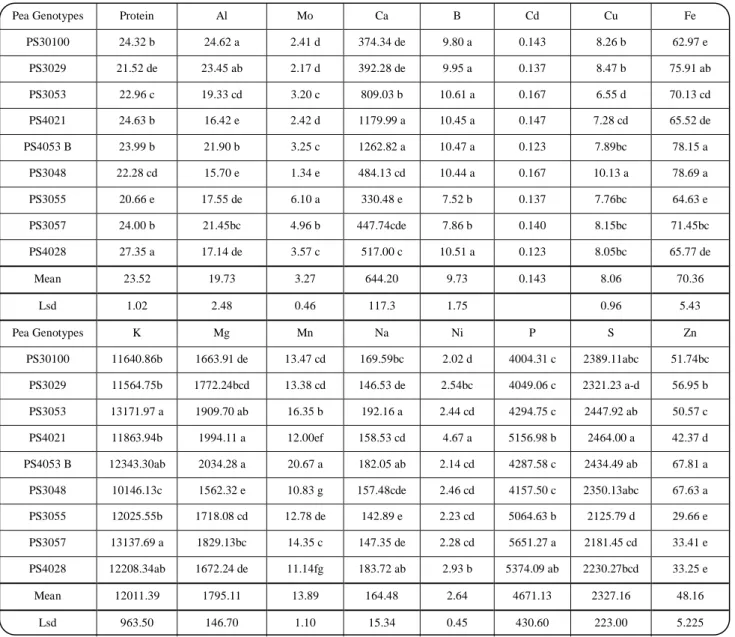
The mineral contents of pea genotypes are given in Table 1. There were significant differences in these values among the nine genotypes of a pea. These differences in mineral and oil contents were due to a combination of genetic and environmental factors. For all genotypes, significant differences were observed in the mineral contents. Potassium was the most abundant element, ranged from 10146.13 mg/kg (PS3048) to 13171.97 mg/kg (PS3053) (Table 1). In addition, the phosphor content of pea seeds was found between 4004.31 mg/kg (PS 30100) and 5651.27 mg/kg (PS 3057). These pea genotypes contained 1562.32 mg/kg to 2034.28 mg/kg magnesium. Zinc contents of pea samples
Table 1: Protein (%) and mineral contents of pea genotype seed (mg/Kg).
Pea Genotypes Protein Al Mo Ca B Cd Cu Fe
PS30100 24.32 b 24.62 a 2.41 d 374.34 de 9.80 a 0.143 8.26 b 62.97 e PS3029 21.52 de 23.45 ab 2.17 d 392.28 de 9.95 a 0.137 8.47 b 75.91 ab PS3053 22.96 c 19.33 cd 3.20 c 809.03 b 10.61 a 0.167 6.55 d 70.13 cd PS4021 24.63 b 16.42 e 2.42 d 1179.99 a 10.45 a 0.147 7.28 cd 65.52 de PS4053 B 23.99 b 21.90 b 3.25 c 1262.82 a 10.47 a 0.123 7.89bc 78.15 a PS3048 22.28 cd 15.70 e 1.34 e 484.13 cd 10.44 a 0.167 10.13 a 78.69 a PS3055 20.66 e 17.55 de 6.10 a 330.48 e 7.52 b 0.137 7.76bc 64.63 e PS3057 24.00 b 21.45bc 4.96 b 447.74cde 7.86 b 0.140 8.15bc 71.45bc PS4028 27.35 a 17.14 de 3.57 c 517.00 c 10.51 a 0.123 8.05bc 65.77 de Mean 23.52 19.73 3.27 644.20 9.73 0.143 8.06 70.36 Lsd 1.02 2.48 0.46 117.3 1.75 0.96 5.43 Pea Genotypes K Mg Mn Na Ni P S Zn PS30100 11640.86b 1663.91 de 13.47 cd 169.59bc 2.02 d 4004.31 c 2389.11abc 51.74bc PS3029 11564.75b 1772.24bcd 13.38 cd 146.53 de 2.54bc 4049.06 c 2321.23 a-d 56.95 b PS3053 13171.97 a 1909.70 ab 16.35 b 192.16 a 2.44 cd 4294.75 c 2447.92 ab 50.57 c PS4021 11863.94b 1994.11 a 12.00ef 158.53 cd 4.67 a 5156.98 b 2464.00 a 42.37 d PS4053 B 12343.30ab 2034.28 a 20.67 a 182.05 ab 2.14 cd 4287.58 c 2434.49 ab 67.81 a PS3048 10146.13c 1562.32 e 10.83 g 157.48cde 2.46 cd 4157.50 c 2350.13abc 67.63 a PS3055 12025.55b 1718.08 cd 12.78 de 142.89 e 2.23 cd 5064.63 b 2125.79 d 29.66 e PS3057 13137.69 a 1829.13bc 14.35 c 147.35 de 2.28 cd 5651.27 a 2181.45 cd 33.41 e PS4028 12208.34ab 1672.24 de 11.14fg 183.72 ab 2.93 b 5374.09 ab 2230.27bcd 33.25 e Mean 12011.39 1795.11 13.89 164.48 2.64 4671.13 2327.16 48.16 Lsd 963.50 146.70 1.10 15.34 0.45 430.60 223.00 5.225
changed between 29.66 mg/kg (PS 3055) and 67.81 mg/kg (PS 4053 B). Harmankaya et al. [20] reported that several pea genotypes contained 45.91-157.4 mg/100g Ca, 47.31-102.8 mg/100g Mg, 562.8 mg/100g-937.8 mg/100 g K, and 163.4-374.2 mg/100 g P and 2.10-5.71 mg/100g Zn. Wang and Daun [21] reported that Canadian field pies contained 59.6-106.9 mg/100g Ca, 4.1-7.9 mg/100g Fe, 687.4-1473.2 mg/100g K, 115.4-172.3 mg/100g Mg, 226.5-950.5 mg/100g P and 2.5-6.4 mg/100g Zn. The results are partly similar to the finding of Wang and
Daun [21] and Harmankaya et al. [20].
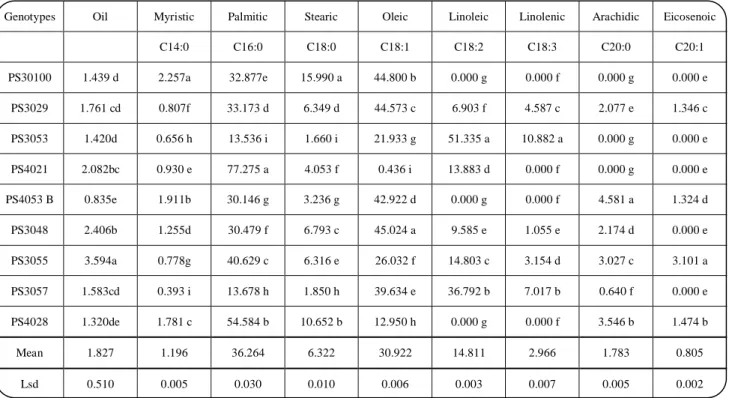
The oil and fatty acid composition of pea genotype seed oils are presented in Table 2. The oil contents of pea samples ranged from 0.84 (PS4053 B) to 3.59% (PS 3055).
In the previous study, pea seed contained 0.24 to 4.97% oil [22-24]. Oleic acid is predominant fatty acid 12.95% to 45.02% followed by palmitic 13.68 to 77.28%, stearic (1.66 to 15.99%) acids. The highest oleic acid was found in PS3048 genotype (45.02%). The highest palmitic acid was found in PS4021 pea sample (77.28%). Wang and
Daun [21] reported that Canadian field pea oils contained
0.30-0.67% myristic, 8.57-12.73% palmitic, 2.39-5.27% stearic, 17.83-30.43% oleic, 40.55-52.44% linoleic, 10.25-17.15% linolenic, 0.50-1.19% arachidic acids. Ryan et al. [25] reported that pea oil contained 10.65% palmitic, 3.29% stearic, 28.25% oleic, 47.59% linoleic, 9.29% linolenic and 0.22% arachidic acids. Srivastava et al. [26] reported that field pea oil contained 12.0-18.4% palmitic,
Table 2: Oil contents and fatty acid composition of pea seed oil (%).
Genotypes Oil Myristic Palmitic Stearic Oleic Linoleic Linolenic Arachidic Eicosenoic
C14:0 C16:0 C18:0 C18:1 C18:2 C18:3 C20:0 C20:1 PS30100 1.439 d 2.257a 32.877e 15.990 a 44.800 b 0.000 g 0.000 f 0.000 g 0.000 e PS3029 1.761 cd 0.807f 33.173 d 6.349 d 44.573 c 6.903 f 4.587 c 2.077 e 1.346 c PS3053 1.420d 0.656 h 13.536 i 1.660 i 21.933 g 51.335 a 10.882 a 0.000 g 0.000 e PS4021 2.082bc 0.930 e 77.275 a 4.053 f 0.436 i 13.883 d 0.000 f 0.000 g 0.000 e PS4053 B 0.835e 1.911b 30.146 g 3.236 g 42.922 d 0.000 g 0.000 f 4.581 a 1.324 d PS3048 2.406b 1.255d 30.479 f 6.793 c 45.024 a 9.585 e 1.055 e 2.174 d 0.000 e PS3055 3.594a 0.778g 40.629 c 6.316 e 26.032 f 14.803 c 3.154 d 3.027 c 3.101 a PS3057 1.583cd 0.393 i 13.678 h 1.850 h 39.634 e 36.792 b 7.017 b 0.640 f 0.000 e PS4028 1.320de 1.781 c 54.584 b 10.652 b 12.950 h 0.000 g 0.000 f 3.546 b 1.474 b Mean 1.827 1.196 36.264 6.322 30.922 14.811 2.966 1.783 0.805 Lsd 0.510 0.005 0.030 0.010 0.006 0.003 0.007 0.005 0.002
2.0-4.2% stearic, 16.5-24.1% oleic, 37.9-53.9% linoleic and 6.8-10.6% linolenic acids. Pea seed oil contained 18.64% palmitic, 50.72% linoleic, 11.3% linolenic, 5.27% oleic and 4.1% stearic acids [27]. This is oil content and its variation during seed growth is a function of variety [28]. Welch and Griffiths [22] reported that pea oil contained 6.4-13.4% linolenic, 43.7-60.9% linoleic, 14.2-33.3% oleic, 2.7-4.2% stearic and 12.0-16.6% palmitic acids. Murcia and Rincoın [28] reported that pea oil contained 16.7-27.3% palmitic, 10.9-21.2% stearic, 14.9-21.7% oleic, 25.2-40.3% linoleic and 7.3-14.5% linolenic acids. In the discussion of the results obtained were probably due to temperature values during pea growth and the value of cotyledon/testa ratio during seed growth [28]. Also it is known that the enzymes involved in fatty acid biosynthesis depend on agroclimatic factors [29], and lipid content varies with climatic environmental conditions [30]. Solis et al. [31] reported that pea seed oil contained 3.67-9.01% palmitic, 3.44-7.31% stearic, 25.52-54.90% oleic, 21.38-44.78% linoleic and 6.01-14.01% linolenic acids. Kukavica et al. [32] reported that linoleic and oleic acids were the main unsaturated fatty acids of field pea, where as palmitic was main saturated fatty acid of field pea. Other researchers have found variable results for mineral contents and fatty acid
composition of pea seeds. There were also differences in the protein and oil contents of pea genotypes. Additionally, the seed specific parameters vary not only between kinds of seed but also for the same seed, due to different conditions in climate, soil, and harvesting [33,34]. The current study contributes to the available information concerning the composition of several pea genotypes grown in Turkey.
Acknowledgement
This work was supported by Selçuk University Scientific Research Project (S.U.-BAP, Konya, Turkey).
Received : Jul. 20, 2017 ; Accepted : Ma. 12, 2018
REFERENCES
[1] Iqtidar A., Akbar S., Khatoon S., Chemical Composition and Nutritional Evaluation of Peas Grown in NWFP (Pakistan), J. Sci. Technol., 6: 114-120 (1982).
[2]Urbano G., Aranda P., Gomez-Villalva E., Nutritional Evaluation of Pea (Pisum sativum L.) Protein Diets After Mild Hydro Thermal Treatment and with and Without Added Phytase., J. Agric.Food Chem., 51: 2415-2420 (2003).
[3] Jabeen T., Iqbal P., Khalil I.A., Amino Acid and Mineral Composition of Pea Cultivars Grown in Peshawar, Pak. J. Agric. Res., 9: 2- (1988). [4] Ashraf M.I., Pervez M.A., Amjad M., Ahmad R.,
Ayub M., Qualitative and Quantitative Response of Pea (Pisum sativum L.) Cultivars to Judicious Applications of Irrigation with Phosphorus and Potassium, Pak. J. Life Soc. Sci., 9(2): 159-164 (2011).
[5] Woźniak A., Soroka M., Stępniowska A., Makarski B., Chemical Composition of Pea (Pisum sativum L.) Seeds Depending on Tillage Systems, J. Elem. Sci., 1143-1152 (2014).
[6] Friedman M., Nutritionalvalue of
Proteinsfromdifferentfoodsources, A Review. J.
Agric. Food Chem.,44: 6-29 (1996).
[7]Bastianelli D., Grosjean F., Peyronnet C., Duparque M., Regnier J.M., Feeding value of pea (Pisum sativum L.) 1. Chemical Composition of Different Categories of Pea, Anim. Sci., 67: 609-619(1998).
[8] Stanek M., Zduńczyk Z., Purwin C., Stefan Florek F., Chemical Composition and Nutritive Value of Seeds
of Selected Pea Varieties, Vet. Ir Zootechnik, 28(50):
71-73(2004).
[9] Ceyhan E., Harmankaya M., Avcı M.A., Effects of Sowing Dates and Cultivars on Protein and Mineral Contents of Bean (Phaseolus vulgaris L.), Asian J.
Chem. 20(7): 5601-5613 (2008).
[10] George R.A.T., Stephens R.J., Varis S., “The Effect of Mineral Nutrients on the Yield and Quality of Seeds in Tomato”, In: Seed production (Ed. Hebblethwaite P.D), pp: 561-567(1980).
[11] Savage G.P., Deo S. The nutritional Value of Peas (Pisum sativum). A Literature Review, Nutr. Abst.
Rev. (Ser. A),59: 65-88 (1989).
[12] Coxon D.T., Davies D.R., The Effect of Therandrloci on the Lipid Content of the Seed of
Pisum satiyum, Theor. Appl. Genet., 64: 47-50 (1982). [13] Mccurdy S.M., Drake S.R., Swanson B.G.,
Leung H.K., Powers J.R., Influence of Cultivars,
Soak Solution, Blanch Method and Brine
Composition on Canned Dry Pea Quality, J. Food
Sci.,48: 394-399 (1983).
[14] Akcin A. “Yemeklik Tane Baklagiller”, Selcuk University Faculty of Agriculture Konya, Publication No. 8, 41-189(1988).
[15] AACC. International. “Method 46-30.01. Crude Protein - Combustion Method”. In: Approved
Methods of Analysis 11th AACC International:
St. Paul, MN, USA (1999).
[16] Matthaus B., Özcan M.M. Quantification of Fatty Acids, Sterols and Tocopherols Turpentine (Pistacia
terebinthus Chia) Wild Growing in Turkey, J.
Agric.Food Chem., 54: 7667-7671 (2006).
[17] Hişil Y., “Instrumental Analysis Techniques” (Eng.Fac.Publ. 55). Ege Üniversity, Bornova -İzmir. (in Turkish), (1998).
[18] Skujins S., Hand bookfor ICP-AES (Varıan-Vista). “A Short Guıde To Vista Series ICP-AES Operation”, VarianInt. AGşZug. Version 1.0. pp 29. Switzerland (1998).
[19] Püskülcü H., Ikiz F., “Introdiction to Statistics”, Bilgehan Presss, p 333, Bornova, Izmir, Turkey (1989) [in Turkish].
[20] Harmankaya M., Özcan M.M., Karadaş S., Ceyhan E., Protein and Mineral Contents of Pea (Pisum sativum L.) Genotypes Grownin Central Anatolian Region of Turkey, South Western J. Hort. Biol. Environ., 1(2): 159-165 (2010).
[21] Wang N., Daun J.K., Effect of Variety and Crude
Protein Content on Nutrients and Certain
Antinutrients in Field Peas (Pisum sativum), J. Sci.
Food Agric., 84: 1021–1029(2004).
[22] Welch R.W., Griffiths D.W., Variation in the Oil Content and Fatty Acid Composition of Field Beans (Vicia faba) and Peas (Pisum spp), J. Sci. Food
Agric., 35: 1282-128 (1984)
[23] Yoshida H., Tomiyama Y., Tanaka M., Mizushina Y., Characteristic profiles of Lipid Classes, Fatty Acids and Triacylglycerol Molecular Species of Peas (Pisum sativum L.), Eur. J. Lipid Sci. Technol.,
109(6): 600-607 (2007).
[24] Coxon D.T., Wright D.J., Analysis of Pea Lpid
Content by Gas Chromatographic and
Microgravimetric Methods. Genotype Variation in Lipid Content and Fatty Acid Composition, J. Sci.
Food Agric., 36: 847-856(1985).
[25] Ryan E., Galvin K., O’Connor T., Maguire A., O’Brien N., Phytosterol, Squalene, Tocopherol Content and Fatty Acid Profile of Selected Seeds, Grains, and Legumes, Plant Foods Hum. Nutr.,
[26] Srivastava R.P, Kumar L., Dixit G.P., Nutritional Composition and Fatty Acid Profile of Important Genotypes of Field Pea (Pisum sativum ssp.
Arvense), J. Food Legumes,22(2): 115-117 (2009).
[27] Zhigacheva I., Burlakova E., Misharina T., Terenina M., Krikunova N., Generozova I., Shugaev A., Saidgarey Fattakhov S., Fatty Acid Composition and Activity of the Mitochondrial Respiratory Chain Complex I of Pea Seedlings Underwater Deficit,
Biologija, 59: 241–249 (2013).
[28] Murcia M.A., Rincon F., Fatty Acid Composition of Pea (Pisum sativum L. var. Citrina) During Growth,
Grasas y Aceites, 42: 444-449 (1991).
[29] Harwood J.L., Stump P.K., Fat Metabolism in Higher Plants. XI. Synthesis of Fatty Acids in the Initial Stage of Seed Germination, Plant
Physiol., 46: 500-508 (1970).
[30] Worthington R.E., Hammos R.O., Allison J.R., Varietal Differences and Seasonal Effects on Fatty Acid Composition and Stability of Oil from 82 Peanul Genotypes, J. Agric. Food Chem., 20: 727-732 (1972).
[31] Solis M.I.V., Patel A., Orsat V., Singh J., Mark Lefsrud M. Fatty Acid profiling of the Seed Oils of Some Varieties of Field Peas (Pisum sativum) by RP-LC/ESI-MS/MS: Towards the Development of an Oil Seed Pea, Food Chem., 139: 986-993 (2013).
[32] Kukavica B., Quartaccı M.F., Veljovıc-Jovanovic S., Navarı-Izzo F. Lipid Composition of Pea (Pisum
sativum L.) and Maıze (Zeamays L.) Root Plasma
Membrane and Membrane-Bound Peroxidase and Superoxide Dismutase, Arch. Biol. Sci. Belgrade,
59(4): 295-302 (2007).
[33] Stein W., Glaser F.W., Continuous Solvent Extraction of Sunflower, Seed, Groundnuts, Palm Kernels, Rape Seed, and Copra, J. Am. Oil Chem.
Soc., 53: 283-285 (1976).
[34] Özcan M.M., Bagcı A., Dursun N., Gezgin S., Hamurcu M., Dumlupınar Z., Uslu N., Macro and Micro Element Contents of Several Oat (Avena
sativa L.) Genotype and Variety Grains, Iran. J. Chem. Chem. Eng. (IJCCE), 36: 73-79 (2017).