KADIR HAS UNIVERSITY
GRADUATE SCHOOL OF SOCIAL SCIENCES PSYCHOLOGY DISCIPLINE AREA
ASSOCIATION BETWEEN PERCEIVED PARTNER
RESPONSIVENESS AND BINGE EATING BEHAVIOR:
MEDIATING ROLE OF THE INTERPERSONAL
EMOTION REGULATION
AHMET FURKAN TOSYALI
ADVISOR: ASSOC. PROF. DR. MEHMET HARMA MASTER’S THESIS
ASSOCIATION BETWEEN PERCEIVED PARTNER
RESPONSIVENESS AND BINGE EATING BEHAVIOR:
MEDIATING ROLE OF THE INTERPERSONAL
EMOTION REGULATION
AHMET FURKAN TOSYALI
ADVISOR: ASSOC. PROF. DR. MEHMET HARMA
MASTER’S THESIS
A thesis submitted to the Graduate School of Social Sciences of Kadir Has University in partial fulfillment of the requirements for the degree of Master’s in the Discipline Area of Psychology under the Program of Psychology.
iii
TABLE OF CONTENTS
TABLES LIST ... v FIGURES LIST ... vi ABSTRACT ... vii ÖZET ... viii INTRODUCTION ... 11. BINGE EATING: ANTECEDENTS AND CORRELATES ... 3
1.1. The Role of Close Relationships on Eating Behaviors ... 5
1.2. Perceived Partner Responsiveness and Binge Eating ... 6
1.3. The Link Between Perceived Partner Responsiveness and Emotion Regulation . 7 1.4. Emotion Regulation and Binge Eating ... 9
1.5. The Current Study ... 13
2. METHOD ... 16
2.1. Participants ... 16
2.2. Procedure... 16
2.3. Measures ... 17
2.3.1 Binge eating scale ... 17
2.3.2 Perceived partner responsiveness scale ... 24
2.3.3 Co-regulation/interpersonal emotion regulation ... 27
2.3.4 Body-dissatisfaction scale ... 29
2.4. Data Analysis Strategy ... 31
3. RESULTS ... 32
3.1. Independent T-Test Results for Gender ... 32
3.2. Descriptive and Correlation Analyses ... 32
3.3. Correlation Results Between Main Variables and Other Variables ... 33
3.4. Actor Effects ... 37
3.5. Partner Effects ... 37
3.6. Indirect Associations Between PPR and Binge Eating ... 38
3.7. Comparing The Strenghts of The Actor and The Partner Effects ... 41
4. DISCUSSION ... 42
4.1. Limitations ... 46
iv SOURCES ... 49 APPENDICES ... 58 CURRICULUM VITAE ... 70
v
TABLES LIST
Table 2.1. Factor Loadings of Binge Eating Scale 20
Table 2.2. Modification Indices on Perceived Partner Responsiveness 25 Table 2.3. Factor Loadings of Perceived Partner Responsiveness Scale 26 Table 2.4. Modification Indices on Co-regulation Scale 28 Table 2.5. Factor Loadings of Co-regulation Scale 28 Table 2.6. Modification Indices on Body Dissatisfaction 30 Table 2.7. Factor Loadings of Body Dissatisfaction Scale 30 Table 3.1. Descriptive Statistics and Bivariate Results among Variables 35
vi
FIGURES LIST
Figure 1.2. The Conceptual Model 15
vii ABSTRACT
TOSYALI, AHMET FURKAN. ASSOCIATION BETWEEN PERCEIVED PARTNER
RESPONSIVENESS AND BINGE EATING BEHAVIOR: MEDIATING ROLE OF THE INTERPERSONAL EMOTION REGULATION, MASTER’S THESIS, Istanbul, 2018.
Main aim of this study is to investigate whether there were relationship between perceived partner responsiveness (PPR), co-regulation between romantic partners, and binge eating. Data were collected from 148 adult females and their male romantic partners (18-61 years old) with mean relationship duration of 8.04 years. Dyadic data was analyzed through actor-partner interdependence model framework. We proposed a model where co-regulation between partners mediates the relationship between PPR and binge eating. Results showed that there was not direct association between any of PPR and binge eating scores of participants. However, significant direct associations were found regarding both actor and partner effects of PPR on co-regulation between romantic partners. Besides, there were four mediational pathways where co-regulation of females mediated the associations. Co-regulation of females mediated the association between both actor and partner effects of PPR on their binge eating scores. Co-regulation of female participants also mediated actor effect of PPR on binge eating scores of male participants. Indirect significant associations still remained after controlling for influence of body dissatisfaction on binge eating scores. These findings are the first to illustrate relationship between PPR and binge eating. Also, this study is the first attempt to examine binge eating in terms of interpersonal emotion regulation processes.
Keywords: Perceived Partner Responsiveness, Interpersonal Emotion Regulation, Binge Eating, Romantic Relationship Dynamics
viii ÖZET
TOSYALI, AHMET FURKAN. ALGILANAN PARTNER DUYARLILIĞI VE
TIKANIRCASINA YEMEK YEME DAVRANIŞI ARASINDAKİ İLİŞKİ: KİŞİLER ARASI DUYGU DÜZENLEMESİNİN ARACI ROLÜ, YÜKSEK LİSANS TEZİ, İstanbul, 2018.
Bu çalışmanın temel amacı algılanan partner duyarlılığı (APD), romantik partnerlerin birlikte duygu düzenlemesi ve tıkanırcasına yeme davranışı arasında ilişki olup olmadığını incelemektir. Ortalama ilişki süresi 8.04 yıl olan 148 yetişkin kadın ve onların erkek romantik partnerlerinden (18-61 yaş arası) veri toplanmıştır. Diyadik olarak toplanan veriler, aktör-partner karşılıklı bağımlılığı modellemesi çerçevesinde analiz edilmiştir. Partnerler arası duygu düzenlemesinin, APD ve tıkanırcasına yeme davranışı arasındaki ilişkide aracı olduğu bir model sunulmuştur. Sonuçlar, APD ve tıkanırcasına yeme davranışı arasında direk bir ilişki olmadığını göstermiştir. Bununla beraber, partnerlerin birlikte duygu düzenlemeleri üzerinde anlamlı aktör ve partner APD etkileri bulunmuştur. Ayrıca, kadınların karşılıklı duygu düzenlemesinin aracı olarak rol oynadığı dört tane anlamlı ilişki bulunmuştur. Kadınların birlikte duygu düzenleme skorlarının, aktör ve partner APD’nin katılımcıların kendi tıkanırcasına yeme davranışı üzerindeki etkileri bağlamında aracılık ettiği bulunmuştur. Kadın katılımcıların birlikte duygu düzenlemesinin ayrıca, aktör APD’nin erkek katılımcıların tıkanırcasına yeme davranışı üzerindeki etkisi bağlamında da aracılık ettiği bulunmuştur. Endirekt anlamlı ilişkiler; vücut memnuniyetsizliği skorlarının katılımcıların kendi tıkanırcasına yeme davranışları üzerindeki etkileri kontrol edildiğinde de anlamlı çıkmıştır. Elde edilen bulgular APD ve tıkanırcasına yeme davranışı arasındaki ilişkiye yönelik ilk olma özelliği taşımaktadır. Ayrıca, bu çalışma tıkınırcasına yeme davranışını kişiler arası duygu düzenlemesi bağlamında inceleyen ilk çalışmadır.
Anahtar Sözcükler: Algılanan Partner Duyarlılığı, Kişiler Arası Duygu Düzenlemesi, Tıkanırcasına Yeme, Romantik İlişki Dinamikleri
1
INTRODUCTION
Have you ever lost your control for keeping yourself away from any kind of snacks, fatty and sweet foods following a stressful event? Stress may divert our attention to high-fat, high calorie, and "comfort foods" and push us toward overeating. Previous studies have shown that hypothalamus produces corticotropin-releasing hormone, which suppresses appetite and individuals may lose their sense of appetite in short term. However, if the stress persists, cortisol is released by the adrenal glands and may result in increases in appetite and motivation to eat (Mathes et al., 2009). Once the stressful situation is handled, cortisol level returns to the baseline level (Mathes et al., 2009). Thus, returning the baseline level after stressful event is vital (and protective factor) for avoiding “binge eating”. Could another “one” help us easily recover our stress reaction? Previous work on the function of close relationships has indicated that romantic partners help us in regulating our stress. This study investigated how the perception about romantic partners associated with regulation of stress together, and in turn, how co-regulation of stress could be associated with eating behaviors from the dyadic perspective.
Considering the established associations between stress and binge eating (e.g., Sulkowski et al., 2011), interpersonal relationship context could be an important domain for understanding the associations between interpersonal relationships and binge eating. Although interpersonal relationship could be one of the sources of distress (e.g. break up, conflict, infidelity, etc.), being in a responsive and satisfactory relationship has important functions: stress-buffering and interpersonal emotion regulation (also called as co-regulation). Previous work has yielded that these functions may lead individuals being healthier in their life. For instance, ten-year longitudinal study showed that couples had healthier cortisol values in parallel with greater perceived partner responsiveness (Slatcher et al., 2015). Similarly, increase in perceived partner responsiveness was related to better sleep quality via lower anxiety and depression levels (Selçuk et al., 2016).
In this study, we focused on the interpersonal emotion regulation function of close relationships on one of the health related behaviors, binge eating. We investigated if perceived responsive partners facilitate regulating negative emotions at dyadic level,
2 and in turn, if successful interpersonal emotion regulation of each partner predicts lower levels of binge eating. Specifically, we suggested that when individuals get stressed, they might not need to seek out compensatory maladaptive behaviors such as binge eating if they have high responsiveness partner. Because having a responsive partner may facilitate “co-regulation of distress”, and thus, it could be an escape for individuals from these hot cognitions (e.g., eating tempting foods).
3
CHAPTER 1
BINGE EATING: ANTECEDENTS AND CORRELATES
Main focus of this study is to investigate binge eating that is also one of the predictors of bulimia nervosa (BN), binge eating disorder (BED), some subtype of anorexia nervosa (AN), eating disorder that is not specified (Wolfe et al., 2009; Bertoli et al., 2015), other clinical conditions and health-related behaviors such as diabetes mellitus and obesity (De Jonge et al., 2014; Serdar et al., 2011). These problems are also related to coronary heart disease, hypertension, some kind of cancer and stroke (United States Department of Health & Human Services, 2004), substance abuse (Dunn et al., 2002) and smoking (Saules et al., 2009; Udo et al., 2016).
It has been reported that 15% of adolescent females and 3% of adolescent males have eating disorders in U.S. (Stice et al., 2013). Consistent results in terms of the gender difference of prevalence rates were reported in different studies (Allen et al., 2016; Bertoli et al., 2015; Preti et al., 2009). Another study conducted with 6041 participants in Australian population indicated that 5.6% of participants had BED (Hay et al., 2015). In Turkey, it was reported that 1% of adolescents had BED (Vardar and Erzengin, 2011). In non-clinical adult population, it was reported that one in 20 adults had binge eating problem (Mitchison et al., 2012) and in college student population, the ratio was reported as 12.9 percent (Nicoli and Junior, 2011). Moreover, in their study, Mitchison and his colleagues (2017) investigated 18-year time trends of binge eating prevalence in the population and they found that binge eating was six times greater in 2015 compared to 1998. Thus, the prevalence rates might give idea about how serious not only behavioral level of binge eating but also pathological level of it as antecedents of aforementioned disorders.
Even though people reported immediate positive affect in a brief period after binge eating, it has been reported that this behavior is strongly related to long-term psychosocial problems (Wolfe et al., 2009) and increased mortality (Berkman et al., 2007). The point that makes worse the situation is that treatment for eating disorders are difficult and costly.
4 There are many studies suggesting some predictors for binge eating such as genetic and environmental associations (O’Connor et al., 2016), specific personality traits (Koren et al., 2014), eating habits (e.g. fat consumption; Wilson et al., 2012), attachment anxiety (Gallagher et al., 2014; Tascha et al., 2007), lack of perceived social support (Ghaderi and Scott, 2001), stress, depression, anxiety (Ivezaj et al., 2010), negative affect (Ivanova et al., 2015; Macht and Mueller, 2007; Tice et al., 2001), body dissatisfaction (Dakanalis et al., 2014), loneliness and emotional dysregulation (Coric and Murstein, 1993; Southward et al., 2014). Another study with diagnosed participants also showed potential mediator effect of loneliness (e.g. bored, discouraged, worthless) in terms of relationship between emotion dysregulation and BED and BN (Southward et al., 2014). Results were consistent in previous studies showing BN-loneliness and BED-loneliness relationship (Coric and Murstein, 1993; Masheb and Grilo, 2006). Similarly, Sulkowski and his colleagues (2011) showed a mediational link between stress and binge eating via different type of coping strategies.
The findings about the role of interpersonal relationships on binge eating are scattered. For instance, a comprehensive cross-sectional study investigated the prevalence rate of binge eating and risk factors of adults who participated loss or weight-maintenance program (Bertoli et al., 2015; N = 7524, age range = 18-81 years). Results revealed significant marital status effect on binge eating. However, there are other studies showing non-significant associations between marital status and binge eating (Pacanowski et al., 2014; Reagan and Hersch, 2005). Some of this gap may be due to differences in relationship and stress reduction processes that couples perform in their daily life. To our knowledge, no systematic empirical research exists addressing the question of partner perceptions and regulation of distress together could predict binge eating.
Following these arguments, it could be worth to discuss that relationship dynamics between couples might be important for binge eating, rather than marital status itself. Supporting this argument, for example, a longitudinal study (N= 157 newly parenting couples) investigated the association between health-related behaviors and romantic relationship dynamics (Cornelius et al., 2016). They found that romantic partners could influence each other in context of specific health behaviors (e.g. weight-related behaviors, tobacco use) that was consistent with previous work (Desrosiers et al., 2015;
5 Jackson et al., 2015). Besides, in their dyadic study, Cornelius et al. (2016) found significant partner influence in eating behaviors, when there was stronger relationship power between partners. Following these studies, couples could help each other to buffer their stress in an effective way, and in turn, they performed healthier behaviors such as less smoking, healthy eating, and weight-related behaviors.
1.1. THE ROLE OF CLOSE RELATIONSHIPS ON EATING BEHAVIORS Previous studies have consistently documented that supportive and positive relationships are associated with both good mental and physical health (Berkman, 1995; Berkman et al., 2000), whereas nonresponsive relationships are related to poor mental and physical health outcomes, and mortality (Berkman and Syme, 1979; Cacioppo et al., 2002; Holt-Lunstad et al., 2010). Responsive partners promote sense of security and this sense of security has two functions: stress buffering and interpersonal emotion regulation of distress (Selcuk et al., 2010). Stress buffering refers to social, informational, and instrumental resources – that are provided to others when it is needed – have potential to heal pathogenic effect of stressful issues. Underlying mechanism is that support inhibits stress appraisal while decreasing perceived harm or increasing perceived coping ability (Cohen, 2004; Cohen and Pressman, 2004). Therefore, partner can inhibit affective reactions or maladaptive behaviors (e.g. binge eating) and provide adaptive problem solving or distraction. Interpersonal emotion regulation refers to mutual conditioning between biological reward systems of significant others (e.g. romantic partners). That kind of mutual connection increases sense of security, which in turn, decreases stress response in both physiological and psychological level (Sbarra and Hazan, 2008).
Studies have focused on the predictor role of emotion regulation on binge eating at intra-individual level (e.g., Han and Pistole, 2014; Sulkowski et al., 2011) rather than interpersonal level. For example; a study conducted by Han and Pistole (2014) aimed to investigate relationship between insecure attachment (in romantic relationship perspective; anxious and avoidant type) and binge eating by using structural equation modelling framework and then, they proposed a model where emotion regulation mediates the association between insecure attachment and binge eating. There were 381 (155 male; 41%) undergraduate or graduate students who participated the study via
6 online survey. Findings of the study confirmed two hypotheses suggested by the authors. Firstly, insecure attachment was found as positively and significantly related to binge eating. Secondly, significant relationship between attachment insecurity and binge eating was fully mediated by maladaptive emotion regulation. However, even though this study had valuable contributions into existing body of knowledge with respect to romantic relationship dynamics and binge eating, the study only examined emotion regulation process at individual level. Thus, more research is needed to examine possible influences of couple-level emotion regulation in the link between the quality of close relationships and binge eating. From this perspective, we hypothesized that interpersonal emotion regulation of distress between romantic partners may have an important role in eating behaviors. This hypothesis is also consistent with the basic premises of the social baseline theory (Coan, 2008, 2010). According to the social baseline theory, efficient psychological and biological regulations are attained through close and trusted others. Through this psychological and biological inter-dependency to close others, emotional and physiological balance can be provided by spending less cognitive and metabolic resource. Therefore, successful emotional coping may be achieved with limited effort in a more adaptive way instead of maladaptive coping strategies. However, it is obvious that attaining psychological and biological inter-dependency between close other requires more responsive and consistent partners. Thus, the quality of relationships and partner characteristics should be taken into account in explaining successful interpersonal emotion regulation (i.e., co-regulation).
1.2. PERCEIVED PARTNER RESPONSIVENESS AND BINGE EATING
Perceived partner responsiveness (PPR) reflects to what extent romantic partners understand, validate, and care each other (Reis and Patrick, 1996) and consists of cognitive and emotional aspects (Reis et al., 2004). Cognitive aspect includes the perceived qualities of the partner and emotional aspect refers to the intensity of emotional bonds with the partner. Reis and his colleagues (2004) defined PPR as a one of the defining components of the self, including believes and perceptions about partner that are attentive and supportive. In addition, responsiveness was suggested as a notion that is formed by thoughtful and empathetic reactions and that forms respect and appreciation (Reis, 1998). It could be also a potential protective factor for binge eating
7 as it was suggested that PPR was critical to understand relationship between support received by partner and health outcomes (Selçuk and Ong, 2013). Moreover, higher PPR between couples was found as related to lower negative affect in daily life (Maisel and Gable, 2009). This finding is noteworthy due to the fact that negative affect is the most common predictor of binge eating (APA, 2013, p.465). Consequently, we argue that PPR should be considered while understanding binge eating in the context of the close relationship dynamics.
However, to our knowledge, there has not been any study investigating possible association between PPR and binge eating, especially from the dyadic perspective. Based on related literature review stressing dyadic nature of PPR between partners (e.g. Lemay and Clark, 2008), we would expect that greater PPR of females and males would lead to lower levels of binge eating behaviors of themselves (actor effects; Hypothesis 1a). Besides, partners’ PPR could also predict binge eating. Specifically, greater PPR of one partner would lead to lower levels of binge eating reports of the other person (partner effects; Hypothesis 1b). Latter hypothesis was consistent with the findings related to dyadic associations between health-related behaviors and romantic relationship dynamics (e.g. Cornelius et al., 2016; Pietromonaco et al., 2013).
1.3. THE LINK BETWEEN PERCEIVED PARTNER RESPONSIVENESS AND EMOTION REGULATION
As romantic relationships are the most intimate ones in adulthood (Levinger and Hustoni 1990), bonding behaviors between partners can enhance positive emotions and reduce negative affect together. This aspect is quite important since emotions include a central function – that is related to both physical and social survival – to adapt problems (Keltner and Gross, 1999). Dysfunctional emotion regulation is associated with worse mental health (Gross and Munoz, 1995) and most of the psychological disorders occur due to problems in emotional processes (Kring and Werner, 2004). Thus, regulation of emotions is also as important as the emotions itself. In this context, emotion regulation was defined by James J. Gross (1998) as ‘’…is the processes by which individuals influence which emotions they have, when they have them, and how they experience and express these emotions’’ (p.275). However, as responsiveness refers to reaction to disclosure of a partner (Reis and Patrick, 1996), expression of these emotions –
8 important part of emotion regulation as understood from the definition – are meaningful and functional when there is a responsive partner who is also perceived as responsive by other party.
PPR – which reflects quality of the relationship – is associated with emotion regulation as Reis (2014) stressed the link between responsiveness and affective interdependence among romantic partners. However, processes such as emotion regulation (Butler and Gross, 2009; Rime, 2009), health (Berkman et al., 2000), depression (Coyne, 1990; Whisman, 2001) have been mostly examined at intrapersonal level. Here, important point is that these kinds of processes should be extended to interpersonal level since human behaviors and experiences are appeared in interpersonal environment and influenced by social context (Reis et al., 2000). This argument is also parallel with two aspects (intrinsic vs. extrinsic) related to emotion regulation introduced by Gross and Thompson (2007). Intrinsic emotion regulation refers to regulation of own feelings while extrinsic one refers to regulation of others’ feelings. There are few studies investigating latter aspect in adult population (for couples; Gleason et al., 2003; Gleason et al., 2008; Hicks and Diamond, 2008), that is to say, we point our scarcity of studies related to interpersonal emotion regulation. In this context, we handled emotion regulation – that is related to binge eating (Han and Lee, 2017; Svaldi et al., 2014) – at interpersonal level as co-regulation (interpersonal emotion regulation) between partners. Interpersonal emotion regulation effort could be seen as a central component of our psychological structures. Individuals get support from others to dampen their stress (e.g., Uchino et al., 1996) and foster positive affect (Gable and Reis, 2010). Related to successful interpersonal emotion regulation, Randall et al. (2013) investigated relationship between emotional coordination and cooperation among romantic partners. Cooperation refers to mutual communication process aiming to reach satisfying solutions and healthy interpersonal emotion regulation (Sheras and Koch-Sheras, 2006). As an example; constructive problem solving and active listening may be elements of this process (Assad et al., 2007). In this context, Randall et al. (2013) aimed to examine association between behavioral cooperation and interpersonal emotional coordination. Dyadic data analysis was conducted through answers of 44 heterosexual couples (Age interval = 19-69). In general, findings demonstrated that high behavioral cooperation predicted both greater emotional experience and successful emotion regulation at
9 interpersonal level. However, pattern of the relationship differed across gender (see Randall et al., 2013). Specifically, pattern of emotional coordination occurred in same direction for men which refers that when women were less positive, men were also less positive or when women were more positive, men were more positive. By contrast, pattern of emotional coordination occurred in opposite direction which refers that when men were less positive, women become more positive or when men were more negative, women become less negative.
Interpersonal emotion regulation was operationally defined as reappraisal and co-brooding in our study. Reappraisal process in itself has beneficial impact on functional emotion regulation strategy, health and well-being (Gross, 1998; John and Gross, 2004). Appraisal of the situation could reduce its negative emotional impact and responsive partner can be an adaptive resource by co-reappraising the stressor together for situations that include perceived threat. In contrast, brooding process, as a maladaptive emotion regulation strategy, refers to repetitively focusing on negative content where same distressing scene is played over and over again in mind that breeds more sadness. In addition, co-brooding is an interactional sharing of the negative issue without responsive reactions (Horn and Maercker, 2016). In other words, if a partner keeps repeating same subjects bothering him/her to other partner over and over again, even though he/she knows that talking with the partner does not make any difference; this process is an example for co-brooding. Thus, in this study, we used co-reappraisal and co-brooding (reversely in our context) as indicators of successful interpersonal emotion regulation.
In the light of existing body of knowledge, we would hypothesize that both females’ and males’ PPR would positively predict their own scores on successful interpersonal emotion regulation (actor effects; Hypothesis 2a). In addition to this hypothesis, due to dyadic nature of close relationship dynamics (e.g. PPR; Reis et al., 2002), we would also expect partner effects: PPR of one partner would positively predict successful interpersonal emotion regulation of the other (partner effects; Hypothesis 2b).
1.4. EMOTION REGULATION AND BINGE EATING
Influence of emotional factors on overeating was stated decades ago (Bruch, 1964). In addition, both cross-sectional and experimental studies presented association between
10 sad mood, depressive symptoms and binge eating (Antony et al., 1994; Dingemans et al., 2015). Besides, a meta-analysis conducted by Cardi et al. (2015) presented remarkable findings. Eligibility criteria for the meta-analysis required experimental studies including mood condition group and control group, adult participants who was diagnosed with eating disorders or obese participants. Having excluded unsuitable studies, thirty-three studies were involved in the meta-analytic review. There were 2491 participants (Mage = 24.4) at total. As a result of this systematic review, causal
relationship between negative mood and greater food intake was found. Parallel to this result, existing body of knowledge confirmed that binge eating could temporarily increase positive mood (e.g. Dingemans et al., 2009; Munsch et al., 2008).
Here, important interpretation is that relationship between mood or affect and binge eating may not only arise due to negative emotions but also lack of adaptive coping strategies with the negative affect (Evers et al., 2010). Adaptive and maladaptive coping strategies varies, for example; reappraisal, that refers to creating positive interpretations or perspectives to diminish negative affect, is considered as an adaptive coping strategy (Danner et al., 2014). In contrast, suppression that refers to response-focused strategy is an example of maladaptive coping strategy and it was suggested that long-term impact of this strategy results in failure (Gross, 2002). Furthermore, studies that included participants who were diagnosed with eating disorders showed that those individuals were more likely to suppress emotions and less likely to use reappraisal as a coping strategy (Dingemans et al., 2017). Therefore, emotions and emotion regulation has been suggested as a crucial indicator of binge eating in both clinical (e.g. Dingemans et al., 2009) and non-clinical sample (e.g. Han and Pistole, 2014) of individuals who had symptoms of binge eating. To be noted, however, related literature review shows that most of studies included clinical samples rather than non-clinical samples that had binge eating problem.
Over and above, to explain binge eating behavior in context of affect or mood, there are several theories which need to be reviewed. Firstly, the escape theory, for example, indicates that binge eating is a maladaptive escape mechanism from emotional distress (Heatherton and Baumeister, 1991). Secondly, the negative affect theory suggests that binge eating provides distraction and comfort when people encounter with negative stimuli (Stice and Agras, 1999; Stice, 2002). This argument was demonstrated as even
11 consistent with children and adolescent participants. For instance; consistent with the relationship between negative affect and binge eating in children and adolescents, Elliott et al. (2010) aimed to examine predictor role of negative affect on loss of control over eating. They proposed a model where negative affect mediates the association between social problems (e.g. inter personal problems in school, home etc.) and loss of control over eating. Participants were gathered through convenience sampling that includes youths (age interval; 8-17) who are part of non-clinical sample. Loss of control overeating was assessed based on individual interviews. As inclusion criteria for binge eating symptom; participants were asked whether they had experienced at least one time in the last month. Then, the proposed model was tested through structural equation modelling framework. Findings suggested that social problems of participants significantly predicted greater negative affect, in turn, led to more binge eating symptoms. Therefore, both escape theory and negative affect theory emphasized the role of affect on binge eating. Consistent results were found in a cross-sectional study (N = 255 women diagnosed with BED) examining similar model where negative affect mediates the association between interpersonal problems and binge eating disorder symptoms (Ivanova et al., 2015). Therefore, efficient emotion regulation against emotional distress or any other negative stimuli is crucial to predict eating behaviors as presented in previous studies (e.g. Micanti et al., 2017).
Dietary restraint theory suggested that high level of dieting is a risk factor for binge
eating due to the fact that individuals may cope with caloric deprivation through binge eating (Heatherton and Polivy, 1992). In addition to context of restraint theory of binge eating, Stice (1998) interpreted that dietary restraint may be resulted due to social reinforcement and modeling of thin-ideal fostered by family, peers, and media. He tested this interpretation that had never been tested before, based on two studies. In the first study, main aim was to investigate correlation between social reinforcement, modeling and abnormal eating behavior (e.g. binge eating). Participants were undergraduate female students (N = 114) from 17 to 29 years old. Note that characteristic of the sample did not include clinical cases and male participants. As a result, positive correlation between social reinforcement of the thin-ideal (by family, peer, and media) and abnormal eating behaviors was found. However, family and peer modeling was found as positively related to abnormal eating symptoms but there was
12 not significant relationship between media modeling and eating pathology. According to those findings, second study was conducted to examine predictor role of social reinforcement of thin-ideal and modeling on eating symptoms based on a longitudinal analysis. In the second study, participants were female senior students (N = 218) from 16 to 18 years old. Male participants were excluded consistent with the first study. Data were collected with 9-month time interval. Consequently, predictor role social reinforcement and modeling (by family and peers, not media) was found on binge eating and purging symptoms. As a summary of both cross-sectional and longitudinal investigation, Stice (1998) suggested that social reinforcement and modeling of thin-ideal is internalized by individuals, which in turn, may breed body dissatisfaction. Due to the sense of dissatisfaction to body, individuals go through dietary restraint process that ends up with binge eating symptoms. Even if he did not measure body dissatisfaction, his interpretation related to body dissatisfaction and binge eating was consistent with current studies (e.g. Andres and Saldana, 2014).
Before those cumulative studies, Stice (1994) suggested dual-pathway model including psychosocial process to explain binge eating. According to this suggestion, Onset of abnormal eating symptoms (e.g. binge eating) was originated due to both dietary restraint and negative affect or combination of those risk factors. Stice and Agras (1999) conducted a study to investigate this view. There were female participants who met diagnostic criteria of bulimia nervosa (N = 265). Questions related to dietary restraint and depressive symptoms were answered. Findings were consistent with a four-year longitudinal study, conducted by Stice et al., 1998, indicating that not only dietary restraint but also negative affect may be related to binge eating symptoms when both of the predictors were considered. To be noted, however, Stice et al. (1998) found that in multivariate analyses, influence of negative affect had become non-significant when it was considered with dietary restraint. Thus, authors stated that this non-significant result occurred due to strong collinearity between dietary restraint and affective problems. Despite of the fact that cumulative knowledge related to emotion, emotion regulation and binge eating has been well documented, to our knowledge, interpersonal aspect of emotion regulation and its relation to binge eating has not been investigated yet.
13 1.5. THE CURRENT STUDY
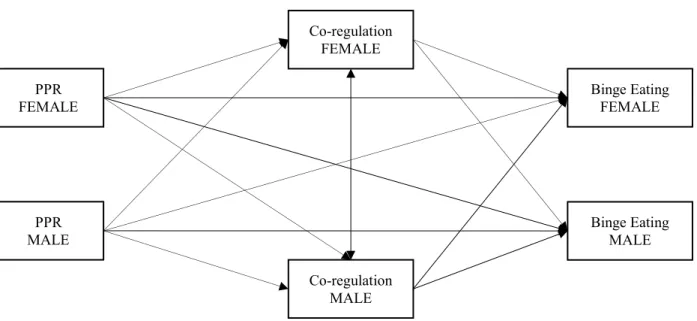
We aimed to investigate possible underlying mechanism explaining the link between perceived partner responsiveness and binge eating via interpersonal emotion regulation (i.e., co-reappraisal and co-brooding) from the dyadic perspective. Since binge eating itself was suggested as an emotion regulation strategy (Wedig and Nock, 2010) or emotional dysregulation significantly predicted binge eating (Buckholdt et al., 2010), interpersonal emotion regulation process between partners might have crucial role on binge eating at dyadic level. Therefore, we would expect that interpersonal emotion regulation of both partners would negatively predict their own binge eating reports (actor effects; Hypothesis 3a). Besides, we would also hypothesize partner effects in the same line: interpersonal emotion regulation of one partner would negatively predict binge eating reports of the other partner (partner effects; Hypothesis 3b). Finally, we also examined if interpersonal emotion regulation mediates the link between PPR and binge eating behavior at both actor (Hypothesis 4a) and partner level (Hypothesis 4b). The current study has several potential contributions into existing body of knowledge related to romantic relationships and health-related behaviors of individuals. At first, even if there have been studies examining some health-related behaviors (e.g. tobacco use, weight-related behaviors) in terms of romantic relationship dynamics (e.g. relationship power; (Cornelius et al., 2016), the literature lacks with respect to binge eating so that we believe the current study fills this gap. Secondly, relationship between interpersonal emotion regulation and binge eating has been mostly examined at individual level. However, the current study emphasizes the role of interpersonal emotion regulation process between romantic partners. Thirdly, previous studies strongly suggested need and benefit for dyadic analysis to fully capture actors’ and partners’ characteristics and their outcomes in health domain (e.g., Pietromonaco and Powers, 2015) so that we collected data from heterosexual couples. Therefore, dyadic nature of the data enables us to investigate the proposed mechanism in a more comprehensive model through Actor-Partner Interdependence Model (APIM; Cook and Kenny, 2005; Kenny and Cook, 1999). Thus, we argue that the constructs in our model should be examined in APIM framework due to dyadic nature of the constructs (e.g. PPR; Reis et al., 2002). In this regard, a unique conceptual model (shown in Figure 1.1)
14 where interpersonal emotion regulation (co-regulation) mediates the association between PPR and binge eating was examined.
15 15 PPR FEMALE Co-regulation FEMALE PPR MALE Co-regulation MALE Binge Eating FEMALE Binge Eating MALE
Figure 1.1. The Conceptual Model
16
CHAPTER 2
METHOD
2.1. PARTICIPANTS
296 participants (148 heterosexual couples) ranging from 18 to 61 years (Mage = 29.98, SD = 11.40) who had romantic relationship for at least three months (Mduration(month) =
96.55, SD = 115.10) took part in the study. Educational levels of participants were diverse; majority of the participants were university students (%45.6), %18.6 were graduated from high school, %14.9 were graduated from university, %8.4 of were master or Ph.D. students, %5.4 were graduated from master or Ph.D., and remaining %7.1 participants were graduated from primary school or secondary high school. A question related to socio-economic status (SES) level of participants was asked based on 10 points Likert-type scale ranging from 1 (lowest SES) to 10 (highest SES) and indicated almost average SES level for the current sample (MSES = 6.00, SD = 1.39).
2.2. PROCEDURE
The measures that we used in this study were submitted for the approval of Kadir Has University, Human Participants Ethic Committee. Having received the approval of ethical standards of the institutional committee in Kadir Has University (Approval number: 23370156-003982), we started to gather the data. In the beginning of the data gathering process, an online survey link was sent via the social media platforms such as WhatsApp mobile messaging application, Facebook, and Twitter. Since we have aimed to collect dyadic data including both male and female answers, participants were asked questions (e.g. ‘Could you please write down second letter of your name/ Could you please write second letter of your partner’s name’) to create a unique code for the purpose of matching each couples’ answers while keeping the answers as anonymous and getting dyads for each couple. However, in this process, we have failed to match unique code questions due to lack of consistent answers for unique code questions. Failure for the data matching strategy might have been due to misunderstanding of
17 participants or deliberate effort of them. Subsequently, we changed the sampling strategy and the study was announced in two different universities. Participants, who had romantic relationship at least for three months were participated either voluntarily or for exchange of bonus points for a selected course. Thus, convenient sampling strategy – which is used due to proximity of participants – was used.
A pair of identical questionnaires, that took 15-20 minutes to complete, for each partner were given in a signed envelope and they had a week to bring back the same envelope that was signed. Couples were required to fill the questionnaire without knowing each other’s responses and delivered the closed envelope. Returning the envelopes without following the instructions was considered as exclusion criteria for the data. All information was kept confidential.
The questionnaire consisted of two parts. In the first part, participants reported demographic information such as gender, age, education, relationship duration, and socio-economic status (SES). Besides, a question related to whether participants had any chronic illness that may lead specific dieting program was also asked. Data returning from two participants who had a chronic illness that might influence eating habits (e.g. diabetes) would be excluded with their partners’ answers due to protecting dyadic nature of the data. In the second part, measurement scales related to binge eating, perceived partner responsiveness, co-regulation (i.e., co-reappraisal and co-brooding), and body dissatisfaction were administered to our participants.
2.3. MEASURES
2.3.1. Binge Eating Scale
Binge eating was assessed by using Binge Eating Scale (BES) developed by Gormally et al., in 1982. This scale was used to screen binge eating severity in overweight and obese adults to examine treatment outcomes and interventions before BED was recognized in APA Manual, in 2013. However, the scale is a tool that is currently used in studies intending to measure binge eating in non-clinical samples (e.g. Duarte et al., 2015; Grupski et al., 2013; Han and Pistole, 2014; Nicoli and Liberatore, 2011).
The Turkish adaptation was conducted on the scale and it was back-translated in Turkish by two other researchers. BES includes 16 items in which eight of those
18 describe feelings/cognitions (e.g. guilt, feeling lack of control) and remaining eight items indicate behavioral manifestations (e.g. eating fast, eating secretly). The scale has been commonly used as it measures single factor (Duarte et al., 2015). Each item presents three to four options stating from normal to abnormal eating. There are weights (0-3) assigned for each option and higher points indicated severity of the binge eating. As an example of sample item: (a) “I am usually physically hungry when I eat
something,” weighted 0; (b) “Occasionally, I eat something on impulse even though I really am not hungry,” weighted 1; (c) “I have the regular habit of eating foods, that I might not really enjoy, to satisfy a hungry feeling even though physically, I don’t need food,” weighted 2; (d) “Even though I’m not physically hungry, I get a hungry feeling in my mouth that only seems to be satisfied when I eat a food, like a sandwich, that fills my mouth. Sometimes, when I eat the food to satisfy my mouth hunger, I then spit the food out so I won’t gain weight,” weighted 3. Items were averaged to create composite score
with higher scores suggesting a greater binge eating severity. Thus, higher scores indicate higher rate of binge eating. The original scale indicated good reliability (α = 0.85) as it does in the current study (α = 0.83 for both gender).
Confirmatory factor analysis (CFA) of binge eating was conducted on single factor as it was used in same way in the original inventory (Gormally et al., 1982). The covariance matrix was used as input and maximum likelihood estimation was employed in all confirmatory factor analyses. Single factor model measuring binge eating was hypothesized. The proposed single factor model presented good fit to the data for binge eating. While assessing model fit, goodness-of-fit indices that are comparative fit index (CFI), root mean square error of approximation (RMSEA), and standardized root mean square residual (SRMR) were interpreted for all of CFA estimated in this study. Since chi-square value of the model is quite sensitive to sample size, Bentler comparative fit index was considered as an additional goodness of fit indices. Combination of cutoff values CFI > .90, RMSEA < .10, and SRMR < .10 is considered as good and CFI > .95, RMSEA < .05, and SRMR < .05 is considered as indicator of excellent fit (Hu and Bentler, 1999). Although results did not meet with cut-off values, values were close to adequate fit [χ² (104) = 221.894, p < 0.001), CFI = 0.877, RMSEA = 0.062, SRMR = 0.052]. Modification indices were examined for further analysis. One remarkable modification indice was presented between the errors of items 14 and 6 (32.16). In a
19 study (Duarte et al., 2015) examining CFA results of BES on single factor, same modification indices (item 14 and 6) was applied and the model significantly improved. After following the modification indices, the model presented good fit [χ² (103) = 188.656, p < 0.001), CFI = 0.911, RMSEA = 0.053, SRMR = 0.048]. Factor loadings (shown in Table 2.1) ranged from .30 (item 1) to .65 (item 10).
20 Table 2.1. Factor loadings of Binge Eating Scale
Item No Items Factor Loadings
1
a. Başkaları ile birlikteyken kilom ve vücut ölçülerim hakkında pek düşünmem. b. Başkalarına nasıl göründüğümü umursarım, ama bu genellikle kendimle ilgili hayal kırıklığı hissettirmez.
c. Beni hayal kırıklığına uğratan görünüşümden ve kilomdan utanırım.
d. Kilom üzerinde çok düşündüğümü hissederim ve sıklıkla kendimden utanır ve iğrenirim. Bu öz-farkındalığım nedeniyle insanlarla iletişim kurmaktan kaçınırım.
.297
2
a. Doğru şekilde, yavaş yemek ile ilgili bir zorluk yaşamam.
b. Yemekleri silip süpürüyor görünsem bile sonunda çok yemekten tıkanmış hissetmem. c. Hızlı yemek yemeye eğilimli olduğum zamanların sonrasında rahatsız edici derecede tok hissederim.
d. Yemeği çiğnemeden yutma gibi bir alışkanlığım vardır. Böyle olduğunda genellikle çok yemiş olduğum için rahatsız edici derecede tıka basa dolu hissederim.
.500
3
a. İstediğim zaman yemek yeme dürtülerimi kontrol edebilirim.
b. Yemek yememi kontrol ederken ortalama bir insandan daha fazla başarısızlığa uğradığımı hissederim.
c. Yemek yeme dürtülerimi kontrol etmek söz konusu olduğunda, kendimi son derece çaresiz hissederim
d. Beslenmemi kontrol etmekte çok çaresiz hissettiğim için, kontrolü ele geçirmeye çalışırken tamamıyla umutsuz olurum
.588
4
a. Sıkıldığım zamanlarda yemek yeme alışkanlığım yoktur.
b. Sıkıldığımda bazen yemek yerim, ama genellikle kendimi meşgul etmeyi ve yemeği aklımdan uzaklaştırmayı başarabilirim.
c. Sıkıldığımda yemek yemek düzenli bir alışkanlığımdır, ama ara sıra başka aktiviteleri aklımdan yemek yemeyi uzaklaştırmak için kullanabilirim.
d. Sıkıldığımda yemek yemek değişmez bir alışkanlığımdır. Hiçbir şey bu alışkanlığımı kırmama yardım edebilirmiş gibi gelmiyor.
.344
21 5
a. Genelde acıktığım zaman bir şey yerim.
b. Ara sıra, gerçekten aç olmamama rağmen içgüdüsel (gayri ihtiyari) olarak bir şeyler yerim.
c. Fiziksel olarak besine ihtiyacım olmadığında bile açlık hissini gidermek için gerçekten keyif almayacağım şekilde yemek gibi düzenli bir alışkanlığım var.
d. Fiziksel olarak aç olmadığımda bile sandviç gibi ağzımı dolduracak bir şey yediğimde geçecekmiş gibi gelen bir açlık hissim olur. Bazen bu açlığımı geçirmek için yemek yedikten sonra kilo almamak için yediğim yemeği kusarım
.471
6
a. Aşırı yedikten sonra suçluluk hissetmem ya da kendimden nefret etmem.
b. Ara sıra, aşırı yedikten sonra suçluluk hissederim ya da kendimden nefret ederim. c. Neredeyse her zaman aşırı yedikten sonra ağır suçluluk hissederim ya da kendimden çok nefret ederim.
.309
7
a. Aşırı yediğim dönemlerden sonra bile diyet yaparken beslenmem üzerindeki tüm kontrolümü kaybetmem.
b. Diyetteyken yasaklı yiyecek yediğim bazı zamanlarda elime yüzüme bulaştırdığımı hissedip daha fazla yerim.
c. Diyetteyken çok yediğim zamanlarda sık sık kendime “şimdi her şeyi batırdım, battı balık yan gider” deme alışkanlığım vardır. Böyle olunca daha fazla yerim.
d. Katı diyetlere başlama gibi bir adetim var ama fazla yiyerek bu diyetleri bozarım. Hayat tarzım, ya kendime ziyafet çekecek ya da kıtlıktaymış gibi davranacak şekildedir.
.524
8
a. Nadiren, rahatsız edecek kadar çok yerim.
b. Neredeyse ayda bir kez, yedikten sonra “tıka basa doymuş” gibi hissedecek miktarda yerim.
c. Ay içinde, düzenli olarak; ya yemek vakti ya da atıştırmalık olarak çok fazla yemek yediğim zamanlar olur.
d. Devamlı olarak yedikten sonra çok fazla rahatsız hissedecek kadar, bazen de midem bulanacak kadar fazla yemek yerim.
.621
22 9
a. Kalori alım düzeyim düzenlidir, ne çok yüksek ne de çok az olur.
b. Bazen, çok fazla yedikten sonra, aldığım fazla kaloriyi dengelemeye yetmeyecek kadar olsa da, kalori alımını düşürmeye çalışırım.
c. Geceleri devamlı çok yeme gibi bir alışkanlığım var. Görünen o ki, sabahları aç kalmama akşamları ise çok yeme gibi bir alışkanlığım var.
d. Kendimi haftalarca gerçekten aç bıraktığım zamanlar oluyor. Bu zaman aralığını çok fazla yediğim zamanlar takip ediyor. Görünen o ki; kendime ziyafet çekecek ya da kıtlıktaymış gibi davranacak şekilde yaşıyorum.
.557
10
a. Genelde, yemek yemeyi istediğim zaman bırakabilirim. Sınırımı biliyorum. b. Bazen kontrol edemediğim bir yemek yeme dürtüsü yaşıyorum.
c. Sık sık kontrol edemediğim yemek yeme isteği yaşıyorum, ama diğer zamanlarda bu yemek yeme isteğimi kontrol edebiliyorum.
d. Yemek yeme isteğimi kontrol etme kabiliyetimin olmadığını hissediyorum. Yemek yemeyi kendi isteğimle bırakamamaktan korkuyorum.
.635
11
a. Tok hissettiğim zamanlarda yemek yemeyi bırakmada sorun yaşamıyorum.
b. Tok hissettiğimde genellikle yemeyi bırakabilirim ancak ara sıra aşırı yemek rahatsız edici derecede tıkanmış hissettiriyor.
c. Bir kere başladıktan sonra yemek yemeyi bırakmakta sorun yaşarım ve genellikle bir öğün yedikten sonra tıkanmışçasına rahatsız hissederim.
d. İstediğim zaman yemek yemeyi bırakmakta sorun yaşadığım için, bazen tıkanmışlık hissimi gidermek için kusarım.
.576
12
a. Hem başkalarıyla beraberken (aile, sosyal çevre) hem de yalnızken aynı miktarda yeme eğilimindeyim.
b. Bazen başkalarıyla birlikteyken istediğim kadar çok yemek yemem, çünkü yemek yemem konusunda kendimi bilirim.
c. Diğer insanlar varken sık sık az miktarda yemek yerim, çünkü yemek yememle ilgili çok utanırım.
d. Aşırı yemek yememden o kadar utanırım ki, yemek yemek için kimsenin beni görmeyeceğini bildiğim zamanları seçerim.
.352
23 13 a. Nadiren yemek arasında atıştırarak günde 3 öğün yemek yerim. b. Günde 3 öğün yemek yerim ve genelde öğün aralarında atıştırırım.
c. Çok fazla atıştırdığım zamanlarda düzenli öğünlerimi atlama alışkanlığım vardır. d. Öğünlerimi planlamadan devamlı yemek yediğim belirli dönemler vardır.
.369
14
a. İstenmeyen yemek yeme dürtülerimi kontrol etmeye çalışmak üzerine çok düşünmem. b. En azından bazı zamanlarda, zihnimin yeme dürtülerimi kontrol etmeye çalışmakla meşgul olduğunu hissederim.
c. Sık sık, ne kadar çok yediğimi ya da daha fazla yememeye çalıştığımı düşünmeye çok zaman harcarım.
d. Uyanık olduğum zamanın çoğunda yemek yemek ya da yememek ile ilgili düşüncelerle meşgulmüşüm gibi gelir. Sürekli yemek yememek için mücadele ediyormuş gibi
hissederim.
.487
15
a. Yemekler üzerine çok düşünmem.
b. Doymak bilmez bir iştahım vardır ama kısa sürede geçer. c. Yemekten başka hiçbir şey düşünemediğim günler vardır.
d. Günlerimin çoğu yemekle ilgili düşüncelerle meşgulmüş gibi gelir. Yemek için yaşadığımı hissederim.
.620
16
a. Genellikle aç olup olmadığımı bilirim. Kendimi doyurmak için yeteri kadar porsiyon alırım.
b. Ara sıra açlığımı bildiğimden emin olamam. Böyle zamanlarda kendimi doyurmak için ne kadar yemek yemem gerektiğini anlamam zordur.
c. Ne kadar kalori yemem gerektiğini bilsem bile, benim için normal miktar yiyeceğin ne kadar olduğuna dair bir fikrim yoktur.
.560
Note. Standardized factor loadings were reported.
24 2.3.2. Perceived Partner Responsiveness Scale
Turkish version of the original scale invented by Reis and Carmichael (2006) was used (Selçuk, 2018). The scale consisted of 18 items (e.g. ‘My partner is responsive to my
needs’) ranging from 1 (definitely disagree) to 9 (definitely agree). Higher scores
indicated higher perceived partner responsiveness. The original scale was found as reliable (α = 0.98). In this study, the scale had good reliability (α = 0.94 for both gender).
Confirmatory factor analysis of perceived partner responsiveness scale was conducted on single factor as it was used in same way in the original inventory. The proposed single factor model did not present good fit to the data for perceived partner responsiveness. [χ² (135) = 859.637, p < 0.001), CFI = 0.795, RMSEA = 0.135, SRMR = 0.072]. Modification indices were examined for further analysis. After following theoretically suitable modification indices (shown in Table 2.2 step by step), the model presented relatively better fit to the data for perceived partner responsiveness [χ² (126) = 495.158, p < 0.001), CFI = 0.900, RMSEA = 0.099, SRMR = 0.060]. Factor loadings (shown in Table 2.3) ranged from .58 (item 1) to .82 (item 7).
25 Table 2.2. Modification Indices on Perceived Partner Responsiveness
Model χ² df p CFI SRMR Δχ2 Δdf Initial 859.637 135 <.001 0.795 0.072 (Item 1 with 2) 708.425 134 <.001 0.838 0.068 151.21 1 (Item 4 with 6) 653.645 133 <.001 0.853 0.068 54.78 1 (Item 13 with 14) 615.719 132 <.001 0.863 0.067 37.93 1 (Item 17 with 18) 584.988 131 <.001 0.872 0.065 30.73 1 (Item 3 with 4) 562.521 130 <.001 0.878 0.063 22.47 1 (Item 6 with 15) 540.016 129 <.001 0.884 0.062 22.51 1 (Item 6 with 9) 521.716 128 <.001 0.889 0.062 18.30 1 (Item 14 with 15) 508.846 127 <.001 0.892 0.061 12.87 1 (Item 5 with 15) 495.158 126 <.001 0.900 0.060 13.69 1
Note. Correlation between error terms were added between items of perceived partner responsiveness scale
26 Table 2.3. Factor Loadings of Perceived Partner Responsiveness Scale
Item
No Items Factor Loadings
1 Nasıl biri olduğumu çok iyi bilir 0.578
2 “Gerçek ben” i görür 0.714
3 İyi yönlerimi ve kusurlarımı, benim kendimde gördüğüm gibi görür 0.469
4 Söz konusu bensem yanılmaz 0.641
5 Zayıf yönlerimi de dahil her şeyimi takdir eder 0.557
6 Beni iyi tanır 0.785
7 Beni anlar 0.818
8 Çoğu zaman en iyi yönlerimi görür 0.596
9 İyisiyle kötüsüyle “gerçek ben” i oluşturan her şeye değer verir ve saygı gösterir 0.803
10 Ne düşündüğümün ve hissettiğimin farkındadır 0.785
11 Beni gerçekten dinler 0.775
12 Bana olan sevgisini gösterir ve beni yüreklendirir 0.778
13 Ne düşündüğümü ve hissettiğimi duymak ister 0.738
14 Benimle birlikte bir şeyler yapmaya heveslidir 0.695
15 Yetenek ve fikirlerime değer verir 0.755
16 Benimle aynı kafadadır 0.718
17 Bana saygı duyar 0.596
18 İhtiyaçlarıma duyarlıdır 0.580
Note. Standardized regression coefficients were reported.
27 2.3.3. Co-Regulation/Interpersonal Emotion Regulation
Co-regulation was assessed by the mean scores of co-regulation scale (Horn & Maercker, 2016) including two co-reappraisal items (e.g. ‘When I am in a bad mood, I
talk with my partner to get a new perspective) and three co-brooding items ranging from
1 (applies not at all) to 5 (applies fully) (e.g. ‘When I am in a bad mood, we get stuck
and circle around the reasons for my mood, and I do not feel understood by my partner). While computing the mean scores of the 5 items, the co-brooding items were
reverse-coded. Thus, higher scores indicated better co-regulation between couples. The original scale was used in a dyadic study and, in both females and males, indicated acceptable reliability for reappraisal (α = 0.74 and α = 0.70, respectively) and co-brooding scale (α = 0.82 and α = 0.76, respectively) (Horn and Maercker, 2016). Co-reappraisal (α = 0.88, for both gender) and co-broodings scales (for females; α = 0.84 and for males; α = 0.76) were found as reliable in our study.
Confirmatory factor analysis of co-regulation scale was conducted on a single factor that was intended to measure co-regulation between romantic partners. The proposed single factor model did not present good fit to the data for co-regulation [χ² (5) = 266.364, p < 0.001), CFI = 0.580, RMSEA = 0.420, SRMR = 0.192]. Modification indices were examined for further analysis. After following theoretically suitable two modification indices (shown in Table 2.4), Results indicated adequate fit to the data for co-regulation [χ² (3) = 4.901, p = 0.179), CFI = 0.997, RMSEA = 0.046, SRMR = 0.019]. Factor loadings (shown in Table 2.5) ranged from .31 (item 2) to .96 (item 3).
28 Table 2.4. Modification Indices on Co-regulation Scale
Model χ² df p CFI SRMR Δχ2 Δdf
Initial 266.364 5 <.001 0.580 0.192
(Item 1 with 2) 17.577 4 .002 0.978 0.043 248.787 1
(Item 4 with 5) 4.901 3 .440 0.997 0.019 12.676 1
Note. Correlation between error terms were added between items of co-regulation scale.
Table 2.5. Factor Loadings of Co-regulation Scale Item
No Items
Factor Loadings
1 Kötü hissettiğimde, olaylar hakkında yeni bir bakış açısı edinmek için onunla konuşurum 0.385 2 Kötü hissettiğimde, olayları farklı bir açıdan görmek için onunla konuşurum ve onun bakış açısını dinlerim 0.308 *3 Kötü hissetme nedenlerim etrafında dönüp dururuz ve çıkmaza gireriz. Sonrasında, onun tarafından anlaşılmadığımı hissederim 0.961 *4 Kötü hissettiğimde, işe yaramayacağını bildiğim halde ona, beni rahatsız eden şeyleri tekrar tekrar söylerim 0.541
*5 Kötü hissettiğimde, ondan duyarlı tepkiler almamış bir durumda, kendimi aynı şeyler üzerinde tekrar tekrar sızlanırken bulurum 0.647
Note. *Reverse coded items. Standardized factor loadings were reported. Item 1 and 2 measured co-reappraisal. Remaining items
measured co-brooding
29 2.3.4. Body-Dissatisfaction Scale
In addition, we measured the potential confound of body dissatisfaction on binge eating behavior due to the stronger associations with binge eating (e.g. Stice, 2002; Andres and Saldana, 2014). To measure body dissatisfaction, sub-scale of the Eating Disorders Inventory (Garner et al., 1983) (e.g. ‘I think that my thighs are too large’) was used. Participants answered based on 5 points Likert-type scale ranging from 1 (strongly
disagree) to 5 (strongly agree). The items were translated in Turkish by means of
back-translation methodology. The scale showed good reliability in both gender (α = 0.88; α = 0.81, respectively) as it was in the original scale (α = 0.90).
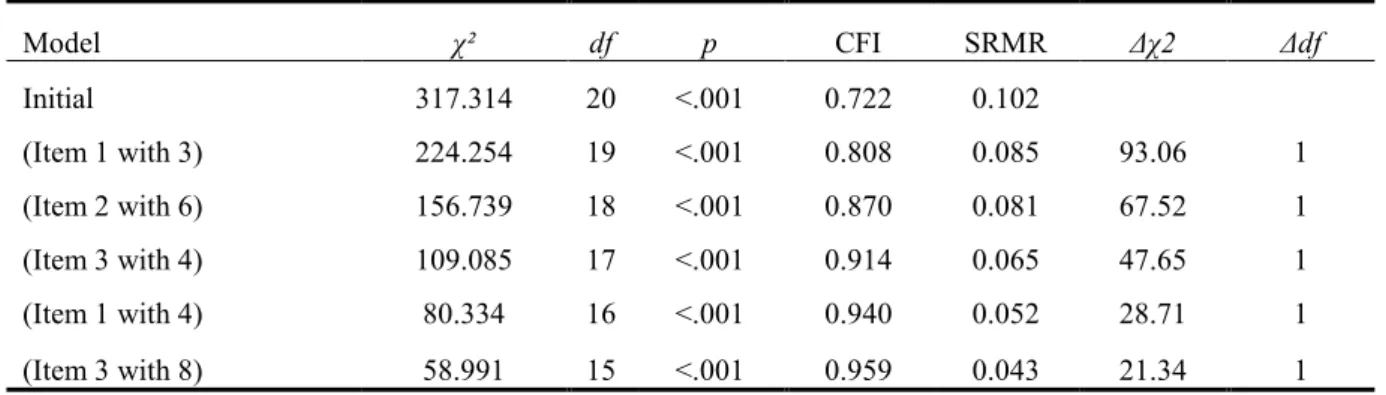
Confirmatory factor analysis of body dissatisfaction was conducted on single factor. Results did not meet with cut-off values, [χ² (20) = 317.314, p < 0.001), CFI = 0.722, RMSEA = 0.224, SRMR = 0.102]. Modification indices were examined in further analysis. Remarkable modification indices were followed as shown in Table 2.6. After following the five modification indices, the model presented adequate fit [χ² (15) = 58.991, p < 0.001), CFI = 0.959, RMSEA = 0.100, SRMR = 0.043]. Factor loadings (shown in Table 2.7) ranged from 0.39 (item 3) to 0.84 (item 7).
30 Table 2.6. Modification Indices on Body Dissatisfaction
Table 2.7. Factor Loadings of Body Dissatisfaction Scale
Model χ² df p CFI SRMR Δχ2 Δdf Initial 317.314 20 <.001 0.722 0.102 (Item 1 with 3) 224.254 19 <.001 0.808 0.085 93.06 1 (Item 2 with 6) 156.739 18 <.001 0.870 0.081 67.52 1 (Item 3 with 4) 109.085 17 <.001 0.914 0.065 47.65 1 (Item 1 with 4) 80.334 16 <.001 0.940 0.052 28.71 1 (Item 3 with 8) 58.991 15 <.001 0.959 0.043 21.34 1
Note. Correlation between error terms were added between items of body dissatisfaction scale.
Item No Items Factor Loadings
*1 Karnımın çok büyük olduğunu düşünürüm 0.402 *2 Bacaklarımın çok kalın olduğunu düşünürüm 0.704 3 Karnımın ideal ölçüde olduğunu düşünürüm 0.283
4 Vücudumun şeklinden memnunum 0.503
*5 Basenimin çok geniş olduğunu düşünürüm 0.881 6 Bacaklarimin ideal ölçüde oldugunu düsünürüm 0.524 *7 Kalçalarimin çok genis oldugunu düsünürüm 0.874 8 Basenimin ideal ölçüde oldugunu düsünürüm 0.489
Note. *Reverse coded items. Standardized regression coefficients were reported.
31 2.4. DATA ANALYSIS STRATEGY
All missing values for each item were less than 5% of the total data. Following Tabachnick and Fidel (2013), we dealt with missing values replacing by means. At first, independent sample t-tests were conducted to compare variables in terms of gender difference. Then, bivariate analyses between the study variables (PPR, co-regulation, binge eating, body dissatisfaction and demographics) were examined for each dyad Next, APIM was conducted on the conceptual model (see Figure 1.1) with Mplus version 6.11 (Muthen and Muthen, 1998-2010), using maximum likelihood estimation. APIM not only enables to examine association between participant’s predictor variable and dependent variable (called as actor effects) but also association between individual’s predictor variable and partner’s dependent variable (called as partner effects). Thus, we measured same variables from different participants whom are members of a couple. Note that while testing the conceptual model (see Figure 1.1), error variances of both actors’ and partners’ interpersonal emotion regulation scores were correlated due to their non-independence. While interpreting adequacy of goodness of fit indices, chi-square is considered as an indicator, however, it is highly sensitive to sample size and normality assumption (Barrett, 2007) so that Comparative Fit Indices (CFI), Root Mean Square Error of Approximation (RMSEA), and Standardized Root Mean Residual (SRMR) were interpreted as additional goodness of fit indices (Hu and Bentler, 1999). Finally, series of chi-square difference tests were conducted to see whether there was significant difference between predictor powers of actor and partner effects (Cook and Kenny, 2005).
32
CHAPTER 3
RESULTS
This section includes bivariate relationship among variables, independent t-tests in terms of gender, chi-square difference test to measure actor-partner equality and APIM results.
3.1. INDEPENDENT T-TEST RESULTS FOR GENDER
Independent sample t-test results showed that there was not significant difference between females (M = 7.541, SD = 1.312) and males in terms of PPR, p = .511. Females (M = 3.759, SD = 0.844) and males (M = 3.833, SD = 0.684) did not significantly differ in terms of co-regulation, p = .409. Binge eating scores of females (M = 0.567, SD = 0.419) and males (M = 0.624, SD = 0.423) were not significantly different from each other, p = .242. However, body dissatisfaction scores of females (M = 3.314, SD = 0.882) and males (M = 3.589, SD = 0.744) significantly differed from each other, p = .004.
3.2. DESCRIPTIVE AND CORRELATION ANALYSES
As Table 3.1 indicated, correlation analyses across partners yielded that PPR score of female and male participants were positively associated with each other (r = .581, p < .001). Similarly, binge eating scores of female and male participants were positively associated with each other (r = .204, p = .013). Co-regulation scores of both members of the couples were also positively associated with each other (r = .462, p < .001). Finally, body dissatisfaction scores of partners were significantly associated with each other (r = .177, p = .032).
Within and between-person correlations also yielded significant associations. Specifically, co-regulation scores of female participants were significantly associated with both their own PPR (r = .531, p < .001) and partners’ PPR (r = .519, p < .001). Similarly, co-regulation scores of male participants were both significantly associated with their own PPR (r = .463, p < .001) and partners’ PPR (r = .473, p < .001). Binge
33 eating scores of female participants were negatively associated with both their own PPR (r = -.243, p = .003) and partner’s PPR (r = -.195, p = .017). In contrast, there was not significant relationship between binge eating scores of male participants and neither their own PPR nor partners’ PPR (see Table 3.1). Finally, binge eating scores of female participants were negatively correlated with both their co-regulation (r = -.438, p < .001) and partner’s co-regulation (r = -.266, p = .001). Binge eating scores of male participants were significantly associated with partners’ co-regulation (r = -.237, p = .004). However, the relationship between binge eating scores of males and their own co-regulation was not significant (see Table 3.1).
3.3. CORRELATION RESULTS BETWEEN MAIN VARIABLES AND OTHER VARIABLES
PPR of female participants were positively associated with their own body dissatisfaction (r = .286, p < .001). Relationship duration among couples and PPR of female participants were found as negatively associated (r = -.303, p < .001). Age of both female and male participants were found as negatively associated with PPR of females (r = -.271, p = .001; r = -.267, p = .001, respectively). Education level of both females and males was found as positively associated with PPR of females (r = .177, p = .031; r = .179, p = .029, respectively). PPR of male participants were negatively associated with relationship duration (r = -.176, p = .032). Age of both females and males’ own age were found as negatively associated with PPR of male participants (r = -.202, p = .014; r = -.192, p = .019, respectively). Co-regulation scores of females were found as positively associated with their own body dissatisfaction (r = .274, p = .001). Relationship duration among couples were found as negatively related to co-regulation scores of females (r = -.214, p = .009). Age of females were found as negatively associated with their own co-regulation scores (r = -.187, p = .023). Co-regulation scores of males were found as positively associated with body-dissatisfaction of females (r = .267, p = .001). We found negative relationship between binge eating scores of females their own and body dissatisfaction (r = -.520, p < .000), in addition, this result was consistent also for male participants (r = -.400, p < .001). Binge eating scores of female participants and their own BMI was positively related to each to other (r = .204,