1ST INTERNATIONAL BLACK SEA CONGRESS ON ENVIRONMENTAL SCIENCES (IBCESS) Giresun, TURKEY | August 31 - September 03, 2016
1
Use of Bio waste active carbon-alkali pellets in fluidized bed
combustion chambers for emission control
Yıldırım İsmail TOSUN11, Şırnak University, Engineering Faculty, Mining Engineering Dept., Şırnak
([email protected]) ABSTRACT
Reasons for growing interest in toxic gas emission control include its potential for reducing noxious emissions. Uses of fuels as potential contributions to rural economic development reduce reliance on high quality fuels, as an additional demand centre for electricity commodities and as a way to urbanization.
Especially in waste incineration pro combustion emission control may cost higher prices such as 60-90$/ton. The biowaste active carbon soaked magnesia slurry may cost lower such as 3-5$/ton. Fly ash or alkali wastes are produced in two different forms in size. One type of marble wastes is in lump size and easily be evaluated in civil industry and other may be evaluated as construction filling materials in fine size under 20 microns as which collected following solid-liquid separation thickeners. That waste in finer size may deteriorate environment near marble processing plants and water contamination in streams. Beneficiate from that finer bio-active carbon in toxic gas emission control during combustion can efficiently be made. However, fluidized combustion are carried out over 100 microns solid fuel combustion. In order to avoid this disturbing flow manner of that waste material, active carbon pellets were used in combustion chamber.
Fine marble wastes may also be evaluated as lime raw material without calcining for filling material in industrial sectors such as rubber, paper and animal food production. 40%,60% and 80% bio-waste and alkali containing active carbon pellets were used in our combustion experiments at 1-2mm sized pellets.
Keywords: bio-active carbon, toxic emission control, gas cleaning, incineration agricultural waste combustion,.
INTRODUCTION
Coal, biomass or waste as a solid fuel, waste liquid fuels from natural sources and biodiesel have gained more market due to its use in electricity. Combustion of coal, biomass or waste creates toxic gas emissions for environmental concern. The electricity production of Turkey from the primary resources are naural gas iporte an coal as high as 22% (Figure 1)(TTK, 2009,TKİ, 2009, IEA 2014). Reasons for growing interest in toxic gas emission control include its potential for reducing noxious emissions. Uses of fuels as potential contributions to rural economic development reduce reliance on high quality fuels, as an additional demand centre for electricity commodities and as a way to urbanization (Demirbaş and Balat, 2004).
2 Figure. 1. The Revised Electricity Production from Turkish Primary Resources and
Renewable Comparison.(IEA 2014)
Desulfurization of coal has firstly applied for the flue gas in coke production and in fluidized bed combustion systems with limestone addition into the coal combustion chamber. The pro-combustion desulfurization methods have significantly been developed by wet desulfurization units in thermal power stations. However, small scale operation of wet desulfurization plants may not be economic (Wheelock, 1979). Especially in waste incineration pro combustion emission control may cost higher prices such as 60-90$/ton. The expanded clay pellets soaked magnesia slurry may cost lower such as 3-5$/ton.
Conventional coal combustion systems using Stokers or grate chambers are not designed to treat potentially contaminated municipal organic waste in order to prevent by post combustion the potential spread of toxic emissions in coal and wastes (Tosun, 2013) and potantial problems related to organic matter, phenol, such as undesirable colour, odour formation(Hartikainenet al. 2001). Solid adsorbents are needed in the combustion chamber systems typically consist of alkali salts intake, coagulation ash processes (Çulfaz et al. 1997, Tosun, 2007, Tosun, 2012).
Specifically, combustion temperature and secondary air may improve to destroy or impair unwanted emissions through chemical adsorption (Sharma et al. 2008).
The different type of chemical alkaline react with coal samples in combustion chamber at atmospheric pressure by the equations as given below (Kumar et al, 2000);
SiO2 + 2NaOH / Na2CO3 2SiO3 + H2O (1)
Al2O3 + 2NaOH / Na2CO3 2AlO2 + H2O (2)
8FeS2 /S2 + 30NaOH /Na2CO3 2S + Na2S2O3/Na2SO3 + 15H2O + 4Fe2O3 (3)
Flue gases of coal combustion were greatly researched for desulfurization in different combustion chambers and burning systems by different methods succeeding great desulfurization. The adsorption techniques and also different types of sorbents widely used in the studies (Demirbaş and Balat, 2004; Wheelock, 1979; Qi et al, 2004; Karaca, 2003; Gürü et al, 2008) and sulfur has been captured as sulfite and sulfate solutions or in solid forms of mixtures with reactive sorbents (Tosun et al., 1996, Tosun, 1996; Tosun, 1997; Tosun , 2007; Karatepe, 2000; Rongfang et al, 2007; Garcia and Moinela, 1991). 7% lime addition to coal during combustion reduced combustible sulfur emissions to certain levels (Ozbas et al, 2002; Altun et al, 2006). The removal efficiency of organic sulfur matter from raw coal in most conventional combustion systems is only approximately 10 per cent (Rongfang et al., 2007).
0 20 40 60 17,8 48,7 22,3 5,7 3,8 0,8 0,1 0,1 0,1 P ro d u ctio n ,%
3 However, the removal efficiency of organic sulphur matter has been largely improved by employing expanded clay media instead of limestone and dolomite. In general, advanced adsorbents which utilize alkali vapours and chlorine gases demonstrated varying efficiencies in removing toxic metal and sulfur matter from waste (Tosun ,2012).
Combustion of solid fuels in the presence of expanded clay was investigated. Expanded clay was examined as an absorbent for a conversion of toxic gas to friendly emissions. It can be a promising waste incineration for the production of electricity from nylon and plastic contaminated municipal wastes because of high activity in the collection and leaching in the toxic gas in the combustion reaction. The combustion chamber conditions were optimized. The different type of solid sorbents such as Şırnak carbonized biomass fine, marly limestone, claystone and the bottom ash soaked carbonized biomass were studied in elimination of toxic emissions in high sulfur coal combustion and the ash composition was characterized by XRF and stereo microscobic pictures. The results demonstrate that the bottom ash showed high performance. it was found that the reduction of toxic gas emissions can reach as high as 74. 2% with soaking carbonized biomass and 90% with soaking carbonized oil slurry after 1 h combustion at 7500C, with a 100:1 weight ratio of clay pellet to fuel, 21 wt. % carbonized biomass/ clay.
Factors affecting toxic gas sorbtion in combustion
Effective sorption in combustion processes depend on numerous factors including coal rank in carbonization, the volatile gaseous matter of coal such as presence of hydrogen, carbonyl gas and oxidation rate so stabilizing the desorbance, the settings of optimal diffusion conditions including structure defects (nitrogen, phosphorus, sulfur, etc.), temperature, oxygen content of coal, etc. and optimization of carbondioksit concentration ratios added the adsorption–desorption balance, the residence time and the spatial distribution of molecules in coal pores among other factors determining the efficiency of carbonization. as factors affecting the rate and extent of carbonization much dependent on the site activation, its desorption properties and its porosity. As discussed in the previous section, carbonization is a prerequisite step for oil generation from biomass wastes and coal (Wheelock, 1979).
Biomass Carbonized particle size
A major reason is that the retention time in fixed film processes is longer than in solid-gas processes. This allows more time to the carbonization for cracking to the desorbed persistent compounds. Furthermore, high rank coals allows an sufficient intimate contact between surface pores and gas atmosphere in the furnace due to more gas desorptions (Tosun, 2012)
Carbonized porosity
The porous structure of activated carbon is a factor that determines to a great extent both the rate and degree of carbonization (Wheelock, 1979). Shadle et al. (2008) found that, a mesoporous coal was more efficiently carbonized than a microporous coal. Phenol molecules that may undergo an oxidative coupling reaction may be irreversibly adsorbed on coal, which in turn may result in low carbonization efficiency. Phenoxy radicals formed by the removal of a hydrogen atom from each phenolic molecule can participate in direct coupling with other phenoxy radicals at even room temperature, coal surface serving as a catalyst.
4 pyrolysis on coal and wood were also reported by Tosun (2013).
Physical surface properties of Carbonized Biomass
BET specific surface areas, total surface activity, oxygen functional groups, total surface impurities, metal concentrations, dielectric value, free radical concentration and reactivity were related to the stimulation of oxidation reactivity. However, in some investigations, the pore size distribution of activated carbon is also likely to affect desorption kinetics (Jess et al.2009).
Combustion temperature and rate
The diffusion rate of combustion gases with solid sorbents may influence the adsorption of toxic emissions amount. Especially, increased combustion temperature will reduce the time of solid sorbent diffusion (Jess et al.2009).
METHOD AND MATERIALS
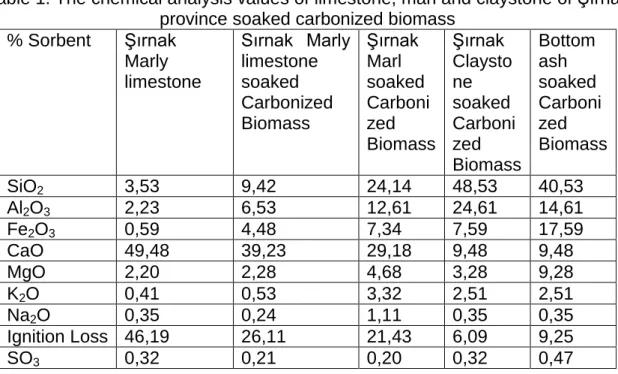
In this research, representative specimens of the Şırnak asphaltite and different types of Turkish lignites; Kütahya Gediz, Tunçbilek, Soma Kısrakdere were crushed and comminuted to minus 1mm size by controlled screening. Air dried samples of 40-50 gr from each different coal types were prepared and sealed in nylon bags. The different type of solid sorbents such as Şırnak limestone, marly limestone and claystone were used in the combustion. The chemical analysis of the solid sorbents are given in Table 1. The results of proximate and ultimate analyses of various sorbents used in the experiments are given in Table 1. The qualities of processed coal products are ascertained by chemical and standard coal analysis of ASTM 3173-3177 as given in Table 2.
Polarizing microscopy (Zeiss) with the progress of micro-cracks pulling on photography, porous limestone, shale texture, marl shows a heterogeneous texture (Figure 2).
Table 1. The chemical analysis values of limestone, marl and claystone of Şırnak province soaked carbonized biomass
% Sorbent Şırnak Marly limestone Sırnak Marly limestone soaked Carbonized Biomass Şırnak Marl soaked Carboni zed Biomass Şırnak Claysto ne soaked Carboni zed Biomass Bottom ash soaked Carboni zed Biomass SiO2 3,53 9,42 24,14 48,53 40,53 Al2O3 2,23 6,53 12,61 24,61 14,61 Fe2O3 0,59 4,48 7,34 7,59 17,59 CaO 49,48 39,23 29,18 9,48 9,48 MgO 2,20 2,28 4,68 3,28 9,28 K2O 0,41 0,53 3,32 2,51 2,51 Na2O 0,35 0,24 1,11 0,35 0,35 Ignition Loss 46,19 26,11 21,43 6,09 9,25 SO3 0,32 0,21 0,20 0,32 0,47
5 Table 2. Proximate Analysis of Biomass. (ADB:Air dried base. DB:Dried base,
DAB:Dried ashless base). Biomass Type Ash,
% ADB Moistu re,% ADB Total S,% DB Volatile Matter, % DAB Şırnak Maize 1.3 20.1 0.1 62.6 Mardin Corn 1.3 28.1 0.1 72.6 Şırnak forest mass 2.2 37 0.2 62.7 Nut shell 0.8 14 0.1 60.4
Screen analysis of Şırnak asphaltite and Turkish lignite samples were made by standard Tyler Screens and particle size distributions and normal distributions of lignites samples are respectively illustrated in Figure 2.
Screen analysis of The different type of solid sorbents such as Şırnak limestone, marly limestone and claystone, MgO soaked expanded clay were made by standard Tyler Screens and particle size distributions and normal distributions of lignites samples are respectively illustrated in Figure 3 and 4.
RESULTS AND DISCUSSION
Turkish lignites may not be destroyed by controlled crushing and screening till reducing particle size of specimens to minus 10 mm. As seen from Figure 3, normal distribution of coal size was determined as two different fractions and highly sufficient in order to combustion and react with solid sorbents.
6 Figure 2. Photos and Bright Sections and Parts of Şırnak limestone, marl, claystone 1mm
7 Figure 3. Particle Size Distribution of
Turkish High Sulfur Coals.
Figure 4. Particle Size Distribution of of Solid Sorbents of Şırnak limestone,
marly limestone, marl, claystone, expanded clay
As seen from Figure 3, 80% of weights of samples were under 3 mm. The lignite samples were mainly distributed between 1mm and 3 mm size fractions. As seen from Figure 4, 80% of weights of solid sorbents were under 2 mm.Two normal distributions are seen from Figure 4 due to different mechanical breakage manners of solid sorbents. Especially, hardly crushed particle size fraction of sorbents was ranging between 2 and 3 mm.
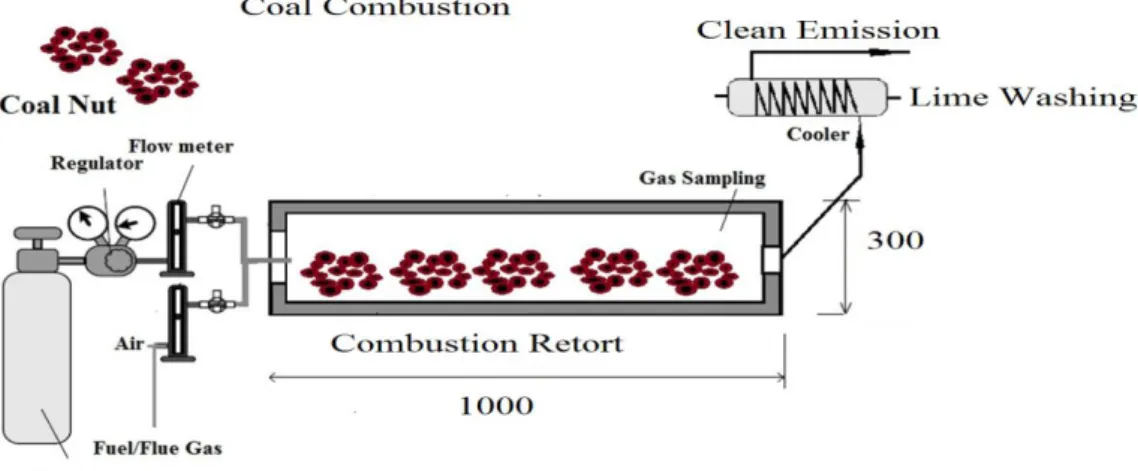
Combustion experiments were carried out in a benchmarked laboratory type 1m kiln reactor put in the furnace at atmospheric pressure at a temperature precision of ±5oC as seen from Figure 5.
Combustion tests were carried out under atmospheric pressure at a constant time period of 3 hours previously determined over 1-2 kg lignite samples. MgO soaked expanded clay were made by calcination of Şırnak claystone at 800 oC and soaking with MgO and SEM picture was illustrated in Figure 6.Total solid sorbent weight was hold constant at a quarter of coal weight. Various sorbents were used at 1/4 weight rate into to coal samples. The effect of particle size of solid sorbents were investigated over the combustion of Şırnak Asphaltite and carried out well on emitted gas substance subjected to reaction with expanded clay in combustion, as shown in Fig. 7. 1 10 100 10 100 1000 10000 Unde rsize, log %
Particle Size, micron Tunçbilek Lignite
Soma Kısrakdere Kütahya Gediz Şırnak Asphaltite Normal Size Distribution
1 10 100 1 10 100 1000 10000 Unde rsize, log %
Particle Size, micron Şırnak Marl
Expanded Clay Şırnak Marl Şırnak claystone Şırnak Marly Limestone Normal Size Distribution
8 Figure 5. Use Coal Combustion Retort subjected to solid sorbent
Figure 6. Scanning electron microscopy of expanded clay bed soaked with carbonized biomass.
Figure 7. The Effect of Particle Size of Clay pellet of carbonized biomass.
y = 6,6983ln(x) + 23,099 y = 10,061ln(x) + 10,299 y = 11,792ln(x) - 0,774 0 10 20 30 40 50 60 70 80 1 10 100 1000 Desulfu rization Rate ,% Combustion Time, s 2-1 mm Clay Pellet 5-2 mm Clay Pellet 10-5 mm Clay Pellet
9 Although molecular gas diffusion is believed to be the primary mass transport process in the combustion chamber, complex convective gas emissions proliferated the alkali clusters below 1-2mm size and exothermic combustion reactions increased toxic substances in the gas form, a relatively porous structure of expanded clay interstitial spaces and cracks reduced over 5mm size. The combustion gases substances towards the expanded clay surface through this surface alkali are primarily accomplished by molecular diffusion across the micro cracks and alkali clusters. A reduction in the size of combustion coal may also permitted more clay substrate to diffuse through the surface towards the expanded clay sites subsequently increase adsorption as illustrated in Figure 8. The gaseous reacted adsorbate then adsorbs to the sorbent in an certain amount that is equal to the amount of previous adsorbate that was partially degraded on the surface of the expanded clay and removing aliphatic hydrocarbons and phenols/chlorinated phenols, carbonyl toxins, along with organic matter related odour substances.
In the combustion experiments, the experimental condition is calculated on the basis of the ash composition in the ambient state. So neither the contained water vapour nor the condensing hydrocarbons are taken into account.
Figure. 8 Clay surface adsorption and pore entrapment.
Initially, most of the toxin removal occurs through chemical adsorption of the toxins to the expanded clay where the combustion temperature was in the pyrolysis phase below 750oC that lasts approximately 2–3 mins .The removal efficiencies of 40–90 per cent were reported during this temperature range. Total organic toxin substances were completely slightly at efficiencies of 75–90 per cent in the late combustion phase. The pictures of MgO fines soaked in expanded clay were illustrated in Figure 9a and 9b. Following the combustion at 800oC adsorbed film of emissions over expanded clay was shown in Figure 9b.
Carbon/alkali granules Carbon/alkali surfaces
Clay Pellet
Gas Diffusion granules and fissures
10
Figure 9. Clay Carbon Soaked photo 500X, a.prior to combustion b.Combustion at 800oC
A common industrial combustion to control the emissions proombustion stage lime washing involves backwashing with air and hydrated lime water rinse. Process variables include the control backwash rate, surface wash rate/duration, time sequence and duration of backwash. Clean filtrate is pumped back into the bottom of the column during backwashing.
These sorbents need to be accurately mixed with combustion matter and the to optimize the combustion process. Reliable models, based on the above results, need to be combustion chamber construction for the estimation of kinetic parameters for toxic emission control. Such toxic gaseous circulation models would aid in the expanded clay sorbent use in waste combustion systems.
The country needs the cleanest fuel to be produced providing the essential oils and gases. For this reason, combustion of high sulfur Şırnak asphaltite and Turkish lignites Kütahya Gediz, Soma lignite, and Tunçbilek lignite were mixed with expanded clay at 1-2mm size soaked with slurries of different alkali sorbents such as Lime, Hydrated lime, Magnesia, Marble fine,NaCl, CaCl2 and KCl were tested in the rotary kiln and the test results were illustrated in Figure 10.
Figure 10. The effect of alkali type on Desulfurization in Kiln Combustion of Turkish Lignites at 800 oC 0 20 40 60 80 Lime H ydr at ed Lime MgO M ar bl e Fi ne N aC l C aC l2 KC l Su lfu r R em oval,%
Şırnak Asphaltite Gediz Lignite Tunçbilek Lignite Soma Lignite
11 Among various cheap alkali fines such as Lime, Hydrated lime, Magnesia, NaCl, MgCl2 and KCl, magnesia were found as efficient desulfurizing solid sorbent. 72-74% desulfurization rates with Şırnak asphaltite, Gediz and Soma lignite could be reached. These cheap alkali sorbent fines may be so feasible at the side of cost and sorbent production. The high amount of gaseous emissions might be reduced instead of massive alkali sorbent use. Advanced coal washing of Turkish lignite may not be feasible. However, the combustion with solid expanded clay soaked alkali fine of Turkish lignites can be managed. The heavy metal and toxic emissions of soot, nitrogen oxides and sulfur oxides with expanded clay soaked MgO managed at high elimination rates ranging 72-74%.
The approach of combustion kinetics assumed basically that the process exponentially was developed itself, as seen in Figure 11 with all specific features. The elimination of emissions with expanded clay sorbent was a decisive factor for the path of the kinetics of combustion reactions of coal. Therefore a static model of coal combustion was developed at 10mm of coal nut size. Instead of fluid bed combustion, packed bed combustion of coarse size coals is highly governed by slow combustion reactions, sufficiently sorbtion of toxic gas.
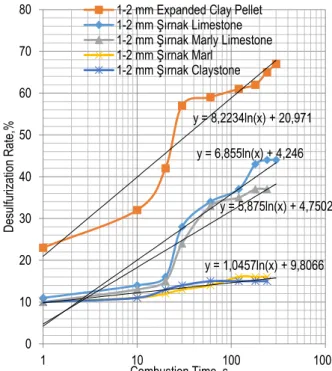
The different type of solid sorbents such as Şırnak limestone, marly limestone, marl and claystone, MgO soaked expanded clay were used at 1-2 mm size in coal combustion at 800oC. The effect of the massive solid sorbent type on elimination of toxic gas emmissions was investigated and the results were illustrated in Figure 12. In comparison of use massive solid sorbents in combustion of solid fuels with the presence of expanded clay it was found that at low particle sized such as 1-2mm lower surface area of massive solid sorbents reduced desulfurization rate. As seen in Figure 12, the expanded clay soaked MgO examined was more efficient as an absorbent for a conversion of toxic gas to friendly emissions. It can be a promising waste incineration for the production of electricity from nylon and plastic contaminated municipal wastes because of high activity in the collection and leaching in the toxic gas in the combustion reaction. The desulfurization rates reached to 74% with Sırnak asphaltite.
In the combustion experiments with addition expanded clay soaked 10% MgO, reactor temperature changed between 700oC and 1000oC. Products received from combustion of lignite with solid sorbent at 1-2 mm size at a quarter weight rate to coal following 3 hours combustion were subjected to analysis for sulfur hold-up
determination. Test results of combustion by expanded clay between 700 oC and 1000 oC were seen in Figure 13.
From the point of view of temperature effect experimentation, the resulted ash and sorbents analysis following combustion showed that increasing temperature reaching 1000 oC in combustion kiln for biomass, lignite and other coal samples were suddenly combusted the volatile substance without reacting sorbent matter in the kiln even in comparison with different sorbent evaluation and so we may reduce the effect of ash sorption.
12 Figure 11. The Combustion rate of
Turkish Coals with Clay %10 carbon Soaked, Combustion at 800oC
Figure 12. The sulphur removal effect of Clay %10 carbon Soaked, Combustion
Şırnak Asphaltite at 800o C
It is based on the assumption that the final process temperature is a decisive factor for the required volatile-matter content in the char being in a quasi equilibrium state with respect to the gas temperature. The amount of uncombusted hydrocarbon or soot was remained between 37 and 40 ppm in the experiments depending on the combustion air. The higher elimination of soot was managed at lower combustion temperatures. it is illustrated that higher particle matter content to be converted to combusted matter was managed over 750oC till 900oC. Combustion rates were lower so that mass diffusion rates of gaseous materials to sobent particle fundamentally control adsorption kinetics depending on combustion temperature as seen from Figure 13.
Fig. 13. The combustion temperature on the Desulfurization removal of Clay %10
carbon Soaked. y = 6,6983ln(x) + 23,099 y = 10,061ln(x) + 10,299 y = 11,792ln(x) - 0,774 y = 9,9601ln(x) + 13,863 0 10 20 30 40 50 60 70 80 1 10 100 1000 C om bu sti on R at e % Combustion Time, s 10mm Gediz Lignite 10mm Tunçbilek Lignite 10 mm Soma Lignite 10 mm Şırnak Asphaltitel y = 8,2234ln(x) + 20,971 y = 6,855ln(x) + 4,246 y = 5,875ln(x) + 4,7502 y = 1,0457ln(x) + 9,8066 0 10 20 30 40 50 60 70 80 1 10 100 1000 D esulfur iz at ion R at e, % Combustion Time, s 1-2 mm Expanded Clay Pellet 1-2 mm Şırnak Limestone 1-2 mm Şırnak Marly Limestone 1-2 mm Şırnak Marl 1-2 mm Şırnak Claystone y = -0,0009x2 + 1,2733x - 388,7 y = -0,0005x2 + 0,795x - 239,83 y = -1E-04x2 + 0,0505x + 79,134 y = -0,0002x2 + 0,1931x + 2,8246 0 10 20 30 40 50 60 70 80 90 100 700 750 800 850 900 950 1000 Desulfu rization Rate ,% Combustion Temperature, oC Sırnak asphaltite Gediz lignite Tunçbilek lignite Soma Lignite
13 Test results of the effect of combustion temperature for Şırnak asphaltite showed higher desulfurization at near 86%. Temperature increase were also reduced desulfurization rate of Turkish lignite as seen in Figure 13. Comparison of Tunçbilek lignite at Gediz lignite showed higher desulfurization at near 76 %.
CONCLUSIONS
The higher desulfurization yields were provided in combustion tests with using the expanded clays with MgO soaked with high sulfur coals in the kiln apparatus at a quarter weight rate to coal.
Combustion of different types of Turkish lignite was successfully processed in terms of desulfurization and depend on the volatile matter.
At higher rates of combustion of different types of Turkish lignite could be obtained from the tests using high combustion temperature of 1000oC. it has been clearly determined that CO2 and steam much beneficial in elimination of toxic matter of different types of Turkish lignite. Şırnak asphaltites should be also desulfurized at high rate of 88 and 74% and high ash content reduced toxic gas emission in combustion.
Benefaction from high sulfur Turkish lignite in the various parametric combustion systems, in order to receive clean energy clean liquid and gaseous products must be managed in low temperature reactions with expanded clay soaked with MgO. It is also advised that the high amount of elimination of toxic gas will be managed at low combustion temperatures over 700 oC and more environmental friendly gaseous emissions were provided by 1-2 mm sized expanded clay in comparison same sized limestone.
Nut sized coal below 10mm sized in retort combustion carried out for Turkish lignite and Şırnak asphaltite showed sufficient desulphurization rates at 800 o
C and even other lignites showed similar trend.
In order to optimize the desulfurization rates of the coal combustion and for the elimination high rate of detoxification in waste inceneration process as given in Figure 13 the low 800 oC combustion was adviced at nut size solid fuel combustion and with finer particle size fractions of coal specimens, the reactor temperature should be optimized to lower combustion kinetics mixed with expanded clay soaked MgO at 10% weight rate. However, as seen in Figure 12 it was showed that desulfurization rate reduced lower than 42 and 37% level at the addition a quarter weight of Şırnak limestone and marly limestone in to the combustion, respectively. That soot remained in ash was among 3,8-5,6%. Therefore it was supposed that porous expanded clay layers, improved finer fill of porous clay layers with alkali and ash metal catalysts of Turkish lignite and even exhibited sufficient gas permeability in small particle size fractions.
ACKNOWLEDGEMENT
14 REFERENCES
IEA, 2012, World Energy Outlook
TKI, 2009, The Turkish Ministry of Energy, Energy, Dept., Lignite Coal Report TTK, 2009, The Turkish Ministry of Energy, Energy, Dept., Hard Coal Report
Demirbaş, A., Balat M., 2004. Coal Desulfurization via Different Methods. Energy Sources, 26,541-550.
Garcia, R., Moinela S.R., 1991. Pyrolytic desulfurization of some high sufur coals. Energy Fuels, 5, 582-586.
Hartikainen, T.; Ruuskanen, J.; and P.J. Martikainen. , 2001, Carbon Disulfide and Hydrogen Sulfide Removal with a Peat Biofilter. Journal of the Air & Waste
Management Association, Vol. 51, p. 387-392.
Karaca, S., 2003. Desulfurization of a Turkish lignite at various gas atmospheres by pyrolysis effect of mineral matter. Fuel, 82, 12, 1509-1516.
Karatepe, N., 2000. A comparison of flue gas desulfurization process. Energy Sources Part A, 22, 197-206.
Culfaz, M., Ahmet, M., Gürkan, S., Removal of Mineral Matter and Sulfur from Lignites by Alkali Treatment, Fuel Processing Technology, 1996, 47, 99-109.
Reimers, G.W., Franke D.W., 1991, Effect of Additives on Pyrite Oxidation, RI:9353, Bureau of Mines
Tosun YI, Rowson NA, Veasey TJ, 1994, Bio-column flotation of Coal for Desulfurization and Comparison with Conventional and Column Flotation, 5th Int. Conf. of Mineral Processing, Nevşehir
Wheelock T:D: 1979, Chemical Cleaning, Coal Preparation(4th Edt.) AIME NewYork Yoon, R.H.,1991, Advanced Coal Cleaning, Part2, Coal Preparation(5th Edh.) AIME, Colorado
Tosun YI , 2012, Semi-fused Salt-Caustic Mixture Leaching of Turkish Lignites - Sorel Cement Use for Desulfurization, Proeedings of XIIIth International Mieral Processing Symposium, Bodrum, Turkey.
Bell D.A. Towler B.F., Fan M., 2011, Coal Gasification and Applications, ISBN: 978-0-8155-2049-8, Elsevier Inc., Oxford
Tosun YI, 2014, Partial Fast Pyrolysis of Turkish Coals, IMPS 2014, 15 - 17 October 2014, Kuşadası.
15 Dioksit Tutma", ULIBTK'95, 10 Ulusal Isı Bilimi ve Tekniği Kongresi, Gazi Üniversitesi, Ankara.
Kajitani S, Suzuki N, Ashizawa M, et al. CO2 gasification rate analysis of coal char in entrained flow coal gasifier. Fuel. 2006;85:163-169.
Shadle LJ, Monazam ER, Swanson ML. Coal gasification in a transport reactor. Ind Eng Chem Res. 2001;40:2782-2792
Sharma A, Saito I, Takanohashi T. Catalytic steam gasification reactivity of hypercoals produced from different rank of coals at 600-775 oC. Energy & Fuels. 2008;22:3561-3565.
Jess A, Andresen A-K. Influence of mass transfer on thermogravimetric analysis of combustion and gasification reactivity of coke. Fuel.; 2009. doi:10.1016/j.fuel 2009.09.002
Ozbas, K. E., Hicyılmaz, C., Kok, M. V., 2002. The Effect of Lime Addition on the Combustion Properties and Sulfur Contents of Three Different Coals. Energy Sources, 24, 643–652.
Ozbayoğlu G, Mamurekli M., 2002. Super-clean coal production from Turkish Bituminous Coal. Fuel, 72, 7, 1221-1223.
Qi Y., I W, Chen H.,Li B., 2004. Desulfurization of coal through pyrolysis in a fluidized bed reactor under nitrogen and 0.6% O2-N2 atmosphere. Fuel, 83, 6, 705-712. Rongfang Z., Shufeng Y., Yusheng X., Yunfa C., 2007. Characteristics and
Reactivities of Solid wastes sorbent for medium temperature flue gas desulfurization. Energy Sources PartA., 29,769-780.