Effects of chicory inulin on ruminal fermentation in vitro
Hakan ÖZTÜRK
Department of Physiology, Faculty of Veterinary Medicine, University of Ankara, Ankara - Turkey
Summary: The objective of this study was to investigate the effects of spray dried inulin powder from chicory roots of
different origins on in vitro ruminal fermentation. For this purpose, two long-term experiments were made with the Rumen Simulation Technique (Rusitec), in which the fermentation of a mixed ration of hay (5 g/d) and concentrate (4 g/d) was compared with the fermentation of the same diet in the presence of chicory inulin. The Rusitec system consisted of nine vessels (fermenters): three of them received daily 1.5 g of inulin powder from the Netherlands, three vessels received daily 1.5 g of inulin powder from Denmark and three vessels received no additives (control) in experiment I. This experimental setup was repeated in experiment II. However, 1.5 g of inulin from China and 1.5 g inulin from Germany were tested. Compared to control vessels, ruminal pH was significantly lower in the vessels supplemented with Chinese and German inulin. Dutch and Danish inulin had no effect on ruminal pH. Danish and Chinese inulin resulted in an increase of total-SCFA (short-chain fatty acids), acetate, propionate, butyrate, iso-valerate and iso-valerate production whereas Dutch inulin led to an increase in butyrate, iso-iso-valerate and iso-valerate production only. Addition of German inulin caused a significant increase in the production of total-SCFA, acetate, butyrate, iso-valerate and valerate in the rumen fluid. Compared to control, all inulin preparations decreased NH3-N concentrations in the fermentation vessels. The
digestibility of organic matter was not statistically influenced by Chinese and German inulin. However, Dutch and Danisch inulin decreased significantly the digestibility of organic matter compared to control vessels. These results indicated that, in relation to its origin, inulin stimulated ruminal fermentation and it was especially effective at decreasing ruminal ammonia concentration in vitro.
Key words: Chicory, fermentation, inulin, in vitro, prebiotic, rumen.
Hindiba inulininin rumen fermantasyonu üzerine in vitro etkileri
Özet: Bu araştırmanın amacı, farklı kaynaklardan gelen hindiba köklerinden elde edilen ve püskürtme tekniği ile kurutulmuş,
inulinin in vitro ruminal fermantasyon üzerine etkilerini belirlemektir. Bu amaçla Rusitec tekniği (Rumen Simulation Technique) kullanılarak iki ayrı deneme yapıldı. Bu denemelerde 5 g/gün kuru ot ve 4 g/gün konsantre yemden oluşan bir rasyonun ruminal fermantasyonu, aynı rasyonun farklı kaynaklardan gelen inulinlerin varlığındaki fermantasyonu ile karşılaştırıldı. Birinci denemede Rusitec sistemin dokuz fermenterinden üçüne günde 1,5 g Hollanda, diğer üçüne de yine günde 1,5 g miktarında Danimarka kaynaklı inulin eklendi. Son üç fermentere ise hiçbir ilave yapılmayıp kontrol olarak kullanıldı. Bu araştırma düzeni ikinci denemede de aynen tekrarlandı, ancak burada Çin ve Almanya kökenli inulinler denendi. Kontrol ile karşılaştırıldığında, Çin ve Almanya kaynaklı inulinler ruminal pH’da belirgin bir azalmaya neden olurken, Hollanda ve Danimarka kökenli inulinler ruminal pH’da bir değişime yol açmadı. Danimarka ve Çin kaynaklı inulinler, toplam uçucu yağ asitleri, asetat, propiyonat, bütirat, iso-valerat ve valeratın günlük üretimlerinde artışa neden olurken, Hollanda kaynaklı inulin yalnızca bütirat, iso-valerat ve valerat miktarında artışa yol açtı. Çin kökenli inulin ise toplam uçucu yağ asitleri, asetat, bütirat, iso-valerat ve valerat üretimini artırdı. Kontrol fermenterleri ile karşılaştırıldığında, tüm inulin preparatlarının NH3-N konsantrasyonunu belirgin bir şekilde düşürdüğü tespit edildi. Organik madde
sindirilebilirliği, Çin ve Almanya kökenli inulin uygulamalarından etkilenmedi, ancak Hollanda ve Danimarka kaynaklı inulinler organik madde sindirilebilirliğinde belirgin bir azalmaya neden oldu. Sonuç olarak kaynağı ile bağlantılı bir şekilde, inulinin in vitro ruminal fermantasyonu uyararak artırdığı ve özellikle ruminal amonyak konsantrasyonunun azaltılmasında etkili olduğu görüldü.
Anahtar sözcükler: İnulin, in vitro, fermantasyon, hindiba, prebiyotik, rumen.
Introduction
A prebiotic is defined as “a nondigestible food ingredient that beneficially affects the host by selectively stimulating the growth and/or activity of one or a limited number of bacteria in the colon and thus improves host health” (1). Inulin is considered an archetypal prebiotic, and it naturally occurs in many food plants. Inulin is industrially obtained from chicory roots by hot water extraction, followed by refining and spray drying and the
degree of polymerization of inulin typically ranges from 3 to 60. It consists of chains of fructose units coupled by β (2,1)-bonds most often (though not always) terminated by a single glucose moiety (2). Due to their β (2,1)-bonds, inulin is resistant to enzymatic hydrolysis in the upper gastrointestinal tract of humans and monogastric animals (3-8). Prebiotics are used successfully in monogastric animals, but not in ruminants. The process of fermentation that occurs in the colon of monogastric
animals is essentially identical to that occurs in the forestomachs of ruminants. Inspection of the available literature shows that information on the degradation and fermentation of inulin in the rumen is limited. However, current opinion contends that inulin can be metabolized in the rumen ecosystem (9). Biggs and Hancock (10) and Öztürk (11) reported that inulin influences ruminal fermentation and reduces ammonia concentration in the rumen fluid.
Addition of inulin to ruminant diets might be beneficial for ruminal fermentation and animal production. The objective of the present study was to investigate the direct effects of spray dried inulin powder from chicory roots of different origins on in vitro ruminal fermentation.
Materials and Methods
Incubation technique: Rusitec incubations were carried out as described previously by Czerkawski and Beckenridge (12). Nine incubation vessels (1 liter volume) were simultaneously used in each experiment. The nominal volume in each vessel was 750 ml. Each vessel was loaded with 2 nylon bags (pore size, 150 µm). At the start of the trial, one bag was filled with 80 g of solid rumen contents to inoculate particle-associated microorganisms into the system and the other with the daily diet, a mixture of 4 g of commercial concentrate and 5 g of hay cut into 1 cm lengths. The chemical composition of the experimental diet is presented in Table 1. The incubation vessel was filled with rumen fluid to inoculate fluid-associated microorganisms. Rumen contents were taken from 2 rumen cannulated adult donor sheep that were maintained on a diet of hay and concentrates. Animals had free access to hay, water, and a vitamin-enriched salt lick. The same dietary components were used for in vitro fermentation trials. The nylon bag with solid rumen contents was replaced after 24 h of incubation with a bag containing the diet. The feed bag was changed after 48 h so that 2 bags were always present. This gave a retention time of 48 h for feed. Bags were exchanged under anaerobic conditions using N2 to flush the incubation vessels. To maintain
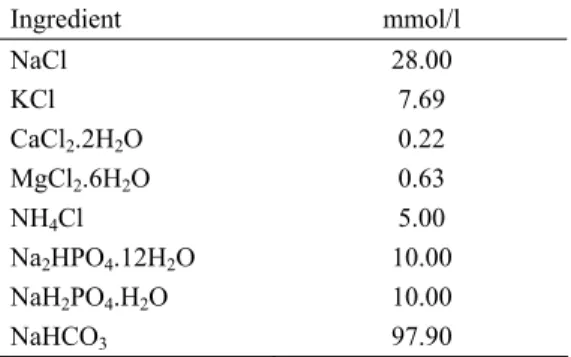
conditions as close to those of the in vivo rumen as possible, the incubation temperature was 39°C and rumen fluid turnover was simulated by a continuous infusion of a buffer solution of pH 7.4 with 293 mosm/l at a rate of 750 ml/d. The buffer composition is presented in Table 2. By moving the inner vessel up and down continuously rumen motility was simulated and the exchange between the fluid and particle phases was facilitated. Rumen gas was collected in gas-tight collecting sacs to ensure a closed system; the fluid outflow was collected in ice-cooled Erlenmeyer flasks.
Table 1. Chemical composition of the diets (%). Tablo 1. Rasyonun kimyasal içeriği (%).
Ingredient Hay Concentrate
Dry matter 93.94 90.48 Crude protein 7.27 15.96 Crude lipids 0.88 2.32 Crude fiber 27.59 10.49 N-free extract 46.01 43.36 Total ash 6.13 8.83
Table 2. Chemical composition of the buffer solution. Tablo 2. Tampon solüsyonun kimyasal içeriği.
Ingredient mmol/l NaCl 28.00 KCl 7.69 CaCl2.2H2O 0.22 MgCl2.6H2O 0.63 NH4Cl 5.00 Na2HPO4.12H2O 10.00 NaH2PO4.H2O 10.00 NaHCO3 97.90
Experimental procedure: To examine the role of spray dried inulin powders (Lohmann Animal Health, Cuxhaven, Germany) in ruminal fermentation, 2 experiments were performed; each experiment lasted for 9 days. The first 5 days represented an adaptation period (to achieve steady state conditions) and was followed by a collection period of 4 days. At the start of the collection period, inulin powders were added to the respective fermentation vessels. During the collection period of Experiment I, the 9 vessels were divided into 3 groups. The first group served as control, 1.5 g of inulin from the Netherlands and 1.5 g of inulin from Denmark were added to the second and third group daily, respectively. This experimental setup was repeated in Experiment II. Experiment II was performed under the same conditions as Experiment I. However, 1.5 g of inulin from China and 1.5 g of inulin from Germany were tested.
Analytical procedures and samplings: The pH values were measured daily in each vessel at the time of feeding using a pH electrode (Typ 408, Mettler Toledo, Steinbach, Germany) connected to a Knick pH Meter (digital pH meter 646, Knick, Berlin, Germany). Liquid effluent was collected daily and samples were taken for analyses of SCFA and NH3-N. The overflow flasks were
placed into ice to stop microbial activity and preserve fermentation products. An aliquot of effluent was centrifuged at 40,000 × g for 20 min at 4°C. The resulting supernatant was acidified with 0.1 mL of 98% formic acid and then centrifuged at 4000 × g for 10 min at 4°C. The supernatant was analyzed for SCFA by Gas
Chromatography (model 5890 II, Hewlett Packard, Böblingen, Germany) equipped with a 1.8 m × 2 mm glass column packed with Chromosorb WAW (mesh 80/100) with 20% neopentyl glycol succinate and 2% ortho phosphoric acid. Helium was used as a carrier gas with a flow rate of 25 ml/min. The temperatures of port, detector, and oven were 220, 250, and 130°C, respectively. Daily production rates of SCFA were estimated by multiplying the respective concentration by the volume of effluent collected. Ammonia N was measured using the steam distillation method of Kjeldahl (13). Dry matter was determined by drying at 65°C for 48 hours (Typ 600, Memmert, Schwabach, Germany). Ash concentration was determined after ignition at 600°C for 12 hours in a muffle furnace (Typ M110 Heraeus, Hanau, Germany) and used to calculate organic matter. The digestibility of organic matter at 48 h was calculated as original organic matter sample weight minus organic matter residue weight divided by the original sample weight. This value was then multiplied by 100 to derive the digestibility of organic matter percentage.
Statistical analyses: Data are expressed as mean ± SD and were evaluated by a one-way repeated measures analysis of variance (ANOVA) followed by the Duncan's multiple range test for all pairwise multiple comparisons. The analyses were performed using the Sigmastat 3.1 statistical software (Systat Software, Erkrath, Germany) and the mean differences were considered statistically significant when p values were less than 0.05.
Results
The effects of Dutch and Danish inulin on in vitro ruminal fermentation were examined in Experiment I (Table 3). The average pH values ranged between 6.85 and 6.88 and were neither affected by Dutch nor by Danish inulin. The daily production of total and individual SCFA (acetate, propionate, butyrate, iso-valerate and iso-valerate) were significantly increased (p<0.05) in response to Danish inulin. However, Dutch inulin led to significant increases (p<0.05) in the productions of butyrate, iso-valerate and valerate only. On the other hand, the addition of both Dutch and Danish inulin resulted in significant decreases (p<0.05) in NH3
-N concentration by 41 and 14%, respectively. Also, organic matter digestibility was 15 and 8% lower in the fermentation vessels supplemented with Dutch and Danish inulin respectively, when compared with the control vessels.
Experiment II was performed in order to determine the effects of Chinese and German inulin on in vitro ruminal fermentation (Table 4). The average pH values were significantly decreased (p<0.05) by 0.12 and 0.10 units in response to Chinese and German inulin. As
already shown with Danish inulin, Chinese inulin resulted in a significant increase (p<0.05) in daily production of total and individual SCFA (acetate, propionate, butyrate, iso-valerate and valerate). However, in the presence of German inulin, the production of total and individual SCFA except propionate were significantly increased (p<0.05).Chinese and German inulin caused significant decreases (p<0.05) in NH3-N
concentrations at the same percentage (17%). The digestibility of organic matter was not significantly affected by both inulin preparations.
Table 3: Effects of Dutch and Danish inulin on ruminal fermentation in vitro (Experiment I)
Tablo 3: Hollanda ve Danimarka kökenli inulinin rumen fermentasyonu üzerine in vitro etkileri (I. Deneme)
Item Control Dutch inulin Danish inulin Ruminal pH 6.88 ± 0.03 6.85 ± 0.03 6.85 ± 0.03 Total-SCFA (mmol/d) 24.45 ± 1.87a 25.11 ± 1.06a 27.83 ± 1.90b Acetate 14.33 ± 1.13a 14.08 ± 0.50a 15.91 ± 1.13b Propionate 5.84 ± 0.57a 5.56 ± 0.37a 6.69 ± 0.75b Butyrate 2.89 ± 0.22a 3.78 ± 0.65b 3.54 ± 0.33b Iso-valerate 0.57 ± 0.09a 0.71 ± 0.08b 0.67 ± 0.10b Valerate 0.83 ± 0.13a 0.98 ± 0.14b 1.03 ± 0.05b NH3-N (mmol/l) 6.08 ± 0.72a 3.60 ± 1.12b 5.23 ± 1.15c Digestibility of organic matter (%) 48.11 ± 5.37a 41.33 ± 2.87b 44.00 ± 3.95b
a-c Means within the same row with different superscript differ
(p < 0.05)
Values are means ± SD, n = 3
Table 4: Effects of Chinese and German inulin on ruminal fermentation in vitro (Experiment II)
Tablo 4: Çin ve Almanya kökenli inulinin rumen fermen-tasyonu üzerine in vitro etkileri (II. Deneme)
Item Control Chinese inulin German inulin Ruminal pH 6.92 ± 0.05a 6.80 ± 0.07b 6.82 ± 0.06b Total-SCFA (mmol/d) 23.15 ± 3.22a 32.39 ± 3.69b 30.08 ± 2.02b Acetate 13.90 ± 1.85a 17.88 ± 2.36b 16.44 ± 1.11b Propionate 5.62 ± 0.93a 7.40 ± 1.15b 6.43 ± 0.65a Butyrate 2.97 ± 0.44a 5.14 ± 0.57b 5.12 ± 0.42b Iso-valerate 0.20 ± 0.11a 0.60 ± 0.08b 0.63 ± 0.06b Valerate 0.46 ± 0.07a 1.38 ± 0.18b 1.46 ± 0.15b NH3-N (mmol/l) 6.37 ± 0.70a 5.26 ± 0.58b 5.31 ± 0.52b Digestibility of organic matter (%) 46.17 ± 6.38 49.00 ± 4.97 46.42 ± 4.40
a, b Means within the same row with different superscript differ
(p < 0.05)
Discussion and Conclusion
Although the pH values were found within the physiological ranges after the application of all inulin treatments, Chinese and German inulin caused significant decreases in this parameter compared to that of the control vessels. These decreases can be explained by the higher increases in SCFA productions of Chinese and German inulin used group than those of the group in which Dutch and Danish inulin were used. Throughout the Experiment I and II, NH3-N concentrations ranged
between 3.60 and 6.37 mmol/l. Satter and Slyter (14) reported that a range of 1.43–3.57 mmol/l of NH3-N was
required for optimum microbial protein synthesis. Therefore, in the current study the data for rumen NH3-N
concentration were within the physiological range required for optimum microbial protein synthesis. Decreased NH3-N concentrations in rumen fluid were
observed when inulin preparations were tested in both in vivo and in vitro rumen studies (10, 11, 15). The fermentation of carbohydrates affects nitrogen metabolism in the gut lumen. This was reported by Jorgensen et al. (16) that ammonia concentration in the gut lumen had been reduced by active carbohydrate fermentation, which stimulates the bacterial requirement for nitrogen due to an enhanced growth. The decreases in NH3-N concentration in the rumen can be associated with
various reasons such as; decreases in proteolysis and in NH3-N utilization by the rumen microorganisms,
increases in absorption of NH3-N from the rumen and in
turnover rate of rumen fluid (17). In the Rusitec system, the NH3-N concentration is only determined by the
protein breakdown and by the NH3-N utilization of
rumen microorganisms. The decreases in NH3-N
concentrations found in this study might have been the result of increased incorporation of ammonia into microbial protein and may be the direct result of altered microbial population and of stimulated microbial activity. Overall, the production rate of SCFA was increased and the concentration of NH3-N was decreased
by all inulin treatments, although digestibility of organic matter was decreased or not changed. This suggested that the rumen microorganisms digested the supplied inulin powders as additional substrates for their metabolic purposes. In the present study, the differences observed in the fermentation parameters between inulin applications may be attributed to chain length of inulin. The chain length has been reported to be influenced markedly by climate, time of sowing, and harvest, respectively (18-20). The chain length has shown to be an important factor in the fermentation of inulin (21). Unfortunately, the chain length of inulin was not determined in this study.
The results of the present study demonstrate that in relation to its origin, inulin stimulates the ruminal fermentation and decrease NH3-N concentration. In vitro
NH3-N reducing effect of inulin could be of great value
in increasing microbial growth and avoiding accumulation of ammonia in the rumen in vivo. Inulin may play a role in creating and maintaining a desired, stable microflora in the rumen when it is added to the diet of ruminants.
References
1. Gibson GR, Roberfroid MB (1995): Dietary modulation of the colonic microbiota: introducing the concept of prebiotics. J Nutr, 125, 1401–1412.
2. Havenaar R, Marol-Bonin S, Van Dokkum W, Petitet S, Shaafsma G (1999): Inulin: fermentation and microbial ecology in the intestinal tract. Food Rev Int, 15, 109–120. 3. Wang X, Gibson GR (1993): Effects of the in vitro
fermentation of oligofructose and inulin by bacteria growing in the human large intestine. J Appl Bacteriol, 75, 373–380.
4. Ellegard L, Andersson H, Boseus L (1997): Inulin and oligofructose do not influence the absorption of cholesterol or the excretion of cholesterol, Ca, Mg, Zn, Fe or bile acids but increase energy excretion in ileostomy subjects. Eur J Clin Nutr, 51, 1–5.
5. Fischbein L, Kaplan M, Gough M (1988): Fructo-oligosaccharides: a review. Vet Hum Toxicol, 30, 104–107. 6. Roberfroid MB, Van Loo JAE, Gibson GR (1998): The
bifidogenic nature of chicory inulin and its hydrolysis products. J Nutr, 128, 11–19.
7. Niness KR (1999): Inulin and oligofructose: What are they? J Nutr, 129, 1402-1406.
8. Flickinger EA, Van Loo J, Fahey GC (2003): Nutritional responses to the presence of inulin and oligofructose in the diets of domesticated animals: a review. Crit Rev Food Sci Nutr, 43, 19–60.
9. Chesson A, Forsberg CW (1988): Polysaccharide degradation by rumen micro-organisms. 251-284. In: PN Hobson (Ed), The Rumen Microbial Ecosystem, Elsevier Applied Science, London and New York.
10. Biggs DR, Hancock KR (1998): In vitro digestion of bacterial and plant fructans and effects on ammonia accumulation in cow and sheep rumen fluids. J Gen Appl Microbiol, 44, 167-171.
11. Öztürk H (2008): Effects of inulin on rumen metabolism in vitro. Vet J Ank Univ, 55, 79-82.
12. Czerkawski JW, Breckenridge G (1977): Design and development of long-term rumen simulation technique (RUSITEC). Br J Nutr, 38, 271–384.
13. Stuck K, Faul K, Hylla S, Stein J, Breves G (1995): The application of a semi-continuous colon simulation technique (COSITEC) for studying the effects of clindamycin on microbial hindgut metabolism. Z Gastroenterol, 33, 241–246.
14. Satter LD, Slyter LL (1974): Effect of ammonia concentration on ruminal microbial protein production in vitro. Br J Nutr, 32, 199–208.
15. Lee MRF, Merry RJ, Davies DR, Moorby JM, Humphreys MO, Theodorou MK, MacRae JC, Scollan ND (2003): Effect of increasing availability of water-soluble carbohydrates on in vitro rumen fermentation. Anim Feed Sci Technol, 104, 59-70.
16. Jorgensen H, Zhao XQ, Theil PK, Gabert VM, Bach Knudsen KE (2003): Energy metabolism and protein balance in growing rats fed different levels of dietary fibre and protein. Arch Anim Nutr, 57, 83–98.
17. Ernst M, Chatterton NJ, Harrison PA (1995): Carbohydrate changes in chicory (Cichorium intybus L var. foliosum) during growth and storage. Scientia Hort, 63, 251–261.
18. Öztürk, H (2003): In-vitro-Studien zum Einfluss von Topinamburmehl und Saccharomyces boulardii auf den mikrobiellen Vormagenstoffwechsel. Diss, Tierärztliche Hochschule Hannover, 96.
19. Van den Ende W, Mintiens A, Speleers H, Onuoha AA, Van Laere A (1996): The metabolism of fructans in roots of Cichorium intybus during growth, storage and forcing. New Phytol, 132, 555–563.
20. Baert JRA (1997): The effect of sowing and harvest date and cultivar on inulin yield and composition of chicory (Cichorium intybus L) roots. Indust Crops & Prod, 6, 195-199.
21. Rossi M, Corradini C, Amaretti A, Nicolini M, Pompei A, Zanoni S, Matteuzzi D (2005): Fermentation of fructooligosaccharides and inulin by bifidobacteria: a comparative study of pure and fecal cultures. Appl Environ Microbiol, 71, 6150-6158.
Geliş tarihi: 13.05.2008 / Kabul tarihi: 20.06.2008 Address for correspondence:
Dr. Hakan Öztürk
Ankara University, Faculty of Veterinary Medicine Department of Physiology
Diskapi 06110 Ankara - Turkey