ISTANBUL BILGI UNIVERSITY INSTITUTE OF SOCIAL SCIENCES
CLINICAL PSYCHOLOGY MASTER’S DEGREE PROGRAM
PSYCHOTHERAPISTS’ EXPERIENCE OF DIFFICULT CLINICAL MOMENTS
A COMPARATIVE STUDY BETWEEN INEXPERIENCED AND EXPERIENCED PSYCHOTHERAPISTS
Gizem GÜROY 116627009
Doç. Dr. Ayten ZARA
ISTANBUL 2019
Acknowledgement
First of all, I would like to thank Ferhat Jak İçöz, for encouraging me in my journey of being a psychotherapist that is full of challenges, teaching me how to be a better psychotherapist, sharing his knowledge, providing his valuable contributions and supporting me in this dissertation through every hardship. I would like to thank Ayten Zara and Ezgi Soncu Büyükişcan for their support and valuable contributions for this dissertations.
I would like to thank the instructors and supervisors of İstanbul Bilgi University Clinical Psychology program for the gift of knowledge that they gave to me and my classmates for being with me in every step of this journey and supporting me in the process of dissertation.
I want to share my thankfullness for my husband, my friends and my family for their love and support.
Lastly, I would like to thank all the psychotherapists who participated in this study and shared their precious experiences with me.
Table of Contents
List of Tables ... viii
Abstract ... ix
Özet...x
1. Introduction………1
1.1. Purpose of the study………...….…………...1
1.2. Personal background...2
1.3. Gap in Research Area...4
2. Literature Review………..6
2.1. Previous Research………...………....…6
2.2. Countertransference...11
2.2.1. Countertransference in the psychoanalytic view..……...…11
2.2.1.1. Classical psychoanalytic theory...10
2.2.1.2. Ego psychology theory...11
2.2.1.3. Self-psychology theory...11
2.2.1.4. Object relations theory...12
2.2.1.5. Contemporary thoughts...12
2.2.2. Countertransference in the existential view...13
2.2.2.1. A real relationship...13
2.2.2.2. Therapist bias...14
2.3. Therapists’ noncountertransferencial inner experiences...16
2.3.1. Therapists’ inner experiences through the perspective of psychoanalytic view...16
2.3.2. Empathy...17
2.3.2.1. Empathic attunement and authentic engagement....17
2.3.2.2. Empathy and intersubjectivity...18
2.3.3. The Wounded Healer...19
2.4. Therapeutic Impasses and Rupture...20
2.4.1. Therapeutic Impasses...20
2.5. Negative Therapeutic Reaction...21 3. Methodology...23 3.1. Participants...23 3.2. Procedure...24 3.3. Data Analysis...25 3.4. Validity...26 4. Results...28
4.1. Themes showing similarities between experienced and inexperienced psychotherapists...29
4.1.1. Fear of Boundary Violations...29
4.1.1.1. Anxiety about keeping the therapeutic frame...29
4.1.1.2. Anxiety about disappearance of the boundaries...31
4.1.1.3. Fear of physical boundary violations...32
4.1.1.4. Emergence of psychosomatic symptoms ...33
4.1.2. Avoiding revealing feelings...34
4.1.3. Sadness...36
4.2. Themes showing differences between experienced and inexperience psychotherapists...38
4.2.1. Feeling Incompetent...38
4.2.1.1. From first session anxiety to a flexible flow...38
4.2.1.2. From the dreadful drop outs, to accepting the client’s capacity of being held...39
4.2.1.3. From being a mother that starves her child to embracing limits...40
4.2.2. Anger management...41
4.2.3. Intolerance to uncertainty...44
5. Discussion...47
5.1. Comparison to the previous research...47
5.2. The themes showing similarities between experienced and inexperienced psychotherapists...48
5.2.2. Avoiding revealing feelings...52
5.2.3. Sadness...56
5.3. The themes showing differences between experienced and inexperience psychotherapists...58
5.3.1. Feeling Incompetence...58
5.3.2. Anger management...60
5.3.3. Intolerance to uncertainty...61
6. Implications of this study...64
6.1. Implications for psychotherapists...64
6.1.1. Accepting that the therapeutic relationship is a real relationship...64
6.1.2. Accepting that it’s normal to be affected in the connectedness of the therapeutic relationship...65
6.1.3. Resisting the idealized image of being a flawless and invulnerable psychotherapist...65
6.1.4. Disclosure in supervisions is beneficial...66
6.1.5. Embracing the uncertainty of therapeutic relationship...67
6.1.6. Self-care is crucial...67
6.2. Implications for experienced therapists, trainers and supervisors...68
6.2.1. A change in the authoritarianism of the psychoanalytic education...68
6.2.2. Self disclosing as a supervisor...69
7. Limitations of the study and Recommendations for future research...71
7.1. Limitations of the Study...71
7.1.1. Researchers experience...71
7.1.2. Sample size...71
7.1.3. Gender of the sample...71
7.1.4. Personal backgrounds, personality dynamics and past traumas of the sample...72
7.2. Recommendations for future research...72
7.2.1. More studies on this area...72
7.2.2. Studies on each specific themes...72
7.2.3. Personal dynamics relation with difficulties...73
7.2.4. Studies on novel findings of this study...73
7.2.5. Studies on further implications for supervisors and trainers...73
Conclusion...74
References...77
List of Tables
Table 1: Information of the Participants Table 2: Superordinate Themes
Abstract
The purpose of this study was to understand how psychotherapists make sense of and give meaning to their subjective experiences of what they define as a difficult clinical moment, to investigate the effects of these moments on their private and professional life and to compare the findings of experienced and inexperienced psychotherapists to find the similarities and differences between their experiences. By comparing the findings, this study aimed to encourage psychotherapists that are new in this profession to seek help and guidance when they need, help improve their clinical practice, motivate them about being a psychotherapist and help trainers and supervisors to improve psychotherapy training programs and supervisions in a way to provide more support to inexperienced psychotherapists experiencing difficulties. A sample of 4 inexperienced psychotherapists and 4 experienced psychotherapists were interviewed to understand their experiences in difficult clinical moments. As a result of the Interpretive Phenomenological Analysis, 6 superordinate themes and 7 sub-ordinate themes have been found. The themes that show similarities between inexperienced and experienced therapists are: 1. Fear of Boundary Violations, 2. Avoiding Revealing Feelings, 3. Sadness. The themes that show differences between inexperienced and experienced therapists are: 1. Feeling Incompetent, 2. Anger Management, 3. Intolerance to Uncertainty. The results of the study were interpreted and discussed in the light of existing psychoanalytic and existential literature on psychotherapists’ experiences in psychotherapy. The meaning of these results and discussions and recommendations for inexperienced psychotherapists, experienced psychotherapists, trainers and supervisors are provided in the implications section. In the last section, the limitations of this study and future research recommendations are given.
Key words: Psychotherapists experiences, difficult clinical moments, psychoanalytic, existential, self disclosure.
Özet
Bu çalışmada, psikoterapistlerin, “zor an” olarak adlandırdıkları öznel klinik deneyimleri nasıl anlamlandırdıklarının anlaşılması hedeflenmiştir. Klinik ortamda yaşanan bu zor anların, özel ve profesyonel hayatlarına nasıl etkileri olduğunun anlaşılması amaçlanmıştır. Bu çalışmada, deneyimsiz ve deneyimli psikoterapistlerin, “zor an” deneyimleri karşılaştırılmıştır. Bu karşılaştırmayla, deneyimsiz psikoterapistlerin bu deneyimler sonucunda yardım almaları konusunda ve psikoterapi mesleğini icra etme konusunda yüreklendirilmesi amaçlanmıştır. Ayrıca, bu çalışmayla, deneyimli psikoterapistlerin, eğitimcilerin ve süpervizörlerin, deneyimsiz terapistlere zor an deneyimleri konusunda daha etkin bir biçimde yardım edebilmesine destek olunması amaçlanmıştır. 4
deneyimsiz psikoterapist ve 4 deneyimli psikoterapistle derinlemesine görüşmeler gerçekleştirilmiştir. Yorumlayıcı Fenomenolojik Analiz yöntemiyle, elde edilen veriler analiz edilmiş, 6 ana tema ve bunlara bağlı 7 alt tema bulunmuştur. Deneyimsiz ve deneyimli terapistler arasında benzerlik gösteren temalar: 1. Sınır aşımı korkusu, 2. Duyguları belli etmekten kaçınma, 3. Üzüntü. Deneyimsiz ve deneyimli terapistler arasında farklılık gösteren temalar: 1. Yetersizlik hisleri, 2. Öfke kontrolü, 3. Belirsizliğe katlanamama. Bu çalışmanın sonuçları,
psikoterapistleri deneyimlerine dair psikanalitik ve varoluşçu literatür ışığında anlaşılmış ve tartışılmıştır. Bu bulguların, deneyimsiz psikoterapistler, deneyimli psikoterapistler, eğitimciler ve süpervizörler için anlamları öneriler kısmında sunulmuştur. Son kısımda ise çalışmanın sınırlılıkları ve gelecek çalışmalar için öneriler ele alınmıştır.
Anahtar kelimeler: Psikoterapistlerin deneyimleri, psikoterapideki zor anlar, psikanalitik, varoluşçu, kendini açma.
1. INTRODUCTION
1.1. PURPOSE OF THE STUDY
The purpose of this study was to understand how psychotherapists make sense of and give meaning to their subjective experiences of what they define as a “difficult clinical moment”, to investigate how these moments affect their private and professional life and to compare the findings of experienced and inexperienced psychotherapists to find the similarities and differences between their experiences. This study aspired to help psychotherapists, especially inexperienced therapists, understand the meaning of their experiences, encourage them to seek help and guidance when they need, help improve their clinical practice and their motivation about being a psychotherapist. This study also aims to help experienced therapists, trainers and supervisors to improve psychotherapy training programs and supervisions in a way to provide more support to inexperienced psychotherapists experiencing difficulties.
By comparing inexperienced and experienced therapists’ subjective experiences and revealing the similarities and differences, this study strives to reveal that no matter how experienced the therapist is, it’s normal to experience difficult clinical moments and to get affected by them professionally and personally. In this study, four experienced psychotherapists with an average experience of 10 years and four inexperienced psychotherapist with an average experience of 1 year participated in unstructured interviews. To explore the experiences of the psychotherapists, interpretative phenomenological analysis (IPA) was used.
Inexperienced psychotherapists may get so emotionally hurt that they can lose motivation for their profession (Honda, 2014). However, difficult clinical moments not only experienced by inexperienced therapists. It has been found that these difficult clinical moments are experienced whether the therapist is inexperienced or experienced (Orlinsky & Ronnestad, 2005). Despite the fact that these difficult clinical moments are inevitable for therapists, there is very little training available regarding the therapist’s experiences of these difficult moments according to recent
research (Pope et al., 2006). It has also been found that therapists prefer not to talk about their experiences about these difficult moments in supervision sessions because of their concerns of being seen as an inadequate therapist and the non-disclosure of these moments prevents the therapists from benefiting from the supervision (Thériault & Gazzola, 2005). It has been found that therapists tend to talk about these experiences with a supervisor who normalizes these experiences by sharing their own experiences in difficult moments (Knox et al., 2011). Knowing that experienced therapists also experience difficult clinical moments, inexperienced therapist can be motivated for their profession, become more likely to seek help for these feelings they have and try to understand their meaning (Schröder & Davis, 2004).
1.2. PERSONAL BACKGROUND
Relationships have always been hard for me. Being in the presence of the other, being in a close relationship or even a casual conversation with a person was enough for me to experience uneasy feelings about both myself and the relationship. Trusting someone, letting them into my life, feeling safe in a relationship, communicating without feeling anxious were rare experiences for me. But then I chose a profession that is all about relationships. I was very young back then and I didn’t think of the consequences of this choice. If I had realized that this profession was all about being in relationships with others, I probably would have given it up with fear back then. I was so interested in psychology. Moreover, I was interested in understanding my own psychology, untying the knots and solving the riddles of my own inner world, discovering my wounds and healing them. I now realize that I chose this profession for the very reason of healing my relational world.
The year 2012 was an important year for me and my career. I started the existential psychotherapy training, got accepted to a master’s degree program in psychology, I experienced being a client by beginning my own therapeutic process and I experienced being a therapist. My first experiences of being in the therapy room with a client were horrific. Both as a person in the presence of another person and
a therapist in a relationship with a client, I was experiencing all sorts of feelings. I remember being frozen with fear, with feelings of incompetence, wondering what the client might think of me, both as a therapists and a person. I remember counting the minutes to the end of the session and feeling like the time was not passing. I felt like I got trapped with this fear and pain and that was excruciating. The clients did not have to do or say much to make me feel this way. For me, the difficult clinical moment was the relationship itself.
Even now as a psychotherapist who finished a four year long training on existential psychotherapy, who is completing her second master’s program (clinical psychology) and is in the termination process of her own therapeutic process, sometimes I still go to that place where time froze and I got trapped in the excruciating presence of the other. But nowadays it’s very rare. Now I know the way out of that feeling. I now have the ability to soothe myself and more importantly, I have the ability to feel safe in a relationship.
Last year during the clinical internship of my master’s program, I experienced that it was not just me who is subjected to these kinds of hardships in the therapeutic dyad. My peers from the program were also experiencing several kinds of difficulty experiences in the therapy room and the training that we had was not sufficient to help us deal with them. We had the opportunity to receive supervision from meritorious supervisors, who helped us with these difficulties but sometimes my peers and I shared a feeling of being left alone with our struggle against these difficulties. Moreover, most of my peers were worried about the fact that they were experiencing these difficulties, thinking that it’s not normal, it’s wrong, it’s a deficiency to feel that way. They stated that their motivation towards becoming a therapists decreased over time.
Because of these experiences, I decided to study this topic and compare the difficulty experiences of experienced and inexperienced therapists to show that it’s not a deficiency to feel this way. It’s normal and it might change in time. With this study I hope to help both myself and inexperienced therapists and I hope to show that it’s normal to experience these difficulties in the therapeutic dyad, because it’s
a hard profession, where we immerse ourselves in others’ wounds and let ourselves be rewounded continuously in this encounter.
Laying out the difficulties I face in relationships and also in the psychotherapy relationship, I believe that this section is important for revealing my assumptions about this study. Being open about my assumptions is crucial for bracketing them as I conduct this study and try to keep my attention to the study’s data in an open minded and non-biased way as much as I can, while trying to minimize the effect of my assumptions on the results of the study.
1.3. GAP IN THE RESEARCH AREA
There are studies on countertransference (Gelso & Hayes, 2007), on the classification of difficult moments in therapy (Schröder & Davis, 2004) and the prevalence of the types of difficulties (Orlinsky & Ronnestad, 2005). Also, there are some valuable “memoir” books (Casement, 2002; Kottler, 2003; Kottler and Carlson, 2003) of experienced psychotherapists about their difficulties in this profession, but these books are written in a fiction-like manner. So, although there are quantitative studies and memoir books written by experienced therapists which reflect their own difficulty experiences in psychotherapy, the area of qualitative research on the subjective experiences of the therapists’ difficult moments seems to have been disregarded. There is just one study on the meaning of the subjective experience of difficult clinical moments, which investigates the experienced therapists’ experiences on difficult clinical moments. (Honda, 2014).
Since there is only one IPA study on this topic, the gap in the research area can also be explained by the lack of phenomenological research in this area.
Existential philosopher Edmund Husserl developed phenomenology as a method for understanding human experiences. Phenomenology is the art of listening to a person’s experiences, feelings and reactions while putting aside biases and assumptions. Since then it has been used as an effective research tool to fully understand people’s subjective experiences. The aim of the phenomenological
research is to discover and describe the human experience as it is, rather than explain and prove it (Van Deuzen & Adams, 2011).
Differing from Honda’s (2014) study, in this study, the subjective difficulty experiences of inexperienced and experienced therapists are to be compared and common themes are aimed to be revealed.
2. LITERATURE REVIEW
Psychotherapists encounter many difficult clinical moments throughout their professional life. A difficult clinical moment can be defined as a moment with the client that causes the psychotherapist to experience distress in or out of a therapy session. The psychotherapist may feel demoralized, inadequate, scared, angry, confused, guilty, ashamed, and helpless and so on. The concept of “difficult clinical moments” is very wide and subjective. Because of this, the therapists who participated in the study were asked to define what a difficult clinical moment for them is. A difficult clinical moment for one therapist, may not be difficult for another therapist. Although the concept “difficult clinical moments” is subjective and vary between therapists, the possible reasons of the emergence of these difficulties and the therapists’ experiences of these difficult clinical moments will be reviewed below.
This chapter includes an exploration of the previous studies and theories on the difficult clinical moment’s issue. Firstly, the empirical studies about the difficult clinical moments for therapists will be reviewed. Secondly, a theoretical literature on countertransferencial, noncountertransferencial experiences of therapists, empathy, therapeutic impasses, raptures and negative therapeutic responses will be presented.
2.1. PREVIOUS RESEARCH
Psychotherapists encounter many difficult clinical moments throughout their professional life and the unique experiences of the therapist is a very important research area. But somehow this research area has been neglected and in the few studies about the difficulties in therapy, main focus tends towards the pathology of the clients (Rachlin & Lev, 2011; Waska, 2011). In the literature review prior to this study, five studies (Davis et al., 1987; Plutchik, Conte, & Karasu, 1994; Schröder & Davis, 2004; Orlinsky & Rønnestad, 2005; Smith et al., 2007; Honda, 2014) about the difficulties experienced by therapists will be reviewed.
A taxonomy of nine difficult experiences for therapists was developed in a study by Davis, Elliot, Binns, Francis, Kelman and Schröder in 1987, where therapists’ difficulties were defined as “experiences that are difficult for the therapist in the therapeutic circumstances:
Incompetent: The therapists who attended the study expressed that they find themselves inadequate in their performance in the therapy room and have narcissistic injuries as a result of the difficult moments with the clients.
Damaging: It has been found that, therapists tend to fear that they are harming their clients and feel guilty. For example, when the client is scared of unbearable feelings and is trying to avoid them, therapists worry about harming the client and feel guilty while suggesting the client gets in touch with the said feelings.
Puzzled: Therapists sometimes feel confused about what should be done in a specific situation and how to respond to the client.
Threatened: Especially with persecutive clients, therapists might feel threatened and try to protect themselves.
Out of rapport: It has been found that, sometimes therapists find it hard to relate with specific clients. Therapists end up feeling distant and aloof with those specific clients.
Personal Issues: Therapists fear that their personal issues or personality dynamic might intrude into the therapeutic relationship.
Painful reality/ethical dilemma: In therapy there are moments where an unavoidable painful reality appears and sometimes the therapist can’t decide what to do with this kind of information and feels confused about what would be ethical. Stuck: Sometimes therapists feel stuck and trapped in specific situations in therapy. They feel like they are going nowhere, not making any progress.
Thwarted: It has been found that, when clients act defensive against the efforts of the therapists, therapists might experience frustration, anger and impatience. As a limitation in the study by Davis and colleagues (1987), the researchers didn’t collect data from a sample from general therapist population and instead participated in the study themselves. Even so, a decent review on this topic has been provided by their study.
In 2004, two of the researchers of this study made a new research grouping therapists’ difficulties under three topics:
Transient difficulties: These difficulties are temporary difficulties that therapists experience, which emerge from the therapist’s lack of knowledge, skills and experience and can be overcome in time.
Paradigmatic difficulties: These difficulties were defined as lasting ones, like therapist’s personal difficulties, conflicts and dynamics.
Situational difficulties: It has been found that there are some situational difficulties caused by external factors and problematic circumstances.
According to Schröder and Davis (2004), as therapists gain experience, a decrease in transient difficulties was observed, while paradigmatic and situational difficulties were not found to be related to therapists’ experience. Again as a limitation, researches participated themselves in the study and the experiences of challenging moments haven’t been examined.
In 2005, Orlinsky and Ronnestad, published their book which studied the professional development of therapists with the participation of 4,923 therapists from several countries and as a result, difficulties of therapists have been collected under three topics:
Professional self-doubt: It has been found that, in the difficult clinical moments, therapists might experience professional self-doubt, emerging from their lack of confidence, inadequacy, fear of harming the client, confusion about the client’s problems, etc...
Frustrating treatment case: Sometimes the difficulties are experienced because of frustrating treatment cases like, feeling angry, powerless and troubled with specific clients or the enduring circumstances that prevents improvement in the client’s life. Negative personal reaction: It has been found that, sometimes therapists find it hard to like a client, feel unable to relate with the client and have empathy.
Even though there are few limitations on this research, the lived experiences of challenging moments haven’t been examined.
In 2007, Smith and colleagues did a research on the challenging moments in therapy with both inexperienced and experienced therapists and collected the reactions of the therapists under three topics:
Traumatic: As a result of the study, it has been found that, the traumatic experiences of clients that unveil in therapy creates difficulties for the therapists. Therapist end up feeling anxious, shocked, overwhelmed, and experience psychosomatic symptoms after being confronted with these traumatic situations. Interactional: Sometimes the difficulty in the therapeutic process appears to be an interactional difficulty with verbally or nonverbally provoking or manipulating clients, which makes therapists feel helpless or make more than usual emotional investment to the process.
Existential: It has been found that, when the client’s circumstances in life are very difficult handle, therapists feel so much responsibility about the client and it becomes a rumination for the therapist.
It has been found that all therapists experience difficulties no matter what their experience level is. However, the lived experiences of challenging moments have once again been disregarded. In Honda’s research (2014) on seasoned therapists’ experiences of difficult clinical moments, a thematic analysis has been made with the help of which the lived experiences of experienced therapists were explored. Six themes have been found:
Feeling Fear: As a result of this study, it has been found that, therapist feel anxious, afraid, frightened, panicked, nervous, horrified, traumatized etc.-and experience physical symptoms in difficult clinical moments.
Feeling Inadequate: It has been found that, in difficult clinical moments, therapists reported feeling a lack of confidence and experiencing feelings of uselessness, incompetence, shame and insecurity.
Feeling Anger: Therapists reported feeling angry, frustrated, furious, hateful, full of rage, etc. in difficult clinical moments, as a result of this study.
Feeling Confused: It has been found that, therapists sometimes feel so confused in difficult clinical moments that they can’t decide what to do.
Feeling an Urge to Hide Feelings: Therapists reported in this study that they sometimes want to hide their feelings from the clients in the difficult clinical moments.
Feeling an Urge to Terminate: Lastly, in this study, it has been found that, therapist don’t want to work with all their clients; in some difficult clinical moments they wish to terminate their clients or wish they would drop out.
Among the few studies on therapists’ difficulties, there is one study (Honda, 2014) that explored the experiences of therapists in difficult moments phenomenologically.
2.2. COUNTERTRANSFERENCE
In the first part of this chapter, countertransference will be reviewed from the theoretical perspectives of psychoanalysis and in the second part, it will be reviewed from theoretical perspectives of existential psychotherapy.
According to Gelso and Hayes (2007), countertransference consists of therapists’ internal reactions (emotions, thoughts, feelings) and external reactions (verbal or nonverbal reactions) in the therapeutic process. Feelings of the therapist, like sadness, fear, anger, disappointment, incompetence, boredom and guilt as well as the therapist’s personal difficulties and vulnerabilities co-created by the therapist-client relationship can be regarded as countertransferencial feelings.
2.2.1. Countertransference in the psychoanalytic view
2.2.1.1. Classical psychoanalytic theory
In his famous case Anna O., Joseph Breuer could not handle the guilt that he felt, which was caused by his reaction to the patient’s unconscious sexual desires and terminated the treatment because of this difficult experience (Blum & Goodman, 1995). Being inspired by his mentor’s reaction, Freud came up with a phenomena called countertransference. He theorized that “countertransference” is the
unconscious feelings that are evoked by patients that should be identified and obviated by the analysts (Freud, 1910).
It’s surprising that Freud remarked on countertransference only a few times after giving this phenomenon significance as he expressed above. The phenomena of countertransference created a paradox for professionals for being both a way to understand patients and something that should be eliminated (Gelso & Hayes, 2007).
2.2.1.2. Ego psychology theory
Ego psychologists’ stance was similar to Freud’s ideas on countertransference. They believed that countertransferencial reactions emerge from the therapist’s unconscious problems and they affect the therapist’s empathic attitude towards the patients (Gelso & Hayes, 2007).
Starting from 1950’s, the attitude against countertransference as a conflict that should be ruled out has changed into it being regarded as an important part of the therapeutic process, which could be both beneficial and inhibiting (Gelso & Hayes, 1998). The understanding of countertransference has changed into being an important source about the patient, therapist, therapeutic process and the therapeutic relationship (Gabbard, 2001).
Relevant with the up and coming self-psychology point of view, Sullivan (1954) states that therapists are not just spectators of the patients, they are the observing participants of the therapeutic dyad.
2.2.1.3. Self-psychology theory
Self-psychology theorists observed the countertransference from an intersubjective stance (Stolorow, 1991). Intersubjectivity in the therapeutic process is defined as “the field created by the interplay between the differently organized subjective worlds of patient and therapist” (Trop & Stolorow, 1997, p. 282). From this point of view, it can be said that, the therapeutic process is the meeting of subjective
worlds of both participants of the therapy, namely the therapist and the patient, and the reactions in this process can be apprehended by examining the both subjectivities and their relationship (Gelso & Hayes, 2007).
2.2.1.4. Object relations theory
Relational stance of countertransference continued with the object relations theorists (Aron, 1991; J. R. Greenberg & Mitchell, 1983; Mitchell, 1988). It’s emphasized that the countertransference is co-constructed by the reaction between patients (with their needs, dynamics and transference) and therapists. Despite this stance, Klein (1946) argued that the therapists’ countertransference emerges mainly from the patients’ dynamics. Klein introduced the term projective identification, according to which, patients make their therapists feel a certain way with their actions, in an effort to get a certain reaction from the therapists that the patients couldn’t tolerate to experience themselves. But this emphasis gives too much burden to patients about countertransference (Ogden, 1994). Even if this definition can be considered right in some aspects, therapists should be in a position where they understand their feelings and take responsibility for their countertransferencial reactions (Eagle, 2000) and all the responsibility of countertransference shouldn’t be burdened on the patients (Spillius, 1992).
2.2.1.5. Contemporary thoughts
According to Gelso and Hayes (2007), the difficulties that therapists face are always caused by countertransferencial reactions. On the other hand, therapists could have a tendency of not taking responsibility for their feelings and reactions. This tendency usually comes from the traditional thoughts and teachings of psychoanalytic theory that advices the therapists to remain neutral in the therapy room.
Contemporary thought on psychoanalytic theory embraced the two-person psychology instead of the one-person psychology. On the positive side, two-person
psychology recognizes the therapists’ unconscious contribution as a participant of the therapeutic process, but on the downside, the followers of two-person psychology also acknowledge projective identification, which undermines the responsibility of therapists’ feelings and reactions towards the patients.
Maroda (1991) suggested that, as an extreme event, therapists sometimes use repetition compulsion in pursuit of resolving early conflicts in their lives (like separation-individuation issues) and this creates a situation called “countertransference dominance” (Gelso & Hayes, 2007).
2.2.2. Countertransference in the existential view
2.2.2.1. A real relationship
According to Cohn’s book Existential Thought and Therapeutic Practice (1997), in several views of countertransference, the realness of the relationship between the therapist and the client is a neglected phenomenon. But according to the existential point of view, the relationship between the therapist and the client is as real as any other relationship, because when two people are involved with each other, this creates a relatedness between those people and it becomes a relationship. At that point, it doesn’t matter under what circumstances this relationship took place. In a phenomenological point of view, there is no difference between countertransferencial experiences and the experiences people have in relationships. According to Van Deurzen (2010), therapists’ experiences, feelings and involvement to their clients is often seen as problematical, especially in the classical view of psychoanalysis. But these experiences shouldn’t be neglected, because they contain valuable information about how the client feels, the client’s world view and stance in the relationships, no matter which orientation a therapist works with. When two human beings meet and relate with each other, an emergence of some dynamics between them is inevitable and the relationship in therapy can’t be excluded from this fact. Van Deurzen (2010), called the therapist’s experience of
the therapeutic process and the relationship with the client “the therapist bias” as an alternative to countertransference.
2.2.2.2. Therapist bias
According to Van Deuzen (2010), in every relationship, including the relationship in therapy, each person sees the other from his/her point of view and his/her own biases. So, in the existential point of view, instead of using the term countertransference, which suggests that the therapeutic relationship distinguishes from other relationships, it’s more appropriate to use the term therapist bias, as it gives a more basic concept of a therapist experiences as a human being in the relationship. A person’s point of view is biased naturally, so the emergence of the therapist bias shouldn’t be pathologised. Because of this natural bias, it’s impossible for a therapist’s stance to be neutral. Countertransference harbors so many questionable implications that it might create a mental weight that is hard to carry for therapists. Remaining in a phenomenological stance, therapists can be aware of their biases about clients and by the help of this awareness, they can differentiate the biases that create misinterpretations.
The aspects of the therapist bias in the relationship with their clients can be examined as follows:
Therapist’s attitude: Every person is unique and each person experiences the world around them differently, due to their own uniqueness. This applies to therapists too. They bring their own unique point of view to the relationship with client. This bias is called therapist’s attitude. The therapists’ personality, the experiences that they have and haven’t had establishes this attitude. People usually have the misbelief that when other people come across with the same experiences as others, they react the same way.
As therapists’ experiences shape their biases and attitudes, the same principle is valid also for clients. Clients have an opportunity to understand, change and revise their attitudes into new insights about themselves, their way of experiencing the
world and the others, as a contribution of therapy. Likewise, therapists have the same opportunity of reshaping their attitudes as they meet new clients. A good therapist should have an open and flexible understanding of his/her attitudes, reshape them, accept his/her weaknesses and strengths and broaden their world view. (Van Deurzen, 2010)
Therapist’s orientation: Theoretical orientation also creates a therapist bias. Therapists often choose to work with a theoretical orientation that serves the best help to their own struggles in life and complementary to their own attitude. When therapists are working with a certain orientation, it’s inevitable that they experience the therapeutic relationship and process through the perspective of their own therapeutic orientation and sometimes this might cloud the therapists’ judgement and prevent them from understanding the clients in every aspect of their life (Van Deurzen, 2010).
Therapist’s state of mind: Therapist’s state of mind is another factor that creates a therapist bias. Simply put, therapist’s state of mind is the therapists’ feelings and reactions, which are influenced by the immediate experiences in their own life. It’s also influenced by the therapists’ attitude and theoretical orientation that they chose to work with. In the therapeutic process, therapists' perspective might change depending on their state of mind, which influences one’s point of view of the world. So, it would be healthy for the therapeutic relationship if therapists frequently looked inside themselves and reviewed their state of mind (Van Deurzen, 2010). Therapist’s reactions: Therapist’s reaction is the instant reaction of therapists towards specific clients, which is influenced by the client’s characteristics or the therapist’s own attitudes, orientations and state of mind. Each client evokes different reactions in therapists, because of the uniqueness of both parts in the relationship. It’s important for the therapists to identify and understand these reactions, so they both understand their clients and themselves. A crucial part of this is to recognize the source of these reactions, whether it rooted from the client’s characteristics or the therapist’s own attitude or both (Van Deurzen, 2010).
2.3. THERAPISTS’ NONCOUNTERTRANSFERENCIAL EXPERIENCES
Therapists’ experiential world doesn’t only consist of countertransference. A part of therapists’ inner experiences and reactions are noncountertransferencial. Some of these feelings and experiences originate from the therapist’s subjectivity as a human being interacting with another human being. The difference between therapists’ noncountertransferencial feelings and countertransference is, the noncountertransferencial feelings do not usually create inner conflicts for the therapists. In a session, therapists might feel all sorts of feelings that are not related with their inner conflicts. For example, if a patient comes to the session with a gun and threatens the therapists, the therapist’s feelings of fear would be a natural response to this situation. This natural response resembles the objective countertransference referred by Winnicott (1965) as mentioned in the previous section (Gelso & Hayes, 2007).
2.3.1. Therapists’ inner experiences through the perspective of psychoanalytic view
Psychoanalytic theory is divided into four clusters by Pine (1990) as: drive psychology, ego psychology, object relations psychology and self-psychology. These clusters can be grouped in two as one-person (drive and ego) and two-person (object relations and self) theories investigating the therapists’ inner world. The perspective on the therapists’ inner world has changed through the years in the psychoanalytic view. Freud’s (1912) stance on the therapists’ inner world was that he recommended his colleagues to put aside all of their feelings and sympathy because they might cloud their skills on treating their patients.
The stance on therapists’ inner world became flexible over the years and the therapists’ experiences started taken into consideration. Crowley (1950) in his paper, Human Reactions of Analysts to Patients, stated that there could be feelings that analysts experience that are noncountertransferencial and these feelings are ignored in the literature of psychoanalysis. Crowley stated that these feelings are
very important, they could make significant contribution to the analytical process and without these feelings and reactions the analytic process is “bound to be mediocre” (Crowley, 1950, p.87).
According to interpersonal and relational approaches therapists’/analysts’ feelings, experiences and reactions have a fundamental significance in understanding and treating the patients. According to Thompson (1956), therapists should have an understanding of patients’ inner worlds, not only using their intellect and knowledge, but also with the help of their own inner worlds.
According to Mitchell and Aron (1999), the client’s materials clarifies whereas the therapist’s inner world, feelings and reactions emerge in the togetherness of the therapeutic dyad (the two-person conception). On the therapists’ inner world, Renik (1993) states:
“It seems to me pointless to ask an analyst to set aside personal values and views of reality when listening or interpreting. Everything an analyst does in the analytic situation is based upon his or her personal psychology. This limitation cannot be reduced, let alone done away with; we have only the choice of admitting it or denying it” (p.559).
In the light of Renik’s words, therapists’ inner world experiences, feelings and reactions shouldn’t be ignored, because they are an essential part of the therapeutic process, Everything that takes place in the therapeutic process consists of the therapist’s subjectivity and the client’s offerings blended with it.
2.3.2 Empathy
2.3.2.1. Empathic attunement and authentic engagement
In her book Modes of Therapeutic Action, Martha Stark (2000), divided psychoanalytic approach into three models:
Model 1; the drive-conflict model represents the classical psychoanalytic theory that consists of Freud’s drive theory and ego psychology. One person psychology. Model 2; the developmental arrest model represents the objects relations and
self-psychology theories. One and a half person self-psychology.
Model 3; the relational conflict model represents relational and intersubjective psychoanalysis theories. Two person psychology.
According to Stark (2000), in the model 2 therapeutic dyad, when therapists engage with clients, therapists decenter from their inner world experiences and start experiencing the client’s inner world as their own inner world. This approach is called empathic attunement. On the other hand, in the model 3 therapeutic dyad, when therapists engage with clients, therapists don’t decenter from their inner world experiences; they continue experiencing their inner world while letting the client’s inner world enter their inner world and experience their inner world as their own inner world. This approach is called authentic engagement.
2.3.2.2. Empathy and intersubjectivity
According to Heinz Kohut (1971), as mentioned above, empathy consists of the therapists’ decentering from their inner world experiences and immersing in the clients’ inner world experiences. Empathy is a fundamental part of a therapeutic process and clients feel understood and accepted with the existence of empathy. The introjection of the client’s inner world is a necessity for a good therapeutic process and it’s only possible with empathy. (Sedgwick, 2001)
Robert Stolorow (1978), at first accepted this approach to empathic attunement, but then, he started to question if this approach was limiting the intersubjective experience. He argued that in the therapeutic dyad, therapists can’t just remain as empathic self-objects, they are a part of this relationship with their own subjectivity (Stolorow, 1988).
According to Sedgwick (2001), sometimes it becomes difficult for a therapist to exist in the empathic togetherness of the therapeutic relationship and it can be regarded as a sign of countertransferencial feelings.
2.3.3. The Wounded Healer
According to Carl Jung (1954), in the therapeutic dyad, two people combine with each other, like chemicals in a test tube and each member experiences a transformation as a result of the treatment. The therapist in this dyad, remains in a “vulnerable” position. The origin of the word “vulnerable” is vulnero, a Latin word that means “wound, wounded”. So according to Jung, the therapist might become wounded or rewounded as a result of the therapeutic process. Gaist’s (2010) statement about this phenomenon is as “...sacrifice is involved, whereby the healer must pay the price of getting in touch with inner trauma for the sake of becoming an effective helper” (p. 284).
According to Jung there are archetypes which he describes as “…patterns of psychic perception and understanding common to all human beings as members of the human race” (Hopcke, 1999, p.13).
Some of these archetypes are “Hero”, “Wise Old Man”, “the Trickster”, “the Divine Child” and “the Wounded Healer”.
The archetype Wounded Healer originates from the Greek myth about a centaur (half man, half horse) called Chiron, who got wounded by Heracles’ arrow. Chiron didn’t die from his wounds and instead, he became a healer, because of the pain of his wounds. Chiron’s woundedness is what makes him able to heal others (Whan, 1987).
According to Jung, this myth represents the therapist in the therapeutic process as the wounded healer. Therapists are able to heal others by becoming aware of their own wounds (Sedgwick, 2001). Also, the process of healing the wounds, therapists’ immersion into the clients’ inner wounds, makes the therapists experience their own wounds again and become rewounded. This phenomenon represents the
countertransferencial or noncountertransferencial experiences, difficult feelings and emotions of the therapists (Viado, 2015).
2.4. THERAPEUTIC IMPASSES AND RAPTURE
2.4.1. Therapeutic Impasses
Sometimes the therapeutic relationship gets to a stage where both sides of the therapeutic relationship, both the client and the therapist feel like the therapeutic process comes to a point of no return; it becomes so complicated and challenging that it creates an impasse, a deadlock (Weiner, 1974; Atwood et al.,1989). Weiner (1974) states that therapeutic impasses create difficult moments for therapists and as a result of an impasse, the therapist might experience feelings like anger, incompetence, frustration and disappointment. According to Atwood and colleagues (1989), the reason for therapeutic impasses might be the client’s pathology, which creates an obstacle for the client to benefit from the therapeutic process; the therapist not meeting the client’s expectations, because of factors like therapeutic orientation, experience or personality type; the lack of therapeutic alliance, the client’s transference and the therapist’s countertransference or the therapist might simply fail to understand the client.
According to Mitchell (1997), the therapeutic impasses should be seen as a coconstructed conception and might provide a unique pathway, a royal road, for the therapeutic dyad. These impasses grant therapists an opportunity to maintain a self-awareness, change their stance in the therapeutic dyad, take a step out of the rigid relational patterns of the client and this makes the client’s self-experience change in a good way (Goldberg, 2000).
In a research study, Hill (1996) found that therapists feel frustration, anger and hurt as a result of the therapeutic impasses. Although therapists experience these feelings as a result of therapeutic impasses, in another study, it has been found that regardless of their feelings, therapists stay helpfully present in the therapeutic relationship (Moltu et al., 2010). In another research, it has been found that, while
therapists are going through therapeutic impasses, the need to share these impasses with a colleague emerges to decrease the tension, to gain a different conceptualization and to maintain a supportive witness (Moltu and Binder, 2011).
2.4.2. Therapeutic Rupture
The ruptures in the therapeutic relationship can be experienced as a difficult moment or not. It depends on the therapist’s subjectivity. Relationships are encounters of two people coming together. There is no exception for the therapeutic relationship on this matter. Relationships requires negotiations and sometimes moments of impasse and ruptures are inevitable. (Safran et al., 2009).
According to Hegel, human beings experiencing themselves as subjects requires experiencing others as separate subjects, but seeing others as a separate subject creates a fear of losing our self-sufficiency, so people tend to control others to reduce this fear. This creates a paradox, because controlling others destroys the subjectivity of the others and destroys their own subjectivity, own sense of self (Safran & Muran, 2000).
According to Jessica Benjamin (1990), negotiations emerge as a result of ruptures in the therapeutic dyad, and with the help of these negotiations, the client’s capacity of seeing the other as not an object, but as a subject and negotiating between their needs and the need of others without jeopardizing the need of their selves and others might be possible. Benjamin calls this phenomena as the intersubjectivity capacity and it’s a necessity for the development of intimacy and authentic relatedness (Benjamin, 1990).
2.5. NEGATIVE THERAPEUTIC REACTION
Sometimes, some clients don’t benefit from the therapy as the others. According to Freud, some patients can get worse in the psychoanalytic process and he named this phenomenon as “negative therapeutic reaction” (Freud, 1961). Freud states that some patients with oedipal issues have a masochistic need to feel worse because of
the guilt that emerges from their sexual and aggressive desires (as cited in Mitchell & Black, 1995).
Karen Horney (1936), grants Freud in this matter and adds that, due to the competitiveness provided from the culture, patients might sabotage the therapeutic process in order to make the analyst feel unsuccessful. Also, healing and feeling better is dangerous because it emerges rage and envy in others. So, remaining sick is safer.
According to Klein, the negative therapeutic reaction does not emerge from oedipal guilt, it emerges from envy. Klein theorizes that, the baby depends on the mother’s good breast to live, but the good breast is not always ready to gratify the baby’s needs, so the baby develops aggression towards the breast. These feelings of greed, aggression and destruction makes the baby feel guilty and worthless. According to Klein, taking help from another, an analyst creates a reenactment of the developmental phase that they got stuck and like trying to destroy the good breast, they sabotage the analytic process (as cited in Mitchell & Black, 1995).
According to Faye Newsome (2004), some clients might have a secondary gain from remaining in their old self and they resist the change, because they might be getting a gratification which makes it worth to stay in the old conflicted self. Geoff Goodman (2005) states that, although the clients experiencing negative therapeutic reaction are very common, they only create a difficulty for inexperienced therapists who feel incompetent.
3. METHODOLOGY
3.1. PARTICIPANTS
The psychotherapists that volunteered for this study was selected to maintain a homogeneous sample, which is coherent to the criteria of Smith et al. (2009). The theoretical orientation of all of the psychotherapists that volunteered to participate in this study was psychodynamic psychotherapy. The participants were all from a similar educational background, a similar sociocultural and socioeconomic background. Also, all of the participants were living and working in Istanbul. In this study, the participants were divided into two groups: four inexperienced psychotherapists and four experienced psychotherapists. The criteria of participation for the first group, the inexperienced psychotherapists, was being a psychotherapist with 6 months to 2 years of experience, with active clinical experience and training or having been graduated from a clinical psychology graduate program which includes psychotherapy training and supervision. The criteria of participation for the second group, the experienced psychotherapists, was being a psychotherapist with 8+ years of active clinical experience and having graduated from a clinical psychology graduate program which includes psychotherapy training and supervision.
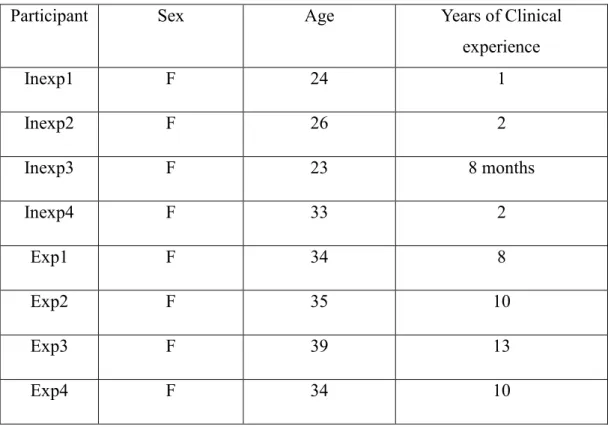
A total of eight participants were interviewed for this study. Inexperienced psychotherapist participants were named: Inexp1, Inexp2, Inexp3, and Inexp4. Experienced psychotherapist participants were named: Exp1, Exp2, Exp3, and Exp4.
Inexp1 is a 24 year old woman, currently training in a clinical psychology graduate program, who has 1 year of active clinical experience. Inexp2 is a 26 year old woman, who graduated from a clinical psychology graduate program and has 2 years of active clinical experience. Inexp3 is a 23 year old woman, currently training in a clinical psychology graduate program, who has 8 months of active clinical experience. Inexp4 is a 33 year old woman, currently training in a clinical psychology graduate program, who has 2 years of active clinical experience. Exp1
is a 34 year old woman, who graduated from a clinical psychology graduate program and has 8 years of active clinical experience. Exp2 is a 35 year old woman, who graduated from a clinical psychology graduate program and has 10 years of active clinical experience. Exp3 is a 39 year old woman, who graduated from a clinical psychology graduate program and has 13 years of active clinical experience. Exp4 is a 34 year old woman, who graduated from a clinical psychology graduate program and has 10 years of active clinical experience.
Table 1. Information of the Participants
Participant Sex Age Years of Clinical
experience Inexp1 F 24 1 Inexp2 F 26 2 Inexp3 F 23 8 months Inexp4 F 33 2 Exp1 F 34 8 Exp2 F 35 10 Exp3 F 39 13 Exp4 F 34 10 3.2. PROCEDURE
The participants were recruited by the snowball method. After the approval of the Ethics Committee for Social Sciences at the Istanbul Bilgi University, the information about the study was announced by the primary investigator (PI) via the contacts of the colleagues and peers of the PI and more potential participants were
recruited.. Then the potential participants were approached by the PI and those who volunteered to participate in the study were informed about the study’s purpose, procedure and confidentiality.
Before starting the interviews, a consent form was given to participants, which explains study’s purpose, procedures, confidentiality, risks and benefits. The consent form was signed by the participants who were willing to proceed. The interviews lasted 45 minutes to 1 hour. All interviews were done in Turkish. The audio of the interviews were recorded and transcribed by the PI.
3.3. DATA ANALYSIS
This study’s purpose is to fully understand the meaning of therapists’ subjective experiences of difficult clinical moments while staying true to its essence, so the most convenient method for this study would be phenomenological analysis. Interpretative Phenomenological Analysis (IPA; Smith & Osborn, 2008) was used to deeply understand meaning of the subjective experiences of difficult clinical moments for both inexperienced and experienced psychotherapists in a phenomenological manner. The recorded audios of the interviews were listened and transcribed to Microsoft Word program by the PI. The transcriptions of the interviews were read and re-read before coding. The interviews were read line by line and initial notes were taken. The initial notes are what stands out in the first place from the data in the basis of experiences, feelings and difficulties. In the data analysis process, a three column system was used. In this system middle column is for the transcript of the data and right column is for the initial notes. After the initial notes, the matters that seems important were extracted and the emergent themes for each participant were written on the left column. Then a list of emergent themes was prepared in the Microsoft Excel program and the emergent themes were clustered into larger themes. Since this study is a comparison of the experiences of the therapists, two categories were prepared as similarities and differences. Lastly, the larger themes that are related to each categories were grouped and created the superordinate themes. The data of this study and the superordinate themes for each
category were discussed with the advisor of this study, who is an experienced psychotherapist.
3.4. VALIDITY
This study is a qualitative study, performed with the IPA method and has no claim of making a statement about the general psychotherapist population; its purpose was to make a phenomenological analysis of the meaning of the difficulty experiences. So, even though the external validity is an unrelated issue in this study, the internal validity is important.
In terms of testing the validity of a study, the four criteria of validity that Yardley (2000) introduced was found helpful:
First criterion of validity is sensitivity to context (Yardley, 2000). In terms of this criteria, the theoretical, sociocultural, personal and ethical backgrounds of the participants was taken into account. In the theoretical context, the literature about therapeutic relationship and the experiences of the psychotherapists were reviewed. The participants of this study are clinical psychologists, with similar educational backgrounds, living and working in Istanbul. So the therapeutic and sociocultural factors were taken into consideration. The participants discussed their training and sociocultural backgrounds in the interviews. The ethical issues of the study were discussed with the advisor of the study and the data collection procedure was started after the approval of the Ethics Committee for Social Sciences at the Istanbul Bilgi University.
Second criterion of validity is commitment and rigour (Yardley, 2000). Even though it was PI’s first experience of an IPA study, the study was conducted as studious as possible. The PI was trained on how to conduct IPA studies and took research supervision from her advisor. The relevant literature was reviewed thoroughly and the data of the study was used in the best possible way.
Third criterion of validity is coherence and transparency (Yardley, 2000). In terms of this criterion, the PI was endeavored to make clear and transparent descriptions in the literature review, method, results and discussion sections.
Fourth and last criterion of validity is impact and importance (Yardley, 2000). In the implications and recommendations sections, the implications that arised as a result of this study were considered in order to manifest the the impact and importance of this study.
4. RESULTS
According to the analysis of the interviews, the superordinate themes that show similarities and differences between experienced and inexperienced psychotherapists’ experiences of difficult clinical moments are shown in the table below:
Table 2. Superordinate Themes
Themes showing similarities Themes showing differences 1. Fear of boundary violations 1. Feeling Incompetent 2. Avoiding revealing feelings 2. Anger
3. Sadness 3. Intolerance to uncertainty
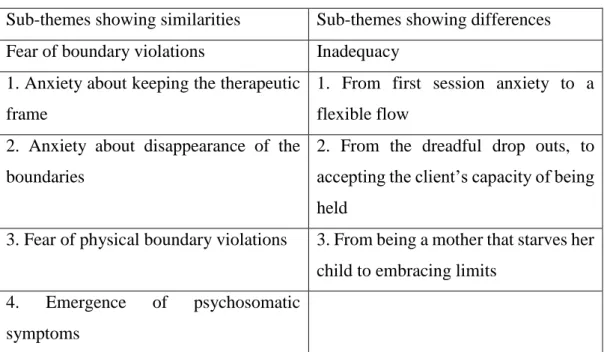
Some main themes in each group have some subordinate themes that can be seen in the table below:
Table 3. Subordinate themes
Sub-themes showing similarities Sub-themes showing differences Fear of boundary violations Inadequacy
1. Anxiety about keeping the therapeutic frame
1. From first session anxiety to a flexible flow
2. Anxiety about disappearance of the boundaries
2. From the dreadful drop outs, to accepting the client’s capacity of being held
3. Fear of physical boundary violations 3. From being a mother that starves her child to embracing limits
4. Emergence of psychosomatic symptoms
4.1. THEMES SHOWING SIMILARITIES BETWEEN EXPERIENCED AND INEXPERIENCED PSYCHOTHERAPISTS
Below there are main themes that were found to be similar between experienced and inexperienced psychotherapists when it comes to their experiences of difficult clinical moments. For a theme to be common between each groups of participants, it had to be narrated by at least two of the four participants in each group.
4.1.1. Fear of Boundary Violations
All participants of this study stated that they experience fear of boundary violations in the difficult moments in psychotherapy.
4.1.1.1. Anxiety about keeping the therapeutic frame
There are several situations that evoke feelings of fear during psychotherapy. One of them is about keeping the therapeutic frame. Both experienced and inexperienced psychotherapist mentioned that they feel fearful and anxious towards patients that are aggressive towards the therapeutic frame.
For instance, Exp1, who was one of the experienced psychotherapists, was working with a client who was aggressive towards the therapeutic frame and who threatened to make a complaint about her:
“I felt that I was in danger. The client was trying to circumvent me. It was like the client was trying to restrict my range of motion. It was like I was in danger, I felt terrified. I tried to keep the therapeutic frame but then I had a feeling like it’s harming my client, keeping the frame is harmful and the client will make a complaint about it and put me in danger. Like this client, the clients that are aggressive towards the therapeutic frame always terrify me. It’s a blurry area for me, remaining there. For example, when a client calls me in inappropriate ways or texts me on WhatsApp…in other words, stepping
outside of the therapy room terrifies me. I have to keep the therapeutic frame, for me and my client’s best interest. I’m scared of stepping outside of the frame, failing to keep it and letting a client manipulate me and not realizing it.” (exp1)
One of the participants who is an inexperienced psychotherapist, Inexp1, also shares this anxiety about keeping the frame and violating the boundaries herself:
“The only solid thing in psychotherapy I’m holding on to is the therapeutic frame and recently I became very obsessive about it. I’m terrified of the things that may occur in the therapy room if I don’t hold on to it discretely. Every kind of boundary violation comes to my mind. The thing I fear the most is that I unintentionally make a boundary violation. What if I fail to realize that I made a boundary violation? Because it’s normal and expected that a client violates the boundaries, the client desires the boundaries to disappear. As a client in my psychotherapy process, I experienced it. It’s me, the therapist that has to keep the frame discretely and I’m scared of failing to hold it. For example, I don’t shake hands with clients. I’m afraid of it. It’s a simple thing, many therapists think its ok to shake hands. Sometimes in sessions I make jokes when appropriate. At first I found it harmless, moreover a good thing for maintaining the therapeutic relationship. But now I constantly think about every word I say, worrying that it might be understood wrongly and cause a boundary violation. I feel terrified. Probably it’s about my own desires. What happens inside the room stays inside the room. We, as therapists, determine the therapeutic frame. Therapist is ethically responsible of the clients. So, it’s very scary.” (inexp1)
4.1.1.2. Anxiety about disappearance of the boundaries
Some participants state that they fear the disappearance of the boundaries between them. Sometimes they identify with the client and fear that their inner world, their dynamics, will interfere with the clients and damage the therapeutic relationship.
Exp4 narrates this fear:
“I’m scared of reflecting my dynamics, my patterns to the client. I fear that the boundaries will become permeable. Like every person in the world, I have personal issues too but I fear that these issues, my inner world will plague the sessions, blend with client’s inner world.” (exp4)
When Exp3 started doing psychotherapy in her native language, she states that she felt traumatized:
“I haven’t been speaking my native language since I came here when I was 7 years old. Until the age of 7, my inner world, my personality was built on the foundation of my native language. When I started a therapeutic process with a client in my native language, I realized that I feel the emotions more intensely than when I work in Turkish. This was so hard for me. It revealed so many raw and unnamed emotions inside of me. I felt traumatized, I was scared a lot. It was like boundaries disappeared. Our inner worlds got blended. The feeling was so heavy for me. I would say that it was a situation beyond counter transference.” (exp3)
Inexp1, tells that she experiences dissociations with a client and fears that their inner worlds are blending with each other:
“These dissociative state I found myself in terrified me. The feeling of disappearance and being groundless I experience in sessions was terrifying.