Influence of Nitrate, Phosphate and Herbicide Stresses on Nitrogenase
Activity and Growth of Cyanobacteria Isolated from Paddy Fields*
Gulten OKMEN (Kurucuoglu)1 Gonul DONMEZ2 Sedat DONMEZ31 Mugla University, Faculty of Science and Arts, Department of Biology, Mugla, TURKEY 2Ankara University, Faculty of Science, Department of Biology, Ankara, TURKEY 3Ankara University, Faculty of Engineering, Food Engineering, Ankara, TURKEY
Corresponding author:
e-mail : [email protected]
* This study is a unit of Ph.D.Thesis Received : 20 June 2006 Accepted : 11 August 2006
Abstract
Samples were collected from paddy fields in Corum-TURKIYE. Nitrogen-free BG-11 medium was used for isolation of nitrogen fixing cyanobacteria. Acetylene reduction technique was used to determine the effects of different chemical agents on the nitrog enase activities of t he cyanobacteria, which wer e identified at the genus level. Nodularia showed the highest nitrogenase activity (0.006 ethylene µl/ mg.h) at 10mM nitrate concentration. At 25mM phosphate concentration, Nodularia showed the highest nitrogenase activity (0.006 ethylene µl/ mg.h ). The highest tolerances for the herbicides were present in Nodularia (0.06 ethylene µl/ mg.h) for bensulphuron (50µg /ml) and Nostoc 6 ethylene µl/ mg.h (for molinate 100µg / ml).
Key words:
Cyanobacteria, nitrogenase activity, isolation, environmental factors
INTRODUCTION
The utilization of nitrogen g as (N2) as a s ource of
nitrogen is c alled nitrogen fix ation and it is a p roperty of only certain pr okaryotes [1, 2 ]. Soil algae, particular ly nitrogen fixing cyanobacteria, are important photosynthetic microorganisms becaus e they contribute to s oil ferti lity b y fixing the atmospheric nitrogen.
In the fixation processs, N2 is reduced to a mmonium and
the ammoni um is converted to the organic for m. The reduction proces s is cataly zed by the nitrogenas e which consists of two separate protei ns called dinitr ogenase and dinitrogenase reductas e [2, 3]. Nitrogenase activity is controlled by a complex regulon called the nif regulon [4, 5].
Biological processes contribute 65 % of the nitrog en used in agriculture [6]. Biological nitrogen fixation contributions to rice culture up to 75kgN ha-1 per culture cycle [7]. Free living
microorganisms on temperate soi l and waters are thought t o fix as much as 45-100kg N ha-1 yr-1 only cyanobacteria fix as
much as 28 kg N ha-1 yr-1[8]. More over, biofertilizers have
been more important because algalization may be effect plant size, nitrogen content and the num ber of tillers, ears, spikelet s and filled grains per panicle.
Certain photos ynthetic bacter ia fix N2, but only under
anaerobic cond itions. Th e nitrogen fixation has been affected b y environmental f actors. Nitrat e, pho sphate and herbicide s tresses are an important environmental factors affecting algal growth and nitrogenase activity.
Singh [9] sugge sted that cu ltures of Nostoc sp. rapidly and significantly lost their ability to reduc e acetylene when incubated with 2mM NH4Cl an d 5mM glutamine in light.
Prosperi et al. [10] determined that the input of nitrogen fertilizers to field reduces nitr ogen fixation since the presence of co mbined nitr ogen in hibits nit rogenase activity , also they researched the repressive effect of ammonium on nitrogenase activity at neutral pH but not at al kaline pH, and it is so-called “fast switch-off”. Singh et al. [11 ] found that nitr ogenase and heterocyst were repressed by NH3 at Anabaena cycadeae.
Juan et al. [12] reported that trans fer of N2-fixer filamentous
cyanobacteria fr om media c ontaining a source o f co mbined nitrogen to a medium lacking combined nitrogen provokes the differentiation of heterocyst, specialized cells able to perform dinitrogen fixati on [13, 1 4]. Me eks et al. [15] i nformed t hat both of species of Anabaena sp were maxi mum inhibited of
acetylene reduction activity and heterocyst formation between 25 and 100µM (69% and 36%), and they did not increase a t higher nit rate concentrations. Moisander a nd Pearl [1 6] explained that dis solved i norganic N is a factor becaus e it inhibits nitrogenase. Sroga [17] also indicated that nitrogenase activity of Microcoleus sp. was inhibited by NO3, NH3, urea
under the light and dark phase. Anneliese et al. [ 18] reported that the effection of inhi bitory of NH3 haven’t been under the
anaerobic condi tions. Jose et al. [19] dete rmined that nitrogenase structural genes and some other genes related t o dinitrogen fixati on repre ssion b y ammo nium a nd differe nt degrees of inhibition have been reported for different strains at nitrate. Bottom ley et al . [20] re vealed that both of NH 4NO3
and KNO3 completely repressed heterocyst development and
nitrogenase activity at Anabaena sp. Valiente et al. [21] found that there was a negative correlation between ammonium and nitrogenase activity and the ac tivation of nitrogenase wa s sharply inhibited. Turpin et al. [22 ] reporte d that 1mM ammonium at all pH was repressed the nitrogenase activity on Anabaena flos-aquae a nd at hig her p H, t he pr oportion o f unprotonated ammonia increases and diffusion across the call membrane can occur.
Adhya et al. [23] said that phosphorus is one of macronutrient essentials for plant growth, and addition of P to rice fields promotes root growth and rhizosphere activity and heterotrophic nitrog en fi xation. Wilson and Alexander [24] established that phosphate equ ivalent to 30kgP/ha stimulated nitrogen fixation by about 60%, an d the growth of nitrogen fixing algae was also limited in flooded paddy fields. Accordin g to Turid [25], phosphorus f ertilization stimulated the nitrogenase a ctivity, bu t to s ome other researchers; it was repressed [26, 27]. Lehtimaki et al. [28] observed that growth of Nodularia sp. incubation in different phosp horus concen trations was barely d etetable during first 21 days. Huber [29] found that th e rate of more or less than 0.9 µM the phosphate concentration is the best condition for akinet growth at Nodularia sp. Leganes et al. [30] established that grain yielding on paddy field stimulated at 100kgP/ha treatments .
Jianyi et al. [31] searched on the effect of 40 herbicides on Chlorella vulgaris and t hey were determ ined that the photosynthetic p eriod of Chlorella vulgaris wa s effected by molinate and the acetolactat sintase of Chlorella vulgaris was
effected by bensulfuron – methyl. Yan et al. [32] researched that the effects of molinate at Anabaena sphaerica on 30 0-3000 lu x (5, 25, 50µg/ ml) and some specific pr oteins were prevented functionally by toxic effect. Mansour et al. [33] and Caux et al. [34] demonstrated that toxic effect of molinate is more effective at low light inte nsity (300lux) tha n high light intensity (3000l ux) and it was related to organic carbon s which was more assimilated in this condition.
Rice cultivation in Indi a star ted in assured irrigation areas during the rainy summer season before 25 to 30 years ago [35] . Herbicid es us ed in rice are categorized into preplant, pr eemergence and pos temergence [36 - 38] . The role of environmental factors on nitrogenase activity is not known yet. Because of this it needs to work on it. This paper summarizes effects of this n itrate, phosphate an d herbicide stresses on gro wths and nitrog enase activities of nitrog en-fixing Anabaena, Nostoc and Nodularia sp.
MATERIALS AND METHODS
Materials
The filament ous, heterocy stous cy anobacteria were use d in thi s st udy in which Anabaena, Nodularia and Nostoc sp . which were isol ated from soil with wate r sa mples obtaine d from rice field s in Coru m, Tür kiye. Nostoc and Nodularia strains were obtained from previous studies of Prof. Dr. Gonul Donmez.
Isolation and p urification wer e performed b y dilution and plating of soil and water samples. Stock cultures were grown in the N-free BG-11 medi um as previously described [10]. Temperature was maintained at 20°C and cultures were
grown under a cool white light (600lux). Cells in the logarithmic phase of growth were collected from stock cultures and used as inocula for experiments.
Experiments were conducted in batch cultures by using 10 ml of i noculated medium in 25ml. Erlenmyer flasks enclo sed with cotton plugs. Culture m edia were adjus ted a ccordingly pH (7, 8, 9) with 1N Na OH and 1N HCl. Illu mination wa s supplied with 600lux cool white light [39 - 41].
Methods
Determination of nitrogenase activity
Nitrogenase activity was m easured b y acetylene reduction techn ique using in 10 ml aliquots of cell suspensions placed in stoppere d 35 m l serum bottles [42] . Cultures were grown under the differ ent en vironmental conditions were enclosed by plastic plugs and p arafin, then 1ml of acetylene gase was injected into the serum bottles.
Cultures were incubated fo r 12h under the exp eriment conditions. After the incubation periods, samples (1ml) were
taken from serum bottles with gas-tight s yringes, inj ected into the gas ch romatograph, and eth ylene co ncentrations were determined using a Shimadzu GC-14B.
Determination of dry weight
The p ellets of centrifuged cultures were was hed with distilled water three times, then dried to constant weight at 70°C for 12h [10, 43]. Dry weight were measured.
Influence of nitrate, phosphate and herbicides on nitrogenase activity and growth
The inf luence of differ ent co ncentrations of KNO 3
(0.5mM-50mM), K 2HPO4 (10µM-1M),
bensulphuron-methyl (50-500 µg/ml) and mo linate (5-50µg/ml) on the nitrogenase a ctivity we re also te sted on Anabaena, Nostoc and Nodularia.
The exp erimental cul tures were grown in 25ml flasks containing 10ml N-free BG-1 1 medium under the same conditions as described below. According to R ippka [41] , the axenic cultures were grown in a liquid sterilized medium at 20 ± 2°C under fluorescent light (600lux) for 35days. At
the end of 35 days, nitrogenas e activ ity of cu ltures was determined using the acetylene reduction technique. For dry weight was mad e as d etermination described by Cappucino et al. [43]. All experiments we re performed in triplicate and parallel conditions.
RESULTS
When Anabaena, Nostoc and Nodularia sp was cultured in the presence of various n itrate, phosphate and herbicide concentrations, distinct eff ects were s een on nitrogenase activities and growths.
Effects of nitrate on nitrogenase activity and growth
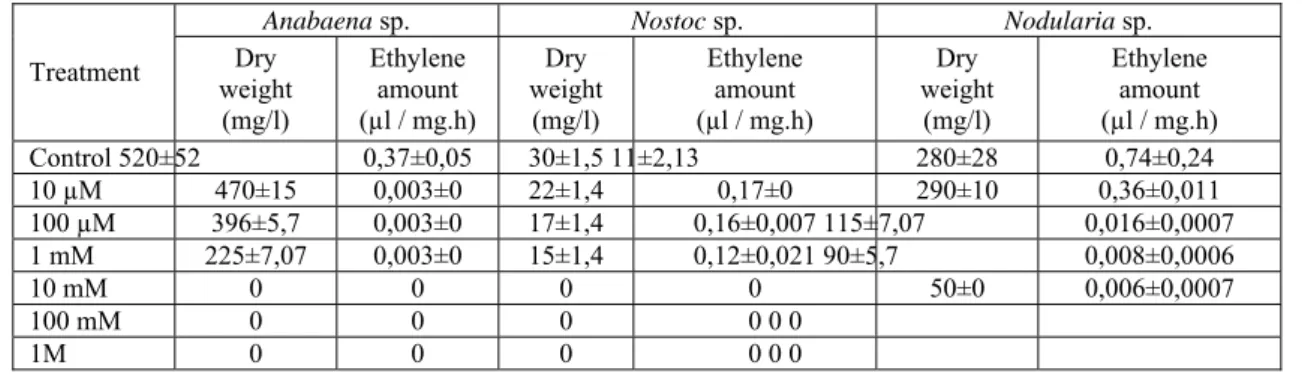
The growths and nitrogenase activities of Anabaena, Nostoc and Nodularia s p treat ed wit h differen t concentrations of nitrate unde r 600 lux light in tensity ar e listed in Table1. It c an be se en that the ni trate m arkedly inhibited the g rowths and n itrogenase a ctivities of all cultures. The inhibitory effect increased with the increase in nitrate concentr ation. Under 100mM nitrate concentr ation, the ni trogenase act ivities of all cul tures wer e com pletely reduced. The h ighest nitrog enase a ctivity of Nostoc sp a t different concen tration wer e registered with 1 mM nitrate (0.12µl ethylene / m g.h). The lowest nitrogenase activity of Nodularia sp at different concentration were found with 10mM nitrate (0.006µl eth ylene / mg.h). The growths of Anabaena and Nostoc sp. completely repr essed at 10mM, but the growth of Nodularia sp supressed at 100mM nitrate concentration.
Table 1. Effects of nitrate on nitrogenase activity and growth of cyanobacteria **
Anabaena sp. Nostoc sp. Nodularia sp.
Treatment weight Dry (mg/l) Ethylene amount (µl / mg.h) Dry weight (mg/l) Ethylene amount (µl / mg.h) Dry weight (mg/l) Ethylene amount (µl / mg.h) Control 520±52 0,37±0,05 30±1,5 11±2,13 280±28 0,74±0,24 10 µM 470±15 0,003±0 22±1,4 0,17±0 290±10 0,36±0,011 100 µM 396±5,7 0,003±0 17±1,4 0,16±0,007 115±7,07 0,016±0,0007 1 mM 225±7,07 0,003±0 15±1,4 0,12±0,021 90±5,7 0,008±0,0006 10 mM 0 0 0 0 50±0 0,006±0,0007 100 mM 0 0 0 0 0 0 1M 0 0 0 0 0 0
** Nitrate effects on the growth ( p < 0.01 ).
Effects of phosphate on nitrogenase activity and growth
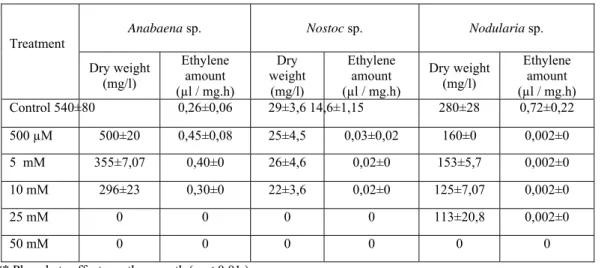
The eff ect of p hosphate on nitrogenase activities and growths of all cultur es shown (Table2). Anabaena and
Nostoc sp. wer e shown to tolerance to 10m M phosphate concentration and Nodularia sp. was shown to toleran ce to 25mM. Nitrogenase activity of Anabaena sp. was stimulated at 500µM phosphate con centration but increasing
concentrations repressed the nitrogenase activity. In Nostoc and Nodularia sp., the a ctivities repressed with incr easing phosphate con centrations durin g the in itial p eriod. The growths of Anabaena and Nostoc sp. c ompletely re pressed
at 25mM and higher phosp hate concentrations, and Nodularia sp. completely suppr essed at 50mM phosphate concentration (Table2).
Table 2. Effects of phosphate on nitrogenase activity and growth of cyanobacteria **
Anabaena sp. Nostoc sp. Nodularia sp.
Treatment Dry weight (mg/l) Ethylene amount (µl / mg.h) Dry weight (mg/l) Ethylene amount (µl / mg.h) Dry weight (mg/l) Ethylene amount (µl / mg.h) Control 540±80 0,26±0,06 29±3,6 14,6±1,15 280±28 0,72±0,22 500 µM 500±20 0,45±0,08 25±4,5 0,03±0,02 160±0 0,002±0 5 mM 355±7,07 0,40±0 26±4,6 0,02±0 153±5,7 0,002±0 10 mM 296±23 0,30±0 22±3,6 0,02±0 125±7,07 0,002±0 25 mM 0 0 0 0 113±20,8 0,002±0 50 mM 0 0 0 0 0 0
** Phosphate effects on the growth ( p < 0.01 ).
Effects of bensulfuron-methyl on nitrogenase activity and growth
Table 3 summarise the eff ects of bensulfuron- meth yl concentrations on all of th e cultures. The maximum tolerance (0.06µl ethylene / mg.h) was seen at Nodularia sp. in 50µg/ml bensulfuron- meth yl concentration. I n Anabaena and Nostoc sp., the tolerances were found in 40 µg/ml bensulfuron- methyl concentration.
Although a low bensulfuro n-methyl con centration (5µg/ml) so mewhat sti mulated nit rogenase activity, at hi gher concentrations n itrogenase activity wa s severely i nhibited at Anabaena sp. In Nodularia sp., th e ni trogenase a ctivity inhibition with bensulfuron-methyl at 5µg/ml was severely. For Nostoc sp., the highest nitrogenase activity was seen at 30 µg /ml be nsulfuron-methyl. T he n egative i mpact of high bensulfuron-methyl on the bioma ss of a ll cultures wa s a lso shown.
Table 3. Effects of bensulfuron-methyl on nitrogenase activity and growth of cyanobacteria **
Anabaena sp. Nostoc sp. Nodularia sp.
Treatment (µg/ml) weight Dry (mg/l) Ethylene amount (µl / mg.h) Dry weight (mg/l) Ethylene amount (µl / mg.h) Dry weight (mg/l) Ethylene amount (µl / mg.h) Control 420±20 0,24±0,04 45±5,6 6,25±0,9 210±10 1±0,2 5 480±30 0,8±0,03 50±1,5 5,8±1,0 145±7,07 0,09±0 10 450±10 0,25±0,03 41±3,5 4,6±0,2 143±5,7 0,08±0,011 20 415±35 0,26±0,014 30±0,7 4,5±0 130±14 0,07±0,02 30 250±30 0,25±0,02 19±2,6 4,5±0 115±7,07 0,07±0,007 40 0 0 0 0 105±7,07 0,07±0 50 0 0 0 0 90±10 0,06±0,006
**Bensulfuron-methyl effects on the growth ( p < 0.01 ).
Effects of molinate on nitrogenase activity and growth
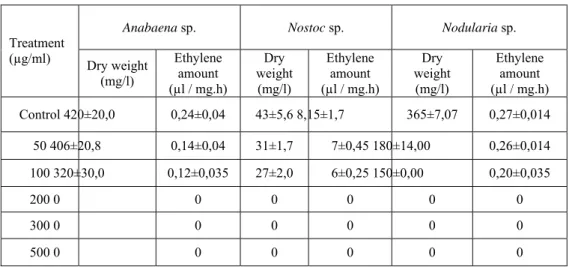
The results in Table 4 show that the nitrogenas e activities and gr owths decreased at al l molinate levels. The minimum activity was de termined at Anabaena sp. (0.12µl ethylene / mg.h) whereas, the highest activity was shown at Nostoc sp. (6µl ethylene / mg. h). T he ma ximum t olerance
were seen at all of cu ltures in 100µg/ml molinate concentration.
Molinate exp eriments have shown that the initia l nitrogenase activity of Nodularia sp. at low concentration of molinate (50µl / ml) does not chang e. Th e nitrogen ase activities of all cultures completely repressed at 200 µg/ml molinate concentration.
Table 4. Effects of molinate on nitrogenase activity and growth of cyanobacteria **
Anabaena sp. Nostoc sp. Nodularia sp.
Treatment (µg/ml) Dry weight (mg/l) Ethylene amount (µl / mg.h) Dry weight (mg/l) Ethylene amount (µl / mg.h) Dry weight (mg/l) Ethylene amount (µl / mg.h) Control 420±20,0 0,24±0,04 43±5,6 8,15±1,7 365±7,07 0,27±0,014 50 406±20,8 0,14±0,04 31±1,7 7±0,45 180±14,00 0,26±0,014 100 320±30,0 0,12±0,035 27±2,0 6±0,25 150±0,00 0,20±0,035 200 0 0 0 0 0 0 300 0 0 0 0 0 0 500 0 0 0 0 0 0
** Molinate effects on the growth ( p < 0.01 ).
DISCUSSION
As stated in th e introduction, soil alg ae ar e grown in different env ironmental fact ors. Variation in growth conditions influenced the growths and nitrog enase activities of all gener a. Nitrate is an im portant one th at affects the algal growth. Generally , the addition of nitr ate inhibited both the algal growth and nitrog enase activity. All nitrogenase act ivities were shar ply repr essed and the algal growth was partly inhibited by nitrate (Table 1).
This confirms the repor t b y Huber [44] for the Nodularia, and it is sim ilar to the reports Bottem ley e t al.[20], who found that the nitrogenase activity of Nodularia suppressed by the addition of nitrate.
According to th e li terature, th e maximal inhibi tion of acetylene redu ction and he terocyst formation in A. cylindrica occurred between and 25 and 100 µM and did not increase at h igher nitrate concentrations [15]. Its results are similar to thos e of our studies. Th ese r esults can be explained in this way: the nitrogenase activity inactivated by nitrate, which resem bles the so-call ed “ switch-off”, observed in phototrophic bacteria.
The comparison of nitrogenase activities of alg al cells under the different phosphate concentration, the nitrogenase activity of Anabaena sp. stimu lated at 500µM phosphate concentration, whereas the nitrogenase activities of the other two species inhibited (Table 2).
In addition, the algal growths of all the c ultures were partly suppressed. These results may b e describ ed like th e following: phosphate is necessary for the algal growth but it is not necessary for the nitrogenase activity [23]. According to the resear ch [25], phosphorus fertilization stimulated the nitrogenase activity and the highest activ ity w as obtained with about 300 µM (200 µE/m2.s) at Anabaena sp., also the
nitrogenase activity of Nostoc s p. s timulated at 12mM phosphate con centration, however more phosphate concentrations repressed the n itrogenase activity, the result of which is sim ilar to this stud y. In Nostoc and Nodularia sp., the nitrog enase activities inhibited at th e beginning (Table2). These results seem to suggest that phosphorus stimulated nitrogenase activity in P- starved cells but not in P- suffient cells [44].
It is anon ymously repor ted th at [45] , bensulfuron- methyl and m olinate are mostly used for elim inating weeds in padd y fields in Corum- Osmanc ık in Turkiye. For this reason, two herbicid es were chosen for this stud y. In herbicide tr eatments, bensulf uron- meth yl stimulated nitrogenase activity of Anabaena sp. at 5µg/ml but not in
higher con centrations. W hereas the ni trogenase ac tivities and growths of other two species were inhib ited during the initial concentrat ion (5µg/ ml) (T able3), it was dem onstrated that Anabaena sp . w as cap able of gr owing b oth photoautotrophically and photohe terotrophically like bacteria to a great extent [32, 46].
In m olinate tr eatments, all ge nera d emonstrated to tolerance to 100 µg/m l level of molinate concentration. In addition, the nitrogenase activities and growths of all genera completely rep ressed with a n incre ase in m olinate concentration. Yan et al.[32] reported that A. sphaerica kept growth rate at 100 µg/ml molinate concentration. This result is similar to our studies.
Most reports de monstrated that the inhibitory effect of herbicide bec ame greater wit h an increas e in herbicid e concentration and suggested that the reduction in the growth rate of algae m ay be due to a decr ease in alg al photosynthesis caused b y th e inhibition of sy nthesis of chlorophyll, the most important pigment in alg al cel ls for collecting solar energy for photosynthesis [47, 48].
The d ata obta ined in this stud y prov ide infor mation about the inhib itory effect of the differen t env ironmental factors on growths and nitrogen ase activities of all genera, under which the cyanobacteria exhibits diff erent sensitivity to the factors. These findings suggest a ban on the use of molinate and bensulfuron- methy l in paddy fields, owing to its inhib itory effect. Moreov er, these results s howed tha t nitrate and pho sphate f ertilizers could b e app lied und er lower concentrations to rice fields.
Several d ifferences in th e gr owth and nitro genase activity rates of Nodularia, Nostoc and Anabaena sp. were observed, which may explai n the differ ent vertical, horizontal and temporal distribu tion of th e thr ee gener a in paddy fields. I n this study , we have shown a clear physiologic dist inction be tweeen Nostoc sp. an d the other strains. Ge nerally Nostoc sp. had the bes t optimal performance of nitrogen ase a ctivity in al l en vironmental conditions, so it is thought that it is a suitable genus for biofertilizer. A better unders tanding of the mechanisms require fu rther stud y about the nitr ate, pho sphate and herbicide stresses.
REFERENCES
[1]. Manahan SE. 1997. The Nitrogen C ycle. In: Environmental Science and Techno logy, Lewis Publishers, N.York, 466-468.
[2]. Madigan MT, Martinko JM an d Parker J. 1997 .Brock Biology of Microorganisms. Prentice-Hall Int. Ltd. 8th edition. In: Chapter 4, pp. 13,14, and 15, London. [3]. Vignais PM. et al. 1985. Biochemistry of nitrogenase.
Advances in Microbial Physiology, 26: 190-234. [4]. Postgate J. 198 9 Trends and p erspectives in nitrogen
fixation resear ch. Advance in Microbial Physiology, 30: 1-21.
[5]. Herrero A, Muro-Pastor AM and Flores E. 2001 Nitrogen contr ol in cy anobacteria. Journal of Bacteriology, 183 (2): 411-425.
[6]. Albrecht SL. 1998. Eukar yotic algae and cyanobacteria. In: Principles and Applications of Soil Microbiology, Prentice-Hall, Inc., America, 94-103. [7]. Irisarri P, Gonnet S and M onza J. 2001. Cyanobacteria
in Uruguay an r ice fields: diversity, n itrogen fixing ability and tol erance to herb icides and com bined nitrogen. Journal of Biotechnology, 91 (3): 95-103. [8]. Metting B . 1990. Micro algae applications in
agriculture. Developments in In dustrial Microbiology, 31: 265-270.
[9]. Singh S. 19 91. Involv ement of ammonium assimilation in ammonium inhibition of nitrog enase activity in cyanobacterium, Nostoc Anth. Indian Journal of Experimental Biology, 29 (6) : 496-497. [10]. Prosperi C, Luna C and Valiente EF. 1993. Influence
of pH light intensity and ox ygen on th e short-term effect of ammonium on nitrogenase activ ity of cyanobacteria f rom rice fi elds. Environmental and Experimental Botany, 33 (4): 545-552.
[11]. Singh HN, Rai UN, Rao VV and Bagch i SN. 1983 Evidence for a mmonia as an inhibitor of heterocy st and nitrog enase formation in the cy anobacterium Anabaena cycadeae. B iochemical and Bioph ysical Research Communications, 111(1): 180-187.
[12]. Juan LR, Francisco M and Miguel GG. 1985. Regulation of nitrogenase levels in Anabaena sp. and other f ilamentous cy anobacteria Archives of Microbiology, 141:105-111.
[13]. Haselkorn R. 1 978. Hetero cysts. Annual Rev iew of Plant Ph ysiology and Plant Molecu lar Bio logy, 29: 319-344.
[14]. Stewart WDP. 1980. Some as pects of structu re and function in N2 fixing cy anobacteria. Annual R eview
Microbiology, 34:497-536.
[15]. Meeks JC, Wycoff KL, Chapman JS and Enderlin CS. 1983. Regulation of expression of nitrate and
dinitrogen assimilation b y Anabaena species. Applied and Environmental Microbiology, 45 (4): 1351-1359. [16]. Moisander PH and Paerl HW . 2000. Growth, pr imary
productivity and nitrogen f ixation potential of Nodularia spp. in water from a subtropical estuary in the United States. Journal of Phycology, 36: 645-658. [17]. Sroga GE. 1997. Regulation o f nitrogen fix ation b y
different nitrog en sources in the f ilamentous non-heterocystous cyanobacterium Microcoleus sp. FEMS Microbiology Letters, 153: 11-15.
[18]. Anneliese E, Reich S, and Böger P. 1990. Modification o f dinitrog enase reductase in the cyanobacterium Anabaena variabilis due to C starvation and ammonia. Journal of Bacteriolog y, 172 –2: 748-755.
[19]. Jose MN, Herrero A and Flores E. 1991. Contr ol of nitrogenase mRNA levels b y products of nitrate assimilation in the cyanobacterium Anabaena sp. strain PCC7120. Plant Physiology, 97: 825-828.
[20]. Bottomley PJ, Grillo JF, Ba alen CV and Tab ita FR. 1979. S ynthesis of nitrogen ase and heterocy sts b y Anabaena, sp. CA in the presence of high levels of ammonia. Journal of Bacteriology, 140 –3: 938-943. [21]. Valiente EF , Quesada A, P rosperi C, Nieva M ,
Leganes F and Ucha A. 1997. Short and long term effects of ammonium on ph otodependent n itrogen fixation in wetland rice f ields of Spain. Biology and Fertility of Soils, 24: 353-357.
[22]. Turpin DH, Edie SA and Canvin DT. 1984. In vivo nitrogenase regulation by ammonium and methylamine and the effect of MSX on a mmonium transport in Anabaena flos-aquae. Plant Physiology, 74: 701-704. [23]. Adhya TK, Pattnaik P, Satpathy SN, Kumaraswamy S,
and Sethunathan N. 1998. Inf luence of phosphorus application on methane emission and production in flooded paddy soils
Soil Biology & B iochemistry,
30-2: 177-181.[24]. Wilson JT and Alexander M. 1979. Effect of soil nutrient status and pH on nitrogen-fixing algae in flooded soils. Soil Science Society of America Journal, 43: 936-939.
[25]. Turid L. 1999. Environmental factors influ encing the nitrogen fixa tion ac tivity of f ree- living t errestrial cyanobacteria f rom a hight arctic area. C anadian Journal of Microbiology, 45-(7): 573-581.
[26]. Basilier K, Gr anhall U and Stenström TA. 1978. Nitrogen fixation in wet minetrophic mos s communities of a subarctic mire. Oikos, 31: 236-246. [27]. Chapin DM, Bliss LC and Bledsoe LJ. 1991.
Environmental regulation of nitrogen fixation in a high arctic lowland ecosystem. Canadian Journal of Botany, 69: 2744-2755.
[28]. Lehtimaki J, Moisander P, Sivonen K and Kononen K. 1997. Growth, nitrogen fix ation and no dularin production b y two Baltic Sea cyanobacteria. Applied and Environmental Microbiology, 63 (5): 1647-1656. [29]. Huber AL. 1985. Factors aff ecting the germination of
akinetes of Nodularia spumigena. Applied and Environmental Microbiology, 49 (1):73
[30]. Leganes F, Carreres R, Tome RG, Nieva M , Quesada A, Sendra J and Valiente EF. 2001. Ef fect of phosphate fertilisation, straw incorporation, insecticide application and inoculation with cyanobacteria on rice productivity. Invest. Agr. Prod. Prot.Veg., 16 (2): 273-282.
[31]. Jianyi M, Ligen X, Shufeng W, Rongquan Z, Shuihu J, Songqi H and Youjun H. 2002. Toxicity of 40 Herbicides to t he Green Alg a Chlorella vulgaris. Exotoxicology and Environmental Saf ety, 51: 128-132.
[32]. Yan GA, Yan X and Wu W. 1997. Eff ects of the herbicide molinate on mixotrophic gr owth, photosynthetic pigments and protein content of Anabaena sphaerica under diff erent ligh t cond itions. Ecotoxicology and Environmental Safety, 38 (2): 144-149.
[33]. Mansour FA, Soliman, AR I., Shaaban-Desouki, SA. and Hussein, MH. 1994. Effect of h erbicides on cyanobacteria. I. Changes in carbo hydrate content,Pmase and GOT activiti es in Nostoc sp . a nd Anabaena sp. Phykos, 33:153-162.
[34]. Caux PY., Menard L. and Kent RA. 1996. Comparative s tudy of th e effects of M CPA, butylate, atrazine and cy anozine on Selenastrum of sp. Environmental Pollution, 92: 219-225.
[35]. Narwal SS. 2000. Weed Management in Rice. Critical Review in Plant Sciences, 19(3): 249-266.
[36]. Gianessi LP, Silvers CS, Sankula S and Carpenter JE. 2002. Herbicide Toler ant Rice. Plant Biotechn ology: Current and P otential Imp act for Improving Pest Management in U.S. Agricu lture an analy sis of 40 Case Studies.( www. ncfap. Org ), 1-14.
[37]. Pratley JE, Bro ster JC, Flower GE and Flower RF. 2001. Herbicide resistance in the rice growing r egions of Southern Australia. A report for the Rural Industries Research and D evelopment Cor poration, No: 0 1/ 40: 1-11.
[38]. Singh LJ and Tiwari DN. 1988. Effects of selected rice field herb icides on photos ynhesis, respiration and nitrogen assimilating enzy me s ystems of pa ddy soil diazotrophic cynanobacteria. Pesticide B iochemistry and Physiology, 31: 120-128.
[39]. Castenholz RW. 1988. Culturing method s for cyanobacteria. Methods in Enzymology, 167: 68-113. [40]. Fogg GE, Stewart WDP, Fay P and Walsby AE. 1973.
Culture, nutrition and growth . The Blue Green Algae, Academic Press, London, NewYork. 129-142. [41]. Rippka R. 19 88a. Isolation and purification of
cyanobacteria. Methods in Enzymology, 167: 3-27.
[42]. Burlage RS , Atl as R, S tahl D, Geesey G, and Sayler G., 1998. Tech niques in Micr obial Ecolog y Oxford University Press, America, 8-14.
[43]. Cappuccino JG and Sherman N. 2001. Microbiology A Laboratory M anual, Sixth Edition , Benjam in Cummings, 119, S. Francisco.
[44]. Huber AL 1986. Nitrogen fixation b y Nodularia spumigena Mertens. 2: Laboratory studies. Hydrobiologia, 133: 193-202.
[45]. Anonymus. 2002. Weed management in the cultured plants growing regions of Corum. Head- Office of Agriculture, page 1, Ankara, Turkiye.
[46]. Jin CY, Song LR and Li SH. 1 996. The mixotrophic growth of Anabaena sp. Acta Hy drobiol. Sin. 2: 134-137.