Full Terms & Conditions of access and use can be found at
https://www.tandfonline.com/action/journalInformation?journalCode=tabe20
Journal of Asian Architecture and Building Engineering
ISSN: 1346-7581 (Print) 1347-2852 (Online) Journal homepage: https://www.tandfonline.com/loi/tabe20
Illustrations of the 1925-edition Yingzao fashi
營造法式: Jørn Utzon’s aesthetic confirmation and
inspiration for the Sydney Opera House design
(1958–1966)
Chen-Yu Chiu, Nur Yıldız Kılınçer & Helyaneh Aboutalebi Tabrizi
To cite this article: Chen-Yu Chiu, Nur Yıldız Kılınçer & Helyaneh Aboutalebi Tabrizi (2019) Illustrations of the 1925-edition Yingzao�fashi 營造法式: Jørn Utzon’s aesthetic confirmation and inspiration for the Sydney Opera House design (1958–1966), Journal of Asian Architecture and Building Engineering, 18:3, 159-169, DOI: 10.1080/13467581.2019.1604357
To link to this article: https://doi.org/10.1080/13467581.2019.1604357
© 2019 The Author(s). Published by Informa UK Limited, trading as Taylor & Francis Group on behalf of the Architectural Institute of Japan, Architectural Institute of Korea and Architectural Society of China.
Published online: 20 May 2019.
Submit your article to this journal Article views: 784
View related articles View Crossmark data
ARCHITECTURAL HISTORY AND THEORY
Illustrations of the 1925-edition Yingzao fashi
營造法式: Jørn Utzon’s
aesthetic con
firmation and inspiration for the Sydney Opera House design
(1958
–1966)
Chen-Yu Chiu, Nur Yıldız Kılınçer and Helyaneh Aboutalebi Tabrizi
Department of Architecture, Bilkent University, Ankara, Turkey
ABSTRACT
In his 1958 study trip to China, Danish architect Jørn Utzon (1918–2008) acquired two copies of the 1925-edition Yingzao fashi (Chinese Building Standards), first published in 1103 AD. Utzon’s own Yingzao fashi meticulously documented the imperial building practice in feudal China with numerous illustrations. The monograph later became one of the most important sources for Utzon to study the design, structure, construction and decoration of Chinese monuments during his enduring interest in Chinese building culture. However, the precise role of Utzon’s ideas and ideals inspired by the Yingzao fashi in the Opera House design still remains largely unexplored. By surveying the primary sources in The Utzon Archives, the State Library of New South Wales and the architectural collection of Utzon’s family, as well as interviewing his staff and colleagues, the authors argue the Yingzao fashi delivered an important impact both on the aes-thetic ideal and architectonic characteristics of Utzon’s Opera House design. This pre-sents that illustrations of Utzon’s Yingzao fashi served not only as a conceptual means to initiate his design but also as practical implements for him and his team to solve the problems of design, production and construction, before their forced resignation in 1966.
ARTICLE HISTORY Received 04 Dec 2018 Accepted 21 March 2019 KEYWORDS
Jørn Utzon; Sydney Opera House; Chinese building culture; the Yingzao fashi
1. Introduction
In his 1958 study trip to China, Danish architect Jørn Utzon (1918–2008) acquired two copies of the 1925-edition Yingzao fashi 營造法式 (Chinese Building Standards),1 first published in 1103 AD, with the help of his colleague in Beijing – Professor Liang Sicheng (1901–1972).2 Utzon’s Yingzao fashi meticulously documented the imperial building practice in China with numerous illustra-tions. The monograph later became one of the most important sources for Utzon studying the design, structure, construction and decoration of Chinese monuments for his lifetime interest in Chinese building culture. Previous scholarship has much argued the importance of Utzon’s perception of
the Yingzao fashi in his Sydney Opera House design (1958–1966).3 However, the precise role of per-ceived ideas and ideals from the Yingzao fashi in Utzon’s Opera House design still remains widely unexplored.
What was Utzon’s perception of Chinese architec-ture in general and the 1925-edition Yingzao fashi in particular? How did Utzon present his understanding of documented Chinese architecture in his Sydney Opera House design? These two fundamental ques-tions serve as the key to decipher the role of Yingzao fashi in Utzon’s design of the Sydney Opera House. In response to these questions, this article first clarifies the important elemental concepts in Utzon’s under-standing of Chinese architecture by surveying his monographs and documents, as well as his writings
CONTACTChen-Yu Chiu [email protected] Department of Architecture, Bilkent University, 06800 Ankara, Turkey
1About 1925-edition Yingzao fashi, see Li Jie and Zhu Qiqian
’s (1925) Li Mingzhong ying zao fa shi: 36 juan.
2
For young Utzon’s passion for and early perception of China, see Chiu, Chen-Yu, Peter Myers, and Philip Goad’s ‘My Country and My People and Sydney Opera House: The Missing Link’ in Frontiers of Architectural Research (2019), Chiu, Chen-Yu, Peter Myers and Philip Goad, and Nur Yıldız Kılınçer’s “Bagsværd Church: The synthesis of Jørn Utzon’s perception of Chinese and Japanese architecture” in arq: Architectural Research Quarterly, volume 22, issue 4, 2018, 1–22, Chiu, Chen-Yu, Philip Goad and Peter Myers’s “China in Denmark: The transmission of Chinese art and architecture from the view of Jørn Utzon’s Danish socio-cultural background” in NORDIC Journal of Architecture, issue 1, 2017, 197–228, Chiu, Chen-Yu’s “CHINA RECEIVES UTZON: The role of Jørn Utzon’s 1958 study trip to China in his architectural maturity” in Architectural Histories – Journal of the European Architectural History Network (EAHN), 4(1), 2015, p.12, and Chiu, Chen-Yu, Philip Goad, Peter Myers’s “The Metaphorical expression of nature in Jørn Utzon’s design for the Sydney Opera House”, in arq: Architectural Research Quarterly, 19.4, 2015, 381–396.
3
The role of Chinese colours in Utzon’s Sydney Opera House is first argued by Peter Myers in his “Une histoire inachevée”, L’Architecture d’Aujourd’hui, no. 285, February 1993, 65. Later, Françoise Fromonot (1998), in Jørn Utzon, The Sydney Opera House, notes the important role of the Yingzao fashi in Utzon’s colour schemes, but does not clarify its precise role. In Philip Drew's (1999) The Masterpiece: Jørn Utzon, the author provided more detailed information about Utzon's perception of China. Recently, Richard Weston, in his Utzon: Inspiration, Vision, Architecture, provides a comprehensive summation of previous scholarship on Utzon. However, this book only refers to the colour scheme of the Two Main Halls as“organic decoration systems”. Later, in Michael Asgaard Andersen's (2014) Jørn Utzon: Drawings and Buildings, the author pointed out the important role of Chinese building culture in Utzon's work based on his survey of previous scholarship.
2019, VOL. 18, NO. 3, 159–169
https://doi.org/10.1080/13467581.2019.1604357
© 2019 The Author(s). Published by Informa UK Limited, trading as Taylor & Francis Group on behalf of the Architectural Institute of Japan, Architectural Institute of Korea and Architectural Society of China.
This is an Open Access article distributed under the terms of the Creative Commons Attribution License (http://creativecommons.org/licenses/by/4.0/), which permits unrestricted use, distribution, and reproduction in any medium, provided the original work is properly cited.
on Chinese architecture.4 The authors also inter-viewed his colleagues, friends and family members. Based on the important findings of primary source materials, the authors construct a series of thematic comparative analyses between the illustrations of Utzon’s copy of Yingzao fashi and the Sydney Opera House design to reveal the analogies between them.
These analyses presented the perceived Yingzao fashi played two important roles in Utzon’s design of the Sydney Opera House; namely, aesthetic confirmation and inspiration. For thefirst, based on the early perceived ideas and ideals of Chinese architecture, the Yingzao fashi served as a precedent illuminating Chinese architecture as the dualistic synthesis of built forms for Utzon setting the fundamental design principle and artistic vision of the Opera House. For the second, the Yingzao fashi provided a fertile ground for helping Utzon to initiate, articulate and represent his design ideas, especially with his radical exploration of structural expressivity. Together, this pre-sents that the Yingzao fashi delivered an important impact both on the aesthetic ideal and architectonic characteristics of Utzon’s Opera House design. This article argues that illustrations of Utzon’s Yingzao fashi served not only as a conceptual means to initiate his design but also as practical implements for him and his team to solve the problems of design, production and construction, before their forced resignation in 1966.
2. Utzon and his 1925-edition Yingzao fashi
During his 1958 trip to China, in Beijing, Utzon bought two yellow-covered copies of the 1925-edition Yingzao fashi營造法式.5One was for himself; and the other was for his elder son, Jan Utzon (1944-) who had decided to be an architect at that time.6 Utzon’s own copy later became one of the most important sources of inspiration for the Sydney Opera House design (1958–66).7 In his office, Utzon often looked at the last four volumes of the eight-volume set and used their illustrations to explain his ideas.8
Although Utzon did not know how to read Chinese, he could easily follow the book because of the abundance of architectural drawings. These drawings appear to be one of the most significant channels for him to build his perception of Chinese building culture throughout his lifetime career.9 Utzon was not only fascinated by the drawings of his own Yingzao fashi but also surprised by its genre and content.10Utzon wasfirst exposed to the photo-lithographic 1919-edition Yingzao fashi, through the collection of his uncle, Professor Aksel Einar Utzon-Frank (1888–1955) at the Danish Royal Academy of Fine Arts.11 Different from this edition, the 1925-edition included reconstructed drawings illustrating the carpen-try work of the late Qing Dynasty (1644–1912). These drawings were used to interpret and clarify the surviving classical drawings in the early edition believed as the Song Dynasty (960–1279) style.12 Moreover, the 1925-edition was supplemented with reconstructed vibrant colours to emphasize the visual expressivity both of the painting and coating code of the Imperial carpentry (Li 2011).13 Finally, the edited and expanded content was lavishly woodblock-printed as a facsimile with a much grander format than the sober monographic 1919-edition.14
Utzon did not know why there were two different sets of drawings indicating two different styles of Imperial carpentry in his 1925-edition Yingzao fashi during his Sydney project.15He saw the modern inter-pretation – the misleading drawings of Qing monu-ments– as the authorized representation of the Song Dynasty.16 This can be clearly followed in Utzon’s 1958 letter to Professor H. Ingham Ashworth (1907–1991) in Sydney showing Utzon’s reflection on his 1958 trip to China and his purchase of the small plain 1953-edition Yingzao fashi in Hong Kong – a miniature of the 1925-edition, as his personal gift to Ashworth:
It was a great experience to me to see the old architecture of China, specially in Peking, and it gave me a valuable
4The authors conducted a detailed survey of materials collected in The Utzon Archives, Aalborg University Library, the State Library of New South Wales,
Australia, and the architectural collection of Utzon’s family, as well as his staff and colleagues. These important primary sources are served as the foundation to deliver the argument of this article.
5
There were two different editions of the 1925 Yingzao fashi 營造法式: one was with yellow cover; and the other was with blue cover. See Chiu, Chen-Yu, “China Receives Utzon: The Role of Jørn Utzon’s 1958 Study Trip to China in His Architectural Maturity,” Architectural Histories, volume 4, 2016, Art 12.
6
Interview with Jan Utzon, 2009. Each copy costs Utzon 100 RMB.
7Interview with Peter Myers, 2010. During his stay in Sydney (1963–1966), his copy of the Yingzao fashi and office bag were Utzon’s two objects which
he carried to the site office at Bennelong Point from his home in every working day.
8Interview with Peter Myers, 2010. 9
After surveying Utzon’s architectural collection, it is difficult to identify any other source which can provide him a richer content of Imperial building design, production, construction, ornamentation and representation in feudal China than his copy of the Yingzao fashi. The authors had fully surveyed Li (2011) The Utzon Archives in Aalborg University Library and Utzon’s private collection stored in Jan Utzon’s warehouse at Sante, Denmark. There are totally around 100 books on Chinese and Japanese art and architecture surviving today.
10
Interview with Lin and Jan Utzon, 2011.
11For Professor Aksel Einar Utzon-Frank’s interest in Chinese art and architecture, see Chiu, Chen-Yu, Philip Goad and Peter Myers, “China in Denmark:
The transmission of Chinese art and architecture from the view of Jørn Utzon’s Danish socio-cultural background”, NORDIC Journal of Architecture, issue 1, 2017, 197–228.
12See Jiren Feng
’s (2012) Chinese Architecture and Metaphor: Song Culture in the Yingzao fashi Building Manual.
13
See Luke Li’s The Yingzao fashi: Caihua Yanjiu.
14All these works conducted by Chinese Officer Zhu Qiqian (1872–1964) and the late Imperial master carpenters and painters, made the colourful
1925-edition Yingzao fashi very different from its early monochromatic 1919-edition or 1920-edition.
15Interview with Else Glahn at Birkerød, 2009. 16
experience to study the innumerable beautiful staircases and the variation of roof constructions (floating roofs). I am enclosing a reprint of the 900 year old building “code” or system and standardization according to which every official building such as temples and castles has been built in the last 900 years.17
Near 40 years later, in his retrospective portfolio Jørn Utzon Logbook Vol. I: The Courtyard Houses (2004), Utzon included illustrations showing one lateral cross-section and four plans of palatial prototype from his Yingzao fashi to indicate the sources of inspiration for his design (Prip-Buus and Weston2004, 168). One should note that Utzon’s illustrations are indicating the Qing Dynasty, rather than the Song Dynasty style. Utzon possibly saw the newly added, much clearer and more precise draw-ings in his 1925-edition as the original content of “900 year old building code”.18
This demonstrates that Utzon might not be able to identify the intricate di ffer-ences between the two Imperial styles in feudal China.19 Perhaps, for Utzon, there were no differences between the Song and the Qing Dynasty carpentry; he might have seen the Chinese building architecture as a unified and unchangeable whole.20
The tension between Utzon’s understanding and mis-understanding of his 1925-edition Yingzao fashi also sug-gests that his perception of Imperial building culture in feudal China can be different from the scholarly outputs on the same subject either before or after his time.21 Utzon’s perception of the 1925-edition Yingzao fashi may be much closer to conceptions he generated. However, these conceptions have never been clearly elucidated by Utzon’s own words throughout his career. Accordingly, previous scholarship on his work fell short of specifying the precise role of his perception of the 1925-edition Yingzao fashi in his Sydney Opera House design, despite Utzon had repeatedly acknowledged its impor-tant role in his yet to befinished masterpiece in Sydney.22
3. A monumental dualistic setting
Before Utzon acquired two copies of the 1925-edition Yingzao fashi, he had studied Chinese architecture through his own monographs.23 Among them, the
work of art historian Osvald Sirén, 喜龍仁 (1879–1966) and Chinese author Lin Yutang, 林語堂 (1895–1976) let Utzon perceive Chinese architecture as a dualistic synthesis characterized by its distinct architectonic forms. This led Utzon to employ similar ideas in the design of his own house at Hellebæk. As the architect explained (Weston2002, 61):
In traditional Chinese architecture, the constructions are all visible; the elements have been divided up into male, bearing, and female, borne, and this system is also carried through in the treatment of colour.
Later in his statement of Middelboe house con-structed with the precast concrete units, Utzon affirmed the similar design intention (Utzon1955, 59):
The constructive elements have been stressed by strong colours: black and red together with the very distinct reinforced-concrete construction emphasizing the rela-tion between the carrying and the carried elements.
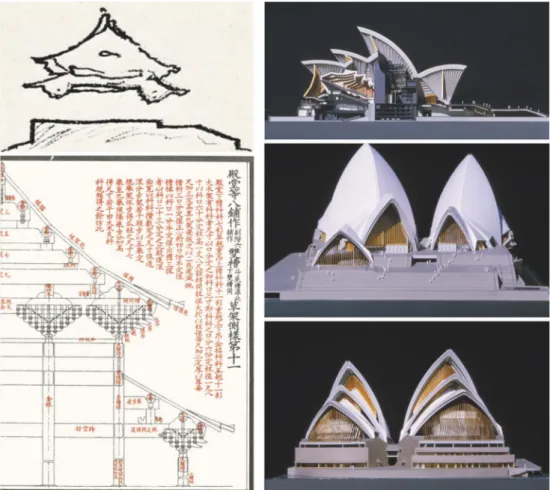
This intention of combining contrasting forms contribu-ted to Utzon’s design principle for his 1953 Langelinie Pavilion competition proposal. The pavilion was drawn as a juxtaposition of angular urban-scale podium and pro-jecting curved roof forms. This Chinese-inspired dualist formula was represented again in Utzon’s 1957 competi-tion proposal for the Sydney Opera House. In 1962, in “Platforms and Plateaus” manifesto, Utzon published his “Chinese houses and temples” sketch showing a combination of two distinct forms– a symmetric curved roof form and an asymmetric angular solid podium (Figure 1). This important sketch combined with Utzon’s own words illustrated the aesthetic ideal of his Opera House– a roof/earthwork juxtaposition (Utzon1962, 116):
Chinese houses and temples owe much of their feel-ing of firmness and security to the fact that they stand on a platform with the same outline as that of the roof or sometimes even of larger size, depending upon the importance of the building. There is magic in the play between roof and platform.
As shown here in the schemes for the Sydney Opera House . . ., you can see roofs, curved forms, hanging higher or lower over the plateau. The contrast of forms and the constantly changing heights between these two
17
Letter from Utzon to Ashworth, 12 June 1958, Ashworth Papers, National Library of Australia, Canberra, Box 1, Folder 9.
18Letter from Utzon to Ashworth, 12 June 1958, Ashworth Papers, National Library of Australia, Canberra, Box 1, Folder 9. 19Interview with Else Glahn at Birkerød, 2009.
20
Interview with Else Glahn at Birkerød, 2009.
21Interview with Else Glahn at Copenhagen, 2009; interview with Tosten Bløndal at Copenhagen, 2010. This perhaps explains why Utzon decided to
exclude a specially written essay on the historical account of the 1925-edition Yingzao fashi for his Logbook Series by his lifetime friend, architectural historian Else Glahn (1921–2011), a leading scholar of the subject, despite having personally invited Glahn to write this essay in the first place.
22
Peter Myers was thefirst scholar arguing the significant role of Chinese architecture in Utzon’s architectural career in his “Une histoire inachevée”, 1993. Later, in Françoise Fromonot, Jørn Utzon, The Sydney Opera House, the role of the 1925-edition Yingzao fashi and Johannes Prip-Møller, Chinese Buddhist Monasteries, Their Plan and its Function as a Setting for Buddhist Monastic Life, in Utzon’s architectural career was mentioned, but without further clarification. In Philip Drew, The Masterpiece, Jørn Utzon: A Secret Life, the 1925-edition Yingzao fashi was mentioned in terms of providing Utzon an important channel to perceive East Asian art and architecture, but there was no detail illuminated. In Richard Weston, Utzon: Inspiration, Vision, Architecture, the 1925-edition Yingzao fashi was suggested as an important monograph in Utzon’s early perception of Chinese building culture. However, its precise role in Utzon’s architectural career was similarly unclarified. In Philip Goad, “An Appeal for Modernism: Sigfried Giedion and the Sydney Opera House,” Fabrications, 8, No. 1, 2012 and Michael Asgaard Andersen, Jørn Utzon: Drawings and Buildings, two authors reconfirmed the importance of the 1925-edition Yingzao fashi in Utzon’s Opera House design with the support from newly discovered evidences. However, the detailed relationship in-between is still unknown.
23
elements result in spaces of great architectural force made possible by the modern structural approach [. . ..].
Based on the preconceived dualism, to Utzon, the podium of Chinese architecture and the Sydney Opera House was representing a historical form– a monumental earthwork seen in ancient human culture (Utzon 1962, 113–140). This was in contrast with the roof forms, which were drawn from natural forms (Utzon 1962, 113–140). Utzon’s artistic vision of roof forms can be seen in two major analogies. One is between the curved projecting roof profile of Chinese architecture and Utzon’s proposed glass mullions, which represented the spreading wings of a skua gull; and the other is the hierarchical and repre-sentational compositions of Chinese bracket sets and
Utzon’s plywood box beams for acoustic ceilings of the Minor Hall, which served as a sign of the transformation and constitution of an organism (Figure 2).24
To further reinforce the analogy between metaphori-cal nature and his design, Utzon decided to apply wood to conduct the interior of the Opera House. The wood was used not only for furniture, interior panelling and cladding, but also for glass mullions, acoustic ceilings, and walls.25 As a result, the Opera House interior was a wooden synthesis, constructed andfinished by prefab-ricated plywood elements. To Utzon, as part of his exem-plification of Chinese inspired dualistic aestheticism, this created contrasting human perceptions between the wooden interior and the concrete roof and podium:
Figure 1.(left above) Jørn Utzon,“Chinese houses and temples,” 1962. Sketch shows his – a combination of two distinct forms – a symmetric curved roof form and an asymmetric angular solid podium,“Platforms and Plateaus: Ideas of a Danish Architect,” Zodiac 10, 116. (left below) The newly interpreted building cross-sections showing 11-purlin palace-type building, Utzon’s 1925-edition Yingzao fashi, Vol.6, Chapter 31, plate 1. (right) Utzon’s final model for the Sydney Opera House, Major Hall, 1966. This model, constructed by Finecraft Scale Models, Sydney, showing Utzon’s final designs for the glass walls and the interior of the Major Hall of his Sydney Opera House. Photographed by Utzon’s chief assistant, Mogens Prip-Buus, 18 March 1966, Jan Utzon’s collection, Sante, Denmark. Prip-Buus wrote to the authors on 26 June 2013:“The work on this second model – half the size of thefirst – was started long before the crisis and the so-called resignation. As long as we still were in the site-office, I checked the work every morning and afternoon, even if we were no more the architects of SOH. When it was near completion, the Usher brothers called me one day– it could have been 18 March 1966 – at the beginning of the afternoon asking me to come as soon as possible with my cameras, as the minister would send a lorry during the afternoon to take the model away. I did so and took my photos and 8mm movie in an extreme hurry, as they could come at any moment, and the quality suffered thus a bit.”
24
As Utzon explained in his Sydney Opera House: Utzon Design Principles:“Approaching one will notice the bronze covered vertical plywood mullions hanging as the folds of a bird’s wing,” and “ [. . .] The overall shape of the hall, a free form hanging like a cloud in the sky,” see page 58.
25
Before Utzon acquired the Yingzao fashi, he indicated the interior of his Opera House should be partially constructed by wood, according to his 1957 competition proposal and 1958 Red Book– the first revised proposal after competition outcome. In both cases, the wood was mainly used for internal facing and panelling. For more details, see Jørn Utzon Architects’ Sydney Opera House: The Descriptive Narrative,1965.
“The walls (of podium) will show the concrete as it was constructed, contrasting with the moulded plywood panels which form the components of the furniture and fixings.” (Utzon 2002, 71). To emphasize the contrast between wood and concrete, Utzon further used “the modular sized moulded plywood panels,finished in the natural colour of the wood.” (Utzon 2002, 79). If con-structed according to Utzon’s idealization and take on the dualistic aestheticism, the Opera House could have been identified by three distinctive components built by two major materials– the concrete forms for podium and roof with wooden interior in-between. (Utzon 2002, 70–71). Arguably, these distinct architectural idioms mir-rored Chinese architecture indicated by Utzon’s Yingzao fashi as the carpentry constructed between the stone podium and roof cladding (Figure 1).
The analogy between the Opera House interior and Chinese carpentry documented in Utzon’s Yingzao fashi
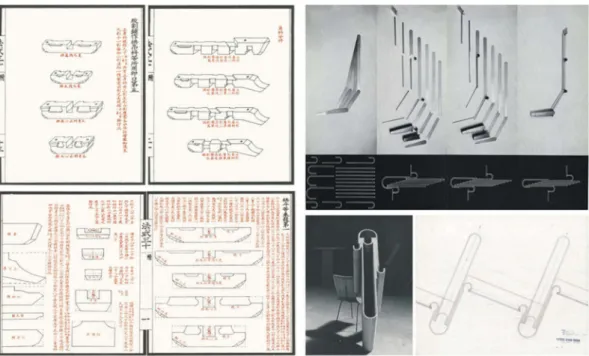
can be reinforced by the architect’s act of dividing interior components into small elements. In contrast with the monolithic roof and podium of the Opera House, the wooden complex both in Utzon’s interior design at Sydney and Chinese monuments were characterised by the distinct form of each element, and this can be seen in the articulated composition both of Utzon’s glass mul-lions and Chinese bracket set (Figure 3).26In both cases, the wooden representational elements have a curved edge: the Opera House mullions were formed by bent plywood sheets, and Chinese brackets were conducted with rounded corner (Figure 3). Moreover, these curved wooden forms set a contrast to the angular forms of the podium. This contrast reindicated Utzon’s perception of the Opera House and Chinese architecture as a synthesis of cultural and natural forms. To further emphasize the analogy between his Opera House interior and animated nature, Utzon applied a series of representational bent
Figure 2.(left) Jørn Utzon, study model of the plywood box-beam segments of acoustic ceiling of Minor Hall in the Sydney Opera House in the mid 1960s, Jan Utzon’s collection, Sante, Denmark. (right) The varied compositions of bracketing sets (the Qing Dynasty revision) below the eaves, Utzon’s 1925-edition Yingzao fashi, Vol.5, Chapter 30, plate 5, 6.
26As Utzon explained with his own word in“The Sydney Opera House”, Zodiac 14,1965, p. 86:“. . . in spite of an extremely complex form world, to create
the glass wall of a relatively small number of interfitting elements to be mass-produced . . ., In my office, the photo below was our inspiration in the fight for arriving at our elements, and I wonder how often I have said: when some clever people have been able to produce a number of elements, put them together and talk through the result, then we must be able to solve this much simple problem, even if it seems impossible.”
plywood elements withflexible joints for producing glass mullions and corridor panels inside the podium. The for-mer can be seen as his interpretation of curved roof out-lines of Chinese monuments shaped by the representational purlins and rafters (Figure 4); and the later was similar to the projecting eaves of Chinese archi-tecture constructed by rafters with varied inclinations.
4. Patterns and pattern design
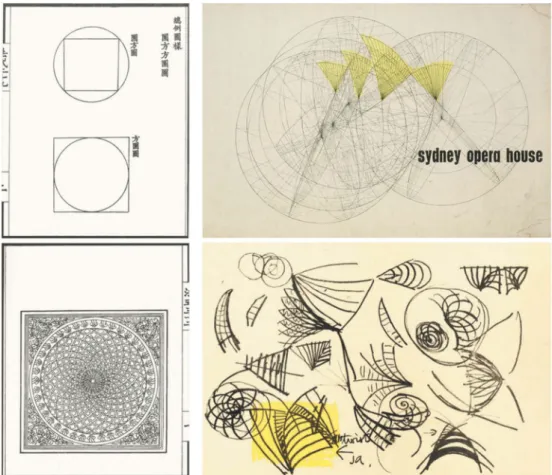
Utzon’s Yingzao fashi not only clearly illustrated the car-pentry of Chinese monuments in great detail, but also illustrated the none-carpentry work. The none-carpentry work covered from decoration patterns for panelling to framing elements. These patterns were mainly composed by two key elements: namely, circle and square (Figure 5). The identical circular elements were superimposed with each other to form the patterns representing metaphori-cal nature.
Utzon carefully studied the pattern of decorative ceil-ing composed as a double spiral formation (Figure 5). Later, in his Yellow Book – The Sydney Opera House (1962), showing thefinal scheme of his geometric princi-ple of roof form, Utzon published his sketch of this pattern on the back cover for indicating his inspirational sources (Figure 5). The shape of the proposed roof form was composed of the identical and superimposed circles with two main intentions: one was that the identical
circles presented the roof shaped by the equal curvature from a spherical form; and the other was to use the identical circle for successfully dividing the roof into repre-sentational ribs, and from ribs into modular rib elements (Figure 6). This resulted in the rib elements on the same latitude of the spherical form were the same, and the ones on different latitudes were sharing the same height (Figure 6). The achieved standardization and modulariza-tion of constitumodulariza-tional elements of the final roof form directly reflected the composition of the studied ceiling decorations in Utzon’s Yingzao fashi.
Following the completion of geometric principle of his roof form, Utzon drew the composition of proposed roof form within a circle which was framed by a bigger square (Figure 6). This sketch was similar to the diagrams docu-mented in Utzon’s Yingzao fashi (Figure 5)– an interplay between circle and square: the former one was applied for shaping the roof representing metaphorical nature; and the latter was applied for the podium representing a historical earthwork. Together, this essential geometri-cal principle helped Utzon to synthesize his dualistic forms.
Clearly, Utzon applied the same principle while con-ducting the geometric composition for the acoustic ceil-ings of the Two Main Halls at Sydney. Both cases were composed by identical and superimposed circles, so the “puzzle” of two acoustics ceilings was shaped by identical curvatures (Figure 7).27This served two specific purposes.
Figure 3. (left above) The illustrations (the Qing Dynasty revision) of detailed mortises and tenons in structural carpentry– inclined rafters and bracketing units, and (left below) the way of tapering bracketing units and horizontal roof beams (the Qing Dynasty revision), Utzon’s 1925-edition Yingzao fashi, Vol.5, Chapter 30, plate 5, 6. (right above) Jørn Utzon, photographs and illustrations showing the segments and assembly of mullions of developed glass wall,“The Sydney Opera House,” Zodiac 14, 1965, 87, 88. (right below) Flashing detail: Plan, mock up, showing the section of glass mullion which could be built up by a two-foot-wide plywood lamination. To Utzon and his team, by producing the specially designed plywood element from the 50-foot-long sheets, there could be without any scarfed joint. Photographed by Utzon’s chief assistant, Mogens Prip-Buus, and drawing no. 1291. Jan Utzon’s collection and The Utzon Archives, Aalborg University Library, Denmark. Published with permission from Utzon family.
27
Practically, due to the same curvature, it can speed up the manufacturing process with identical bending and moulding process. Aesthetically, the “puzzle” was
presenting the metaphorical nature, such as the clouds, winds and waves. Utzon presented this idea with his own words and model constructed by interlocked metal tube:
Figure 5.(left above) The circle-square, square-circle geometric principle, and (left below) the illustration showing the patterns of small-scale carpentry– a decorative ceiling, Utzon’s 1925-edition Yingzao fashi, Vol.5, Chapter 29, plate 2 and Vol.6, Chapter 32, plate 13. (right) Jørn Utzon, the covers of Yellow Book, Sydney Opera House (Yellow Book), 1962.
Figure 4.(above) Glass walls, north major. Plan, elevation and section, showing the sweep of glass wall by varying inclinations to represent the volumetric spherical shape of the Opera House roof and to emphasize the horizontal curvilinear edge of its base, drawing no. 1318, The Utzon Archives, Aalborg University Library, Denmark. (below) The newly interpreted building cross-sections (from 11-purlin to 5-purlin building), Utzon’s 1925-edition Yingzao fashi, Vol.5, Chapter 31.
The invisible wind works up the water forming the surface into waves, varying winds – varying waves, but always of the same character.
The character, the style, has developed from a series of shapes in combination, all with the characteristic of water, waves – waves within waves – the water that breaks, foams, etc.
In my thought, I mould the invisible space with geome-trically defined shaped in combination and when I have established the void I want, I freeze the situation in my mind.
Because I have moulded space with geometrically defined shapes, the whole enclosure of the void is fully defined and the surface of the enclosure is divi-sible in a number of similar elements. These similar elements can be mass produced – and, when their relationship has been clarified they can be assembled like a big jig-saw puzzle in space [. . ..].28
5. Structural expressionism and formalism
In his design for the acoustic ceilings of the Two Main Halls at Sydney, Utzon did not use the plywood elements with inspired curvilinear shapes as panelling or cladding components. Instead, Utzon planned to use bent ply-wood sheet reinforced by the metal frame inside to form the plywood box beams with a span varying from 15 to 45 metres above the auditorium (Figure 7). This ambitious proposal reflected Utzon’s sketch of “Chinese houses and temples” in which the roof floated in the air and in contrast with the sense of heaviness of an urban-scale podium below (Figure 1). In both cases, the support-ing pillars were reduced, and the sculptural and volu-metric roof forms were embodied with articulated structural expressivities.
It is safe to assert that the 22 sections of Chinese monuments inside Utzon’s Yingzao fashi provided an important channel for him to understand the structural expressionism and expressive formalism of Chinese car-pentry (Figure 4). The systematically arranged forma-tions of bracket sets and stepped-beam roof frames illustrated in Utzon’s Yingzao fashi indicated that the formation of Chinese roof forms and projecting eaves was conducted by a hierarchical and representational system. Within this system, a monument with a higher status was constructed by more and larger representa-tional wooden elements of roof and projecting eaves. This made its roof and eaves bigger, heavier and its curved profile more completed. Meanwhile, the number of internal columns and their height were reduced hier-archically. This approach made the roof form perceived as iffloating in the air. This directly reflected the expres-sivity and monumentality of Chinese architecture.
Utzon’s perception of structural expressionism and expressive formalism of Chinese historical monuments stimulated him to launch his radical experiments for synthesizing his Sydney project. In 1962, Utzon designed the concrete canopies over the main stair-cases leading to the upper gallery of the Two Main Halls. The curved treatment on the soffit of concrete canopies can be read as the continuation of thefloor beams, and shows the structural requirement for its projection (Figure 8). Utzon also designed the triangular projecting cladding elements above the openings of the Opera House podium. Both were alluded to the projecting eaves of Chinese architecture. Similar inten-tion can be seen in Utzon’s proposal for the balconies of the Two Main Halls. They projected out and towards the side galleries (Figure 8). Utzon’s proposal for the Opera
Figure 6.(left above)“Shells – Minor Hall inside elevation,” schematical, 1962, and (left below) “Sells – Minor Hall, plan of soffit,” schematical, 1962. Drawings show the formation of finalized shell-vault structure of the Sydney Opera House roof form, The Utzon Archives, Aalborg University Library. Published with permission from Utzon family. (right) Jørn Utzon, conceptual sketch of shell-vault roofs of the Sydney Opera House, early 1960s, Sydney Opera House collection, 1956–1967, Manuscripts Section & Pictures Section, Mitchell Library, State Library of New South Wales.
28
House glass mullions made by hot bonded plywood sheet clad with bronze outside and reinforced by the metal frame inside also revealed a similar approach. Without any vertical supporting element, the proposed mullions should be hanged and further projecting out-ward, seen as part of projecting canopy and cladding elements of the podium outside (Figure 4) and the inclined concrete ribs supporting the back balcony of the Two Main Halls inside (Figures 1and8).29
As soon as Utzon won the competition proposal for the Sydney Opera House in 1957, he sought for the ideal solution of its roof form, which for him was a freestanding shell structure with hyperbolic shape. He rejected to put any supporting pillars beneath the roof as a compromise to structural expressivity. After five years of struggling for consolidating his geometric principle for the roof, in 1962, Utzon transformed the originally proposed hyperbolic curve into spherical form. Utzon also rejected the scheme of space frame covered with double concrete skin for pursuing the
concrete rib structure, which was far much heavier, more expensive, labour costing and difficult to build (Figure 6) (Mikami2001, 62). Despite the alleged scan-dals of increasing cost and changes of design after this decision, at that time, Utzon directly picked the latter proposal and said:“. . . I don’t care how much it costs, I don’t care how long it takes to build or what scandals it causes, but this is what I want.” (Mikami 2001, 62). Utzon later explained:“The architecture with the ribs is much more expressive than if the shells had been cast in-situ, with the resulting flat constructed surfaces.” (Utzon2002, 78).
While conducting the design for acoustic ceilings both of the chamber music hall and rehearsal rooms, Utzon developed the plywood beam made by bent plywood sheets with maximum of 15-metre span. The roof forms of Utzon’s own house in Bayview – the Bayview House – was served as its mock up for testing the bean’s strength and durability. The composition of roof beams at Bayview was directly driven from Utzon’s study of Chinese
Figure 7. (left above) The geometric principle of superimposed sections of acoustic ceilings in the Major Hall of the Sydney Opera House, and (left below)“Minor Ceiling: Setting out of ribs,” showing the shape and composition of acoustic ceilings of the Minor Hall, The Utzon Archives, Aalborg University Library. (right above) Jørn Utzon, surviving sketches of his Bayview House were clearly showing the analogy between studied Chinese stepped-beam roof frame and his precast plywood-sheet-bent beams cladded with aluminum panels– the prototype of acoustic ceilings of experimental theatre of the Sydney Opera House, The Utzon Archives. (right middle) The mock-up of precast plywood-sheet-bent beams cladded with aluminum panels for the roof forms of Utzon’s Bayview House, photo-slide, Jan Utzon’s collection, Sante, Denmark. (right below) “Rehearsal room No 1179, Major Hall– First Floor Plan + Sections,” showing the formation of proposed acoustic ceilings of rehearsal room of the Sydney Opera House, The Utzon Archives. Published with permission from Utzon family.
29These heavy elements had no chance to be tested by mock-up process, and Utzon and his team did notfinalize the joint between the rib of shell vault
stepped beam roof frame documented in his Yingzao fashi (Figure 7).
At the end of 1965, Utzon and his team tried tofinalize the geometric principle of plywood box beams for the Two Main Halls’ acoustic ceilings at Sydney. They were ready for exploring the beams’ internal structural forma-tion for achieving the proposed large span above the auditoriums by conducting a mock-up evaluation (Figure 7). Unfortunately, the Sydney office of Arup and Associates, the partnering engineer, disapproved the pro-posal and further sent their report to the Ministry of Public Works, the government of New South Wales, Australia. This report not only provided two alternative schemes but also delivered their criticism to the Chinese inspired structural expressionism and expressive formalism seen in Utzon’s proposal:
[. . ..] The weight of the proposed ceiling is greater than that which can be supported [. . ..].
[. . ..] The erection of large units, 50 ft. long and 10 tons weight as required by the proposed scheme is consid-ered difficult and expensive because of the size of the units, the weight and the restriction of the shell above . . .. The cost of erection, however, would be considerably above that for the two modified schemes.
[. . ..] The timber proposed, White Serayn, has high strength but is subject to a degree, to“nail sickness.” Further investigation would be required into the use
of a less prone timber for those structural compo-nents which are not visible [. . ..].30
In conclusion of this report, the Sydney office of Arup and Associates delivered their rejection of Utzon’s scheme using plywood (Ove Arup and Partners 1966), which was less practical than their“structural steel solution” in which “plywood sheets” were “a form of cladding” instead of being“part of the structure of the ceiling.”31
After receiving the report, the Minister, David Hughes, immediately stopped the payment to Utzon and his consulting team for further negotiations. As Utzon refused to change his position from the archi-tect in chief into the “design architect,” as well as to abandon his radical approach, he together with his team resigned in April 1966. None of their remaining proposals for the interior were realized.32
6. Conclusion
Examining Utzon’s understanding and reflection of Yingzao fashi in his design of the Sydney Opera House project provides us a channel to assess his per-ception of Chinese architecture as a synthesis of varied conceptions and artefacts. This helps to review the important knowledge making, transfer and transforma-tion of Chinese building traditransforma-tion within a specific cross-cultural context. Utzon’s reinterpretation of the
Figure 8.(left above) Jørn Utzon,“The longitudinal section through the Minor Hall of the Sydney Opera House,” showing the formation of folded-plate concretefloor and canopy over main staircase towards the upper gallery, Sydney Opera House (Yellow Book), 1962, 7. (left below) “Canopy over main staircase plan of soffit and sections” showing the animated shape and composition of in-situ concrete formation, and (right) three sections through the Major Hall of the Sydney Opera House, showing the formation of projecting balconies constructed by in-situ concrete structure, The Utzon Archives, Aalborg University Library. Published with permission from Utzon family.
30See the report prepared by Ove Arup and Partners, Sydney Opera House Site, Bennelong Point,“Report on the structural details of the proposed
scheme for the Minor Hall auditorium ceiling,” January 1966, Mitchell Library, State Library of New South Wales, 2, 3.
31See“Report on the structural details of the proposed scheme for the Minor Hall auditorium ceiling,” 4. 32
interpreted Chinese traditional built forms in his 1925-edition Yingzao fashi further provides us a channel to decipher the architect’s design and artistic vision of the Sydney Opera House.
Historical and monumental Chinese built forms, illuminated by his Yingzao fashi, inspired Utzon to launch into his radical exploration of the extremity and extravagance of building design, production and construction. Indeed, the triumphal Chinese floating roof seen in his sketch of “Chinese temples and palaces” became the very ideal which Utzon so deeply admired and worked to achieve. However, on many occasions, Utzon’s Chinese inspired ideas were involved with difficulties in the progress of the Opera House. Rhetorically, like the absence of col-umns in Utzon’s sketch of a Chinese monument, the “absence” represents the surreal scene of making the rooffloat, so as to erect the whole Opera House in the air. This “absence” in both Utzon’s perception and reinterpretation of Chinese architecture further reminds us the absence of Utzon’s design in today’s Opera House. None of Utzon’s proposals has been realized after his forced resignation, and he never had a chance to finish his job and so had a reason to come back to Australia. Utzon’s republication of “Chinese temples and palaces” sketch in Sydney Opera House: Utzon design principles (2002), was his wordless allegory of the Opera House, as his doom, as his achievement (Utzon2002, 6).
Disclosure statement
No potential conflict of interest was reported by the authors.
Notes on contributors
Chen-Yu Chiu graduated from Chung Yuan Christian University, Taiwan in 2002 with a Bachelor’s degree in Architecture. He achieved a Master’s in Urban Design at Columbia University in New York in 2005 and received his PhD at the Faculty of Architecture, Building and Planning, The University of Melbourne, in 2011. His primary research interest is in the cross cultural/national relationships within thefield of architecture.
Nur Yıldız Kılınçerreceived her Bachelor’s degree in Interior Architecture and Environmental Design from Bilkent University, Turkey in 2016. In 2017 she started her Master’s education in Bilkent University in the Department of
Architecture. She is interested in Japanese art and architec-ture, cultural exchanges between Europe, central and East Asia.
Helyaneh Aboutalebi Tabrizi received her Bachelor’s degree in Architecture at Islamic Azad University of Tabriz, Iran (IAUT) in 2014. In 2017, she started her Master’s education in Bilkent University in the Department of Architecture. She is interested in the relationship between architecture and feminism in the history and theories of modern architecture.
References
Andersen, M. A. 2014. Jørn Utzon: Drawings and Buildings. New York: Princeton Architectural Press.
Chiu, C.-Y. 2016.“China Receives Utzon: The Role of Jørn Utzon’s 1958 Study Trip to China in His Architectural Maturity.” Architectural Histories 4 (1). doi:10.5334/ ah.182.
Chiu, C.-Y., P. Myers, and P. Goad.2019.“My Country and My People and Sydney Opera House: The Missing Link.” Frontiers of Architectural Research.
Drew, P. 1999. The Masterpiece: Jørn Utzon, a Secret Life. South Yarra, Victoria: Hardie Grant Books.
Feng, J.2012. Chinese Architecture and Metaphor: Song Culture in the Yingzao Fashi Building Manual. Hong Kong: Hong Kong University Press.
Fromonot, F. 1998. Jørn Utzon: The Sydney Opera House. Berkeley, CA: Gingko Press.
Li, J., and Q. Zhu.1925. Li Mingzhong ying zao fa shi: 36 juan. Wujin: Tao Xiang, Chuan jing shu she fa xing.
Li, L.2011. The Yingzao Fashi: Caihua Yanjiu. Nanjing: East China University Press.
Mikami, Y.2001. Utzon‘S Sphere: Sydney Opera House: How It Was Designed and Built. Tokyo: Shokokusha.
Myers, P. 1993. “Une Histoire Inachevee‘.” L‘Architecture d‘Aujourd‘hui 285: 60–67.
Ove Arup and Partners.1966. Report on the Structural Details of the Proposed Scheme for the Minor Hall Auditorium Ceiling. Sydney: Ove Arup and Partners. Mitchell Library, State Library of New South Wales.
Prip-Buus, M., and R. Weston.2004. The Courtyard Houses: Jorn Utzon Logbook: v. I. Hellerup: Edition Bløndal. Utzon, J. 1955.“Huset Ved Søen.” Mobilia 11: 55–56. Utzon, J. 1962. Platforms and Plateaus: Ideas of a Danish
Architect. Zodiac 10: 113–117.
Utzon, J. 1965a. “Sydney Opera House: The Descriptive Narrative.” The Utzon Archives, 1–71. Sydney: Jørn Utzon Architect.
Utzon, J.1965b.“The Sydney Opera House.” Zodiac 14: 48– 56.
Utzon, J.2002. Sydney Opera House: Utzon Design Principles. Sydney: Sydney Opera House Trust.
Weston, R. 2002. Utzon: Inspiration, Vision, Architecture. Hellerup: Edition Bløndal.