Dergi web sayfası:
www.agri.ankara.edu.tr/dergi www.agri.ankara.edu.tr/journalJournal homepage:
TARIM BİLİMLERİ DERGİSİ
—
JOURNAL OF AGRICUL
TURAL SCIENCES
22 (2016) 349-359
The Factors Affecting Heavy Metal Levels in the Muscle Tissues of
Whiting (Merlangius merlangus) and Red Mullet (Mullus barbatus)
Ali ALKANa, Nigar ALKANb, Ufuk AKBAŞcaKaradeniz Technical University, Institute of Marine Sciences and Technology, Trabzon, TURKEY bKaradeniz Technical University, Faculty of Marine Sciences, Sürmene, Trabzon, TURKEY cKaradeniz Agricultural Research Institute, Tekkeköy, Samsun, TURKEY
ARTICLE INFO Research Article
Corresponding Author: Ali ALKAN, E-mail: [email protected], Tel: +90 (462) 377 18 61
Received: 15 November 2014, Received in Revised Form: 13 March 2015, Accepted: 16 March 2015 ABSTRACT
This study aims to determine heavy metal accumulation levels in the muscles tissues of two economically most important demersal fish species in the Eastern Black Sea, Turkey, red mullet (Mullus barbatus) and whiting (Merlangius
merlangus), and evaluate the effects of fish species, sampling locations, fishing season and size groups on heavy metal
accumulation levels. Chromium (Cr), manganese (Mn), cobalt (Co), nickel (Ni), copper (Cu), zinc (Zn), arsenic (As), cadmium (Cd) and lead (Pb) concentrations in fish muscle samples were measured with Inductively Coupled Plasma Mass Spectrometry (ICP-MS). Co, Zn, As and Cd accumulation levels in both species differed significantly (P<0.05). The metal concentrations of muscle tissues of both species, in general, were higher during summer and autumn. In the study, the differences in concentrations levels of As and Pb in whiting, Co, Cu, and Pb in red mullet muscle tissues were significantly related to fishing locations. The results of metal concentrations were compared with various legal limits such as Turkish Food Codex (TFC 2011), European Communities Commission Regulation (EC 2006) and Food and Agriculture Organization (FAO 1983) and the obtained metal levels of fish muscle tissues of both species were found to be below the limit values which are a threat to human health.
Keywords: Black sea; Fish; Heavy metal; Whiting; Red mullet; Pollution
Mezgit (Merlangius merlangus) ve Barbunya (Mullus barbatus)
Balıklarında Ağır Metal Düzeylerini Etkileyen Faktörler
ESER BİLGİSİ Araştırma Makalesi
Sorumlu Yazar: Ali ALKAN, E-posta: [email protected], Tel: +90 (462) 377 18 61 Geliş Tarihi: 15 Kasım 2014, Düzeltmelerin Gelişi: 13 Mart 2015, Kabul: 16 Mart 2015
ÖZET
Bu çalışmada, Doğu Karadeniz’de (Türkiye) ekonomik öneme sahip en önemli iki demersal balık türü olan barbunya ve mezgit balıklarındaki ağır metal birikim düzeylerinin tespit edilmesi ve metal birikim düzeylerinin balık türü, örnekleme
1. Introduction
Metals are among the most detrimental elemental contaminants in aquatic ecosystems due to their toxic effects and accumulation by entering the food chain (Tepe 2009; Boran & Altinok 2010). Some elements such as iron (Fe), copper (Cu), zinc (Zn), manganese (Mn) and selenium (Se) are considered as essential for their important roles in biological systems and nickel (Ni), vanadium (V), cobalt (Co) are known as probably essential metals. Such metals as lead (Pb), cadmium (Cd) and mercury (Hg) are non-essential metals and even very low amounts of these metals may have toxic effects (Canlı & Atlı 2003; Tüzen 2003; Uluozlu et al 2007; Turan et al 2009; Mendil et al 2010; Özden et al 2010). Industrial wastes, mining activities and marine sediment geochemical structure are potential sources of heavy metals affecting aquatic ecosystem (Balkıs et al 2007; Mendil et al 2010; Alkan et al 2012). Fish, major components of aquatic ecosystems, are protein-rich foodstuffs (Fındık & Çiçek 2011) containing high amounts of unsaturated fatty acids. Moreover, they are very important both economically and ecologically due to their key roles in food webs dynamics. Fish accumulate heavy metals as they are in the upper levels of the food chain. Therefore, fish especially demersal fishes are used as indicators of ecosystem contamination in the monitoring programs for the determination of metal pollution in seas (Has-Schon et al 2008; Harmelin-Vivien et al 2009; Mendil et al 2010; Özden et al 2010; Alkan et al 2012). Red mullet
and whiting are generally known as demersal fish species. Nevertheless, though red mullet inhabits in more shallow waters compared to whiting and is an entirely bottom feeding species, whiting is a bathi-pelagic species. Heavy metal accumulation levels in fish may change depending on species, size groups (Canlı & Atlı 2003), tissues, seasons and geographic regions (Mendil et al 2010).
The Eastern Black Sea where almost 60% of the total fishing takes place has an important role in Turkish fisheries. The contributions of Eastern Black Sea to the total fishing of red whiting and red mullet were 68% and 19%, respectively (Turkish Statistical Institute 2011). The decrease in fish stocks due to overfishing and pollution made it necessary to determine the quality level and usability of the available resources.
In the present study, it is aimed to determine the levels of heavy metal accumulation in the muscle tissue of economically important fish species in Turkey, whiting and red mullet and evaluate the effects of fish species, fishing locations, fishing season and size groups on heavy metal accumulation levels.
2. Material and Methods
The study area fed by Kızılırmak, Yeşilırmak and Melet rivers is more densely populated particularly Samsun and its vicinity, in terms of industrial and agricultural activities.
yeri, avlanma dönemi ve boy grubu gibi faktörlerle ilişkilerinin ortaya konulması hedeflenmiştir. Balık kas dokularında krom (Cr), mangan (Mn), kobalt (Co), nikel (Ni), bakır (Cu), çinko (Zn), arsenik (As), kadmiyum (Cd) ve kurşun (Pb) derişimleri indüktif eşleşmiş plazma kütle spektrometresi (ICP-MS) ile ölçülmüştür. Barbunya ve mezgit balıklarının kas dokularındaki Co, Zn, As ve Cd birikim düzeyleri farklılığı istatistiksel olarak önemli bulunmuştur (P<0.05). Her iki balık türünün kas dokusundaki metal düzeylerinin de genellikle yaz ve sonbahar döneminde daha yüksek olduğu belirlenmiştir. Çalışmada mezgit balığı kas dokusundaki As ve Pb derişimleri farklılığının, barbunya balığı kas dokusunda ise Co, Cu ve Pb derişimleri farklılığının avlandıkları lokasyonlar yönünden istatistiksel olarak önemli olduğu tespit edilmiştir. Tespit edilen metal derişimleri Türk Gıda Kodeksi (TFC 2011), Avrupa Birliği Komisyonu Tüzüğü (EC 2006) ve Gıda ve Tarım Örgütü (FAO 1983) gibi çeşitli yasal limitler ile karşılaştırılmış ve balık kas dokularındaki metal düzeylerinin insan sağlığı açısından tehdit oluşturabilecek limitlerin altında olduğu belirlenmiştir.
Anahtar Kelimeler: Karadeniz; Balık; Ağır metal; Mezgit; Barbunya; Kirlilik
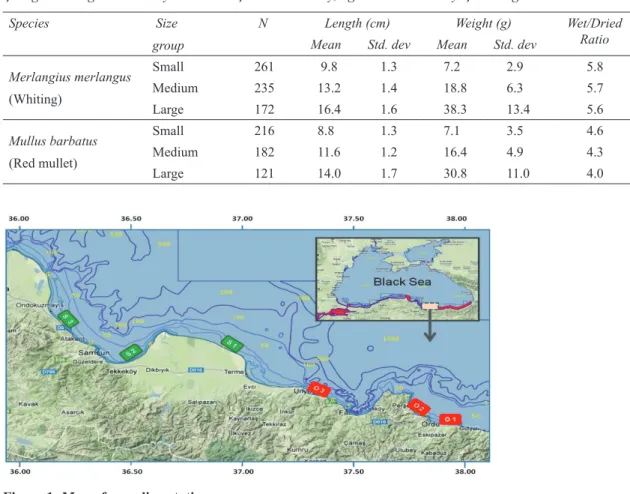
A total of 668 whiting and 519 red mullet analyzed specimens were collected from six stations in the Eastern Black Sea, which were located in Samsun (S1, S2, S3) where trawl fishery are permitted and in Ordu (O1, O2, O3) not permitted (Table 1 and Figure 1).
S2, S3, O1 and O2 stations are more affected by the industrial and urban pressures compared to others. Sampling was carried out with trawl nets in July, October, January and April corresponding to summer, autumn, winter and spring seasons, respectively. The fishes were grouped as small, medium and large sizes following the separation of species
(Table 1) and the length and weight were measured and muscle tissues were taken. Metal analysis in tissues is usually done on the dry weight since the legal limits are given as wet weight which requires converting wet into dry weights. Muscle tissues of fish samples were dried under vacuum with freeze dryer (Eyela, Japan) until tissues reached constant weight. About 0.5 g sample was taken from dried and homogenized samples for digestion in a sensitive manner after weighing. The samples were digested with microwave system (Milestone Ethos 1, Italy) and 7 mL ultrapure HNO3 (65% Merck, Darmstadt, Germany) and 1 mL H2O2 (30% Merck, Darmstadt, Table 1- Average lenght, weight and muscle wet/dried ratio of whiting and red mullet
Çizelge 1- Mezgit ve barbunya balıkları için ortalama boy, ağırlık ve kas doku yaş/kuru ağırlık oranı
Species Size
group
N Length (cm) Weight (g) Wet/Dried
Ratio
Mean Std. dev Mean Std. dev
Merlangius merlangus (Whiting) Small 261 9.8 1.3 7.2 2.9 5.8 Medium 235 13.2 1.4 18.8 6.3 5.7 Large 172 16.4 1.6 38.3 13.4 5.6 Mullus barbatus (Red mullet) Small 216 8.8 1.3 7.1 3.5 4.6 Medium 182 11.6 1.2 16.4 4.9 4.3 Large 121 14.0 1.7 30.8 11.0 4.0
Figure 1- Map of sampling stations
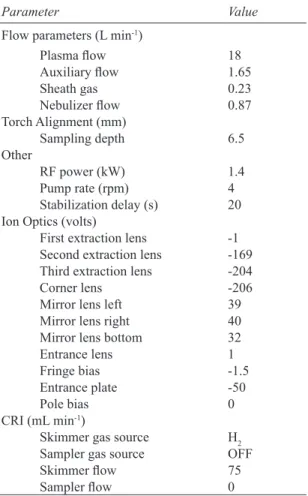
Germany) was used according to (Milestone 2011) procedure at 200 °C in 15 min. The solution was diluted to 25 mL with ultrapure water obtained from deionized water system (Barnstead Nanopure, USA) following digestion. Heavy metal analyses were performed using Varian 820 model ICP-MS (Melbourne, Australia) according to EPA (1994) Working conditions of the instrument were given in Table 2. Scandium (Sc) and Indium (In) elements were used as internal standard in the measurements. In order to validate digestion procedure and method of analysis, DORM 3 (National Research Council, Canada) certified reference material was digested and analyzed with the same procedure.
Student t-test was applied for statistical differences of the measured parameters between fish species. One-Way ANOVA, followed by Tukey post hoc test, was used to test difference in the metal accumulation levels among the size groups, sampling locations and sampling stations of both species. In order to determine the factors affecting metal accumulation levels, factor analysis was applied to the data using principle component analysis.
3. Results and Discussion
The analysis results of DORM 3 certified reference material are given in Table 3. The results of the recovery metal values as percentage were within the acceptable limits as specified on the certificate.
The mean concentrations of metals in each fish species are summarized in Table 4. In the muscle tissues, the mean concentrations of the heavy metals were determined as Zn>As>Cu>Mn>Cr>Ni>Cd>Co>Pb for whiting and Zn>As>Cu>Mn>Cr>Ni>Co>Pb>Cd for red mullet. The differences in the mean concentrations of metals (Zn: 21.5 mg kg-1, As: 6.34 mg kg-1, Co: 0.03 mg kg-1
and Cd: 0.031 mg kg-1) for whiting and red mullet
tissues (Zn: 19.7 mg kg-1, As: 14.7 mg kg-1, Co: 0.11
mg kg-1 and Cd: 0.018 mg kg-1) were statistically
significant (P<0.05). The mean concentrations of Co and As of the red mullet were higher than those of the whiting (Table 4). Cr, Mn, Ni and Cu concentrations in muscle tissues of whiting and red mullet were not statistically significant (P>0.05).
Table 2- Instrument parameters for Varian 820 ICP-MS
Çizelge 2- Varian 820 ICP-MS için cihaz parametreleri
Parameter Value
Flow parameters (L min-1)
Plasma flow 18 Auxiliary flow 1.65 Sheath gas 0.23 Nebulizer flow 0.87 Torch Alignment (mm) Sampling depth 6.5 Other RF power (kW) 1.4 Pump rate (rpm) 4 Stabilization delay (s) 20
Ion Optics (volts)
First extraction lens -1
Second extraction lens -169
Third extraction lens -204
Corner lens -206
Mirror lens left 39
Mirror lens right 40
Mirror lens bottom 32
Entrance lens 1
Fringe bias -1.5
Entrance plate -50
Pole bias 0
CRI (mL min-1)
Skimmer gas source H2
Sampler gas source OFF
Skimmer flow 75
Sampler flow 0
Table 3- Concentration of metals found in certified reference material DORM 3
Çizelge 3- DORM 3 sertifikalı referans materyali analizinde bulunan metal derişimleri
Metal Certificated value (µg g-1) Observed value (µg g-1) Recovery (%) As 6.88±0.3 6.54±0.4 95.1 Cd 0.29±0.02 0.29±0.02 100.0 Cr 1.89±0.17 1.93±0.23 102.1 Cu 15.5±0.63 14.78±0.78 95.4 Ni 1.28±0.24 1.33±0.17 103.9 Pb 0.395±0.05 0.383±0.11 97.0 Zn 51.3±3.1 48.5±1.9 94.6
The small, medium and large length groups of the whiting were determined as 9.8±1.3 cm, 13.2±1.4 and 16.4±1.6 cm, respectively (Table 1). The differences in Mn, Co, Cu, Zn and Cd accumulation levels among size groups of the whiting were statistically significant (P<0.05), whereas the differences in Cr, Ni, As and Pb accumulations levels among size groups of the whiting fish were statistically insignificant (P>0.05). Cu and Zn concentrations of small size whiting were higher than those of medium and large sizes (Table 5).
In the study the small, medium and large length groups of the red mullet were determined as 8.8±1.3
cm, 11.6±1.2 cm and 14±1.7 cm, respectively (Table 1). The differences in Mn and Cd accumulation in the red mullet fish size groups were statistically significant (P<0.05); however, the differences in Cr, Co, Ni, Cu, Zn, As and Pb accumulation levels were statistically insignificant (P>0.05). Cd concentrations of the small size group of red mullet were found to be higher than those of medium and large size groups. Mn concentrations of small and medium size red mullet were significantly higher than those of the large size group (Table 5).
When metal accumulation levels were evaluated according to sampling location (Samsun-Ordu), it Table 4- Average heavy metal concentration of Merlangius merlangus (whiting) and Mullus barbatus (red mullet) species in this study, results of the previous study and legal limits (mg kg-1)
Çizelge 4- Bu çalışmadaki mezgit ve barbunya balıkları için ortalama ağır metal derişimleri, daha önceki çalışmalara ait sonuçlar ve yasal limitler (mg kg-1)
Metal concentration (mg kg-1) Cr Mn Co Ni Cu Zn As Cd Pb References Whiting 0.97 1.96 - 1.92 1.25 48.6 - 0.55 0.93 Uluozlu et al (2007)1 0.14 0.08 - 1.36 - 6.03 - 0.19 0.5 Turan et al (2009)2 0.80 - 0.03 0.27 1.02 22.76 5.65 0.04 0.08 Alkan et al (2012) 1 0.82 3.6 0.25 - 1.8 20.6 - 0.18 0.46 Mendil et al (2010) 2 - - - 3.78 3.72 31.34 - 0.002 0.58 Nisbet et al (2010) 1 0.69 0.74 0.10 0.90 1.03 13.52 0.29 0.03 0.26 Özden et al (2010) 2 0.86 7.63 1.14 1.32 65.4 0.17 0.21 0.53 Tüzen (2009) 2 - - - - - - 0.03 0.22 13 Balkıs et al (2012)1
1.5 - 0.04 0.31 2.5 18 4.96 0.03 0.05 Ergül & Aksan (2013)1
0.62 0.92 0.03 0.61 1.56 21.5 6.34 0.031 0.024 This study1 Red mullet 1.63 6.54 - - 0.98 106 - 0.45 0.84 Uluozlu et al (2007) 1 1.06 0.005 - 0.66 - 7.57 - 0.21 0.73 Turan et al (2009) 2 0.62 - 0.12 0.18 1.12 27.36 13.95 0.02 0.10 Alkan et al (2012) 1 0.99 2.05 0.38 - 1.4 17.8 - 0.23 0.40 Mendil et al (2010) 2 - - - 2.47 3.14 23.71 - 0.02 0.92 Nisbet et al (2010) 1 1.83 1.31 0.17 0.57 0.96 17.38 0.44 0.05 0.15 Özden et al (2010) 2 1.35 2.76 - 1.55 0.96 75.5 0.11 0.17 0.36 Tüzen (2009) 2
0.33 - 0.05 0.05 1.0 14.6 12.7 0.70 0.02 Ergül & Aksan (2013)1
0.56 1.05 0.11 0.46 1.36 19.7 14.75 0.018 0.020 This study1
Legal limits
0.05 0.30 TFC (2011)
30 30 0.50 0.50 FAO (1983)
0.05 0.50 EC (2006)
was found that the difference in accumulations levels between locations for the whiting was statistically insignificant (P>0.05), but was significant for Cr, Cu and Pb accumulation levels between sampling location (Samsun-Ordu) for red mullet (P<0.05). The length and weight differences among fishing stations for the red mullet were statistically significant (P<0.05 level), but insignificant for the whiting. The stations dependent mean concentrations of Cr, Mn, Co, Ni, Cu, Zn and Cd in muscle tissues as well as length and weight were statistically insignificant. Arsenic (As) concentrations of S1 station which is under the influence of Yeşilırmak were higher than that of O3 station. Pb concentrations
in O1 station may be related to geological origin and were higher than all stations (Table 6). The stations dependent mean concentrations of Cr, Mn, Ni, Zn, As and Cd in red mullet muscle tissues were statistically insignificant (P>0.05). Co concentrations determined in S3 station which was affected by urban pollution were higher than those obtained in S1, S2 and O2 stations and Cu concentrations in S3 station were higher than O2 and O3 stations. Pb concentrations may be related to geological origin as it was obtained in O1 station and the difference was statistically significant (P<0.05) and higher than all stations for red mullet muscle (Table 6).
Table 6- Average heavy metal concentration of Merlangius merlangus (whiting) and Mullus barbatus (red mullet) according to sampling stations, (mg kg-1)
Çizelge 6- Örnekleme istasyonlarına göre mezgit ve barbunya balıkları ortalama ağır metal derişimleri, (mg kg-1)
Heavy metals
Sampling stations
Whiting Red mullet
O1 O2 O3 S1 S2 S3 O1 O2 O3 S1 S2 S3 Cr 0.70 0.54 0.50 0.45 1.02 0.45 0.44 0.46 0.53 0.63 0.83 0.60 Mn 0.87 1.19 0.79 0.89 1.09 0.77 1.26 1.01 1.19 0.86 0.89 0.96 Co 0.03 0.05 0.02 0.04 0.03 0.03 0.09 0.09 0.11 0.12 0.07 0.16 Ni 0.68 1.19 0.09 0.32 0.96 0.44 0.26 0.41 0.44 0.55 0.64 0.57 Cu 1.71 1.61 1.03 1.66 1.65 1.52 1.34 1.08 1.07 1.40 1.33 1.81 Zn 21.47 21.95 19.57 22.52 21.08 22.14 21.45 18.77 17.64 18.98 18.53 21.17 As 5.59 6.98 3.76 9.67 5.97 5.60 12.28 18.51 14.08 17.35 11.16 14.89 Cd 0.04 0.02 0.02 0.04 0.03 0.03 0.02 0.01 0.01 0.02 0.02 0.02 Pb 0.05 0.01 0.01 0.02 0.02 0.02 0.04 0.01 0.02 0.01 0.01 0.01
Table 5- Average heavy metal concentrations of Merlangius merlangus (whiting) and Mullus barbatus (red mullet) according to different length groups, (mg kg-1)
Çizelge 5- Farklı boy gruplarına göre mezgit ve barbunya balıkları ortalama ağır metal derişimleri, (mg kg-1)
Heavy metals Whiting Size groups Red mullet
Large Medium Small Large Medium Small
Cr 0.49 0.64 0.72 0.65 0.50 0.55 Mn 0.64 0.80 1.28 0.79 0.89 1.38 Co 0.02 0.03 0.05 0.11 0.10 0.11 Ni 0.61 0.41 0.82 0.48 0.43 0.47 Cu 1.04 1.59 1.96 1.18 1.33 1.52 Zn 18.78 20.59 24.83 19.06 18.89 20.99 As 4.92 7.12 6.73 13.43 17.87 12.61 Cd 0.01 0.03 0.05 0.01 0.01 0.03 Pb 0.02 0.02 0.03 0.02 0.02 0.02
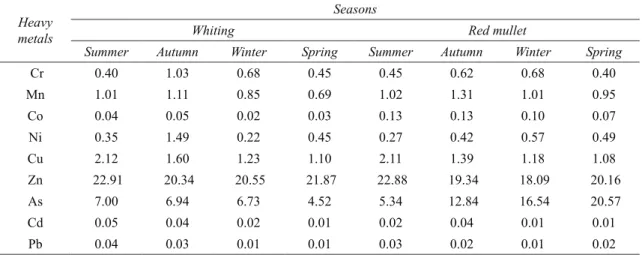
Seasonal differences can cause changes in tissue weights, fat contents/composition and water content of aquatic organism because of variation in food supply, reproduction, behavior and other physiological function all of which affect tissue contaminant concentrations (UNEP 1993). In the study, the samplings were carried out seasonally. Although seasonal differences in the mean length and weight of the whiting and red mullet were found to be insignificant (P>0.05), the mean length and weight taken from the samples in autumn and winter periods were found higher (Table 1). The seasonal difference in Cr, Co, Cu, Cd and Pb accumulation levels of the whiting and Co, Cu, Zn, As and Cd accumulation levels of the red mullet
were statistically significant (P<005). Even though Mn and Ni accumulation levels observed in autumn were higher than those of other seasons for whiting, the differences were found to be statistically insignificant (P>0.05) (Table 7). The mean accumulation levels of Cu, Zn, As, Cd and Pb were detected higher than the mean levels in summer for the whiting. The mean metal accumulation levels of Mn, Cu, Zn, Cd and Pb values for red mullet were higher in summer and Cr and Ni levels were higher in winter. Co and As accumulation levels among sampling seasons for the red mullet were statistically significant (P<0.05). The lowest accumulation levels of were obtained for Co in spring and for As in summer (Table 7).
Table 7- Average heavy metal concentration of Merlangius merlangus (whiting) and Mullus barbatus (red mullet) according to sampling seasons, (mg kg-1)
Çizelge 7- Örnekleme mevsimine göre mezgit ve barbunya balıkları ortalama ağır metal derişimleri, (mg kg-1)
Heavy metals
Seasons
Whiting Red mullet
Summer Autumn Winter Spring Summer Autumn Winter Spring
Cr 0.40 1.03 0.68 0.45 0.45 0.62 0.68 0.40 Mn 1.01 1.11 0.85 0.69 1.02 1.31 1.01 0.95 Co 0.04 0.05 0.02 0.03 0.13 0.13 0.10 0.07 Ni 0.35 1.49 0.22 0.45 0.27 0.42 0.57 0.49 Cu 2.12 1.60 1.23 1.10 2.11 1.39 1.18 1.08 Zn 22.91 20.34 20.55 21.87 22.88 19.34 18.09 20.16 As 7.00 6.94 6.73 4.52 5.34 12.84 16.54 20.57 Cd 0.05 0.04 0.02 0.01 0.02 0.04 0.01 0.01 Pb 0.04 0.03 0.01 0.01 0.03 0.02 0.01 0.02
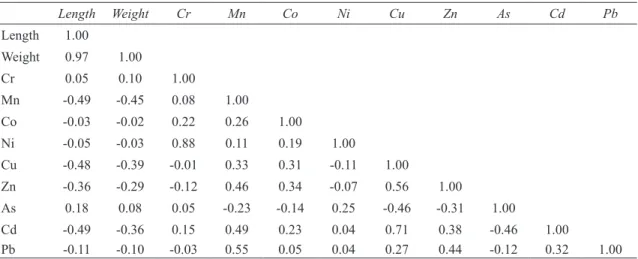
Correlation matrix for whiting and red mullet were given in Table 8 and Table 9. Very high correlation coefficients between length and weight of both species were obtained. A high inverse correlation coefficient was found between fish length and Zn concentration in whiting and positive high correlation coefficient was found between Mn and Co. Positive high level correlation coefficients were obtained between Cr, Ni and Cu, Cd metals in red mullet.
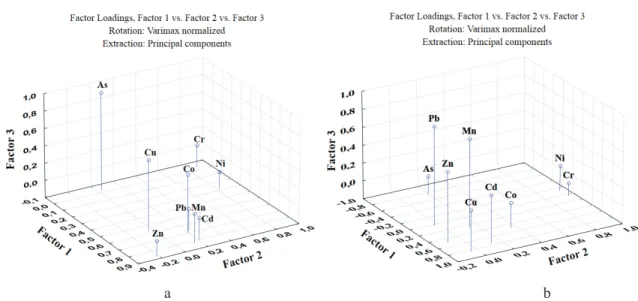
The data were evaluated by the factor analysis to express the relationships among variables. A small number of unrelated but conceptually significant new variables (factors, dimensions) from a large number of variables were obtained and new findings were gathered from these data (Kalaycı 2010). Factors were evaluated in terms of their contribution to total variance and the number of influential factors was determined. The variances expressed by three factors were about 73% for whiting and 71%
for red mullet (Figure 2). While factor 1 in whiting is related to fish length in relation to the Zn, Mn and Cd, factor 2 in whiting is related to sampling stations in relation to Cr (maximum in S2 station) and Ni (maximum in O2 station) and Factor 3 is related to sampling season (maximum in summer) in relation to arsenic. The first factor in red mullet was the sampling season and was positively correlated with Cu and Cd (maximum in summer) and negatively
correlated with arsenic. Second factor was related to the sampling stations as it was in whiting. Fish length in red mullet was related to Pb and Mn (large<medium, small) indicating the factor 3.
In this study, the results relating to metal levels of the fish muscle tissue were given in terms of wet/dried ratio. The wet/dried conversion factor was used 5.7 for whiting and 4.3 for red mullet Table 8- Correlation matrix for whiting
Çizelge 8- Mezgit balığı için korelasyon matrisi
Length Weight Cr Mn Co Ni Cu Zn As Cd Pb Length 1.00 Weight 0.97 1.00 Cr -0.05 -0.06 1.00 Mn -0.54 -0.47 0.14 1.00 Co -0.49 -0.48 0.10 0.74 1.00 Ni -0.03 -0.02 0.53 0.33 0.45 1.00 Cu -0.51 -0.50 0.05 0.45 0.62 0.10 1.00 Zn -0.77 -0.68 -0.16 0.68 0.53 0.10 0.44 1.00 As -0.17 -0.24 0.08 0.11 0.33 0.02 0.37 -0.01 1.00 Cd -0.59 -0.53 0.21 0.58 0.48 0.29 0.42 0.62 0.13 1.00 Pb -0.35 -0.31 0.14 0.45 0.37 0.30 0.44 0.38 0.08 0.64 1.00
Table 9- Correlation matrix for red mullet
Çizelge 9- Barbunya balığı için korelasyon matrisi
Length Weight Cr Mn Co Ni Cu Zn As Cd Pb Length 1.00 Weight 0.97 1.00 Cr 0.05 0.10 1.00 Mn -0.49 -0.45 0.08 1.00 Co -0.03 -0.02 0.22 0.26 1.00 Ni -0.05 -0.03 0.88 0.11 0.19 1.00 Cu -0.48 -0.39 -0.01 0.33 0.31 -0.11 1.00 Zn -0.36 -0.29 -0.12 0.46 0.34 -0.07 0.56 1.00 As 0.18 0.08 0.05 -0.23 -0.14 0.25 -0.46 -0.31 1.00 Cd -0.49 -0.36 0.15 0.49 0.23 0.04 0.71 0.38 -0.46 1.00 Pb -0.11 -0.10 -0.03 0.55 0.05 0.04 0.27 0.44 -0.12 0.32 1.00
Mezgit (Merlangius merlangus) ve Barbunya (Mullus barbatus) Balıklarında Ağır Metal Düzeylerini Etkileyen Faktörler, Alkan et al
(Table 1) and made it possible comparison with the previous studies (Table 4). The maximum metal concentrations in the whiting and red mullet were found below the limit values set by TFC (2011), EC (2006) and FAO (1983) (Table 4).
The Cr concentrations in the muscle tissues of whiting were significantly lower than same species fish Cr concentrations obtained by Tüzen (2009), Özden et al (2010) and Mendil et al (2010). On the other hand red mullet muscle tissue Cr concentrations significantly lower than determined by Turan et al (2009), Tüzen (2009), Mendil et al (2010) and Özden et al (2010). The determined Mn concentrations in muscle red mullet and whiting were lower than all of the studies except for the research conducted by Turan et al (2009). In this research, Co levels in the whiting and red mullet muscle tissues were lower than whiting Co levels determined by Özden et al (2010) and Mendil et al (2010). It was also determined that Ni concentrations in this study were lower than Ni concentrations obtained by Turan et al (2009), Tüzen (2009), Özden et al (2010) and Nisbet et al (2010) in whiting and red mullet. Cu concentrations
determined by Tüzen (2009), Nisbet et al (2010), Mendil et al (2010) and Özden et al (2010) and in whiting and red mullet were relatively higher than the results of this study. Arsenic (As) concentrations determined in this study for the whiting and the red mullet were higher than all the values detected in the previous studies except for the results by Alkan et al (2012) and Ergül & Aksan (2013). In this study Cd concentrations were lower than the values from other studies except Alkan et al (2012) and Nisbet et al (2010) and Pb concentrations were more lower than the values other than Alkan et al (2012) and Ergül & Aksan (2013). Pb concentrations in whiting muscle tissue were determined by Balkıs et al (2012) and were higher than the our values and the others (Table 4). The mean length and weight differences of three different size groups of fishes (small, medium, large) were statistically confirmed (P<0.05). The difference in the water content of the muscle tissue of the both fishes was statistically significant (P<0.05).
The average metal concentrations determined in this study for the whiting and red mullet, the results of the previous studies that have been made other
8
Çizelge 9- Barbunya balığı için korelasyon matrisi
Length Weight Cr Mn Co Ni Cu Zn As Cd Pb Length 1.00 Weight 0.97 1.00 Cr 0.05 0.10 1.00 Mn -0.49 -0.45 0.08 1.00 Co -0.03 -0.02 0.22 0.26 1.00 Ni -0.05 -0.03 0.88 0.11 0.19 1.00 Cu -0.48 -0.39 -0.01 0.33 0.31 -0.11 1.00 Zn -0.36 -0.29 -0.12 0.46 0.34 -0.07 0.56 1.00 As 0.18 0.08 0.05 -0.23 -0.14 0.25 -0.46 -0.31 1.00 Cd -0.49 -0.36 0.15 0.49 0.23 0.04 0.71 0.38 -0.46 1.00 Pb -0.11 -0.10 -0.03 0.55 0.05 0.04 0.27 0.44 -0.12 0.32 1.00
The data were evaluated by the factor analysis to express the relationships among variables. A small number of unrelated but conceptually significant new variables (factors, dimensions) from a large number of variables were obtained and new findings were gathered from these data (Kalaycı 2010). Factors were evaluated in terms of their contribution to total variance and the number of influential factors was determined. The variances expressed by three factors were about 73% for whiting and 71% for red mullet (Figure 2). While factor 1 in whiting is related to fish length in relation to the Zn, Mn and Cd, factor 2 in whiting is related to sampling stations in relation to Cr (maximum in S2 station) and Ni (maximum in O2 station) and Factor 3 is related to sampling season (maximum in summer) in relation to arsenic. The first factor in red mullet was the sampling season and was positively correlated with Cu and Cd (maximum in summer) and negatively correlated with arsenic. Second factor was related to the sampling stations as it was in whiting. Fish length in red mullet was related to Pb and Mn (large<medium, small) indicating the factor 3.
a b
Figure 2- Factor analysis for whiting, a and red mullet, b fish species
Şekil 2- Mezgit, a ve barbunya, b balık türleri için faktör analizleri
In this study, the results relating to metal levels of the fish muscle tissue were given in terms of wet/dried ratio. The wet/dried conversion factor was used 5.7 for whiting and 4.3 for red mullet (Table 1) and made it possible comparison with the previous studies (Table 4). The maximum metal concentrations in the whiting and red mullet were found below the limit values set by TFC (2011), EC (2006) and FAO (1983) (Table 4).
Figure 2- Factor analysis for whiting, a and red mullet, b fish species
researchers and the limit values set by the various regulatory authorities are given in Table 4. None of the metals measured in this study in terms of average values exceeded the limits established by the legal authorities such as TFC (2011), EC (2006) and FAO (1983).
4. Conclusions
In this study, metal levels of the muscle tissues of the two fish species (whiting and red mullet) were determined by ICP-MS which has high sensitivity and lower detection limits. Chromium (Cr), manganese (Mn), cobalt (Co), nickel (Ni), copper (Cu), zinc (Zn), arsenic (As), cadmium (Cd) and lead (Pb) concentrations in the muscle tissues of fishes were found to be below the limits set by the Turkish Food Codex (TFC 2011), European Communities Commission Regulation (EC 2006) and Food and Agriculture Organization (FAO 1983) (Table 4).
Whiting and red mullet fish in the Eastern Black Sea region which occupies an important place in the country’s fishery potential are safe for human health.
Acknowledgements
This work is part of the TAGEM/HAYSUD/2010/09/01/04 project financially supported by the Ministry of Food, Agriculture and Livestock. The authors would like to thanks KARTRIP project (TAGEM/HAYSUD/2010/09/01/04) personnel, SURAT research ship personnel and Bayram Zengin for fish sampling.
References
Alkan N, Aktas M & Gedik K (2012). Comparison of metal accumulation in fish species from the southeastern Black sea. Bulletin of Environmental Contamination
and Toxicology 88(6): 807-812
Balkıs N, Aksu A & Hicsönmez H (2012). Metal levels in biota from the Southern Black Sea, Turkey. Journal
of the Black Sea/Mediterranean Environment 18(2):
134-143
Balkıs N, Topcuoğlu S, Güven K.C, Öztürk B, Topaloğlu B, Kırbaşoğlu Ç & Aksu A (2007). Heavy metals in shallow sediments from the Black Sea, Marmara Sea and Aegean Sea regions of Turkey. Journal of the
Black Sea/Mediterranean Environment 13(2):
147-153
Boran M & Altinok I (2010). A review of heavy metals in water, sediment and living organisms in the Black Sea. Turkish Journal of Fisheries and Aquatic
Sciences 10(4): 565-572
Canlı M & Atlı G (2003). The relationships between heavy metal (Cd, Cr, Cu, Fe, Pb, Zn) levels and the size of six Mediterranean fish species. Environmental
Pollution 121: 129-136
Ergül H A & Aksan S (2013). Evaluation of non-essential element and micronutrient concentrations in seafood from the Marmara and Black Seas. Journal of the Black
Sea/Mediterranean Environment 19(3): 312-331
EC (2006). Setting maximum levels for certain contaminants in foodstuffs. Official Journal of the European Union, Commission Regulation No: 1881/2006
EPA (1994). Method 200.8: Determination of Trace Elements in Waters and Wastes by Inductively Coupled Plasma-Mass Spectrometry. Revision 5.4 Fındık Ö & Çiçek E (2011). Metal concentrations in two
bioindicator fish species, Merlangius merlangus,
Mullus Barbatus, Captured from the West Black Sea
Coasts (Bartin) of Turkey. Bulletin of Environmental
Contamination and Toxicology 87(4): 399-403
FAO (1983). Compilation of Legal Limits for Hazardous Substances in Fish and Fishery Products, Food and Agriculture Organization Fishery. Circular No: 464, Rome, Italy
Harmelin-Vivien M, Cossa D, Crochet S, Banaru D, Letourneur Y & Mellon-Duval C (2009). Difference of mercury bioaccumulation in red mullets from the north-western Mediterranean and Black seas. Marine
Pollution Bulletin 58(5): 679-685
Has-Schon E, Bogut I, Rajkovic V, Bogut S, Cacic M & Horvatic J (2008). Heavy metal distribution in tissues of six fish species included in human diet, inhabiting freshwaters of the Nature Park “Hutovo Blato” (Bosnia and Herzegovina). Archives of Environmental
Contamination and Toxicology 54(1): 75-83
Kalaycı Ş E (2010). SPSS Uygulamalı Çok Değişkenli İstatistik Teknikleri. Asil Ltd. Şti., Ankara
Mendil D, Demirci Z, Tuzen M & Soylak M (2010). Seasonal investigation of trace element contents in commercially valuable fish species from the Black sea,
Mendil D, Unal O F, Tuzen M & Soylak M (2010). Determination of trace metals in different fish species and sediments from the River Yesilirmak in Tokat,
Turkey. Food and Chemical Toxicology 48(5):
1383-1392
Milestone (2011). Application Note. (HPR-FO-17; Dried Fish), SK-10 Application Book (Rev 5), pp. 412, Sorisole-Italy
Nisbet C, Terzi G, Pilgir O & Saraç N (2010). Determination of heavy metal levels in fish samples collected from the Middle Black Sea. Kafkas Universitesi Veteriner
Fakültesi Dergisi 16(1): 119-125
Özden Ö, Erkan N & Ulusoy Ş (2010). Determination of mineral composition in three commercial fish species (Solea solea, Mullus surmuletus, and Merlangius
merlangus). Environmental Monitoring Assessment 170(1-4): 353-363
Tepe Y (2009). Metal concentrations in eight fish species from Aegean and Mediterranean Seas. Environmental
Monitoring Assessment 159: 501-509
TFC (2011). Regulation on contaminants in foodstuffs. Republic of Turkey Ministry of Food Agriculture and Livestock, Number: 28157, Ankara
Turan C, Dural M, Oksuz A & Öztürk B (2009). Levels of heavy metals in some commercial fish species captured from the Black Sea and Mediterranean Coast of Turkey. Bulletin of Environmental Contamination
and Toxicology 82(5): 601-604
Turkish Statistical Institute (2011). Fishery Statistics 2010. Yayın No: 3624, ISSN: 1013-6177, Ankara Tüzen M (2003). Determination of heavy metals in fish
samples of the middle Black Sea (Turkey) by graphite furnace atomic absorption spectrometry. Food
Chemistry 80: 119-123
Tüzen M (2009). Toxic and essential trace elemental contents in fish species from the Black Sea, Turkey.
Food and Chemical Toxicology 47: 1785-1790
Uluozlu O D, Tuzen M, Mendil D & Soylak M (2007). Trace metal content in nine species of fish from the
Black and Aegean Seas, Turkey. Food Chemistry 104:
835-840
UNEP (1993). Guidelines for monitoring chemical contaminants in the sea using marine organisms. Reference Methods For Marine Pollution Studies No: 6, Monaco