Determination of efficient CIDR application periods in timed artificial
insemination of Damascus goats during the breeding season
Gökhan DOĞRUER
1, Fikret KARACA
2, Ece KOLDAŞ ÜRER
1, Nurdan COŞKUN
2,
Ayşe MERVE KÖSE
1, Cafer Tayyar ATEŞ
3, Oğuzhan ÖZCAN
4, M. Kemal SARIBAY
11Mustafa Kemal University, Faculty of Veterinary Medicine, Department of Obstetrics and Gynaecology, Hatay; 2Department of
Fertility and Artificial Insemination, Hatay; 3Department of Zootechnia, Hatay; 4Faculty of Medicine, Department of Biochemistry,
Hatay.
Summary: This research was conducted to determine the most efficient CIDR application periods in timed artificial insemination (TAI) protocols in Damascus goats during the breeding season. Ninety-six Damascus goats were used and the animals were randomly allocated into four equal groups. CIDR was used for 18, 12, 6 and 3 days in groups VL, L, S, and VS, respectively. 500 IU of eCG and 125 mcg of cloprostenol were administered on the day of CIDR removal. The goats were timely inseminated intra-cervically by cooled semen 48-60 h after removal of CIDR together with 5 mcg GnRH administration. Pregnancy rates were 62.5%, 79.2%, 75% and 62.5% in VL, L, S and VS groups, respectively. Abortion rates were 13.3%, 5.3%, 5.6% and 13.3%, also kidding rates were found to be 86.6%, 94.7%, 94.4% and 86.6% in VL, L, S and VS groups, respectively. Fertility rates were 54.2%, 75%, 70.8% and 54.2% in VL, L, S and VS groups, respectively. No significant difference was observed in pregnancy rates, abortion and kidding rates among the groups (p>0.05). As a result, CIDR has a wide range of application period in TAI protocols in Damascus goats during the breeding season. The short-term usage as short as 3 days, will offer high flexibility in TAI protocols of goats. Even no statistical difference was obtained among the groups, lower rates of fertility in VS and VL groups may provide economic loss. Further studies with a larger number of animals are needed to clarify the questions about fertility and economic issues.
Keywords: CIDR, goat, timed artificial insemination.
Damascus keçilerinde aşım sezonunda sabit zamanlı tohumlama uygulamalarında CIDR’ın etkin
uygulama sürelerinin belirlenmesi
Özet: Çalışma, Şami keçilerinde aşım sezonunda, sabit zamanlı tohumlama protokollerinde CIDR’ın en uygun uygulama zamanını belirlemek amacıyla düzenlendi. Çalışmada 96 keçi kullanıldı ve hayvanlar rastgele dört eşit gruba ayrıldı. CIDR VL, L, S ve VS gruplarında sırasıyla 18, 12, 6 ve 3 gün süre ile kullanıldı. Hayvanlara CIDR çıkartılma anında 500 IU eCG ve 125 mcg kloprostenol yapıldı. Keçiler, CIDR’ın çıkartılmasından 48-60 saat sonra intra-servikal olarak soğutulmuş sperma ile tohumlandı ve tohumlama anında 5 mcg GnRH kas içi yolla uygulandı. Gebelik oranları VL, L, S ve VS gruplarında sırasıyla %62.5, %79.2, %75 ve %62.5 bulundu. İlaveten abort oranları VL, L, S ve VS gruplarında sırasıyla %13.3, %5.26, %5.55 ve %13.3 bulundu. Doğum oranları ise sırasıyla %86.6, %94.7, %94.4 ve %86.6 olarak belirlendi. Fertilite oranları VL, L, S ve VS gruplarında sırasıyla %54.2, %75, %70.8 ve %54.2 bulundu. Gruplar arasında fertilite parametrelerinde istatistiksel farklılık belirlenemedi (p>0.05). Sonuç olarak CIDR’ın keçilerde aşım sezonunda sabit zamanlı tohumlama uygulamalarında geniş bir kullanım aralığı olduğu tespit edildi. Bu zamana kadar bildirilen en kısa kullanım süresinin (3 gün) senkronizasyon ve sabit zamanlı tohumlama uygulamalarında uygulama kolaylığı sağlayabileceği kanısına varıldı. Her ne kadar istatistik fark bulunmasa da VL ve VS gruplarındaki fertilite oranlarındaki düşüklüğün ekonomik kayıplara sebep olabileceği ve daha geniş gruplarla yapılacak çalışmaların bu konuyu aydınlatabileceği kanısına varıldı.
Anahtar sözcükler: CIDR, keçi, sabit zamanlı tohumlama.
Introduction
In order to increase both productivity and prolificacy of small ruminants, reproductive activity is manipulated by exogenous hormonal treatments. These treatments intend to obtain synchronized estrous (13). The success of any estrous synchronization protocol is directly related to
proper estrous detection (7, 22). In ruminant breeding industry, proper estrous detection appears to be an important problem. False estrous detection, lower rates of correct diagnosis or misdiagnosis of the estrous result in both lower degrees of pregnancy rates and economic loss (11). To overcome the estrous detection phenomenon,
timed artificial insemination (TAI) programs are being improved by enabling the application of inseminations without estrous detection (10, 16, 23).
To provide synchronized estrous in small ruminants progestagens are widely used (3). Controlled internal drug release device (CIDR) is produced form medical silicone containing low levels of natural progesterone and is as efficient as progestagen containing sponges (21). Additionally, CIDR has advantages in food production systems in terms of not having a residue problem. CIDR has been found to be much easier to be withdrawn from the vagina when compared to the sponges and has an advantage of reusing (two or three times) compared to other progestagen sources (19, 26).
Generally, the time of application for CIDR is reported between the periods of 9-16 days as that of other progestagen sources (18, 19, 21). The use of progestagens in shorter periods of time (5-7) in estrous synchronization was found to be effective as longer periods (17, 23), but no reported study was found for both more longer (18 days) and shorter (3 days) periods of time in CIDR use in goats at TAI protocols even though this treatment period is trying to be shortened in European Union countries for reducing hormonal drug residues on foods (15, 24).
In this research, we aimed to determine the most efficient time of CIDR application period in TAI protocols in Damascus goats during the breeding season.
Materials and Methods
The research was carried out in a dairy goat farm located at 36°90” north latitude and 37°15” east longitude. The animal material of the study consisted of 96 multiparous and lactating Damascus goats. The ages of the goats varied between 3-5 years old. Daily average milk yield was 1.75 lt/goat. The goats were intensively bred, and feed with a ration of 2800 kcal/kg metabolic energy and 18% crude protein level. Water was given ad libitum over the day. The present study was approved by the local animal research ethics committee of Mustafa Kemal University, with the approval number of 2016-2-7.
All of the goats were subjected to 0.33 gr progesterone containing CIDR with the special applicator according to the manufacturer’s protocol (Eazi Breed, Pfizer, Turkey). The study groups were described as very long (VL), long (L), short (S) and very short (VS) according to a period of CIDR remaining in the vagina (18, 12, 6 and 3 days, respectively). Each group consisted of 24 goats that were administered 500 IU eCG (Chronogest PMSG, Intervet, Turkey) and 125 mcg of cloprostenol (Estrumate, MSD, Turkey) at the time of CIDR removal via the intramuscular route. The animals were inseminated intracervically between 48-60 hours after CIDR removal regardless of estrus detection. Five
mcg of buserelin acetate (Receptal, Intervet, Turkey) was administered through the intramuscular route at the time of TAI.
Three fertile bucks were used for the semen
collection. The ejaculates were collected by
electroejaculation method by an electroejaculator producing 12-volt electricity (Ruakura Ram Probe, Manufactured for Shoof International Ltd. New Zealand) The lubricated electroejaculator were introduced into the rectum. No stimulation was given for 1 minute after the introduction of electroejaculator. The stimulation was given for 4 seconds. Than the stimulation was cut-off for 4 seconds. Approximately after 6-7 stimulation
ejaculation occurred. The collected semen was
immediately evaluated for volume and motility. For eliminating the individual differences in the ejaculates of the bucks the semen were mixed and re-examined for sperm motility and concentration for calculating the dilution rate (25). The sperm were extended by skimmed milk (Pınar, Turkey) and antibiotic-containing 1000 IU sodium G penicillin and 1000 mcg dihydrostreptomycin
sulphate /ml, up to 8x10⁷ spermatozoa/ml. The extended
semen was stored in 0.25 ml straws. The straws were chilled to 4-6° C in the refrigerator within 2 hours and used in 12 hours period after the collection (6).
Blood samples were taken from 10 randomly selected animals from each group. Plasma was obtained by centrifuging the blood from the heparinized blood tubes for 10 minutes at 5000 rpm. The plasma samples were taken on days 0, 1, 2, 3, 4, 6, 9, 12, 15, 18 in group VL, on days 0, 1, 2, 3, 4, 6, 9, 12 in group L, on days 0, 1, 2, 3, 4, 6 in group S and on days 0, 1, 2, 3 in group VS. Also, all of the animals were sampled at the time of TAI and at
21st-day post-TAI. The plasma samples were stored at -20 oC
until the plasma progesterone levels were measured. Plasma progesterone levels were analyzed by an electrochemiluminescent method in an autoanalyzer (Siemens Advia Centaur XP, UK).
Pregnancy diagnosis was carried out both by means of progesterone at 21st-day post TAI and by means of ultrasonography 50 days after TAI. The goats with a level of >5 ng/ml progesterone at 21st day post TAI mentioned to be pregnant. Also, diagnosis of pregnancy was carried out extra abdominally with 5-7.5 MHz convex probe of the ultrasound at 50 days post-TAI (Falco 100, Pie Medical, Netherlands)
In the current study, the fertility parameters were calculated according to these formulas: Pregnancy rate= (pregnant goats/goats inseminated) x 100. Abortion rate= (goats aborting/pregnant goats) x 100. Kidding rate= (goats kidding/pregnant goats)x100. Fertility rate= (goats kidding/goats inseminated)x100 (2, 23).
The pregnancy, kidding, abortion and fertility rates
among the groups were compared by X2 test also plasma
progesterone levels among the groups were compared by One-way ANOVA and F- test by using SPSS 22.00 software.
Results
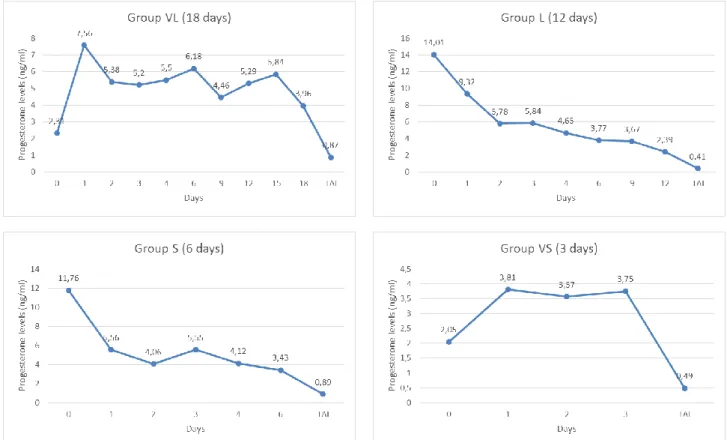
The initial progesterone levels of the groups are above the levels of 1 ng/ml. The progesterone levels were
balanced to the levels of 3.75±0.46-5.84±0.36 ng/ml during 3 days. Plasma progesterone values during the course of the treatment remained higher than 2 ng/ml. The progesterone values were observed below the levels of 1 ng/ml at the TAI. The plasma progesterone concentrations in the groups were given in figure 1.
Pregnancy rate, abortion rate, kidding rate and fertility rate in groups of the study were given in table 1. No significant difference was observed in fertility parameters among the groups (p>0.05).
Group VL: Group very long, Group L: group long, Group S: Group short, Group VS: Group very short .
Figure 1. The mean plasma progesterone concentrations (ng/ml) of groups during the course of CIDR treatment and at time of TAI. Şekil 1. CIDR tedavileri sürecinde ve tohumlama anında gruplardaki ortalama plazma progesteron konsantrasyonları (ng/ml).
Table 1. Some fertility parameters obtained in groups VL, L, S and VS Tablo 1. VL, L, S ve VS gruplarından elde edilen bazı fertilite parametreleri
Fertility parameters GROUPS
GROUP VL (18 days) GROUP L (12 days) GROUP S (6 days) GROUP VS (3 days) P Pregnancy rate at d 21 (%) 79.1 (19/24) 83.3 (20 /24) 79.1 (19/24) 75.0 (18/24) NS Pregnancy rate at d 50 (%) 62.5 (15/24) 79.2 (19/24) 75.0 (18/24) 62.5 (15/24) NS Abortion rate (%) 13.3 (2/15) 5.3 (1/19) 5.6 (1/18) 13.3 (2/15) NS Kidding rate (%) 86.6 (13/15) 94.7 (18/19) 94.4 (17/18) 86.6 (13/15) NS Fertility rate (%) 54.2 (13/24) 75.0 (18/24) 70.8 (17/24) 54.2 (13/24) NS
Discussion and Conclusion
The progesterone levels at day 0 were greater than 1 ng/ml in our study, which was interpreted as goats were both normally cyclic and in the breeding season. The difference of progesterone values among the groups (p<0,05) at day 0 could be attributed to the multiple ovulations. Vilarino et al. (26) reported to obtain higher progesterone concentrations just after the CIDR insertion, but Khanthusaeng et al. (12) found the greatest values 4 days after the insertion. A rapid increase in progesterone concentration was obtained one day after CIDR insertion in groups VL and VS, while a decrease was seen in groups L and S, because initial endogenous progesterone levels were higher in groups L and S. Furthermore, in this research it was observed that the plasma progesterone levels were balanced to the ranges of 3.75±0.46-5.84±0.36 ng/ml in three days that was thought to be enough for reaching the optimal levels of progesterone for suppressing the follicular wave (26). It can also be mentioned that the initial levels of endogenous progesterone are not important for the biological actions of CIDR.
The main activity of the progestagens is suppressing the preovulatory secretion of pituitary hormones especially LH (1, 3). This causes the atresia of the largest follicle (27). Longer progestagen treatment (>10 days) results in lower plasma progesterone levels when compared to shorter durations at the cessation of progesterone treatment (13). The result of the current study is not congruent with this finding because each of the groups in our study has nearly similar plasma progesterone levels at CIDR removal time. This situation could be arisen from that the CIDR may provide adequate levels of progesterone to suppress estrous and ovulation for 27 to 31 days (13). It was reported that even a decrease in progesterone levels determined in the course of time after CIDR insertion the final levels of progesterone should be higher than 1.0 ng/ml to suppress the estrous behavior and ovulation until withdrawing of devices (26). Fluctuating levels of progesterone during the course of treatment were seen in this study. At the time of CIDR withdrawal, the plasma progesterone levels were determined at levels of 2.39±0.54-3.96±0.73 ng/ml in the groups either longer or shorter durations of treatment. During the treatment period, none of the goats exhibited estrous symptoms in each of the groups, this could be explained by no effect of either extension or shortening the duration of CIDR treatment on the main activity of the CIDR on estrous activity.
Additionally to CIDR treatment even long (13-16 days) or short duration (5-9 days) eCG and PGF2α are advised to be administered at the time or prior to inserting removal (13). The aims of eCG administrations are both
to reduce the time interval between estrous onset and progestagen removal and to stimulate follicular development (8). Vinoles et. al. (27), observed that the growing process of the follicle in the long-term treated ewes was completed at the end of progestagen treatment and the ovulation occurred in the following 48 hours, this process was already going on in short-term treated ewes. The possible negative effects of short-term treatments in Group S and Group VS on follicle development may be eliminated by the administration of eCG at the time of CIDR withdrawal. eCG in such conditions may promote the follicular development, GnRH also may synchronize the ovulations (3).
The PGF2α or analogs is used for eliminating the presence of possible cyclic corpus luteum (21). The progesterone levels at day 0 were greater than 1 ng/ml in our study. This level may indicate that goats had a cyclic CL at the initiation of treatment; hence this result shows the necessity of PGF2α injections during the breeding season. PGF2α injections were preferred at the time of progestagen insertion (15), at the time of progestagen removal (6, 14, 15) or one to two days before the progestagen removal (19). Motlomelo et al. (18) used PGF2α at the time of progestagen insertion and at the time of progestagen removal. They obtained similar fertility rates. In the current study, the PGF2α is administered at the time of progestagen removal.
In this research, the goats were inseminated 48-60 hours after CIDR withdrawal regardless of estrous detection. In previous studies, goats are inseminated either 12-24 hours after the onset of estrous or 48-60 hours after the progestagen source withdrawal regardless of estrous detection (9, 21). Romano (21) reported that the type of progestagen affects the time of estrous onset and TAI. CIDR treated goatswere in estrus between 36 and 44 h following device withdrawal (20). The time period selected for TAI seems to be suitable for both of the
insemination protocols. Additionally, the plasma
progesterone levels obtained at TAI is lower than 1.0 ng/ml which shows that the goats are in estrous. This finding is compatible with the results obtained previously (9, 12).
In this research, the pregnancies were determined both by means of progesterone analysis at 21 days post-TAI and by ultrasonography at 50 days after post-TAI. Motlomelo et al. (18) reported that the pregnancy can accurately be diagnosed 21 days post-insemination by means of progesterone analysis. Kor et al. (14) have taken the blood progesterone level at 21 days post-insemination as an indicator of pregnancy either single or multiple kids pregnancy. They determined the pregnancy criteria level of progesterone as 1.4 ng/ml but found the levels greater than 5 ng/ml in pregnant goats. Khanthusaeng et al. (12),
has also accepted the pregnancy criteria as 5 ng/ml. Our pregnancy criterion in this research for pregnancy diagnosis by progesterone analysis is the levels over 5 ng/ml. The pregnancy rates by means of progesterone analysis were 79.1%, 83.3%, 79.1% and 75% in VL, L, S and VS groups, respectively. The ultrasonographic pregnancy diagnosis showed that the pregnancy rates were 62.5%, 79.2%, 75% and 62.5% in VL, L, S and VS groups, respectively. The difference at the rates of pregnancy
between the progesterone and ultrasonographic
examinations may be originated from the embryonic loss. Embryonic loss is reported to occur between 25-35 days of pregnancy in goats (28). These ranges (21-50 days post-TAI) seem to be within the limits of embryonic loss (25-35 days). Also, the difference between pregnancy rates of these techniques may be associated with the prolonged life of corpus luteum and short estrous cycles (5).
The pregnancy rates in long-term usage (>10 days) of CIDR varies between the ranges of 22.2% and 63% (12, 14, 21). Romano (21) used CIDR for 13 days and obtained a 63% offspring rate in their research in which the estrous of the goats were determined and artificially inseminated with diluted cooled semen. However, these authors did not use eCG in their research. Khanthusaeng et al. (12) used CIDR for 14 days and obtained a 22.2% pregnancy rate in goats after TAI. On the other hand, Kor et al. (14) used CIDR for 14 days and obtained a 60% pregnancy/kidding rate. In their study, the estrous was determined and artificial insemination was applied with diluted fresh semen. Motlomelo et al. (18) obtained a 46.7% pregnancy rate in their research in which they used CIDR for 16 days. At the time of CIDR removal, 300 IU eCG was administered in their study and TAI was performed between 48-60 hours after removal of CIDR. In our study, the pregnancy rates of long period groups (VL= 62.5%, L= 79.2%) were determined to be higher than those in abovementioned studies. The difference could be originated from the dose of eCG, insemination time, semen storage and breed difference. Vilarino et al. (26) applied TAI to the goats at 54 hours after the CIDR removal with short period primings (5 days) and obtained a 75.3% pregnancy rate. Menchaca and Rubianes (17) used progestagens for 5-6 days in their study. They applied TAI at 48 and 54 h after progestagen removal and obtained 49.4% and 63.7% pregnancy rates, respectively. Both S and VS groups in this study seem to have similar pregnancy rates (70.8% and 62.5%) as abovementioned studies. Martemucci and Alessandro (15) obtained a 60.9% fertility rate in goats of which were treated with progestagens for 5 days. The result of fertility rate in Group S (70.8%) was found to be higher than those of the researchers. But the fertility rate of VS group (54.2%) was lower than those of the researchers. No statistical
difference (p>0.05) was obtained in fertility rates among the groups but economically it seems to be important especially in groups VL and VS. Higher number of goats may provide more satisfactory results in terms of statistics. Five percent abortion is also mentioned within the limits of fertility in goats (4). In this research, the abortion rate can be mentioned within the fertility limits in all of the groups.
The results of the study show that CIDR has a wide range of application period in timed artificial insemination protocols in Damascus goats during the breeding season. The short-term usage as short as 3 days, which has never been used previously to our best of knowledge, will offer a high flexibility in synchronization and timed artificial insemination protocols in goats. Even no statistical difference was obtained among the groups, the lower rates of fertility in VS and VL groups (54.2% and 54.2%) may provide economic loss. Further studies with a larger number of animals are needed to clarify the questions about fertility and economic issues.
Acknowledgment
This study was funded by Mustafa Kemal University Scientific Research Committee by the project number of 13980.
References
1. Abecia JA, Forcada F, González-Bulnes A (2012):
Hormonal control of reproduction in small ruminants.
Anim Reprod Sci, 130, 173-79.
2. Ahmed MMM, Makawi SE, Jubara AS (1998):
Synchronization of oestrus in Nubian goats. Small Rumin
Res, 30, 113-120.
3. Amridis GS, Cseh S (2012): Assisted reproductive
technologies in the reproductive management of small ruminants. Anim Reprod Sci, 130, 152-161.
4. Edmondson MA, Roberts JF, Baird AN, et al. (2012):
Theriogenology of sheep and goats. 150-230. In: Pugh DG,
Baird AN, (Ed). Sheep and Goat Medicine. 2nd ed. Missouri: Elsevier Saunders.
5. Engeland IV, Ropstad E, Andresen O, et al. (1997):
Pregnancy diagnosis in dairy goats using progesterone assay kits and oestrous observation. Anim Reprod Sci,
47(3), 237-243.
6. Erarslan C, Karaca F (2017): Üreme Mevsiminde vajinal
sünger ve kulak İmplantı uygulamalarıyla senkronize edilen kıl keçilerinde farklı zamanlarda yapılan servikal tohumlamaların gebelik oranlarına etkisi. Atatürk
Üniversitesi Vet Bil Derg, 12(1), 63-70.
7. Freitas VJF, Baril G, Bosc M, et al. (1996): The influence
of ovarian status on response to estrus synchronization treatment in dairy goats during the breeding season.
Theriogenology, 45, 1561-1567.
8. Gordon I (1997): Controlled Reproduction in sheep and
9. Greyling JPC, van der Nest M (2000): Synchronization of
oestrus in goats: Dose effect of progestagen. Small Rumin
Res, 36, 201-207.
10. HoltzW, SohnreyB, Gerland M, et al. (2008): Ovsynch
synchronization and fixed-time insemination in goats.
Theriogenology, 69 (7), 785-792.
11. Kenfack A, Ngoula F, Yombi-Malonga JP, et al. (2013):
Prominent signs of oestrus in the West African Dwarf Goat.
IJAS, 3(4), 791-795.
12. Khanthusaeng V, Navanukraw C, Moonmanee T, et al. (2013): Efficiency comparison of first use and re-use
synthetic progesterone on estrus synchronization and pregnancy rates after natural breeding and Timed AI in goats. Chiang Mai Veterinary Journal, 11(1), 31-40.
13. Knights M, Singh-Knights D (2016): Use of controlled
internal drug releasing (CIDR) devices to control reproduction in goats: A review. Animal Science Journal,
87, 1084-1089.
14. Kor NM, Ziaei N, Pour EE (2011): Comparison of
reproductive performance in Raieni Goats following different estrous synchronization methods and subsequent eCG treatment during the natural breeding season. Global
Veterinaria, 7 (6), 618-624.
15. Martemucci G, D’Alessandro AG (2011):
Induction/synchronization of oestrus and ovulation in dairy goats with different short term treatments and fixed time intrauterine or exocervical insemination system. Anim
Reprod Sci, 126, 187-194.
16. Menchaca A, Rubianes E (2004): New treatments
associated with timed artificial insemination in small ruminant. Reprod Fertil Dev, 16, 403-413.
17. Menchaca A, Rubianes E (2007): Pregnancy Rate
Obtained with Short-term Protocol for Timed Artificial Insemination in Goats. Reprod Dom Anim, 42, 590-593.
18. Motlomelo KC, Greyling JPC, Schwalbach LMJ (2002):
Synchronisation of oestrus in goats: the use of different progestagen treatments. Small Rumin Res, 45, 45-49.
19. Nogueira DA, Lopes Júnior ES, de Peixoto RM, et al. (2011): Using the Same CIDR up to three times for estrus
synchronization and artificial insemination in dairy goats.
Acta Sci Anim Sci, 33, 321-325.
20. Omontese BO, Rekwot PI, Ate IU, et al. (2016): An
update on oestrus synchronisation of goats in Nigeria.
APJR, 5 (2), 96-101.
21. Romano JR (2004): Synchronization of estrus using CIDR,
FGA or MAP intravaginal pessaries during the breeding season in Nubian Goats. Small Rumin Res 55, 15-19.
22. Rubianes E, Menchaca A (2003): The pattern and
manipulation of ovarian follicular growth in goats. Anim
Reprod Sci,78, 271-287.
23. Sarıbay MK, Karaca F, Doğruer G, et al. (2012): Effects
of Long and Short Term Progestagen Treatments Plus GnRH Followed by TAI on Fertility Parameters in Lactating Hair Goats during the Transition Period. Kafkas
Univ Vet Fak Derg, 18(3), 507-511.
24. Simões J (2015): Recent advances on synchronization of
ovulation in goats, out of season, for a more sustainable production. APJR, 4(2), 157-165.
25. Tekin K, Daşkın A (2016): Effect of different extenders on
motility and some sperm kinematics parameters in Norduz goat semen. Turk J Vet Anim Sci, 40, 490-495.
26. Vilariño M, Rubianes E, Menchaca A (2011): Re-use of
intravaginal progesterone devices associated with the Short-term Protocol for timed artificial insemination in goats. Theriogenology, 75, 1195-1200.
27. Viñoles C, Forsberg M, Banchero G, et al. (2001): Effect
of long-term and short-term progestagen treatment on follicular development and pregnancy rate in cyclic ewes.
Theriogenology, 55, 993-1004.
28. Zamfirescu S, Anghel A, Nadolu D, et al. (2011):
Plasmatic profiles of pregnancy-associated glycoprotein and progesterone levels during early pregnancy in Carpathian Goat, Annals of RSCB, 16, 2,50-53.
Geliş tarihi : 27.12.2017 / Kabul tarihi : 19.04.2018
Address for correspondence:
Assoc. Prof. Dr. Gökhan DOĞRUER Mustafa Kemal University
Faculty of Veterinary Medicine Tayfur Sokmen Campus 31040 Hatay, Turkey