See discussions, stats, and author profiles for this publication at: https://www.researchgate.net/publication/275770622
Growth, Mortality and Spatial Distribution of Brushtooth Lizardfish, Saurida
undosquamis (Richardson, 1848), Inhabiting the Karataş Coasts (Iskenderun
Bay, Northeastern Mediterranea...
Article in Acta Zoologica Bulgarica · January 2011 CITATIONS
5
READS
128
1 author:
Some of the authors of this publication are also working on these related projects:
Destination Revenue Management System FeasibilityView project
Journal of Animal Diversity (ISSN: 2676-685X; http://jad.lu.ac.ir)View project Erdoğan Çiçek
Nevşehir Hacı Bektaş Veli University
150PUBLICATIONS 947CITATIONS
Introduction
The greatest change in Levantine marine environ-ment took place after the opening of the Suez Canal. The creation of a direct link between Mediterranean and Indo-Pacifi c basins resulted in the introduc-tion of unintenintroduc-tional and intenintroduc-tional species into Levantine aquatic systems (GOREN, GALIL 2005).
To date, over 65 fi sh species of Indo-Pacifi c origin (lessepsian) have entered Levantine Basin through the Suez Canal and established fl ourishing popula-tions (GOREN, GALIL 2005, GOLANI et al. 2002, CICEK,
BILECENOGLU 2009).
The brushtooth lizardfi sh, Saurida
undosqua-mis is distributed in the Eastern Indian Ocean, Malay
Peninsula, southern Philippines, northern Java, Arafura Sea, Louisiade Archipelago, and northern half and southwestern Australia. The fi sh is a benthic species, found on the sublittoral zone above 100 m over sand or mud bottoms of coastal waters. It feeds mainly on fi sh, crustaceans, and other invertebrates (FROESE, PAULY 2009).
The brushtooth lizardfi sh, was fi rst recorded in 1953 along the Mediterranean coast of Israel and was found to be much rarer than the native Mediterranean lizardfi sh Synodus saurus (GOREN, GALIL 2005, BEN
TUVIA 1953). However, by 1955 S. undosquama had
became an important part of the trawl catch, with commercial catches increasing steadily to a total of
Growth, Mortality and Spatial Distribution of
Brushtooth
Lizardfi sh,
Saurida undosquamis (Richardson, 1848),
Inhabiting the Karataş Coasts (Iskenderun Bay,
Northeastern Mediterranean)
Erdoğan Çiçek
1,*,
Dursun Avşar
21 Nevşehir University, Faculty of Art and Science, Department of Biology, 50300 Nevşehir/Turkiye;
E-mail: [email protected]
2 Cukurova University, Faculty of Fisheries, 01330 Balcalı, Adana/Turkiye
Abstract: This study was carried out from September 2002 to April 2003 in Karataş Coasts (Iskenderun Bay). A total
of 279 specimens were trawled by monthly sampling in 2002-2003 fi shing season. The age of Saurida
un-dosquamis was estimated by examining sagittal otoliths and it was found out that the age composition
var-ied from I to VIage classes. The mean total length and total weight values were calculated as 14.22±3.42 cm and 20.73±15.42 g respectively and the calculated length-weight relationship was W=0.0083*L2.879.
The von Bertalanffy growth parameters were L∞: 38.05 cm, K: 0.124 year-1 and to: -1.680 year. The
instan-taneous rate of total mortality (Z) was 1.77, the natural mortality (M) was 0.35 and the fi shing mortality (F) was estimated to be 1.42. The exploitation rate (E) was calculated as 0.80 using value of M and F. Therefore, the population of S. undosquamis from the coast of Karataş, Iskenderun Bay was exploited over the optimum level because of overfi shing pressure.
Key words: Saurida undosquamis, Iskenderun Bay, Length-weight relationship, mortality, exploitation rate.
Çiçek E.,D. Avşar
266.5 tons in 1956, 20% of the total annual trawl catch (GOREN, GALIL 2005, OREN 1957a, b). In some years S.
undosquamis represented up to 53% of the total catch
in the northeastern Mediterranean coasts (GOREN,
GALIL 2005, GORGY 1966, GUCU, BINGEL 1994).
S. undosquamis is of major commercial
im-portance to the bottom trawl fi sheries in the north-eastern Mediterranean. The landings of this species were reported 348 t for the Mediterranean coasts of Turkey and 1575 t for the whole Mediterranean in 2007-2008 fi shing season (ANONYMOUS 2010).
Distribution, age, growth, maturity, mortality and bottom trawl selectivity parameters (BEN YAMI,
GLASER 1974, BINGEL 1988 a, b, BINGEL, AVSAR 1988
a, b, GUCU, BINGEL 1994, GUCU et al. 1994, MATER,
TORCU 1996, TURELI, ERDEM 1997, CELIK, TORCU
2000, ISMEN 2003, ÖZYURT 2003) were determined
for S. undosquamis in the Mediterranean previously. This study aims to determine the age, growth, mor-tality and exploitation of S. undosquamis off the Karataş coast of Iskenderun Bay.
Material and Method
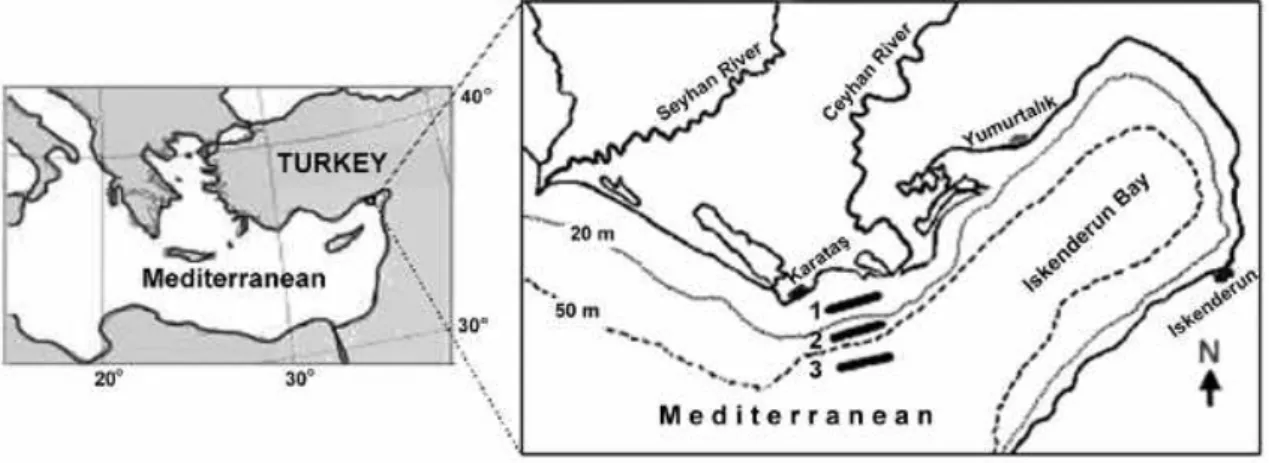
This study was carried out between September 2002 and April 2003 off the Karataş Coasts of Iskenderun Bay during the 2002-2003 fi shing season. The ma-terials were obtained by monthly sampling using commercial bottom trawl vessel (Coskun Reis, 22 m length and 285HP) in depths from 0 to 100 m from the stations represented in Fig. 1. Trawl operations were done during the day time with 1 h haul dura-tion using Mediterranean Type Bottom Trawl 22 mm mesh size (knot-to-knot).
All of the catches were transferred from fi eld to the laboratory in ice and stored at -18 oC in the
re-frigerator. Then the samples were defrosted and sort-ed by species and weighsort-ed for the determination of Catch Per Unit Effort (CPUE) in the laboratory for each depth range. In order to determine population parameters, the sub sampling procedure was applied as recommended by HOLDEN and RAITT (1974). The
total length and the total weight were measured and weighed to the nearest 1 mm and 0.01 g respectively. The sagittal otoliths were examined under the stereo binocular microscope for the age determination.
The length-weight relationships were determined according to the allometric equation given by SPARRE
and VENEMA (1998) where W=a*Lb. In this equation,
W is total weight, a and b are regression constants
and L is total length. Growth in length and weight were expressed in terms of von Bertalanffy equation Lt=L∞[1-e-K(t-to)]. The growth parameters K, L
∞ and to were estimated using the Least Squares Method as recommended by SPARRE and VENEMA (1998).
Correspondence between empirical data and an expected distribution was tested by Khi2 test. The b
value was tested by ttest to verify that it was signifi -cantly different from the isometric growth (b: 3).
Total mortality rate (Z) was estimated based on the length at fi rst capture methods evaluated by BEVERTON
and HOLT (1957). Z=K*(L∞-Lm)/(Lm-Lc). Lm is the
aver-age total length of the entire catch, while Lc is the length at which 50% of the fi sh entering the gear are retained (SPARRE, VENEMA 1998). Instantaneous natural
mortal-ity rates (M) were estimated using the equation derived by URSIN (1967) based on the mean total length, where
M=W-(1/b) (W: mean total length; b: constant of
weight relationship). Fishing mortality rates (F) were calculated as the difference between Z and M (Z=F+M). The value of the average annual exploitation rate (E) was obtained by E=F/Z (SPARRE and VENEMA 1998).
Results
Monthly Time Series of Trawl Catch
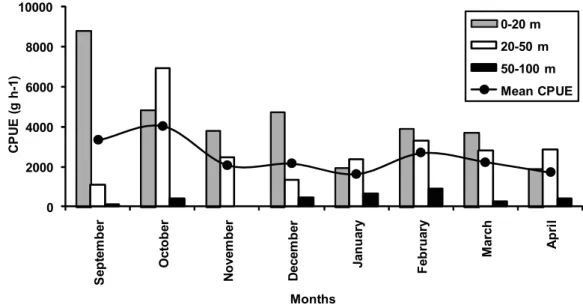
Monthly distribution of CPUE value of S.
un-dosquamis for each depth range and whole study
pe-riod is given in Fig. 2. As it can be seen, the highest CPUE was obtained in September as 4.1 kg h-1 and
the lowest one was observed 1.6 kg h-1 in January
with the mean value of 2.5±0.8 kg h-1.
Taking into consideration CPUE distribution in each depth range, over half of the catch (55.78%) was obtained in depths of 0-20 m, and 38.69% was obtained in depths of 20-50 m, and 5.53% was ob-tained in depths of 50-100 m. To take CPUE distri-bution in each depth range into consideration, S.
un-dosquamis spreads to a wide depth range, it prefers
depths below 50 m and the value of CPUE decreases from coastal area to deeper waters.
During the study period, S. undosquamis repre-sented 12.69% of the total catch in the depth of 0-20 m and 8.67% in the depth of 20-50 m with the mean value of 9.46%.
Age and Growth Parameters
A total of 279 individuals were sampled, ranging in size from 4.70 to 24.40 cm TL and in weight from
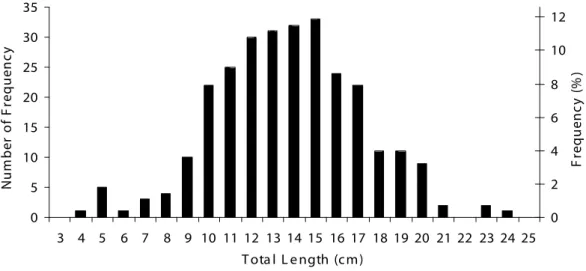
1.68 g to 98.02 g. Overall mean total length and weight were calculated as 14.22±3.42 cm and 20.73±15.42 g respectively. Length-frequency distribution of S.
un-dosquamis was given in Fig. 3. As can be seen in the
fi gure, the dominant length classes were 12-15 cm. Length-frequency distribution, minimum, maximum and mean length and weight values of S.
undosquamis for each age class are listed in Table 1.
As it can be seen, the age of S. undosquamis ranged from I to VI age classes and the most dominant age class was II with a value of 44.1% and age class I ranks second with a value of 31.9%.
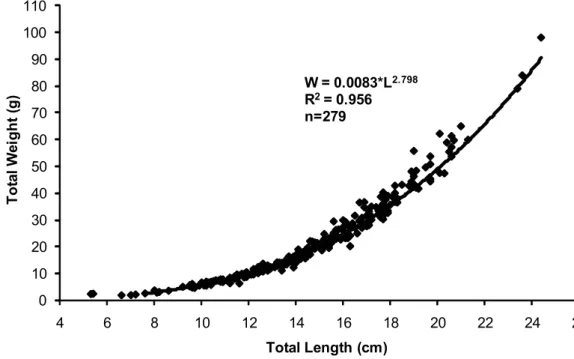
The relationship between TW and TL is pre-sented in Fig. 4. Length-weight relationship was expressed W=0.0048L3.079. The growth parameters
calculated by von Bertalanffy were L∞: 38.05 cm, K: 0.124 year-1 and t
o: -1.680 year.
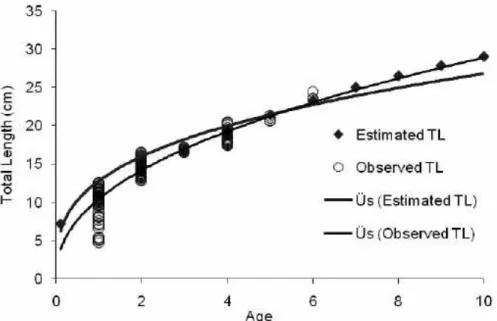
The back-calculated lengths were determined by using von Bertalanffy growth parameters and both the observed and calculated growths in total length are list-ed in Table 2. The growth curves were not signifi cantly different between the observed and calculated length (p>0.05). The von Bertalanffy growth curve was fi tted to lengths-at-age for S. undosquamis (Fig. 5). Growth is fast until the II age classes and with growth in length is slightly reduced beyond the age class II.
Mortality and Exploitation
The annual instantaneous rate of natural mortal-ity (M) was estimated at 0.35 yr−1 and instantaneous
total mortality rate was estimated at 1.77. Using the
0 2000 4000 6000 8000 10000 S ept em be r Oc to b er N o vem b er D ecem b er Ja nua ry Fe br ua ry Ma rc h Ap ri l CP UE (g h -1 ) Months 0-20 m 20-50 m 50-100 m Mean CPUE
Çiçek E.,D. Avşar
estimate of Z from the mean total length and the es-timate of M obtained based on the length at fi rst cap-ture methods, an estimate of fi shing mortality was obtained at 1.42 The exploitation rate was estimated at 0.80 using the value of Z and the estimated F.
Discussion
To take CPUE distribution in each depth range into consideration, S. undosquamis is distributed over a wide fi eld and the relative index of CPUE and the population abundance decreased with depth. It is re-ported that the lessepsian fi sh species are generally distributed on the shallow areas (BEN-YAMI, GLASER
1974). Indeed, their biomass proportion of the total catch accounted for 51.9% and 67.6% in October of 1983 and 1984, respectively at depths of 14-59 m (GUCU, BINGEL, 1994). In this case, distribution
pat-tern of S. undosquamis shows similarity with other lessepsian fi sh species.
A dramatic decrease from the opening of the fi shing season to the end of the season was observed for the most of trawlable species during the study period. Different from the other trawlable species, monthly distribution of CPUE of S. undosquamis did not show dramatic changing during the fi shing sea-son (CICEK 2006). Indeed while the coeffi cient of
var-iation of CPUE was 175.4% for M. barbatus and the value was calculated 33.28% for S. undosquamis.
During the study period, S. undosquamis repre-sented 12.69% of the total catch off the Karataş coast. Whereas, S. undosquamis represented over 50% of the total catch in the northeastern Mediterranean coasts in some years (According to GOREN, GALIL
2005, GORGY 1966, GUCU, BINGEL 1994).
The mean CPUE was calculated as 2.5 kg h-1 this
study. In the previous study, the values were reported as 12.0 kg h-1 in 1983, 9.9 kg h-1 in 1984 and 0.5 kg
h-1 in 1989 in Iskenderun Bay (GUCU et al. 1994).
According to this the CPUE decreased from 1983 0 5 10 15 20 25 30 35 3 4 5 6 7 8 9 10 11 12 13 14 15 16 17 18 19 20 21 22 23 24 25 T ota l L e ngth (cm) Nu m b er o f F req u en cy 0 2 4 6 8 10 12 Fr eq u en cy ( % )
Fig. 3. Length-frequency distribution for Saurida undosquamis off Karataş coast (10 mm length classes).
Table 1. Length-frequency distribution, minimum, maximum and mean length and weight values for each age class for
Saurida undosquamis off Karataş coast.
Age n (frequency) Total Length (cm) Total Weight (g)
Min-Max Mean Min-Max Mean
I 89 (% 31.9) 4.70-12.60 10.47±2.00 1.68-13.51 7.23±3.00 II 123 (% 44.1) 11.80-16.50 14.53±1.08 10.87-29.74 18.48±5.01 III 16 (%5.7) 15.50-17.20 16.90±0.22 24.80-36.50 31.00±3.41 IV 42 (% 15.1) 16.40-21.30 18.61±0.93 30.11-62.08 41.76±7.93 V 6 (% 2.2) 20.60-21.30 20.80±0.29 53.54-64.80 59.35±3.83 VI 3 (% 1.1) 23.40-24.40 23.80±0.53 78.93-98.02 86.95±9.91 Total 279 4.70-24.40 14.22±3.42 1.68-98.02 20.73±15.42
to 1989, than the value has increased respectively. Similarly, fl uctuations of the biomass were reported in the coasts of Israel as well (GOREN, GALIL 2005).
LW relationships parameters and the von Bertalanffy growth parameters are listed in Table 3 for the previous studies in Turkey. As can be seen on the table, b value ranged from 2.6165 to 3.2957 in these studies. All these results indicate that type of growth showed isometric or positive allometric growth in the previous studies, except for CAN et al.
(2002) and MATER and TORCU (2000). The growth
type was founded as negative allometric growth in this study (b: 2.789, SE: 0.036; 95% confi dence in-tervals of b: 2.808-2.950). According to FROESE and
PAULY (2009) b value was reported between 2.933
and 3.320 with the median value 3.031 for
differ-ent regions of Mediterranean. The K observed in this study which is lower than previous 0.3 imply growth of S. undosquamis population inhabiting off Karataş coasts was slow (FROESE , PAULY 2009). Therefore,
estimated low b value and negative allometric growth are not surprising in this study.
The value of L¥ was reported as 22.43 cm by TURELI and ERDEM (1997) in Iskenderun Bay and
41.27 cm by AVSAR et al. (2000) in Mersin Bay.
The value L¥ reported by TURELI and ERDEM (1997)
is probably not the correct estimation because in-dividual catches bigger than 22.43 cm are not rare in the catch of bottom trawl fi sheries in Iskenderun and Mersin bays. Indeed maximum observed length was 24.40 cm in this study and the value was given 33.0 cm by CICEK et al. (2006) in Mersin Bay. The
W = 0.0083*L2.798 R2= 0.956 n=279 0 10 20 30 40 50 60 70 80 90 100 110 4 6 8 10 12 14 16 18 20 22 24 26 Tot al W ei ght ( g ) Total Length (cm)
Fig. 4. Length-weight relationship for Saurida undosquamis off th Karataş coast.
Table 2. Observed and calculated total length of Saurida undosquamis using von Bertalanffy growth equations off
Karataş coast.
Age Total Length (cm) Total Weight (g)
Observed Calculated Observed Calculated
I 10.47 10.72 7.23 7.13 II 14.53 13.90 18.48 15.85 III 16.90 16.70 31.00 27.92 IV 18.61 19.18 41.76 42.77 V 20.80 21.38 59.35 59.67 VI 23.80 23.31 86.95 77.94
Çiçek E.,D. Avşar
value of L¥ ranges from 29.8 to 68.5 cm with the median value of 37.0 cm in 31 studies from different parts of the world (FROESE, PAULY 2009). There are
close similarities for the estimated L¥ values between this study and median value reported by FROESE and
PAULY (2009). However, the estimated parameters
may vary as a function of a variety of factors such as region, sampling methods, year, methodology etc. (GONÇALVES et al. 2003).
The length at fi rst sexual maturity determined in the previous studies ranged from 12.5 cm to 16.0 cm (TURELI, ERDEM 1997, OZYURT 2003, ISMEN
2003). When the length at fi rst maturity of these spe-cies 12.5 cm was taken into consideration (TURELI,
ERDEM 1997, OZYURT 2003) 70.2% of the total
catch consisted of immature individuals off Karataş coasts. Otherwise when the length at fi rst maturity,
16.0 cm, was taken into consideration (ISMEN 2003)
70.0% of the total catch consisted of mature indi-viduals off Karataş coasts. On the other hand, when the age at fi rst maturity of these species II-III years old were taken into consideration (TURELI, ERDEM
1997, OZYURT 2003, ISMEN 2003) at least 76.0% of
the total catch consisted of immature or just matured individuals.
The estimated fi shing mortality rates and ex-ploitation rates were very high in the study area. These results indicated that this species was under extensive fi shing pressure on the fi sh populations in the studied area.
Acknowledgement: This study is a part of PhD Thesis and sup-ported by Cukurova University Scientifi c Research Found. Proj-ect No: FBE.2002.D.138
Fig. 5. von Bertalanffy length-at-age growth curve for Saurida undosquamis off Karataş coast.
Table 3. Length-weight relationship and von Bertalanffy growth parameters of Saurida undosquamis from Turkish
coasts.
n a b R2 L
∞ (cm) K (yıl-1) t0 (yıl) Author/s
430 0.3830 2.617 0.81 - - - Mater, Torcu 1996 100 0,0117 2,797 0.90 - - - CAN et al. 2002 333 0.1270 3.022 - 22.43 0.597 -1.365 Tureli, Erdem 1997 2757 0.0047 3.086 0.98 41.27 0.118 -1.895 CICEK et al. 2006 137 0.0000052 3.092 0.98 - - - Anonymous 1993 66 0.0000045 3.105 0.98 - - - Anonymous 1993 100 0.2650 3.296 0.91 - - - Mater, Torcu 1996 275 0.0083 2.789 0.96 38.05 0.124 -1.680 This study
103 References
ANONYMOUS 1993. Report on the Bottom Fish Resource of
Mar-mora, Aegean and Mediterranean seas. Japanese Interna-tional Cooperation Agencies (JICA), Turkish Ministry of Agriculture and Rural Affairs, 579 p.
ANONYMOUS 2010. FishStat Plus. Fishery Statistics programme.
Statistical Databases. http://www.fao.org/fi shery/statistics/ programme/3,1,1/en, 02.03.2010.
BEN TUVIA A. 1953: Mediterranean fi shes of Israel. – Bull. Sea
Fish. Res. Stn. Haifa, 8: 1-40.
BEN-YAMI M., T. GLASER 1974. The Invasion of Saurida
un-dosquamis (Richardson) into the Levant Basin-an Example of Biological Effect of Interoceanic Canals. – Fishery Bul-letin, 72 (2): 359-373.
BEVERTON R. J. H., S. J. HOLT 1957. On the dynamics of exploited
fi sh population. Fish.Invest. Minist. Agric. – Fish. Food G.B. (2 Sea Fish.), 19: 533.
BINGEL F. 1988a. Prey Size of Saurida undosquamis in the
North-ern Cilician Basin (EastNorth-ern Mediterranean). – Rapp. Com. Int. Mer Medit., 31 (2): V-II11.
BINGEL F. 1988b. Note on the Spawning of Saurida undosquamis
in the Northern Cilician Basin-Turkish Coast. Submitted to the Workshop of XXXI Congress of I.C.S.E.M., October 17-22 1988, Athens, Greece.
BINGEL F., D. AVSAR 1988a. Food Items of Saurida undosquamis
in the Northern Cilician Basin (Eastern Mediterranean). – Rapp. Com. Int. Mer Medit., 31 (2): V-II9.
BINGEL F., D. AVSAR D. 1988b. Time Series of the Stomach
Fill-ings of Saurida undosquamis in the Northern Cilician Basin (Eastern Mediterranean). – Rapp. Com. Int. Mer Medit., 31 (2): V-II10.
CAN M.F., N. BAŞUSTA, M. ÇEKIÇ 2002. Weight-Length
Relations-hips for Selected Fish Species of the Small-Scale Fisheries off the South Coast of Iskenderun Bay. – Turk J. Vet. Anim. Sci., 26: 1181-1183.
CICEK E. 2006. Study on the potancially economical important
species trawled from Karataş (Adana) coasts. Cukurova University, PhD Thesis, 146 p (In Turkish).
CICEK E., D. AVŞAR, H. YELDAN, M. ÖZÜTOK 2006. Length-weight
relationships for 31 teleost fi shes caught by bottom trawl net in the Babadillimani Bight (northeastern Mediterranean. – J. Appl. Ichthyol., 22: 290-292.
CICEK E., M. BILECENOGLU 2009. A new alien fi sh in the
Mediter-ranean Sea: Chamsodon nudivittis (Ogilby, 1895). – Acta Ichthyologica et Piscatoria, 39: 67-69.
CELIK O., H. TORCU 2000. Biology on red mullet (Saurida
un-dosquamis Linnaeus, 1758) in Edremit Bay Aegean Sea. – Turk. J. Vet. Anim. Sci., 24: 287-295. (In Turkish). FROESE R., D. PAULY (Eds.) 2009. FishBase. World Wide Web
elec-tronic publication. www.fi shbase.org, version (10/2009). GONÇALVES J. M. S., L. BENTES, R. COELHO, C. CORREIA, P. G. LINO,
C. C. MONTEIRO, J. RIBEIRO, K. ERZINI 2003. Age and growth,
maturity, mortality and yield-per-recruit for two banded bream (Diplodus vulgaris Geoffr.) from the south coast of Portugal. – Fisheries Research, 62: 349-359.
GOREN M., B. S. GALIL 2005. A review of changes in the fi sh
assemblages of Levantine inland and marine ecosystems following the introduction of non-native fi shes. – J. Appl. Ichthyol., 21: 364-370.
GORGY S. 1966: Les pe€cheries et le milieu marin dans le secteur
Me´diterrane´en de la Re´publique Arabe Unie. Rev. – Trav. Inst. pe€ches Marit., 30: 25-92.
GUCU A.C., F. BINGEL 1994. Trawlable Species Assemblages on the
Continental Shelf of the Northeastern Levant Sea (Mediter-ranean) with an Emphasis on Lessepsian Migration. – Acta Adriatica, 35 (1/2): 83-100.
GUCU A.C., F. BINGEL, D. AVŞAR, N. UYSAL 1994. Distribution
and Occurrence of Red Sea Fishes at the Turkish Mediter-ranean Coast-northern Cilician Basin. – Acta Adriatica, 34 (1/2): 103-113.
HOLDEN M. J., D. F. S. RAITT 1974. Manual of Fısheries Science
Part 2-Methods of Resource Investigation and their Ap-plication. FAO, Rome, 214 p.
ISMEN A. 2003. Maturity and Fecundity of Lizardfi sh (Saurida
undosquamis Richardson, 1848) in İskenderun Bay (East-ern Mediterranean). – Turkish Journal of Zoology, 27: 231-238.
Mater S., H. Torcu 1996. Research on the Biology of Lizard-fi sh, Saurida undosquamis (Richardson, 1848) inhabiting Fethiye ve Mersin Bays. XIII. National Biology Congress, 17-20 September 1996, Istanbul, 178-189. (In Turkish).
OREN O. H. 1957a. Changes in the temperature of the eastern
Mediterranean Sea in relation to the catch of the Israel trawl fi shery during the years 1954-1956. – Fish. Bull., Haifa, 12: 4-6.
OREN O. H. 1957b. Changes in the temperature of the eastern
Mediterranean Sea in relation to the catch of the Israel trawl fi shery during the years 1954-55 and 1955-56. Bull. Inst. Oce´angr. Monaco, 1102: 1-13.
OZYURT C.E. 2003. The Determination of mesh size for some
commercially important demersal fi sh species captured by deep trawl net at Babadıllimanı Bight (Silifke-Mersin). PhD Thesis, Cukurova University, Adana, 124 p. (In Turkish). RICKER W.E. 1975. Computation and Interpretation of
Biologi-cal Statistics of Fish Populations. – Bull. Fish. Res. Board Can., 191: 382 p.
SPARRE P., E. URSIN, S.C. VENEMA 1989. Introduction to Tropical
Fish Stock Assesment-Part II: Manual. FAO Fisheries Technical Paper, No: 306/2, Rome, 429 p.
TURELI C., U. ERDEM 1997. The growth performance of red
mul-let (Saurida undosquamis Linnaeus,1758) and brushtooth lizardfi sh (Saurida undosquamis (Richardson,1848)) from the coastal region of Adana Province (İskenderun Bay, Turkey). – Tr. J of Zool., 21: 329-334. (In Turkish).
URSIN E. 1967. A mathematical model of some aspects of fi sh
growth, respiration, and mortality. – J. Fish. Res. Bd. Can., 24: 2355-2453.
WHITEHEAD P. J. P., M. L. BAUCHOT, J. C. HUREAU, J. NIELSEN,
E. TORTONESE (Eds.). 1986. Fishes of the North-Eastern
Atlantic and the Mediterranean. Richard Clay Ltd, II: 511-1007.
Received: 12.05.2010 Accepted: 13.01.2011