INFLATION TARGETING
SİNEM BÜBER
105622012
İSTANBUL BİLGİ ÜNİVERSİTESİ
SOSYAL BİLİMLER ENSTİTÜSÜ
EKONOMİ YÜKSEK LİSANS PROGRAMI
KORAY AKAY
2007
Inflation Targeting
Enflasyon Hedeflemesi
Sinem Büber
105622012
Koray Akay
: ...
Ege Yazgan
: ...
Göksel Aan
: ...
Tezin Onaylandığı
Tarih
:
...
Toplam Sayfa Sayısı:
60
(kapak
ile
birlikte)
Anahtar
Kelimeler
(Türkçe)
Anahtar
Kelimeler
(İngilizce)
1)enflasyon
hedeflemesi
1)inflation
targeting
2)beklentiler 2)expectations
3)para
politikasi
3)monetary
policy
4)ortuk enflasyon hedeflemesi
4)implicit inflation targeting
5)tam enflasyon hedeflemesi
5)explicit inflation targeting
ABSTRACT
In this study, the policy of inflation targeting which is adopted by many countries as main monetary policy has been analyzed. This framework necessitated credibility,
accountability, transparency and independency of Central Banks in the design and practice of monetary policy and in this respect these prerequisites were discussed.
The outcome of this target as illustrated in this study is its direct effect on expectations providing a lesser inflation rate accompanied by a declined level of inflationary tendency. This paper also examines the inflation targeting period experienced in Turkey that is divided into implicit and explicit sub-periods. The hidden inflation targeting period between 2002 and 2005 was an inevitable transition period to satisfy primarily preconditions of inflation
targeting framework and in Turkey which has high and chronicle inflation level and loss of credibility this period became effective and useful. Considering the data given in this study, after adoption of explicit inflation targeting in 2006, the importance of independency of the monetary authority became more significant and the experience in Turkey illustrated the effective role of inflation targeting to maintain price stability with the existence of the fiscal discipline.
ÖZET
Bu çalışmada son yıllarda pek çok ülke tarafından temel para politikası olarak kabul gören “enflasyon hedeflemesi” politikası incelenmektedir. Bu hedef hesap verme,
güvenilirlik, şeffaflık ve merkez bankası bağımsızlığı ilkelerini para politikası için gerekli kılar. Bu hedeflemenin çalışmamızda açıklanan kesin etkisi enflasyon beklentilerindeki düşme üzerindedir.
Çalışmada ele alınan diğer bir konu Türkiyedeki uygulamalardır. Türkiye’de enflasyon hedeflemesi politikası iki ayrı dönem içerisinde incelenmiştir. 2002-2005 arası dönem gizli enflasyon hedeflemesi ve 2006 sonrası dönem “Açık enflasyon hedeflemesi” olarak
adlandırılan dönemlerdir ki; birincisi Türkiye gibi kronik yüksek enflasyon sorunuyla beraber güven kaybını da yaşayan ülkeler için enflasyon hedeflemesi politikasının önkoşullarını sağlamada kaçınılmaz olarak faydalı ve etkilidir. Bu geçiş döneminin ardından Türkiye’de 2006 sonrası açık enflasyon politikası ile para otoritelerinin bağımsızlığı önem kazanmış ve böyle bir ortamda enflasyon hedeflemesi fiyat istikrarını sağlamada etkin bir rol oynamıştır.
Table of Contents:
Introduction: 1
1. Inflation Targeting: 4
1.1. Inflation: 4
1.2. Inflation Targeting as a Framework: 7
1.3. Design and Implementation of Inflation Targeting: 10
1.4. Critical Issues about Inflation Targeting: 11
1.4.1. Technical Issues: 11
1.4.2. Communications Issues: 15
2. Inflation Targeting and Other Monetary Regimes: 17
2.1. Advantages and Disadvantages of Inflation Targeting: 17
2.1.1. Advantages of Inflation Targeting: 17
2.1.2. Disadvantages of Inflation Targeting: 19
2.2. General Features of Other Monetary Regimes: 20
2.2.1. Definition and Types of Monetary Policy: 20
2.2.1.1. Price Level Targeting: 22
2.2.1.2. Exchange Rate Targeting: 23
2.2.1.3. Money Aggregate Targeting: 24
3. Preconditions and Conditions for Inflation Targeting: 26
3.1. Preconditions for Inflation Targeting Framework: 27
3.1.1. Central Bank Independency: 27
3.1.2. Strong Financial Markets: 29
3.2. Conditions for Inflation Targeting Framework: 30
3.2.1. Transparency: 30
3.2.2. Accountability: 32
3.2.3. Communication: 33
3.2.4. Flexibility: 34
3.2.5. Credibility of Central Bank: 35
4.1. Implicit Inflation Targeting Period from 2002 to 2005: 38
4.1.1. Difficulties of Central Bank in Transition Period: 39
4.1.2. Structural Reforms in Implicit Inflation Targeting Period: 42
4.2. Inflation Targeting Period in Turkey after 2006: 43
4.3. Positive Trend in Inflation Rate: 44
Conclusion: 48
List of Tables:
Table 1: Types of Monetary Regimes and Long-term Objectives: 21
List of Graphs:
Graph 1: Public Debt Ratio: 40
Graph 2: Annual Percentage Change in Consumer Price Index (2003=100): 45
Introduction:
Inflation targeting is a new monetary regime with respect to the other monetary policies. This framework was first adopted by New Zealand in 1990 and concurrently, more than twenty countries including both industrialized and developing countries have
introduced this target as a monetary policy. Inflation targeting is a monetary policy in which a monetary authority forecasts and announces a targeted inflation rate and uses the interest rate as a monetary tool to achieve the planned inflation rate.
In the first part, critical issues about the design and implementation of inflation targeting which technically affects the achievement of inflation targeting, are examined. Determining the best measurement techniques, deciding the targeted inflation level, choosing the best time to start the implementation of monetary regime and time horizons are the technically weak points of inflation targeting regime. In addition, central bank is supposed to adjudge to implement a range targeting or a point targeting policy. Finally, central bank arranges the communication path carefully, since communication is one of the main pillars of requirements of inflation targeting.
Secondly, from adopting countries’ experiences, it should be said that, inflation targeting is a monetary policy which has significant macroeconomic outcomes, like reflecting in the lesser inflation rate accompanied by a declined level of inflationary expectations. In many countries this remarkable performance occurred concurrently with a decreased nominal effective exchange rate. Additionally, inflation targeting framework improves the credibility of monetary authority by effect of increased level of accountability
and transparency of central bank’s monetary policy. In contrast to other monetary regimes, it reduces the uncertainty in economic environment and future expectations by an
announced targeted inflation rate. Therefore, as a transparent monetary regime, inflation targeting directly affects expectations. It also enhances the communication among central bank, private sector, public and government.
In the third chapter the preconditions and requisites of inflation targeting are
explored in detail. As a monetary regime, inflation targeting has a number of preconditions like independency of central bank and having strong financial markets in economy which are supposed to be satisfied before implementation of the target and also, requisites which are the inevitable components of implementation, are another issue to discuss. The adopting monetary authority has to be credible, transparent in monetary policy and policy
instrument, accountable and flexible. Besides, monetary authority is supposed to publish reports to enhance communication. These periodic reports include the forecasts, targeted inflation rate, overall macroeconomic conditions, potential risks against the achievement and also if occurs, the causes of deviations from targeted level.
Finally, in this paper, the inflation targeting period of Turkey has been analyzed. Turkey has turned inflation targeting regime in 2006 officially, but inflation targeting process actually started in 2002 after February 2001 crisis. In the post-crises period, the Central Bank of the Republic of Turkey switched to floating exchange rate, instead of fixed exchange rate regime. Since, the prerequisites of inflation targeting framework were not satisfied, central bank chose to adopt an implicit inflation targeting regime instead of full-fledged version. The reason lying behind this transition period is the risks of adopting
inflation targeting framework without filling the preconditions. In the case of not gratified conditions, inflation targeting should lead the economy worsen. That is why, it took time to implement inflation targeting regime in Turkey. Therefore, the inflation targeting of Turkey would be examined in two divided periods, hidden inflation targeting period between 2002 and 2005, and inflation targeting period after 2006. In each period, inflation targeting is the monetary regime of Turkey with significant macroeconomic outcomes especially in
lowering and stabilizing the chronicle inflation levels accompanied by a high level of credibility of monetary authority.
1. Inflation Targeting:
In this chapter, inflation targeting and related economic indicators will be defined. Then, inflation targeting, implementation and design of this monetary regime will be explained. Additional to implementation, some technical and communication issues about framework like level of targeted inflation, distinction between range targeting or strict targeted level, time horizons and the best time to adopt the inflation targeting will be explored.
1.1. Inflation:
In economics, inflation means a persistent increase in overall prices. Inflation presupposes the existence of money, introduction of coins in Lydia and Ionia and China about 630 BC. The term of ‘inflation’ is derived from the Latin word inflare which means to blow up or inflate and also according to the Oxford English Dictionary (1989) first used in the concept of inflation of the currency in 1838.
There are more terms in economics related to inflation defining the movements and fluctuations of price levels. A general decrease in overall price levels is defined as deflation and also disinflation is delineated as a reduction in inflation rate. Furthermore, stagflation and hyper-inflation are the additional concepts about price levels where stagflation occurs in inflation with a rising unemployment rate and hyper-inflation is the uncontrollable inflationary circular reasoning.
There are many indexes being used to measure the inflation rate in an economy. Instances of most conventional measures of inflation are,
Consumer Price Index (CPI) is a measure of the overall cost of the goods and services
bought by a typical consumer or an economic agent.
Cost of Living Index (COLI) measures the change in the cost of a constant basket of goods
and services, including the services consumed by an economic agent daily like housing, electricity, food, and transportation.
Producer Price Index (PPI) is the total cost of the goods and services received by a
producer including taxes, price subsidization and profits.
Wholesale Price Index reflects the alternation of a fixed-basket commodity, a selection of
goods at wholesale.
Commodity Price Index calculates the change in the basket of selected commodities which
are weighted according to importance in respect of the other commodities in the basket.
Gross Domestic Product (GDP) Deflator is a measure of the price level calculated as the
ratio of nominal GDP to real GDP times 100.
These all indexes are just some of the measurement tools in order to indicate the inflation rates. Furthermore, inflation rate is a useful and important parameter defining the economic conditions in an economy also a high inflation rate affects economy negatively in the way of causing a significant fall in purchasing power parity.
Three major problems which worsening economic environment, come into being in the case of inflation,
1. Because of increase in overall price levels, economic agents with constant income levels will be worse off in real terms as having the same nominal income with higher prices. Thereby, this will lead to a decrease in purchasing power of their income.
2. In open economy, countries trade with each other. If the trading country has a higher inflation rate relatively and that country perpetuates a fixed exchange rate with other countries, therefore, the country will face off a fall in exports due to being more expensive to purchase compared to the countries with low-inflation level. Then, this fall will create a deficit in its current account.
3. Due to increasing price levels, trade unions do not demand higher wage levels as the wage increase rates are supposed to keep in step with the inflation rate. According to collective bargaining, salaries are an adjustment of price expectations. An increasing acceleration in inflation also promotes the expected price levels. This circle should beget the case of wage spiral.
Since high inflation level is a great barricade to a better economic condition, there are numbers of methods being used by Central Banks as the Monetary Authority to counteract the inflationary process. However, inflation rate 0 percentages have never been succeeded yet. Central Banks can make the inflation rate move to a significant scope by using
monetary policies such like setting interest rates. Keeping the interest rates at high levels and slowing down the growth of money supply are the conventional ways in order to achieve a lower inflation rate. There are also different approaches called inflation targeting followed by Central Banks newly, to prevent inflation.
1.2. Inflation Targeting as a Framework:
It is well known that the ultimate goal of the monetary policy is the price
stabilization and the inevitable question is ‘what is the most effective strategy to achieve this important and ultimate target?’ For decades, many central banks, monetary authorities and academicians discussed about a number of different strategies to decide which one is the most efficient and effective way. Inflation targeting is one of these strategies which are seen as a better way to achieve price stabilization.
Inflation targeting is a framework for monetary policy characterized by the public announcement of official quantitative targets or target ranges for the inflation rate over one or more time horizons, and by explicit acknowledgement that low, stable inflation is monetary policy’s primary long-run goal. (Bernanke, 1999)1
In 1990, The Central Bank of New Zealand is the first monetary authority which implemented ‘the inflation targeting framework’ and, up till now about twenty Central Banks adopted inflation targeting approach. Concurrently, much theoretical work deals with this framework. This has superseded the monetary policy tools being implemented those are using targets for the exchange rate or monetary aggregates. Currently a significant number of emerging-market economies and developing economies have embarked to apply this framework, induced by the accomplishment of inflation-targeting countries in
1
See Bernanke, Ben; Thomas Laubach, Frederic S. Mishkin, Adam S. Posen ‘Inflation Targeting /Lessons from International Experience’ (1999) for the definition of inflation targeting monetary regime as a
achieving and catching low levels of inflation. However, initially inflation targeting-based monetary regimes were implemented by industrialized, developed countries.
As its name suggests, in inflation targeting, price stabilization is the main goal of monetary regime, and the inflation target uses nominal anchor during the implementation of monetary policy. The main difference of the inflation targeting that distinguishes the
inflation targeting policy from other monetary regimes is directly affecting the expected inflation rate by announcing the level targeted. The implementation process starts by declaring the target and policy tools will be used in achievement to public in regular time horizons. Thereby, it directly affects not only the expected inflation rate but also influences the price and wage settings. This is an important part of the rationale for inflation targeting. However, it is strongly defended that inflation targeting has positive effects on expectations and generally, from the experiences of adopted countries, results with better
macroeconomic outcomes, cooperation is key point of the policy that leads to success. Cooperation among public, central bank, government and also private sector contributes to the success of the regime. It is needless to say that credibility of the monetary authority provides this cooperation, in other words, as economic agents believe in that monetary authority is equal and eligible to design, implement and end the policy up to achievement, inflation targeting policy pans out.
The concept of inflation targeting argues that the main objective of the monetary policy is supposed to be to achieve a low and stable inflation level. It is still arguable, but the following axioms those support the idea of setting the low inflation level as the primary goal are widely accepted by the economists;
• Because a rise in the money supply is neutral in the long-run, the employment and also output levels are not influenced by a low-inflation based monetary policy. It can be said that output gap and also unemployment are not consequences of a decrease in money supply.
• Moreover, it can be added that the allocation of resources and output growth in the long-run are negatively influenced by a high inflation levels.
• Contrary to long-run, money is not neutral in the short run. That is to say, monetary policy has vital temporary effects on some of real variables, together with output and
unemployment.
• Monetary policy imposes the inflation level with lags of uncertain time period and changing strength. These lags make the current inflation level difficult to be controlled by the central bank on a period-by-period basis.
These factors make the inflation targeting framework, among a significant number of economists, as a monetary regime that improves the economy. Additionally, the
macroeconomic outcomes of the experienced countries canalize the other countries to adopt inflation targeting framework as the monetary regime. However, the consequences of inflation targeting are generally in practice rather in theory.
1.3. Design and Implementation of Inflation Targeting:
We will analyze the advantages and disadvantages of inflation targeting framework in chapter 2. Whether these benefits and costs will be understood, they are primarily depends on how efficiently and effectively the inflation targeting is designed and applied. Therefore, as the first step the process of inflation targeting framework, implementation and design will be focused.
Recalling the definition of inflation targeting, the concept can be expressed as a framework for monetary policy, characterized by the public announcement of official quantitative targets or target ranges for the inflation rate, over one or more time horizons, and by explicitly acknowledgment that low, stable inflation is monetary policy primary long-run goal (Bernanke, Mishkin, 1997)2. By the definition of Bernanke and Mishkin implementation process follows the five main steps:
1. Announcement of the mid-term quantitative targeted inflation level to the public by the central bank (central bank is always used as monetary authority).
2. Price stability is supposed to be realized as the ultimate and primarily goal of monetary policy by an institutional commitment and other goals are subordinated. 3. Setting the policy tools based on a comprehensive information strategy which
includes not solely money aggregates and the interest rate but also does all economic variables.
2
Implementation process of inflation targeting regime defined in different numbers of steps. In this paper, we categorized it into five main steps. See also Bernanke, B. S., Mishkin, F. S. (1997): "Inflation targeting: A new framework for monetary policy" for details.
4. Communication with public, market institutions, other monetary authorities and monetary institutions is the key element in a successful inflation targeting process. Therefore, increasing the transparency in the way of communication with economic agents is one of the most important parts of implementation to achieve the target level. Thereby, monetary authority is supposed to declare the plans, objectives and decisions in a predetermined time horizons.
5. Accountability of the Central Bank must be increased in order to attain the targeted inflation objectives.
1.4. Critical Issues about Inflation Targeting
By examining the steps, it can be seen that there are critical issues about a
successful inflation targeting implementation period. In this part some technical issues are taken into consideration for a deeply look in the deciding process.
1.4.1. Technical Issues:
The initial step in inflation targeting implementation process is the measure of
inflation rate being used. Choosing the right index which measures the basket including the
key products, goods and services and excluding the alterations those affect the core
inflation level in a negative way. Most common used index is Consumer Price Index (CPI). The leading advantage of using the consumer price index is being well known by the public
and being the eldest index among the measurement techniques. (Petursson, 2000). Additionally, an adjusted CPI contains some products those are not in the range of monetary policy and do not have permanent effect of inflation. Therefore, it becomes the conventional index being used by most of the countries.
The following important issue about inflation targeting which leads the framework to achievement is the level of targeted inflation. In deciding about the numerical value of inflation, most commonly, monetary authority mentions ‘price stability’ as its policy goal. In this case, ‘price stability’ can be defined as low level of inflation that can be ignored in daily or short-term decisions by economic agents. There are two different aspects
considering this issue. Some argues that, zero inflation targeting is the best way to make the inflation certain for economic agents, and then they can realize the changes in prices of related goods and services since there is a fluctuation in aggregate price levels.
Dissimilarly, according to Bernanke, Laubach, Mishkin and Posen (1999), targeting a zero inflation rate creates some major problems. Since Consumer Price Index (CPI) is used as index, measurement can be biased upward. One of the reasons of this case is this
measurement technique ignores the substitution effects, namely, an increase in a good or a service can make people to substitute this product with a similar good or service with a lower price. This case does not reflect the consumer price index. Another reason to avoid the zero-level inflation targeting is, due to being a fixed-weighted basket measure; consumer price index cannot distinguish the price increase caused by an improvement quality from a price level increasing and reflects this rise as inflation.
On the other hand, instead of measurement, there are still some critiques about low level inflation. It is also stressed that low rate of inflation should protect real wages from decreasing since the nominal wages are rigid. Therefore, a significant fall in labor demand can be faced specifically in some sectors and this will lead the economy to an increasing unemployment level and additionally can hinder the reallocation of labor between different industries. To sum up, zero-inflation target can cause an increase in the natural rate of unemployment. Another argument about the low-level of inflation is inducing a low level of interest rates in nominal terms, thereby, in the case of a recession; low level of interest rates will challenge the central bank. These disadvantages of low-inflation level lead the central banks to set the targeted level above zero, for instances 1% to 3% rates annually.
Another vital point for monetary authority on inflation targeting implementation is deciding about whether to aim a range or strict inflation level3. There are also two different approaches to this subject. The supporter of a strict point argues that a range should
canalize the economic agents into an uncertainty in inflation expectations. On the other hand, Bernanke argues that a range, in stead of a strict point, is better for the economy in order to targeting a range let the central bank to be more flexible in implementing the monetary policy (1999)4. Additionally, a narrow range communicates more significant commitment by the monetary authority to be more close to the targeted objective than a broader range. Unfortunately this makes the central bank to overcome the unpredictable events more difficultly. Furthermore, besides the flexibility of range inflation level, missing
3
Point targeting or point level targeting terms are used to define strict inflation targeting level. 4
a target range has a more negative impression on credibility of central bank than a case of missing a strict target level.
Another operational issue about application process of inflation targeting is time
horizons. Central Bank can set the target for one or more time horizons. Most commonly,
monetary authorities aim inflation between one to four year ranges. Practically, targets less than one year, in other words short-term targeting, and more than four years are not
meaningful, since inflation is a variable that cannot taken under control in short-run and similarly, to estimate and guarantee long-run price stabilization is not credible. To add, according to Batini and Nelson, central banks are supposed to design the inflation targeting framework in medium term to be achieved, as central banks could not respond the
inflationary shocks in short-run, but they can absorb gradually (2000). Furthermore, there is a tradeoff between flexibility and transparency for the central bank in the case of a one to four year period. Because a targeting inflation stabilization requires a high level of transparency, declaration of the policies being and will be implemented to the economic agents will lower the freedom of monetary authority in short-term.
Finally, the last technical issue mentioned is deciding the best time to start
implementing inflation targeting framework. Although, inflation targeting by itself, is a
policy aiming lowering the inflation level, the best time to start to implement the policy is the time when inflation level was already lower and falling in terms of credibility. To sustain the credibility in behalf of monetary authority and at the same time to ensure the political support, it is vital to choose the most convenient time in the way of being
successful in the initial periods. That support and credibility will lead the central bank to an achievement in the following periods.
1.4.2. Communications Issues:
Besides operational issues there are some critical points must be satisfied on communications issues. The more technical parts are playing important roles in success of framework, the more communications issues are vital steps, at least as important as the operational parts.
First of all, what information should be declared to the public by the central bank has a significant weight in communication. The information shared with the other economic agents is supposed to retain credibility to the central bank. Therefore, central bank as the monetary authority is tended to notify the public including private sector about the
monetary policy and the policy intentions. From a deeply perspective, the targeted inflation level, the policy strategy, panorama of the current economic conditions, records of the inflation and other economic parameters and estimations of both private sector and central bank itself. Besides this information, central bank is responsible to make the public known the tradeoffs in monetary policies. By this information system, the accountability of the central banks will strengthen.
During the execution of the inflation targeting framework, a critical path is required to be followed to develop an analysis system. This communication path will let the central bank has a planned and regular database and reporting system which is required and helpful
for transparency and accountability. Laxton and Scott5 describe this communication path as the subsequent steps; a forecasting team will be engaged with a predetermined
responsibilities. Second step is development of a database system that will assist to monitor and estimate short-run conjecture. These databases will make the reporting progression easier and that will sustain the consistency and transparency in the forecasting process. The following step is development of a periodical reporting system and formation of a storage area for written documents, and also these written documents will include a standardized set of tables and charts which are updated periodically and let the monetary authority have a command of ongoing developments in the economy. Additionally, by developing an uncomplicated form of the economy, monetary authority should use the model to realize the characteristics of the economy and in order to ensure some degree of macro consistency. Defining the implications of risk and uncertainty in the conjecture and stress this
uncertainty to the Monetary Policy Committee and externally are the next steps in the way developing a strong communication within the central bank.
5
This referred to the speech of Laxton and Scott in Inflation Targeting Conference of Central Bank of Republic of Turkey. To read the documentation of lecture visit the website:
2. Inflation Targeting and Other Monetary Regimes:
In this chapter, the advantages and disadvantages of inflation targeting framework will be explored and also compared to the other monetary policies like exchange rate targeting, monetary aggregate targeting and price level targeting.
2.1. Advantages and Disadvantages of Inflation Targeting:
Economies those adopted inflation targeting as the monetary policy, not theoretical but in practice, most commonly experienced better macroeconomic results, for instance, sustaining a stable growth rate and lower inflation levels. However, such as other explicit monetary anchors, inflation targeting strategy has also numbers of negative impacts on the economy.
2.1.1. Advantages of Inflation Targeting:
I. Inflation targeting requires coordination between monetary policy and fiscal policy. Since the central bank has credibility significantly, a commitment between government, monetary authorities, trade unions and also private sector, leads the policy to achievement easier. Then, prices and wages should have more comprehensible reference parameter by an announced, predetermined inflation level, as a strengthening credibility of the monetary authority. Therefore, by a
particular success in targeted inflation level, economic conditions are closer to certainty more than other monetary policy-based economies.
II. By implementing a forward-looking, announced, more transparent strategy, inflation targeting framework lets the monetary policy reduce the fluctuations in business cycle and as well, make the growth trend smoother.
III. As preconditions and requirements during the implementation process of the inflation targeting regime require transparency, accountability and communication, the credibility of the central bank is reinforced within the process.
IV. In the countries adopted inflation targeting, many optimistic effects on the
macroeconomic variables are experienced, like reflecting in the lesser inflation rate accompanied by a declined level of inflationary expectations. In many countries this remarkable performance occurred concurrently with a decreased nominal effective exchange rate.
V. Inflation risk premium reduces as a result of a decreased inflation level and also this reduction becomes imbedded in long-run interest rates. As a consequence of a lower level of real interest rate, investment levels and as well as permanent income
become higher.
VI. Due to better expected price levels, scared resources are allocated more efficiently within the economy.
VII. During the inflation targeting period, central bank reports the forecasts, policy being implemented; policy tools will be executed to achieve the target, to the public. This accountability and transparency make the inflation targeting more understandable
and acceptable rather than older monetary policies for the public (Alparslan, Erdönmez, 2000).
2.1.2. Disadvantages of Inflation Targeting:
I. The inflation targeting policy must be implemented without tolerance and more rigidly than other monetary policies. Therefore, the structure of policy hinders economy respond to unpredictable shocks (Coric, 2007).
II. Compared to other monetary policies, inflation targeting policy causes inefficient output stabilization. This case is generally faced in serious supply shocks, such like oil price shocks (Alparslan, Erdönmez, 2000).
III. In short-run, output gap is a result of rigid inflation targeting policy, although in the long-run output is neutral and not effected by the policy.
IV. As a requirement of the framework, flexible exchange rate regime should result as financial instability (Mishkin, 2001).
V. To achieve the targeted level, in case of being above the targeted level, central bank executes limiting monetary policy measures, and vice versa and this alteration in monetary policy regime cause the income level fluctuate (Coric, 2007).
VI. Inflation targeting should not prevent fiscal dominance (Alparslan, Erdönmez, 2000).
2.2. General Features of Other Monetary Regimes:
In this part, we will define what the monetary policy is and types of different types of monetary policies. Then, we will analyze the pros and cons of the monetary aggregate targeting and exchange rate targeting and price level targeting as the three main and strong competitive monetary policies to inflation targeting framework. The common feature of these two monetary policies; monetary aggregate targeting and exchange rate targeting, is both are focusing on an intermediate target, instead of a direct target as in inflation targeting and price level targeting, to achieve the ultimate goal, lower inflation rate.
2.2.1. Definition and Types of Monetary Policy:
Monetary policy is basically, the combination of the monetary tools designed by the monetary authority, generally central bank or government by controlling the money supply to achieve the monetary goals, for instances; low inflation rate, sustainable growth rate, exchange rate or a lower unemployment rate. There are numbers of ways to manage the money supply used by monetary authority; changing the volume of the money in the
circulation, adjusting the reserve portions being hold by central bank reserves, changing the interest rates, trading the foreign currencies or instrument called open market operations and so on.
There are different types of monetary policy called monetary regimes to achieve monetary targets. Inflation targeting, price level targeting, money aggregate targeting,
exchange rate targeting and mixed policy which is a combination of different types of monetary regimes, are the main monetary regimes6. Now, we will look at benefits and costs of price level targeting, exchange rate targeting and money aggregate targeting.
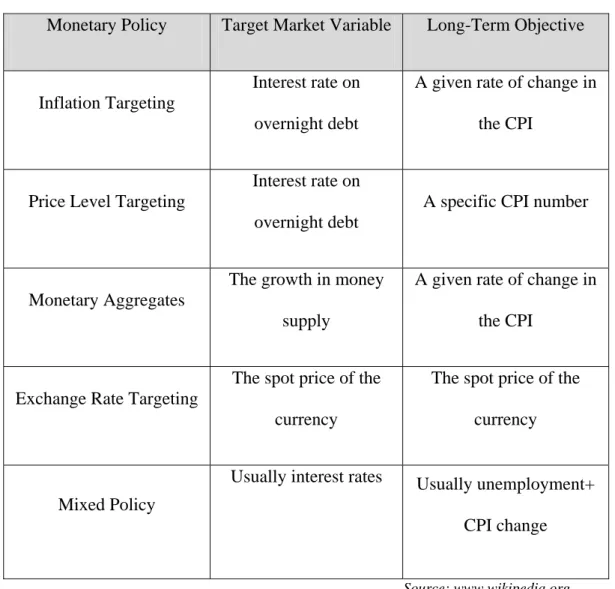
Before, defining one by one table 1 summarizes the long term objectives and target market variables of each monetary regimes.
Table 1: Types of Monetary Regimes and Long-Term Objectives
Monetary Policy Target Market Variable Long-Term Objective
Inflation Targeting
Interest rate on overnight debt
A given rate of change in the CPI
Price Level Targeting
Interest rate on overnight debt
A specific CPI number
Monetary Aggregates
The growth in money supply
A given rate of change in the CPI
Exchange Rate Targeting
The spot price of the currency
The spot price of the currency
Mixed Policy
Usually interest rates Usually unemployment+ CPI change
Source: www.wikipedia.org
6
There is also income level targeting. Because there is no country adopted income level targeting as a monetary regime, there is no experience explaining advantages and disadvantages of income level targeting.
2.2.1.1. Price Level Targeting:
In inflation targeting, from the econometric perspective, there is a unit root in price levels and that makes it non-stationary. In other words, in inflation targeting framework the deviations of previous years’ inflation levels from targeted inflation level are not undone. Therefore, there is an increasing conditional variance of the future price in inflation targeting (Svensson, 2007)7. In price level targeting, the aim is to make the price level stable about a targeted price level. Because the price level has a deterministic trend parallel to a steady inflation, then it is a trend stationary series. There are two advantages of price level targeting with respect to the inflation targeting monetary regime:
• Inflation targeting does not have a lower level uncertainty with respect to the price level targeting in the long-run.
• It can be said that price level targeting has an automatic stabilization mechanism. Practically, when the price level is below the targeted rate, due to a higher expected inflation rate, the real interest rate decline, since the nominal interest rate is
constant. The lower real interest rate will motivate the economy and price level will converge to the targeted level gradually (Svensson, 2007).
7
2.2.1.2. Exchange Rate Targeting:
As the name of the policy suggests, in the exchange rate targeting policy, the adopting country targets a fixed exchange rate, namely fixing the domestic currency to a foreign currency that is a domestic currency of a reputable and credible country. In other words, by hedging the domestic currency by a foreign currency, the monetary authority adopting this regime, uses the credibility of the reputable country. Lower interest rate is an outcome of this regime and also it is most significant benefit of this regime; however the adopting country loses its independency. There are also undesirable sides of a fixed exchange rate policy:
• First of all, in the exchange rate targeting regime is more restrictive with respect to other monetary regimes. The opening exchange rate determined for fixing the domestic currency reflects to the overall attitude of policy in the short-run. There are still many discussions among the policy makers on calculating the best equilibrium point for the exchange rate.
• In case of an idiosyncratic shock, the adopting country is supposed to increase the interest rates leading to a degree of tightness.
• Beside these problems, the adopting country should face off a large output gap and a real exchange rate which could not be recovered in a rational time horizon, as the inflation rate converges.
2.2.1.3. Money Aggregate Targeting:
It is also called as money-growth targeting. In money aggregate targeting regime, the adopting country controls the money supply to make the inflation rate converge to a lower and a stable level. Country experiences show that targeting money supply in order to move the inflation level down is not successful inflation stabilization way, practically (Svensson, 2007). Because the relation between money growth and inflation is not stable enough and undependable, thereby, to design the monetary policy based on the correlation between money growth and inflation rate does not lead the economy to achieve a
satisfactory outcome. Above and beyond, the theory and the practices do not coincide; there exists some additional problems about money aggregate targeting:
• To begin with, in practice, money aggregate targeting only stabilizes the money supply in the economy, not the inflation level or interest rates and also money demand. In case of instability due to a technical change, this encourages the economic agents, firms, banks, financial institutions and also individuals, to increase their money holdings. This challenges the economy in order to face off a significant level of money demand.
• Moreover, in an economy, money supply should not be the main reason of the inflation problem. Then, a monetary regime based on a money supply could not work.
• More to the point, it is possible that the economy should face up to a re-entry problem. When an inflationary shock occurs, to sustain the targeted money supply
level, the interest rates are increased, then, the economy shall slow down and as a result, the inflation rate converges to the determined level. But, this is not possible in the short-time. In this restricted time, the price level will have increased. The monetary authority will accommodate the change rate in prices, other than any following inflation. In other words, a once-off change in the money supply will occur in an inflationary shock, in money aggregate targeting regime, this type of change is strictly difficult.
3. Preconditions and Conditions for Inflation Targeting:
Inflation targeting as a monetary regime has specific requirements before and during the implementation process. Because the framework based on an announced target level, to achieve the target, the central bank as the monetary authority adopting, is supposed to satisfy credibility, transparency, accountability, communication and flexibility conditions during the implementation period. Besides these, central bank is also supposed to be
independent and economy is required to have strong financial markets as the preconditions before adopting the inflation targeting framework for the success of regime. Since inflation targeting regime is unlike to other monetary regimes affects expectations directly, and also these expectations shape actual inflation level and overall economic conditions in the country, the satisfaction of the preconditions and requirements has a vital role in order to have a rewarding outcome. The preconditions of transition process could be summarized as independency of monetary authority, strong and adequate financial markets. Additionally in the implementation process, credibility of the monetary authority, transparency and
accountability to the public and also communication and flexibility are the requisites which lead the economy to achieve the targeted inflation level. In this part, these all preconditions and requirements will be analyzed.
3.1. Preconditions for Inflation Targeting Framework:
Central bank independency and adequate financial markets are the prerequisites of inflation targeting monetary regime. By satisfying these prerequisites in the transition period, central bank inspires confidence which means less uncertainty; policy leads the economy to achieve the targeted objectives.
3.1.1. Central Bank Independency:
Fiscal dominance is the main obstacle for monetary policy to be implemented. Monetary policy and fiscal policy are supposed to be driven independently in order to have a robust economic environment. That’s why; independency of central bank has a higher level of importance.
Independency of monetary authority could be defined as central bank is independent from government in operational and management issues. Supporters of central bank
independency argue that political pressure encourage the economic cycles, like increasing the wage rates in election periods and thereby; speculates the economic environments. Therefore, an independent central bank guarantees a stable monetary policy regardless to political speculations. Additionally, independency bears credibility which is also an obligation in inflation targeting regime. In absence of an independent central bank, since governments influence the monetary policy, a dependent monetary regime does not prevent short-term government from inflating the monetary aggregates.
In inflation targeting framework, the roles of monetary policy and fiscal policy must be defined clearly. In inflation targeting, although government does not interfere to
monetary policy, agrees with the central bank about the numerical target, time horizons and price stabilization as the main objective of monetary policy. Then, government delegates instrumental authority to central bank in order to achieve the monetary targets and on the other side, government holds the central bank accountable for the monetary regime and its results to public (Demirhan, 2002)8.
As mentioned at the beginning, fiscal dominance sets a bar against the monetary policy. To avoid fiscal dominance, it is required to lessen the public borrowing from central bank, have strong financial markets in order to reduce the responsibility of central bank in public borrowing, not to rely on the protection of seignorage, and also have a reduced public deficit (Demirhan, 2002). Why is fiscal dominance an obstacle for a robust monetary regime? It is needed to say, fiscal dominance has fateful and negative effects on money supply by upsetting the financial statements of central bank. In other words, it becomes more difficult for the central bank to control its financial statements, since fiscal policy dominates balance sheet items of central bank. In the absence of fiscal discipline, monetary policy is restricted. This case leads the central bank to finance the public deficit taken root from fiscal policy.
Furthermore, international organizations, such like IMF and World Bank, support central bank independency. That conviction increases the number of countries which define the role and authorization of central bank independently from fiscal authorities. Also, it can
8
See Demirhan, Erdal ‘Para Politikasinin Degisen Yuzu: Enflasyon Hedeflemesi’ (2002) for details about the preconditions of inflation targeting framework.
be added that, an independent central bank has higher scores and also it is more successful than the dependent monetary authority.
To sum, it is inevitable to empower the central bank in decision-making and implementation process of monetary policy to achieve the targeted objectives and for a long-term stable monetary policy.
3.1.2. Strong Financial Markets:
To have strong and dynamic financial markets is another required pillar for the inflation targeting. It is the next step which is supposed to be satisfied in the transition period, before adopting the inflation targeting regime. In a way, the effectiveness of the monetary instruments designed by monetary authority depends on developed and dynamic financial, monetary, capital and foreign exchange markets. Since the financial markets are not adequate, they should not response to monetary tools not as quickly as requires and this belated reaction can also results as deviations from the targeted level. Deviation from the targeted level is the tender point of the inflation targeting framework which causes loss of credibility (Alparslan, Erdonmez, 2000)9.
As mentioned in the previous precondition, independency of central bank, fiscal dominance is a barrier to monetary policy. In the case of insufficient financial markets, public borrowing should not be absorbed by the financial markets via trading stocks, bonds
9
See Alparslan, Melike; Pelin Ataman Erdonmez; ‘Enflasyon Hedeflemesi’ (2000) for details about preconditions and conditions in inflation targeting.
or other financial assets. Thereby; central bank takes the responsibility on financing public borrowing and this case creates fiscal dominance on monetary policy and leaves a limited room to the monetary authority during designation and implementation of monetary regime. Therefore; dynamic and strong financial markets could rank as a prerequisite of inflation targeting framework.
3.2. Conditions for Inflation Targeting Framework:
As mentioned above, as an economy satisfying the preconditions should adopt inflation targeting framework. However, there is a number of requisites can be counted during the adopting process itself. Credibility of the central bank, transparency,
accountability, flexibility and communication as the main conditions will be analyzed in this part.
3.2.1. Transparency:
Transparency can be defined as the consequence of ‘the right to know’ of public. The central bank is supposed to have a high degree of transparency, simply, by issuing annual or quarterly reports about the policy tools, targets, forecasts on inflation, analyses of economic conditions and next steps in implementation by defining the following
This level of transparency is a concept come into being by the inflation targeting framework. Till 1990’s, generally, central banks prefer not to declare the monetary policy tools and targets to both public and private-sector, they impose secrecy on policy
instruments. It is austere to figure out the logic lying behind this level of secrecy, but possibly, it can be assumed that high degree of transparency leaves an incapacitated room for monetary authority to change the monetary tools. Additionally, this degree of secrecy keeps the central bank away from the inquiry and pressure of both government and public (Svensson, 2007). What is the reason supporting the high degree of transparency in inflation targeting? It can explicitly be answered by recalling the distinctive feature of inflation targeting that leads the framework to achievement and distinguishes it from other monetary regimes, the concept of ‘controlling the expectations’. The inflation targeting framework by exhibiting the monetary instruments, targets, estimations and the future instrument settings abrogates the uncertainty and thereby; manages the expectations directly. These expectations affect the current and future economic parameters and conditions through shaping interest rates, current and future pricing decisions effectively (Svensson, 2007).
To add that, transparency has a positive effect on credibility of monetary authority. As a consequence, this central bank credibility creates the credibility for inflation targeting regime, moreover, this regime credibility results as an achievement of the policy.
3.2.2. Accountability:
Accountability is a requirement for both inflation targeting framework and independency of monetary authority. In inflation targeting, because central bank is independent in setting the monetary policy and its instruments, at the same time, it is the only responsible body from the success of monetary policy. Therefore, central bank announces the potential risks against success of monetary regime and also accounts to public, government and private sector about the deviations from targeted levels if occur. Additionally, in case of a deviation from targeted level, central bank also accounts for the reasons lying behind failure.
In inflation targeting framework, central bank is not just responsible only for the public and government, but also have to account internally. As the target is not achieved, the policy-makers are supposed to declare the reasons to central bank.
Accountability is related to transparency directly. Since central bank is transparent in its monetary policy, public, government and private sector should be aware of the
policies being implemented and also should see the external inflationary risks which do not take root from monetary policy, such like oil price shocks. Then, central bank should assure economic agents that the deviations from targets are temporarily and not results of
monetary policy, in the long-run targets are still authoritative (Demirhan, 2002)10.
10
Erdal Demirhan explained the preconditions of inflation targeting framework in two main concepts; credibility of central bank and accountability-transparency. Because transparency and accountability are two related prerequisites, explained together.
To add, accountability creates positive improvements in credibility. Economic agents, since the central bank is transparent in monetary policy instead of keeping the policy instrument secret; accredit the monetary regime. Therefore, inflationary expectations are replaced by low inflation expectations, and this case leads inflation targeting regime to achievement.
3.2.3. Communication:
Communication can be defined as the tools which central bank uses to provide accountability and transparency. Inflation reports are the basic communication tools being published periodically by most of the countries adopting inflation targeting framework. Most commonly, inflation reports are published quarterly or annually. Central bank announces the targets, forecasts and informs the public about the monetary instruments. Additionally, inflation reports include the potential risks against the targets and analyses on past and also future economic conditions (Demirhan, 2002).
Another type of communication tools is public letters which central banks write to government and public. In the case of a deviation, most of the central banks adopting inflation targeting write a public letter -also it is called as open letter- explaining the reasons of deviations and what reaction central bank will take against the deviation (Svensson, 2007). Furthermore, these reports let the central bank to response the critics about its policy instruments and make it to maintain the credibility. Moreover,
Another benefit of communication is to strength the commitment among central bank, private sector and public. The strong institutional commitment renders the central bank in order to be more independent from political pressure and fiscal dominance, to have full control over designing and implementing the monetary policy, therefore, as a
consequence, to have the authorization to set the price stabilization as the main objective. To sum, we can say that for achievement communication is a requirement in
inflation targeting and, vice versa, it can also be called that communication is an advantage of inflation targeting in the way increasing credibility.
3.2.4. Flexibility:
Flexibility can be defined as the ability of central bank to respond the
macroeconomic fluctuations in order to achieve the targeted variables. In inflation targeting framework, there is a tradeoff between the flexibility and other requirements. Since
transparency and accountability increases, the flexibility of central bank in its reactions against the unpredictable macroeconomic fluctuations decreases (Alparslan, Erdonmez, 2000). In other words, because the central bank is responsible from monetary regime and achievement in targets, central bank is supposed to inform the public about the policy instruments. Therefore, in contrast the decorous secrecy, public and private sector are aware of the instruments and also the next steps of current monetary policy. Additionally, as a requirement of transparency and accountability which feed the credibility, central bank is supposed to account for any change in instruments or type of policy. Therefore, this
degree of accountability leaves a limited reaction room for the monetary policy, namely, a reduced flexibility rate is an inevitable consequence of high degree of accountability. That is the tradeoff mentioned between the concepts of transparency and flexibility.
On the other hand, central bank is supposed to adjust the level of transparency and accountability in order not to decrease flexibility to signaling levels, however, both transparency and accountability are the main conditions for inflation targeting. Because in the case of an unpredictable macroeconomic shock, a reduction in flexibility more than required, creates higher leveled fluctuations in macroeconomic parameters.
3.2.5. Credibility of Central Bank:
It can be said that, the most vital requirement for the inflation targeting framework is to build and sustain the credibility of the central bank. Credibility of central bank means economic agents accredit that central bank should achieve what it stipulates. In other words, a central bank is credible for economic agents, if central bank was successful in past monetary regimes, did what they guaranteed and it is also adequate and enough powerful to control the economy and should cope with potential difficulties economy should face.
All prerequisites and conditions mentioned in this part are important in order to ensure and sustain the credibility of central bank. Independency, transparency,
accountability and communication are the main pillars feed the credibility of central bank. In the first part, it is mentioned that, it is very important to start to implement the inflation targeting policy after the inflation rate has already started to decline. Since the inflation
curve has a downward trend, economic agents believe in a monetary policy which is aimed to decrease the inflation level as the primary objective. That’s why it is emphasized that a central bank should be more successful while adopting inflation targeting regime, if it starts to implement it as inflation curve starts to decrease.
In inflation targeting, credibility is a critical concept that must be satisfied before and during the implementing, and also it is the tender point of inflation targeting
framework. That means if even a credible central bank deviates from targeted level unexpectedly, this fail unnerves the credibility and it is needless to say, this discrediting affects the expectations negatively. As a result of chain reaction, negative expectations lead the monetary policy to fail. As seems, credibility is the most critic, important and inevitable condition for the inflation targeting framework.
4. Inflation Targeting in Turkey:
Turkey has adopted inflation targeting in 2006 officially, but inflation targeting process has started in 2002, by adopting hidden inflation targeting. Because preconditions of inflation targeting framework were not satisfied, The Central Bank of The Republic of Turkey did not announce the inflation targeting as the monetary regime in 2002. After some structural reforms and acceding inflation a downward trend, at the end of 2005, central bank of Republic of Turkey declared inflation targeting as monetary regime from 2006. Therefore, in this part, inflation targeting period of Turkey will be analyzed in two parts, hidden inflation targeting period between 2002 and 2005, inflation targeting period from 2006.
First, the implicit inflation targeting process between years 2002 and 2005 will be examined by focusing on the difficulties which The Central Bank of The Republic of Turkey faced, the overall economic conditions and premature conditions of inflation targeting regime and in the second part, the full-fledged inflation targeting process of Turkey will be analyzed by understanding the fluctuations in inflation rate and deviation from target in 200611. Additionally, the quarterly inflation reports published by The Central Bank of The Republic of Turkey will be analyzed.
11
In first part, hidden inflation targeting period, the challenges in the transition period are examined. The inflation fluctuations in the transition period are analyzed in the second part, together with the full-fledged
4.1. Implicit Inflation Targeting Period from 2002 to 2005:
Turkish economy faced an economic crisis in 2001; therefore the period after 2001 should be called as the post-crisis period. Before 2001 crisis, the monetary policy was based on exchange rate targeting, namely, fixed exchange rate monetary policy was implemented by the central bank till February 2001. After the economic crisis boomed, monetary authority switched to a floating exchange rate system. Up till 2001, a number of different monetary policies were adopted, but, none of them cracked to the chronicle inflation problem in Turkish economy. The Central Bank of The Republic of Turkey chose to adopt the inflation targeting regime which has significant macroeconomic outcomes in adopting countries, but there are many preconditions and conditions must be satisfied to reach the expected outcomes. Because adopting inflation targeting regime without satisfying the conditions should bear problems instead of curing the inflation illness, monetary authority applied an implicit inflation targeting framework instead of full-fledged version, and spend the transition period to satisfy the conditions and prerequisites. Central Bank faced a number of difficulties during this transition period like fiscal dominance, high public debt, volatile risk premium, uncertainty and loss of credibility; however Turkey has significant advantages in independency of monetary authority.
4.1.1. Difficulties of Central Bank in Transition Period:
During the transition period, central bank faced a number of difficulties like fiscal dominance, loss of credibility, volatile risk premium and insufficient database system. It was difficult for the central bank to bypass another monetary regime after fixed exchange rate system. Economic conditions of post-crises period were not eligible for adopting the inflation targeting framework. That’s why; the transition period was inevitable for Turkish economy in order to ensure the preconditions of inflation targeting policy.
First, challenge for the central bank is lack of fiscal discipline. As discussed in the previous chapters, fiscal dominance is the most critical challenge to monetary policy. In case of fiscal dominance, central bank is not able to adopt the monetary policy
independently. Due to high public debt ratios, refinancing the debts and to maintain its sustainability become preferential for the economy. Therefore, in post-crises period monetary policy was not driven regardless to fiscal policy. Graph 1 shows the ratio of net public debt to gross national product in crisis and post-crisis years, 2000, 2001 and 2002. It can be observed that in 2001, debt ratio ascended to 90.5% and in 2002, this ratio was about 78.5%. These high public debt ratios caused a critical obstacle in order to implement a full-fledged inflation targeting regime, since monetary regime was dominated by fiscal policy.
Graph 1: Public Debt Ratio
Source: Treasury Beside high public debt ratio, volatile risk premium is another problem of the Central Bank of the Republic of Turkey during the transition period. What is the problem with volatile risk premium? What does the volatile risk premium cause? Volatile risk premium sets a bar against controlling the inflation and also limits the adequacy of central bank to estimate the future inflation performance. In case of a volatile risk premium, exchange rate variability increases. Therefore, it becomes more difficult to control the inflation for monetary authority. Not only to control the future inflation fluctuations but also uncertain time horizons appeared as another difficulty as a result of volatile risk premium. Remember that, in inflation targeting, it is also important to make the future
inflation certain for a determined time horizon. In existence of variable risk premium, the central bank should forecast the inflation in limited time horizons, like a couple of months which is not an adequate period for implementing the inflation targeting framework.
Moreover, loss of credibility was another obstacle in transition period. As mentioned before, Turkey faced an economic crisis in 2001. As a result of an economic crisis and also due to high inflation levels before 2001 expected inflation levels were
significantly high. Economic agents properly had inflationary expectations in the post-crisis period. In hidden inflation targeting period, uncertainty was not just about expectations of economic agents, but also occurred in the forecasts of central bank. In the transition period, insufficient data sources created problems for the central bank. Expected inflation surveys were reflecting the expectations overall, not specifying the central bank’s forecasts. Because a robust database system is a must in inflation targeting regime, these ineffective data challenged the central bank in forecasts. Also, it is supposed to be added, changing the methodology and basket of consumer price index in 2004 increased the uncertainty about expectations (Kara, 2006)12.
12
4.1.2. Structural Reforms in Implicit Inflation Targeting Period:
The next question is although these difficulties how did the Central Bank of the Republic of Turkey has successful outcomes? The answer is structural reforms, increasing credibility by implementing a robust monetary policy and amended the Central Bank Law in order to increase independency.
Although the difficulties mentioned in the previous part, the Central Bank of the Republic of Turkey had a big advantage in independency. The changes in the central bank law in April 2001 empowered the Central Bank of the Republic of Turkey fully authorized to design and implement the monetary policy and policy instrument. According to renewed law, the Central bank of the Republic of Turkey is also required to inform the public about monetary policy which improves accountability. Furthermore, this law also includes central bank is supposed to account for the deviations from targets. Additionally, this law set the primarily objective of the Central Bank of the Republic of Turkey as achieve and maintain the price stability (Kara, 2006)13.
Moreover, during the transition period, central bank increased its credibility. Under normal circumstances, since the inflationary expectations come into being, central bank generally prefers to increase the interest rates to meet the targets. In contrast, the Central Bank of the Republic of Turkey never increased the interest rates during the implicit inflation targeting period, preferred fiscal reforms rather than using the interest rates as a policy tool. This attitude of central bank created and improved its credibility.
13
Also the Central Bank of the Republic of Turkey declared that the primarily objective of central bank is to maintain price stabilization via its website. Visit www.tcmb.gov.tr for details.
4.2. Inflation Targeting Period in Turkey after 2006:
The Central Bank of the Republic of Turkey declared to bypass the inflation targeting regime at the end of 2005 and started to adopt from 2006. Kara explains the transition steps as follows (2006);
1. The database system was renewed. Projections focused on new inflation dynamics and monetary transmission mechanism. The restructured techniques are modified to improve the policy analyses and forecasts.
2. Monetary policy committee meetings settled periodically. In these meetings, the policy being adopted and will be adopted, are decided and announced to public. Not only the policies but also fixed meeting dates are declared to public as a result of accountability and in order to eliminate the uncertainty.
3. The Central Bank of the Republic of Turkey started to publish inflation reports quarterly and financial stability reports twice a year on previously announced dates as requirement of communication condition. This reports aim to inform the public about ‘what central bank is doing’.
What do this inflation reports include? Actually, inflation reports are published by the central bank to inform the public about overview of the economy, outlook to future, inflation developments and also supply and demand developments. They also analyze the financial markets and financial mediations, budget developments, and medium term forecasts including the risk factors against the achievement of monetary policy.
reasons in inflation reports. Moreover, central bank announces the monetary policy committee meeting dates. It is needless to say, these reports improve transparency and communication to public.
4.3. Positive Trend in Inflation Rate:
During the transition period, the structural reforms and adoption of three-year budget planning have positive effects in expectations. Not only these structural changes, but also progress in the European Union membership, enhanced financial stability, money reforms14, decrease in medium and long-term real interest rates and sustained fiscal discipline also lead the inflation rate to a decrease gradually (CBRT, 2006-I)15.
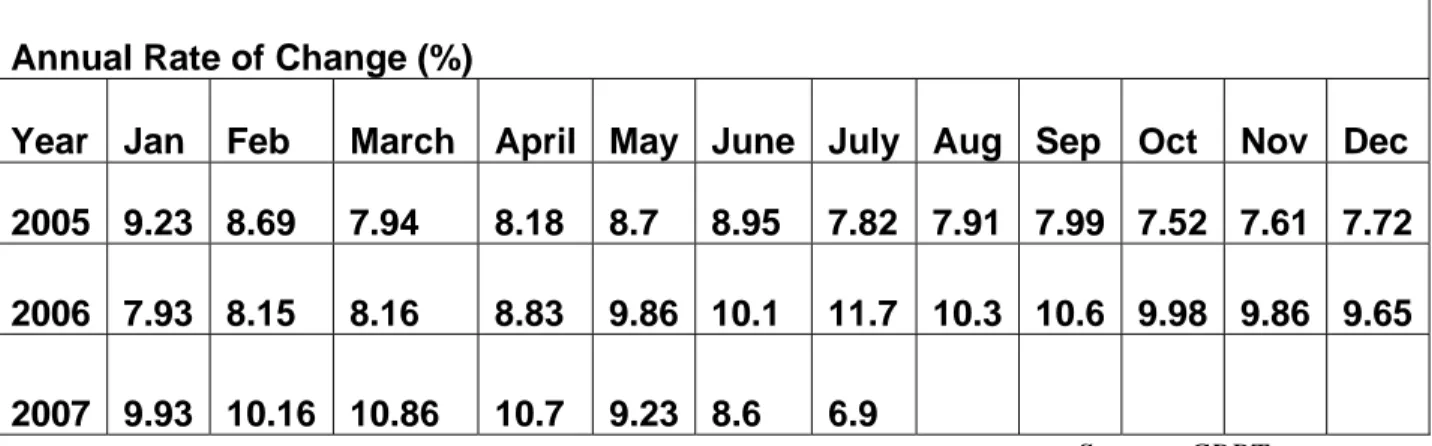
The outcomes of both implicit and full-fledged inflation targeting framework are significantly successful. At the end of 2001, after February 2001 economic crisis the inflation rate was 68%, and at the end of implicit period, in 2005, the inflation rate was 7.72%, 9.65% at the end of 2006. Table 2 and also Graph 2 sum up the annual percentage change in consumer price index (CPI).
14
Printing New Turkish Lira. 15
The inflation reports published by the Central Bank of the Republic of Turkey are used as a reference to these inflation analyses. The inflation reports are published quarterly, therefore 2006-I refers to the inflation report of the first quarter of 2006.
Table 2: Percentage Change in CPI
Annual Rate of Change (%)
Year Jan Feb March April May June July Aug Sep Oct Nov Dec
2005 9.23 8.69 7.94 8.18 8.7 8.95 7.82 7.91 7.99 7.52 7.61 7.72
2006 7.93 8.15 8.16 8.83 9.86 10.1 11.7 10.3 10.6 9.98 9.86 9.65
2007 9.93 10.16 10.86 10.7 9.23 8.6 6.9
Source: CBRT
Graph 2: Annual Percentage Change in Consumer Price Index (2003=100)