OUTPOSTS OF AN EMPIRE: EARLY TURKISH MIGRATION TO PEABODY, MASSACHUSETTS
The Institute of Economics and Social Sciences of
Bilkent University
by
IŞIL ACEHAN
In Partial Fulfilment of the Requirements for the Degree of MASTER OF ARTS in THE DEPARTMENT OF HISTORY BİLKENT UNIVERSITY ANKARA May 2005
I certify that I have read this thesis and have found that it is fully adequate, in scope and in quality, as a thesis for the degree of Master of Arts in History.
---Visiting Associate Professor John J. Grabowski Supervisor
I certify that I have read this thesis and have found that it is fully adequate, in scope and in quality, as a thesis for the degree of Master of Arts in History.
---Asst. Professor Timothy M. Roberts Examining Committee Member
I certify that I have read this thesis and have found that it is fully adequate, in scope and in quality, as a thesis for the degree of Master of Arts in History.
---Asst. Professor Dennis Bryson Examining Committee Member
Approval of the Institute of Economics and Social Sciences
Prof.Dr. Erdal Erel Director
ABSTRACT
This thesis examines early (1890s-1920s) Turkish immigration to Peabody, Massachusetts. It is a case study which argues that the most prominent factor driving early Turkish migration to Peabody was economic. Thus the migration movement constituted a “brawn drain” from Anatolia to the “streets paved with gold.” As was the case with some European peoples who immigrated to the United States at the same period, the Turkish immigrants in Peabody, Massachusetts, did not intend to stay in the United States. They only wanted to earn money and return to the homeland as soon as possible. More importantly this thesis argues that the Turkish immigrants were part of a larger Ottoman migration to the United States. The Turks in Peabody were part of a chain of migration that included Armenians, Greeks, and Sephardic Jews. They, together with the Armenians, Jews and Greeks constructed an Ottoman microcosm in Peabody essentially recreating the millets of the Ottoman Empire in which inter-communal support helped the Turks contend with the strange new environment. By the early 1930s most of the Turkish immigrants in Peabody had returned to their homeland. Overall, this thesis provides new insight into the Turkish and Ottoman diaspora that challenges popular conceptions of continual strife between the Turks and members of the other Ottoman millets. Additionally, it shows that this early Turkish immigrant community was, in some ways, strikingly similar to later twentieth century Turkish immigrant communities, such as those in Germany during the 1960s.
Key Words: Migration/Immigration, ABCFM, Harput, American Missionaries, Tanzimat, U.S. Censuses, 20th century
ÖZET
Elinizdeki tez, Massachusetts, Peabody şehrine ilk Türk göçünü (1890-1920) inceliyor. Peabody’ye ilk Türk göçüne neden olan başlıca etkenin ekonomik olduğu görüşünü savunan bir vaka incelemesi niteliğini taşıyor. Bundan dolayı, meydana gelen göç dalgasının, Anadolu’dan “altınla döşeli” sokaklara bir “kas göçü” özelliği taşıdığı görüşünü savunuyor. Aynı dönemlerde ABD’ye göç eden Avrupalıların aksine, Türklerin Peabody’ye yerleşmek ve yeni bir yaşam kurmak gibi bir amaçlarının olmadığını, mümkün olduğu kadar kısa bir sürede para kazanarak, anavatana kesin dönüş yapmayı hedeflediklerini iddia ediyor. Bu çalışmanın vurguladığı en önemli noktalardan biri, Peabody’ye göç eden Türklerin, Ermenileri, Rumları ve Yahudileri de kapsayan, büyük bir Osmanlı göç zincirinin halkalarından biri olması, Osmanlı milletlerinin anavatandaki sosyal yaşantılarını Peabody’de yeniden kurmaları ve aralarındaki ilişkiler ağı sayesinde yabancı bir dünyada ayakta kalmayı ve yaşamlarını sürdürmeyi başarmalarıdır. Sonuç olarak, nüfus sayımlarına dayanarak Peabody’deki ilk Türk ve Osmanlı toplumuna yeni bir soluk veren bu çalışma, bir yandan Türkler ve diğer Osmanlı milletlerine mensup kişilerin arasındaki düşmanlığın anlatıldığı popüler yazına meydan okurken, bir yandan da Peabody’deki ilk Türk toplumu ve 1960’larda Federal Almanya’daki Türk toplumu arasındaki çarpıcı benzerliklere dikkati çekiyor.
Anahtar Kelimeler: Göç/Göçme, ABCFM, Harput, Amerikan Misyonerleri, Tanzimat, ABD Nüfus Sayımları, 20. Yüzyıl
ACKNOWLEDGEMENTS
Special thanks to Professor Mehmet Kalpaklı, who recommended the subject of this thesis to me who encouraged me in my research and who was a great conductor on a journey full of hardships; to Professor John J. Grabowski, who showed me the way to approach Turkish immigration, who taught me to be skeptical about historical “facts”, and to whom I owe much for the construction of this thesis; to Professor Timothy M. Roberts, who started the journey at Bilkent with me and accompanied me all three years of my graduate study, who has always been understanding and encouraging, and taught me to be a careful observer; to Professor Dennis Bryson who introduced me to Foucault and who honored me with his very presence in my thesis jury; to Frank Ahmed, who contributed this thesis with his great knowledge of the first Turks in Peabody and who encouraged me in extending my research on this subject; to Professor Talat Halman who recommended various sources about the early Turkish immigrants in the United States; to Doğan Hızlan who gave me the opportunity to undertake research at the Hürriyet archives; to Oktay Özel, who contributed much to the Ottoman section of this thesis; to Professor Stanford Shaw who listened to me and encouraged me in my research; to Professor Halil İnalcık who gave us the opportunity to carry on our studies in a great academic environment and who contributed to this thesis by reminding me of the Turkish immigrants in Germany; to Professor Edward P. Kohn for giving me strength during my research and for silencing everyone talking about the date of my jury; to Ergun
Acehan who encouraged me to start this road, who helped me to survive throughout my educational life, and who has always supported me in all of my decisions; and to Bahar Gürsel and C. Akça Ataç for accompanying me with their nice friendship during this difficult year.
TABLE OF CONTENTS
ABSTRACT...i
ÖZET...ii
ACKNOWLEDGEMENTS...iii
TABLE OF CONTENTS...v
LIST OF TABLES...viii
LIST OF FIGURES...ix
INTRODUCTION...1
CHAPTER I: PUSH AND PULL FACTORS IN THE EARLY
OTTOMAN MIGRATION TO THE UNITED STATES...5
Life and Population in the Ottoman State...5
Economic Factors...8
Social and Political Factors...13
Other Factors Peculiar to the Ottoman Migration...17
The Harput Mission and Harput American Consulate...18
Ottoman Migration Policy and Legal Status of the
Emigrants...21
CHAPTER II: THE ROAD TO PEABODY,
MASSACHUSETTS...32
Peabody...33
The Ottoman Millets in Peabody...35
Armenians...
35
Jews
...37
Greeks...
37
Turks...
38
Date of Arrival in America...46
Number of the Turks in Peabody...44
Work in the Leather Factories...46
Emergence of a Segmented Labor Market in Peabody...47
Who were the Turks in Peabody………...51
Occupations...56
Everyday life of the Turks in Peabody...60
Language...62
The Coffeehouse Culture in Peabody...67
Changing Attitudes...69
Religion...71
American Perceptions of the “Others”: Cultural Identity in
Peabody...76
CHAPTER III: SETTLEMENT AND THE DECISION TO
RETURN TO THE HOMELAND...83
Settlement and Interaction of the Ottoman Millets in
Peabody...83
Contribution of Turks in the Peabody to the Economy of the
Mother Country...94
The Decision to Return and the Remnants of the Turks in
Peabody...95
CONCLUSION...99
BIBLIOGRAPHY...107
APPENDICES...114
APPENDIX A...114
APPENDIX B...116
APPENDIX C...117
APPENDIX D...124
APPENDIX E...131
APPENDIX F……….139
LIST OF TABLES
Table 2.1. Total Volume of Armenian immigration to U.S...35
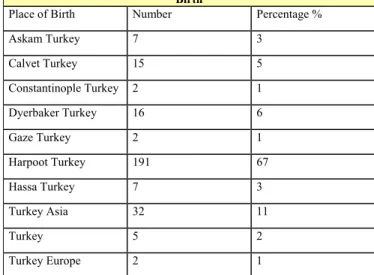
Table 2.2. 1920 Census: Turks in Peabody According to the Place of
Birth...37
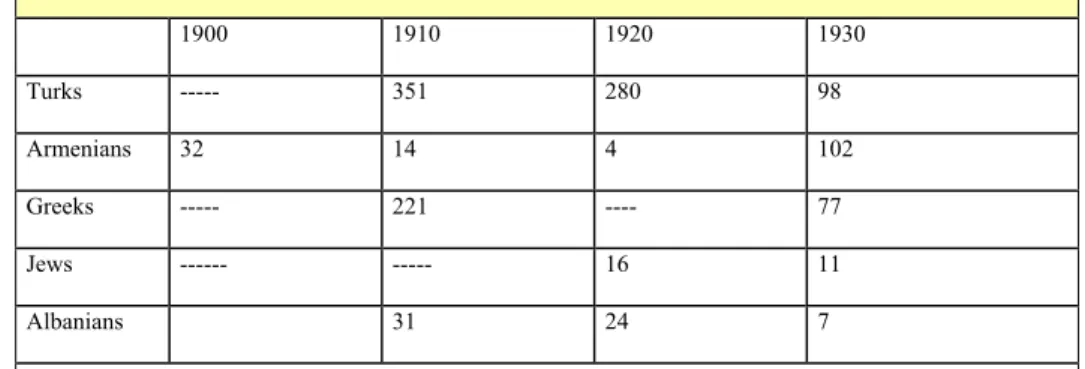
Table 2.3. The Number of Immigrants from the Ottoman Millets in
Peabody...44
Table 2.4. 1910 Occupations of Turks in Peabody...54
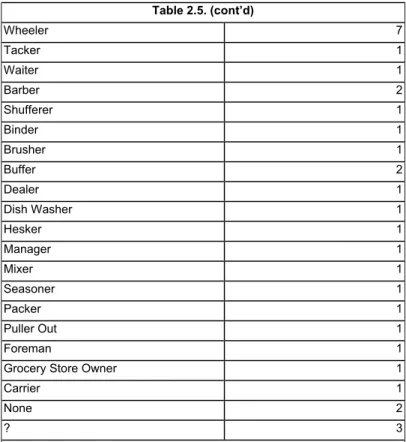
Table 2.5. 1920 Occupations of Turks in Peabody...55
Table 2.6. 1930 Occupations of Turks in Peabody...56
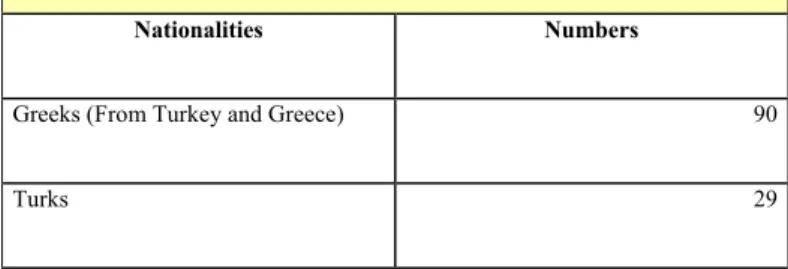
Table 2.7. The Ottoman and Greek Inhabitants of Walnut Street in
1910...66
LIST OF FIGURES
Figure 2.1. Year of Arrival in the U.S. for Turks Resident in
Peabody, Mass. 1910...41
Figure 2.2. Year of Arrival in the U.S. for Turks Resident in
Peabody, Mass. 1920...42
Figure 2.3. Year of Arrival in the U.S. for Turks Resident in
Peabody, Mass. 1930...42
Figure 2.4. Ages of Turkish Immigrants in Peabody, Mass. 1910...49
Figure 2.5. Ages of Turkish Immigrants in Peabody, Mass. 1920...50
Figure 2.6. Age Upon Arrival in the U.S., Turks in Peabody in
1910...51
Figure 2.7. Age Upon Arrival in the U.S., Turks in Peabody in
1920...51
Figure 2.8. Marital Status of Turks Residing in Peabody in 1910..52
Figure 2.9. Marital Status of Turks Residing in Peabody in 1920..52
Figure 2.10. Marital Status of Turks Residing in Peabody in
1930...53
Figure 2.11. 1910 English Speaking Ability...61
Figure 2.12. 1920 English Speaking Ability...63
Figure 2.13. 1930 English Speaking Ability...64
Figure 3.1. Households-Single and Mixed Millet- Peabody
1910...81
Figure 3.2. Households-Single and Mixed Millet- Peabody
1920...81
Figure 3.3. Households-Single and Mixed Millet- Peabody
1930...82
INTRODUCTION
When I started searching for the Turkish immigrants in Peabody, Massachusetts, I knew none of them. The first time I saw a Turkish name on the U.S. census microfilm, I was really very happy, I felt as if I had saved one life. Then, gradually I found myself walking on every street in Peabody with the census taker, smelling this “leather city”, entering the boarding houses, hearing the immigrants’ halting voices, seeing the tired looks on their faces, and coming to understand the desperate life that was lived there. They were not simply names on hundreds of census sheets. They were breathing, eating, walking, laughing, thinking human beings who were born, lived some time and then died as does every being. What made them different was that they were people who ventured to leave their countries and lives behind, and journeyed thousands of kilometers to the “Golden Door” of the United States in search of something better. But, then wheels began to turn in my head. Who exactly were these people? Why did their names seem so different from what they actually were? Why did they choose to leave? How did they manage to reach the United States and under what circumstances? How were they able to live in a totally strange world? What happened to them? Did they return Turkey or remain in Peabody? I decided to work as if I were a detective searching for a group of lost people. These people were dead, I could not talk to them, and it was
impossible to find their families. The only way to achieve my goal was to collect as much evidence as I could. Then, taking a blank canvas as the background, I would put my immigrants in a painting one by one, and in the end create a picture of their lives and the challenges they faced. This painting has two sides: One shows them in the Ottoman lands, and the second in Peabody. First, we will see the Ottoman side of the picture and then across the Atlantic.
At the end of the 19th century, during the “Great Wave” of migration,
the United States became a destination for migrants from all over the world who were lured by stories of riches and job opportunities waiting for them. Capitalism, which became a great global force beginning by the second half of the 19th century, functioned both as a push and pull factor in U.S. immigration. While the economy of the Ottoman Empire deteriorated, the United States witnessed a great economic shift with the growth of industry. American growth catalyzed migration from different parts of the world to the “Golden Door”. Within that stream of immigrants, there were also Ottomans, most of whom were from the Christian and Sephardic Jewish millets of the Ottoman Empire. The Ottoman Muslim millets’ migration to the United States, which has not been studied until recent times, also occurred at this time and was large enough to form communities and neighborhoods in a number of American cities. From the 1890s until the outbreak of World War I, Anatolian Turks, almost all male, journeyed to the United States along with other Ottoman migrants. The Muslim Turks who migrated to the United States were mainly from the villages and
towns of Harput, Dersim, Malatya, Siverek, Rize, Samsun, Giresun and Elazığ. Stories of opportunity in America could easily have spread among the millets of these towns and villages. As Frank Ahmed points out, “the United States, it was referred to as ‘Amrika’ came to represent hope, the possibility of achieving the impossible, instant wealth, economic security and relief from a life of abject poverty.”1
The United States’ immigration records show that a total of 291,435 immigrants whose “Country of last residence” was Turkey, entered America between the years 1900 and 1920. Those who left the Empire first were its non-Turkish citizens, the Greeks, Jews, Armenians and Syrians. News of their success and wealth did not take long to spread among the peoples of the regions they left.2 Moreover, the American missions and consulates, although they were for Christians, contributed to a considerable degree to the decision to move to America among all the millets of the Empire. Shipping companies involved in the lucrative business of carrying migrants to the United States also contributed to the great wave of Turkish migration. Moreover, policies of both the United States and Ottoman Empire, which will be dealt with later, played an important role in Ottoman migration.
Immigrants, once reaching the port of New York, would move to industrial urban areas where work might be found.3 In New England, especially in the industrial cities of Massachusetts there was a great need for laborers in
1 Frank Ahmed. Turks in America: The Ottoman Turk’s Immgrant Experience. (Columbia:
Columbia International, 1993),xvi-xvii.
2 Ibid, xvii-xviii. 3 Ibid, 29.
the leather industry and these places became a destination for unskilled Ottoman immigrants until the outbreak of World War I. Peabody, Massachusetts, was one of these “leather cities.” It experienced a considerable Turkish migration, especially from eastern Anatolia during this period. Job opportunity in leather factories of Peabody attracted many unskilled laborer immigrants from all over the world as well as from the Ottoman Empire. In order to have a deeper understanding of the factors which triggered the Turkish migration to the United States, we need to review the changing circumstances in both the Ottoman Empire and the United States.
CHAPTER I:
PUSH AND PULL FACTORS IN THE EARLY OTTOMAN
MIGRATION TO THE UNITED STATES
In order to understand population movements, it is important first to understand the “push” and “pull” factors which paved the way for a change in the existing population. Economic, social, political and other factors will be analyzed as both push and pull factors. Emphasis will be placed on the push factors and conditions in the Ottoman Empire at the time the Turks emigrated. The lives and history of the Turkish immigrants in Peabody can only be appreciated through knowing about their lives in Turkey before they left.
Life and Population in the Ottoman State
The first significant number of Turks migrated to the United States during the last years of Sultan Abdul Hamid II’s reign (1876-1915), the last sultan with any meaningful power. The Ottoman state was composed of various different ethnic and religious elements, and interaction between the Ottoman millets at the last decades of the nineteenth century must be understood in order to understand their reconstruction and interaction in Peabody.
It is very difficult to imagine what kind of a life it was with today’s mind. As the reviewer of Sir Harry Luke’s The Making of Modern Turkey explains “in the days of the Sultans, Turkey was less like a country than like a block of flats inhabited by a number of families which met only on the stairs.” But when the middle of the nineteenth century was reached, “the walls of the flats had crumbled leaving the millets in a large hall exposed to each other’s curious looks.”4 Ottoman nationality can only be comprehended within the Ottoman context of that time. Religion was the most significant identifier of an Ottoman nationality unlike the nations of today whose most obvious identifier is a common history and language. The Ottoman Empire developed a system of government based on dividing its subjects into religious groups, each of which had autonomy to some extent within itself. All public facilities were provided for them by the state. In the Balkans, for example, “although there were many religiously mixed villages and neighborhoods in cities,” as Justin McCarthy points out “co-religionists tended to live and work together.”5
The walls of the flats began to crumble with the Tanzimat which introduced a Western idea of state: “the state was to do for its people what they needed and wanted but could not do for themselves.”6 When Sultan Abdülmecit proclaimed the Hatt-ı Humayun on 3 November 1830, he triggered a new phase in the overall structure of the Empire. A series of reforms by the
4 Kemal H. Karpat. “Millets and Nationality: The Roots of the Incongruity of Nation and State
in the Post-Ottoman Era.” Christians and Jews in the Ottoman Empire, Benjamin Braude and Bernard Lewis eds. (New York: Holmes and Meier), 162.
5 Justin McCarthy. The Ottoman Peoples and the end of Empire. (New York: Oxford
University Press, 2001), 39.
Tanzimat slowly began to reshape both government and society. Administrative, educational, and economic reforms paved the way for the different outlook of the state. The reforms in the area of education were of great importance for its peoples because they would come to play major roles in triggering migration. The Tanzimat reforms of 1839 led to the construction of a public education system which was based on the training of teachers who trained students and teacher trainers in return. Although this was slow to affect the population in general, the most critical effect of the change in the educational system was the government’s support for foreign, especially American missionary schools. It was a sincere effort of the government, as McCarthy points out, because “it supported them, despite the fact that they benefited only Christians and sometimes became recruiting centers for separatist movements. Some 23,000 students were enrolled in the schools of the American Board of Commissioners for Foreign Missions in 1913.”7 These mission schools, as we will see later, became a source of information about life in the United States.
The Tanzimat reforms brought about a new understanding of citizenship. With them, the Ottoman government “tried to develop a common secular sense of political belonging.” In order to achieve this goal, “it adopted first, after the Tanzimat reforms in 1839, the concept of Ottomanism—that is, the idea of regarding as Ottoman subjects all individuals living in Ottoman
7 Ibid, 19.
territories regardless of their faith and language.”8 The authority of the government was extended through these reforms and the rights and freedoms, which were inherent in the millet, were extended but now derived from the government rather than the millet. With the Nationality Law of 1869, a secular kind of Ottoman citizenship was born.9
Economic Factors
During the last half of the nineteenth century, many economic changes took place both in the Ottoman state and the United States, and became important “push” and “pull” factors for the Ottoman immigration. One of the most drastic changes in the Ottoman state was the shift of the traditional economy “to a primitive form of dependent capitalism that came to rely almost entirely on agriculture.”10 Between the years 1792 and 1853 as a result of epidemics and wars the population of the state decreased. Because of the demographic loss, especially in Anatolia and Rumili, the Ottoman government pursued a policy of encouraging immigrants from Europe, attracting them by methods such as tax exemptions. On 9 March 1857 a decree by the high council of Tanzimat was issued considering migration and settlement. The decree declared that “migration into the Ottoman state was open to anyone who was willing to give his allegiance to the sultan, to become his subject, and to respect the country’s laws.” Furthermore, “the government promised to give
8 Karpat, “Millets and Nationality,” 162.
the settlers, without any charge, the best arable lands owned by the treasury and to exempt them from all taxes and military service for six years, if they settled in Rumelia, and for twelve years, if they settled in Asia.”11 However
when, instead of European immigrants, millions of Muslim refugees from the Balkans and the Caucasus began to pour into the Ottoman land contrary to expectations, it resulted in a reverse of the liberal immigration policy.
The Muslim refugees were settled on uncultivated state-owned lands. As a result of the European demand for agricultural products a “mini-revolution” in the Ottoman agricultural economy took place “stimulating the cultivation of cash crops and turning certain farm sectors toward a market economy.” As a consequence of this development, large areas both in Anatolia and Syria began to be cultivated for cash crops. However, while some coastal areas with relatively rich agricultural hinterlands or suitable ports prospered, the interior parts did not benefit because of the lack of transportation and other causes. While in some parts of Anatolia and Syria many of the immigrant Bosnians, Circassians, Cretans, and Turks prospered, the natives, who could not adapt to the new methods, did not. Some of the immigrants shared their fate because of their slowness in adaptating to their new home. 12
These developments in the Ottoman economy had a dual effect. While the increased economic activity in the port cities led to new employment opportunities, at the same time the cities became home to many of the 10 Kemal Karpat, “The Ottoman Emigration to America, 1860-1914.” International Journal of
Middle East Studies 17 (1985), 176-7.
11 Kemal Karpat, Osmanlı Nüfusu (1830-1914): Demografik ve Sosyal Özellikleri. (İstanbul:
unemployed. The rapid occupational transformation in the state led to unemployed craftsmen and professionals in the cities where their skills were no longer useful in a changing society. This general change in the economic condition of the whole state was the most important factor in Ottoman emigration, particularly in areas such as eastern Anatolia and Syria where traditional craftsmen and professionals were left unemployed in their native cities. In the interior cities, where there was a lack of transportation and conservative farmers who could not easily adopt the new agricultural methods, the economic situation became worse. Many of the Ottoman immigrants in Peabody, as well as in other parts of the United States, were farmers who left their lands and served as unskilled laborers in the United States.13
The economic “pull” factors in the United States were far more powerful than those “push” factors in the Ottoman state yet both had their roots in capitalism. Immigrants to the United States were children of capitalism, as John Bodnar puts it, who “transplanted” to America in the century of industrial growth after 1830: “They were products of an economic system and, indeed, a way of life which penetrated their disparate homelands in particular parts of the world at various stages throughout the nineteenth century.”14 After 1860, the deterioration of economic conditions which affected various groups of the Ottoman population coincided with the growth of American industrial 12 Karpat, “The Ottoman Emigration,” 176-7.
13 See Karpat, “The Ottoman Emigration”. Syrian immigration to the United States was result
of the same economic considerations: “The desire to escape from a condition of poverty or to remedy one’s deteriorating economic situation by moving to a place that offered the possibility of bettering oneself was a powerful one.”
capitalism. The lure of jobs in America became the most powerful attraction for the Ottoman emigrant. The rapid growth of American industry beginning in the 1880s was accompanied by technological innovations in America’s iron and steel, boot and shoe, rubber textiles, building and mining industries. The subsequent need for highly skilled manpower and an unskilled labor force for mass production in the factories of the United States were the most important ingredients in economic pull factors. Robert Mirak provides a very good example of this change in American industrial system:
The boot and shoe industry, which came to employ many Armenians, was a classic example of technological change. Although the sewing machine and the metal fastener had been invented by 1885, as of that date Yankee cobblers in Lynn, Massachusetts, still arduously nailed heels and sewed buttonholes by hand – a skilled nailer could fasten only 100 to 125 pairs of heels per day. After 1903, however, there were important improvements in nailing machines which permitted a semiskilled laborer and an apprentice to nail over 1,080 pairs of heels in a mere three hours, and this saved the wages of 48 additional shoe workers per day.15
Although Mirak’s focus is Armenian immigrants, all of the ingredients of the economic forces which pulled them can also be applied to the Turkish immigrants in Massachusetts, particularly to those in Peabody, who lived together and worked together at the same places with their Armenian neighbors. The similarities between employment of the Armenian and the Turkish immigrants will be discussed in later chapters.
How did news about the availability of employment reach the Ottoman state? The ways were the same for all the millets of the Ottoman state. It was
mostly based on hearsay—news came through the immigrants who departed earlier. Additionally, there were requests for immigrants addressed directly to the Ottoman Foreign Ministry. Kemal Karpat provides the following story:
For example, Paulo Duval, a landowner of Sao Paulo, Brazil, asked permission to bring large numbers of immigrants to work on his lands. He wrote that he was particularly impressed with “the activities, sobriety, and facility of adaptation of oriental workers, among whom the Armenians, it seems to me, appear to embody the qualities necessary for agricultural labor”.16
When such emigrants returned to their homes from the Americas with considerable wealth, including money to build large houses, and with their tales about the riches and availability of employment, even those who had money were tempted to move to the New World in search of better opportunities and wealth. Moreover, there were various immigrant groups who functioned as de facto employment agencies.17
The immigrant press which advertised jobs in factories promising excellent working conditions and wages became another device to attract the fellow Ottoman immigrants after 1899. For example, Dr. Bedros Torosian of West Hoboken tried to attract his fellow Armenians and urged them to settle in a New Jersey Town (population 15,000) which was “attractive, clean, and healthy” and wanted Armenian laborers to work there.18
15 Robert Mirak, Torn Between Two Lands: Armenians in America 1890 to World War I.
(Cambridge: Harvard University Press, 1983), 78.
16 Karpat, “The Ottoman Emigration”, 179. 17 Mirak, Torn Between Two Lands, 80.
Social and Political Factors
By the middle of the nineteenth century the Ottoman state was no longer “a block of flats inhabited by a number of families which met only on the stairs.”19 There was a growing discontent among the non-Muslim millets of the Ottoman state. The Serbian and Greek revolts in 1804 and 1821 respectively started as protests of social discontent and later took the form of political and national uprisings. The Ottoman government responded to these developments with a series of reforms whose intent was to strengthen the power of the central government. The central government also tried to soothe the problems with its non-Muslim millets by trying to create a secular sense of political belonging, the concept of Ottomanism after the Tanzimat reforms. However, this sweeping nationalism put its mark on the nineteenth-century Ottoman state. It is hard to delineate the word “nation” in the context of the Ottoman Empire, which was based on religious identification of peoples, but nationalist movements created a tremendous change and a point of no return for the Empire during its last decades. The concept of being a nation will not be discussed here but the story of nationalist movements in several millets needs to be discussed in order to understand them as driving forces behind early Turkish immigration to the United States.
Revolutionary nationalism, which drew great support from the Western Europeans and Americans, became a powerful ingredient in the push factors 18 Ibid, 81.
for the immigration of Armenians as well as other Christians to the United States. The Ottoman government’s decision to accept foreign schools as a part of improvements in reforms of education by the Tanzimat period opened the door to internal nationalist aspirations. Justin McCarthy points out this development in the educational system: “The Ottoman government was willing to accept foreign schools, even those that educated only Christian minorities, in the hope that improved educational methods would filter through the entire society.” For example, “missionaries from the American Board, mainly Congregationalists, increased from 2 in 1819 to 34 in 1845, 146 in 1880, and 209 in 1913. By 1913 they were educating 26,000 students in 450 schools, mainly Armenians in Anatolia.”20
American missionaries thus were put in contact with the most vulnerable part of the Ottoman state. Their influence on its Christian millets, although consequences were unforeseen at the beginning, had a tremendous impact on the concept of nationalism and catalyzed the Ottoman emigration to the New World. In eastern Anatolia an antagonistic separation of the Muslims and Armenians became more visible by 1880. Rising Armenian nationalism was in large part linked to religion, the key to the identity of the Ottoman millets. Armenian contacts with Russia, whom they saw as a brother Christian state, aided the Russian conquest of Transcaucasia beginning in the late eighteenth century. (The Russians called the region across the Caucasus 19 Quoted in Kemal Karpat, “Millets and Nationality: The Roots of the Incongruity of Nation
and State in the Post-Ottoman Era.” Christians and Jews in the Ottoman Empire, Benjamin Braude and Bernard Lewis eds. (New York: Holmes and Meier), 162.
Mountains from Russia “Transcaucasia,” which is a Russo-centric term). Many Armenians fought against the Ottoman and Persian empires for the benefit of Russia. While they acted as spies for Russia, the Muslims of Transcaucasia and Anatolia were on the side of the Ottomans and served as spies for the Empire.21 In 1855 and 1877, Ottoman Armenians helped the Russians in invasions of Anatolia. However, as a result of the peace treaties, the Russians were forced to abandon some of their conquests and tens of thousands of Armenians followed them as they left the Ottoman lands. A population exchange took place when Muslims, coming from areas retained by Russia, replaced these Armenians. Armenian separatists, who had envisioned the creation of an Armenian state to be created after the Russo-Turkish War in 1877-78, were disappointed when they came up empty handed after the treaty of San Stephano in 1878. As a result, they began to see revolution as the means to create an Armenia within the Ottoman lands.22
Armenian nationalism thus was a factor to be considered by the American missionaries looking for converts in the Ottoman state. When the American Board of Commissioners for Foreign Missions sent its first missionaries to the Middle East in 1819, they saw that neither Muslims nor Jews could be converted. Moreover, most of the Orthodox Christians refused to adopt Protestant beliefs.23 Despite strong opposition from the hierarchy of the
21 See McCarthy, Ottoman Peoples and the end of Empire, 66-8 for more information. 22 Ibid.
23 The Muslims’ refusal to adopt Christianity appears to have changed because by the end of
the nineteenth century it was reported that there were Muslims who converted to Protestantism because of their need for the money offered by the missionaries. See Erdal Açıkses,
288-Armenian Gregorian Church, 288-Armenians were the only group who could be converted in large numbers. Receiving a superior education at missionary schools and being trained with improved American teaching methods, Armenians rose above the other peoples in the Empire. American missionaries also sponsored Armenian students in America and then promoted Armenian migration to the United States. The missionaries who were against violence, unfortunately helped plant the seeds of an Armenian nationalist revolt.24
The reason for the rise of Armenian nationalism was not only the nationalist movements that spread among all the Ottoman millets but also concepts of liberty, democracy, and equality brought by the American missionaries. Americans were a people who had declared their independence from a king and who were free from the power of any monarch, king, or Pope. The missions scattered around the Ottoman Empire were symbols of these concepts on which the United States was constructed. Thus they not only functioned as representatives of a religion but also they stood for the epitome of American ideals. The effects of these ideas, which the missionaries brought
9 for further information. However, converting to other religions from Islam would be punished with death according to Islamic law. Moreover, according to the law passed in 1834 Christians could not change their sects. Later in the nineteenth century England tried to get the Ottomans to change this law claiming that it was against religious freedom. In the end, after the Crimean War, with the efforts of the British Ambassador Stradford de Redcliffe, the Ottoman government adopted a more benevolent attitude towards the American missionaries.
Moreover, in 1844 with the continuous efforts of the Lord Canning, the British Ambassador to İstanbul new measures by the Ottoman government were taken to remove the death penalty for conversion from Islam replacing it with a penalty of imprisonment. Islahat Fermanı and the Treaty of Paris in 1856 secured religious liberty to the zimmîs. In 1874, there were instances of Muslims who said that they were Christians in order not to be enlisted to the army. See Gülnihal Bozkurt, Alman-İngiliz Belgelerinin ve Siyasî Gelişmelerin Işığı Altında Gayrimüslim Osmanlı Vatandaşlarının Hukukî Durumu (1839-1914) (Ankara: Türk Tarih Kurumu, 1996), 130-9 and Emrah Şahin,“Errand to the East: A History of Evangelical American Protestant Missionaries and their Missions to the Ottoman Istanbul During the Nineteenth Century,” (M.A. thesis., Bilkent University, 2004), 60.
with them across the Atlantic, probably were unforeseen at that time. However, the search for a land free from any omnipotent ruler would be a powerful attraction for the Armenians educated by the American missionaries.
Other Factors Peculiar to the Ottoman Migration
Among the other factors which triggered the Ottoman migration to the United States was the problem of army service. Members of the non-Muslim millets traditionally would not be conscripted in the army and in return they would pay a tax called cizye. However, with the air of equality brought by the Tanzimat reforms, it was decided that non-Muslims would be conscripted in the Ottoman army. The decision to conscript non-Muslims to the army was a part of the Ottomanization process which was envisioned to be prevailing all among the Ottoman millets. By 1843 army service became compulsory for both the Muslim and non-Muslim millets of the Ottoman Empire in all regions except the autonomous Christian states. However, both the non-Muslims and Muslims, who did not want to fight shoulder to shoulder, objected to this decision. Although a new decree brought about some changes regarding military service, in the end the government did not succeed in recruiting non-Muslims to the army. However, on 7 August 1909, the Constitutional change brought an end to this confusion and it was decided that all millets of the Empire would be subjected to conscription.25 When soldiers were needed for
24 See Erdal Açıkses, Amerikalıların Harput’taki Misyonerlik Faaliyetleri, 225-92.
25 See Gülnihal Bozkurt, Alman-İngiliz Belgelerinin ve Siyasî Gelişmelerin Işığı Altında
the army during the Balkan Wars, some of the non-Muslims began to flee to the United States in order to escape service.26
Another factor that led to the Ottoman migration was the business of emigrant transportation which resulted in a competition among European steamship companies for business. French shipping companies, which had an interest in the trade of hazelnuts and other goods carried between France and the Black Sea soon became involved in carrying passengers, first to Istanbul and then to Marseilles. The tales of shipping agents about the riches of America encouraged many Ottomans to leave for the United States. They “eventually became the most successful travel agents for that period of Turkish immigration” beginning in the second half of the 19th century.27
The Harput Mission and Harput American Consulate
Although there were various missions scattered all around the Ottoman state, the Harput mission, which opened in 1855, had a unique place among all because of its role in Ottoman migration to the United States. As was stated earlier, Tanzimat reforms made it easier for missionaries to diffuse among the Ottoman millets and carry out their activities. Harput was an ideal location as it was the home of many Armenians with a prospect of conversion to Protestantism. The first ABCFM missionaries in Harput were George W. Dunmore and his wife, who lived in İzmir until 1851 and then were sent to the
26 Leland James Gordon, 1932 (Cited in Rifat N. Bali, Anadolu’dan Yeni Dünya’ya:
Amerika’ya Göç Eden Türklerin Yaşam Öyküleri. (İstanbul: İletişim Yayıncılık, 2004), 298-302.
interior places of Anatolia. Serving in Diyarbakır first, they were sent to Harput in 1855 because of the hot weather and threat of epidemics such as cholera in Diyarbakır. Besides the mission, an American consulate in Harput opened eventually requested by the American missionaries for their own safety and because Harput and Erzurum had a great number of inhabitants. After a long debate between the Ottoman government and the American government, the American consulate opened in Harput in 1901.28
The year the consulate was opened, there were, according to a report written by the consul, sixteen American citizens in Mamuratül-Aziz vilayet, (Elazığ) and two hundred and sixty Ottoman Armenians who had become American citizens lately. Furthermore, in Diyarbakır, which was within the mission’s territory, there were twenty four Armenian American citizens. From Harput year by year there was a rising migration of Armenians to the United States. After the establishment of Fırat College at the Harput mission in 1878, the number of migrants reached even higher levels. Ottoman officials tried to restrict this uncontrolled migration but failed. Eventually the Turks joined the Armenians migrating to the United States. The number of migrants from Harput to the United States exceeded those from other parts of Turkey such as İstanbul, İzmir, or Diyarbakır. As Erdal Açıkses points out, the immigrants, who went from Harput to cities such as New York and Boston, eventually reached 3000 per year and that number constituted 25 percent of the whole
27 Ahmed, Turks in America, xxi.
number of immigrants from the Ottoman state in one year.29 Within the U.S. the immigrants’ needs were met by Fırat College’s students and alumni who already resided there. With the organized efforts of both Fırat College and the Association of Protestant Armenian Churches the number of people who migrated from Harput reached the highest level among all areas which sent migrants to the United States.30
The most striking thing about the Harput missionaries’ and consulate’s role in the migration movement from Harput is that they not only helped Armenians but also some Muslims who were prospective converts. Emigration of Muslims was officially prohibited in the spring of 1888, but Muslims continued migrating secretly to the New World. An Armenian immigrant, Tophaneliyan, wrote a letter in 1892 in which he also mentioned the condition of these Muslims. He wrote that American missionaries deceived some Muslims in Anatolia by promising them a job, made them migrate and then converted them to Christians. When this news reached Bab-ı Âli, an investigation was conducted in America by the Ottoman government. In 1892 the Ottoman legation in Washington sent a report to the Ottoman Foreign Ministry (Hariciye Nezareti) stating that still there were some 200 Muslim Turks in the United States and noting that these people were poor and unskilled laborers who came for the purpose of earning a considerable amount of wealth. The report states that these Muslim Ottomans were to be found in
29This information is given in Açıkses, Amerikalıların Harput’taki Misyonerlik Faaliyetleri,
197 and is derived from Joseph Grabill, Protestant Diplomacy and the Near East Missionary Influence on American Policy, 1810-1920 (Minneapolis, 1971). The reliability of this information is questionable.
Massachusetts, Michigan, and St. Louis, Missouri. “It noted particularly that 10 Muslims from Kharput had recently come to Worchester, Mass., and that one of these was an imam (religious leader) who had come to work with his sons already in the country.” It also provides a fascinating insight about the identity of these immigrants.31 It mentions that,
in many cases Muslims preferred to pass as Christians – particularly as Armenians whose living habits were similar to those of other Anatolians and who often spoke Turkish as a first language – in the hope of gaining easier acceptance in the U.S. and of avoiding trouble with the Ottoman government.32
This concern over the emigration and possible conversion of members of the Muslim millet was one of the factors that caused the Ottoman government to reexamine and change its emigration policy. Its liberal migration policy was reversed completely in the period 1900-1903.
Ottoman Migration Policy and Legal Status of the Emigrants:
The history of the Ottoman policy toward immigration and citizenship is complex, but essential to the story of Turkish immigration to the United States. First, it must be noted that the Ottoman government did not adopt any firm policy about migration. Thus, the lack of a firm policy regarding30 Açıkses, Amerikalıların Harput’taki Misyonerlik Faaliyetleri, 195-7.
31 This information is taken from Osmanlı Belgelerinde Ermeniler Kataloğu, Vol. 11, No: 57,
Date: January 26, 1892. (From Washington Legation to the Foreign Ministry No: 6139/16). It is mentioned in Erdal Açıkses, Amerikalıların Harput’taki Misyonerlik Faaliyetleri, 286. The same information is given in Karpat, “The Ottoman Emigration to America, 1860-1914,” 182 and is taken from AFM, fol. 473 (Idare), letter of 20 November 1892, signed by Mavroghenii, an Ottoman Greek.
32 Kemal Karpat, “The Ottoman Emigration to America, 1860-1914” [International Journal of
migration undercut the effect of any ban on emigration. Two considerations were at the heart of the Ottoman diplomatic controversy over the issue of migration from Syria, Anatolia, and Egypt: travel documents and citizenship. Certificates of travel (mürur tezkeresi), which was introduced during the last years of Mahmud II (1808-1839), could be used by travelers outside of Ottoman territory instead of passports. If it was not stamped as “reserved for the interior”, foreign governments would honor the tezkere.33 The Empire’s liberal policy of emigration allowed unlimited freedom of return to all Ottoman subjects without any kind of discrimination and provided the returnee with financial help.
However, this liberal policy reversed drastically in the period between 1900-1903 to a conservative emigration policy. Emigration had been forbidden beginning by the 1880’s not only because of the potential loss of tax income and population but also because the government’s belief that the poor immigrants would damage the Ottoman prestige abroad. For example, Turkhan Bey, who was a consul in Barcelona at that time, was a prestige-conscious, elitist-minded individual and expressed his views about this issue: “The prevailing view in Ottoman official circles in 1888 was that many emigrants belonged to the ‘proletarian classes’ and intended to become beggars in Americas.” Also the Ottoman government was concerned about the negative image of the immigrants as they appeared in the U.S. press. The same anxiety about the condition of the Turkish immigrants can seen in the letter of
Mavroyeni Bey which is addressed to the U.S. Secretary of State James J. Blaine which pointed at the miserable condition of the “Turkish” immigrants who were ignorant of English and who suffered from “the alleged failure of American authorities to assist them from the perils of fraud on ‘their arrival in a strange land’.” Even some 150 Armenians in the United States tried to stop further immigration of their fellow Armenians in 1889. They requested the Turkish legation in Washington to ban Armenians migrating to Worcester because “hundreds of them were idle and without any prospect of getting work.”34
Although emigration was prohibited officially by the Ottoman government, it continued clandestinely because of the officials who took bribes from the emigrants and showed no efforts to stop the traffic. Denial of passports to would-be emigrés, although adopted as a policy to prevent emigration, was turned upside down and paved the way for a conspicuous business of middlemen, transport companies, and others who worked for defeat of the ban. As Karpat points out, “Beirut and (to a lesser degree) Izmir and Alexandria harbored a multitude of agents who prospered by recruiting emigrants and arranging their passage.”35
The Ottoman government was also concerned about Armenian revolutionary planning taking place in the United States and the possible return
34 Karpat, “The Ottoman Emigration to America, 1860-1914,”186.; James J. Blaine to
Mavroyeni Bey, Washington , June 7, 19, 21, 1889; W.F. Wharton, Acting Secretary of State, Notes to Foreign Legations in the United States from the Department of State, 1834-1906, Record Group 59, National Archives Microfilm Publication, M99, Roll 96, (Cited in Mirak, Torn Between Two Lands, 43-4).
of those individuals to the Empire.36 When the government realized that its efforts to bring emigration movement to an end did not succeed, the officials decided that Armenians could migrate but only with the condition that they would sell their immovable properties and cut their relationship completely with the state.
Also at the heart of the U.S.-Ottoman controversy about immigration to the United States were the two different concepts of citizenship and individual rights: “the Ottoman State adhered to the principle of jus sanguinis, which denies the citizen the right to expatriate himself without government permission, while the U.S. accepted the doctrine of jus soli with the right of expatriation.”37 With the Ottoman nationality law of 19 January 1869 (Article 5), it was decided that when former Ottoman subjects, whose nationality had been changed by emigrating with the permission of the Ottoman government, returned home, they would be considered as foreign aliens. The problem with this law arose when claims of inheritance or property were at stake.38 The United States adopted a policy different from the European governments, such as England and France, which honored the Ottoman Nationality Law and did
36 The Armenians set up a political structure in the United States called the Social Democratic
Hnchagian Party which was founded first in Geneva in 1887. The Hnchags published their journal named Hnchag in Geneva. Mirak asserts that “the objective of the Hnchags was to overthrow the Ottoman Empire and then usher in a socialist Armenian republic in which Armenians from Turkey, Persia, and Russia would all join. To achive such ends the Hnchagist leader Nazarbeg and his colleagues in Geneva planned to employ propaganda, terror, and assassination against Turks, Armenian traitors and spies. At the same time they would ignite a far flung insurrectionary movement among all of Turkey’s disaffected minorities, including Cretans, Macedonians, and Albanians.” Beginning in the 1890s passionate meetings were held in cities such as Worcester, Massachusetts, and money was for firearms and other things needed for a revolution in the Ottoman Empire. Mirak states, that by 1894, Garabedian, who was one of the party’s founders, had raised $10, 000 in the United States. Mirak, 207.
not extend privileges or protections to those who were Ottoman subjects before and naturalized as their citizens upon their return to the homeland. Contrarily, the U.S. government extended protection to those who remained for 5 years in America and who had been naturalized as American citizens.39
Thus, when Armenians involved in political turmoil fled to the United States and then tried to reenter the Ottoman state with their American passports, a decision was taken and approved by the Sultan. According to this decision those who came back to the state, despite having American passports, would not be accepted.40 When conflict between the Ottoman government and the Armenians, whom the government believed were using and abusing the privileges and protection they attained from the U.S. government upon their naturalization, became more acute, the Ottoman government sought to solve the problem with a treaty. As pointed out by Roger R. Trask, “between 1900 and 1924 about seventy thousand such persons returned to Turkey from the United States.”41 Being naturalized as American citizens, they would not be subjected to Ottoman law. Although a new draft of a treaty was prepared by the Ottoman government according to the objections raised before on 8 January, 1889, it was still refused by the U.S. government and as a result the issue of nationality was left unresolved. It also remained a hot issue at the beginning of
38 Ibid.
39 Ibid., 190.
40 This information is taken from Osmanlı Belgelerinde Ermeniler Katoloğu, Vol. 15, No: 124,
Date: 24 September 1883, Page: 280 and used in Açıkses, Amerikalıların Harput’taki Misyonerlik Faaliyetleri, 280.
the 20th century.42 Lacking a treaty, the Ottoman government decided to deal with the matter by itself. The imperial decree of 9 October 1896 was designed to bring a solution to the problem of Armenian nationalists who returned to the Ottoman state after being naturalized as American citizens. The decree liberalized emigration under certain conditions but made the legal return of such emigrants almost impossible.43
By 1902/03, as emigration from Albania and Macedonia increased, the provisions of the decree became more strict. As the French Ambassador in Istanbul reported, by 1907 emigration began to affect even the Ottoman provinces in the interior. For example, he noted that 1,000 Greeks and 100 Armenians from Bursa migrated to North and South America and Russia. Most of these migrants were composed of “young men: craftsmen and artisans such as carpenters, shoemakers, blacksmiths, tailors, tanners, pastry makers, etc., who found easy employment in the cities of North and South America.” There were also peasants who could be easily employed in mining industries. The
42 Ibid, 190.
43 Ibid, 191. The provisions relevant to this problem are as follows: “All who desire to leave
the country must sign a document and also have a solvable guaranty, confirmed by the patriarchate, that they will not return to Turkey. This declaration must be accompanied by the likeness of the emigrant, and it will only be after fulfilling such formalities that emigration will be authorized. The passports delivered to these emigrants will state that such persons will not be allowed to set foot again on Ottoman territory.” The explanation in question, as well as a declaration that the emigrants have lost Ottoman nationality, will be duly inscribed in the register of the commission ad hoc, in the archives of the competent department, as well as at the chancellery of the Armenian patriarchate. A delay of a month and a half, and in cases of plausible hindrance, two months’ delay, commencing from today, will be granted to those who have gone abroad without authorization from the Imperial Government to return to their homes. In the event of their design to stay where they are, they must make a declaration to this effect in the Turkish embassies or legations abroad. Emigrants of this category will, nevertheless, lose their nationality as Ottoman subjects, unless they return to Turkey within the above named period. Ottoman Armenian subjects who have emigrated under false names and, yet, by diverse means, have returned to Turkey with foreign passports will not be recognized as foreign subjects, nor will they be allowed to live in any part of the Empire.
wave of migration not only caused a drop in production of goods but also affected the structure of the various religious communities in a negative way. While emigration from several parts of the Ottoman state continued, emigration of Muslim refugees from the Balkans and the Caucasus caused a drastic change in the overall fabric of the Ottoman Empire.44
Transportation of the Emigrants
As was stated earlier, the transportation of emigrants became a lucrative business for European maritime companies. Their tales about the riches of America and their encouragement of people to leave had a great effect on emigration of Ottomans from various parts of the state. However, the way to America was not an easy one and the prohibitive costs of traveling across Turkey, and then reaching Europe, and finally sailing to New York served to limit the number of immigrants. Migrants from eastern Anatolia would usually go either to a Black Sea port such as Samsun or to the Mediterranean by time-honored wagon caravan. Bribery became common for taking the certificates of travel (mürur tezkeresi). One’s obtaining certificates of travel was as expensive as one’s sailing from Turkey to America. The bribes for the tezkere were between $20 and $30, or ten to fifteen times the legal fee for permission which was $2. The average sum for a visa and a steamship ticket was $50 to $60. This meant a year’s wages for a journeyman in Turkey, or three year’s savings for an artisan. While some emigrants bribed boatsmen to stow away on board 43 Ibid, 191.
European vessels, others journeyed from Turkey to the United States in two or three stages and earned money on the way. Passengers for North America usually would go through Marseilles. The road to America was a process of suffering for migrants from all millets. William Saroyan recalls:
the journey from Bitlis to New York took almost two years, for it was necessary for my grandmother Lucy, who was in charge of the journey, to halt several times while she and her daughters...and her son...worked to earn money for further passage.
They spent three or four months in Erzeroum, a month or two in Marseilles, and almost six months in Havre. My uncle...then eleven or so, learned French and acted as interpreter for many Armenians on their way to America. The women knitted stockings which... [he] sold to small shopkeepers.45
The journey to Marseilles was a nightmare for these immigrants who were “herded into steerage, packed together in extremely close, often unclean, quarters.”46 Exploitation of immigrants, which started at the very beginning of their journeys, continued throughout their way to the New World. For example, those who bought expensive “through tickets to America” found themselves marooned in Naples the actual destination of their tickets. In Marseilles, immigrants, composed of both Armenians and Turks ignorant of English, were at the mercy of Armenian smsars (agents). They often ended up “in dilapidated, vermin-infested boardinghouses where they were overcharged and forced to room with a large number of other unfortunate victims of the Armenian smsars.” In Marseilles, French authorities tried to bring the exploitation of the immigrants to an end by informing passengers before they 44 Ibid, 191-2.
45 William Saroyan, “The Bicycle Rider in Beverly Hills,” in Saroyan Reader, 469. (Cited in
landed that they had the liberty of staying at any boardinghouse. However, these precautions did not work because passengers from Turkey were alien to the world and language in Marseilles. They had to leave themselves to the “caring” hands of the Armenian smsars.47
Once in Marseilles, passengers bought trans-Antlantic tickets and then journeyed to their destinations.48 Their journey across the Atlantic was more comfortable compared to the one from Turkey to Marseilles. However, their suffering was not over. There were legends of horror stories of people whose entries were barred on Ellis Island, in other words “Heartbreak Island”.49 The medical teams examined and found those with communicable diseases such as favus, a scalp disease, and trachoma, a contagious eye disease, marked by inflammatory granulations at the eyelids, and capable of causing blindness if left untreated. Trachoma was very common in the Middle East and 40 percent of all Turkish Armenians were trachoma victims.50
According to U.S. legislation of 1897, a steamship line would be fined $100 each time it carried a trachoma victim to the United States. As a result, medical inspection stations were established at European ports to examine 46 Ahmed, Turks in America: The Ottoman Turk’s Immgrant Experience, xxi.
47 Mirak, Torn Between Two Lands, 62. It seems probable that the Turks also used the
assistance of the Armenian smsars because they too did not know English and came on the same ships with the Armenians en route to the ports of the United States.
48 See Karpat, “The Ottoman Emigration to America, 1860-1914,” 187-8.
49Ahmed contends that most of the immigrants including Turks entered the United States
through the Port of Providence Rhode Island. The United States did not place an overall limit immigration before 1917 except the series of laws passed by Congress in 1882 debarring the entry of Chinese laborers, the 1907 Gentlemen’s agreement restricting Japanese immigration and exclusion of “any convict, lunatic, idiot, or any person unable to care for himself or herself without becoming a public charge.” Some health measures were taken in order to stop the undesirable elements and those with contagious diseases entering America as were measure barring known radicals.
would-be emigrants before they started their journey to America. For example, the United States Public Health Service’s physicians in Naples, medical officials of the British Board of Trade at Liverpool, and physicians of the steamship companies in other places examined emigrants. This policy led to various kinds of abuses by quack doctors and charlatans.51
At Ellis Island those who could not pass the medical examination would be sent to hospitals or wards in order to be kept under control. After the medical examination, the immigrants would form long queues according to the number of their ship manifests to be questioned by inspectors of the Immigration Commission. If the immigrant did not know English, he was questioned by the help of a translator. The first question was name of the immigrant. Those who wanted to change their names and gain a new identity at the very beginning of his experience in the United States would give the name they wanted to have.52 The 1917 legislation, which demanded all adult
would-be immigrants to would-be literate, brought about the first significant general restriction on immigration. However, if the immigrants came as a family, the husband’s literacy was enough for the family to enter the United States.53
Another problem that the immigrants faced was money. They needed to possess a minimum of $25 in order to enter the United States. For example,
50 Mirak, Torn Between Two Lands, 63.
51 See Mirak, Torn Between Two Lands, 64. 52 Bali, Anadolu’dan Yeni Dünya’ya, 38-46.
53 Therefore, by 1917 immigration to America was restricted in seven major ways: Restriction
on immigration of Asians (except Japanese immigration); persons who failed to meet moral standards; criminals; persons with various diseases; paupers; assorted radicals; and illiterates. Roger Daniels, Coming to America: A History of Immigration and Ethnicity in American Life. (New Jersey: Harper Collins Publishers, 1990), 278-9.
between 1899 and 1915 among those 2,356 Armenians whose entries were denied there were 577 trachoma or other disease victims; 929 were “paupers or persons likely to become public charges,” in other words, without having $25, and 257 “undesirable persons.”54
One can easily appreciate the difficulty of the decision to leave the mother country and travel thousands of kilometers to a foreign land and an alien culture, from a religious empire to a secular world. However, at the turn of the century push and pull factors, which were mainly based on economics, were so powerful that many decided to take the risks of this long and difficult journey. The first Turkish migration to the United States was a labor migration and thus must be considered with modern analyses of international migrations.
54 U.S. Commissioner General of Immigration Reports, 1899-1914. [Cited in Robert Mirak,
CHAPTER II:
THE ROAD TO PEABODY, MASSACHUSETTS
Turkish immigrants did not depart simply for the United States but for a specific industrial city in the United States where they could find jobs, homes, and earn enough money to support themselves and to send to their families. Therefore, the Turkish migrant did not have the United States in his mind when he decided to journey but, for example, Peabody where he knew he could find a job, a place to stay, and money. As Nermin Abadan-Unat points out, the Turkish migrants (the Turkish laborers) do not have a tradition to migrate to set up a new life.55 The Turkish migrants who went to Peabody were composed mainly of unskilled workers from rural areas looking for employment. Thus, the early Turkish migration to Peabody must be considered in the context of labor-related issues in Peabody at the time of migration, issues that are closely related to the history of Peabody.
55 Nermin Abadan-Unat, Bitmeyen Göç: Konuk İşçilikten Ulus-Ötesi Yurttaşlığa (İstanbul:
Bilgi Üniversitesi Yayınları, 2002), 37. Abadan-Unat analyzed Turkish migration to the Federal Republic of Germany in the 1960s. There are many similarities between the Turkish migrants to Peabody in the 1900s and those who went to Germany in the 1960s. Therefore, some of Unat’s findings about the Turkish immigrants in Germany will be referenced in order
Peabody
Peabody was settled as early as 1626. It was originally a part of Salem known as Brooksby Village. Tanning businesses, which had been well established by 1668, became central to its industry. Brooksby separated from Salem in 1752 and formed Danvers town. South Danvers became the town of Peabody in 1868, named after George Peabody, a famed philanthropist and banker who was born there. In 1916 Peabody was large enough to be designated a city, the 37th in Massachusetts. By 1919 Peabody was recognized as the world’s largest producer of leather.56
By 1855, tanning and preparing leather became the main industry of Peabody.57 The work was carried on by native laborers until the Peabody
tanneries experienced two major strikes in 1863 and 1886. The leather industry laborers, most of whom belonged to the Knights of Labor, went on a general strike for a new price list for splitting and other tasks within the industry. They also wanted a ten hour working day. However, the manufacturers refused these demands and as a result many workers left their work. Therefore, “shops were abandoned with hides in lime, without a hand to save them except the owner.” The manufacturers then began to bring non-union help from Maine and Canada. The new immigrant laborers, who could take the place of skilled labor with careful supervision, became the new work force in the leather industry. By the late nineteenth century the leather industry was largely dependent on an
to understand the general characteristics of unskilled Turkish labor migration to the industrialized countries as a whole.
unskilled immigrant labor force.58 Thus by 1910, the town had become a “melting pot” of all nations. The Irish constituted the majority of the immigrant population. By the early 1900s Armenian, Turkish, and Greek immigrants became the newest components of an increasingly multicultural community.
When the places of the former laborers began to be filled with the first Turkish, Armenian and the Greek newcomers, an Ottoman migration network evolved in Peabody. For example, a laborer working for $1.50 per day in a Peabody leather factory in 1901 would be asked by a foreman if he knew other Turks who would work in the same job at the same wage. The immigrant would write a letter to his homeland and relatives and/or friends who would migrate not simply to the United States but to a leather factory in Peabody.59 This is reflected in ships’ manifests. For example, “Hassan, Ahmed Oglu” notes that his final destination is Peabody where he will join his brother. Bikaael, Ahmed Oglu living on Central Street, whose calling is “shoe maker”.60
Peabody’s proximity to Boston, in which the headquarters of the American Board of Commissioners for Foreign Missions was located, was perhaps the key factor in leading Turkish immigrants to the city. As noted
56 John A. Wells, Events in Peabody’s History 1626-1972. (Salem: Essex Institute, 1972), 426.;
Peabody official website
57 Ibid, 426. 58 Ibid, 323-47.
59 This example is given for the Armenians in Mirak, Torn Between Two Lands, 80.
60
“List or Manifest of Alien Passengers for the United States Immigration Officer at Port of Arrival,”<http://www.ellisisland.org/EIFile/popup_weif_5a.asp?src=%2Fcgi%2Dbin%2Ftif2gi f%2Eexe%3FT%3DK%3A%5C%5CT715%2D1533%5C%5CT715%2D15330193%2ETIF%2 6S%3D%2E5&pID=101407030198&name=Ahmed+Oglu%26nbsp%3BHassan&doa=August ++++14%2C+1910&port=Marseilles&line=0004> January, 2005.
earlier the missionaries had fostered the movement of Armenians to the United States and then the Turks and other millets of the Empire followed them.
The Ottoman Millets in Peabody
Armenians
The first among the Ottoman millets to migrate to the industrial cities of New England were the Armenians who were sent to the area by the American Board missionaries for education. The first Armenian student sent to the United States was Khachadur Osganian, a pupil of the missionaries at the Bebek School near İstanbul. He came to the United States in 1834. In the 1880s, a different group of Armenians who came from the poorer and rural parts of Anatolia joined him. It was this group that eventually triggered the migrations of the Muslim Turks from the same areas. Most of the rural Armenians were from Elazığ, Harput, and Diyarbakır. The first emigrant from Harput to the United States is said to be one “Garo” who went there accompanying Reverend George Knapp in 1867. Serving at first at the Reverend Knapp’s home, he made his way to work in the wire mills in Worchester, Massachusetts. He wrote “enthusiastic letters” to his home, and friends and relatives and initiated the mass movement of people from poorer classes.61
In 1885, the “American fever” among the Armenians in Harput grew to the point where it worried the missionaries who wanted to educate and convert them while they were within the Empire. For example, a missionary report