THE IMPLEMENTATION OF THE HIGH TECHNOLOGY
METHODS OF CUTTING ON St 50 ALLOYED STEEL
AND THE EXAMINATION OF THE EFFECTS
OF CUTTING OPERATION AT THE SURFACE OF MATERIAL
Received – Prispjelo: 2012-02-03 Accepted – Prihvaćeno: 2013-05-15 Preliminary note – Prethodno priopćenje METABK 53(1) 89-92 (2014) UDC – UDK 669.14.018:672.7:621-426:621.45=111
L. Dahil, Istanbul Arel University, Department of Mechanical and Metal Technologies, Turkey, İ. Dahil, Ministry of Education, Istanbul Provin-cial Administration of Education, Turkey A. Karabulut, AfyonKocatepe University, Faculty of Technology, Mechanical Engineering, Turkey
Since competition has risen in the manufacturing methods of present conditions, the chance of competition has lost in the situations which new or high technologies aren’t exactly known. The proper selection is important for competing in the market conditions. In this study, the aim is to present the most advantaged cutting method for obtaining quality products by using high technology for gaining a better chance of competition. In the test, St 50 alloyed steel is used as sample. This sample is cut with the methods of laser, erosion and abrasive water jet (AWJ) among the cutting operations made with the high technology. The micro structure photograph of surface of sam-ple, which is cut, are taken and the eff ects of diff erent methods of cutting on the metallurgical structure of material are compared. Also, changes are examined by performing the measurement of rigidity to the core from the edge of cutting. The most advantaged cutting method is presented by considering these examinations.
Key words: steel St50, cutting, wire, laser, water jet
INTRODUCTION
Traditional methods have different disadvantages. In the last years, there are the manufacturing methods called as the high technology cutting techniques.
In the optimization study carried out for the selec-tion of processing parameters in wire erosion, important factors, which affect to the operation performance, by the design method of Taguchi test and the analysis of variance [1]. A hard layer and hair cracks occur on the surface of the work piece depending on the operation conditions, which are generally carried out in the wire erosion, the thermal properties of material [2].
It is presented with studies which are carried out that when the feed rate of jet is decreased, the sharpness of abrasive particles is partially lost in the region of defor-mation abrasion and the particles which rupture from the materials cut increase the depth of hole by contact-ing the surface[3]. Since the water jet hasn’t the thermal properties on especially material which is cut, it be-comes more effective than other methods which it com-petes with[4]. Depending on the depths of cutting, an increased roughness of surface is in evitable like laser, plasma, underwater plasma and the cutting with oxy-acetylene fl ame [5]. Since the cutting operation with the water jet is provided with water, it is absolutely proper
to the health conditions which the food sector needs[6]. The water jet is never abraded, doesn’t become clear its rotations, doesn’t leave burrs on the corners, doesn’t form forces to deform materials during the cutting, hasn’t the effect of heat and so, it is a cutting set in which is not seen the structural defect, obscuration, dis-tortion, deliquation, the formation of spotting and the burning problems. Also, the most complicated types of it can even cut with the high sensibility and very clear surface properties [7].
In the study, the sample is subjected to laser, the wire erosion and the cutting operations. The micro structure photographs of surfaces of sample which is cut and the micro structure photographs of the original photographs are compared and the effects of different high technol-ogy cutting methods on the metallurgic structure of ma-terial are evaluated.
Also, in the samples cut with different methods, the hardness measurement to the core from the edge of cut-ting are carried out and the effects of hardness changes are examined on the graphics which are obtained.
MATERIALS AND METHODS
St 50 alloyed steel, which is commonly used, is used as sample. As seen in Figure 1, the sample which is used has 20x20x20 mm. Its chemical properties are given in Table 1. The sample, which is prepared, is cut with la-ser, the wire erosion and abrasive water jet (AWJ) among the high technology cutting.
90 METALURGIJA 53 (2014) 1, 89-92 L. DAHIL et al.: THE IMPLEMENTATION OF THE HIGH TECHNOLOGY METHODS OF CUTTING ON St 50 ALLOYED...
Table 1 The chemical properties of St 50 material which is used in the test / wt %
C Si Mn P S N
0,17 0,40 0,50 0,040 0,050 0,007
Cutting with Laser
The method of cutting with laser can be defi ned as the transmittal of the photon energy to the part to be operated with thermal or photochemical ways, the op-eration of “atom-atom” of the material to be operated with melting and evaporation way and the remove of the dilution material from the cutting region with the help of gases which are used [8].
For the cutting of material with laser, triaxial CNC Laser Cutting Table with 3015 brand in Zinox Company is used Figure 2.
The Cutting with the Wire Erosion
The wire erosion is the cutting method with the help of a wire on which a high fl ux is conducted. In these tables, when the wire electrode which is connected to different electrical poles is closed to the work piece, the high temperature occurs with the electrical discharges and rasping is removed with the local way of metal melting [9].
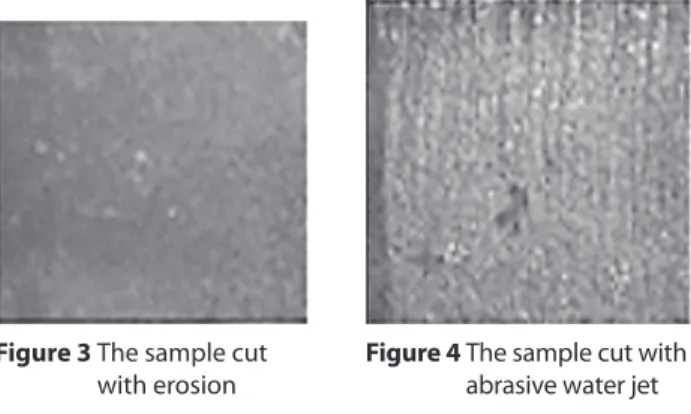
In the cutting of the material with the wire erosion, Sodick AQ 535 L 550 x 350 x 300 mm CNC Wire Ero-sion Cutting Table of Kalıpsan sheet-metal diesinking company is used. The state in which the sample is cut with the wire erosion is presented in Figure 3.
The Cutting with Abrasive Water Jet
The base of the cutting of water jet is that the beam of high speed water jet obtained by the passing of water, whose pressure is increased (4000 bar), from a narrow gap abrades particles from the material with the effect of strike and so, the material is processed [10].QMAX Abrasive Water Jet Table of Majet Company is used in the cutting of materials with abrasive water jet. In this study, GMA Gamete is used among GMA Gamete, Bar-ton, Gamete and Power Gamete which are commonly used in the systems of abrasive water jet. The state in which the sample is cut with abrasive water jet is pre-sented in Figure 4.
The hardness of surface cut is measured with the value of “HV0.5” in the “SHUMAZU” hardness mea-suring machine. The photographs of surfaces which are cut are taken by magnifying 200 times of their micro surfaces with the help of the microscope of “OLYM-PUS BX-60 MODEL” and “Intel core 2 Duo PC.
Since the changed hardness value of the sample which is cut with different cutting methods and the structural deterioration and changes which are originated from the cutting method in their internal structure and their sur-faces are intended to examine, the edges which are adja-cent to the cutting surface of samples which are cut are cleaned with 240-360-400-600-800-1000-1200 swingers which are located at the rotating disk and contain SIC particles in the different extents. The reason of the imple-mentation of the operations of cleaning and polishing on the adjacent surface to the cutting surface is to examine the hardness change belonging to the cutting surface from the edge to the core. The operation is carried out until the base and the surface on which the examinations would be made paralled to each other. These operations are repeat-ed until the intendrepeat-ed surface would be obtainrepeat-ed for the metallographic examinations. Each material which is polished is subjected to etching with 3 % nital in 6 sec-onds with the aim of showing the surface structures. Af-ter the etching, the surface to be subjected to thinning is cleaned by washing pure water and alcohol. The photo-graphs of etching materials are taken by magnifying 200 times by examining with optic microscope.
For observing the changes in the micro structure of the material, the structure which doesn’t affect from the cutting method and form in the edge of cutting and the micro structure in one point is comparatively examined.
For fi nding differences in the end of examination, many photographs are taken with magnifi cation of 200 times from three different parts of material surface and the changes of deformation and hardness which the cut-ting method creates in the material structure is deter-mined in the examinations of all photographs.
The hardness measurements of materials, whose mi-cro structures are examined, are made with Vickers hardness measurement device and the results obtained are transferred into graphics. In the same sample, the hardness with two each mm intervals from the edge to the core are measured and the changes of hardness from the edge to the core are determined. Depending on these changes, the effects of different methods are evaluated.
Figure 1 Nontreated sample
Figure 2 The sample cut with laser
Figure 3 The sample cut with erosion
Figure 4 The sample cut with abrasive water jet
FINDINGS
The Evaluation of Changes Occurring in the
Internal Structure of Sample
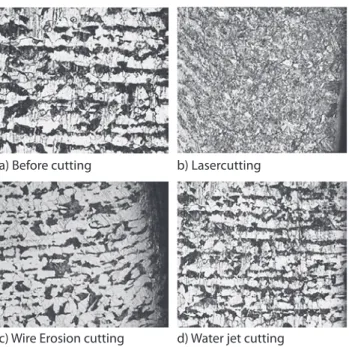
What changes would be created by the changes of temperature on the external structure of the part during the different cutting operation on the prepared sample is examined and the fi ndings obtained are compared with the micro measurements. The adjacent surfaces of sur-faces obtained in the end of cutting are subjected to the examination of internal structure by polishing. After mi-cro fi lm and the hardness measurement, the hardness and the structural changes occurring depending on the cutting methods in the material are evaluated. The photographs of micro structure of cutting edges and surfaces of the sample which is cut with different cutting method are presented in Figure5(a), 5(b), 5(c), and 5(d).
Changes occurring in the end of these comparisons are shown in Table 2. As seen in Table 2, there are no signifi cant changes in the cutting edge and the internal structure of material surface in only water jet among the cutting methods which are used.
The Hardness Changes of the Sample Which
Is Cut with the High Technology Cutting
Methods
For determining these changes occurring in the ma-terials which are cut, the original hardness value of the sample which is not primarily subjected to the cutting operation is determined. For making the determination and comparison of changes in the following the cutting operations, the hardness values of Vickers (HV) type in 2,4,6 intervals on the adjacent surfaces to the core from the cutting edges are measured.
Graphics which are formed for understanding how the sample, which is subjected to different cutting meth-ods, shows changes of the hardness values in the sur-faces, which are cut, towards the interval part of the material and comparing after and before the operation are presented to Figures 6, 7 and 8.
c) Wire Erosion cutting d) Water jet cutting
Figure 5 The photographs ofcutting magnify 200 times micro structure of cutting edges and surfaces of sample which is cut with diff erent cutting methods a) Before cutting b) Lasercutting
Table 2 The evaluation of eff ects of material which is cut with diff erent cutting methods on the
metallurgical structure in the cutting edge
Cutting Method St 50
UntreatedSample
Intermediatelevelhardness of theinter-nalstructure of thematerial. High impact-strength.
LaserCutting Thecuttingedge of structuraldeteriorationoc-curredduetooverheating. Carbonwerelost. WireEresionCutting Structuraldistortionscausedbyheat has been
on thecuttingedge. Increasedhardness. Abrasive Water Jet No structuralchanges in thecuttingzone. No
change in hardness. 160 181 166 161 130 140 150 160 170 180 190 HV 0,5 Untreated Sample Laser Cutting Wire Eresion Cutting Water Jet Cutting Hardness V alue / HV 159 178 160 158 130 140 150 160 170 180 190 HV 0,5 Untreated Sample Laser Cutting Wire Eresion Cutting Hardness V alue / HV 157 173 158 155 130 140 150 160 170 180 190 HV 0,5 Untreated Sample Laser Cutting Wire Eresion Cutting Water Jet Cutting Hardness V alue / HV
Figure 6 The Hardness Value in 2 mm interval from the cutting edge
Figure 7 The Hardness Value in 4 mm interval from the cutting edge
Figure 8 The Hardness Value in 6 mm interval from the cutting edge
92 METALURGIJA 53 (2014) 1, 89-92 L. DAHIL et al.: THE IMPLEMENTATION OF THE HIGH TECHNOLOGY METHODS OF CUTTING ON St 50 ALLOYED...
When these graphics are examined, it is shown that the hardness values change depending on the internal structure of material in the different cutting methods. This change is shown at most in the laser cutting method and it is shown at least in the water jet cutting method.
It is shown that regarding different hardness values in the material, the operation is completed by having the advantage in the top level without leading to the internal deformation in the materials. The wire erosion and the laser cutting among other cutting methods follow to the water jet in terms of advantage.
The results of these measurements are presented to Table 4. When this table is examined, it is shown that when the original material structure and hardness are compared in terms of the metallurgical features and the changes in the hardness, the best result is obtained from abrasive water jet and the cutting method.
The hardness of surfaces which are cut with abrasive water is approximately viewed in very close values to the original material hardness.
Table 4 % hardness values in the surfaces which are cut with diff erent methods depending on the original hardness values of materials which are cut CuttingMethod Hardness / HV Change / %
Core 160
-Waterjet 159 0,64
WireEresion 166 3,75
Laser 181 13,13
CONCLUSION
In the study which is carried out with the aim of this study, the results in the following are found.
• In the surfaces which are cut with the cutting meth-od of abrasive water jet, as any thermal operation doesn’t occur in the region where the jet ray con-tacts with, any changes of the internal and the dif-ferences of hardness doesn’t occur in the materi-als.
• Depending on the micro structure of the material which is cut, when the region affecting to tempera-ture and the extents of this region are regarded, the high temperature and the shock cooling are
impor-tant for the structural changes which occur in some methods. Depending on the features of cutting methods, the structure of coarse grained in some methods and the structure of fi ne grained in some methods depending on shock cooling draw atten-tion. In the methods except for the cutting with AWJ, the formation of high temperature and the shock cooling lead to the deformation to the micro structure in the region which is cut.
REFERENCES
[1] Y. S. Liao, J. T. Huang, H .C. Su, A study on themachining parameter optimization of wire electrical discharge machi-ning. Journal of Materials Processing Technology, 71 (1997), 487-493.
[2] K. Y. Chou, C. J. Evans, White Layersand Thermal Mode-ling of Hard Turned Surfaces. International Journal of Ma-chine Tools and Manufacture, 39 (1999), 1863-1881. [3] C. Ojmertz, A study on abrasive water milling. Department
of Production Engineering, Thessis Degree of Doctor Phi-losopy, Sweden, 1997.
[4] A. Akkurt, Comparision of cut surface properties obtained from aısı 1030 steel by abresive water jet and by other me-thodologies. Pamukkale University Journal of Engineering Sciences, 15 (2009), 142-152.
[5] N. S. Guo, H. Louis, H, G. Meier, Recycling capability of abrasive water jet cutting. In: Lichtarowicz Jet Cutting Technology, (1992), 503-523.
[6] A. Akkurt, Effect of cutting speed on surface roughness in AWJ cutting Applications of comercial püre aluminiumand Al-6061 Aluminiumalloy. Journal of Polytechnic, 8 (2005), 69-79.
[7] C. Ojmertz, Abrasive water jet machining chalmers teknıska hogskola. Chalmers Unıversıtyof, Goteborg Swe-den (1994), 91-96.
[8] H. Y. Zheng, Z. Z. Han, Z. D. Chen, W. L. Chen, S. Yeo, Quality and cost comparisons between laser and water jet cutting. Journal of Material Processing Technology, 62 (1996), 294-298.
[9] M. Ay, D. Aydoğdu, Experimental investigation of the ef-fects of particle size measurement of Wire EDM cutting parameters. Electronic Journal of Machine Technologies, (2010), 31-44.
[10] N. Geren, T. Tunç, Containing Water-Jet Cutting Systems Structural Differences Determiningthe most appropriate one. Journal of Engineers and Machine, 42(2001), 42-49. Note: Theresponsibletranslatorfor English language: Gülsen Bozdemir,