See discussions, stats, and author profiles for this publication at: https://www.researchgate.net/publication/279988638
An Appeal to the Global Health Community for a Tripartite Innovation: An
“Essential Diagnostics List,” “Health in All Policies,” and “See-Through 21 st
Century Science and Ethics”
Article in Omics: a journal of integrative biology · July 2015 DOI: 10.1089/omi.2015.0075 · Source: PubMed
CITATIONS
5
READS
382 38 authors, including:
Some of the authors of this publication are also working on these related projects: Malignant Pleurl Effusion TreatmentView project
Biosynthesis of Magnetic Core shell nanoclusters and their potential medical applicationsView project Edward S. Dove
The University of Edinburgh 109PUBLICATIONS 1,126CITATIONS SEE PROFILE i.ömer Barlas Mersin University 16PUBLICATIONS 132CITATIONS SEE PROFILE William Byne Columbia University 125PUBLICATIONS 4,459CITATIONS SEE PROFILE Florence Chaverneff NYU Langone Medical Center 6PUBLICATIONS 130CITATIONS
SEE PROFILE
All content following this page was uploaded by Lotte M G Steuten on 15 July 2015. The user has requested enhancement of the downloaded file.
An Appeal to the Global Health Community for a Tripartite
Innovation: An ‘‘Essential Diagnostics List,’’ ‘‘Health in All
Policies,’’ and ‘‘See-Through 21
st
Century Science and Ethics’’
Edward S. Dove,1_I. O¨mer Barlas,2 Kean Birch,3Catharina Boehme,4 Alexander Borda-Rodriguez,5,6
William M. Byne,7Florence Chaverneff,8Yavuz Cosxkun,9Marja-Liisa Dahl,10 Tu¨rkay Dereli,11
Shyam Diwakar,12Levent Elbeyli,13 Laszlo Endrenyi,14 Belgin Erog˘lu-Kesim,15Lynnette R. Ferguson,16
Kıvanc¸ Gu¨ngo¨r,17 Ulvi Gu¨rsoy,18 Nezih Hekim,19Farah Huzair,20 Kabeer Kaushik,21Ilona Kickbusch,22
Olcay Kırog˘lu,23 Eugene Kolker,24–27 Eija Ko¨no¨nen,18 Biaoyang Lin,28,29Adrian Llerena,30Faruk Malhan,31
Bipin Nair,12George P. Patrinos,32Semra Sxardasx,33O¨ zlem Sert,34Sanjeeva Srivastava,35Lotte M.G. Steuten,36,37
Cengiz Toraman,38 Effy Vayena,39 Wei Wang,40,41Louise Warnich,42and Vural O¨ zdemir9,11,12,26,38*
*All authors are listed alphabetically except the first and the corresponding authors. They endorse, in the capacity of independent scholars, the presented tripartite innovation policy appeal to global society.
1
J. Kenyon Mason Institute for Medicine, Life Sciences and the Law, University of Edinburgh School of Law, Edinburgh, United Kingdom.
2Faculty of Medicine, Department of Medical Biology and Genetics, Mersin University, Mersin, Turkey. 3
Department of Social Science, Faculty of Liberal Arts and Professional Studies, York University, Toronto, Ontario, Canada.
4
Foundation for Innovative New Diagnostics (FIND), Campus Biotech, Chemin des Mines, Geneva, Switzerland.
5
Secretarı´a Nacional de Educacio´n Superior, Ciencia, Tecnologı´a e Innovacio´n, Quito, Ecuador.
6
Development Policy and Practice Group, The Open University, Milton Keynes, United Kingdom.
7
Departments of Psychiatry, The Icahn School of Medicine at Mount Sinai, New York, NY and The James J. Peters VA Medical Center, Bronx, New York.
8
Department of Neuroscience and Physiology, NYU Langone Medical Center, New York, New York.
9Office of the President, Gaziantep University, Gaziantep, Turkey. 10
Division of Clinical Pharmacology, Karolinska Institute, Stockholm, Sweden.
11
Department of Industrial Engineering, Faculty of Engineering, Gaziantep University, Gaziantep, Turkey.
12
Amrita School of Biotechnology, Amrita Vishwa Vidyapeetham (Amrita University), Amritapuri, Clappana P.O., Kollam, Kerala, India.
13
Faculty of Medicine, Gaziantep University, Gaziantep, Turkey.
14
Department of Pharmacology, Faculty of Medicine, University of Toronto, Ontario, Canada.
15
Sxisxli Etfal Research and Education Hospital, Istanbul, Turkey.
16
Discipline of Nutrition, The University of Auckland, Auckland, New Zealand.
17
Faculty of Health Sciences, Gaziantep University, Gaziantep, Turkey.
18Department of Periodontology, Institute of Dentistry, University of Turku, Turku, Finland. 19
School of Medicine, Beykent University, Istanbul, Turkey.
20Science, Technology and Innovation Studies, School of Social and Political Science, University of Edinburgh, Edinburgh, United
Kingdom.
21
Vainteya Films Pvt Ltd, New Delhi, Delhi, India.
22
Global Health Program, Graduate Institute of International and Development Studies, Geneva, Switzerland.
23
Department of Pharmacology, Faculty of Medicine, Cxukurova University, Adana, Turkey.
24
Bioinformatics and High-Throughput Analysis Laboratory, Seattle Children’s Research Institute and CDO Analytics, Seattle Chil-dren’s, Seattle, Washington.
25
Departments of Biomedical Informatics and Medical Education and Pediatrics, and University of Washington, Seattle, Washington.
26
Data-Enabled Life Sciences Alliance (DELSA Global), Seattle, Washington.
27Department of Chemistry and Chemical Biology, College of Science, Northeastern University, Boston, Massachusetts. 28
Department of Urology, University of Washington, Seattle, Washington.
29Collaborative Innovation Center for Diagnosis and Treatment of Infectious Diseases, Zhejiang University, Hangzhou, China. 30
Extremadura University Hospital and Medical School, Badajoz, Extremadura, Spain
31
Istanbul Design Foundation, Istanbul, Turkey.
32
Department of Pharmacy, University of Patras School of Health Sciences, Patras, Greece.
33
Faculty of Pharmacy, Marmara University, Istanbul, Turkey.
34
Urban Studies Center and the Department of History, Hacettepe University, Beytepe, Ankara, Turkey.
35
Proteomics Laboratory, Department of Biosciences and Bioengineering, Indian Institute of Technology Bombay, Powai, Mumbai, India.
36PANAXEA bv, Enschede, The Netherlands. 37
School of Pharmacy, University of Washington, Seattle, Washington.
38Faculty of Communications and Department of Management Sciences, Gaziantep University, Gaziantep, Turkey. 39
Institute of Biomedical Ethics, University of Zurich, Zurich, Switzerland.
40
School of Medical Sciences, Edith Cowan University, Perth, Australia.
41
Beijing Municipal Key Laboratory of Clinical Epidemiology, School of Public Health, Capital Medical University, Beijing, China.
42
Faculty of Science, Stellenbosch University, Stellenbosch, South Africa.
ª Mary Ann Liebert, Inc. DOI: 10.1089/omi.2015.0075
Abstract
Diagnostics spanning a wide range of new biotechnologies, including proteomics, metabolomics, and
nano-technology, are emerging as companion tests to innovative medicines. In this Opinion, we present the rationale
for promulgating an ‘‘Essential Diagnostics List.’’ Additionally, we explain the ways in which adopting a vision
for ‘‘Health in All Policies’’ could link essential diagnostics with robust and timely societal outcomes such as
sustainable development, human rights, gender parity, and alleviation of poverty. We do so in three ways. First,
we propose the need for a new, ‘‘see through’’ taxonomy for knowledge-based innovation as we transition from
the material industries (e.g., textiles, plastic, cement, glass) dominant in the 20
thcentury to the anticipated
knowledge industry of the 21st century. If knowledge is the currency of the present century, then it is sensible to
adopt an approach that thoroughly examines scientific knowledge, starting with the production aims, methods,
quality, distribution, access, and the ends it purports to serve. Second, we explain that this knowledge trajectory
focus on innovation is crucial and applicable across all sectors, including public, private, or public–private
partnerships, as it underscores the fact that scientific knowledge is a co-product of technology, human values,
and social systems. By making the value systems embedded in scientific design and knowledge co-production
transparent, we all stand to benefit from sustainable and transparent science. Third, we appeal to the global
health community to consider the necessary qualities of good governance for 21st century organizations that
will embark on developing essential diagnostics. These have importance not only for science and
knowledge-based innovation, but also for the ways in which we can build open, healthy, and peaceful civil societies today
and for future generations.
‘‘[R]evolutionary situations arise also in science when the legitimacy of the previously accepted order and ways of ‘doing things’ are questioned and eventually overthrown.’’
Helga Nowotny(2007)
The Concept of Essential Medicines
T
he global health community recognizes thevalue and importance of ensuring populations have
adequate and reliable access to certain medicines. Health authorities in countries need to know what to prioritize to ensure they have a basic health care system that can ade-quately serve the needs of the population. In this regard, the history of essential medicines is relatively recent. Consider that aspirin was only introduced in 1897 as the first synthetic pharmaceutical, and is arguably the first truly essential medicine that aimed to satisfy the health care needs of the majority of the population. Although the history is recent, already the concept of essential medicines is well recognized. In 1977, the World Health Organization (WHO) launched the forward-looking and dynamic ‘‘Model List of Essential Medicines’’, and identified 208 individual medicines which together could provide safe, effective treatment for the ma-jority of communicable and non-communicable diseases. The List is updated every 2 years by an international expert committee.
Essential medicines are ‘‘those that satisfy the priority health care needs of the population,’’ selected based on disease burden, efficacy, safety, and cost-effectiveness evidence (World Health Organization, 2013). The medicines listed are ‘‘intended to be available within the context of functioning health systems at all times in adequate amounts, in the appropriate dosage forms, with assured quality, and at a price the individual and the community can afford’’ (World Health Organization, 2013). The List is not intended as a global standard. Each country, or states within countries, may adopt the list of essential medicines based on local context and priorities.
Pharmaceuticals represent up to 66% of health-related expenditures in developing countries (World Health Orga-nization, 2013). Since many international and
nongovern-mental organizations (NGOs) consider it as a guidepost, the List also assists in procurement, reimbursement, access, quality, and rational use of medicines. Essential medicines are often associated with principles of equity, pro-poor
pol-icies, and good governance. The latest 19thWHO Model List
of Essential Medicines was published in May 2015 (World Health Organization, 2015). As important as an essential medicines list is for all countries, science and medicine have moved into new areas, accelerated in no small measure by
Big Data (Sxardasx et al. 2014). This shift in science and
medicine, and health care delivery, calls for innovative thinking to develop new governance tools that address the pressing health care needs of populations.
What about Essential Diagnostics?
Social studies of science scholar Helga Nowotny has noted that radically new ways of ‘‘doing things’’ emerge in the course of scientific practices (Nowotny, 2007). A crosscutting change, precision medicine develops and makes use of diagnostic tests that, through stratification, explain the basis of large person-to-person (or subgroup) variations in drug safety and efficacy. Beyond targeting medicines to the right person at the right dose, precision medicine also signals a shift from treatment to preven-tion in healthcare, ranging from identificapreven-tion of those at highest risk of developing a disease, adverse drug reactions (ADRs), treatment failures, to those who would benefit most from preventive interventions.
The benefit of precision medicine to countries can be profound, not just in terms of promoting healthy aging, but also in realization of socioeconomic benefits. Using a health simulation model, a recent analysis published in The Lancet suggests that the years of healthy life that can be cultivated by a precision medicine approach in six diseases (cancer,
diabetes, heart disease, high blood pressure, lung disease, and stroke) in the US population could generate, in the case of heart diseases, an impressive $607 billion in improved health over the next 50 years (Dzau et al., 2015).
Diagnostics spanning a wide range of biotechnologies, including genomics, proteomics, metabolomics, and nano-technology, are emerging as companion tests to innova-tive medicines (Conde and Artzi, 2015; Higdon et al., 2015).
The 19th WHO Model List of Essential Medicines brings
to the fore innovative medicines for hepatitis C, breast can-cer, leukemia, and multi-drug resistant tuberculosis (World Health Organization, 2015). Innovative medicines desig-nated as ‘‘essential’’ can have enormous positive impacts on global health. Furthermore, innovative medicines might have even broader reception in future Essential Medicines Lists if we consider therapeutics with companion ‘‘essential diagnostics’’ aimed at prevention of ADRs and ineffective treatments.
Too often, however, diagnostics are overlooked as a crit-ical component of modern health care (ElRakaiby et al.,
2014; O¨ zdemir and Cho, 2012). From a discovery science
standpoint, not all innovative medicines may attain the status of an ‘‘essential medicine.’’ But they are more likely to emerge out of the laboratory and ‘‘into the street’’ if we move away from the traditional one-size-fits-all model of drug development by recognizing the multi-omics basis of person-to-person heterogeneity in drug safety and efficacy by
diag-nostic tests (Higdon et al. 2015; O¨ zdemir and Lerer, 2005).
When an innovative medicine attached to a companion di-agnostic is granted an essential medicine status, there is a need for parallel policy and regulatory mechanisms to govern and evaluate the diagnostic counterpart of such innovative essential medicines.
Thus, we propose and call for the development of an Es-sential Diagnostics List, which is comprised of the necessary
diagnostics for robust and crosscutting impacts on global health, as well as societal endpoints such as sustainable de-velopment, gender parity, global health diplomacy/security, and inclusive and peaceful societies, among others. These essential diagnostics should be made available in an evidence-based, cost effective, and ethical manner at all times in health systems, together with essential medicines. An Essential Diagnostics List in an era of precision (stratified) medi-cine offers a real opportunity to improve rational therapy and health outcomes in subpopulations defined by
diag-nostic tests (Fig. 1) (O¨ zdemir and Lerer, 2005; Tutton,
2012). Essential diagnostics and essential medicines are two sides of the same coin for rational therapeutics, and complement each other as concepts and practices (Fig. 2). An Essential Diagnostics List places global health firmly on the life sciences innovation agenda. At the same time, we neither neglect nor underestimate potential trepidation that might exist within the global health community towards de-veloping a list of essential diagnostics. Public health had a longstanding and laudable focus on addressing the needs of the entire population, but this view also risks treating com-munities as homogeneous organisms, overlooking the diverse needs of distinct subpopulations defined both by variations in biology and environment.
In the future, by using an essential diagnostic test, an in-novative essential medicine might target a subpopulation wherein it may display maximum efficacy and minimum toxicity. No doubt this will (and ought to) raise ethical con-cerns about what may come of other subpopulations with unmet therapeutic needs. But one should also consider that failure to prevent ADRs and ineffective treatments, while diagnostics are increasingly available to identify at risk populations, is an ethical concern in its own right.
In this era of Big Data analytics and precision medicine, we must face proactively the reality that many biomarker
FIG. 1. Precision medicine visualized as stratified medicine and enabling rational
claims and diagnostics candidates are in transition from lab to applications as precision medicine diagnostics worldwide
(Sxardasx et al., 2014). This has already created unmet policy
gaps on diagnostics in regards to what needs to be considered as ‘‘essential’’ for global health versus clinical practice ver-sus personal utility verver-sus recreational diagnostic tests with dubious value. Moreover, the impacts of new diagnostics on global health and societal endpoints regrettably are not often considered as a major criterion for adoption. We think such a criterion would be essential beyond clinical and personal utility for a diagnostic to be deemed ‘‘essential’’ (Fig. 2). An Essential Diagnostics List would help preserve scientific rigor and standards in resource-limited settings laden with economic, social, geographical and political instability or
pseudo-scientific actors (Dandara et al., 2014; O¨ zdemir,
2014; O¨ zdemir et al., 2013; 2015a).
Having an Essential Diagnostics List in place could also serve as a guidepost to prevent ‘‘parachute science’’ in re-source-limited regions that exploit local communities, their populations, and biodiversity, as de Vries and Pepper note:
The trend has been to use data derived from African popu-lations to build research programmes and enhance individual careers in more affluent communities with little or no con-sideration for the populations from which this material was derived. (de Vries and Pepper, 2012).
At the same time, we must not leap into assumptions about where precision medicine is most achievable or suitable. In
the 21stcentury, old binaries such as developed and
devel-oping country are increasingly blurred (Dove, 2013; Haffeld
and Siem, 2013; O¨ zdemir, 2015a). Peter Hotez has aptly
noted that resource-constrained regions exist not only in developing world but also in major geographical parts of the
G20 nations and the developed countries (Hotez, 2013). An Essential Diagnostics List would serve the global health community well as a new technology and innovation gov-ernance instrument.
Linking Diagnostics to Broad Societal Impacts Health in All Policies (HiAP)
A key criterion for an essential diagnostic is veritable linkages with and impacts on broad societal outcomes beyond clinical utility (Fig. 2). A corollary of this is that the value of essential diagnostics cannot be deciphered solely through looking from inside the health ecosystem and related orga-nizational structures. We need to look at health from the outside as well. Understanding health innovations such as essential diagnostics across sectors demands shared gover-nance and knowledge of the ‘‘languages’’ and ‘‘ways of knowing’’ by other disciplines—in particular, anthropology, sociology, philosophy, and political science.
In the same way that molecular biology has made visible the pathways underlying diseases normally invisible to the naked eye—social science and humanities scholarship equips us with the knowledge of invisible societal and micro-level contexts and dynamics that shape, and are shaped by, sci-entific practices. In short, such interdisciplinary scholarship is instrumental to understanding the inner workings of human societies and the socio-material environments in which they are entrenched. For example, without a social sciences and humanities lens, we run the risk of turning a blind eye, willfully or unintentionally, to important justice issues such as human rights, ethics, and power dynamics in scientific practice, gender gaps, rural versus urban communities’
FIG. 2. Linking the selection of essential diagnostics to broad societal outcomes and
crosscutting governance instruments such as ‘‘Health in All Policies’’ (HiAP) and ‘‘See-Through Science and Ethics.’’
access to health in global society, and the structural and psychosocial constraints of laboratory and professional life.
If we are to link the selection of essential diagnostics not only to clinical utility but also to societal impacts, we need additional governance instruments grounded in social science and humanities, as well as (natural) science and technology. Health in All Policies (HiAP) is one such governance instrument that we suggest should be consid-ered in tandem with decisions concerning the proposed Essential Diagnostics Lists. HiAP values the systems approaches often discussed in OMICS: A Journal of In-tegrative Biology; it highlights the need to heed both ‘‘trees’’ and ‘‘forests’’ to address complex life sciences and related societal challenges and opportunities.
HiAP examines, analyzes, and engages with health and non-health sectors to understand the root causes of illness and good health. In the context of HiAP, Ilona Kickbusch has noted the value of bi-directional linkages between health and sectors that are traditionally considered as being outside the scope of health and life sciences. These can include sectors such as global health diplomacy, security, and development:
This is critical for twenty-first century health policy because good or bad health outcomes depend on the action of other sectors but also affect the outcomes of a wide range of other sectors. (Kickbusch, 2010).
Gender parity and maternal health diagnostics
Essential diagnostics, if evaluated under the overarching frame of HiAP, could offer firm linkages with societal and global health endpoints neglected previously, such as gender parity. The World Economic Forum, amongst others, has asserted that gender parity is an indispensible dimension of
21st century organizations and society (World Economic
Forum, 2015). Novel diagnostics impacting maternal health and by extension, gender parity, are important on principled ethics and human rights grounds as well (Tasioulas and Vayena, 2015).
A pharmacogenomics peace and conflict resolution clinic
Yet another novel example of potential broader societal impacts of essential diagnostics could be drawn from the field of pharmacogenomics. Cytochrome P450 2D6 (CYP2D6) is one of the most intensively studied drug metabolizing en-zymes, with extensive polymorphic pharmacogenomics var-iation across world populations. Aklillu and colleagues have shown that in Ethiopia, 29% of the study sample carried al-leles with duplicated or multiduplicated CYP2D6 genes, in-dicative of ultra-rapid metabolism, and which often leads to treatment failure (Aklillu et al., 1996). Owing in part to historical human migration patterns, there is a gradient (from high to low) of CYP2D6 ultra-rapid metabolizers from Ethiopia to the Middle East to Spain and Northern Europe
(O¨ zdemir et al., 2006). Because conflict and war are not
un-common in certain points on this historical migration route (e.g., consider the ongoing conflict in Syria and the Middle East), conflicted populations that share similar genetic make-up, and thus need shared solutions for diagnostic tests for rational therapy, might be able to reconcile their perceived differences or at least ‘‘agree to disagree’’ in a peaceful
manner when global health services are provided for shared health needs.
Moreover, a global health diplomacy and security initia-tive of CYP2D6 testing and other diagnostics could offer a health-based conflict resolution forum. This would resonate very well with the ethos of HiAP. While we do not have HiAP in place in most parts of the world, these examples might help commence a multi-sector discourse on the subject matter of essential diagnostics in regions and for global health appli-cations where HiAP is most needed.
Finally, as a complement to traditional academic pub-lishing with a generally modest global circulation, engaging with mass media, both traditional and social, and in multiple languages, might offer ways forward for broader engage-ments central to HiAP. We suggest a need for greater en-gagement between scientists, communication sciences and mass media in ways that are credible, trustworthy, held ac-countable to and driven by society (Zhao et al., 2014).
Who Shall Take on the Task? Designing New 21stCentury Organizations
Governing innovations by ‘‘see-through science and ethics’’
From the invention of steam power at the beginning of the Industrial Revolution, to the growth of material indus-tries (e.g., textiles, glass, cement, plastics) over the last 2 centuries, there has been a longstanding tradition to classify organizations as public, private, and public–private partner-ship, among others. As we transition to a new revolution based not on manufacturing so much as ‘‘mensafacturing’’ (intellectual outputs), centered on knowledge society and much-hoped for knowledge-based innovations such as global
health diagnostics (Dove, 2013; O¨ zdemir, 2014), we need a
new taxonomy of workplace and organizations. If knowledge is the currency of the current century, then we must think anew about organizational taxonomy informed by an ap-proach that examines knowledge from all points, from its production aims, means, quality, distribution, access, and to
the ends it serves (Birko et al., 2015; Dove and O¨ zdemir,
2013; European Commission, 2007; Yearley, 2004). Hence, this Opinion does not aim to appeal to any one particular organization, public, private, nongovernmental, nor any conceivable international agency, to take on the task of developing and promoting an Essential Diagnostics List. Instead, it aims to appeal to the readers of this journal and global health community at large, to consider thinking about
the necessary qualities of new 21st century organizations
before a discussion is launched to determine which actors should take on this challenging task.
No doubt, we need innovation in institutional design as well. Twenty-first century universities are sorely in need of evolution towards an expanded and productive dialogue be-tween science and society (Callon et al. 2011; Nowotny, 2007). It is uncertain whether the current university designs and research funding mechanisms as we know them can adequately meet the challenges and prospects of emerging
technologies and novel diagnostics (O¨ zdemir et al., 2015b).
Rather than convergent thinking, this is a time for divergent thinkers and perhaps unorthodox or ‘‘indie’’ and off-road organizations to come up with innovative institutional
A starting point is to re-think scientific organizations (be-yond research universities and the binaries of public versus private) and unpack the ways in which knowledge is co-pro-duced together with values introco-pro-duced by a range of actors, be they publics, scientists, citizen scientists, funders, academics, industry, governments, or policymakers. This ‘‘trajectory’’ fo-cus is crucial and applicable across all sectors because it un-derscores the fact that scientific knowledge is a co-product of technology, human values, and social systems. By making the value systems embedded in scientific knowledge production transparent, we all stand to benefit from sustainable and
transparent science (Birch and Tyfield, 2013; O¨ zdemir, 2015).
Thinking about the ways in which science is constructed is not an intellectual project that ended with the Enlight-enment. We continue to make the case, conceptually and empirically, that knowledge experts bring their socially constructed values to the laboratory and influence, and are influenced by, the social and political systems that charac-terize their fields. Although the long-held, widely accepted version of scientific history since the early luminaries of the Enlightenment has promoted the view that scientific prac-tice and knowledge are neutral, value free, and inherently objective, we know this is more myth than reality (Birko
et al., 2015; Callon et al., 2011; Dove and O¨ zdemir, 2013;
Editorial, 2013; Yearley, 2004). For example, while scien-tific evidence is considered an important gatekeeper for
adoption of diagnostics, it also begs the question of ‘‘which evidence’’ produced ‘‘by whom’’, to benefit ‘‘which stakeholders,’’ and under ‘‘what societal context, values and priorities’’ (Birko et al., 2015; Nowotny, 2007).
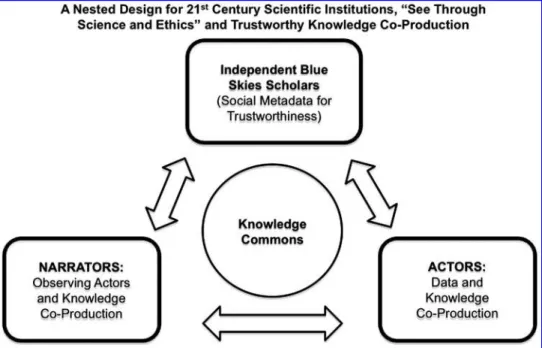
To enable a broad and open discussion of essential diag-nostics, therefore, we offer below a taxonomy, in part building on nested governance systems designed by the late Elinor Ostrom (Ostrom, 1990), and in part based on our past synthesis for omics systems sciences (Dove et al., 2012;
O¨ zdemir et al., 2015a). Here, knowledge experts are
classi-fied as actors (e.g., scientists producing knowledge), narra-tors (e.g., ethicists, social scientists and humanists observing and analyzing knowledge co-production practices), and in-dependent blue skies scholars (IBSS) who generate and an-alyze ‘‘social metadata’’ on the sorts of questions noted above that impact not only scientists, but also ethicists’ and social scientists’ daily practices (Dove et al., 2012; Dove and
O¨ zdemir, 2014; O¨zdemir et al., 2015a) (Fig. 3).
Such a taxonomy of the innovation trajectory makes ex-plicit that no knowledge expert is ‘‘above the fray’’: all shall remain accountable and make their practices transparent. The taxonomy invites us to be self-critical and reflexive (e.g., how do our own values, motivations, and expectations influence our actions and the conclusions we reach?). Through the tri-adic taxonomy described in Figure 3, knowledge experts can create a trustworthy and ‘‘see-through science and ethics’’
FIG. 3. A triadic taxonomy and design for ‘‘See-Through Science and Ethics’’ and new
21stcentury scientific institutions for knowledge-based innovations. These envisioned 21st
century organizational re-designs of work and society could contribute to the proposed post-2015 United Nations Sustainable Development Goals (SDGs) such as peaceful and inclusive societies. At the heart of the proposed taxonomy rests ‘‘nested architectures’’ that help foster environments of transparency and trustworthiness, and balanced power in society and its science and technology institutions. The proposed taxonomy is comprised of Actors who produce knowledge (e.g., scientists), Narrators (e.g., social scientists, humanists, ethicists) who observe the actors and their practices in real-time, and
Independent Blue Skies Scholars (IBSS) who are not entrenched in traditional
profes-sional network structures (e.g., independent scholars, scholars-in-residence, society-driven self-organized groups or citizen scientists), and thus can offer truly independent broad systems-oriented (blue skies) analyses of both actors’ and narrators’ practices. The term
IBSS was coined in an earlier article (O¨ zdemir et al., 2015a).
knowledge commons where power differences among the ecosystem’s actors and narrators are kept in check in real-time. This proposed model warrants field-testing and should be compared to existing science organizations in regards to impacts on sustainable science and responsible innovation.
Conclusions
With the arrival of Big Data and many biomarker claims— some valid and others less valid or even irrelevant—developing essential diagnostics will be critical if we are to link technology to responsible innovation in ways that concretely and positively impact global health. Developing an Essential Diagnostics List provides an opportunity to harness the latest science and di-agnostic technology to establish linkages with health policies that are crosscutting across sectors inside and outside health (e.g., the application of whole genome sequencing in pharma-cogenomics) (Mizzi et al., 2014), and with science and ethics that are fully transparent and held accountable to global society. This we hold to be essential, too, not only for global health and knowledge-based innovation, but also for the ways in which we can build open, healthy, and peaceful civil societies today and for future generations.
Acknowledgments
No funding was received in support of this analysis. The views expressed are the personal opinions of the authors only and do not necessarily reflect the views of their affiliated
institutions or funding agencies. VO¨ is supported in part by
TU¨ B_ITAK (The Scientific and Technological Research
Council of Turkey) 2232 Career Investigator Program.
Author Disclosure Statement
No conflicting financial interests exist.
References
Aklillu E, Persson I, Bertilsson L, Johansson I, Rodrigues F, and Ingelman-Sundberg M. (1996). Frequent distribution of ul-trarapid metabolizers of debrisoquine in an ethiopian popu-lation carrying duplicated and multiduplicated functional CYP2D6 alleles. J Pharmacol Exp Ther 278, 441–446. Birch K, and Tyfield D. (2013). Theorizing the bioeconomy:
Biovalue, biocapital, bioeconomics or.what? Science Technol Human Values 38, 299–327.
Birko S, Dove ES, and O¨ zdemir V. (2015). A Delphi technol-ogy foresight study: Mapping social construction of scientific evidence on metagenomics tests for water safety. PLoS One 10, e0129706.
Callon M, Lascoumes P, Barthe Y, and Burchell G. (2011). Acting in an Uncertain World: An Essay on Technical De-mocracy. Cambridge, Massachusetts: The MIT Press. Conde J, AND Artzi N. (2015) The next generation of smart
gold nanobeacons: Nanotheranostics is ready for prime time. Nanomedicine (Lond) 10, 1535–1538.
Dandara C, Huzair F, Borda-Rodriguez A, Chirikure S, Okpechi I, Warnich L, and Masimirembwa C. (2014). H3Africa and the African life sciences ecosystem: Building sustainable innovation. OMICS 18, 733–739.
de Vries J, and Pepper M. (2012). Genomic sovereignty and the African promise: Mining the African genome for the benefit of Africa. J Med Ethics 38, 474–478.
Dove ES. (2013). Questioning the governance of pharmacoge-nomics and precision medicine for global health. Curr Phar-macogenom Person Med 11, 253–256. Available from: http:// eurekaselect.com/118310. Accessed May 28, 2015.
Dove ES, and O¨ zdemir V. (2013). ‘Regular science’ is inher-ently political. EMBO Rep 14, 113.
Dove ES, and O¨ zdemir V. (2014). The epiknowledge of socially responsible innovation. EMBO Rep 15, 462–463.
Dove ES, Faraj SA, Kolker E, and O¨ zdemir V. (2012). Designing a post-genomics knowledge ecosystem to translate pharmaco-genomics into public health action. Genome Med 4, 91. Dzau VJ, Ginsburg GS, Van Nuys K, Agus D, and Goldman D.
(2015). Aligning incentives to fulfil the promise of persona-lised medicine. Lancet 385, 2118–2119.
[Editorial, No authors listed] (2013) What is the purpose of medical research? Lancet 381, 347.
ElRakaiby M, Dutilh BE, Rizkallah MR, Boleij A, Cole JN, and Aziz RK. (2014). Pharmacomicrobiomics: The impact of human microbiome variations on systems pharmacology and personalized therapeutics. OMICS 18, 402–414.
European Commission. (2007). EUR 22700—Science & Governance—Taking European Knowledge Society Ser-iously. Luxembourg: Office for Official Publications of the European Communities. Available at: http://ec.europa.eu/ research/science-society/document_library/pdf_06/european-knowledge-society_en.pdf. Accessed May 28, 2015. Haffeld J, and Siem H. (2013). The post-2015 agenda:
Com-plexity theory-based governance of the global health system in the era of postgenomics and personalized medicine. Curr Pharmacogenomics Person Med 11, 309–311.
Higdon R, Earl RK, Stanberry L, et al. (2015). The promise of multi-omics and clinical data integration to identify and target personalized healthcare approaches in autism spectrum dis-orders. OMICS 19, 197–208.
Hotez PJ. (2013). NTDs V.2.0: ‘‘blue marble health’’— Neglected tropical disease control and elimination in a shifting health policy landscape. PLoS Negl Trop Dis 7, e2570. Kickbusch I. (2010). Health in all policies. Where to from here?
Health Promot Intl 25, 261–264.
Mizzi C, Mitropoulou C, Mitropoulos K, et al. (2014). Perso-nalized pharmacogenomics profiling using whole genome sequencing. Pharmacogenomics 15, 1223–1234.
Nowotny H. (2007). Putting the ‘‘limits of science’’ into context. ‘‘Knowledge Production and its Constraints: epistemic and societal considerations’’, Gulbenkian Foundation, Lisbon, Oc-tober. Available from: http://www.helga-nowotny.eu/downloads/ helga_nowotny_b58.pdf. Accessed May 28, 2015.
Ostrom E. (1990). Governing the Commons: The Evolution of Institutions for Collective Action. Cambridge, United King-dom: Cambridge University Press.
O¨ zdemir V. (2014). Personalized medicine across disciplines and without borders. Per Med 18, 687–691. Available from: http://www.futuremedicine.com/doi/pdf/10.2217/pme.14.70. Accessed May 28, 2015.
O¨ zdemir V, and Lerer B. (2005). Pharmacogenomics and the promise of personalized medicine. In: Pharmacogenomics, Second Expanded Edition. Kalow W, Meyer UA, Tyndale RF (Editors), New York: Francis & Taylor, pp. 13–50.
O¨ zdemir V, and Cho WC. (2012). Theranostics: Rethink-ing postgenomic diagnostics. Expert Rev Mol Diagn 12, 783– 785.
O¨ zdemir V, Gunes A, Dahl ML, Scordo MG, Williams-Jones B, and Someya T. (2006). Could endogenous substrates of drug-metabolizing enzymes influence constitutive physiology
and drug target responsiveness? Pharmacogenomics 7, 1199– 1210.
O¨ zdemir V, Borda-Rodriguez A, Dove ES, et al. (2013). Public health pharmacogenomics and the design principles for global public goods—Moving genomics to responsible innovation. Curr Pharmacogenomics Person Med 11, 1–14.
O¨ zdemir V, Kılıc¸ H, Yıldırım A, et al. (2015a). A code of ethics for ethicists: What would Pierre Bourdieu say? ‘‘Do Not Misuse Social Capital in the Age of Consortia Ethics’’. Am J Bioethics 15, 64–67.
O¨ zdemir V, Faris J, and Srivastava S. (2015b). Crowdfunding 2.0: The next-generation philanthropy: A new approach for philanthropists and citizens to co-fund disruptive innovation in global health. EMBO Rep 16, 267–271.
O¨ zdemir V. (2015). New biology and United Nations Sustain-able Development Goals (SDGs) 2016–2030: Values steering the OMICS: A Journal of Integrative Biology editorial flight deck. OMICS 19, 368–370.
S
xardasx S, Endrenyi L, Gu¨rsoy UK, et al. (2014). A call for phar-macogenovigilance and rapid falsification in the age of big data: Why not first road test your biomarker? OMICS 18, 663–665. Tasioulas J, and Vayena E. (2015). Getting human rights right
in global health policy. Lancet 385, e42–44.
Tutton R. (2012). Personalizing medicine: Futures present and past. Soc Sci Med 75, 1721–1728.
World Health Organization. (2013). Essential medicines. Available from: http://www.who.int/medicines/services/essmedicines_def/ en/. Accessed May 28, 2015.
World Health Organization. (2015). WHO moves to improve access to lifesaving medicines for hepatitis C, drug-resistant TB and cancers. Available from: http://www.who.int/mediacentre/ news/releases/2015/new-essential-medicines-list/en/. Accessed May 28, 2015.
World Economic Forum. (2015). The Gender Parity Pro-gramme. Available from: http://www.weforum.org/women-leaders-and-gender-parity. Accessed on May 28, 2015. Yearley S. (2004). Making Sense of Science: Understanding the
Social Study of Science. London: Sage.
Zhao F, Chen Y, Ge S, et al. (2014). A quantitative analysis of the mass media coverage of genomics medicine in China: A call for science journalism in the developing world. OMICS 18, 222–230.
Address correspondence to:
Vural O¨ zdemir, MD, PhD, DABCP
Editor-in-Chief OMICS: A Journal of Integrative Biology Mary Ann Liebert, Inc. 140 Huguenot Street New Rochelle, New York 10801 E-mail: [email protected] Associate Professor Faculty of Communications, and Department of Industrial Engineering Advisor to President, International Technology and Innovation Policy Office of the President Gaziantep University
U¨ niversite Bulvarı, Sxehitkamil,
Gaziantep, 27310 Turkey E-mail: [email protected]; [email protected] Adjunct Professor Amrita School of Biotechnology Amrita Vishwa Vidyapeetham (Amrita University) Amritapuri, Clappana P.O. Kollam Kerala, 690 525 India E-mail: [email protected] 8 DOVE ET AL.
View publication stats View publication stats