! « wrçji s "Tí’ i
¿ 'tií¿ i w Ы» J wi* ■*' ►■ * · «' w·'**’ '««í'-.a.í-, U', ѣ H U T I Ş f ı ^ ; Íl^ 5 «fe í - ’íi'j' T ^^^5 '·* ' · Ί " ;-■. ^ ^ ’ ^1 \ύί/ «/•J ·*^ ·* *'*·^ '^'’ “'·' ■*■«■ *^ w ~·* “**· T^_. у.-·» .7>й ·κ л Г . W . WW w^ w.
Û C
1 7 - 6 - S■P6
/336
APPROXIMATION METHODS
IN THE POLARON THEORY:
APPLICATIONS TO
LOW DIMENSIONALLY CONFINED POLARONS
A THESIS
SUBMITTED TO THE DEPARTMENT OF PHYSICS AND THE INSTITUTE OF ENCINEEIUNG AND SCIENCE
OJ·' BILKENT UNIVERSITY
IN PARTIAL FULFILLM ENT OF THE REQUIREMENTS FOR THE DEGREE OF
MASTER OF SCIENCE
By
R,. Tuğrul Seliger July 1996
- Р6
S*46 І 3 5 в
I certify tliat 1 luive read this thesis and that in my opinion it is fully adequate, in scope and in quaJitj^, a.s a dissertcition for the degree of Master of Science.
Prof. Atilla Erçelebi (Supervisor)
1 certify that I have read this thesis and that in my opinion it is fully adequate, in scope and in quality, as a dissertation tor the degree of Master of Science.
Prof. Mehmet Tomak
1 certify that I have read this thesis and that in my opinion it is fully adequate, in scope and in quality, as a dissertation lor the degree of Master of Science.
Approved for the Institute of Engineering and Science:
Prof. Mehmet Bciray,
Abstract
A P P R O X IM A T IO N M E T H O D S IN T H E P O P A R O N T H E O R Y : A P P L IC A T IO N S T O L O W D IM E N S IO N A L L Y C O N F IN E D P O L A R O N S R. Tuğrul Seiiger M . S. in PhysicsSupervisor: Prof. Atilla Erçelebi July 1996
The pelaron problem has been of interest in condensed matter physics cind held theory tor cibout half a century. Within the framework of Vcist variety of theoreticcil approximations, the bulk polaron properties have been extensively (explored and fairly well understood in the literature. In the last two deccides, with the impressive progress achieved in the mici-ofabrication technology, it became possible to ol)t£iin low dimensional microstructures, in which the charge ca.rriers are confined in one or more spatial dii'ections. Consequently, there has appeared (|uite a large interest in phonon coupling-induced effects and polaronic properties of low dimensionally confined electrons.
In this context, this thesis work is devoted to the study of low dimensional optical polaron properties, with the application of several different formal approaches common in the literature, such as perturbation theory, variatioiicil principles and Feynman path integral formalism. The model we adopt in this
work consists of an electron, confined within an external potential (quantuni well), and interacting via the Fröhlich Harniltonian with the bulk LO-phonons of the relevant well material. Therefore, our primary concern is to give a clear view of only the bulk phonon effects on an electron in confined media, and we disregard all other complications that may come about from screening effects, phonon confinement, etc. Under these assumptions, we calculate the ground state energy, the effective mass, and some other quantities of polaron in several confinement geometries. We also provide a broad interpolating overview to the one polaxon problem in the overall range of electron-phonon coupling constant and in a general type of confinement, which can be conformed from one geometriccd configuration to another.
Another interesting theme of the polaron theory, magneto-polaron, is considered in the context of the confinement effect on the polaron, brought about by the rncignetic field. A detailed analysis is given in the case, where the effect of electron-phonon coupling is dominated over by the magnetic field counterpart of the problem.
Keywords:
Optical polaron, electron-phonon interaction. Fröhlich Hamil- tonicui, low dimensional structures, quantum wire, quantum dot, path integral, magneto-polaron.
özet
P O L A R O N K U R A M IN D A Y A K L A Ş IM Y Ö N T E M L E R İ: D Ü Ş Ü K B O Y U T L U P O L A R O N L A R A U Y G U L A M A L A R
R. Tuğrul Serıger Fizik Yüksek Liscins
Tez Yöneticisi: Prof. Atilla Erçelebi Temmuz 1996
Polaron problemi, yaklaşık yarım yüzyıldır, katı hal fiziği ve alanlar kurcimımn ilgi konusu olagelmiştir. Çeşitli kuramsal yaklaşımlar altında yapılan çalışmalarla, üç boyutlu polaronlarm özellikleri geniş ölçüde ciraştırılmış ve oldukça iyi anlaşılmıştır. Son yirmi yıl içinde, çok küçük yapıların üretim teknolojisinde sağlanan etkileyici gelişmeler sayesinde, yüktaşırlarm bir veya daha çok yönden smırla.ndırıldığı düşük boyutlu yapıların üretimi mümkün olmaktadır. Bundcuı dolayı, düşük boyutlara sıkıştırılmış elektronlarda polaronik özellikler ve l'ononlarla etkileşim kaynaklı problemler üzerine yoğun bir ilgi uyanmıştır.
Bu bağlamda, bu tez çalışmasının kapsamı içinde, tedirgeme kuramı, dciğişken ilkesi kuramı ve Feynman yol integralleri yöntemi gibi yaygın olarak kullanılan çeşitli yaklaşımlar çerçevesinde, düşük boyutlu optik polaronlarm özellikleri ele alındı. Çalışma, bir dış potansitel tarafmdan sınırlahdırılımş ve Fröhlich Hamiltonu yoluyla üç boyutlu boylamsal optik fononlarla etkileşen bir elektron modeli üzerine kuruldu. Başlıca amacımız, sınırlandırılmış ortamlcirda bulunan elektronlara üç boyutlu fononlarlarnı etkilerini sergilemek olduğundan, perdeleme etkileri veya İbnon sınırlandırılması gibi olası yan etkenler tamamen gözardı
edildi. Bu varsayım altında, temel durum enerjisi, efektif kütle ve diğer bazı polaron nicelikleri değişik geometrilerde hesaplandı. Ayrıca, bir geometrik yapıdan diğerine dönüştürülebilen esnek bir potansiyel kuyusu içinde ve tüm (dektron-fonon bağlaşım sabiti değerleri için geçerli olmak üzere tek polaron problemine geniş ve birleştirici bir bakış açısı sunuldu.
Polaron kurammm bir başka ilginç konusu ohın manyeto-polaron problemi, manyetik alanın polaron üzerindeki sınırlandırıcı etkisi yönünden ele alındı. Problemin, manyetik alan etkisinin elektron-fonon bağlaşım etkilerine göre daha baskın olduğu durumlar için kaiDsarnlı bir analizi yapıldı.
Anahtar sözcükler:
Optik polaron, elektron-fonon etkileşmesi, Fröhlich Hamiltonu, düşük boyutlu yapılar, kuvcuıtum kuyusu, kuvanturn teli, yol integralleri, manyeto-polaron.
Acknowledgement
I would like to express my deep gratitude to my supervisor Prof. Atilla Ergelebi not only for the guidcince cuid the support he provided through out my gi'ciducite study, but also for his enjoyable, friendly attitude to me, going lar beyond the academic relations.
I wish to thank cdl the members of the Department of Physics, for their morale and technical support, in every case that I needed some. I’m iilso indebted to those people who have encouraged me to make the right decision on being a physicist, rather than an engineer.
Finally, it is my duty and pleasure to thank my family, and the lovely Suheyla, without whom the life would be boring and less meaningful.
Contents
Abstract i Özet İÜ Acknowledgement v Contents vi List of Figuresix
List of Tablesxi
1 IN TR O D U C TIO N 1 1.1 Fröhlich Hcuniltonian... 4 1.2 Approxiiricition M e t h o d s ... 10 2 PERTURBATION THEORY 14 2.1 Application: Quasi 2-Diinensional P o l a r o n ... 153 STRONG COUPLING THEORY 21 3.1 Displaced Oscilhitor Transformation... 21
3.2 Application: Infinite Boundary Quantum Wire . . . · ... 23
3.2.1 Introdu ction... 24
3.2.2 T h e o r y ... 25
3.2.3 Results and C o n clu sio n s... 28
4 IN TER M ED IATE COUPLING THEORY 35
4.1 LLP T ra n sform a tion ... ;],5
4.2 Application: Quantum W i r e ... 38
4.2.1 in trod u ction ... 38
4.2.2 T h e o r y ... 40
4.2.3 Results and C o n clu sio n s... 44
5 PERTUR BATIVE VARIATIO NAL APPROACH 49 5.1 In trodu ction ... 49
5.2 Application: Quantum W i r e ... 50
5.2.1 Displaced Oscillator Transformation... 51
5.2.2 Vciriational State for Arbitrary C ou i:)lin g... 53
5.2.3 F orm ulation... 55
5.2.4 Results and C o n clu sio n s... 57
5.2.5 A p p e n d i x ... 67
6 PATH IN TE G R A L FORM ALISM 68 6.1 In trodu ction ... 68
6.1.1 Basic C o n c e p t s ... 68
6.1.2 Elimination of the Phonon F ie ld ... 70
6.1.3 A Variational P rin cip le... 70
6.2 Application: General Parabolic C onfinem ent... 73
6.2.1 Introduction... 73
6.2.2 T h e o r y ... 74
6.2.3 Results and C o n clu sio n s... 80
7 M A G N E T IC FIELD AS A M EANS OF C O N FIN EM EN T 89 7.1 In trodu ction... 89
7.2 Appliccition: 2D-M agneto-Polaron...· . ... 93
7.2.1 Formal P relim inaries... 93
7.2.2 T h e o r y ... 95
7.2.3 Remarks cuid Conclusions 100
7.2.4 Appendix 8 CONCLUSIONS Bibliography . 110 111 113 VllI
List of Figures
2.1 3.1 3.2 3.3 3.4 3.5 4.1 4.2 4.3 4.4 5.1 5.2 5.3 5.4 5.5 5.6 6.16.2
6.3 6.4 6.5Perturbation theory results for quasi-2-diinensional polaron . . . . 19
Sketch of displaced oscillator potential... 23
The variational pcirameters and spaticd extents as functions of radius 29 Radial part of electronic wave fu n c t i o n ... 30
Phonon-couiiling-induced potential well profiles... 32
Polaronic binding energy and effective mass ... 33
The extended domain of validity of strong coupling theory in highly confined systems... 39
Comparison of alternative aj^proaches. 45 The results at weak coupling... 47
The coupling constant dependence of the binding energy... 48
Comparison of two forms for the wave function... 58
The binding energy and the effective mass of pohiron at strong coupling... 60
Results for CdTe cind GaAs based quantum w i r e s ... 62
A global view of pohironic binding energy ... 64
A global view of polaron longitudinal spcitial e x t e n t ... 65
The longitudinal spciticd extent at weak coupling. 66 Illusti'cition of .Jensen’s ineqiuility... _... 72
The model of confined polaron... 77
Polaron properties in three- and two-dimensions... 82
A global view of polaronic binding energy... 84
Comparison of different confinement geometries... 86
6.6 The scaling of polaron properties, in shrb-like confinement... 87 7.1 Sketch for the states of the 2D polaron in a uniform magnetic field. 90 7.2 Polaron induced shift in the ground state energy at high magnetic
field limit, for cv = 0.01... 104 7.3 versus cUc in the low field regime... 106 7.4 The phonon-induced shift in the lowest Landau level energy as
function oi toc... 107 7.5 The phonon-induced shift in the lowest Landau level energy as a
function of cv... 109
List of Tables
1.1 Coui^ling constants and LO-phonon frequencies of some common m aterials... 10 1.2 Results of perturbation and strong coupling theories for the
polaron properties... 12
1.3 Scaling factors for polaron properties from 3D to 2D ... 13 2.1 Comparison of polaron binding energies in different confinement
geom etries... 20
7.1 The ground state energy versus the cyclotron frequency for at weak coupling (a = 0.01)... 103
Chapter 1
IN T R O D U C T IO N
The problem of polaron is an old and interesting subject. It has been a long time (more than half a century) since the first appearance of it in the literature of, then newly developing branch, solid state physics, in the early 1930’s, but there still occurs a considerable amount of work devoted to the study of polarons. Mainly there are two reasons of the interest on the subject; firstly, it is relevant to the cipplied physics of semiconductors, which has a wide area of technological applications, secondly, it represents a simple but nontrivial example of a particle coupled to a quantum field, presenting a challenging Ibrmal mathematical structure. Besides, with the theoretical prediction and subsequent fabrication of semiconductor based quantum - well confined systems, the subject is enriched with the polarons of lower dimensionality, in the hist two decades.
The concejDt of polaron is based on the motion of an electron in an ionic or polar semiconductor crystal. The long range Coulomb interaction of the electron with the ions of the crystal produces a polarization field around it due to the displacements of ions from their equilibrium positions. Alternatively stating, the electron couples to the phonon modes of the crystal, resulting in a cloud of phonons surrounding and accompanying it, as it moves. The system of electron plus the concomitant phonon cloud (or the lattice deformation) is called the polaron. The interaction with phonons modifies the electron properties, lowering the self energy and increasing the inertia of it by an amount depending on the
Chapter 1. INTRODUCTION
strength of the coupling.
The first conceptual approach to polaron problem was by Landau^ in 19.33. He introduced the idea ol a self-tapped electron in the polarization potential produced by the Coulomb interaction of the electron with the ions of the ionic crystal. In 1937, introducing the concept of polarization held, Fröhlich^ gave a quantitative treatment of electron scattering in ionic crystals. After some early semiclassical works^“^ on the subject, in which the lattice properties were incorporated into a classical macroscopic pohirization, the formulation of the problem in the framework of qucintum field theory was first given by fröhlich, Pelzer and ZienaiC in 19.50, by proposing a microscopic model Hamiltonian, which now bears the name of Fröhlich.
Until now, the Fröhlich Hamiltonian remained the basic concept of enormous number of publications on the theory of pohirons. Having no exact solution it hcis been a testing ground for several approximation methods in quantum field theory and ciuantum statistics. An elaborate summary of the theoretical and experimental developments achieved in the history of polarons can be found in the books edited by Kuper & WhitfielcH and Devreese.® An excellent overview of the approximation methods in the polaron theory is also given in a recent paper by Bogolubov and Plechko.^ Finally, we should mention about a distinguished review article of Gerlach and L ö w e n , in which they have considered and formcilly settled the famous controversy of j^olaron theory; whether the polaronic phase transitions exist or not, by concluding that the qualitative changes in the polaron quantities take phice in a smooth cind continuous way, and that any non-analytical behavior encountered is an artifact of the approximating theory rather than the intrinsic property of the Fröhlich Hamiltonian.
The bulk polaron properties have been extensively explored and fairly well understood in the literature, with the development of a variety of theoretical approaches. Recently, the progress in the fabrication techniques, such as molecular beam epitaxy and lithographic methods, made it possible to obtain low dimensional microstructures, where the charge carriers are confined in one or more spatial directions. Consequently, there occurred a renewed interest
Clmpter 1. INTRODUCTION
in the study of polarons of reduced dimensionality in the context of quantum well structures. Particular emphasis has been given to quasi- and strict- two dimensional s y s t e m s . T h e quasi-one (quantum wire),**’“ '*^ and zero dimensional (quantuiTi bo.x)^^“^^ systems are also extensively studied. Presenting a, unified picture for polarons in confined media, covering all these special geometries cind smoothly interpolating cunong them, is one of the motivations of the present work (cf. Clmpter 6).
In low dimensional systems, besides the confinement of electron, it is also possible to consider the confinement of phonons with the notion of confined phonon m o d e s , a n d / o r the surface and interface phonon rnodes^'^’'^’^ that occur at the boundaries. An alternative or complementciry cipproach in this sense is the so called bulk phonon approximation, where the spa.tially confined electron is visucdized cis interacting via the Fröhlich Hamiltonian solely with the bulk LO- phonons of the relevcint well materiell. Throughout this thesis, we will apply the bulk phonon approximation for the one polaron problem within the framework of the well known theoretical methodologies common in the literature. We will give most emphcisis to the generic low dimensional ¿ispect of the dynamical behavior of the electron confined in an external potential, and leave out all the other effects; thus our concern will primarily be to give a view of the bulk phonon effects stripped from all other perturbing ejuantities. Apcirt from omitting the contributions that may come from all other kinds of phonon modes, we will also ignore any screening effects and further complications such as those due to the nonparcibolicity corrections to the electron band or the loss of validity of both the effective-mass approximation and the Fröhlich continuum Hamiltonian in very sI nall microstructures.
'rhe rest of this thesis is organized as follows. In the next sections of this chapter, the Fröhlich Hamiltonian will be derived stcirting from the basic principles, and a brief summary of the approximation methods will be presented. 'File Chapters 2 through 6, are devoted to the different theoretical approaches, each chcipter starting with a short presentation of the essential points of the methodology, is accompanied with an original (except for Chapter 2) application
of it to a low dimensional configuration. In the seventh chapter we will consider the problem of polaron in a magnetic field, where the extenicil field acts as a means of confinement. Firicdly a short summary together with relevant discussions and conclusions will form the last chapter.
1.1
Prohlich Hamiltonian
Chapter 1. INTRODUCTION 4
In this section, we shall drive the Hamiltonian describing the system coini: of a single electron, confined in an external potential, and interacting with the LO-branch of bulk phonon modes of the crystal. Although the label Fröhlich Ilamiltonian is used for all class of more complicated systems involving electron- phonon interactions, with such considerations as polaron gas, confined phonon modes, etc., we shall restrict ourselves within the scope of the present work. For a more detailed derivation one may consult to the original paper by Fröhlich et al.,^ and some relevant books.
To represent the motion of the electron and of the lattice vibrations in the simplest possible form, we shall consider that, the electron lies close to the lower edge of the band, where the related Bloch functions have small A>vector values, so that the corresponding wavelengths cire large compcired with the lattice constant. Then, it is appropriate, to ignore the detailed lattice structure and to treat the lattice as a dielectric continuum, and also, to apply the effective mass approximation for the electron. As a further approximation we shall take the LO-phonon modes to be dispersionless; ioiQ) = uJho·
in view of these simplifying considerations, the total polaron Hamiltonian can be stated as composed of three parts,
/ / = / / e -b //p h + / /e - p h , ( 1 . 1 )
where the subscripts ‘ e’ , ‘ ph’ and ‘ e-p/d stand lor ‘electron’ , ‘phonon’ , ‘electron- phonon interaction’ respectively.
The first term in the above, is simply IL = P
Chapter 1. INTRODUCTION
where cind p are electron position and inoinentum operators, rn* is the effective l:)and mass of electron and Konf defines the external potential through which the electron is confined. The set of parameters {0*·} characterizing the potential, will generally be taken as tunable, by means of which we shall obtain several low dimensional confinement geometries.
For the remaining two terms in E q .(l.l), we will first consider the energy of the polarization oscillations induced by the electron, and the electron-polarization field interaction energy within the framework of classical electrodynamics. Afterwards, the form of the Hamiltonian in the language of quantum field theory will be obtained through the quantization of the polarization field.
As a model of the polarizcition P(r^) of the medium, consider individual dipoles dn = (^ndn·, located at the sites of the lattice. The dipoles oscillate with the characteristic frequency culo, the frequency of optical lattice vibrcitions, and they correspond to oscillating masses mn, with effective charges e*, in the normal coordinates ç„(i). With the cissumption that the dipoles are not coupled, the total energy is stated as.
^ Y , rrin [q^ + ■ (1.3)
Switching from the individual dipoles to a dielectric continuum is cichieved through the following substitutions;
P (f) 77/,r g{r)d^r (1.4)
where g(r) is the mass density. If we further let g {r)le* [f) = 7 to be a constant, the total energy of the polarization field gets the form;
(1.5)
Therefore, introducing the momentum variable H = P /7, canonically conjugate to P, one can express the polarization Hcimiltonian Hp as,
' 1
Hp =
J ê
.27
2
,Cimpter 1. INTRODUCTION
In the above, the uncletermined 7 is to he found from the phenomenological theory.
Let us, therefore, consider the interaction energy between the electron and the polarization oscillations. From electrostatics, we know that the interaction energy density between an electric charge e at point r and a continuously distributed dipole density P {r ') is given by.
— eV,. 1
r — r P { f ') d V . (1.7)
integration with respect to r\ gives the interaction Hamiltonian /7/,
^ 1
Hr -e / A
-?· - r P i n ■ (
1
.8
)To determine the free constant 7, for the time being, let us consider the electron to be stationary and investigate the equations of motion for the polarization vibrations under the influence of the electron. With the Hamiltonicui II = Up + Ilp the Hamilton’s equcitions of motion.
Pi = 8II li, = - d L
iPi I = xpy. lead us to the following equation;
^ ( ' n n p ^ i o P n ] = - ( ^ r
\ r — r
(1.9)
(1.10)
Notice that the right-hand side of the equation represents simply the dielectric
—^ ^
displacement D {r ') due to the electron. In the stcitic case, i.e. P ('r') = 0, we liave,
^ u l o P n = D { f ' ) · (1.11)
Using the relation between the field strength and the dielectric displacement.
D — F t dTrPtot — 1 one Ccui write.
47r7^(tot
- ] D .
Cq,
(1.12)
Clmpter 1. INTRODUCTION
Here, Plot = A P + P is the total pohirization, which consists of two parts; one from the polarization of the electrons in the ionic shells, A P , and the other froiTi the ionic displacements, P. With an applied stcitic field, both contributions develop fully, so thcit to is the static dielectric constant.
Since the effect of the pohirization due to the electrons of ionic shells has already been accounted in the effective rmiss approximation for the electron, we are only interested in the contribution coming from the polarization of the lattice itself. To isolate this contribution, let us think of the external electron as having been suddenly created, in the lattice. Only the electrons are able to keep up with this sudden switch-on of the field, because the ions are much more inerticd than the electrons. Consequently, we obtain a formula relating A P to D, simihvr to Eq.(1.13), but where now Cq is rephvced by the high frequency dielectric constant
47tA P = ( 1 - — ) Z).
e. (1.14)
Therefore, for the part of the polarization due to the lattice vibrations, we obtcun. 4TrP = ( —
to /3 = - /3 .
e
Comparing the E q s .(l.ll) cUid (1,15), the value of 7 is obtained as 47re
7 = cu
LO
(1.15)
(1.16) Having found 7, we can proceed with the quantizcition of the pohirization field, as a consequence of which IIp —>■ IIp\, and IIj —> Z/e-pj,. However, before that, let us express the interaction pcirt of the Hamiltonian in Eq.(1.8), in a more convenient form. Using the relation
V , 1
r - r
(1.17)P i n
the contribution coming from the first term cd'ter the substitution in E<:|.(1.8), becomes zero due to the boundciry conditions, and Hi reduces to,
lli = - f d V — . P n . (1.18)
y\.n important remark pertaining to tins tbrm of the interaction Hamiltonian is that the plane Wcive expansion of the term V,./ · P (r') contains only longitudinal wa.ves. We are, therefore, confirmed in restricting our considerations only to the longitudinal lattice vibrations, from the beginning.
To quantize the pohirization field, the conjugate variables P and If cire to l^e considered as operators obeying the commutation relation.
Clmpter 1. INTRODUCTION 8
in.. P.1\ = -Ui6i:j i , j = x , y , z . (1.19) phonon annihilation and creation operators are defined as,
A ir) = (1.20)
/Tt(f) =
with
[A-(f),At(7·')] = % 6 ( r - r ' ) . Expcuiding the operators in plane waves;
(
1
.21
)(1.22)
Ht(r) = 1 ^
r,T
s / V ^ Q Ü Q t
where V is the normalization volume and Q is the phonon wave vector, the commutation relation (1.21) implies for the new operators,
Cl-iPl] — Sij and [a,;,a,] = at, at 0 . (1.2:1) lnvo',rting the set of (xiua.tions (1.20) and substituting /l(?^) and A^(?") cis given i Eq.(1.22), we have, Q m P ir ) = H('r) = 7U
h
I'fijJioV Q Q ^ (1.24)7/ia>LO y-^ ^ ^,-i.Q-f
2\/ Q (IgC. age
iQ
Chapter 1. INTRODUCTION
Inserting these expressions in equcitions (1.6) and (1.18), we obtain,
= IlLOl^o UpCtQ (1.25)
Q
«.-pi. =
Q
where Vq = -iA'K^Je^hl2^uJi^o V il/Q ) is the interaction arnplitucle. With the value of 7 as given in Eq.(1.16) substituted in, and choosing hu\,o as a unit of energy, u = ( /i /2??r*o;Lo) '^^ as a unit of length, i.e. rncdiing the following seeding transformations,
H r —> u r Q —> Q/u V —> u^V (1.26)
the dimensionless Fröhlich Hamiltonian, in its well estciblished form, is written as H —
+
Vcouiir',{H,·}) +
^
Vq (^UQe‘^^ '+
UqS Q Q where now. Q /dTTCv 1is taken as real for notational convenience, and in which,
■,2
tt' - ( -2
u , , TrrCiOui 1 (1.27) (1.28) (1.29) Co/ V I'l- h<^LOis the dimensionless electron-phonon coupling constant.
The polaron Ccilculations are performed genercilly in dimensionless units. It is convenient to choose li — lo\^o = T facilitate the notation. If further, 2m* = 1
is chosen, the form of the Hamiltonian in Eq.(1.27) remains the same, but if m* = 1 is the choice, the scaling unit length becomes u = l /\ /2, so that we have a fcictor of 1/2 in front of ¡T, also the interaction amplitude becomes modified as
\/q = (2\/2a/V)^^'^{l/Q), where the numerical value of cv rerricdns the same for both cases.
The Hamiltonian derived in this section, will be the starting point for all tlie ccdculations to be presented in this work. Since the exfict solution of the
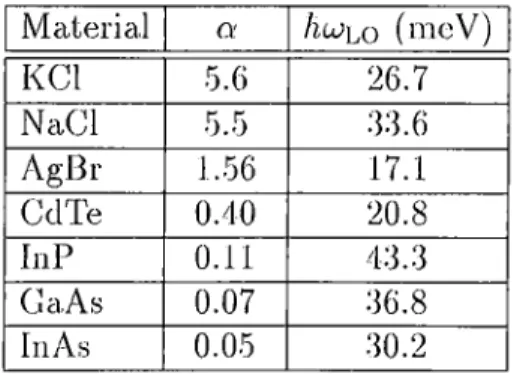
Chapter 1. INTB.ODUCTION 10 Material a (meV) KCl 5.6 26.7 NaCl 5.5 33.6 AgBr 1.56 17.1 CdTe 0.40 20.8 InP 0.11 43.3 CaAs 0.07 36.8 IiiAs 0.05 .30.2
Table 1.1: Coupling constants and LO-phonon frequencies of some common
materials
Note that these experimental values correspond to liquid helium temperature and one may expect slightly larger values at 0°K.
Hamiltonicin is not avaihible, we will consider several approximation methods, common in the literature, for obtaining the ground state properties of the pohuon, giving most emphasis to the bulk phonon effects on the low dimensionally confined electron.
In the next section we will briefly mention those approximation techniques, which will be dealt with in more detciil, in the Ibllowing chapters.
1.2
Approximation Methods
In the Fröhlich Hamiltonian, when expressed in units of hu\_,o, all the material dependent parameters are summed up into the dimensionless constant a. The numerical Vcdue of this electron-phonon interaction constant can be quite different for different types of the materials, ranging from ~ 0.01 up to ~ 10. It is large for highly polar materials such as alkali halides, whereas it is small lor compound semiconductors. In Table 1.1 we list the values of a and the energy unit liuju) for several common materials, as calculated with the given data in a review article by Kartheuser.'^^
Chapter 1. INTRODUCTION 11
relatively simple and well understood in the asymptotic limits of the interaction strength. One of the basic points of view is the case where the kinetic energy of tlie electron is much smaller than the energy of the phonon modes, and a <C 1. In this case the lattice deformation tends to follow the electron, as it moves through the crystal. A reasonable treatment to such a case is to take the electron-phonon interaction, i/c-ph? as a. perturbation*^''^““'^'^ and to calculate the corrections to the energy eigenvalues brought al>out by the polaron effect.
Another approach which successfully gives a good description of the behavior of the electron and its concomitant lattice deformation at weak coupling has been developed by Lee, Low and Pines'^^^ (LLP). This theory is of variational nature and leads to essentially the same results as the perturbation theory in the leading order in cv, but this approximation remains valid for a broader domain of the coupling constant, therefore, it is generally referred to as the intermediate coupling theory. They have introduced a canonical transformation which eliminates the electron coordiiicites from the Hamiltonian. The LLP approximation became particularly influential and it has been applied cis an important tool in many subsec|uent publications.*^“''·^
A contrasting point of view originates from the idea that for a strong enough electron-phonon interaction (a ^ f) the electron goes into a bound state with a highly loccilized wave function in the sell-induced potentiel!, which is built up by the field of correlated virtual p h o n o n s . I f the electron is really deeply bound, one expects the lattice deformation to react back and produce some structure in the electronic wave function, and the presence of the electron in turn determines and maintains the size and shape of the deformation. The point of view presented by these arguments is referred to as the strong coupling (adiabatic) theory. The method, basically consists of proposing a trial wave function lor the electron with some pai’cimeters, and making use of the variational principle, to calculate the ground state polaron properties. There are several other works on the strong coupling theory,''·^’''''’“·” ’'·'*’'''' in the literature. Since for the bulk, the strong coupling theory gives dependable results only cit some unrealistic values of the coupling constant, (a > 10), it can be considered cis an academic theory.
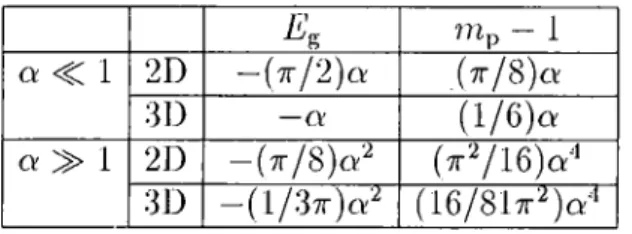
Clmpter 1. INTRODUCTION i2 nip - 1 2D — (Tr/2)a (tt/S ) « 3D — CY ( l /6)cv 2D (7r‘^/16)a'' 3D — ( l /37r)cv‘·^ (16/8l7T "*)«■'
a
< 1 a > 1Table 1.2: Results of perturbation and strong coupling theories lor the polaron
properties
PolcU’on ground state energy, iig, is in units of /¿culo arid the polaron mass, m,>, is taken in units of electron band mass m*.
but however, as we will see, the coniinement effects bring about the concept of pseudo-enhancement in the electron-phonon coupling, extending the doniciin of validity of this apiDroach in low dimensional systems.
The results of the perturbation and strong coupling theories, up to the leading orders in cv, for the ground state energy, and the effective mass of the polaron, are summarized in Table 1.2. We have provided the results of 2-dimensional (2D) jrolaron as well as those of the bidk (3D) polaron, to demonstrate the effect of confinement, on the polaron properties.
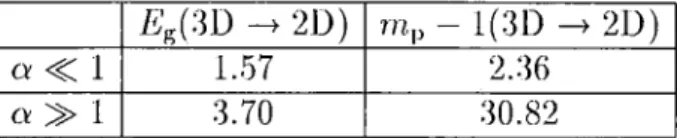
It is seen that the functional dependences of the ground state energy and phonon contribution to effective mass (m,, — 1), on a, are quite different at the two limiting regiiTies. Besides, the numerical coefficients get considerably larger with the reduction in the dimensionality (cf. Table 1.3).
Recently, Peeters et have derived an interesting scaling rehrtion for (2D) polaron properties, taking (3D) case as a reference;
( ■ ^ ‘^) ■ (i'-lO)
Similar relations hold true for other physiciil quantities of interest, such as mean number of phonons, linear mobility and impedance function. 3die form of the relations in Eq.(1.30) immediately signals the mentioned pseudo-enhancement of the interaction strength in low dimensioned systems.
For a more general view of the problem, not restricted to the limiting regimes, one requires more powerful methods or interpolating approximations. One ol
(Jimp ter 1. INTRO D U(JTION 13
ü,’s(3D ^ 2D) mp - 1(3D ^ 2D)
a < 1 1.57 2.36
a > 1 3.70 30.82
Table 1.3 : Scaling factors for polaron properties from 3D to 2D
such methods, which can be named cis a “perturbcitive variational approach” , has been introduced by Devreese et al. in an application to bound polaron. 'riie procedure is an extension of the adial)atic approximation, in the sense that a strongly coupled pohiron stcite combined with a first order perturbative extension is used cis a variational trial state, by which it is possible to cichieve a satisfying extrapolation towards the weak coupling regime, it has been recently applied to
3D and 2D free polarons'^^ successfully, cuid also we will consider the quantum wire'^^ and magneto-polaron''® cipplications in the following chapters.
The fiiml approach to polaron problem, to be stated here, is the Feynman pa,th integral Ibrmalism. It is the most successful theory, in the sense that it provides superior upper bound lor the ground state energy of the Fröhlich polaron at arbitrary electron-phonon coupling strength, compared to the other approximations. It has been first applied to bulk polaron by Feynman‘^‘^ in 1955, and became an indispensable tool lor the study of the Fröhlich polaron. The pioneering work of Fe3mman, initiated the development of functional-integral methods in the polaron theory, which, with refined Vciriational procedures, pi’oved to be an extremely powerful tool, if not the most powerful. There are very elegcint applications of functional-integrcil methods in the literature,*^*“ '*" and the Feynman path integral formalism applied to the case of general cpiadratic confinement,'^' will be presented in the sixth chapter.
Chapter 2
P E R TU R B ATIO N TH E O R Y
When the electron-phonon interaction constajit cv is snicill, as it is, in most of the semiconductor corni:)ouncls, it is appropriate to consider the interaction term of the Fröhlich Hamiltonian as a perturbation. The unperturbed Hamiltonian then, describes a decoupled system of an electron and phonons, d'he effect of electron-phonon interaction leads to sma.ll corrections for the eigenstci.tes a.nd eigenenergies of the unperturbed Hamiltonian, in the form of a i^ower series in £v. d'o demonstrate the approach ol the i)erturbation theory consider tlie following Hamiltonian, in which is small compared to the unperturbed part, /7^^.
H = 7/(0) + //(<) I'()r the polaron problem we luive,
= 77e + / / p h ,
The solution of the Schrödinger equation
H \^n) = E„,\y]>n) Ccan be expanded in a perturbation series of the form,
En = +
(2.1)
(
2
.2
)(2.3)
Chapter 2. PERTURBATION THEORY 15
where n stcuicls for all the quantmn nurnbers characterizing the system. Substituting these series in Eq.(2.3), one can consider the terms with the same order independently. The zeroth-order terms give simply the equation for the unperturbed Hamiltonian,
(2.5) which can be assumed to be solved exactly. The first order correction to the energies can be found to be the expectation value of in the unperturbed states,
= (2.6)
For the polaron, as we will see, this first order correction becomes zero, so one shoidd consider the next order correction for the energy,
/ |(^(r)|//(^)|vf/W)p
E l?0) _ I?(0) (2.7)
L/n J^rn
Finally, for the eigenstates, the perturbation theory leads to the correction term
E
p (0) _ p(O)i-y/l — I-yjn
(
2
.8
)in the leading order.
2.1
Application: Quasi 2-Dimensional Polaron
Among the polaron pa.pers,'^^“^'' in which perturbation theory has been applied, we will consider a recent one by Yildinm and Erçelebi^^ as cui example. In tliat work, they have a.ttempted to give a unifying picture for all confinement geometries of weakly coupled polaron. It is instructive to review the essential steps of the formuhition given therein, since in Chapter 6, the same problem will l)e treated within the framework of j^ath integral formalism and the correspondence between the two methodologies will be discussed.
'File simple model adopted in that work, is capable of reflecting the ground sta.te property of the confined polaron, where the degree of confinement can
Clmpter 2. PERTURBATION THEORY 16
be chosen flexibly, through the usage of an cuiisotropic parabolic potential box. However, here we will consider the ciuasi-2 dimensional slab-like conhgurcition for the confinement of the electron.
With the appropriate units (2rn* — h — culo = 1), the Hamiltonian describing the confined electron coupled to LO-phonons is in the form as given in Eq.(1.27). For the confining potential,
K o „ f = (2.9)
has been chosen, where the dimens.ionless frequency ÍÍ in units of cjlo the measure of the degree of confinement in the r¿;-directioii. By vaiying íi from zero to values much larger than unity, one am ¿ichieve a continuous transition from bulk to the strict 2-dimensional geometry.
The unperturbed states of the system is expressed in a product form of the electron and phonon parts,
= W (2.10)
wliere the electronic part satisfies the wave equation
Яе = еДА?) |Ф^У^(7Т,2')) ;у = 0,1,2,... (2.11)
The electronic wave function is composed of harmonic oscillator states for the ,::-direction, and since the electron is free in the transverse directions, a plcirie wave representation is utilized for its motion pcirallel to the x-y plane.
e x p (-h b '·^ ) ф1;{д) (2.12)
~ expiik · ¿7) (2.13) with ER denoting the Hermite polynomial of degree v. The corresponding energy eigenvalues of Eq.(2.11) are then given by
= {y + ~ )0 . ('■^•14)
The phonon stcvte \u q) is the Fock number state, with the ground state (phonon Vcicuurn), |0), characterized as;
Clmpter 2. PERTURBATION THEORY 17
For the ground state of the pohu-on, the electron should also be taken in the lowest subband (;/ = 0).
The first non-Vcinishing contribution to the ground state energy conics from the second order term, as given in Eq.(2.7),
(2.16)
y^ I' A-'.i/.lq' PM fc,o,o / I
~ Q P - l + t A P ) - e o i k )
With the form (1.27) of the Prohlich interaction, the above equation ca.n be written alternatively as.
if >
= - E EE
I'vi'/or'
vvhere ihA(h) = Q k 1 1 + ihy + k'-^- A:2 (2.17) \/2‘'iA V Q \ w roo ( il \ 1 ^ j J_^ dz e\p{-iqzz) Hu ( YI
exp(-:jii.?'^) (2.18) i t f jProjecting out the k' summation one obtains
1 1
f ' = - E K J E
Q
_____________________( ¿ V
1 + Çly ( f — 2k. · q \ 0 , j \ 0 ^ (2.19) It should be noted that, in the ground state, the electron is stationary [k — 0). However, to keep trci.ce of the effective mass of the polaron, one can consider the electron to have a small momentum [k ~ 0), cind expand the summand in Eq.(2.f9) in a power series up to second order in k · </,
{2k · q)'^ / i f = - E ' ^ q«^p Q the identity 1 f r + Vlv + q'^ (1 + Hi-' + qA2\3 (
2
.20
) Ey iy\ (a + hv)'“1+1 I I — — (/t; r/"· exp(—m /+ /fe“ ^*') n = 0,1,2,... (2.21) 7i! JoChapter 2. PERTURBATION THEORY 18
and defining
i2?/ I _ g-n?; ’
the ground state energy, + E^^\ CcUi be written as,
Eg = -i2 — £p + A:^(l — p) roo where e exp Q 2 and /•'Xi
H Kq r/'-^ / di] i f e~" exp
Q (7(v/) )?/ (2.2 2) (2.23) (2.24.) (2.25) In the above, Sp is the polaron binding energy and p is the pohironic contribution to the composite inertia of the electron together with the concomitant cloud of virtual phonons, i.e.
nip = (1 - p)~^ ~ 1 + /i (2.26) is the polaron effective mass in units of rri*.
The evalucition of the integrals in Eq.(2.24) and (2.25) re(|uire numerical treatment for arbitrai'y values of i2. Tor the two special cases, however, the aucdytic results are readily available. In the case of i2 = 0, a(r/) = 1 and one obtains the results relevant to the bulk polaron. Pbr the binding energy one luis
I'OO p
e“ ’' exp -iq^ + ql)·!]] = ^
Q Q 1 +
= CY
Similarly, Eq.(2.25) reduces to
I3D) = d q i f e '’ exp\^-{q^ + ql)i] (2.28)
CY E '^qV ( . ^ ^ q2).3 6 ·
In the strict 2D limit (i2 —> oo), cr(?/) tends to infinity, and the corresponding integrals simplify to
Chcipter 2. PERTURBATION THEORY 19
e / a |Li/a
0.40
0.30
0.20
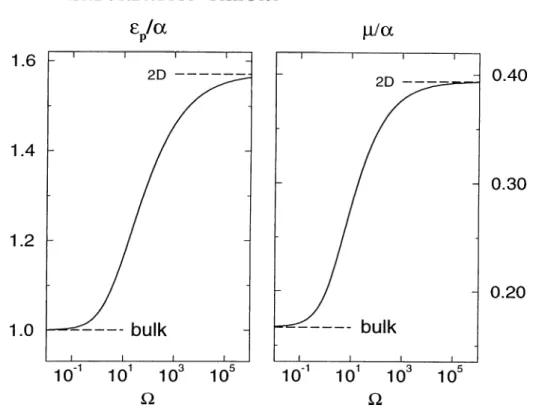
Figure 2.1: Perturbcition theory results for quasi-2-dimensiona.I polaron
The hiiiding energy op, and the phonon correction to the effective mass p as functions of tl>e degree of confinement il.
and
( 2 D )
E
7T-a . (2,:!0)Q ( i + < ; V 8
The binding energy and the phonon contribution to the effective nuiss as functions of the degree of coniinement, are provided in Fig.2.1. With the increasing value of il, laoth Tp and p approach smoothly to their asymptotic two-dimensional values.
For a. total overview interpolating between all possible extremes of the effective dimensionality one should refer back to the Eq.(2.2) and revise the calculations with a more general confining potential,
c„„r = jif'ie' + ■ (2.31)
The binding energy thus obtained is given in the same form as in Eq.(2.24) where now it reads as
„2 roo
5p = Vq / di) e“ " exp
Q
!lm.pter 2. PERTURBATION THEORY 20
ill and/or O2 slab (ill = 0) wire (ÎÎ2 = 0) box (ill = Ü2)
10 1.16 1.44 2.02
100 1.33 2.23 5.72
Table 2.1: ( Joinparison of polciron binding energies in different confinement
geometries with M v ) = üiT] ■i = 1,2 . (2.33) 1 - e - “ '"
Projecting out the summations over the wave vector comiDonents one obtains,
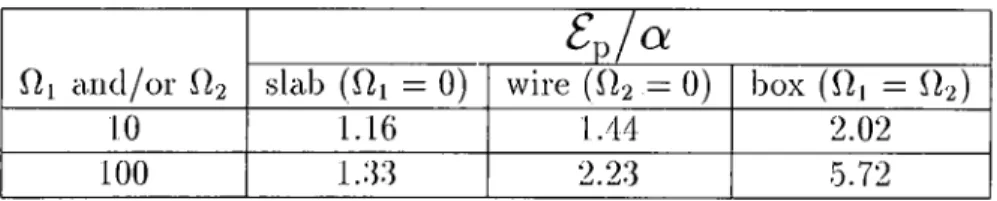
s/tt Jo V V (J2(?/) a.rctan7(7/) l i v ) where - ' ) (2.34) (2.35) The solution of Eq.(2.34) reciuires numericcd treatment. By varying the potential parameters 0 ,, one can trace out all possible extremes of the effective dimensionality. For a comparison of the different confinement geometries, consider the data given in Table 2.1. The binding gets deeper as the electron confinement is increased.
The domain of validity of perturbcition theory is restricted to small values of cv. In certain compound semiconductor structures, such as II-V I compounds, the relevcmt coupling consta.nts cannot be regarded as sufficiently small (o; 0.4 for CdTe, for instance) for the perturbation cipproach to be totally dependable. Moreover, we have mentioned about the pseudo-enhancement in cv, realized in confined systems, bringing about a strong coupling counterpart to the prol)lem. Therefore, one requires alternative methods to deal with interifiediate and strong coupling regimes, and yet more powerful interpolating theories to get a unifying picture over the complete range of a. Those theories will be the subject matter of the following chapters.
Chapter 3
STR O N G COUPLING
TH E O R Y
When the electron-phonon interaction is strong enough, due to the phonon held, there induces a deep deforniation potential surrounding the electron, and it appecirs to be trcipped in this potential. With this consideration, the polaron, in strong coupling regime was studied by Pekar" (and otliers'·'’’ "’’·*") who hypothesized that in this limit the total ground state wave function could l)e l.aken as a product of an electronic function and a phonon part. I'he Pekar ansatz is l)ased on the physically appealing notion that, at large coupling, the phonons cannot follow the rapidly moving electron (as they do at weak coupling) and so resign themselves to interacting only with the mean electronic density (adiabatic condition).
Befoi'e discussing the details of these a.rguments, let us first consider the standard canonical transformation of strong coupling theory.
3.1
Displaced Oscillator Transformation
d'he Frcihlich polaron can l)e viewed as an assembly of harmonic oscillators interacting with the electron. Thus, considering one of the oscillators that of the assembly, the wave equation describing the coupling of the oscillator to the
Chcipter 3. STRONG COUPLING THEORY 2 2
(electron is given by
Nq^q '^>-Q^Q ) 'i’Q = (q'^Q (3.1)
where Xq and eg are the dimensionless coordinate and the energy of the oscillator
with the wave vector Q, and the parameter u q is the force term due to the interaction.
After completing to a squcire, the Eq.(3.1) takes the form 1
~'^Xq + ~ ~ “qj (3.2)
from which 2u q can be interpreted iis the equilibrium coordinate. Assuming that all the phonon modes beluive independently in the same way, tlie total Hamiltonian can be written in terms of the phonon creation and annihilation operators as,
II = Y^ [«Q«Q - “ g («g + «q)
Q
(3.3)
d'he terms linear in Uq and u q can easily be made to disappear by defining a. set of new operators,
«g = «g - Uq al ^ = aj, - u q (3.4) which
Cciri
be obtciiiied through a canonical transformation of the previous ones,Uq = V ‘iIq V i l = where U = exp « g (« g - al^) . Q (3.5) (3.6)
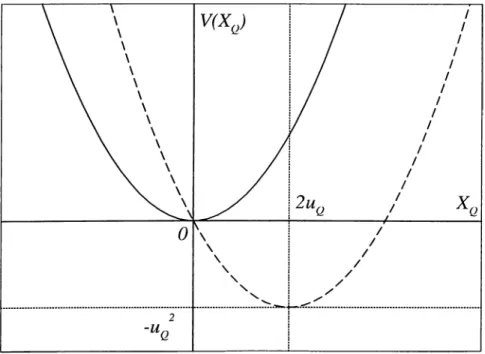
Instecid of transforming the phonon opera.tors, one can equivalently consider the phonon ground state to be chosen as U|0) rather than,the bare phonon vcicuum |0), where the origin is shifted over to the equilibrium coordinirtes (cf. Fig.3.1). This kind of representation is widely known as displaced oscillator transformation.
Clearly, the amount by which the origin is to be displaced depends on the interaction strength and further on the electronic charge density in a somewhat
Clmpter 3. STRONG COUPLING THEORY 23
Figure 3.1: Sketch of displaced oscillator potential.
'L'he solid and dashed curves represent undisplaced and displaced oscillators respec tively.
implicit manner. Therefore, the procedure of strong coupling theory will consist of proposing a variatioiicil Wcive function for the electron and throngh the minimization of the ground stcite energy, determining the variational pariuneters and the terms uq simultaneously. In the rest of this chapter, we will exem|:)lify these arguments in the case of strongly coupled polaron in a cylindrical quantum wire.5'1
3.2
Application: Infinite Boundary Quantum
Wire
In this section we retrieve, within the strong-coupling theory, the quasi-one dimensioncil analog of the standcird optical polaron relevant to a cylindrical (|uantum well wire. Under the assumption of perfect confinement the ground state binding energy, effective polaronic mass and the phonon-coupling - induced
(Jimpter 3. STRONG COUPLING THEORY 24
potential well profiles will be given as functions of the wire I'ciclius and the electron- phonon interaction strength.
3.2.1
Introduction
Qucuitum well - heterostructure - type systems with reduced dimensionality have become important ¿is a basis for novel devices, owing to the possibility of tailoring their electronic and optical properties. The impressive progress achieved in microfabrication technology (such as molecular beam ei^itaxy, lithogi’ciphic and etching techniques) 1ms created a variety of opportunities for the fabrication of new semiconductor structures. Of particular interest is the quantum well wire (QWW) configuration based on the confinement of electrons in a thin semiconducting wire where the motion is quantized in the transverse directions normal to its length. Since their early prediction'^ and subsequent fabrication,™^®^ there has appeared quite a large interest in phonon-coupling - induced effects and polaronic properties of one dimensionally confined electrons. Some considerable amount of the literature published within this context hiis l)een devoted to the interaction of electrons with bulk-like LO-phonons and the study of the relevcint polaron p r o p e r t i e s . T h e common prediction led by these works is that in quantum wires where the electrons are fundamentally quasi-one dimensioned (Q lD ) the polaronic binding is far much deeper than in compiirable quasi-two dimensional systems. Alternatively stating, high degrees of confinement (as realized in thin wires) lead to a pseudo-enhancement in the effective electron-phonon coupling which in turn brings about the possibility that, in spite of weak polar coupling as in GaAs, for instance, the polaron problem rna.y as well have a strong-coupling counterpart coming from confinement effects. This salient feature can be more prominent in II-VI compound semiconductors or in alkcdi halides where the relevant coupling strengths are a,lniost an order of magnitude larger or even much stronger tlmn those in III-V matericils. We thus feel that for not too weak and pseudo-enhanced electron-phonon coupling, the strong-coupling polaron theory should not be accounted for as a totally academic
Chapter 3. STRONG COUPLING THEORY 25
ibriTiaJism but may serve so as to provide some insight into the study of polarons in confined media consisting of materials of somewhat strong polar crystals. Here we refer to the case of an electi'on perfectly conhned within a cylindrical boundary with infinite potentiell, studying the ground state properties (the binding energy, mass and the phonon-coupling - induced effective potential) of the Q lD strong coupling polciron as functions of the coupling strength and the Q W W radius.
3.2.2
Theory
Hamiltonian and Wave Function
As always, we start with the Fröhlich Hcimiltonian in dimensionless units in the form as it is given in Eq.(1.27). For the confining potential we adopt an infinite boundary cylindrical quantum wire of radius ft.
hconf(^) 0 if g < R (3.7)
oo if ^ > ft
In cylindrical coordinates, r = {g,z)^ we take the electron trial wave function as consisting of two adjustable parameters A and ¡.i accounting for the anisotropic nature of the confined system
^eiQ.z) = (A V7r)'/V(i0exp(-^A^F'^) (3.8)
and
1
T {q) = i'L>3o(K.g) e x p ( - - / i g ) . (3.9)
In the above, the exponential factor e""' (with w being a. further variational ])arameter) sets the system in motion, thus enabling one to trace the polaron mass along the wire axis. .Jo is the zeroth order cylindriccil Bessel function of the first kind in which k. = jo, JR·, where jo.i ~ 2.4048 · ·· is its first zero. The
normalizcition constant rig is given through ‘Itt dg g j^ ig ) — 1. With the form (3) adopted for the lafei'cil part of the electron trial state, the Bessel function takes Ccire of the geometric confinement, and the further confinement induced l)y phonon coupling is governed by the Caussian counterpart through pcirameter p.
Chcipter 3. STRONG COUPLING THEORY 26
Adiabatic Formulation
In the foregoing approxirmition we assume a highly rapid charge density fluctuations for the electron to which the lattice responds by acquiring a relaxed static deformation clothing the entire extent of the electron. Due to Pekar, the adiabcitic polciron ground state thus formed can be written in a product ansa.tz consisting of the electron and lattice parts, i.e.,
= U|0), (d.io)
where |0) is the phonon vacuum state, and
U = e x p ^ tig($«)(aQ - a^) (3.11)
Q
is the unitary displcicement opercitor of the displaced oscilbitor transfornuition mentioned in the previous section, changing the reference system of virtiud particles by an amount iig($e). It should be noted that simulta.neous optimizcitions with respect to #e ¿«id ug(d)e) correspond to the self-trapping picture of the polaron where the electron distribution and the lattice polarizcition influence each other in such a way that a, stable relaxed state is eventually attained. Under the canonical transformation H —> U ~ ‘ //U , the HamiltonicUi conforms to
H' =
+ K o n f ( £ ' ) + m m e x p ( f Q ·r)
+ CCQ Q
Q Q
(iQ + h c} (3.12)
Since the Hamiltonicur is invariant to translations of the electron together with its concomitant lattice distortion, the total momentum along the wire cixis
=
Pz+
(1zUq(î q(-I-1-1)
Q
must be conserved. The variation therefore requires an optimization of the polaron state tlfg which minimizes ( \kg |//| il/g ) subject to the constraint that
is a constant of motion. Thus, minimizing the functional
Clmpter 3. STRONG COUPLING THEORY 27
with respect to -w and uq yields
1 w = - V , cllld = VqSq îJq (3.15) wliere I ex p (± iQ · r) I ) VQ = { l v u p ) ' -(3.16) (3.17) in which the Lagrange multiplier is to be identified as the polaron velocity^'"’*^' along the wire cixis, as it turns out.
In what follows we ¿idopt the case of a stationciry polaron, i.e. take (# e |U -lP ,U |$e) as zero, and thus regard v, as a virtual velocity which we retain in the foregoing steps to keep track of the effective mass of the coupled electron-phonon complex.
In complete form, with the optinicd fits for to cuid u q substituted in, Eq.(3.14) takes the form
F(A,/i,Uj) = Cfc + X ] ^'^q^q(Vq ~ ^Vq) ~ T'^z ~ ^ "^q^%Vq'^z(Iz (3.18)
Q ^ Q
where \p'^ I ) ·
In order to trace out the polaron mass from the above equa.tion we liave to split the right hand side into its parts consisting of the binding energy of the polaron alone and the additional kinetic contribution which shows up after having imposed a virtual momentum on the polaron. We are thus tempted to expand the summands in Eq.(3.18) in a power series up to order vj. We obtain
F(A,//,u,0 = E’g(A,|t¿) - ^vlnip where
Q
refers to the ground state energy cuid the factor m,, multiplying is identified as the polaron mass, given by
(3.19)
(3.20)
rnP = l + E K ^ k '
Q
Chapter 3. STRONG COUPLING THEORY Defining NO 28 /•.70.1 .(.t) = / d t t C ] U t ) J , , A t ) M x l : ) e x p ( - ! — C ) , (;5.22) •/0 K.
we write the following expressions lor Ckcincl sq which take pcirt in Eq.(3.20) and (3.21)
.. _ ' \2 , ,.2 , ,.2ro 2(7ioVo) - ( /t //i ) V i J ( 0 ) ,
(3.23) a.nd A SQ = exp( ’ (3.24) with
^00
A ! (3.25)Projecting out the Q-sumrnations: Y^q VQSQql'’\ we further write roo - a dq , (3.26) and ^ l~2 ?7rp = 1 + cv dq rj { y - A - <lf„} , (3.27) where / , = e x p ( , , ^ . J e r f c ( ^ p , (3.28) with erfc denoting the complementary error function.
3.2.3
Results and Conclusions
In order to obtain the binding energy and effective mass cori’ection of the polaron we numerically minimize Eq.(3.26) with respect to the variational parameters //. and A. The parameters thus determined are displayed against the wire radius for a. succession of strong a values in Fig.3.2(a). It is seen that for large wire radii the curves for ¡.i cind A both luive the same asymptotic 3D limit (y< = A = y^2/97ro'), and as R is made to ¿ipprocich the bulk - polaron size the curves begin to split depicting the anisotropy due to the confinement imposed by the wire boundary. We note thcit the place cit which the anisotropy stcirts to show up gets shifted to
Chapter 3. STRONG COUPLING THEORY 29
Radius
F ig u re 3.2: The variational pcircurieters and spaticil extents as functions of radius (a.) The variational parameters /./, (solid curve) and A (dashed curve), and (b) the spatial extents (solid) and C (dashed) of the polaron as a function of the wire radius.
smaller R values for stronger phonon coupling since for large cv the starting state of the polaron is already a highly-localized one (as implied by the relatively large values of the parameters p and A) and a. smaller - sized polaron feels the effect of t.he confining boundciry only for smaller wire radius.
For a complementary understanding of the variation of the spaticil extent of the polaron in the laferal and longitudinal directions, we cilso provide plots (Fig.3.2(b)) of the direct measures of localization of the electron coordinates expressed in terms of the corresponding rrns - values given by
1 / 2 = « ' ^ \ Æ V '2 ^00 a.nd = {($,|.^''|<I>,)}'^' = (2A^)^-1/2 (3.29) (3.30)
Chapter 3. STRONG COUPLING THEORY 30
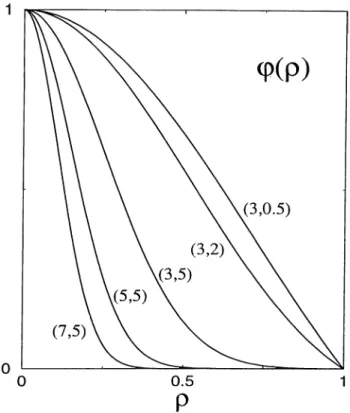
Figure 3.3: Rcidicil part of electronic wave function
<pig) versus g for various pairs (a,R ) of a ( = 3,5,7) and R (= 0.5,2,5). In the plots the peak value of (p is normalized to unity, and g is expressed in units of R.
It should be remarked that the two parameters (cv and R) characterizing the system do not enter the problem in an independent way but together ta.ke part in an interrelated manner in the binding, thus inducing an implicit coupling l)etween the transverse and longitudinal coordinates of the electron. Examining the family of curves for ju and A and lor and we see that, even though there is no geometric confinement along the wire axis, the axial extent of the polaron shrinks monotonically inwards contrciry to what one might have expected if the effective electron - LO phonon interaction in the axial direction were insensitive to the varicition of R.
Going from the bulk case to the quasi-one dimensional lim it/Q ID ) there comes about a competitive interrelation between whether the charge distribution (and lienee the lattice deformation) will condense onto the origin (the polaron center) or will expand to relax itself in the longitudinal directions along the wire axis.
Clmpter 3. STRONG COUPLING THEORY 31
Starting from /2 > 1 and then restricting the transverse spread of the electron the contribution corning from the tendency of the polaron to expand longitudinally is compensated over by the pseudo-enhancement in the effective phonon coupling due to lateral loccilization towards the wire axis, thus in the overall, leading to a shrinking spatial extent in the ± z directions. Meanwhile, with contracting wire size there results an alteration in the hiteral structure of the electron wave function ci.s depicted by the ^[¿-proiile, disphiying first a monotonic decrease and tlien an increase, implying that the radial part, (f(g), of the electron wave function conforms to a form structured more by its Bessel-function counterpcxrt, .lo(/vp), rcither than a narrow Gaus.sian, exp(—/i^p^/2), decaying far before the boundary is reached (cf.. Fig.3.3). This Ccin alternatively be recognized from that, regcU’dless of cv, the curves for (cf.. Fig.3.2(b)) all tend to the same asymptote meaning that at small wire radii the lateral extent of the polaron is governed mairdy by the geometric confinement rather than phonon coupling - induced localization. A comiDlementary feature is that when R is far below unity both /i and A display rather rapidly growing profiles compatible with a considerably pronounced effective phonon coupling and a highly localized characterization of the polaron in all directions.
For completeness, we also present a pictorial view of the phonon-coupling - induced potential well profiles
V ie, .^) = 7 E Vq( 'I'g Ke'«' ·’« « + hc)| 't, ) . (3.31)
Q
along the radial and transverse directions. Using Eq.(3.12) with u q = Uq-sq, Eq.(3.31) conforms to
1
l/(p,.r) = — X :F ^ Sq(G^-’> C C ) Q
(3.32)
in which sq is given by Eq.(3.24). Setting z — 0 and = 0, respectively for the potential profiles along the radicil (g)- and longitudinal {z)- directions and projecting out the wave vector summation we obtain
2 p
Vg = ---- a dqr,.e erfc(f) Jo(i></)