ISSN: 1680-5593
© Medwell Journals, 2010
Corresponding Author: H. Ozpinar, Department of Food Engineering, Istanbul Aydin University, Istanbul, Turkey
Effects of Vitamin E, Vitamin C and Mannanoligosaccharide (Bio-Mos )
®Supplements on Performance and Immune System in Broiler Chicks
H. Ozpinar, M. Erhard, F. Ahrens, C. Kutay and H. Eseceli
1 2 2 3 4
Department of Food Engineering, Istanbul Aydin University, Istanbul, Turkey
1
Chair of Animal Welfare, Ethology, Animal Hygiene and Animal Housing,
2
Department of Veterinary Science, Faculty of Veterinary Medicine, Munich, Germany Department of Animal Nutrition, Istanbul University, Istanbul, Turkey
3
Bandirma Vocational School of Higher Education, Turkey
4
Abstract: Maintaining gut health is important for the production of high quality and profitable poultry. The goal
of this study was to examine the effects of supplemental mannan oligosaccharide (Bio-MOS ), Vitamin E (VE)®
and C (VC) on the growth performance and immune response of broilers given a corn based diet over a 6 weeks experimental period. About 1 day old male broilers (n = 300) were randomly distributed to 4 groups (75 birds in each group and 15 birds in each subgroup for repetation 5 times) and reared under similar conditions. Standard husbandry and good management practices were followed that met or exceeded industry guideline. At each feeding, the following treatments were administered: control (no Bio-MOS , VE and VC), 1.5 g kgG Bio-MOS ,® 1 ®
500 µg kgG VE and 500 µg kgG VC. Body Weights (BW), Feed Intake (FI) and Feed Conversion Ratio (FCR)1 1
were measured on day 1, 21 and 42. Blood samples were taken from vena ulnaris every 7 days and were analyzed on IgG concentration. The results showed that there was no significant difference in BW, FI and FCR among the treatment groups. During the 6 weeks of trial period considering plasma IgG levels significant differences were only found as following: compared to control group it was significantly lower in VE group at week 1 and 2, higher in VC and Bio-MOS groups at week 2 and lower in Bio-MOS group at week 6. Additionally, at 4 week® ®
lowest (0.90±0.06 mg, n = 15) and at 5 week highest (2.85±0.18 mg, n = 15) plasma IgG level was found after applying the dietary treatment in Bio-Mos group. Consequently, this data suggest that supplementation of®
Bio-MOS , VE or VC may not improve either broiler performance or immune response in healthy broilers.®
Key words: Broiler chick, immune system, vitamin E, vitamin C, mannanoligosaccharide, performance
INTRODUCTION use of safe alternatives, natural antioxidants including the
Dietary composition has an impact on immune important to animal health. Enhancing the immune function of the broiler chicken. Nutritional immunology is response and resistance to pathogens of birds through becoming popular. Clearly, commercial poultry producers nutrients is considered to be both practical and efficient do not have the luxury of focusing on specific disciplines in terms of improving performance in modern poultry when field problems occur. Hence, in practice interaction production. Antimicrobials have traditionally been used exists among nutrition, genetics, management and as a supplement in the poultry industry to improve health diseases (Kidd, 2004). Nutrition has some effects on both and performance of birds. Nowadays, antibiotics are innate and cellular immunities if the feed is severely removed from animal feed because of increasing restricted (Hangalapura et al., 2005). Antibody responses, percentage of antibiotic-resistant bacteria.
blood lymphocyte proliferative responses and production Therefore, researchers have focused on alternative of Reactive Oxygen Intermediates (ROI) in chickens on
different levels of feed restirictions results in lower spleen weight a marked reduction in natural antibodies binding lipoteichoic acid. The recent European Union’s ban on the prophylactic use of in-feed antibiotics has escalated the search for alternatives in poultry industry (Janardhana et al., 2009). Given the current interest in the
mannan oligosaccharides and vitamins E and C are
feed additives to antibiotics such as pre- and probiotics. One class of prebiotics is represented by oligosaccharides. Oligosaccharides have been shown to increase beneficial bacteria like bifidobacteria or lactobacilli in the intestinal tract of broilers (Patterson et al., 1962). Mannan Oligosaccharides (MOS) are derived from mannans on yeast cell surfaces. Based
on the literature, MOS improve antibody response in made on the effects of VE supplementation in feedlot broilers and layers (Cotter et al., 2000) modulate the
immune response in chickens (Cotter et al., 2002; Savage et al., 1996; Shashidhara and Devegowda, 2003) and increase serum IgG levels in turkeys (Cetin et al., 2005) but do not enhance plasma IgG levels in dogs (Swanson et al., 2002). In addition, beneficial effects of MOS supplementation on body weight gain in broilers (Rosen, 2007) and feed conversion ratio in birds (Waldroup et al., 2003) as well as turkeys (Fritts and Waldroup, 2003) were observed. Conversely, several previous reports did not result in improved performance in terms of these parameters in broilers (Waldroup et al., 2003; Stanczuk et al., 2005) and Turkeys (Yalcinkayal et al., 2008), respectively. However, data regarding effects of MOS on chicken performance are limited. As mentioned above, although some information is available on data regarding effects of MOS, the role of MOS on performance and immune response on chicken is not completely understood.
Regarding nutritional supplementation vitamins are of great interest because vitamins like vitamin E and vitamin C, possessing potent antioxidant activities are able to decrease the effects of stress and infection on feed intake and body weight gain in chicken (Colnago et al., 1984; McKee and Harrison, 1995). Vitamin E (VE) is necessary as an antioxidant as a regulator of the transcription and of the activity of enzymes. Body weight gain and viability (Colnago et al., 1984) of chicks may improve with VE supplementation. However, numerous studies have reported no beneficial effects of VE either on mortality (Richter et al., 1985), body weight or feed intake (Nameghi et al., 2007; Niu et al., 2009). Further, many parameters of the immune system including resistance to infection, specific antibody production and number of antibody producing cells are altered by supplementing diets that are deficient or marginal in VE (Meydani and Blumberg, 1993). Vitamin E is an essential constituent of all the cell membranes including mitochondrial and nuclear membranes (Machlin, 1984). Colnago et al. (1984) found out that immunisation of chicken against coccidiosis was enhanced by vitamin E supplementation. An injection of vitamin E into the amnion three days prior to hatch enhanced antibody and macrophage response in Turkey and chicken (Gore and Qureshi, 1997). Abdukalykova et al. (2008) examined the effets of Arginin (Arg) and VE on the subpopulations of T Lymphocytes in peripheral blood in broiler chickens after an infectious bursal disease virus vaccination. Broiler chickens were fed diets with both normal and hight levels of Arg and VE. The results suggested that Arg and VE have complementary effects on cellular and humoral immune function and enhance the resistance of broilers to infectious diseases. A Meta-Analysis procedures were
cattle by Cusack et al. (2009). The health outcome morbidity, the production outcomes of Average Daily Gain (ADG) and Gain to Feed ratio (G:F) were analysed. It was concluded that supplemental dietary VE should be fed as an injection within Recommendation which is 15-60 IU kgG of diet DM. The effects of VE were1
evaluated on the fatty acids and MDA level in broiler chicken meat quality. It was concluded that the fatty acid concentration in broiler meat changes with respect to the nutrition and dietary composition of liver oil together with VE and VC increases n-3 fatty acid levels that is good for human health in broiler meat.
Several researchers have reported beneficial effects of Vitamin C (VC) supplements given either in diets and/or in drinking water. Vitamin C may also play a role in enhancing the immune system. In general, immunoglobulins and complement factors protect against systemic infections. Studies demonstrate that Vitamin C is required for the systemic availability of substances such as immunoglobulins and interferons (Bendich, 1990). Furthermore, VC increased in chicken the number of CD 8 (+) and IgM (+) cells (Wu et al., 2000) increased bacterial killing by heterophils and lowered plasma corticosterone (McKee and Harrison, 1995). Furthermore, beneficial effects of VC supplementation on body weight gain (Blaha and Kreosna, 1997; Jaffar and Blaha, 1996), feed intake (Sahin and Kucuk, 2001) and feed conversion ratio (McKee and Harrison, 1995; Blaha and Kreosna, 1997) were observed in poultry. In contrast, several studies (Blaha and Kreosna, 1997; Jaffar and Blaha, 1996) reported that supplementation of VC did not influence feed intake. VC has been demonstrated to improve immune responsiveness (Nameghi et al., 2007). Pulmonary Hypertension Syndrome (PHS, ascites) is a common metabolic disorder of modern, fast-growing strains of broilers. Concurrent supplementation of Arg, VC and VE was conducted to evaluate the effects on cardiopulmonary performance in broiler chickens under cold environmental conditions after an acute Epi challenge with increased no concentrations and lower hematocrit concentrations (Ruiz-Feria, 2009).
In recent decades, deficiencies in feed formulation and management practices have been masked by the routine Use of Antibiotic Growth Promoters (AGP). However, the ban of AGP in Europe has driven the implementation of safe alternatives such as antioxidants for optimizing health and performance of broilers (Awad et al., 2008). Antioxidants are molecules which can safely interact with free radicals and terminate the chain reaction before vital molecules are damaged. However, published reports on some natural antioxidants in broiler diets are rare and contradictory. Therefore, there is vast interest in understanding the mechanisms of immunosuppression and developing strategies to
(live weight, kg×liveability%) EPEF = ×100
(feed conversion ratio×age, days)
enhance immune responsiveness in commercial poultry. Thus, the aim of this study was to determine the effects of supplemental dietary MOS, VE and VC on parameters of performance and immune responses on healthy broilers. Several micro and macro-nutrients are needed for normal maintenance of the immune system (Bhaskaram, 2001). This includes amino acids, essential fatty acids and several vitamins and minerals. Numerous investigations since the early 1900s have shown that marginal and profound nutrient deficiencies impair the immune response in animal models as well as in humans, leading to an increased morbidity and mortality (Grimble, 2001). Therefore, dependency of the immune system on adequate nutritional status is unquestionable. More recent studies, however have looked beyond deficiency of nutrients and focused on the level of nutrients needed for optimal immune response. Therefore, the aim of this study was to investigate the effects of different feed additives (immunomodulators) such as vitamin E, vitamin C, Bio-Mos on broiler performance and immune®
system.
The effects of $-mannanase (Hemicell) on growth performance and immunity in broiler chickc fed the same basal diet based on corn-soybean meal were examined and Hemicell was added to the basal diet at 0, 0.025, 0.05 and 0.075%, respectively. The results indicated that hemicell may improve growth performance and immunity of broilers. Hemicell supplementation increased most of the relative immune organ weights and significantly increased the concentration of serum IgM. Hemicell supplementation at 0.05% significantly increased T-lymphocyte proliferation (Zou et al., 2006). Broiler chickens were fed with dietary treatments of MOS at 50 ppm in the 1st week, 30 ppm in the week 3 and 2 g of MOS kgG of diet (Yang et al., 2007). MOS1
supplementation did not improve significantly the growth performance of the broilers. On the other hand, MOS supplement numerically icreased the villus height and specific activity of maltase in the jejunum. The inclusion of MOS did not show a clear positive effect on the intestinal digestibility of nutrients, morphology or the mucosal enzyme activities.
MATERIALS AND METHODS
Birds, housing and diets: About 300 of 1 day old male
broiler chicks (Ross) were obtained from a local hatchery (Pak Pilic, Istanbul, Turkey). The birds were weighed at the beginning of the experiment, randomly divided into four groups (75 male birds/group) which are control (no Bio-MOS , VE and VC), 1.5 g kgG Bio-MOS , 500 µg kgG® 1 ® 1
VE and 500 µg kgG VC and housed in pens of identical1
size (1.75×6 m) in a deep litter system. The study was repeated 5 times for each of 4 groups. So, there were 15
Table 1: Composition of the starter and grower diets
Ingredients and analysis Starter (%) Grower (%)
Maize 47.55 55.55 Soya meal 45.00 37.00 Vegetable oil 4.00 4.00 Limestone 1.90 1.90 DCP 0.83 0.83 Vitamin-mineral premix* 0.30 0.30 Salt 0.20 0.20 Lysine 0.08 0.08 Methionine 0.15 0.15 Dry matter 88.56 88.32 Crude protein 23.00 20.00 Calcium 1.08 1.04 Total phosphorus 0.75 0.77 ME kcal kgG1 3100.00 3200.00
The broiler premix provided the following per kilogram of diet: vitamin A, 1204 µg; cholecalciferol, 25 µg; vitamin E, 4.5 mg; riboflavin, 2.25 mg; niacin, 15.0 mg; d-pantothenic acid, 4.0 mg; folic acid, 0.25 mg; vitamin B , 5 µg; choline cloride, 200 mg; thiamine, 0.5 mg; biotin, 25 µg;12
ethoxiquin, 12.5 mg; menadione sodium bisulfite, 1.25 mg; pridoxine, 0.50 mg; manganese, 24.9 mg; zinc, 22 mg; iodine, 0.2 µg; iron, 13.6 mg and copper, 1.6 mg. The treatment groups were fed with the basal diet with additional 1.5 g kgG Bio-MOS (Alltech, Izmir, Turkey), 500 µg kgG VE1 ® 1
and 500 µg kgG VC (Roche Vitamins, Inc. Istanbul, Turkey). The chicks1
were fed with the starter diets from days 1-21 and grower feed from day 21-42 (Table 1). The birds had free access to water and feed. The experimental procedures were approved by the institutional animal care committee
birds in each subgroup actually. Wood shavings were used as the litter material. The climatic conditions and lighting program were computer-operated and followed the commercial recommendations. The chicks were raised using standard temperature regimes that gradually decreased from 35-21°C and under a 23L:1D cycle throughout the studies. The control group was fed with starter and grower diets based on corn, soya, vegetable oil and a premix with vitamins, minerals, amino acids (lysine, methionine) and salt (Table 1).
Performance of broiler chicks: Chicks were weighed
individually at the beginning of the experiment (initial body weight) as well as at week 3 and at the end of feeding period (at week 6). The feed consumption was measured weekly during the 6 weeks experiment. Cumulative weights gain (BW); Feed Intake (FI) and food conversion ratio (food intake/weight gain, FCR) were calculated. The mortality rate and liveability rate at the end of the feeding period were determined. The European Production Efficiency Factor (EPEF) was calculated according to the following equation:
Blood sampling and analysis: All the chicks were bled by
puncture of the ulnar vein by using a 0.5-heparinized insulin syringe with a 28-gauge needle (Becton Dickinson and Co., Istanbul,Turkey). At the beginning of the study all male chicks in the control group were bled and 1-heparinized syringe with a 25-gauge needle
(Becton, Dickinson and Co) on day 14, 21, 28, 35 and 42. 6 time points (week 1-6). Three of male chicks in each The heparinized blood samples were centrifuged at 700×g
for 15 min at 4°C. Subsequently, plasma samples were stored at -20°C until analysis for IgG. In each of the four groups, the concentrations of specific chicken IgG in plasma was measured with Enzyme-Linked Immunosorbent Assay (ELISA) as described by Erhard et al. (1992).
Statistical analysis: The Statistical Package for the
Social Sciences (SPSS version 14.0) was employed to perform statistical analysis. The experimental design was completely randomized with dietary treatment as the main effect.
Statistically significant differences between group means were determined by Analysis of Variance (ANOVA). When the differences were significant, Duncan’s multiple range test was performed. Probability values p<0.05 were considered significant. Data are expressed as mean values±SEM.
RESULTS AND DISCUSSION
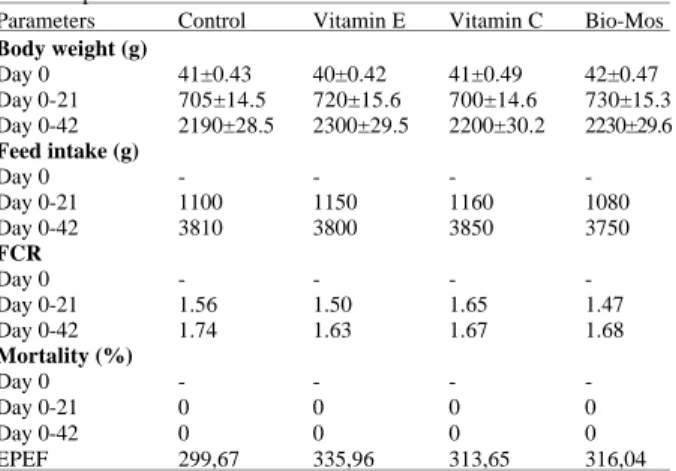
Feed intake and body weight: The supplementation of VE,
VC or Bio-MOS to the diets did not improve the general®
BW of broilers (Table 2). The cumulative feed intake of broilers for control group and VE, VC and Bio-MOS®
groups at week 3 were 1100, 1150, 1160, 1080 g at week 6 they were 3810, 3800, 3850, 3750 g, respectively.
The food conversion ratio at week 3 was lower for control group (1.56) than VC group (1.65) but it was higher for control group than VE (1.50) and Bio-MOS group®
(1.47) at week 6 FCR was higher for control birds (1.74) than Bio-MOS group (1.68), VC group (1.67) and®
VE group (1.63).
The liveability was 100% in all groups during the 6 week trial period. Additionally, the European Production Efficiency Factor (EPEF) was higher for VE, VC or Bio-MOS supplemented groups (VE = 335,96, VC = 313,65®
and BM = 316,04, respectively) than for the control group (Control Group = 299,67).
Total igG levels in the chicks plasma: The levels of IgG
in the chicks plasma were examined on day 1 and then at
group were randomly selected from each group and this selection was repeated 5 times for every subgroup. So, number of 15 was obtained in this way. Plasma IgG value of control group (n = 15) was highest on day 1 (3.41±0.36 mg) and lowest on week 2 (1.53±0.11 mg) during the 6 weeks study period. Considering plasma IgG level, at week 1 after the dietary treatment was applied, no statistically significant differences were observed between the control group and VC group and between the control and Bio-Mos group while at 2 week the control®
group was significantly lower than the VC and Bio-Mos®
group (p<0.05). Both at the 1st and 2nd week of the study plasma IgG levels in VE group was significantly lower than those in the other three groups (p<0.05). At 3rd week of the dietary treatment, no statistically significant differences were observed between the groups.
The lowest IgG level after applying the dietary treatment was found in Bio-MOS group (0.90±0.06 mg) at®
4th week and it was significantly lower than that in the other three groups (p<0.01). The highest IgG level after applying the dietary treatment was also observed in Bio-Mos group (2.85±0.18 mg) at week 5 (p<0.05). At the®
6th week of the dietary treatment, no significant differences were observed between the control and VE group and also between the control and VC group while plasma IgG values of these three groups were statistically higher than that of Bio-MOS group (p<0.05) (Table 3).®
Table 2: Effects of vitamin E, vitamin C and Bio-Mos on growth®
performance of broilers
Parameters Control Vitamin E Vitamin C Bio-Mos Body weight (g) Day 0 41±0.43 40±0.42 41±0.49 42±0.47 Day 0-21 705±14.5 720±15.6 700±14.6 730±15.3 Day 0-42 2190±28.5 2300±29.5 2200±30.2 2230±29.6 Feed intake (g) Day 0 - - - -Day 0-21 1100 1150 1160 1080 Day 0-42 3810 3800 3850 3750 FCR Day 0 - - - -Day 0-21 1.56 1.50 1.65 1.47 Day 0-42 1.74 1.63 1.67 1.68 Mortality (%) Day 0 - - - -Day 0-21 0 0 0 0 Day 0-42 0 0 0 0 EPEF 299,67 335,96 313,65 316,04
Table 3: Mean serum IgG concentrations in broilers of vitamin E, vitamin C and Bio-Mos and control group®
Control Vitamin E Vitamin C Bio-Mos®
--- --- ---
---Weeks Mean SEM Mean SEM Mean SEM Mean SEM
0 3.41 0.36 - - - -1 2.08a 0.16 1.50b 0.23 2.23a 0.07 2.33a 0.08 2 1.53b 0.11 1.01c 0.13 2.29a 0.13 2.31a 0.13 3 2.24 0.15 2.05 0.09 2.00 0.15 2.31 0.21 4 1.88a 0.24 2.13a 0.08 2.13a 0.21 0.90b 0.06 5 1.56b 0.18 2.72a 0.31 1.07b 0.10 2.85a 0.18 6 2.84a 0.20 2.46a 0.07 2.72a 0.15 1.87b 0.16
This study was conducted to evaluate the efficiency during the first few weeks of age because their immune of natural antioxidants as Bio-Mos , VE and VC on® system is not fully developed hence, maternal antibodies performance and immune responses of broiler chickens. are the primary means of antigen-specific protection
Performance: The results of using MOS as natural characteristic measured in blood at 1-6 weeks of age and growth promoters in poultry diets are inconsistent. The IgG levels did not indicate positive changes in systemic current study identified no significant effect on immune capacity as a result of Bio-MOS , VE or VC performance in chicks fed with supplemental 1.5 g kgG1 supplementation in broiler chicks at 3 and 6 weeks of age. Bio-MOS on 21 or day 42. In agreement with the® Mannan and glucan of the yeast cell wall may bind to observations, addition of 1 or 3 g kgG of MOS did not1 pattern-recognition receptors on a variety of defence influence BW and FCR (Eren et al., 1999) or FI cells of the gut-associated lymphoid tissue and in turn (Shafey et al., 2001) whereas 5 g kgG of MOS led to minor1 activate immune defences such as phagocytes, the improvements in FCR (Iji et al., 2001). These results were alternative complement pathway and the lectin pathway contradictory to recent studies reported that the inclusion (Shashidhara and Devegowda, 2003). However, in the of MOS in broiler diets resulted in significant improvement present study, supplementation of Bio-MOS in the in BW (Blake et al., 2006; Rosen, 2007) and FCR broilers diet increased the IgG levels at week 2 and 5 (Waldroup et al., 2003). Published report on the effects of decreased at week 4 and 6 and not influenced at 1 and MOS on broiler performance is rare and contradictory. week 3 compared to control. In particular agreement with This may be due in part as the levels of MOS used in this the observations, Swanson et al. (2002) reported that the study were not sufficient to elicit a pronounced response. addition of MOS did not significantly influence IgG This warrants further study with levels of inclusion in the concentrations after 2 weeks trial period in dogs.
diet. Cetin et al. (2005) pointed out that the addition of MOS
In the present study, either inclusion of 500 µg kgG1 significantly increased serum IgG levels at the end of the VE or VC supplementation to the diet of chicks did not 15 weeks trial period in Turkeys. Savage et al. (1996) result in a significant influence on performance of broilers reported that feeding Turkeys with diet with 0.11% MOS that are compatible with previous researches who led to significant increases in plasma IgG level. In the reported that inclusion of one of these antioxidants into present study the initial decrease in the plasma IgG the broiler diet did not resulted in a significant levels at week 2 may be due to the catabolism of improvement on BW (Coetzee and Hoffman, 2001; maternal IgG in chicks as the half-life of IgG in the Nameghi et al., 2007), FI (Niu et al., 2009; Blaha and plasma (Patterson et al., 1962). The role of Bio-MOS in Kreosna, 1997; Jaffar and Blaha, 1996) or FCR modulation of the IgG levels during the initial 6 weeks of (Coetzee and Hoffman, 2001). However, these results broiler chickens is not completely understood.
disagreed with previous reports indicating that chickens Regarding nutritional supplementation vitamins are of benefited from a dietary supplementation of VC increased great interest because vitamins like VE and VC, BW (Blaha and Kreosna, 1997; Jaffar and Blaha, 1996), possessing potent antioxidant activities have recently improved their FI (Sahin and Kucuk, 2001) or FCR been shown to influence immune system. Previous reports (McKee and Harrison, 1995; Blaha and Kreosna, 1997). on beneficial effects of VE are as follows: Erf et al. (1998) The reason for this finding is unclear. However, kidneys reported that beneficial effects on the development and which are the principal organs for chickens to synthesize function of adaptive immunity in 5-7 weeks old broilers. ascorbic acid can not synthesize adequate amounts of Konjufca et al. (2004) suggested that the addition of VE ascorbic acid until after 15 days of age (Puls, 1994). may have a substantial positive impact with respect to Considering VE, Raza et al. (1997) showed that disease resistance and improved broiler health. In the case supplementary VE had beneficial effects on performance of humoral immune response, the effect of added VE related parameters. An explanation for performance results depended on the nature of the antigen and quantity. may be attributable to the fact that there was no increase Typically, addition of VE in amounts between 25 and in protein or energy utilization between dietary VE 50 IU to the basal diet containing the National Research treatments, since all dietary treatments were balanced Council suggested requirement of 10 IU was the most energy to protein ration. immunomodulatory. This emphasize that higher levels of
Immune response: Birds respond to antigenic stimulation 2001). This may explain the result obtained in this study by generating antibodies as well as cellular immunity. that the supplementation of VE did not indicate enhanced Very young chicks are susceptible to many pathogens IgG levels in plasma compared to control during 6 weeks (Hamal et al., 2006). In the present study, immune
®
®
®
of study period. VC addition only significantly increased Bhaskaram, P., 2001. Immunobiology of mild micronutrient the plasma IgG concentration at 2 weeks of age deficiencies. Br. J. Nutr., 85: S75-S80.
during 6 weeks dietary trial period compared to control in Blaha, J. and K. Kreosna, 1997. Effect of vitamin and the present study. In agreement with the observations electrolytes supplements on broilers performance, Hesta et al. (2009) found that addition of VC did not show slaughter value and chemical composition of meat any significant effect on the serum IgG concentration during the heat stres. Univ. Agric. Praga Press, at 5 weeks of age in healthy dogs. This observation 30: 103-113.
differs from those of other researchers. Zhao et al. (2002) Blake, J.P., J.B. Hess, K.S. Maklin, S.F. Bilgili, A.E. Sefton reported that the plasma levels of the IgG showed a linear and A. Kocher, 2006. Mannan oligosaccharide increase in pigs with increasing levels of VC supplementation of wheatbased diets for broilers. supplementation. Wu et al. (2000) pointed out that IgG Proc. 12th Eur. Poult. Conf. Suppl. World Poult. Sci., antibody secreting cells in spleen at 3 weeks of age were 62: 342-342.
significantly higher in ascorbic acid supplemented group Cetin, N., B.K. Guclu and E. Cetin, 2005. The effects of which was vaccinated against infectious bursal disease in probiotic and mannan-oligosaccharide on some chickens. These results indicated that dietary haematological and immunological parameters in supplementation of ascorbic acid may improve humoral Turkeys. J. Vet. Med., 52: 263-267.
and cellular immune responses in chickens. Whether or Coetzee, G.J.M. and L.C. Hoffman, 2001. Effect of dietary not VC plays a role in stimulating humoral immune vitamin E on the performance of broilers and quality function in broilers requires further study since the results of broiler meat during refrigerated and frozen storage. of the experiments do not completely rule out the South Afr. J. Anim. Sci., 31: 158-173.
possibility that such a role exists. Although considerable Colnago, G.L., L.S. Jensen and P.L. Long, 1984. Effect of research have been performed on the effects of selenium and vitamin E on the development of supplementation of antioxidant such as VE and VC, its immunity to coccidiosis in chickens. Poult. Sci., effects on performance and immune function have yet to 63: 1136-1143.
be concluded on healthy broilers. Cotter, P.F., A. Malzone, B. Paluch, M.S. Lilburn and
CONCLUSION commercial laying hens by a dietary prebiotic. Poult.
In conclusion, although Bio-Mos , vitamin E or C® Cotter, P.F., A.E. Sefton and M.S. Lilburn, 2002. addition to broiler diets seemed to alter IgG Manipulating the Immune System of Layers and concentrations in plasma in various times, they did not Breeders: Novel Applications of Mannan improve the immune system in broilers. With regard to Oligosaccharides. In: Nutritional Biotechnology in performance, BW, FI and FCR were not affected by the Feed and Food Industries, Lyons, T.P. and dietary treatment. Therefore, 1.5 g kgG Bio-Mos ,1 ® K.A. Jacques (Eds.). Nottingham University Press, 500 µg kgG vitamin E or C may not be used in broiler diets1 Nottingham, England, pp: 21-27.
to improve performance and enhancing immune capacity. Cusack, P., N. McMeniman, A. Rabiee and I. Lean, 2009. A wider MOS, vitamin E or C supplementation range and Assessment of the effects of supplementation with more biochemical data in future research will help to vitamin E on health and production of feedlot cattle clarify the understanding of the optimal and marginal using meta-analysis. Prev. Vet. Med., 88: 229-246. levels for broilers with respect to performance and immune Eren, M., G. Deniz, H. Biricik, S.S. Gezen, I.I. Turkmen and
system. H.M. Yavuz, 1999. Effects of supplementation of zinc
REFERENCES broiler feeds on fattening performance. Uludag Univ.
Abdukalykova, S.T., X. Zhao and C.A. Ruiz-Feria, 2008. Erf, G.F., W.G. Bottje, M.D. Bersi, M.D. Headrick and Arginin and vitamin E modulate subpopulations of T C.A. Fritts, 1998. Effects of dietary vitamin E on the lymphocytes in broiler chickens. Poult. Sci., 87: 50-55. immune system in broilers: Altered proportions of Awad, W., K. Ghareeb and J. Bohm, 2008. Intestinal CD4 T cells in the thymus and spleen. Poult. Sci.,
structure and function of broiler chickens on diets 77: 529-537.
supplemented with a Synbiotic containing Erhard, M.H., I.V. Quistorp, I. Schranner, A. Jungling,
Enterococcus faecium and Oligosaccharides. Int. J. B. Kaspers, P. Schmidt and R. Kuhlmann, 1992.
Mol. Sci., 9: 2205-2216. Development of specific enzyme-linked
Bendich, A., 1990. Antioxidant vitamins and their immunosorbent antibody assay systems for the functions in immune response. Adv. Exp. Med. Biol., detection of chicken immunoglobulins G, M and A
262: 35-55. using monoclonal antibodies. Poult. Sci., 71: 302-310.
A.E. Sefton, 2000. Modulation of humoral immunity in Sci., 79: 38-38.
bacitracin, mannanoligosaccharide and Probiotic in Vet. Fak. Derg., 18: 73-84.
Fritts, C.A. and P.W. Waldroup, 2003. Evaluation of McKee, J.S. and P.C. Harrison, 1995. Effect of bio-mos mannan oligosaccharide as a replacement for
growth promoting antibiotics in diets for Turkeys. Int. J. Poult. Sci., 2: 19-22.
Gore, A.B. and M.A. Qureshi, 1997. Enhancement of humoral and cellular immunity by vitamin E after embryonic exposure. Poult. Sci., 76: 984-991. Grimble, R.F., 2001. Nutritional modulation of immune
function. Proc. Nutr. Soc., 60: 389-397.
Hamal, K.R., S.C. Burgess, I.Y. Pevzner and G.F. Erf, 2006. Maternal antibody transfer from dams to their egg yolks, egg whites and chicks in meat lines of chickens. Poult. Sci., 85: 1364-1372.
Hangalapura, B.N., M.G. Nieuwland, G. de Vries-Reilingh, J. Buyse, H. van den Brand, B. Kemp and H.K. Parmentier, 2005. Severe feed restriction enhances innate immunity but suppresses cellular immunity in chicken lines divergently selected for antibody responses. Poult. Sci., 84: 1520-1529.
Hesta, M., C. Ottermans, S. Krammer-Lukas, J. Zentek, P. Hellweg, J. Buyse and G.P. Janssens, 2009. The effect of vitamin C supplementation in healthy dogs on antioxidative capacity and immune parameters. J. Anim. Physiol. Anim. Nutr. (Berl.), 93: 26-34. Iji, P.A., A.A. Saki and D.R. Tivey, 2001. Intestinal
structure and function of broiler chickens on diets supplemented with a mannan oligosaccharide. J. Sci. Food Agric., 81: 1186-1192.
Jaffar, G.H. and J. Blaha, 1996. Effect of ascorbic acid supplementation in drinking water on growth rate, feed consumption and feed efficiency of broiler chickens maintained under acute heat stress conditions. Zivocisna Vgroba, 41: 485-490.
Janardhana, V., M.M. Broadway, M.P. Bruce, J.W. Lowenthal, M.S. Geier, R.J. Hughes and A.G.D. Bean, 2009. Prebiotics modulate immune responses in the gut-associated lymphoid tissue of chickens. J. Nutr., 139: 1404-1409.
Kidd, M.T., 2004. Nutritional modulation of immune function in broilers. Poult. Sci., 83: 650-657. Konjufca, V.K., W.G. Bottje, T.K. Bersi and G.F. Erf, 2004.
Influence of dietary vitamin E on phagocytic functions of macrophages in broilers. Poult. Sci., 83: 1530-1534.
Leshchinsky, T.V. and K.C. Klasing, 2001. Relationship between the level of dietary vitamin E and the immune response of broiler chickens. Poult. Sci., 80: 1590-1599.
Machlin, L.J., 1984. Vitamin E. In: Handbook of Vitamins, Machlin, L.J. (Ed.). Marcel Dekker Inc., New York.
supplemental ascorbic acid on the performance of broilers chickens exposed to multiple concurrent stress ors. Poult. Sci., 74: 1772-1785.
Meydani, S.N. and J.B. Blumberg, 1993. Vitamin E and the Immune Response. In: Nutrient Modulation of the Immune Response, Unnigham-Rundles, S. (Ed.). Marcel Dekker, New York, pp: 233-238.
Nameghi, A.H., H.N. Moghaddam, J.T. Afshari and H. Kermanshahi, 2007. Effects of vitamin E and C supplementation on performance and immune response of broiler chicks. J. Anim. Vet. Adv., 6: 1060-1069.
Niu, Z.Y., F.Z. Liu, Q.L. Yan and W.C. Li, 2009. Effects of different levels of vitamin E on growth performance and immune responses of broilers under heat stress. Poult. Sci., 88: 2101-2107.
Patterson, R., J.S. Younger, W.O. Weigle and F.J. Dixon, 1962. The metabolism of serum proteins in the hen and chick and secretion of serum proteins by the ovary of the hen. J. Gen. Physiol., 45: 501-513. Puls, R., 1994. Vitamin Levels in Animal Health:
Diagnostic Data and Bibliographies. 1st Edn., Sherpa International, Clearbrook, BC, Canada.
Raza, F.K., S.A. Khan, A. Raza, M.A. Saeedand and I.N. Bashir, 1997. Effect of vitamin E deficiency and excess on immune system of broilers. Int. J. Anim. Sci., 12: 39-41.
Richter G., I. Rodel, E, Wunderlich and E. Marckwardt, 1985. Evaluation of laying-hen feed with varied vitamin E and antioxidant supplementation. Arch. Tierernahr., 35: 707-714.
Rosen, G.D., 2007. Holo-analysis of the efficacy of bio-mos in broiler nutrition. Br. Poult. Sci., 48: 21-26. Ruiz-Feria, C.A., 2009. Concurrent supplementation of
arginine, vitamin E and vitamin C improve cardiopulmonary performance in broilers chickens. Poult. Sci., 88: 526-535.
Sahin, K. and O. Kucuk, 2001. Effects of vitamin C and vitamin E on performance, digestion of nutrients and carcass characteristics of Japanese quails reared under chronic heat stress (34EC). J. Anim. Physiol. Anim. Nutr., 85: 335-342.
Savage, T.F., P.F. Cotter and E.I. Zakrzewska, 1996. The effect of feeding a mannan oligosaccharide on Immunoglobulins, plasma IgG and bile IgA of Wrolstad MW male turkeys. Poult. Sci., 75: 143-143. Shashidhara, R.G. and G. Devegowda, 2003. Effect of dietary mannan oligosaccharide on broiler breeder production traits and immunity. J. Poult. Sci., 82: 1319-1325.
Stanczuk, J., Z. Zdunczyk, J. Juskiewicz and J. Jankowski, Yalcinkayal, H., T. Gungori, M. Bafialani and E. Erdem, 2005. Indices of response of young turkeys to diets
containing mannanoligosaccharide or inulin. Vet. Zootech., 31: 98-101.
Swanson, K.S., C.M. Grieshop, E.A. Flickinger, L.L. Bauer and H.P. Healy et al., 2002. Supplemental fructooligosaccharides and mannanoligosaccharides influence immune function, ileal and total tract nutrient digestibilities, microbial populations and concentrations of protein catabolites in the large bowel of dogs. J. Nutr., 132: 980-989.
Waldroup, P.W., E.O. Oviedo-Rondon and C.A. Fritts, 2003. Comparison of Bio-Mos and antibiotic feeding programs in broiler diets containing copper sulfate. Int. J. Poult. Sci., 2: 28-31.
Wu, C.C., T. Dorairajan and T.L. Lin, 2000. Effect of ascorbic acid supplementation on the immune response of chickens vaccinated and challenged with infectious bursal disease virus. Vet. Immunol. Immunopathol., 74: 145-152.
2008. Mannan oligosaccharides (MOS) from
Saccharomyces cerevisiae in broilers: Effects on
performance and blood biochemistry. Turk. J. Vet. Anim. Sci., 32: 43-48.
Yang, Y., P.A. Iji, A. Kocher, L.L. Mikkelsen and M. Choct, 2007. Effects of mannanoligosaccharide on growth performance, the development of gut microflora and gut function of broiler chickens raised on new litter. J. Applied Poult. Res., 16: 280-288.
Zhao J., D. Li, X. Piao, W. Yang and F. Wang, 2002. Effects of vitamin C supplementation on performance, iron status and immune function of weaned piglets. Arch. Tierernahr., 56: 33-40.
Zou, X.T., X.J. Qiao and Z.R. Xu, 2006. Effect of B-Mannanase (Hemicell) on growth performance and ýmmunity of broilers. Poult. Sci., 85: 1276-1279.